




Abstract
This article constitutes a big data study of Twitter during the peak of the so-called refugee crisis in the period between October 2015 and May 2016. The article analyzed almost 7.5 million tweets collected through hashtags such as #refugee, #refugeecrisis, # flüchtling, and others. Theoretically, the article draws on concepts such as hybrid media, affective publics, networked framing, and voice. In the context of any increasingly hybrid media, we ask what are the frames on refugees that emerge on Twitter, who are the emerging elites, and to what extent do these frames represent alternative voices. Overall, the findings indicate that overall, the dominant frames remain the same, revolving around security and safety on one hand and humanitarianism on the other. The study also identified some explicitly racist hashtags linked to some of the security and safety frames. Elite politicians, media, and non-governmental organizations (NGOs) represent the most prominent actors. In general, the refugee issue on Twitter was found to be subsumed and instrumentalized by political interests. Affect and networked frames are captured by and within a specific political position that we found revolving around the personage of Donald Trump and the increasingly strident anti-immigration voices in Europe. In these terms, the results indicate that Twitter’s contribution to the refugee debate is profoundly equivocal.
Introduction
The reception and hosting of refugees from the Middle East and Africa pose significant political questions for Europe and the world more broadly. The high-profile tragedies in the Mediterranean, such as, for example, the death of Aylan Kurdi, moved Angela Merkel to issue a public welcome to refugees in Germany and calling on other European governments to do the same. In a historical statement, she said, “If Europe fails on the question of refugees, then it won’t be the Europe we wished for” (Ridley, 2015). However, rather than Europe stepping up to its responsibilities toward refugees, European governments began squabbling over numbers, prevaricating over accepting allocated quotas, and in some instances refusing outright to accept any refugees.
This kind of ambiguous reception is not surprising given a history of a hostile public opinion toward migrants attributed to messages from politicians and media (Sides & Citrin, 2007). However, mainstream media are only part of a media system, which Chadwick (2013) understands as hybrid. This includes a variety of voices enabled by social media, all competing in a complex and unpredictable media landscape. In this context, can social media allow for more voices and a more balanced discussion? This article addresses this question empirically through focusing on a particular social media platform, Twitter, and its mediation of the refugee issue. 1 We are interested in discovering whether Twitter’s mediation of the refugee issue differs from the mainstream media and, if so, how. We want to find out who is talking about refugees on Twitter and what are the new relevant hubs. Ultimately, we ask, what can Twitter tell us about the so-called refugee crisis?
To answer these questions, the article begins with a discussion of the mainstream coverage of the refugee issue, and a theoretical discussion of social media, making use of the concepts of digital storytelling (Couldry, 2008), affective publics (Papacharissi, 2015), and networked framing (Meraz, 2017; Meraz & Papacharissi, 2013, 2016). It then develops a set of research questions and methodology, before presenting and discussing the findings. Overall, the findings indicate that while the story emerging is more nuanced, plural, and complicated compared to the one emerging in mainstream media, the main frames remain the same. Moreover, the refugee issue on Twitter was also found to be subsumed and instrumentalized by political interests. Affect and networked frames are captured by and within a specific political position that we found revolving around the personage of Donald Trump and the increasingly strident anti-immigration voices in Europe. In these terms, the results indicate that Twitter’s contribution to the refugee debate is profoundly equivocal.
Refugees in the Hybrid Media System
A largely negative and occasionally overtly hostile coverage of the refugee issue has been a staple for most mainstream media. Philo, Briant, and Donald (2013), focusing on the United Kingdom, show how mainstream media are producing almost exclusively negative stories, often proven false. Similarly, in a recent comparative study of five European countries (Britain, Germany, Italy, Spain, and Sweden), Berry, Garcia-Blanco, and Moore (2016) found that negative frames referring to refugees as a security or cultural threat were relatively common in the British and Italian press, while refugee and migration figures and numbers were very prevalent in the German and British press. In the same vein, a study of Hungarian media found references to security issues, violence emanating from refugees, and the use of dehumanizing language focusing on “illegal immigrants” and “illegal border crossings” (Lakner, 2016). In Germany, which has seen the largest numbers of refugees and which has been at the forefront of the European Union (EU) policy for quotas of resettlement, Holmes and Castaneda (2016) found that the media operate by parsing moral deservedness and through this by demarcating the population in biopolitical terms. German media were found to mobilize terms such as “floods” and “flows” threatening to “overwhelm” or “drown” Europe. Another form of threat reported is that of the migrant/refugee as a terrorist or criminal, which contributes to a culture of suspicion toward all refugees. While Holmes and Castaneda note that German media are not devoid of humanitarian and welcoming responses to refugees, this takes place within a given moral economy, in which the refugees must always show gratitude while the Germans/Europeans are constructed as humanitarian heroes. In recent research, Georgiou and Zaborowski (2017) found that the use of crisis as the dominant frame across eight European media divides Europeans and “Others,” who are in turn dichotomously classified as either “dangerous” or “vulnerable.” Georgiou and Zaborowski further found that there were very limited opportunities for the voices of refugees themselves, who were generally spoken about by others. Security, deservedness, cultural incompatibility, limited voice but also some humanitarian responses are therefore the most common frames in the mainstream media coverage of the refugee issue.
Yet, mainstream media constitute only a part of changing media landscape that has become much more complex, unpredictable, and volatile. This is what Chadwick (2013) refers to as a hybrid media system. If mainstream media tell the stories of the powerful, social media are thought to involve generalized inclusivity and participation. Everyone is invited to have an account and share their views and opinions. This kind of widened participation entails the promise for more “voice” as Couldry (2010) put it. Such “voice” is typically but not exclusively expressed through digital storytelling, in which people relate personal events, opinions, or comments, enabling them to challenge dominant narratives. In social media platforms such as Twitter, voice manifests through affective expressions, which introduce more diversity of expression in the public sphere. Papacharissi (2015) refers to the collectivities emerging as affective publics. The expansion of cultural production and public participation in debates points to the possibility of important changes in deeply consolidated structures of power and domination. For the refugee debate, such arguments have important implications, as it has long been set by mainstream media agendas.
In the hybrid media system, power is not all concentrated in the hands of mainstream or legacy media. Rather, it emerges out of the interrelations between the components of the system. As Chadwick (2013) put it, “power is exercised by those who are successfully able to create, tap or steer information flows in ways that suit their goals” (p. 207). Within this context, digital storytelling emerges as a digital media practice employed by ordinary people as media actors, and which has the potential to actively challenge dominant narratives and viewpoints. Couldry (2008, p. 373) defines digital storytelling as “the whole range of personal stories now being told in potentially public form using digital media resources.” The rise of digital and social media has been very important in this respect because it has drastically redistributed important symbolic resources, and multiplied the ways in which people can participate in the public sphere. Importantly, digital storytelling entails the promise of telling and sharing stories that wouldn’t otherwise be told or exchanged and, crucially, connecting such personal narratives to bigger, political questions.
For the refugee issue, this is crucial, given their lack of voice and representation in the mainstream press (Georgiou & Zaborowski, 2017) following a long trajectory of silencing or usurping the voice of the others (cf. Spivak, 1988. Indeed, Andén-Papadopoulos and Pantti (2013) report that Syrian migrants and refugees using social media are important brokers, linking voices of refugees to broader publics. The issue of voice is very important for Couldry (2008, 2010), who argues a democratic society cannot function properly without recognizing others as peers and inviting equal participation in the social world (cf. Honneth, 1996; Honneth & Fraser, 2003). The question of voice in digital media has been researched and discussed by, among others, Andre Brock (2012) and Sanjay Sharma (2013) who have studied how Black Twitter and related hashtags multiply and render online race more complex. The emergence of the hashtag activism of #BlackLivesMatter has generated new counterpublics and social movements that have explicitly politicized and centralized the voice and experiences of the excluded (Jackson, 2016; Jackson & Welles, 2016). But voice is always bound to recognition: recognition requires not only the expression of voice, as found in digital storytelling and the opportunities offered by social media platforms to give an “account of oneself” (Couldry, 2010, p. 7), but also the acceptance of this voice by others as a priori valuable. To be recognized, voice must be heard. It is in this mutuality that recognition resides, and this is what distinguishes voice and digital storytelling from self-branding and instrumental communication. Digital media are considered more likely to enable voice because of their lower threshold for participation, along with their interactive features and affordances, and therefore can be, and have been, used for civic purposes (Couldry et al., 2014). Indeed, in the case of the #BlackLivesMatter movement, Freelon, McIlwain, and Clark (2016) found that the movement succeeded in bypassing mainstream media and in circulating a new narrative of police brutality which was then picked up and shared by other Twitter users.
A dimension emerging from all this is that of connectedness and the resonance of voice. It is not any kind of individual voice that Couldry is referring to but voice which has the potential to connect with others and mutually shape our social and political worlds. It is here that Zizi Papacharissi’s work is instructive. Writing after the Arab Spring and Occupy movements, Papacharissi traced the formation of a new kind of networked public, which is connected through the exchange of stories and the affective investment and value placed on them. Affective publics refer to “networked public formations that are mobilised and connected or disconnected through expressions of sentiment” as these materialize in social media (Papacharissi, 2015, p. 125). Affective publics emerge when people feel part of a story that develops, and to which they too contribute their own expressions, through words, pictures, or videos, thereby also taking the story further.
Papacharissi (2015) is building on previous work on networked gatekeeping and framing (Meraz & Papacharissi, 2013). These processes are characterized by a kind of “emergent eliteness,” where certain actors are propelled to prominence through crowdsourcing. Together, hashtags and other addressivity markers, for example, replies or mentions, frame issues in specific ways and allow for new actors and hubs to emerge organically through the actions of users. Meraz and Papacharissi (2013, 2016) understand networked framing as a process whereby actors take the information circulating, add to it their own layers of information, thereby collectively contributing to a “simultaneously fragmented and pluralized storytelling” (p. 156) using Twitter’s affordances, such as retweets (RTs), hashtags, and mentions/replies. In this manner, affective publics on Twitter typically produce disruptions/interruptions of dominant narratives. This is a crucial attribute that resonates with Couldry’s discussion of voice. For Papacharissi (2015), this occurs because affective publics allow the “presencing” of under-represented viewpoints. Although, Meraz and Papacharissi (2016) point to the existence of a power law on Twitter, in which the top 10%-20% accounts enjoy disproportionate influence over the rest of the network, they argue that being placed in that position is the result of bottom-up processes of crowdsourcing. This bottom-up process is what makes power more fluid and temporary. As Papacharissi (2015) put it, in affective publics, power is liminal, rather than structural and permanent. Here, Papacharissi’s argument echoes Chadwick (2013), who similarly sees power as emerging out of networks rather than being a property permanently attached to certain actors.
Taking these arguments into account, we understand the publics coalescing around refugee-related Twitter hashtags and keywords as networked publics connected both through the overarching story of refugees and through the medium’s technological affordances. We understand their actions on Twitter as digital storytelling, that is, as positioned, personalized, and diverse narratives constructing a kind of overarching distributed story framed through hashtags and addressivity markers. Based on all this, we formulated three research questions:
RQ1: What are the frames of the refugee issue emerging on Twitter through hashtags?
RQ2: Does networked framing disrupt dominant frames on refugees?
RQ3: What are the emerging elites among the refugee-related networked publics?
Methodology
We addressed these questions through a big data study, collecting tweets using specific hashtags and keywords. Big data is typically defined as involving very large datasets, with a complex and varied structure, creating issues for storage, analysis, and visualization (Sagiroglu & Sinanc, 2013). Big data analytics refers to the processes used in order to extract meaning and to create value out of these datasets. Big data is not without its problems. boyd and Crawford (2012) discussed several challenges posed by and to big data, including questions of epistemology. Specifically, one of the most important critiques in boyd and Crawford concerns the question of objectivity and accuracy: claims that big data studies are more accurate or objective because they use larger datasets have to be questioned because large datasets still require interpretation. Second, big data presents considerable ethical challenges, leading to the developments of specific codes of ethics and best practices (Zook, Barocas, boyd, Crawford, Keller, & Gangadharan, 2017). We have tried here to follow closely best practices, focusing the research on hashtags, on well-known political and institutional accounts and on some pseudonymous accounts. Finally, we are aware the specific measures taken to interrogate and visualize the data already contain certain assumptions which are then transferred to the analysis (cf. Kennedy & Hill, 2016). The specific procedures and measures applied alongside some of their limitations are examined below.
Sampling
We gathered our data using a python-based crawler that interrogated the streaming application programming interface (API) of Twitter. We used hashtags as our main criteria for data gathering because hashtags are a key addressivity marker or device by which Twitter users themselves classify a tweet as pertinent to a particular theme and anchor the meaning of their tweets. This use of the # sign allows users to search the Twittersphere for specific topics of interest and to follow threads of discussion related to those topics (Arvidsson, Caliandro, Airoldi, & Barina, 2016; Marres & Weltevrede, 2013). The tweets were collected on the basis of the following keywords which represent the word refugee in different languages (English, French, Italian, German, Swedish, Turkish, and Hungarian): refugee, réfugié, rifugiato, flüchtling, flykting, mülteci, and menekült. In addition, we followed an additional four refugee-related hashtags that were prominent during the time period: #refugees, #refugeeswelcome, #refugeecrisis, #refugeesGR, and #refugeeconvoy. The sample included the words as keywords and as hashtags, with the # sign. In this way, we aimed for a comprehensive sample of all refugee-related tweets in the period, albeit gathered through the streaming API rather than the firehose. Previous research has found that the streaming API estimates the top hashtags for a large sample well, albeit often misleading when the sample is small (Morstatter, Pfeffer, Liu, & Carley, 2013). It is also possible that the sampling method did not identify all of the key accounts. However, aggregating across multiple days, and in our case months, increases the accuracy substantially. The analysis presented here relies on 7,499,127 tweets, by 1,781,741 unique screennames, collected in the period between October 22, 2015 and May 16, 2016.
The sampling specifically harvested #refugee and related hashtags and keywords as opposed to broader hashtags such as, for example, #migrants or #immigration in order to study the hashtags that were meant to recognize the plight of people fleeing dangerous situations. United Nations High Commissioner for Refugees (UNHCR, 2016, n.p.) has clarified the distinction by defining as refugees those “fleeing armed conflict or persecution,” as opposed to migrants, who move mainly to “improve their lives.” Moreover, the use of the term indicates that states have legal obligations toward these people. The choice of the term migrant over refugee may reflect an anti-migrant perspective—an editorial in Al Jazeera English explained that it will not use the term migrant as it had deteriorated to “a tool that dehumanises and distances, a blunt pejorative” that “strips suffering people of voice” (Malone, 2015, n.p.). Since this article is looking to find whether and how “voice” exists on Twitter with respect to the refugee issue, the focus of this study is on hashtags that are expected to frame the issue of refugees in terms that are more accepting of the specificity of this category of people. Additionally, the focus on refugee-related hashtags and keywords precluded the inclusion of tweets that may have reflected broader concerns regarding migration. Another issue in the harvesting of tweets concerns the linguistic limitations, as we limited the sampling to one word per language, when in some instances, for example, in Italian, both rifugiato and profugo are used.
To the limitations of the current sampling method, we can add that hashtags represent a specific subset of Twitter communication (Bruns & Moe, 2014) and not all users are inclined to use hashtags. In effect, Twitter and hashtags, in particular, produce an aggregated community where publics are formed, re-formed, and coordinated via dynamic networks of communication and social connectivity organized primarily around issues or events rather than pre-existing social groups (cf. Bruns & Burgess, 2015). In this way, the knowledge produced and shared can be simultaneously individualistic and communal (Murthy, 2013, p. 62). Publics coalescing around hasthags can be ad hoc issue publics, brought together by breaking news but they can also be calculated publics, using hashtags created in order to discuss specific issues, for example, scheduled media programs (Bruns & Burgess, 2015). Extending this work, Bruns, Moon, Paul, and Münch (2016) developed a typology of hashtag publics, which includes those emerging around hashtags for acute events, media, political or sports events, as well as keyword and meme hashtags. The hashtags used here fall under more than one categories, as for example, #refugees may be a keyword hashtag, while #refugeeconvoy may cover an acute event and #refugeeswelcome can be a meme hashtag as it expresses “a particular sentiment in response to current domestic or international events” (Bruns et al., 2016, p. 36). It is therefore important to note that the publics this article refers to represent a particular subset of Twitter users, which is using related hashtags in diverse ways and under different circumstances.
In interpreting the use of hashtags, we make use of the notion of network framing (Meraz, 2017; Meraz & Papacharissi, 2013, 2016), and understand their use as contested and variable: users of the refugee-related hashtags may not necessarily endorse them, but may want to address the publics who use them, or to anchor their arguments, points, or information in a specific way. While hashtags provide a dual role in discourse in that they are both context-dependent deictic and indexical (Rambukkana, 2015), they can also provide space for both sides of an issue or argument, and indeed be indicative of criticism. To understand their role in more depth, we applied a series of measures detailed below.
Measures
The measures applied included descriptive statistics, primarily frequencies, and social network analysis. More specifically, we have employed the following computations: (1) time-series (frequencies) counts of tweets, Twitter users, hashtags, mentions, and RTs; and (2) network analyses of two kinds of networks extracted from these tweets: networks of co-occurring hashtags and networks among Twitter users in their mentioning activities (including Replies To and RTs). The methodology for producing the Twitter networks follows the principles of social network analysis (Wasserman & Faust, 1994). First, co-occurring hashtags networks were produced from the two-mode networks of Twitter users versus hashtags: each tweet in our database was written by a single Twitter user and it may contain a number of hashtags (or none). Projecting this two-mode network on the mode of hashtags, we derived a one-mode network of co-occurring hashtags, that is, a weighted undirected graph, the nodes of which are hashtags, the edges are formed between those hashtags co-occurring in the same tweet, and the edge weights count the number of tweets for any such co-occurrence of hashtags. Second, the “mentions” networks are one-mode networks between Twitter users, which rely on the following “recipe”: if a tweet is written by user A and in the content of that tweet one encounters the screen name of Twitter user B (this would be the case if A’s tweet is a reply to a previous tweet written by Twitter user B, if A’s tweet is a recommendation to B, or if A retweets a tweet including a reply to or a mention/recommendation to B, etc.), then include in the network. Such a mentions network is a weighted directed graph, in which the weights of (directed) edges count the number of tweets for any such (from A to B) reply to, mentions/recommendations, or RTs.
The visualizations of the Twitter networks that we are presenting here were produced by filtering a small number of nodes possessing top PageRank and degree centralities (cf. Newman, 2010) and therefore focus on the most commonly co-occurring hashtags and most frequently mentioned/retweeted/replied to accounts. Additionally, the graphs of all networks are generated by the Fruchterman–Reingold algorithm of force directed-placement (Fruchterman & Reingold, 1991). In these, the size of nodes is proportional to the (total) degree of nodes and the color of nodes corresponds to the “community” to which each node belongs, using the community detection algorithms of modularity maximization for undirected graphs and label propagation for directed graphs (Newman, 2010).
The analyses of the frequencies and co-occurrences of hashtags are addressing RQ1 and RQ2, which are concerned with the framing of the refugee issue through hashtags, while the Mentions/RT/Replied network analysis addresses RQ3, concerning the emerging hubs and actors.
Findings: The Rhythms of #Refugee Stories
In interpreting our findings, we used the following operationalizations. We traced the rhythms of tweeting as an indication of an evolving story; in other words, spikes were taken to mean an event and an accompanying story. We then traced the story through the hashtags that emerged and became attached to the original hashtags and keywords. We subsequently traced the emerging dynamics through network analysis, which gave an indication of the connections between the hashtags, and the types of actors involved and the connections between them. Figure 1 below shows the rhythms of tweeting across the whole time period. On the basis of this, we divided the sample into three periods and associated and partially overlapping stories: the terrorist attacks in Paris in November 2015; the sexual assault incidents in Cologne around the end of the year but which were reported in the media in January 2016; the Idomeni crisis, when Macedonia sealed its borders with Greece, effectively trapping refugees in Greece, and the EU-Turkey deal both of which occurred in March 2016. These stories structure the approach to the research questions.

Rhythms of tweeting on refugees, October 2015 to May 2016. Complete dataset.
Observing the rhythms of tweeting points to the co-existence of several stories rather than one single story on refugees. Although the tweets are continuous, the three main spikes indicate that the discussion on Twitter is driven by events, but also by the mediation of these events by mainstream media. This is clearer in the case of the January to February 2016 spike, where the media actually picked up the Cologne story in late January and early February, though the attacks occurred on New Year’s Eve. If we are to aggregate all these, the story that emerges is a complex, multi-faceted one that is co-told differently by different actors, as shown by a variety of hashtags, found in Figure 2.

Hashtag frequencies, complete dataset.
If we remove the hashtags that were used to harvest this dataset (the bottom five), we can group the remaining ones into four categories found in Table 1 below.
Hashtag Categorization.

The place hashtags show where the refugee debate unfolds: this is primarily in the Middle East and Europe, but also featuring the Greek islands where refugees first landed in Europe (Lesvos and Chios) and where they got stranded (Idomeni). The places therefore show the origins of refugees (Syria, Iran, and Iraq), the transit places they go through (Turkey, Greece, Lesvos, Chios, and Idomeni), and their assumed destinations (Germany and Sweden). Three hashtags do not follow this pattern: Calais, Paris, and Nauru. Calais and the infamous “Jungle” have been at the center of the UK debate on refugees/migrants as it is where the ferries cross the Channel from France to Britain. The “Jungle” has since been dismantled, but Calais more broadly signifies for some the threat of more migrants coming into Europe and the United Kingdom, and for some the humanitarian crisis and responsibilities of Europeans. Paris is included here because of the very prominent terrorist attacks which will be discussed in more detail below. The hashtag Nauru refers to the Pacific island where Australia has built a detention camp in order to process refugees and asylum seekers without entering Australian territory. This points to the extension of the debate beyond Europe.
The political hashtags are revealing of the actors and perspectives involved. In terms of political institutions, only two are included: the EU and UNHCR, both involved in the management of refugees in Europe. The hashtags include three politicians referred to by name: Angela Merkel, Barack Obama, and Donald Trump. It is important to note that at the time, Donald Trump had not even received the Republican nomination to run for president, yet his name came just after Barack Obama’s. Equally significant are the hashtags #tcot, #WakeUpAmerica, and #PjNet, all US-based far-right hashtags as well as #Pegida referring to the far-right German political party and used by its supporters. These point to the politicization of the refugee crisis and to the rising influence of the far right. The two remaining political hashtags #Auspol and #Cdnpoli show that the refugee story also concerns Australian and Canadian politics.
The humanitarian hashtags, #safepassage, #letthemstay, #humanrights, and #wedenounce, indicate a concern with the hardships imposed on refugees. It is likely that such a humanitarian concern is also encountered in tweets using some of the other hashtags but it is striking to see so few humanitarian hashtags. This shows that the refugee story is more about politics than about humanitarian responsibilities. The remaining hashtags point to the way in which religion, and therefore questions of cultural compatibility, became part of the story (#Muslim and #Islam) alongside terrorism (#Parisattacks and #Isis). The clearly problematic hashtag #rapefugees is also present—this emerged in the context of the alleged sexual assaults in Cologne, an event that led to a spike to be discussed below. Finally, two hashtags were linked to the news (#news and #antireport)—#antireport is an alternative-left hashtag used on Greek Twitter.
Given that tweets were harvested using refugee-related hashtags, and as mentioned earlier, the term “refugee” is a politicized word suggesting entitlement to protection, the sample is already skewed to the part of the debate that is friendlier to refugees. Yet, here we find a set of far-right hashtags, associated with politicians like Trump who have taken a clear anti-refugee stance. It is worth recalling the dataset dates from before Trump gained the Republican nomination. While it is likely that overall a number of tweets will be positive or neutral, the debate seems to be politicized from a far-right Islamophobic perspective that associates refugees with terrorism and to some extent with sexual assault. Political views that link refugees to other forms of crisis and exploitation seem to be lost. Humanitarian concerns are there, but the relevant tags are fewer than the political ones. In terms of the overall hashtag analysis, therefore, the main frames are political and humanitarian, and in this manner, the overall framing is not different to that of mainstream media. Focusing on the particular stories will allow for some of the nuances to emerge and to see when alternative voices can be heard through the noise.
Period 1: The Paris Story
This story emerges from tweets harvested in the period November 13 to December 15, 2015 and constitutes the main event in our sample. The terrorist attacks in Paris took place on November 13, and almost immediately, the main hashtag #Parisattacks was associated with refugee-related hashtags (Figure 3). Figure 4 shows the rhythm of tweets in this period, showing that the refugee issue became entangled with the attacks just after the attacks in the period November 15 to about November 22. This dataset consisted of 2,084,873 tweets.

The Paris story, rhythms of tweets/hashtags.
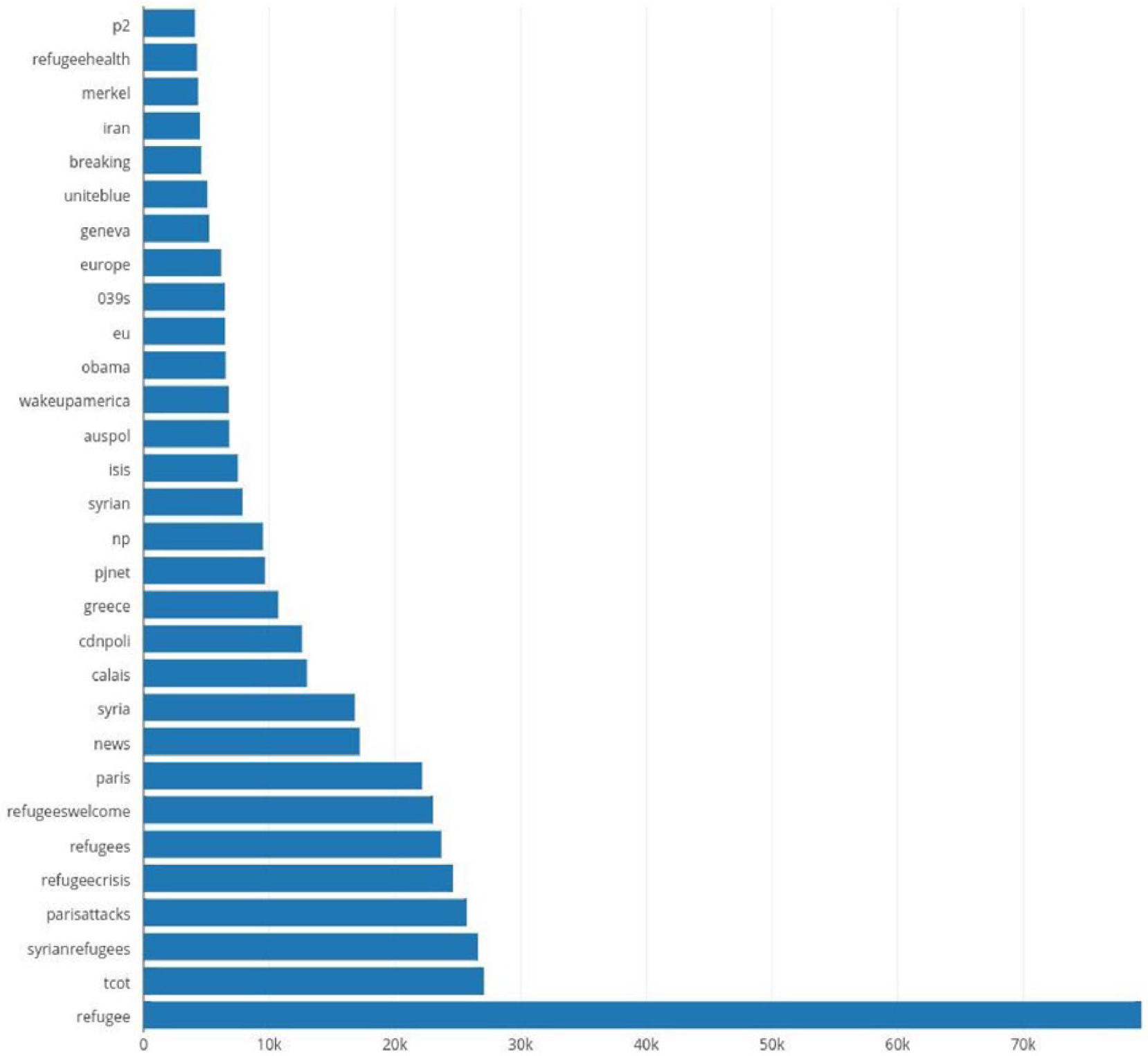
Hashtag frequencies, dataset November 13 to December 15, 2015.
In Figure 4, we see the hashtag frequencies in the dataset of the Paris story. The hashtag distribution pattern shows the dominance of political and event-related hashtags, alongside some humanitarian ones. The political hashtags include several US-related tags (#tcot, #pjnet, #wakeupamerica, #uniteblue, and #p2—the latter two associated with the Democrats and liberal-progressive politics). These hashtags point to the resonance that the combination of the terrorist attacks in Paris with the refugee issue had for US politics that was at the time entering an election period. It should be noted that the same hashtag can be used in different and opposing ways. For example, the #syrianrefugees hashtag is used by opponents but also supporters of refugees: “If your town on this map, your Senator, Rep. or Mayor has sold you out for #SyrianRefugees” and “#deBlasio says, ‘#NYC WILL welcome #SyrianRefugees’. [NY ‘Sanctuary’ City].”
To obtain a better insight into how these tags are related, we produced a network of co-occurring hashtags in Figure 5. Here, some of the conceptual links between tags are made more apparent. The color of nodes indicates that these correspond to communities of hashtags, that is, groups of hashtags which are more densely connected in their interior than externally. Four such “communities” are identifiable here, of which the yellow one is the largest, connecting tags such as #migrantcrisis, #merkel, and #terrorism alongside tags such as #war, #humanrights, and #children. Here, we see a diversity and a mixture of frames, humanitarian, security-related, and religious-cultural ones (#islam and #muslim). The blue community connects together the US-based political hashtags along with the tag #syrianrefugee, showing the politicization and polarization of the refugee issue in the US context. This indicates that the refugee issue is politicized in a purposeful way by certain tags popular within certain political groups but this does not necessarily involve other tags within the same story that exist in parallel. The red community appears to bring together news-related hashtags (#cnn, #news, and #politics), while the green community is more directly linked to the Paris attacks and France while it also includes the only non-English hashtag flüchtling, pointing to the resonance of the issue for Germany.

Hashtags graph—the Paris story. Selection criteria: Subgraph of nodes with degree bigger than 350. Nodes: 58.
Turning to RQ3 and the prominent actors or emerging elites, Figure 6 shows the network of mentions/RTs and replied to, which in turn indicates which accounts or Twitter handles were the most influential within this story. Again, here the politicization of the issue is hard to miss.

Mentions network graph—Paris dataset. Selection criteria: Subgraph of 42 nodes having total-degree bigger than 108. Nodes: 42 nodes. Edges: 81 edges.
The color of the nodes shows the various communities within the network. While in the hashtag network there were few differences among the various nodes, in the mentions network, the size of the node gives an indication of its degree centrality, calculated as the sum of indegrees and outdegrees. This measure indicates that the larger nodes received more mentions or were (re)tweeted more. The largest community is the green coded on, with nodes corresponding to accounts connected to US politics: @Potus, @realDonaldTrump and @HillaryClinton, but also @Gop_Regugee16 and @Irate_American, as well as @FoxNews and @CNNPolitics. What is noteworthy here is that the largest node in this network is user account @GOP_Refugee_16, a pro-Trump account with less than 300 followers which has since turned the account private. This community points to the politicization of the refugee issue and its use in the US political context. The second largest community is the purple one which includes humanitarian accounts, such as @PosNegOrg and @SharetheMealOrg, some media accounts such as @Reuters and @Time, and some political accounts such as @JustinTrudeau and @WhiteHouse. The largest node in this community is @BlueLotusDC, which has around 700 followers and tweets pro-refugee tweets. The red community is a variation of the green one, with most accounts linked to US politics and media, with the largest node belonging to a pro-Trump user account @Feru012, an account with about 1,200 followers. The remaining two communities, the blue and yellow, contain a few nodes, humanitarian and media, and US politics and media ones, respectively.
Table 2 has categorized the Twitter handles in terms of the kind of account, showing that most accounts belong to media and journalists, followed by general user accounts, political accounts, and lastly, humanitarian accounts. The general Twitter handles here revealed two accounts that can be seen as friendly to refugees (@RealJamesWood and @BlueLotusDC), five accounts that are self-characterizing as patriotic and pro-business, and four suspended accounts. This indicates on one hand that established actors and accounts operating in a professional capacity predominate, and on the other that some user accounts manage to become visible despite their relatively low number of followers.
Network of Most Mentioned Users, Paris Dataset.

UKIP: UK Independence Party.
Interpreting these findings, it is clear that political frames were more dominant than humanitarian ones. The Twitter debate around refugees during the Paris attacks was immediately politicized, and used in terms of the US election campaign which in November 2015 was picking up momentum. The prominent role of mainstream US news media in conjunction with politicians shows that the loudest voices are those of established and powerful actors—the emerging elite is therefore very similar to the established elites in the offline world. The new element here is that of mainly US-based, “patriotic,” right-wing accounts that support Donald Trump and have a strong anti-Muslim and anti-refugee stance. Their typical strategy is one where they tag various influential media and political accounts in the text of their tweets. The smaller role of humanitarian accounts shows that they have not managed to influence or shape the agenda toward a more humanitarian approach to the refugee issue at least in this story. Finally, the prominence of right-wing politicians, media, political commentators, and general accounts indicates the rising influence of the right-wing political agenda. In this respect, therefore, the overall framing was very similar to the mainstream media one, as found in Georgiou and Zaborowski (2017), but on Twitter, the voice and role of the extreme US-based right wing appear to be more prominent as shown by the many far-right users identified here.
Period 2: The Cologne Story
This story was identified after observing a spike in mid- to late January 2016. Following the Paris story, the refugee-related tweets petered out before they began picking up again in early 2016. Figure 7 shows the rhythm of tweeting here. The period covered is from December 7, 2015 to February 14, 2016. The incident of mass sexual assaults took place on New Year’s Eve of 2015, but was not reported by the media until later in January. Most media reported on this by using frames of irreconcilable cultural differences, fueling what has been described as media anti-immigrant hysteria revolving around questions of gender and the female body (Della, 2017). The incident in Cologne was followed by similar media reports in Sweden, Finland, Germany, Austria, and Switzerland (Wyke & Akbar, 2016) and led to street protests against sexual harassment (Shammas, 2016). The dataset here includes tweets in this period.

The Cologne story, rhythms of tweets/hashtags.
Looking into the hashtags in more detail, Figure 8 shows the most common hashtags in a bar-chart format.

Hashtags in the Cologne story.
The chart contains a number of the same or similar hashtags to the Paris story: place and country names, political (#obama, #merkel, and #eu), and humanitarian tags (#letthemstay). The US political hashtag #tcot is prominent in this dataset as well.
Figure 9 shows the emerging network of co-occurring hashtags. The hashtag network makes the connections between tags more apparent: the four communities that make up this network point to different emphasis on the story. The yellow community, which is the largest in terms of nodes, includes hashtags related to US politics, #tcot, #Obama, #Trump, and #US, alongside hashtags related to the reported assaults in Germany and Sweden, such as #rape, #women, #german, #sweden, and connecting these to hashtags such as #refugee, #syrian, and #migrant. In a similar manner to the Paris attacks story, the criminal case of sexual assaults is linked to Syrian refugees and is politicized in terms of the US political agenda. The second community, which contains the blue nodes, seems to present a different frame, including some humanitarian tags, such as #humanrights, #humanity, #unhcr, and #un next to tags such as #war, #syria, and #iraq, but also #russia, #berlin, #denmark, and #auspol. This does not seem to thematize the sexual assaults but to focus on the issue of refugees in different contexts. The green community appears to be more directly linked to the German political sphere with tags such as #merkel, #pegida, #afd, #fluechtlinge, and the racist #rapefugee tag. Finally, the red community points to the ongoing refugee arrivals in Greece, with tags such as #greece, #lesvos, #turkey, and #refugeecrisis. The network indicates that dominant frames linked the sexual assaults to political questions, viewed from a right-wing perspective, while humanitarian and crisis frames were present as well but less visible. This overall negative connection between refugees and rape or sexual assault has also been found in the mainstream media in Germany, where frames mobilizing fear and representations of refugees as predatory males became much more common following the incident in Cologne (Braun-Klöpper, 2016).
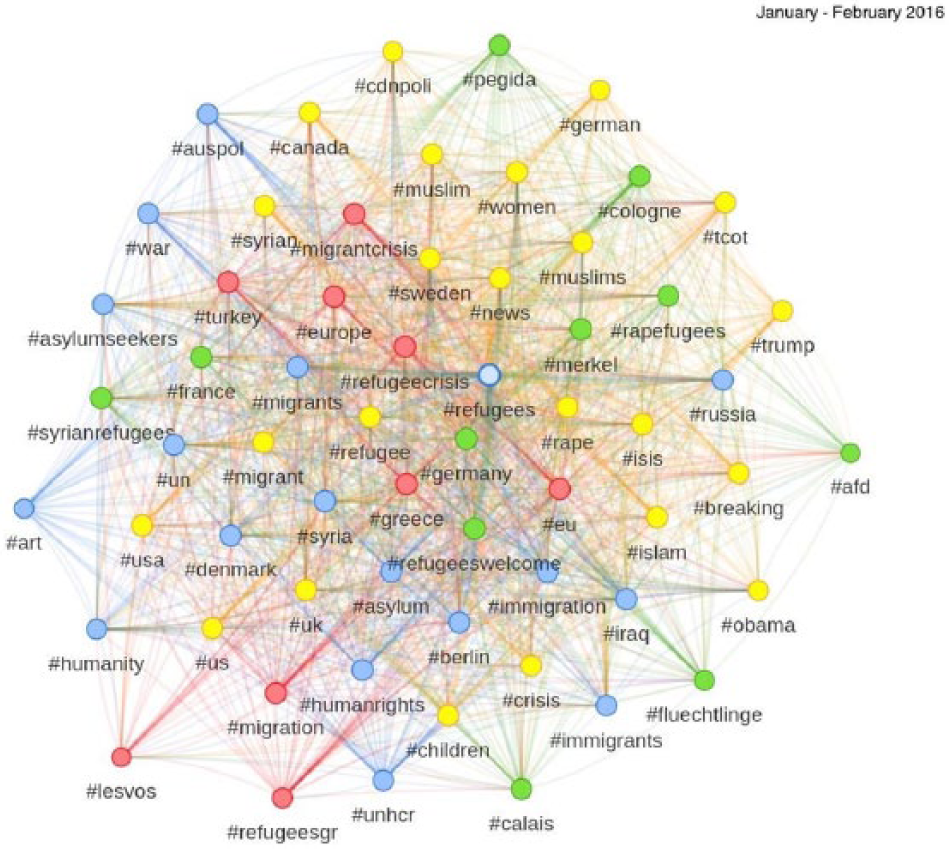
Hashtags graph—The Cologne dataset. Selection criteria: Subgraph of nodes with degree bigger than 350. Nodes: 61.
In terms of actor visibility in this story, Figure 10 shows the mentions network and Table 3 tabulates the accounts according to their category.
Network of Most Mentioned Cologne Story.

HRW: Human Rights Watch.
Network of Most Mentioned Idomeni.


Mentions network graph—Cologne dataset. Selection criteria: Subgraph of 43 nodes having total-degree bigger than 2,200. Nodes: 43 nodes. Edges: 98.
The network visualization shows one very large community, color coded blue, which contains a mixture of humanitarian accounts, media accounts, only one political account, notably @realDonaldTrump, and two anti-refugee accounts (@janimine, now suspended, and @DavidJo52951945). The largest node is that of the account belonging to the Chinese artist and humanitarian Ai Wei Wei. The green community similarly revolves around a humanitarian account, @7piliers, and includes media and other humanitarian accounts. The remaining nodes do not form strong communities but are nevertheless part of the overall network. A set of users mentioned but unconnected to the other accounts are @jeremycorbyn and @skynews. This shows that UK politics were part of the story but not a very central one. In contrast, US politics and more specifically far-right politics were a much more integral part.
Overall, the refugee story in this period seems to be told in two different ways: one that is stringently against refugees, using tags such as #rapefugees and #rape and connecting the Cologne incident to anti-immigrant political groups such as Pegida and Alternative for Germany (AfD) in the context of Germany, while also raising concerns over the integration of the mostly Muslim refugees through tags directly implicating religion such as #muslim or #Islam; and another that seems to dispute the wholesale tarring of refugees as rapists insisting on helping refugees using tags such as #refugeeswelcome, and focusing on the humanitarian aspects as seen by the involvement and visibility of humanitarian accounts. In parallel, the politicization of the refugee issue through the prism of “alt-right” politics is also present here. Finally, the presence of a left-wing politician, the leader of the Labour Party in the United Kingdom, Jeremy Corbyn, is important but does not seem to be linked to the debates among the most visible Twitter accounts.
In terms of the current research questions, the two dominant frames are a negative, racist one, in which refugees are tarred as rapists, and then used for political purposes by far-right political organizations and politicians, and a second frame which focuses on humanitarian issues. These frames do not appear to differ from those in mainstream media. Looking at the emerging main actors in this part of the story, these include established media and political commentators, politicians, and accounts of well-known non-governmental organizations (NGOs) and humanitarian activists. What is noteworthy here is the presence of suspended accounts, whose activity has fallen foul of Twitter’s regulations, and that of far-right-wing, anti-immigration accounts.
Period 3: The Idomeni and EU-Turkey Deal Story
Around the beginning of March 2016, Macedonia, which had already closed its borders to those without an Iraqi or Syrian passport, decided to completely close its borders to all refugees, creating a bottleneck at the Greek borders and leaving over 50,000 refugees stranded in the Greek-Macedonian border, close to a village known as Idomeni (Squires, Holehouse, & Freeman, 2016). At around the same time, the EU made a deal with Turkey to relocate refugees there, offering Turkey a budget of €6b for refugees plus a visa waiver for EU travel. The deal has been criticized extensively by the United Nations (UN) and other bodies due to its refusal to admit persons seeking asylum on European soil and blanket returns which are in contravention of the UN 1951 Geneva Convention for the Treatment of Refugees and the right to nonrefoulement (Frelick, 2016; Spindler, 2016). Equally, the extent to which Turkey—a non-signatory to the Geneva convention—is in fact a safe country is also under considerable discussion (Ulusoy, 2016). This period includes tweets harvested in the period February 9 to March 20 and includes the unfolding of the drama in Idomeni and the build up to the EU-Turkey deal which was took effect on March 20, 2016 (Figure 11).

The Idomeni/EU-Turkey story, rhythms of tweets/hashtags.
The rhythms here show that the refugee story picked up pace compared to the January period with four spikes: February 29, when Macedonian police tear-gassed refugees trying to cross the border (Kantouris & Gatopoulos, 2016); March 8, when the border closed completely (Squires et al., 2016); March 15, when Macedonia forcibly returned refugees to Greece (Smith, 2016); and March 19, when there were rallies organized in support of refugees just ahead of the implementation of the EU-Turkey deal.
The hashtags in Figure 12 show that this story continues along the lines of previous stories, with hashtags encountered earlier sticking to this story as well, though their frequency is lower. We therefore see the US political tag #tcot; the German political hashtag #merkel, #germany; and the Australian tag #auspol. The new tags identified here include #safepassage which clearly references the border closures; #euco, referring to the EU conference that led to the EU/Turkey deal; #letthemstay which references the deportations planned in the EU/Turkey deal; and the tag #euturkey referring to the deal. Two more hashtags of note here include the #m19 and #wedenounce tags used during the organized rallies in support of refugees and one of the few non-English hashtags #prouracisme, which is in Catalan and means #enoughracism. Figure 13 shows the network of the co-occurring hashtags, making the connections between them clearer.

Hahstags in the Idomeni story.

Hashtags graph—the Idomeni and EU-Turkey deal story. Selection criteria: Subgraph of nodes with degree bigger than 350. Nodes: 53.
The largest community of nodes here is represented by the blue nodes, and this includes a mixture of political, geographical, and humanitarian tags, such as #eu and #auspol; #canada, #calais, and #usa; and #humanrights and #unhcr. The blue community seems to subsume a variety of issues and positions, ranging from #calais and #france, #uk and #brexit, to #us and #trump, alongside #war and #asylum, #isis and #iraq. A similar pattern found in the red community includes far-right tags such as #afd and #tcot alongside humanitarian tags #humanity, #women, and #children. The yellow community includes tags such as refugeesgr, #safepassage, and #refugeecrisis, but also #rapefugees, indicating the kinds of debates that are taking place and some polarizing views. The framing of the Idomeni and EU-Turkey deal story follows the pattern encountered in the other two stories, where it is explicitly politicized and figuring in political debates in the United States, but also in France, Germany, and the United Kingdom. This is accompanied by a humanitarian frame focusing on the safety of refugees.
Turning to the visible actors in this story, Figure 14 shows the network emerging, with Table 4 containing sample tweets of the main accounts in this network.

Mentions network graph—Idomeni/EU-Turkey dataset. Selection criteria: Subgraph of 44 nodes having total-degree bigger than 1993. Nodes: 44. Edges: 143.
The network here is similar to the one for the previous period. The largest community is color coded blue and includes humanitarian and media accounts, mostly accounts belonging to established NGOs, such as @Amnesty, @Refugees (UNHCR), and @Unicef, and media, such as @Guardian and @TheEconomist. The second largest community consists of US-based, right-wing accounts, such as @AnnCoulter, @SouthLoneStar, and @Trump2016fan alongside media such as @RT_com and @MailOnline but also @Wikileaks. The dark blue network contains humanitarian accounts belonging to activists, such as the @Refugees_Gr, @Fotomonimiento, and @AntiRacismDay accounts, alongside accounts belonging to journalists (@Faloulah and @Juanmi_news). The remaining nodes do not form communities, and include the account of Bernie Sanders and Ai Wei Wei. Table 4 shows that, as in the previous networks, the media accounts dominate, but the humanitarian accounts are sizeable here in contrast to their relative lack in the Paris story. It can be said that this story is therefore driven by these accounts.
As with the Cologne story, we see that this story is divided into two: a story about the humanitarian crisis, that is in support of refugees and against racism, and is associated with international NGOs and organizations such as the UNHCR; and a parallel story that is linked to the far right, and which connects refugees to politics. But in this particular story, it seems that the humanitarian voices alongside those media that are friendlier to refugees or at least neutral, such as Al Jazeera, and the Guardian, are more prevalent. Yet the far right, both in terms of pro-Trump campaigners and in terms of media commentators such as Ann Coulter and pseudo-media such as @OnlineMagazin, and in terms of tags such as #afd, is consistently and vocally present as well, especially when compared to the marginal role played by left-wing politicians such as Bernie Sanders. This story therefore is characterized by a (re)turn to a humanitarian crisis discourse but alongside far-right politics, and alongside efforts to politically address the issue (the involvement of the @EU_Commission account).
Returning to the research questions, the dominant frames here are found to be a negative and occasionally explicitly racist political frame associated with far-right politics, a humanitarian one, and one associated to the institutional politics of the EU. In terms of compatibility to mainstream media discourses, a study of press coverage of the refugee issue in Germany, Greece, and the United Kingdom in the same period as this story showed a preoccupation with numbers and the management of refugee arrivals, representations of refugees as victims of war needing help, and expressions of skepticism toward the EU deal with Turkey (Fotopoulos & Kaimaklioti, 2016). A difference that is emerging between the mainstream media coverage and Twitter discourses is that the latter contain a significant far-right element that seems to be absent from the mainstream media. This is emerging both in terms of hashtags but also in terms of accounts that politicize and connect the refugee issue to the far-right politics in the United States, Germany, and elsewhere. The emerging elites here come primarily from established media and humanitarian accounts; second, from US-based right-wing accounts, and third, from activists supporting refugees.
Conclusions: Voice or Noise?
This article began with a consideration of mainstream media representation of the refugee issue. The review revealed a problematic picture, dominated by representations of “othering,” securitization, and deservedness. However, recent theorizing of the media sphere suggests that mainstream media are only part of a more complex landscape that includes digital and social media (Chadwick, 2013). These, in turn, are associated with the potential to offer voice to those typically marginalized, leading to eventual recognition of their equal worth (Couldry, 2010; Freelon et al., 2016). In addition, emerging congregations of people connected through shared affect and common stories point to the potential of such media to harbor social change, toward the direction of more inclusivity and diversity (Papacharissi, 2015). Together, such publics may be contributing to alternative networked frames (Meraz, 2017) of the refugee issue. Based on these arguments, this article examined the various frames as they emerge on Twitter alongside the main actors or elites, analysed through addressivity markers such as mentions, replies, and RTs.
The results are mixed. The overall story and the inter-related stories that comprise it point to a complex story told by many different people. However, the power law that characterizes Twitter points to the marginal role played by most of these users. The stories that emerged based on the rhythms of tweeting seem to revolve around key events that were widely publicized through mainstream media. Looking at the stories as framed by hashtags, we found two main versions: a frame politicized from a far-right perspective, in which refugees were framed as terrorists or rapists, following along the lines of representations that mobilize security and safety; and a humanitarian frame, which revolved around human rights, and was created by humanitarian organizations, activists, and some mainstream media. Both frames were found across our three events/stories here, though in Paris and Cologne, the frame of security was more prominent, while in Idomeni/EU-Turkey story, the humanitarian frame appeared to be used more. In terms of comparing these to mainstream media coverage, it is evident that processes of othering are present on Twitter, and if tags such as #rapefugees are any indication, they are even more dehumanizing than those observed in the studies on media representations of refugees. Additionally, while the EU press narrates the refugee “crisis” as primarily a European issue (cf. Georgiou & Zaborowski, 2017), our findings demonstrate an important role played by US political actors, as well as hashtags alluding to refugee-related issues in Australia and Canada.
On the other hand, the humanitarian accounts contributed significantly in the making of the refugee story on Twitter and this cannot be overlooked; but humanitarian responses and style of communication and campaigning are not without problems as the work of Lilie Chouliaraki (2014; Chouliaraki, Georgiou, Zaborowski, & Oomen, 2017) has shown. It is significant here that in terms of the most visible users, there were few, if any, “ordinary” users. It is noteworthy that most of these accounts were loudly campaigning for Donald Trump. In terms of voice and diversity of the stories, the results cannot support unequivocally the existence of either, as they seem to replicate the media coverage of the refugee issue. Additionally, as Couldry (2010) pointed out, voice does not refer only to the enunciation or articulation process but also to the reception: voice is only voice when it gets heard. We understand here RTs, mentions, and replies to as pointing to something been heard in the sense that it has triggered a reaction. But if RTs, mentions, and replies are taken as an indication of being heard, then this voice is reserved for already established actors, such as media, politicians, and humanitarian NGOs. This leads to the question of power: both Chadwick and Papacharissi see power as an emergent property of the networks that are created. But in our research, we can see that this power, understood as visibility and ability to set the agenda through hashtags, mentions, and RTs, is concentrated in some accounts and hashtags that include well-established actors who already enjoy power and visibility both on and off Twitter. When non-established actors become visible, the pattern we observed is as follows: rather than enjoying a broad basis, as expected through processes of network framing, their visibility is contrived through concentrated actions by a few very active accounts, as the Trump-supporting accounts in our sample show. Moreover, pre-existing tags seem to appropriate newer tags to use for their own purposes. For example, the ubiquitous #tcot hashtag has been found to indicate patriotic-nationalistic ideological polarity in earlier studies of Twitter during the Occupy movement (Meraz, 2017) and seems to perform a similar function here with respect to the refugee issue. Returning to the notion of affect, voice, and affective publics, it is clear that a large number of people were touched by the refugee story and participated in it; however, if affect is seen as a drive that circulates and perhaps eventually dissipates, we have also seen here affect captured and used instrumentally by certain groups for their own political purposes. This is how we may understand the involvement of tags and accounts linked to US politics and the then unfolding election campaign.
As a big data study, the research here focused on the broader picture and the structural dynamics that emerge in the mediation of the refugee issue by Twitter, and lacked the more textured approach of a smaller, more qualitative study that could potentially offer more insights into the particular nuances of these stories. Nevertheless, the structural dynamics identified here are telling of an emerging pattern regarding Twitter’s mediation. We have seen that in the refugee issue, the publics that emerge coalesce around established actors and narratives. If there was any disruption of dominant narratives, it got lost amidst, or subsumed under, these dominant tags and hubs. Mainstream media rather than marginal were one of the main categories of hubs. We have also observed that rather than power emerging from the bottom up, existing and rising political networks—for example, those around the ever present #tcot hashtag—capture and instrumentalize the affect that circulates on Twitter. The humanitarian tags and accounts cannot be overlooked, but in the refugee debate, these large NGOs and international political institutions are already enjoying a good deal of power and yield significant influence. We have also seen that while security frames took over in the Paris story, humanitarian ones took over in the Idomeni story, indicating that events play a role in terms of the frames used. Overall, the refugee debate on Twitter is caught between the security and racist frames on one hand and humanitarian responses on the other, emulating the frames encountered in mainstream media.
Finally, this discussion leads to the formulation of further hypotheses regarding the role of Twitter in networked publics and in processes of mediation. While Papacharissi’s arguments on the rise of affective publics are compelling, our evidence suggests that we may have entered a new phase in which such publics are captured by pre-existing quasi-organized groups that operate through long-standing hashtags and through strategically tagging and retweeting influential accounts. Linking any new issue to the pre-existing hashtags—for example, #refugees and #tcot—points to an emerging dynamic in which new issues are subsumed and used for different political purposes. This is no longer a social media platform that operates as a leveling field; rather, the long-standing presence of some has already conditioned the medium, “socializing” new tags in their own way and “broadcasting” to millions of followers. This supposition points to the instrumentalization of Twitter, where it is used strategically to achieve certain political ends. In these terms, affective publics may no longer be the authentic expression of soft structures of feeling but they may be subsumed or captured by strategic publics.
Footnotes
Declaration of Conflicting Interests
The author(s) declared no potential conflicts of interest with respect to the research, authorship, and/or publication of this article.
Funding
The author(s) disclosed receipt of the following financial support for the research, authorship, and/or publication of this article: Eugenia Siapera and Jane Suiter received a DCU Faculty Humanities and Social Sciences research grant.