



Abstract
Current literature on networked publics lacks research that examines how emotions are mobilised around specific actors, and quantitative analysis of affective phenomena is limited to vanity metrics. We address this issue by developing a network analytic routine, which guides the attribution of emotions contained in hashtagged tweets to their sources and targets. The proposed template enables identification of networked inconsequentiality (i.e., inability to trigger dialogue), reply targets (i.e., individuals targeted in replies) and voice agents (i.e., senders of replicated utterances). We demonstrate this approach with two data sets based on the hashtags #Newzealand (n = 131,523) and #SriLanka (n = 145,868) covering two major incidents of terrorism related to opposing extremist ideologies. In addition to the methodological contribution, the study demonstrates that user-driven emergence of networked leadership takes place based on conventional structures of power in which individuals with high power and social status are likely to emerge as targets as well as sources of emotions.
Introduction
Recent years have witnessed a surge of academic interest in digital manifestations of affective phenomena, such as affect (e.g., Blevins et al., 2019; Döveling et al., 2018; Johns & Cheong, 2019) and emotions (Margolin & Liao, 2018; Neag & Supa, 2020; Wang & Wei, 2020). Concepts such as affective publics that acknowledge the role mediated feelings play in online activism (Papacharissi, 2016) have inspired analysis of digital publics (e.g., Adi et al., 2018; Adlung et al., 2021; Basmechi & Ignatow, 2021; Dawson, 2020; Hautea et al., 2021; Siapera et al., 2018; Ural, 2021). This emphasis on affect and emotionality is necessary to understand networked publics, since platforms enable social formations such as ad hoc publics organised around specific hashtags (Bruns & Burgess, 2011) based on shared feelings and emotions. As Papacharissi (2016) notes, we may envision discourse organised by hashtags ‘as structures of feeling, comprising an organically developed pattern of impulses, restraints, and tonality’ (p. 321). Examining such structures can provide insight into the role emotionality plays in mobilising users within affective digital social formations.
While there is an emphasis on affective phenomena as a basis to examine networked structures of feeling (Papacharissi, 2016), there is a lack of attention among researchers who study hashtag publics to examining how specific emotions that indicate different states of affect are mobilised. There are several limitations of current literature on affective and emotional dimensions of digital publics. First, scholars have defined affect in several ways, from a subjective feeling to presubjective intensity (Laszczkowski & Reeves, 2015), reflecting a lack of agreement on how digitally mediated affect can be observed. Second, an emphasis on narratives has resulted in concepts such as affect being umbrella terms rather than specific tools for analysis. Third, social media researchers do not adequately deal with studies in psychology and affective neuroscience that identify affect as a bodily reaction that is intertwined with emotions (e.g., Barrett, 2009, 2011; Posner et al., 2005; Russell, 1980). Despite the availability of automated emotion-detection techniques, quantitative analysis of collective activity within affective publics is largely limited to vanity metrics, that is, measures such as counts of page views and likes that are used to assess how well one is doing online (Rogers, 2018).
Analysis of specific emotions can complement current work on hashtag publics (e.g., Papacharissi, 2016) as it can show how affect, transformed into specific emotions, is verbalised via social media posts. Accordingly, the objective of this study is to propose a template for structural analysis of networked emotions with an emphasis on how platform affordances enable the emergence of networked publics via individual acts, such as posting, reposting and replying to content. We aim to achieve three related goals to develop a template for mapping networked emotions. First, we classify social media utterances, specifying three distinct primary orientations (i.e., expression, targeted replies and replication). Differences between such primary orientations are crucial to establish directionality of emotions and develop an approach for mapping flows of emotion. Second, we suggest a network analytic routine, based on a measure of weighted degree in directed networks, to attribute emotions contained in different types of utterances to their sources and targets. This approach allows contextualising the role individual users play in the construction of hashtag publics and identifies sources and targets of emotions. We use the abovementioned primary orientations and the analytic routine to describe three actor types that characterise affective influence in ad hoc hashtag issue publics. Identification of modes of affective influence can help examine nuanced aspects of digital publics by explicating how affective networked gatekeeping (Meraz & Papacharissi, 2013) takes place via distinct processes of digital engagement, such as celebrity engagement (Bennett, 2014; Click et al., 2013) and populist political leadership (Kaur et al., 2021; Masch & Gabriel, 2020).
The third goal was to use Twitter ‘hashtag publics’ related to incidents of terrorism as the empirical context to demonstrate the abovementioned approach. Research that examines digital engagement related to terrorism represents a variety of topics. Further work on digital engagement related to terrorism is necessary as accessibility of social media intensifies the mediatization of tragedy. Accordingly, we examine mobilisation of affect via uptake activity within Twitter hashtags #Newzealand and #SriLanka, two ad hoc publics that emerged in response to the March 2019 attacks in Christchurch, New Zealand, and the April 2019 Easter Day bombings in Sri Lanka, respectively. These two attacks represent acts of terrorism related to opposing extremist ideologies.
Mapping affective phenomena within hashtag publics: methodological challenges
Different conceptualizations of affective phenomena, such as emotion, affect and feeling, have implications for how emotion is understood and applied to examine media (Alinejad & Ponzanesi, 2020). A discussion of such implications is necessary for the development of different analytical approaches. The notion of affect has evolved through several scholarly traditions across different fields that represent distinct theoretical and epistemological positions (Wetherell, 2013). Many studies that examine affect within the context of digital media depend on the theoretical foundation developed by Baruch Spinoza, Gilles Deleuze and Félix Guattari. Papacharissi (2014) notes that this school of thought, which defined affect as the ability to affect and be affected, paved the way for understanding affect as intensities dependent on, but independent of, individual emotions. The Deleuzian school of thought makes a clear distinction between affect and emotion in which the former is considered as an ‘intensity’ that does not require interpretation, while the latter involves secondary cognitive processes (Alinejad & Ponzanesi, 2020). While the critical theoretical approach has its merits, especially in terms of theorising digital assemblages, our emphasis lies in a conceptual basis that enables empirical analysis of emotionality. The position that affect exceeds subjective experience has troubled researchers, especially in terms of methodological application of the concept (Robinson & Kutner, 2019). Our position is that affect, when used in isolation as a nonsignifying, nondiscursive intensity, offers limited potential for empirically examining digital publics.
Scholars who use affect as a theoretical lens to examine hashtag publics face the above challenge. Affective publics – ‘public formations that are textually rendered into being through emotive expressions that spread virally through networked crowds’ (Papacharissi, 2016, p. 320) -deserves attention within this context as it has inspired a wide range of studies (e.g., Adi et al., 2018; Adlung et al., 2021; Basmechi & Ignatow, 2021; Hautea et al., 2021). Papacharissi (2016) conceptualises affective publics as networked publics mobilised, identified, connected and disconnected through expressions of sentiment, which materialise uniquely, facilitate connective action and leave distinct digital footprints. She describes affect as a form of subjectively experienced pre-emotive intensity with which individuals experience emotions. This conceptualisation recognises the interrelatedness between affect and emotions. However, it does not identify expressed emotions as evidence of affect. This may limit the ability to analyse specific evidence of affect because of abovementioned difficulties in measuring individually experienced intensities underlying digital publics.
The abovementioned issue also relates to the question of whether affect can be measured on a collective level. Social media researchers discuss affective intensity and networked rhythms on a collective level. For instance, Papacharissi uses the total volume of tweets to show networked rhythms of activity in the hashtag #Egypt and notes that, within the hashtag, affect was present through the intensity that permeated the stream of tweets and rhythms and pace of storytelling. Siapera et al. (2018) used a similar approach to examine hashtags related to a refugee crisis in 2016 in which they used the volume of messages as an indicator of rhythms of tweeting. Similarly, Papailias (2016) describes the high level of views generated by a specific video tribute as affective energy. While Papacharissi (2016) highlights rhythms as an indicator of affective intensity, she also points to what can arguably be described as individual traces of verbalised affect, using a sample of tweets, which displayed a variety of emotions. We suggest that intensity and rhythms should be considered as separate phenomena as rhythms is a collective property (i.e., temporal changes in the extent of engagement) while intensity is a subjectively felt experience. While vanity metrics (Rogers, 2018), such as the volume of tweets, can help examine rhythms, more sophisticated methods are needed to examine outcomes of subjective intensity.
While quantitative analysis of digital affective publics reflects an emphasis on collective rhythms, related qualitative work pays attention to the emergence of narratives. For instance, Hautea et al. (2021) discuss how TikTok content related to climate change (re)produces affective publics. They demonstrate how the platform is used to produce content that can indicate earnestness and mockery, move between care and indifference and rely on repetition and variation of existing creative styles. The authors argue that their analysis offers empirical traces of affective publics by documenting the production and reproduction of textures of storytelling. Dawson (2020) discusses the hashtag #MeToo from the perspective of emergent storytelling. He examines narratives within the hashtag and argues that, although Twitter is not designed for a narrative experience, the platform facilitates interactive construction of narratives and the affective encounters that such an interaction produces. Both Hautea et al. (2021) and Dawson (2020) focus on how the discourse unfolds within chosen digital publics and the role individual utterances play in the construction of collective narratives. In a similar vein, Ural’s (2021) analysis of the Twitter hashtag #AliErbaşYalnızDeğildir, which framed public debate in Turkey, shows how the hashtag served as a performative site for imagining a Muslim self. He identifies themes emerging from content and examines the extent to which such themes articulate subject positions, such as truth of Islam and hatred. Ural identifies such subject positions as ‘affective resonances of hashtag discourse’. While these studies provide useful insight, the emphasis on narratives has resulted in a disconnection between theory and empirical work because affect is used as an umbrella term to describe a given hashtag public, rather than as an analytical tool that guides specific analysis.
The emphasis on affect as the main analytical unit seen above poses challenges. Within this context, we observe a lack of structural analysis that explains how subjectively felt affect is verbalised in structures of interaction. To address this issue, we consider specific emotions as discursive outcomes of affective intensity. Therefore, analysis of emotions serves as an approach to demonstrate evidence of affective intensities underlying emotional social media content.
Empirical analysis: emotion as an analytical unit
We draw on research in the field of social psychology (Barrett, 2011; Barrett & Bliss-Moreau, 2009; Barrett & Russell, 1999; Russell & Barrett, 1999) to suggest that emotion can serve as a viable analytical unit to observe affective behaviour. Core affect – ‘consciously accessible elemental processes of pleasure and activation’ (Russell & Barrett, 1999, p. 805) – is a precise concept which Barrett and Bliss-Moreau (2009) identify as a ‘neurophysiologic barometer of the individual’s relationship to an environment at a given point in time, with self-reported feelings as the barometer readings’ (p. 5). Russell (2003) defines core affect as ‘a neurophysiological state that is consciously accessible as a simple, nonreflective feeling that is an integral blend of hedonic (pleasure–displeasure) and arousal (sleepy–activated) values’ (p. 147). According to Russell (2003), core affect can be experienced as ‘free-floating (mood) or can be attributed to some cause (and thereby begin an emotional episode)’ (p. 145). Core affect provides the basis for the analytical approach developed in this study as previous work explains how core affect is intertwined with specific emotions.
Prototypical emotional episodes, which Russell and Barrett (1999) described as what many individuals identify as the clearest cases of emotions, include a complex set of subevents concerned with an object. Russell and Barrett argue that emotional episodes include several elements: core affect; overt behaviour in relation to, attention towards, appraisal of, and attributions to an object; experience of emotion and neural, chemical and other bodily reactions. Barrett and Russell (1999) note that affective feelings are central to emotional experience, and emotional episodes may not exist in the absence of strong affective feelings. The circumplex model (Barrett & Russell, 2009; Posner et al., 2005; Russell & Barrett, 1999) shows how affect-related items can be decomposed into basic psychological properties. In this model, affective states arise from valence and arousal, and affective experiences, which represent specific emotions, result from a linear combination of such systems (Posner et al., 2005). For instance, fear indicates high activation and unpleasantness while sadness can be characterised by high unpleasantness and slight deactivation. This supports the argument that traces of emotions contained in digital text can be seen as visible evidence of latent states of core affect. Accordingly, emotion is a more viable analytical unit as it is traceable in digital text data. In this model, sadness, disgust, anger and fear show somewhat similar levels of subjectively felt unpleasantness. However, they differ in terms of activation in which anger and fear can be seen as highly active states. The extent to which these emotions are mobilised in digital text data can show the level of activation as well as sources and targets of such intensity, enabling mapping flows of emotion and characterising affective influence. The following discussion builds an empirical basis for such analysis.
Step 1: specifying primary orientations of social media use
This section focuses on specifying how different types of individual acts, such as posting, reposting and replying to content, contribute to complex structures of interaction. This classification guides mapping of emotions contained in each act to their sources and targets. Social media provide affordances such as replicability, scalability and searchability, as well as high visibility of content (boyd, 2011), which enable the formation of conversational structures. Affordances such as triggered attending and metavoicing (Majchrzak et al., 2013) facilitate interaction among users. In general, platform affordances are actualized via uptake of elements in digital environments. Uptake is the relationship that emerges when an actor’s actions take traces of prior or ongoing activity as relevant for an ongoing activity (Suthers et al., 2010). Uptake is not limited to transactivity and acknowledges situations where interactions can occur without other-directed utterances (Rathnayake & Suthers, 2018). This concept allows understanding how individual actions aggregate to larger entities within and across platforms. Uptake can take many forms on social network sites. For instance, a user may take up platform elements and features (e.g., Facebook ‘Create Post’ option, Twitter ‘What’s Happening’ option, a twitter @ handle, Facebook profile) to post content for a public or a community. Outcomes of other users’ use of such elements, including content perceived as traces of an imagined public or a community for engagement (e.g., Tweets, retweets, Facebook posts), can also be taken up for engagement. Accordingly, social media use includes different types of uptake that expand into structures of interaction (Rathnayake & Suthers, 2018).
A relational logic for mapping networked affect via uptake activity on Twitter can be developed based on three layers of primary orientation (see Table 1 for definitions). Bruns and Moe (2014) identified three layers of communication on Twitter: (1) macro (hashtag), (2) meso (follower networks) and (3) micro (@replies). They argue that, while Twitter affordances allow inherent interconnections between layers, users may also deliberately transition between layers. The primary orientations defined in this section reflect this model. Tweets, retweets and replies in an ad hoc public function within the macro layer as they contain hashtagged text. They also relate to meso and micro layers as the tweeted text is visible to follower networks and that some messages may take the form of ‘@replies’ or mentions. However, the use of original tweets (without mentions), retweets and replies (or mentions) reflects disctinct orientations
Primary orientations of social media utterances.
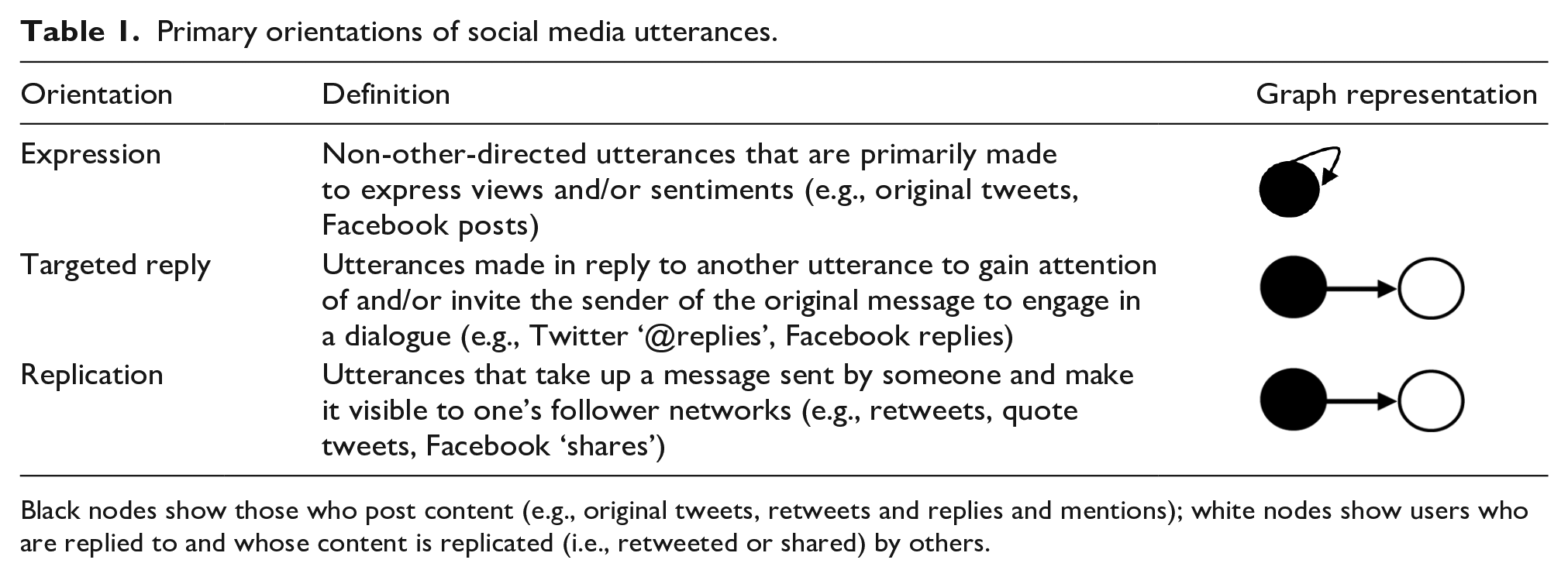
Black nodes show those who post content (e.g., original tweets, retweets and replies and mentions); white nodes show users who are replied to and whose content is replicated (i.e., retweeted or shared) by others.
An original tweet takes up platform features and affordances for posting content. If the user marks the tweet with a hashtag, the message becomes a member of a collective (i.e., a public organised around a hashtag ‘frame’ and the macro layer as suggested by Bruns and Moe). Although original tweets contain the potential for future uptake, they do not in themselves constitute explicit structures of interaction among users since by definition they do not tag other users or reference existing contributions. Accordingly, our graph representation of original tweets consists of a vertex, which represents a user, and a self-loop that indicates that the tweet takes up emotions originating in the user. In contrast, replies, mentions and retweets explicitly take up existing twitter handles and content for engagement (i.e., structures within the micro layer). Accordingly, both replies and retweets contribute to ‘explicit interactive uptake structures’, represented using vertices connected by edges. Replies/mentions and retweets have distinct primary orientations. A reply can be identified as primarily a targeted response as they are other-directed utterances made in reply to a previous utterance. A reply may act as an invitation for further engagement, and it motivates triggered attendance (Majchrzak et al., 2013). Other-directed tweets that mention specific users also fall under this category. In contrast, a retweet is a specific act of metavoicing, that is, engagement by reacting to content created by others, rather than voicing one’s opinion (Majchrzak et al., 2013). Retweets are primarily replicative as the main intention behind retweeting is to take up an existing tweet and make it visible to a user’s follower network with or without an emphasis. In the following section, we discuss how these orientations provide a basis for understanding directionality of networked emotions.
Step 2: attributing emotions contained in digital text to actors
In this section, we use the abovementioned classification to attribute emotions contained in original tweets, replies and retweets to their sources and targets. Identification of sources of emotions helps uncover the extent to which affective influence takes place via each orientation.
Sources of emotions
In primarily expressive utterances (i.e, original tweets) and targeted replies, senders can be identified as sources of emotions. Therefore, the sum of emotions contained in original tweets, replies and mentions shows the extent of emotions originated from the person who posted them. However, senders of replicative utterances (i.e, retweets) cannot be considered as original sources of emotions as they primarily replicate content originally posted by others. It is more logical to consider the person whose message is retweeted as the source of emotion. Therefore, the total of emotions contained in retweets show the extent to which the original sources (i.e., whose tweets get taken up for retweeting) act as sources of emotions. However, since the graph representation of targeted replies and replicative utterances is the same (see Table 1), separate networks should be constructed for these orientations.
Targets of emotions
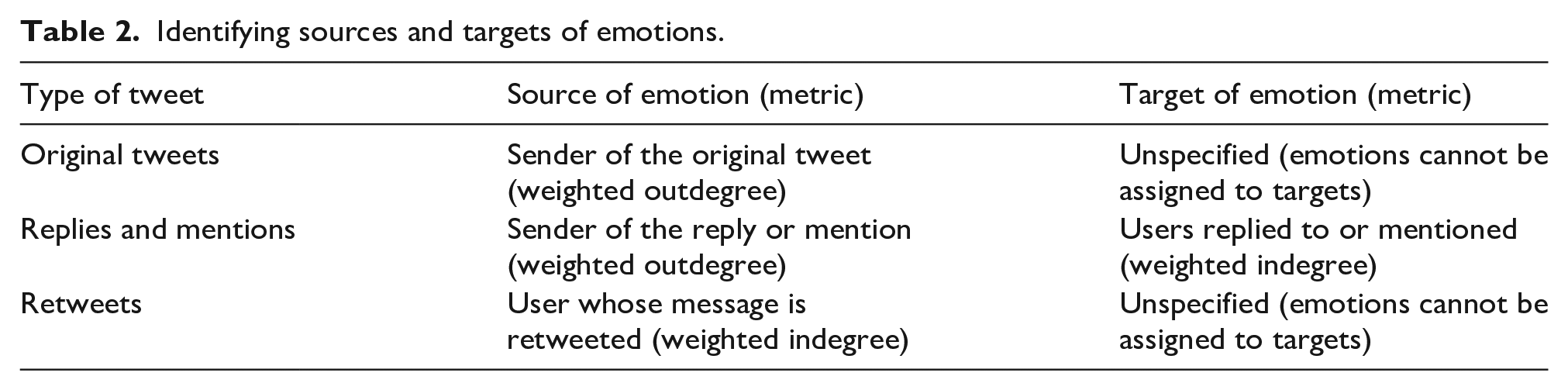
Emotions in replies and mentions can be assigned to targets (i.e., those who are replied to or mentioned) to identify the extent to which users have been targets of emotional uptake. In contrast, assigning emotions in retweets to senders of retweets shows the extent to which users replicate emotional content. This distinction is crucial when identifying sources and targets of emotions in Twitter reply and retweet structures. In retweet structures, specific targets of (retweeted) emotions cannot be identified as the audiences are imagined by the sender. In other words, traceable retweet structures are limited to ties between sources of emotion and ‘replicators’ (i.e., users to replicate content posted by such sources). Figure 1 summarises this argument, and Table 2 shows network metrics that can be used based on this argument to identify the extent to which users become sources and targets of emotions.
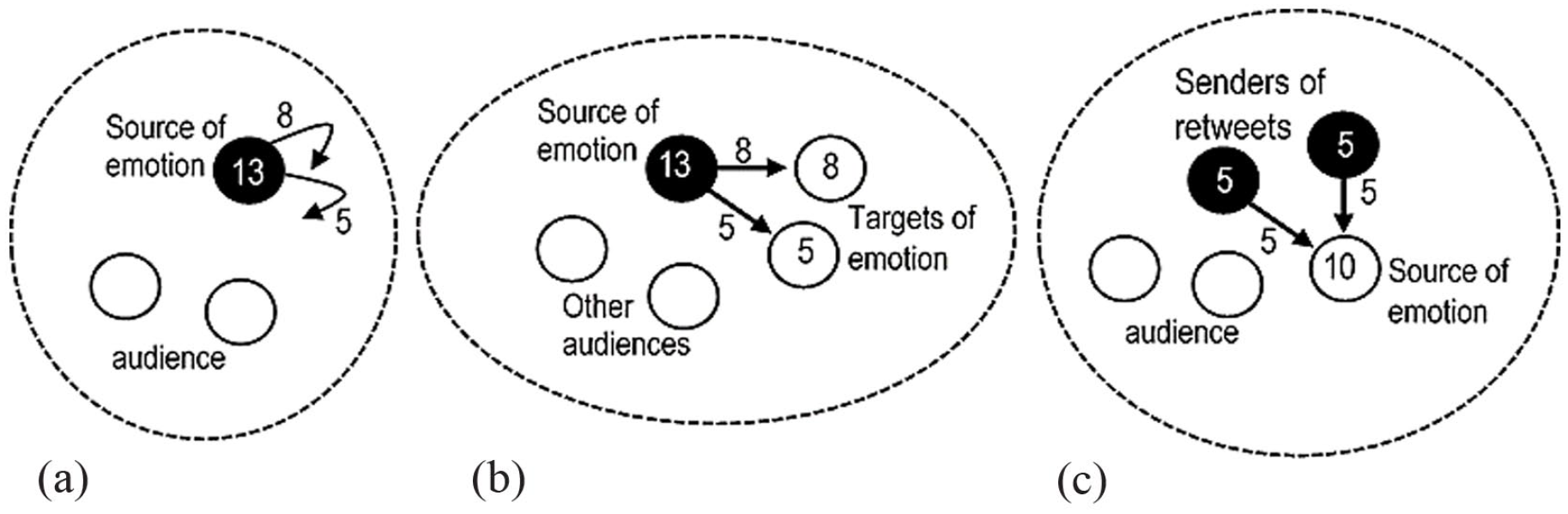
Sources and targets of emotions.(a) Original tweets. (b) Replies and mentions. (c) Retweets.
Identifying sources and targets of emotions.
Metrics
Weighted vertex degree can be used to attribute emotions to sources and targets in uptake relationships described above. Weighted degree is defined to be the sum of edge weights (i.e., emotion scores for each reply/mention or retweet) for each vertex. In directed networks, weighted indegree calculates the sum of emotions contained in incoming edges. Accordingly, weighted indegree can be used to measure (a) the strength of emotions originating from a user whose message is retweeted and (b) the extent to which a user becomes a target of emotional uptake via replies and mentions. Weighted outdegree can be used to assess the extent to which (a) users replicate emotional content in retweet networks and can also show (b) the strength of emotions originating from users as they reply to messages or mention others (see Figure 1).
Weighted degree measures actors’ total emotional engagement in the network summed across all their interactions. This will naturally favour actors who have high degree, which is appropriate if one is interested in characterising the emotionality of a network as a whole and identifying those who have the greatest impact on this emotionality. However, weighted degree is not identical to degree: Examples discussed in the following sections illustrate how different actors emerge as prominent ones in the same network (holding degree distribution constant) under different emotions. If one were instead interested in the emotionality of single actors’ typical individual interactions with others (controlling for how many others they interact with), one could use the mean weight, that is, weighted indegree or outdegree divided by the respective degree. However, such a measure could mark actors as prominent individuals with only one or a few very emotionally intense interactions who are not significant from the standpoint of emotionality in the the overall network.
Data, emotion detection and network construction
To illustrate the approach, we use two data sets based on the hashtags #Newzealand (n = 131,523; 29,993 original tweets, 2294 replies and mentions and 99,236 retweets) and #SriLanka (n = 145,868; 40,273 original tweets, 6388 replies and mentions and 99,207 retweets) gathered using the standard Twitter API for analysis. The Christchurch attack took place on March 15, 2019, targeting two mosques. The first data set, which covered the 6 hours immediately after the attack, represented the hashtag #Newzealand that was used to express sentiments relating to the attack. The second data set that included #SriLanka was gathered on April 21, 2019, covering Sri Lanka’s Easter attacks. These bombings included multiple suicide attacks targeting several churches and luxury hotels. Data collection started immediately after the first attack tookplace, and the full data set covered 8 hours. Accordingly, our samples cover the most intense period of Twitter activity that emerged immediately after the incidents.
Emotions contained in tweets were calculated using the NRC Emotion Lexicon (EmoLEx) (Mohammad & Turney, 2013). EmoLEx contains a repository of word-sense associations that mark the presence of a given emotion in a word. The lexicon includes more than 14,000 words, which help quantify the extent to which a given emotion is present in a corpus. EmoLEx is a widely used lexicon, and it has been applied to examine Twitter content (Yu & Wang, 2015). Total sentiment scores for each tweet were calculated using the get_nrc_sentiment function in the R SyuZhet package. Words express multiple emotions, and overlaps are expected. For example, when called on ‘IS, as claimed, brutal terrorist attack on #Christians in #SriLanka: World must unite to annihilate these insane, brutal Shaitans for peace’, get_nrc_sentiment returns the following scores: anger 5; anticipation 1; disgust 1; fear 5; joy 1; sadness 1; surprise 1; trust 1; negative 5; positive 1. While the lexicon-based emotion detection shows the extent to which words that indicate specific emotions are present in each document (i.e., tweet), it does not examine the semantic context within which such words are used (e.g., sarcasm). Therefore, our analysis is limited to the use of emotion words, rather than how such words are used. However, it should be noted that the analytical approach proposed by this article does not depend on the emotion-detection method used. More sophisticated emotion-detection methods can be used with the same network analytic template.
A multilayered graph analysis was used to examine structures of uptake that emerge via replies, mentions and retweets. This approach considers each reply or retweet as having multiple layers of emotions in varying degrees. As recommended earlier in this article, separate networks were created to examine how different emotions were embedded in reply and retweet structures. Network vertices represented users, and edges were based on acts of replies, mentions and retweeting. Self-loops were created for original tweets. Edges that had zero emotion scores were removed. Figure 2 summarises the network construction process. The Louvain method (Blondel et al., 2008) was used to observe the community structure.
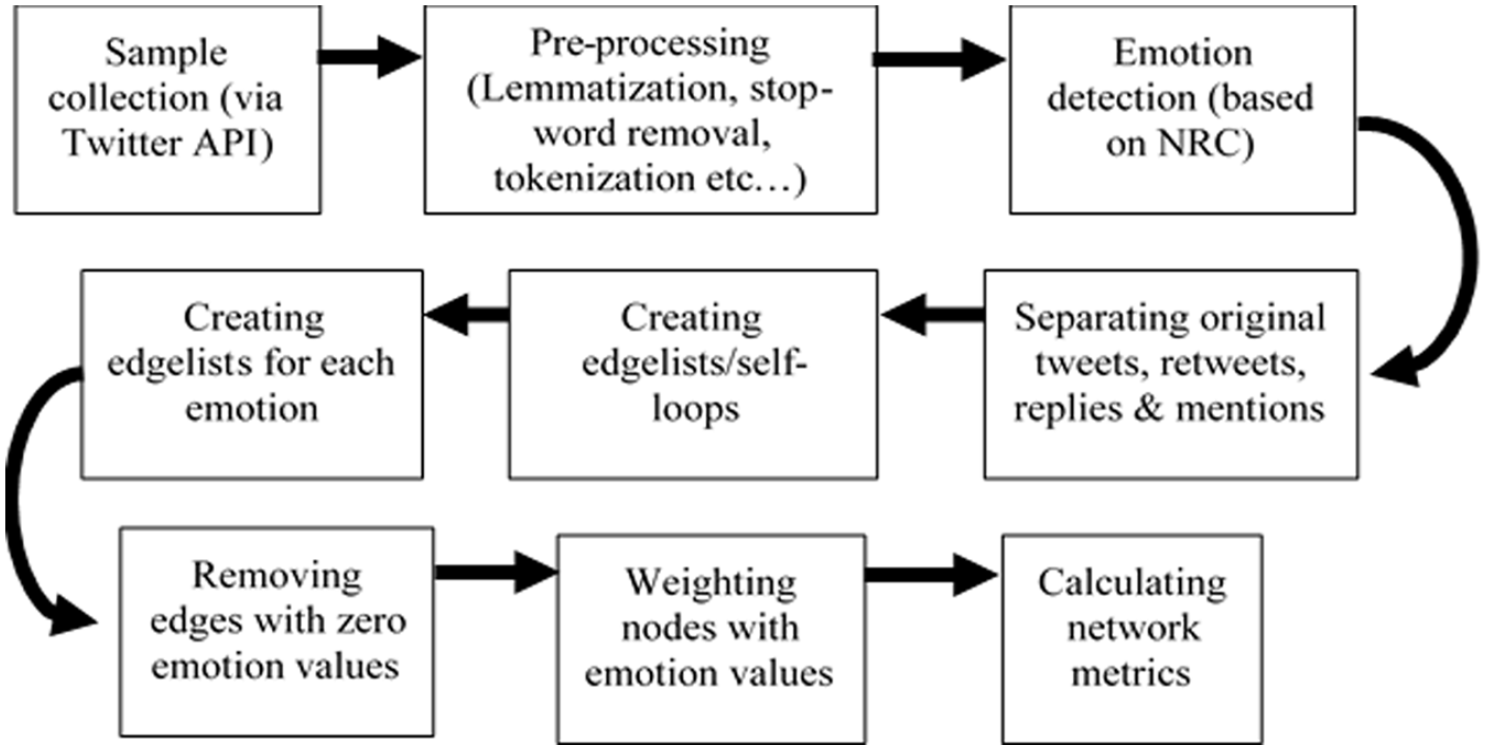
Network construction and analysis process.
Step 3: mapping flows of emotion
Networked influence takes place within complex structures of interaction, and as Meraz and Papacharissi (2013) note, the power of elites to frame a given issue depends on networked actions of the nonelite. The abovementioned classification and the network analytic routine help observe such bottom-up construction. In this section, we demonstrate the use of the proposed approach and describe how three actor types that characterise different types of affective influence (inconsequentiality, dialogic targets and voice agents) emerge via individual acts of uptake.
Networked inconsequentiality
Primarily expressive utterances (i.e., original tweets) can reveal users who display ‘networked inconsequentiality’, that is, failure to trigger actual uptake at the point of observation. Such unrealised potential for uptake shows a lack of influence. Nodes with self-loops were identified in the full networks that included original (nontagged) tweets, replies/mentions and retweets. Profiles that emerged as top sources of emotion in original tweets representing both hashtags included regional news outlets. For instance, @DunyaNews (Pakistani media organisation, weighted outdegree, anger: 24, fear: 31), @MusafirNamah (Indian travel and tourism news outlet, fear: 36) and @ewnreporter, (Eye Witness News team, South Africa, fear: 24) were among top sources of emotions in original tweets in #NewZealand. Similarly, local Sri Lankan news outlets and journalists, such as @SriLankaTweet (weighted outdegree, anger: 62, fear: 99, sadness: 60), @newsradiolk (anger: 35, fear: 61, sadness: 33, disgust: 13) and @Kavinthans (anger: 55, fear: 82, sadness: 31) appeared among top sources of emotions in #SriLanka. Individuals with a low Twitter following were also included among top sources of emotions in expressive utterances. This shows that although institutional profiles with a local character as well as individuals with relatively small follower groups can use the platform for expression, they fail to mobilise discussion.
Targeted replies and replicative utterances
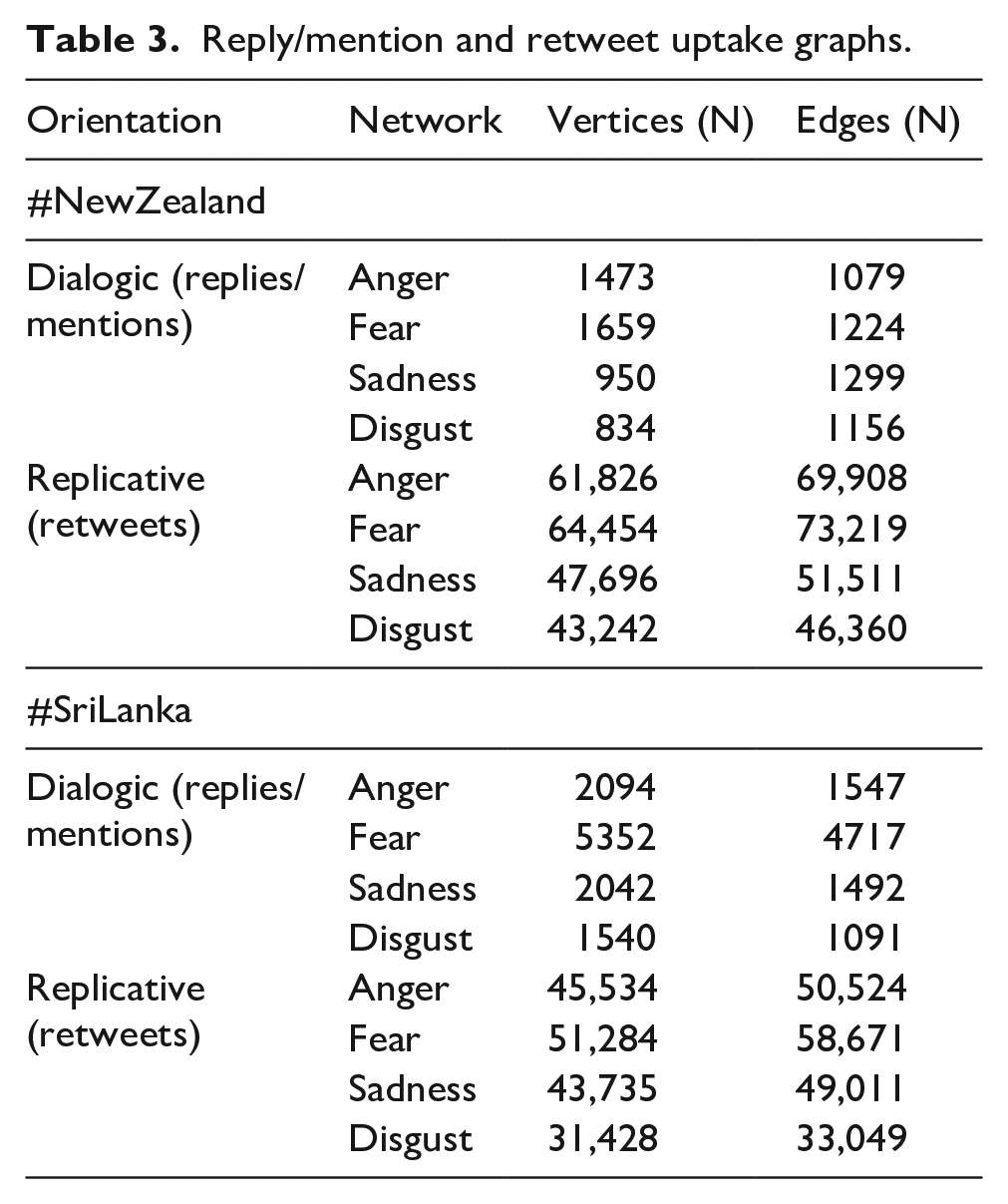
Replies and retweets form traceable structures of interaction among users. Analysis of such structures can show how content is chosen by followers for engagement and the user-driven ‘construction’ of top actors. We identify two modes of influence within these structures. In reply/mention structures, users whose profiles and/or expressions are taken up by others can be identified as reply targets. Within retweet structures, sources of content retweeted by others can be seen as agents of voice. These two types of affective influence are different from each other as users direct their voice at targets in replies while they take up voice from agents in retweets. Table 3 shows the sizes of reply and retweet networks for each emotion. These networks had strong structures characterised by clearly defined partitions (modularity values estimated by the Louvain method ranged between 0.972 and 0.853).
Reply/mention and retweet uptake graphs.
Reply targets
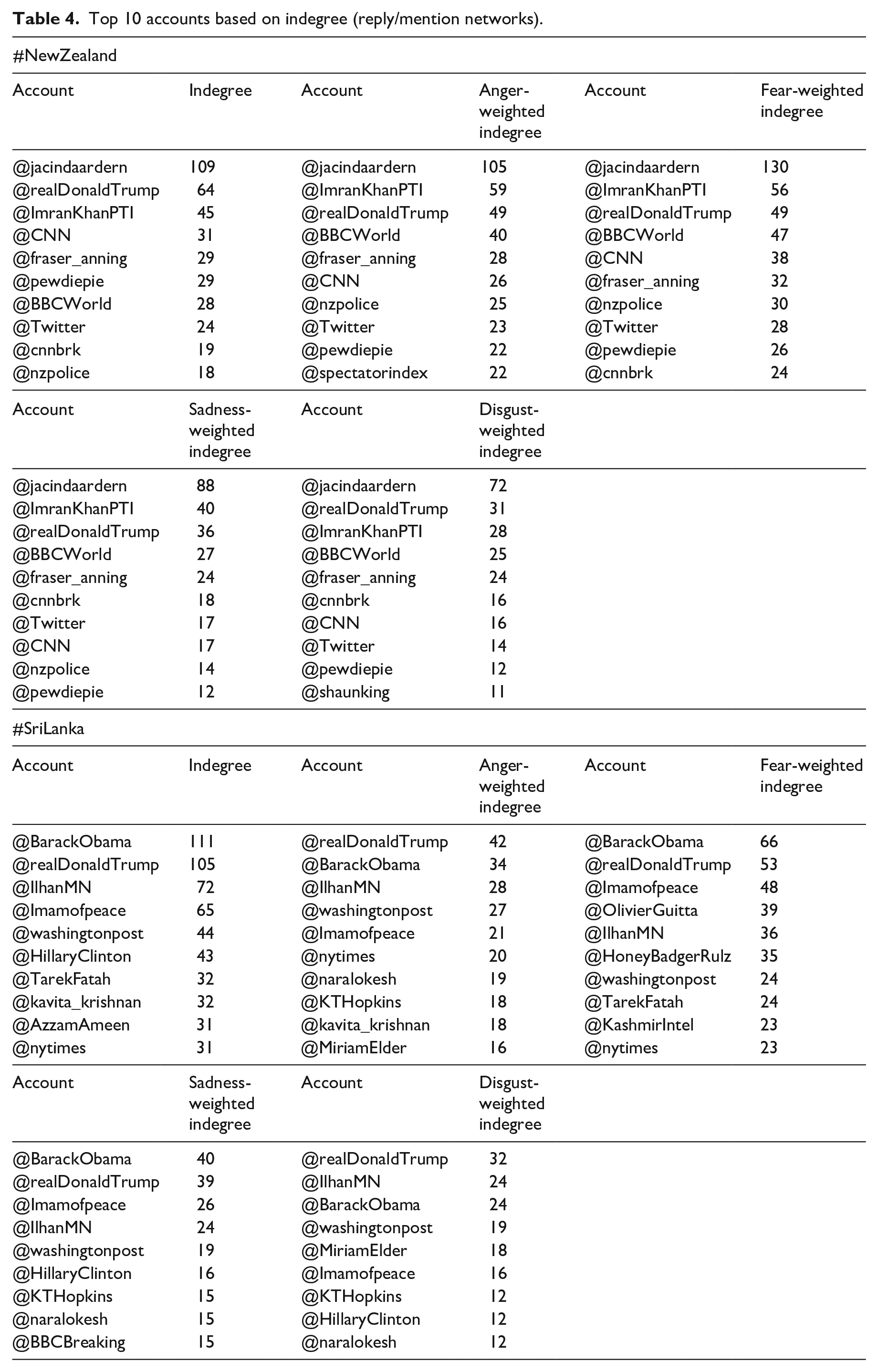
Reply targets can be characterised as actors who emerge via targeted replies. Reply targets emerge when users respond to previous utterances or profiles (‘@handles’), inviting ‘triggered attendance’ (see Majchrzak et al., 2013). This allows users to respond to individuals with different levels of power and social capital although such figures may not engage in an active dialogue with followers. However, the ability to target such figures itself is a soft form of influence afforded by platforms. Table 4 shows top actors based on indegree values for the full reply/mention network (before the construction of networks based on emotions) and the weighted indegree values for separate networks. Figure 3 shows the largest partitions in reply/mention networks in each hashtag. The node size indicates weighted indegree (i.e., the extent to which a user becomes a target of a given emotion). As the visualisations show, political leaders, such as Jacinda Ardern (weighted indegree, anger: 105; fear: 130; sadness: 88; disgust: 72), Donald Trump (anger: 49; fear: 49; sadness: 36), Imran Khan (anger: 59; fear: 56; sadness: 40; disgust: 28) and accounts representing media organisations including CNN (anger: 26; fear: 38; sadness: 17) and BBC World (anger: 40; fear: 47; disgust: 25) emerged as top reply targets in each network layer in #Newzealand.
Top 10 accounts based on indegree (reply/mention networks).
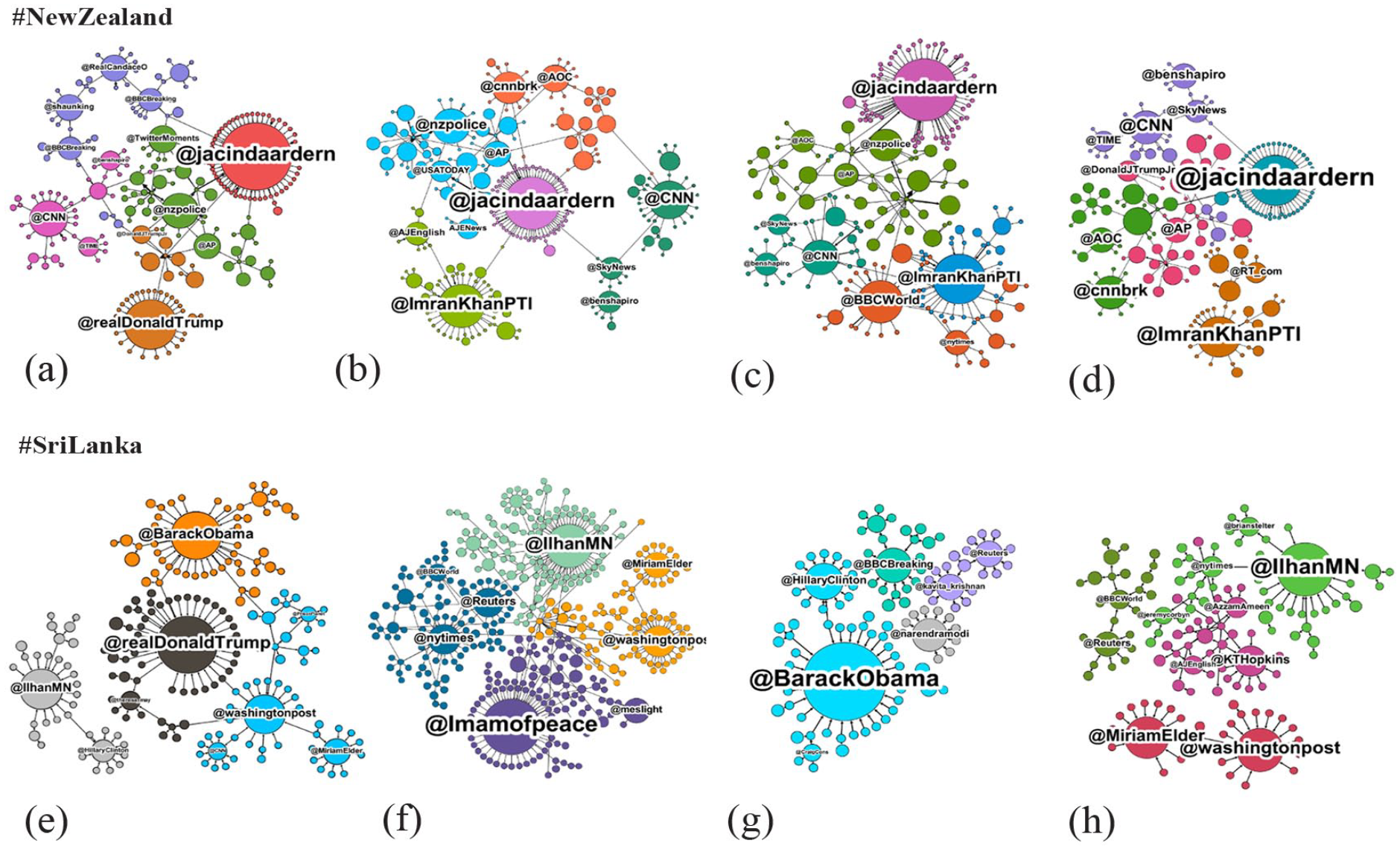
Partitions in reply/mention networks. (a) Anger. (b) Fear. (c) Sadness. (d) Disgust. (e) Anger. (f) Fear. (g) Sadness. (h) Disgust.
Similarly, the largest partitions in #SriLanka formed around political figures, such as Donald Trump (weighted indegree, anger: 42; fear: 53; sadness: 40; disgust: 32) and Barack Obama (anger: 34; fear: 66; sadness: 40; disgust: 24), religious leaders (e.g., @Imamofpeace; anger: 21; fear: 48; sadness: 26; disgust: 16) and media organisations (e.g., @washingtonpost; anger: 27; fear: 24; sadness: 19; disgust: 19, and @nytimes; anger: 20; fear: 23; sadness: 9; disgust: 7). This indicates that, although general users may reply to each other within the context of issues, targeted replies gather around accounts that represent individuals or organisations that have high political power and/or social status. These top accounts had zero weighted outdegree values, indicating that although they are targets of uptake, they do not engage in active dialogue with others. Within this context, influence can be characterised mainly based on the mere availability of such accounts as targets.
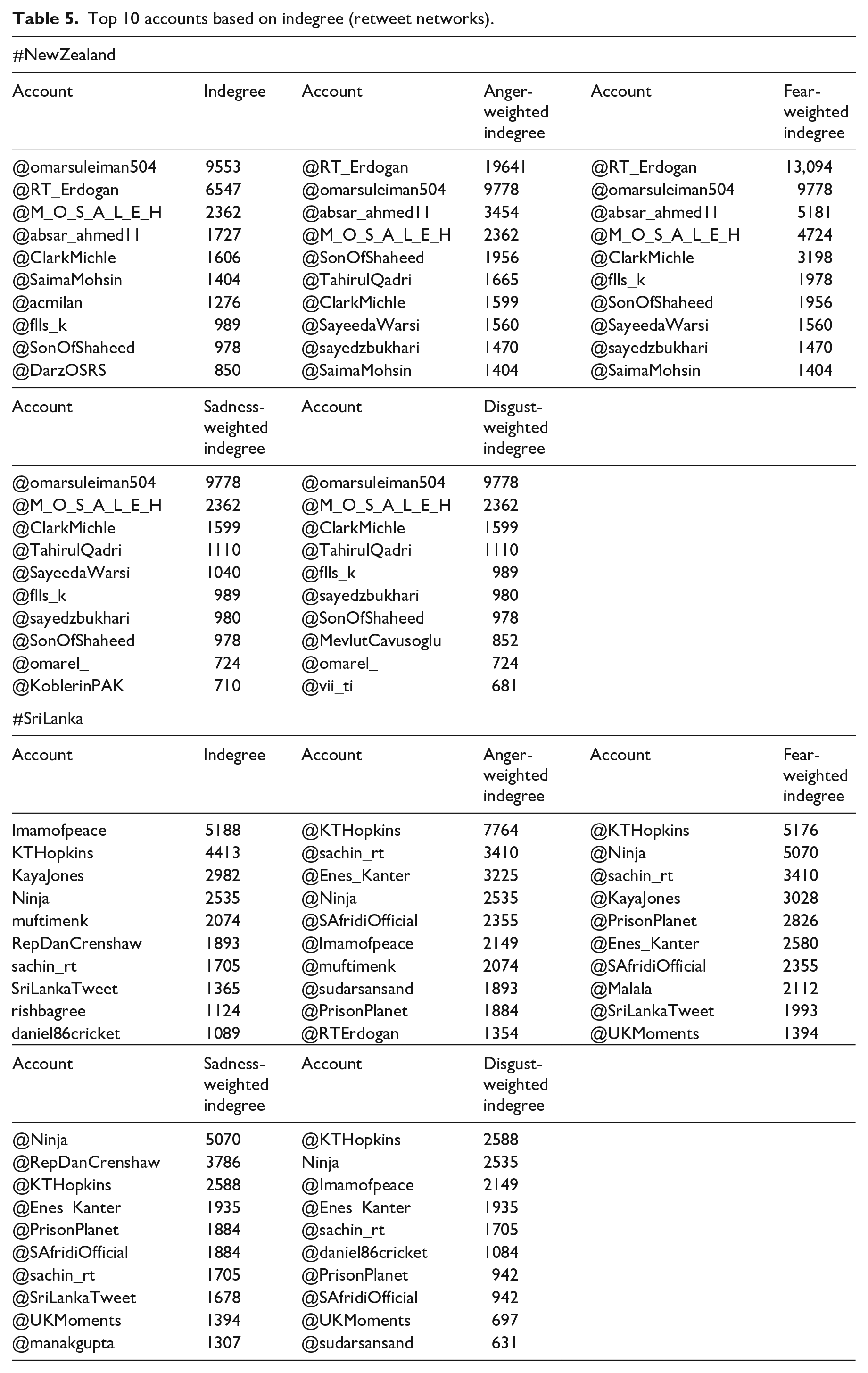
Voice agents
In retweet structures, influence takes place when users become agents of voice as their utterances are selected by others for reposting. Table 5 shows indegree values of top 10 accounts in both general and weighted networks. Figure 4 shows the largest two partitions in retweet networks representing each hashtag. Replicative structures in #Newzealand included accounts representing political figures, such as RT_Erdogan (Recep Tayyip Erdoğan, President of Turkey; weighted indegree: anger: 19,641; fear: 13,094), MBA_AlThani (Sheikh Mohammed bin Abdulrahman Al-Thani, Deputy Prime Minister and Minister of Foreign Affairs, Qatar; anger: 795; sadness: 530), MevlutCavusoglu (Mevlüt Çavuşoğlu, Minister of Foreign Affairs of the Republic of Turkey; anger: 1278; fear: 852) and sayedzbukhari (Sayed Bukhari, Pakistani-British entrepreneur, special assistant to Prime Minister Imran Khan; anger: 1470; fear: 1470; sadness: 980). These networks also included religious figures, such as Dr. Tahir-ul-Qadri, Founding Leader and Patron-in-Chief of Minhaj-ul-Quran International, Pakistan (weighted indegree, anger: 1655; fear: 1110; sadness: 1110) and Dr. Omar Suleiman (imam and academic; anger: 9778; fear: 9778), and diplomats (e.g., KoblerinPAK, Martin Kobler, former German Ambassador to Pakistan; anger: 710; sadness: 710; disgust: 355).
Top 10 accounts based on indegree (retweet networks).
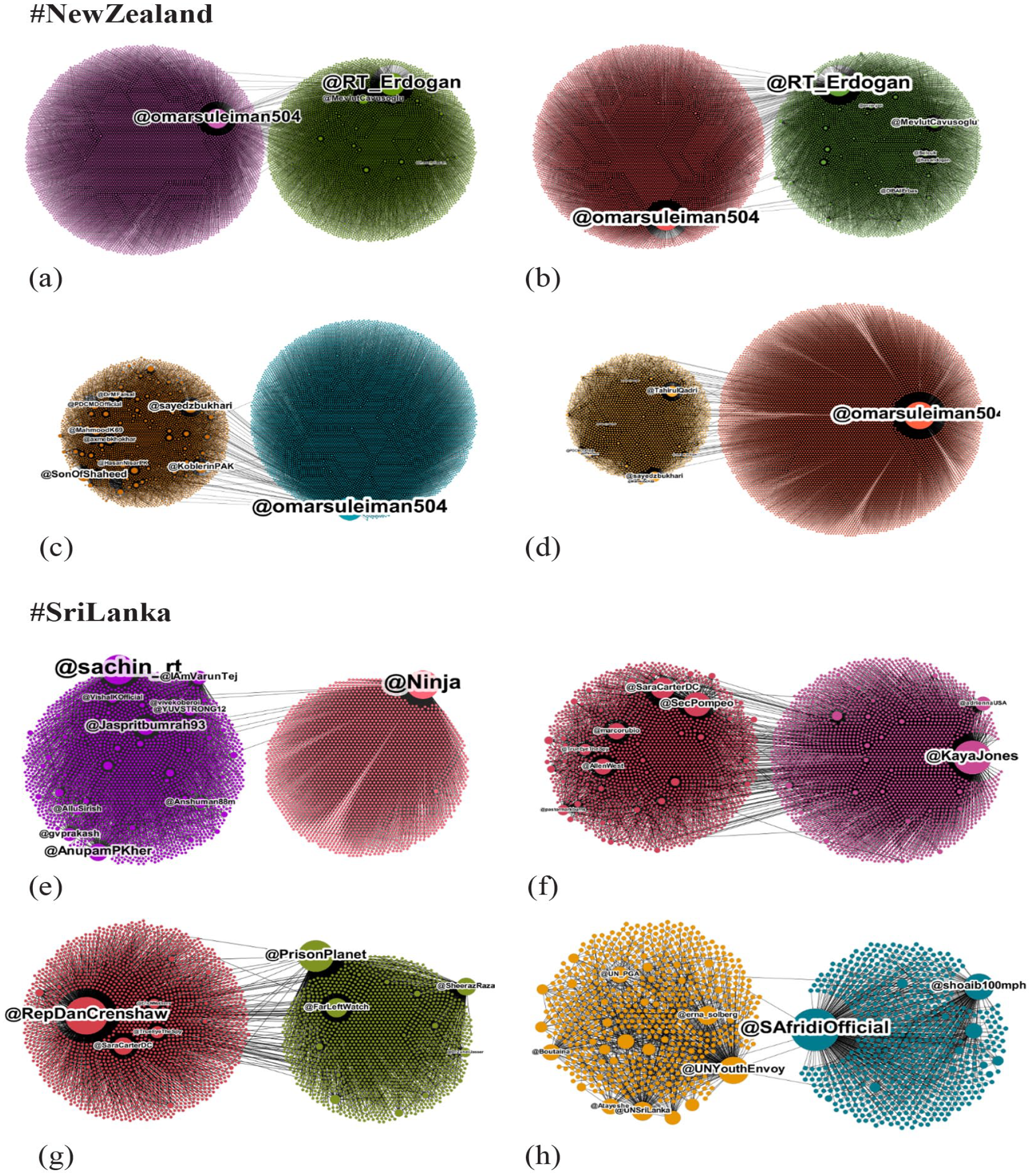
Partitions in retweet networks. (a) Anger. (b) Fear. (c) Sadness. (d) Disgust. (e) Anger. (f) Fear. (g) Sadness. (h) Disgust.
Celebrities and religious figures appeared more frequently among sources of emotion in retweet networks in #SriLanka. Celebrity accounts including sachin_rt (Sachin Tendulkar, former Indian cricketer; weighted indegree, anger: 3410; fear: 3410; sadness: 1705), SAfridiOfficial (Shahid Afridi, former Pakistani cricketer; anger: 2355; sadness: 1884), Ninja (Richard Tyler Blevins, gamer and YouTuber; anger: 2535, fear: 5070, disgust: 2535) and Kaya Jones (Canadian-American singer; fear: 3028) were among top 20 actors with high indegree. Results also show that accounts representing religious leaders, such as Imamofpeace (weighted indegree, anger: 2149) and Muftimenk (Islamic scholar based in Zimbabwe; anger: 2149), had high indegree in these networks. Retweet networks also included individuals representing distinct orientations, such as Paul Joseph Watson (British right-wing YouTuber), Pakistani Nobel laureate Malala Yousafzai and the former US Secretary of State Mike Pompeo.
Methodological implications
Social network sites are complex conversational environments that enable different modes of user engagement. Fine-grained analysis is required to examine how emotions flow among users representing different levels of socio-political power and cultural capital in such environments. Our primary goal is to develop a network analytic template for mapping flows of emotion within hashtag publics. An empirical analysis of #NewZealand and #SriLanka shows that mapping networked emotions provides useful insight that can characterise hashtag publics. The analysis encapsulates the view that affect ranges from ‘individual expressions of feeling to the production of sensation within human-technology assemblages’ (Pedwell, 2017, p. 149). Not only is this approach consistent with the argument that the attribution of emotional words to specific actors is a key element in the identification of affect in language (Adlung et al., 2021), it also shows a systematic basis for such attribution.
The three types of actors introduced in this study complement previous work that discusses networked gatekeeping (e.g., Meraz & Papacharissi, 2013) by providing a framework for fine-grained analysis that allows understanding the emergence and positionality of actors and the role emotions contained in their messages play in determining such positionality. Meraz and Papacharissi’s work on the hashtag #egypt focuses on prominent users, gestures and conversational practices. Our findings show structural positioning of such users and the nuanced nature of affective influence that they display within hashtag publics. Twitter users follow each other for different reasons, and interactions within global ad hoc publics emerge based on such logics. As we demonstrate in the current study, such leading actors locate in separate clusters. This characterises polymorphic publics that display internal diversity in terms of user orientation (Rathnayake, 2021; Rathnayake & Suthers, 2018), such as political followership and fandom. While identification of top actors is commonly applied in social media research (e.g., Ausserhofer & Maireder, 2013; Chen et al., 2017), the abovementioned approach can differentiate actors under different emotions and allow observing how emotions accumulate as such power structures develop.
While the three actor types discussed above provide a basis for empirical analysis of soft forms of influence, these three modes of construction require further refinement and application. While we define actor types within a relational context, using network analysis as the method, qualitative analysis can allow close reading of the role played by different types of social media users in the construction of networked leadership. Such analysis enables observation of how different power relationships are embedded in ad hoc publics and interpreting mobilisation of networked emotions. Moreover, further work is needed to examine the extent to which shared affective intensities and emotions determine the formation of communities around key figures. While the abovementioned results show flows and accumulation of emotions within chosen hashtags, our illustrative results are subject to limitations of lexicon-based emotion detection. However, the analysis template proposed does not depend on the emotion-detection method used in the example, and more sophisticated methods of natural language analysis for emotion detection can be applied within this template to enable more accurate mapping of networked emotions.
Characterising hashtag publics
While we reveal reply targets and voice agents within #NewZealand and #SriLanka, we emphasise a more general characterisation of ad hoc and affective publics based on the abovementioned results. Specifically, the abovementioned analysis helps determine whether ad hoc affective publics constitute citizen-oriented, nonhierarchical, grass-roots social formations or merely reproduce offline social and political structures. Posts that accumulate within affective publics mainly consist of content subjectively retold and repeated, displaying a variety of emotions (Papacharissi, 2016). The above analysis reveals the logics based on which such repetition and retelling take place. Dominance of political figures, religious leaders and celebrities shows that user-driven emergence of top actors takes place based on the power through which individuals with high power and social status are likely to emerge as targets as well as sources of emotions. Actors who have high indegree in general nonweighted networks frequently appear among top actors in emotion-weighted networks (Tables 4 and 5). Their dominance in weighted networks results from the fact that popular actors have larger networks, are more visible and are likely to become reply targets and voice agents. However, their positionality among leading actors changes across different emotion networks. An inspection of the top 100 profiles in weighted networks revealed that differences in rankings among networks representing distinct emotions get even more noticeable when examining a large number of top actors. As Tables 4 and 5 show, several new profiles appear among top 10 actors in emotion-weighted networks. A considerable number of new actors appear in different ranking positions in the top 100 profiles in weighted emotion networks.
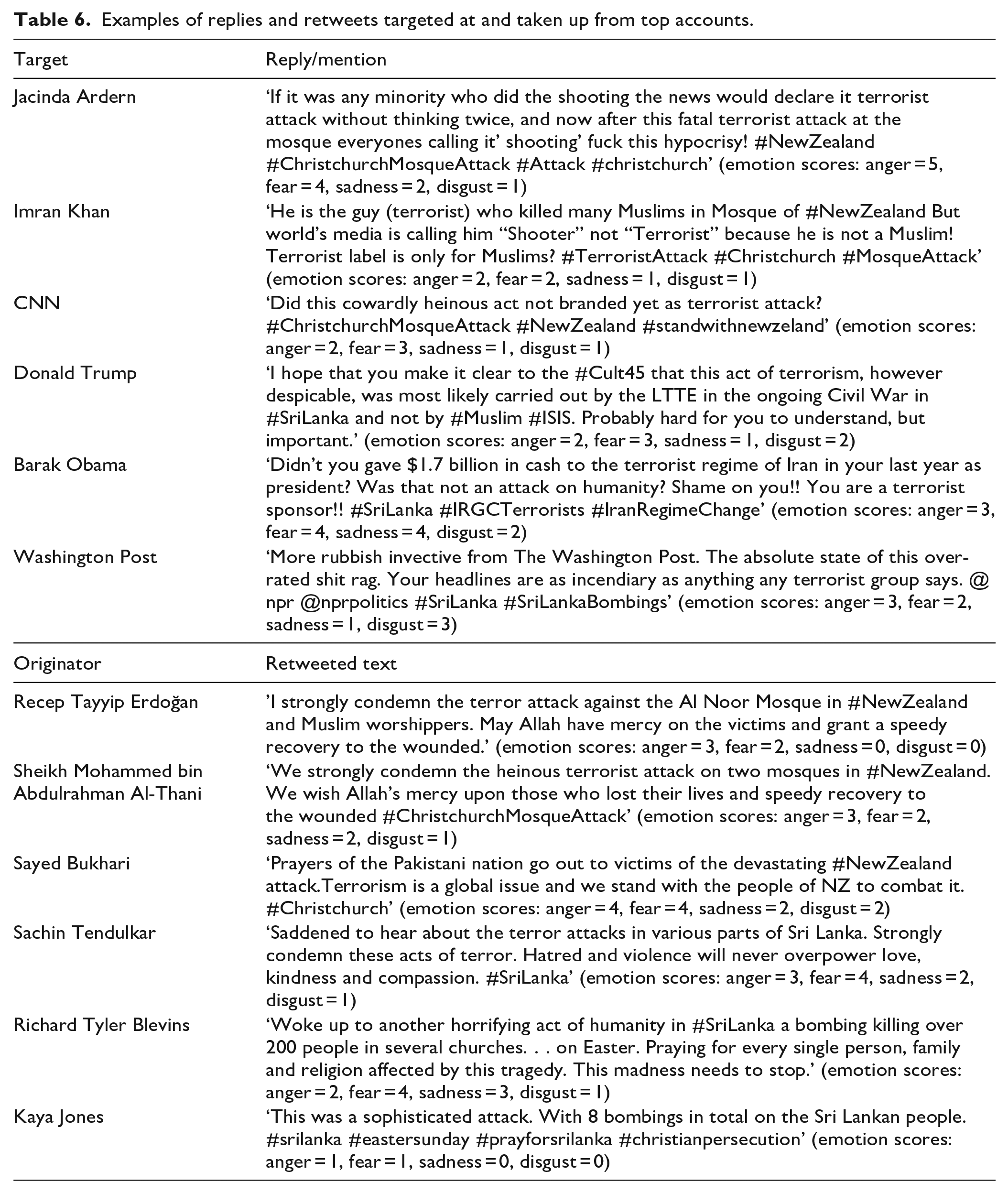
Table 6 provides examples of replies directed at and retweets taken up from top actors that had relatively high emotion scores. As the examples show, emotions expressed in some replies in Table 5 were directed at political leaders such as Jacinda Arden and Donald Trump, as well as media organisations, rather than those who committed acts of terrorism. Replies received by the top actors included messages that showed sympathy with emotions that some top accounts expressed. However, these replies did not have high emotion scores. While replies showed political motives, especially in terms of critiquing how acts of terrorism committed by different groups are portrayed, retweets were mainly limited to expression of sympathy and condemnation of terrorism. This shows that Twitter affordances allow contentious exchanges as well as replicative utterances to emerge within the same issue public.
Examples of replies and retweets targeted at and taken up from top accounts.
The prominence of actors with high power and cultural status shows that hashtag publics do not reflect an internal logic, that is, a logic or a purpose unique to such publics themselves. Instead, they form based on pre-existing interests and follower relationships (e.g., political and religious leadership and fandom), which are reflected not only in degree distribution but also in the expressed emotions. Interconnections among the three layers of communication (Bruns & Moe, 2014) allow ad hoc formation of momentary publics based on pre-existing structures. Accordingly, the abovementioned results do not show evidence of a distint type of leadership that is primarily driven by emotions. Nevertheless, our results are consistent with Papacharissi’s (2016) observation that affective publics are driven by affective statements of opinion, fact or a blend of both. However, the prominence of conventional actors or opinion leaders in the abovementioned networks contradicts with Papacharissi’s claim that affective publics typically disrupt dominant political narratives. As argued above, affective publics dominated by conventional actors and opinion leaders, such as #NewZealand and #SriLanka, are unlikely to produce alternative or disruptive narratives. Therefore, the true disruptive potential of affective public lies in more intense issues, such as the hashtag #egypt, a hashtag that forms the basis of Papacharissi’s study.
The abovementioned results are consistent with the argument that digital politics constitutes phatic communion characterised by gestures intended to enable communion, rather than motivating action or political dialogue (Miller, 2015). Uptake or profiles (i.e., ‘@handle’) and media expressions (i.e., tweets) and the lack of reciprocity shows that hashtag publics provide feelings of engagement, rather than active dialogue against terrorism. Moreover, dominance of figures with high political power and cultural capital as seen in abovementioned results support Miller’s argument that such communion is likely to reproduce the status quo. Accordingly, while the current study confirms Papacharissi’s (2016) claim that ad hoc affective publics are structures of feeling, it also suggests that such feelings reinforce top-down power structures. Globally connected ad hoc publics that we examine do not show potential in contributing to significant dialogue among citizens that can help address the issue of terrorism. Yet, as self-organising networks (see Bennett & Segerberg, 2012), they play a crucial role by enabling expressions, gestures and acts of sharing that motivate global-level engagement with minimal effort, especially among those users who are less likely to participate in any organizationally enabled or brokered networks. This claim is also consistent with the argument that affective publics can be characterised by connective rather than collective action (Papacharissi, 2016).
Although a generalizable power structure reflects tie formation, the two hashtags are considerably different from each other in terms of top reply targets and voice agents. While political leaders representing countries with a Muslim majority (i.e., Pakistan, Turkey) and religious leaders dominate #NewZealand, a more diverse set of leaders, including athletes, political leaders from Western countries and religious figures, emerge in #SriLanka. This indicates the possible impact of religious faith in triggering affective responses related to violence against Muslim communities within the context of the Christchurch attack. The diversity of leaders who emerged within #SriLanka shows that violence against Catholic places of worship mobilised different populations. This may show signs of religio-political tensions and a global divide in digital affective engagement related to violence against different faith groups. However, as this characterization is based on the preliminary structural analysis discussed above, an in-depth analysis of the content of tweets can strengthen our claims.
The above analysis helps explain the socio-technical infrastructure that allows the emergence of ad hoc publics (Bruns & Burgess, 2011). Digital platforms allow actors to maintain presence by creating profiles, articulating a list of connections and traversing such connections within a bounded system (boyd & Ellison, 2007). This apparatus also contains a layer of social and cultural power based on which users form connections. This includes hierarchical relationships, such as fandom, which, as previous studies highlighted, can lead to mobilisation (e.g., Bennett, 2014; Click et al., 2013, 2017), emotive political leadership (Kaur et al., 2021; Masch & Gabriel, 2020) and journalistic practices (Hasell, 2021). While the technological architecture affords uptake, such hierarchical social and political structures determine the extent to which some utterances gather momentum. Accordingly, we argue that ad hoc publics, such as responses to tragic events, can be seen as momentary manifestations of pre-existing structures enabled by platform affordances. In general, our analysis shows that global ad hoc publics are driven by a dual logic characterised by bottom-up construction as well as top-down influence. In other words, ad hoc publics are bottom-up social formations as they emerge via individual acts of uptake. However, such acts are triggered by the top-down impact of reply targets and voice agents.
Conclusion
Emotionality within hashtag publics emerges via interaction among users. The proposed approach enables fine-grained analysis of affective publics, showing how subjective emotionality is positioned within structures of interaction that contribute to collective expression of emotions related to a given issue. While this is a first step towards a detailed analysis of networked emotions, future work can focus on more detailed analyses of emotionality within uptake structures. Metadata, such as timestamp and location, can be used to examine how sequences of uptake can transform over time and to analyse how users in different locations are positioned within such sequences. Moreover, the methodological basis that we develop should not be limited to a technique for analysing Twitter networks. The concept of ‘uptake’ applies to any form of media and indeed was first proposed to characterise interactions that are distributed across different forms of media (Suthers et al., 2010). Further work is needed to adapt the classification of primary orientations for different social network sites.
As mentioned previously, the analytical approach suggested in the current study does not depend on the emotion-detection method used. More sophisticated emotion-detection methods can be used to map flows of emotions using the template we suggest. Applications of the template should also not be limited to mapping emotions such as anger and fear. General sentiments (i.e., negative and positive sentiment scores) as well as other qualities, such as toxicity, can be mapped using this technique. Moreover, qualitative analysis of sentiments can compliment network analysis of emotions. In general, we encourage mixed-method analysis of distinct primary orientations that characterise different platforms and their use in different social and political contexts.
Footnotes
Acknowledgements
The authors wish to acknowledge the constructive feedback given by Prof. Nigel Fabb (University of Strathclyde) and the suggestions made by anonymous reviewers to enhance the quality of the manuscript.
