



Abstract
While most of the online participation research assumes the Western notion of fulfilling deliberative practices, online contexts have been also found to be an active battleground for so-called information warfare. To test the potential for online comments being used by cross-national political opponents, we analyze the case of online comments on the most active Lithuanian online news portal’s Russian-language edition. This news portal presents itself as a unique case, since Russia was found to engage in a support or mobilization of the compatriot community in the Baltic States by exercising “soft influence.”To analyze such “soft influence” our study proposed a framework called Commenting User Typology (CUT). The CUT combines three types of data points: a) content level (topic of the story category), b) user level (frequency of posting), and c) the timing and location of the posting to contribute to studies of online social influence.
We have applied the CUT framework to the commenting practices of 4,940 users who produced 34,038 comments over a month. In the analysis, we found that the majority of the users’ posts were low in topic variety and infrequent; followed by low in variety and frequent; high in topic variety and frequent; and high in topic variety and infrequent in posting. Moreover, while around a half of the comments come from Lithuania, 16% from Russia, yet more than 7% were found to mask IP addresses. Also, the results of this study suggest that more active participants tend to participate in more topic areas and that posting occurs faster in more active topic areas.
The implications of this study relate to online news portals overall as well as online news portals in the non-Western contexts or electoral totalitarian regimes as Russia. We argue that user-based analysis, such as the CUT-based approach we proposed, can be particularly relevant for contexts where deliberative practices are still in negotiation.
Keywords
Online news portals allow audiences not only to read but also to post comments to news stories (Deuze, Bruns, & Neuberger, 2007). Commenting through such interactive online contexts along with web pages or social media comments by regular users has evoked hopes for the emergence of an online Habermasian (1991) public sphere. Commenting in news portals in the Western context has been treated as providing a new dimension of a deliberative system or user active participation (Carpentier, 2011; Dahlberg, 2001). New media have been applauded for the potential to present not only a variety of points of view but also alternative points of view to mass media (Al-Saggaf, 2006; Freelon, 2015; Ruiz et al., 2011). Similarly, online commenting to news stories has been considered an alternative public sphere (Scheufele & Nisbet, 2013).
While most of the online participation research assumes the Western notion of fulfilling deliberative practices, online contexts have also been found to be an active battleground for so-called information warfare, defined as use and management of information and communication technology in pursuit of competitive advantage over an opponent (Thornton, 2015). This study is interested in the potential for online comments being used by cross-national political opponents. We analyze the case of online comments on the most active Lithuanian online news portal’s Russian-language edition. Our choice of a Russian portal outside of Russia helps reduce the effect on observed user behavior of censorship, filtering, manipulation by news sociotechnical and institutional systems of the portals, and fear of government repercussions. On the other hand, it increases the chances of observing samples of governmental propaganda. 1
Russia, which has been described by the international community (and assessment agencies like Freedom House, Polity, etc.) as an electoral authoritarian regime, presents itself as a unique case for analyzing user participation. First, insights on online commenting practices are rather limited; blogosphere has been analyzed as preferred ways of user interaction (Etling et al., 2010). Second, Oates (2013) describes the online sphere in Russia as influenced not only by the regular citizens but also by the third-party influencers—thus, raising a need to analyze users and their practices. Third, the need of user analysis in Russian online portals is based on the argument that “non-democratic regimes [. . .] are shifting toward proactively subverting and co-opting social media for their own purposes” (Gunitsky, 2015, p. 42). For example, analysis of deleted tweets has suggested that the pro-government forces do engage in a deletion and dilution of the political content (Filer & Fredheim, 2016).
This research provides a view into user participation practices on Ru.Delfi.lt, a Russian language news portal, hosted on a Lithuanian server and aims to trace user topic preferences for comment-posting frequency. It is described as: ru.delfi.lt news about the events in Lithuania and the word—actualities, politics, weather, business, entertainment, stars, TV, video, and horoscopes. “Новости
Comments on this news portal are particularly relevant to analyze contentious forces of potential social influence between governments because of the peculiarity of Lithuania’s relationships with Russia’s media. Also, potential government interference in shaping public opinion emerged through the recent accusations of the Russian government using government-paid employees to comment on foreign media sites. This phenomenon, known as Russian troll farms (Chen, 2015), has escalated in the Baltic news. Moreover, Russia was found to engage in a support or mobilization of the compatriot community in the Baltic states by exercising “soft influence” (Simons, 2015).
The country-specific perspective becomes particularly pertinent in times where neighboring countries experience political tensions. It has been argued that information warfare is particularly contentious where countries propose their own opinions, positions, and sometimes propaganda (see, for example, Thornton, 2015). User-generated content, in particular, provides an interesting terra franca in those contexts: Loosely codified practices allow for various types of behaviors; some of them are deliberative, and others used by governments.
Our goal is to contribute to the understanding of user-commenting practices. We focus on identifying patterns of user behaviors and their content preferences, timing and location of posting to contribute to studies of online social influence (Onnela & Reed-Tsochas, 2010). In the long run, we expect that the outcomes of our study will aid in the detection of government interference, astroturfing, trolling, or other online practices. Furthermore, while users clearly take advantage of interactive affordances of news portals (Boczkowski & Mitchelstein, 2012), it remains to be defined to what degree, to which capacity, and how this participation can be equated in the Russian-language online contexts?
We treat user commentary through content choices: With 14 topic categories provided by the news portal, we aim to answer the question: How do users navigate across content categories and how is this behavior related to frequency of posting? Moreover, to tap on the diversity of content preferences that can illustrate a certain number of viewpoints (Baden & Springer, 2014), we focus on two key questions: (a) What is the frequency and content preference by high- and low-frequency commenters? (b) How does temporal latency account for commenting? To contextualize commenting practices and geopolitical forces, we further include the geolocation from which users’ comments originated.
News Portals in “Young Democracies” and Outside of the “Western” Deliberative Spaces
In “young” democracies, such as the Bulgarian case, deliberative practices were found to be still in flux (Bakardijeva, 2008). For example, one user can constantly comment on news content categories, thus, setting the tone of the conversation. Bakardijeva (2008) has compared the discussion on news forums to new deliberative spaces, finding that they resemble private conversations that are publicly available. However, she contends that Bulgarian news portals, while resembling chaotic and carnevalesque performances, play an important role in a sense-making process in “young” democracies where users actively participate in forums.
Arabic news outlets have been analyzed from the media coverage perspective, rather than deliberative spaces. Al-Saggaf (2006) has found that there was very little debate present on the Al Arabiya database. In terms of the topical focus, military, political violence, and foreign relations were found to be rather infrequent in coverage (Abdul-Mageed, 2008; Al-Saggaf, 2006). Even less is known about other political structures. Filer and Fredheim (2016) who have conducted a comparative analysis of Twitter discourses surrounding deaths of two oppositional politicians in Russia and Argentina contend that contexts of new media platforms provide insights on country-specific practices.
Case Study: News Portal ru.defi.lt
This study focused on the Russian language news portal ru.delfi.lt hosted on a Lithuanian news server. This portal has been the most read news portal in its category for the past 15 years. We focused on a Russian language news portal in Lithuania that is tailored for a Russian-speaking audience (either the Russian diaspora in Russia or the rest of the world, or the Russian-speaking population in the Baltic States). In addition to Lithuanian and Russian languages, this news portal also holds Polish and English language sections, commenting there is rather rare.
The Delfi news portal in Russian has been chosen for several reasons, in addition to its geopolitical relevance to analyze forces of influence. First of all, previous researchers have been concerned that user commenting is manipulated by media professionals (Enli, 2007) or sociotechnical systems of a given news portal (Sawyer & Tapia, 2007). Most of the other news portals are filtering or blocking user comments for a given time before releasing them, as described by Almgren and Olsson (2015). Users are, thus, discouraged from participating in such news portals. Filtering also places considerable methodological challenges on accurately representing user-commenting preferences due to the incomplete commenting records in the datasets. In such cases, user preferences can only be analyzed post hoc when commenting filtering is suspended. In contrast, user commenting on ru.delfi.lt is not filtered by media professionals; comments are released as the users post them. 2 Additionally, its geolocation outside of the Russian borders reduces the impact of government filtering and of fear of repercussions. Second, the portal is extremely active. For example, Delfi.lt news stories range from 70 comments, on average, to a maximum of thousands of comments per story even if a typical user-commenting cycle for a given story lasts around 3 days. Third, from a technical perspective, the website features pre-defined content topic categories that have allowed us to extract user topic preferences while avoiding intercoder reliability issues.
Finally, as we mentioned above, news portals in contexts, even outside the Western notion of public sphere, represent an important arena for the ongoing sense-making process of their users (Bakardijeva, 2008). Yet, such media systems are still in flux and are, thus, open to experimentation and to uncontrolled forms of audience engagement (Bakardijeva, 2008).
Social Influence and the CUT Framework
This study is situated within a theoretical framework of Commenting User Typology (CUT) in online news contexts to capitalize on its potentials to analyze online social influence. Social influence is defined as “[c]apturing the ways in which people affect each other’s beliefs, feelings, and behaviors” (Onnela & Reed-Tsochas, 2010). While in online environments, social influence has been measured in network-based sociotechnical systems, this study looks at news portals that are threaded in structure. We argue that the social influence can be captured through individual interaction and not necessarily through network-based structures. Social influence, in this study, is conceptualized not only through the nature of the comment (specific topic categories or a variety of topic categories) but also by the frequency and location of posting of a given user or the timing when the content is posted. News portals are subjected to influence that can occur through systematic use of structural features of the web page.
The media-user typology (MUT) proposed by Brandtzæg (2010) was envisioned as “a more nuanced approach when investigating the association between media usage and social implications” (p. 940). Yet, MUT approach has been broad in scope. By analyzing users in online news contexts, we assume that user preferences in elected authoritarian contexts, such as the Russian one, might signal strategic behaviors by a given individual or by third parties. We argue that, by dividing user groups by types of activities, one can achieve a more granular understanding of online participation.
In this study, we propose the CUT, a framework that departs from the user commenting as a way to dominate public opinion as in Graham and Wright (2014) and applies it to news portals. For example, Graham and Wright (2014), in their study of an online forum, were interested in the nature of superposter—as the ones who dominate the discourse. Yet, based on discursive strategies, superposters have not been found to dominate the discourse in the studied forum.
Components of the CUT Framework
The CUT framework combines three components: (a) content level (topic of the story category), (b) user level (frequency of posting), and (c) the timing of the posting. So far, studies have treated news portals through these categories disjointly by focusing either on topic preferences or on user participation frequency, topic preferences, and temporal latency. In this study, we argue for a comprehensive approach, and in addition, we include geographic location of the senders. Topic choices, frequency, and timing of posting become tools through which users can leverage participation as a potential arena of influence. All three components can potentially be used to set the tone of a given story, rather than contributing to the diversity of the opinion, as a desirable outcome of online spaces as deliberative arenas, following Habermasian (1991) democratic ideals.
Topic Preferences
Source-based studies have focused on a media source diversity perspective in online contexts. They aimed to account for the new potential of online spaces, deliberative discourse (Dahlberg, 2001), and to provide more diverse points of view among the users (e.g., Carpenter, 2010). User analysis through topic preferences has been thought to provide a granular understanding of media use (Livingstone & Helsper, 2007; Zillien & Hargittai, 2009) and content preferences (Tewksbury, 2005). User engagement in online contexts has been treated either as information source preferences (Papacharissi & Rubin, 2000), content choices, (Carpenter, 2010; Highfield, 2013; Shmueli, Kagian, Koren, & Lempel, 2012; Tatar et al., 2011), content types (Giannopoulos, Weber, Jaimes, & Sellis, 2012), categorization of user behaviors or user types (Bartle, 1996; Hamari & Tuunanen, 2014), practices (Boczkowski & Mitchelstein, 2012; Grace & Fonseca, 2015; Huang, Dasgupta, Ghosh, Manning, & Sanders, 2014), or motivations (Mitchelstein, 2011; Utz, 2009).
User Commenting Frequency
User commenting has been previously analyzed based on frequency. Analyzing the most active users in the online environments provides insights about the most prominent practices and has been used qualitatively and quantitatively (see, for example, Bua, 2012; Frith, 2014; Graham & Wright, 2014). Online participation has been found to follow the power-law distribution (Graham & Wright, 2014). They have developed a typology of superparticipants—superposters, agenda setters, and facilitators who by nature of the forum adopt different roles and different activities. For example, superposters are the ones who start new threads or post in existing threads, and facilitators manage those forums on a daily basis. Graham and Wright (2014) have analyzed the discourse of the most frequently contributing posters—“superparticipants.” Agenda setters—as a qualitatively assessed user category—represent users who push new content on the web (Bua, 2012). User participation in online comments has been analyzed by observing roles that constitute power—from ordinary citizens to superposters who are journalists and politicians (Highfield, 2013).
User Participation and Content Perspectives
While there is a smaller body of research that has analyzed user commenting across content categories (Abdul-Mageed, 2008; Almgren & Olsson, 2015), the focus has been on the journalistic practices rather than on user typology. As a result, previous studies have analyzed online commenting mainly by focusing on two approaches: (a) content types or (b) users—their typologies, behaviors, or motivations. More specifically, studies have focused on content choices (Carpenter, 2010; Highfield, 2013; Shmueli et al., 2012; Tatar et al., 2011), user types (Bartle, 1996; Hamari & Tuunanen, 2014), practices (Boczkowski & Mitchelstein, 2012; Grace & Fonseca, 2015; Huang et al., 2014), and motivations (e.g., Mitchelstein, 2011; Utz, 2009).
Temporal Dimension
In addition to user preferences, the timing of posting has been considered a crucial variable for describing user decisions to contribute or not (Kalman, Ravid, Raban, & Rafaeli, 2006; Lee & Lewis, 2012; Tsagkias, Weerkamp, & De Rijke, 2010). Previous studies have included the temporal dimension of user commenting to predict comment popularity (e.g., Ahmed, Spagna, Huici, & Niccolini, 2013; Kalman et al., 2006; Tatar et al., 2011). For example, Kalman and colleagues (2006) identified a binary temporal behavior in synchronous email exchanges—where users responded either extremely fast or relatively slow. Based on user behaviors and temporal relevance, recommender systems for news stories have been proposed (Shmueli et al., 2012). Temporal dimension, thus, provides the insight of users who want to be the first to comment on news stories, as a result, potentially setting the “tone” of the conversation.
While there is an extensive body of literature that covers user typology and content practices (see Kraut, Resnick, Kiesler, Ren, & Chen, 2012, for a review), Brandtzæg (2010) laments, “[u]nfortunately, the existing body of research still lacks a common basis for (a) identifying and describing the variety of ways in which people use new media and (b) classifying these differences into meaningful categories of user types” (Brandtzæg, 2010, p. 942).
Therefore, while previous studies have analyzed user activity overall, we are interested in user commenting across content categories. The CUT framework is designed to enable assessing posting frequency across content categories as ways to conceptualize the preference for and the level of content “specialization,” that is, topic specificity or topic variety. To account for the interplay between user-posting frequency and the distribution across categories, we have focused on user-commenting behaviors across content categories and content frequency.
We have further expanded user analysis by providing a combinatory approach to analyze users by taking into account contextual variables such as the sociotechnical platform affordances (e.g., topic categories defined by the news portal, IP address that traces geographical location of the post, or non-filtering practices). 3 This type of online activity is viewed as providing a new way to assess user participation in online contexts. While user activities have been primarily evaluated by using self-report measurements (Brandtzæg, 2010), this study uses user identification as a proxy for the content frequency use.
Conceptual Framework: Commenting and User Typology
Our CUT framework expands the MUT framework to user commenting. At its core is the ability to take into account which, and how many, topic categories users contributed to in online news portals. CUT framework extends MUT (Brandtzæg, 2010) by accounting for user roles and practices in online contexts as in Bartle (1996). By doing so, it not only extends the pragmatic vision of user typologies for market segmentation purposes (Johnson & Kulpa, 2007) but also proposes to analyze CUT to online social influence, which can be particularly relevant to analyze not only various (potentially competing) forces of opinions but also between various oppositional agendas, potentially driven by governments.
In this study, we build upon the MUT framework, which is defined as “[a] categorization of users into distinct user types that describes the various ways in which individuals use different media, reflecting a varying amount of activity/content preferences, frequency of use and variety of use” (Brandtzæg, 2010, p. 941). Brandtzæg (2010) treats MUT as defining and unifying salient features in user behavior based on the ways individuals engage in media use. The MUT entails the following two components: frequency of use (no use, low use, medium use, and high use) and variety of use of a given media site (no use, low variety, medium variety, and high variety; Brandtzæg, 2010).
The CUT framework is proposed in a context where no institutional restrictions are imposed and users can post on a news portal at any time and with self-defined frequency. We aimed at analyzing the case in which posting practices are anonymous. 4 Anonymity of commenting has been treated as fostering participation or at least self-disclosure (Chester & Gwynne, 1998). To assess such anonymous user-commenting preferences, the frequency and range of content categories were analyzed, as proposed in the theoretical framework by Bartle (1996) and expanded by Brandtzæg (2010). Bartle (1996), in his seminal research on online immersive multiplayer online spaces, has identified a series of user behaviors that are based on a sociotechnical system of the particular environment by categorizing them into four groups with two fundamental dimensions: a people-environment dimension and an activity types’ dimension that includes acting versus interacting. Based on these two dimensions, he has classified users as killers, socializers, achievers, and explorers.
Similarly, Bartle’s (1996) framework is used here to analyze news portals by focusing on two dimensions: frequency of posting and types of content (i.e., the range of categories involved as in Brandtzæg, 2010). Based on these two dimensions, we expect users to fall into four categories: frequent, occasional, heterogeneous, or homogeneous posters, as shown in Table 1.
Commenting User Typology Framework.

We have operationalized homogeneity and heterogeneity through a continuum number and types of content categories; while frequent and occasional refers to variables that indicate the frequency of posting::
Quandrant 1. Topic specific/occasional: Focus on few topics with few messages.
Quandrant 2. Topic variety/frequent: Focus on many topics with many messages.
Quandrant 3. Topic specific/frequent: Focus on few topics with many messages.
Quandrant 4. Topic variety/occasional: Focus on many topics with few messages.
Commenting allows users not only to express their points of view but also to reflect the frequency of participation and specialization on topic categories. Users can choose various positions in commenting practices. They can become “specialized” in specific topic categories—in this case, the focus is on content categories’ homogeneity. On news portals, users can resemble traditional news professionals (e.g., journalists who specialize on topics). However, in such cases they have to appear regularly and, thus, resemble the “core” or superparticipants (Graham & Wright, 2014). Finally, users can also choose to comment frequently on a range of content categories—a role that is more associated with a common citizen who is informed and engaged in the ideal Western Habermasian (1991) public sphere.
In addition to identifying users as frequent and infrequent or homogeneous and heterogeneous, we have included a spatio-temporal component by identifying users who post fast and those who post slow and from where users comment. Fast posting creates a greater visibility on news portals especially if messages are arranged in a chronological order where the first message is visible to all the readers. Initial messages also receive more acknowledgments (e.g., through down-votes or up-votes). Location of posting through IP addresses allows to map the geography of forces of influence.
Research Questions and Hypotheses
The overarching question that drives this research regards the concept of users’ online commenting practices by considering various sources of influence. In this study, we also consider geographical forces as a variable. Thus, we first ask: What is commenters’ geographic distribution? This positions us to address the overarching question: Do frequent or occasional posters specialize in one specific topic or in many topics of a given news portal? Specifically asked are:
RQ1. How frequently do users participate?
RQ2. How many categories do users participate in?
RQ2a. If people write a limited number of messages, do they write to one specific category or many categories?
Note that Kalman et al. (2006) have examined the importance of the temporal dimension for the responses. Similarly, we ask if the response timing varies:
RQ3. Do users comment slowly or quickly?
Based on the outcomes of previous research, our work assumes that not all users post equal amounts of content even if news portals provide interactive affordances for the audiences (Bruns, 2005). We assume that the majority of news portal users are readers of news stories and/or other users’ comments. However, we focus on users who comment, rather than just read, because such contributions provide some tangible evidence of one’s opinions. In line with the previous research on online participation (see e.g. Napoli, 2011), we assume that user commenting follows a power-law distribution: A small number of users being very active participants, the superposters (Highfield, 2013), or superparticipants (Graham & Wright, 2014), then the majority of users posting just one or two messages, the largest majority read comments, while a substantial number of news readers do not read or post comments at all.
Sample and Method
Sample
The data were extracted in a continuous flow from the ru.Delfi.lt news portal archives. To make sure, the commenting reached its full saturation (i.e., it captured all possible comments for a given story), the data were retrieved from the archive section of the website, where stories are moved, after about one month from publication, together with the corresponding posts. Specifically, we downloaded one month’s worth of data consisting of the stories published between 15 February 2015 and 15 March 2015 and all of their comments. The sample consists of 4,940 users who contributed to the delfi.ru portal with 34,038 comments over a period of one month or 6.9 comments per user, on average. The sample contains 14 content categories as defined by the news portal.
For each story, we retrieved the category, title, publication timestamp, and posts. For every post, we collected the author’s IP address, the author field (a free-form text field sometimes also used by posters as the subject of the comment), the timestamp, whether the post was in reply to a previous one, and the content of the post.
User Identification
If users authenticate themselves to the news portal, commenter identification can be achieved through items such as social networking site logs. However, we observed that the majority of users tend not to authenticate themselves through the portal. Instead, they use the anonymous posting facility the portal provides and put their first name or nickname in the heading field, or simply let their IP address be used for (somewhat limited) identification. Thus, this study includes users from the anonymous posting category.
Note that users can post an unrestricted number of comments across categories. Each category has a number of stories that are released during the course of the day by the news portal. When a new story appears, the older story is displayed with a lower prominence on the web page. For each story, a given user can see the number of comments posted on it, displayed adjacent to the title of a story. The portal allows for replying, and such replies are threaded below each comment.
Temporal Dimension
Each message contains the timestamp of its posting. We have computed a temporal unit based on seconds from the time when the story was posted.
To answer research questions, we have first plotted user-commenting preferences by topic (as categorized by the portal). Correlation analysis has been performed between the number of comments and content categories. Then, we have identified user distribution by number of messages and content categories. Finally, analysis of variance (ANOVA) was employed to identify categories to which users post fast.
To account for the content groups to which users comment, depending on whether they were frequent or occasional users, we have divided users by the number of messages (1–15 and 16 and more) and divided by content category groups—whether one group (either top, medium, or marginal), two groups (a combination of top and medium, top and marginal, and medium and marginal), or all three. Given that the amount of frequent and occasional users was disproportional (n = 4,106 vs. 371), the sum of users in each category was normalized by creating ratios of the messages divided by the total of messages within a given topic category.
For geographic location, we have identified user location based on the IP addresses attached to a given comment. The network origin and geolocation of each post were determined by referring to public online databases such as whois.com and freegeoip that allow to trace locations from a given IP address.
Results
To answer research question RQ1 (“How frequently do users participate?”), descriptive results include (a) geolocation data of the posters of the comments and (b) the overview of the sample.
Geolocation analysis of the data shows the following distribution of the countries from which comments have originated. Countries that constituted more than 1% of comments (constituting 96.5% of the comments) are displayed in Figure 1.
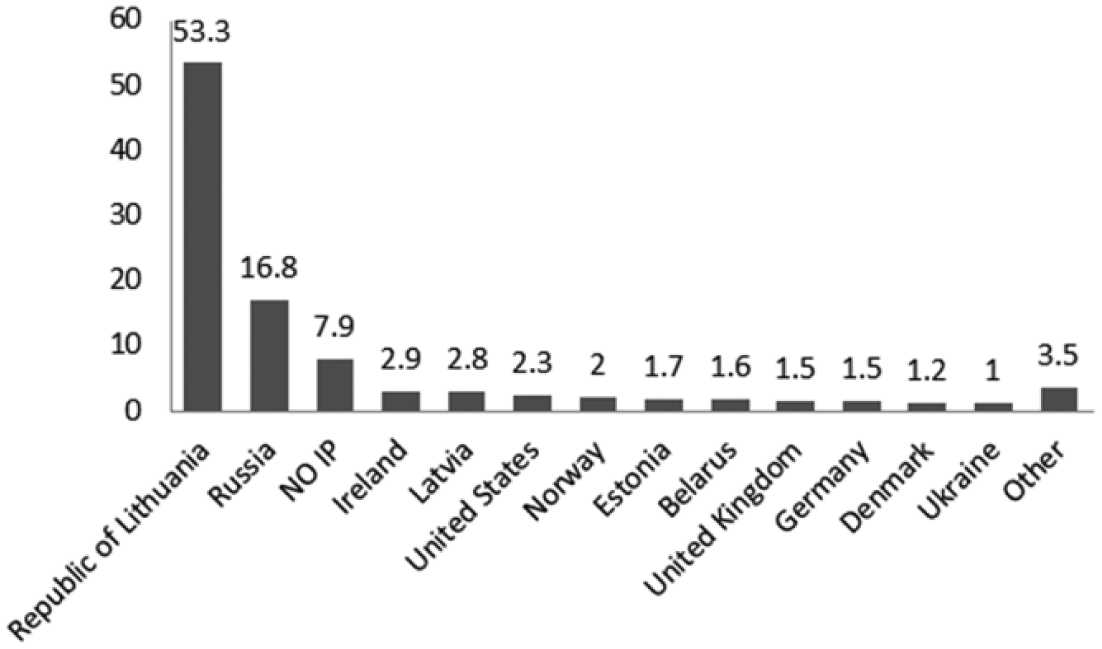
Distribution of IPs by country (%).
Figure 1 shows that the largest amount of comments was from Lithuania (53.3%), followed by Russia (16.8%) and followed by cases in which the location could not be identified (consisting of 7.9%).
The overview of the sample based on categories is illustrated in Figure 2.

One-, two-, or three-group cases.
In Figure 2 top categories included: Society + In the World + Politics + Russia + Business (those that had more than 2,000 comments). Medium categories included: Notorieties + Criminal + Opinions + Culture + Belarus (those that ranged from 100 to 2,000 comments). Marginal categories included: Health + World’s Sports + Day’s Citation + Fashion and Style (those that had less than 99 comments; Table 2).
Descriptive Statistics of the Sample by Users, Content Categories, Comments.
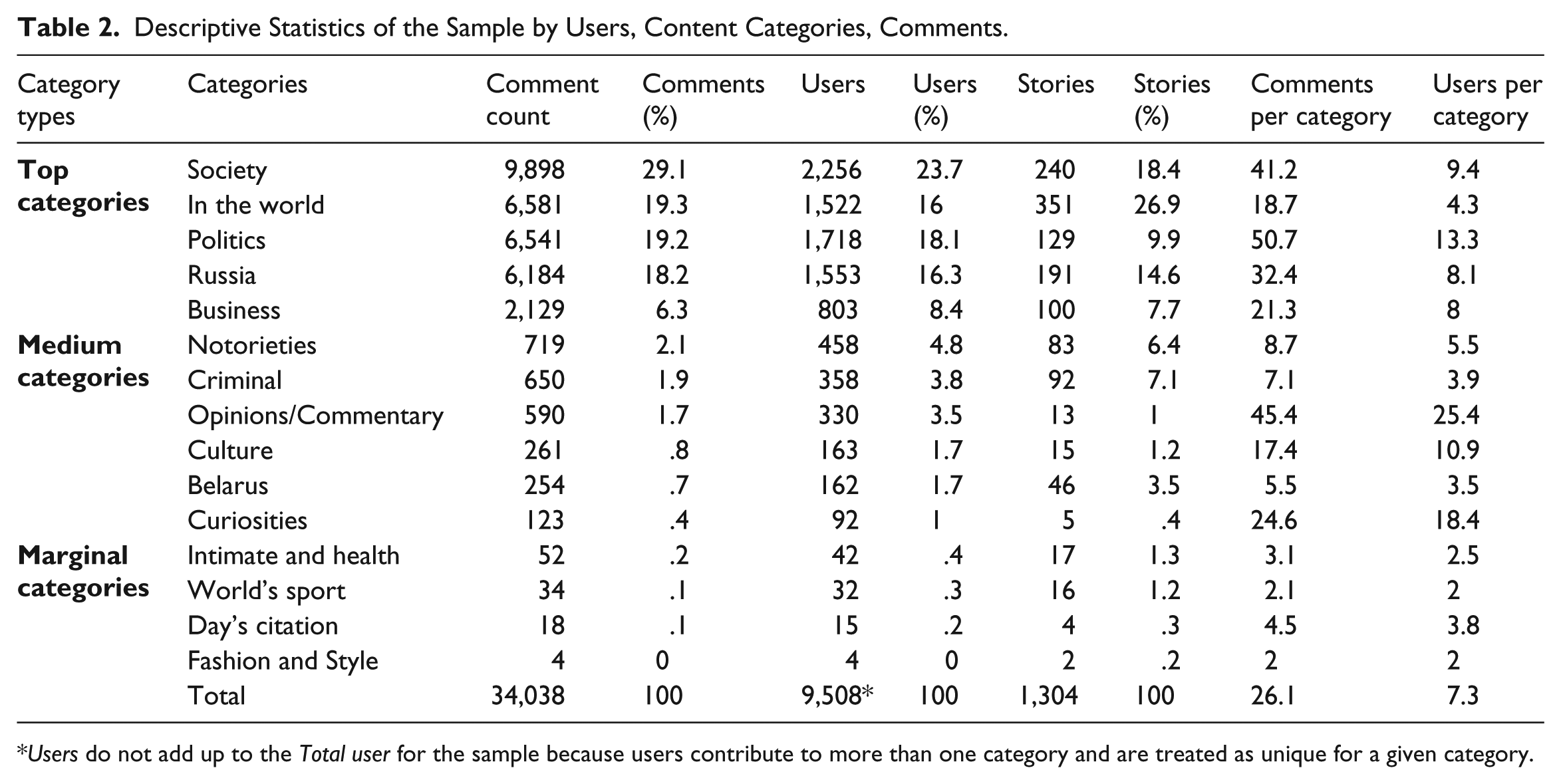
Users do not add up to the Total user for the sample because users contribute to more than one category and are treated as unique for a given category.
To answer research question RQ2 (“How many categories do users participate in?”), we first performed a Pearson correlation analysis. A statistically significant positive correlation between the two has been found, r = .613; p = 000; n = 4,940 (mean = 6.9, SD = 25.971); number of categories (mean = 1.92; SD = 1.642). To assess user contribution across a number of content categories, user contributions were plotted, regardless of how many messages they wrote. There were 3,047 (61.7%) of users who wrote to one content category (as defined by Delfi, for example, Notorieties), 840 (17%) to two categories; 413 (8.4%) to three categories; 233 (4.7%) to four categories; 159 (3.2%) to five categories; 95 (1.9%) to six categories; 70 (1.4%) to seven categories; 37 (.7%) to eight categories; 23 (.5%) to nine categories; 14 (.3) to 10 categories; 6 (.1%) to 11 categories; 0 users left messages to 12 categories; 1 user left messages to 13; and 2 users left messages to fourteen categories.
To answer research question RQ2a (“If people write a limited number of messages, do they write to one specific or many categories?”), which accounts for topic specificity or topic variety by posting frequency, users have been divided into binary categories—those who posted fewer than 15 messages (15 messages have been chosen to fit a maximum number of messages sent to a maximum number of topic categories) and those who posted more than 16 messages.
Given that the majority of users (4,169 or 84.3%) wrote from one to six messages, we wanted to understand whether they contributed to the same or different categories. Users who posted only one message could obviously choose only one category. The users falling in this category were 2,461. There were 788 users who chose two content categories and 413 users who chose three content categories (Table 3).
Frequent versus Infrequent Users.

Furthermore, we aimed at identifying to which categories users contributed if they wrote a few or many messages. Results are summarized in Figure 2.
Figure 2 shows that users, who posted a few messages, constituted the “dominant” (i.e. top and medium) content categories, while users who posted many messages contributed to “dominant” and “marginal” content categories.
Temporal Dimension
To answer research question RQ3 (“Do users comment slowly or quickly?”), users were compared as follows: those who posted 15 messages and those who posted more than 16 messages. Analysis of variance has shown a statistically significant difference: Users who write more, write faster m = 22,232.65 (s) versus. m = 37,178.81 (s), F(1, 33,680 = 2,883,665,645) = 580.421, p = .000.
The average comment-posting time was 27,032.42 s after the story was posted. The mode was equal to 840 s, and the median was 12,240. The minimum time to answer was 11 s; the maximum time to answer was 1,838,700 s. Recall that posting delay was calculated based on seconds after the story has been released. The extremes of posting delay revealed that on one side of the posting distribution, there were 88 users who posted 143 comments within 5 min after the story release. Two out of 143 messages were responses. On the other side of the posting distribution, temporal delay was equal to 260,000 s (72.2 hrs) or more. A total of 86 (34.4%) messages were replies. There were 271 users who engaged in fast and slow posting.
Discussion
CUT Framework Applied
User participation fell under a power-law distribution with some users being more active than the others, as in other participation-based media (see Napoli, 2011). User participation was relatively high, with more than six messages per person, on average. We also found that users mostly fell into the category of occasional and homogenous participation—accounting for the power-law distribution expectation (92.4%), where 60% of users wrote to one content category. Yet, there were a small but substantial number of users who were frequent and homogeneous, as well as frequent and heterogeneous posters.
Based on the CUT framework, the results are summarized in Table 4.
Use-Posting Frequency and Category Preference.
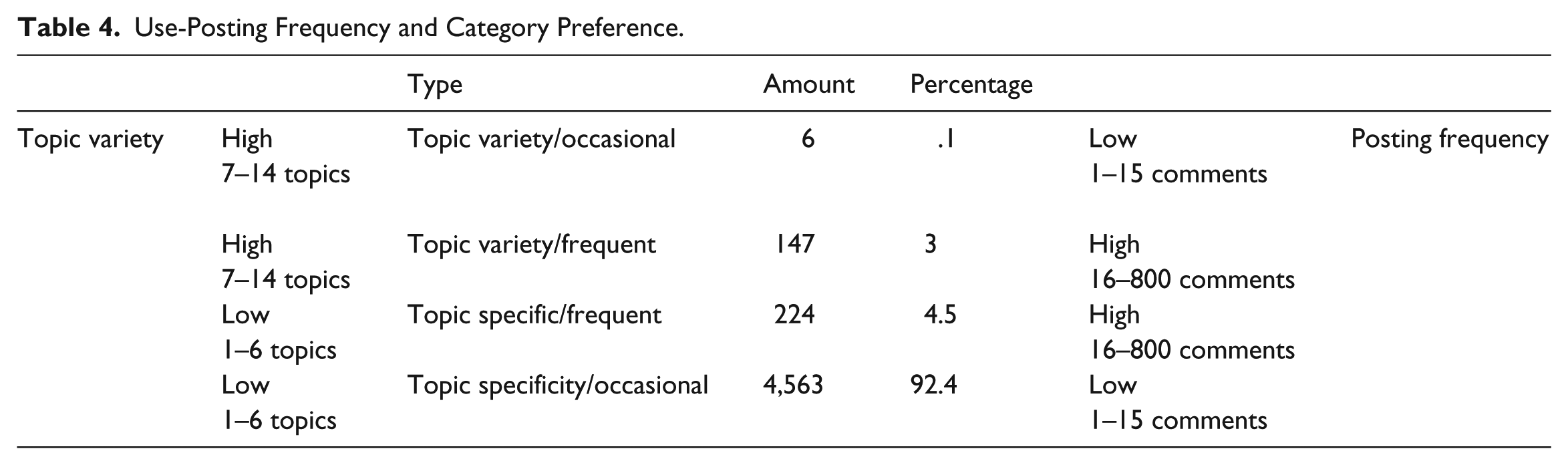
Table 4 shows that there were 371 users who posted comments frequently (constituting 7.5% of users in Table 4 that combine High frequency/high and low topic variety users). A total of 3% of them were posting to various topics (7–14) and 4.5% percent posted to 1–6 topics. While the majority of users (92%) posted to 1–6 topics, and they fell into the occasional poster category. Six users posted to a variety of topics, even if they posted occasionally.
Implications of CUT Framework Quadrants
The CUT framework shows that the majority of users tended to focus on a few content categories. Yet, frequent posters were divided into two camps—the same percentage (around 4%) posted either to a few specific topic categories or to many categories. User-commenting preferences gravitated toward news topics such as Society, In the world, Politics, Russia, and Business. More specifically, the Politics category had the highest number of comments per category (50.7) and the highest number of users per category (13.3).
To contextualize ru.Delfi.lt case, geolocation analysis of comments has revealed a more complicated story regarding potential sources of unexplained influence. Around half of the comments were found to be written from the locations originating from Lithuania and 16.8% were from Russia. Most surprisingly, in the third most frequent case (7.9%), the geolocation could not be determined. Upon further investigation, we were able to trace the source of almost all of these posts to servers owned by Google (913 cases) and Opera (1,405 cases) acting as proxy servers. Proxy servers essentially act as “repeaters” of a user’s network traffic (see, for example, Blum & Lueker, 2001; Mighdoll, Leak, Perlman, & Goldman, 1999), thereby masking the true origin of the traffic. Proxy servers run by Google and Opera are publicly accessible, and any user with the necessary technical skills can configure a browser to route all of its network traffic through them.
From the point of view of a portal receiving a post that was routed through a proxy server, the source of the post is the proxy server itself. As a result, not only the identity but also the geolocation of the poster is masked. While this mechanism explains why in a number of cases the geolocation of posts could not be determined, we are unable to determine the reasons why users chose to take this route. While multiple reasons are possible, it should be noted that proxy servers are a rather effective anonymizing tool. The required setup involves a certain degree of technical skills and effort, which appears to indicate that their use was deliberate. This may indicate that a rather sizeable group of users wanted to make sure to mask not only their identity but also the country in which they are located.
Given that this study analyzed Russian language news portal, the frequency of posting can be interpreted from two divergent perspectives: the deliberative space interpretation and strategic influence-based framework interpretation. The CUT framework results (see Table 4), on one hand, point to what we call user economy practices and, on the other hand, commenting heterogeneity preferences.
User economy practices refer to the fact that infrequent users’ posted to the top content categories. Also, if users posted one message, they clustered around central content categories. Content heterogeneity refers to the inclination of some users to comment on a diverse range of content categories; that is, frequent users (who write more messages) are those who diversify themselves across content categories.
Both of these findings may offer insight on the ways in which organized online influence can be studied. On the surface level, commenting economy and content heterogeneity can be interpreted as expressions of democratic practices. From democratic deliberative perspective, users can be categorized as follows. Frequent users who posted a variety of topics can be treated as invested experts, who are knowledgeable or curious about many topics and who constitute the core members of the community, what Graham and Wright (2014) call agenda setters, facilitators, or superposters. Frequent users who post to specific categories can be treated as invested influencers who have strong interest in a specific topic. Users who post occasionally to a specific topic are debaters, yet the ones who infrequently post to multiple topics can be treated as socializers who browse the news portal and comment without any specific sense of belonging to the community.
Commenting economy, that is, interest to focus on the central content topics might suggests a potential for the diversity in points of view for a given popular content category, as previously proposed by some (Al-Saggaf, 2006; Freelon, 2015; Ruiz et al., 2011). Thus, this finding should be applauded from the democratic deliberation perspective. Content heterogeneity, that is, user commenting across many content categories may reflect their readership interest. In other words, the wider the readership interest is, the higher the number of content categories to which users post.
While the nature and motivations of heterogeneous commenting remain to be unveiled, such behavior can be interpreted in several other ways. On one hand, users’ posting might be a result of the range of the interests when users gravitate toward the most popular content. Yet, considering research that has questioned the online contexts as representing the “public sphere” for the Russian population (e.g., Filer & Fredheim, 2016), one might argue that randomization of posting across various categories may as well serve as a tactic to camouflage the content that is posted by specific influencers who post more frequently than an average person. Yet, it may also reflect as another strategy of “soft influence,” discussed by Simons (2015), from third parties to skew public opinion.
Limitations and Future Research
While this study aims to shed light on the heterogeneity of commenting by frequent users, its nature and the motivations of its users toward such commenting remain unclear, especially in how it relates to potential gain of influence. We argue that influence can be gained through commenting frequency and timing of posting based on sociotechnical contexts of news portals (Sawyer & Tapia, 2007), that is, threaded and posted in a chronological order on a variety of topic categories. Yet, commenting across various topics can be used strategically. Based on the content preferences, results of this study suggest that the most active posters gravitated toward political stories, even if who they were—human or possibly non-human actors (e.g., bots)—remains unclear (see Bessi & Ferrara, 2016; Zelenkauskaite & Niezgoda, 2017).
Future studies should address user motivations and content specificity that could account for strategies used in posting. A potential approach should consist of addressing in more depth content types and commenting practices by “superposters,” as in Graham & Wright (2014), or the behavior of high-frequency and high-topic variety users, in order to further examine the nature of commenting in contexts that go beyond the Western public sphere. The implications of this study relate to online news portals overall and online news portals in a context of “young” democracies, electoral totalitarian regimes as Russia, or analysis of influence between countries.
Conclusion
This study aimed at providing a more granular understanding of user participation and potential social influence by identifying topic preferences in online news portals and the frequency of posting by developing the CUT framework and applying it to the Russian language online news context. Social influence through the CUT framework has been conceptualized as comprising the following categories: commenting frequency, preference across homogeneous or heterogeneous content categories, temporal dimension, and posting location.
Geographical data have been tested as a suitable complementary variable to the CUT framework of social influence for this specific context since it has provided information regarding the most frequent posters from various regions, including a relatively large number of posters with an untraceable geolocation. Thus, considering the nature of Russian news portals and the complex relationship of online sphere and third parties (see, for example, Filer & Fredheim, 2016; Oates, 2013), user typology, along with geolocation analysis, becomes a useful tool to map the overall regularity and intensity of homogeneous or heterogeneous posting. Heterogeneity in source participation can indicate several practices; active core participation across content may indicate not only loyalty or invested interest in various content categories but also specific interest in shaping opinion.
We argue that the CUT framework quadrants, in conjunction with the location and timing of posting, can serve as starting points to analyze oppositional government forces or the information warfare. Based on this specific sample, those forces are imprinted through the location, timing, and quadrants that define frequent users who post across multiple content categories, as well as frequent users who post to a few but specific content categories and the ones, since all of those points to a broad or specialized interest.
We argue that user-based analysis, such as the CUT-based approach we proposed, can be particularly relevant for contexts where deliberative practices are still in negotiation, as it is ru.delfi.lt. The CUT framework can, thus, become a starting point to identify the concentration or dispersion of influencers, or number of actors involved in the deliberative discourse. Such an approach is particularly relevant considering controversial accounts of online discourse in Russian or former Soviet Union contexts (see Smyth & Oates, 2015), or the suspicion risen by some (Chen, 2015) regarding Russian government’s influence in the shaping of opinion through online commenting.
As a result, CUT framework can lead to a better understanding of astroturfing behavior, an increasingly prevalent practice used to shift commercial opinion making where the third parties engage in reputation management of a given brand (Woodcock & Baum, 2015). Astroturfing or political social influence has begun to be addressed in specific social media contexts—such as Twitter where network-based structure, hashtags, and sentiment analysis facilitate tracing social influence (Ratkiewicz et al., 2011). Yet, the terrain for social influence analysis still remains vast, given the automated and non-automated forces that are used, as well as the specificity of sociotechnical tools that can be used (Woolley, 2016).
Footnotes
Declaration of Conflicting Interests
The author(s) declared no potential conflicts of interest with respect to the research, authorship, and/or publication of this article.
Funding
The author(s) received no financial support for the research, authorship, and/or publication of this article.