



Abstract
Depressive symptoms are highly prevalent among younger populations and have been clearly associated with lowered activity in general. Focusing on Facebook use as an extremely popular leisure activity, this study examines the influence of depressive tendencies on the intensity of using Facebook by considering the moderating effects of relevant personality traits and different motivations associated with social network site (SNS) use. Based on an online survey among 510 young Facebook users, this study shows that increasing depressive tendencies are associated with an increased frequency of posting status updates—most likely for negative reasons. Moderated mediation models show that the personality traits of neuroticism and extraversion only influence the motivations behind using Facebook and not the time spent on the SNS. Findings are also discussed with regard to novel digital help offers for Facebook users with depressive tendencies.
Over the last few years, the average amount of time spent on social network sites (SNSs), such as Facebook, has increased constantly, and with about an hour spent on SNSs every day, we currently spend more time on SNSs than we spend on reading (19 min), doing sports or exercise (17 min), or going to social events (4 min) (Stewart, 2016). With an average of more than 1.1 billion active daily users, Facebook is the most popular SNS (Facebook, 2016), and among others, the most popular functions of Facebook are still posting status updates, photos, or videos, sharing and liking online information, and messaging friends (e.g. Nadkarni & Hofmann, 2012).
Concurrently, over the last few years, the size and burden of mental disorders, especially depression, have increased globally (Whiteford et al., 2013; Wittchen et al., 2011), and with 5.7 million adults aged 18 or older in the United States facing at least one depressive episode in the past year, the 12-month prevalence for depression is 6.7% of all US adults. Depression is regarded as one of the diseases with the highest burden (WHO, 2014), with about twice as many women being diagnosed with depression than men and with an onset in adolescence and young adulthood. Therefore, the World Health Organization (WHO) points out that depression is among the largest single cause of disability worldwide (WHO, 2013), and estimates that by the year 2020, depression will be the second most common disorder after cardiovascular disease (WHO Ministerial Round Tables, 2001).
With depression being a serious and common disease, affecting not only general activity levels but also individual media use (e.g. Scherr, 2016; Scherr & Reinemann, 2011), the systematic investigation of the influences of depression on specific forms of media use is highly important. Specifically, as the onset of clinically relevant depressive symptoms is often at a young age, with SNSs being among the most popular media for this age group, this study focuses on how depressive symptoms influence younger people’s use of Facebook. Moreover, as suggested by significant research that carved out a link between personality traits and specific patterns of use for Facebook (Caci, Cardaci, Tabacchi, & Scrima, 2014; Kneidinger, 2010) and that links those patterns with depressive symptoms (Jylhä & Isometsä, 2006; Nezlek, Schütz, Schröder-Abé, & Smith, 2011), we specifically investigated whether the personality traits of extraversion and neuroticism moderate influences of depressive symptoms on specific motivations associated with Facebook (see Ross et al., 2009).
We begin by reviewing previous research on the motives behind using Facebook, and then turn to the body of research investigating the connections between depression, personality traits, and Facebook use. Based on this existing research and theorizing, we develop a model that predicts the time spent on Facebook being dependent on the severity and number of depressive symptoms, and the main motives for using Facebook. Specifically, we propose a moderated mediation model examining whether the predicted relationships (depression → motives for Facebook use → time spent on Facebook) differ in terms of the two personality traits of extraversion and neuroticism, as pointed out by other research. To do so, we conducted a survey among 510 young users of Facebook that includes measures for these different sources of influence.
Motives for Using SNSs
Many existing studies have explored the motives behind using SNSs, such as Facebook (e.g. Ellison, Steinfield, & Lampe, 2007; Hollenbaugh & Ferris, 2014; Kneidinger, 2010; Nadkarni & Hofmann, 2012; Sheldon, 2008; Tosun, 2012; Yang & Bradford Brown, 2013), and they found communicative purposes to be the main motive for using SNSs, besides self-presentation, and private or topic-related information. For instance, Kneidinger (2010) differentiates between the following motives for using Facebook: (1) general and social information, (2) making new or keeping up with existing friends, and (3) passing time, with the first two being most relevant for Facebook users. In a survey of Facebook users, Kneidinger (2010) shows that about 90% of the participants agreed that keeping up with old friends is most important to them. In the same study, 80% indicated that looking up news and developments among their Facebook friends is most important to them, followed by 72% agreeing that Facebook use is mostly for entertainment purposes (see also Tosun, 2012). Other studies especially point to passing time as being another main motive for using Facebook (Hollenbaugh & Ferris, 2014; Sheldon, 2008). More specifically, Yang and Bradford Brown (2013) found that depending on the main motive for using Facebook, students who used Facebook for relationship maintenance were found to be more socially adjusted to the college environment and suffered less often from loneliness. On the contrary, participants who used Facebook for relationship formation were found to be less socially adjusted and reported feeling lonelier. Based on the uses and gratifications approach as well as the social network approach, Papacharissi and Mendelson (2011) analyzed the social capital generated on Facebook. Specifically, the interactions between the motives for using Facebook, psychosocial predispositions (such as age or the unwillingness to communicate), structural factors (such as the size and density of the network), and the social capital generated have been studied. A factor analysis revealed a nine-dimensional structure of motives for using Facebook: expressive information sharing, a habitual way of passing time, relaxing entertainment, a cool and new trend, companionship, professional advancement, escape, social interaction, and new friendships (Papacharissi & Mendelson, 2011). Building on these findings, Smock, Ellison, Cliff, and Wohn (2011) investigated these Facebook use motives for particular communicative Facebook functions (such as sending messages and posting comments). The authors conclude that the different functions Facebook offers its users are used to fulfill different motives, and, therefore, conclude that instead of asking participants about their general motives, the focus should be more on the functions used (Smock et al., 2011). Currently, the way motives for Facebook use are measured varies tremendously with regard to depth and complexity, and we are not yet close to having standardized measures for capturing the motives behind Facebook use. Nevertheless, there are both excellent universal instruments (e.g. Ellison, Steinfield, & Lampe, 2006) and very specific measures (see, for example, Papacharissi & Mendelson, 2011) available. Therefore, it seems that the extent and accuracy of how motives for Facebook use are measured partly depend on what is researched or how important motives for Facebook use are within the broader scope of the study.
Depression and Facebook Use
According to the International Classification of Diseases, Tenth Revision (ICD-10) system for classifying diseases, depression is considered an affective disorder (Dilling, Mombour, & Schmidt, 2011). The three main symptoms are (1) a depressive mood, (2) a loss of interest and joy, and (3) elevated tiredness, and reduced motivation and activity. Further additional symptoms are sleep disturbances, reduced appetite, or reduced self-esteem. With that said, there might be different needs resulting from depressive symptoms, such as the need for social contact, which can be fulfilled by using SNSs. In line with the main aspects of self-determination theory (SDT), it can be argued that individuals will be motivated to pursue certain activities if the three following basic psychological needs are met: autonomy, competence, and social relatedness (Deci & Ryan, 2000; Ryan & Deci, 2000). Regarded as intrinsic motivations, their fulfillment is accompanied by elevated interest, deeper satisfaction, and stronger experiences of enjoyment. Przybylski, Weinstein, Ryan, and Rigby (2009) showed that participants whose intrinsic needs were not satisfied tried to compensate for those unmet needs with media use. Therefore, especially the need for social relatedness might be of particular interest in the context of this study: Sheldon, Abad and Hinsch (2011) found that Facebook use can elevate perceived social relatedness and is therefore considered a possibility when attempting to compensate for reduced social contacts in everyday (offline) life. Especially in the context of depressive symptoms, such as prevailing social isolation or reduced social activities, the basic need for social relatedness is unmet, and participants try to compensate for this lack by using Facebook. For instance, Masur, Reinecke, Ziegele, and Quiring (2014) showed, in the context of Facebook addiction, that a lack of social connectedness enhances the motive of using Facebook for self-presentational purposes and the search for social contact, which, in turn, contributed to higher levels of Facebook addiction. Nevertheless, in contrast to explaining the use of online video games using SDT (see Peng, Lin, Pfeifer, & Winn, 2012; Przybylski et al., 2009; Ryan, Rigby, & Przybylski, 2006; Tamborini, Bowman, Eden, Grizzard, & Organ, 2010), the theory has rarely been used to explain (motives behind) Facebook use to date.
Regarding the relationship between Facebook use and depression, most studies have focused on the effects of Facebook use on the psychological well-being or the mood of its users. Kross et al. (2013) found that users felt worst after using Facebook, and that they were less satisfied with their lives the more they had spent time online on the SNS during the previous 2 weeks. Moreover, three studies conducted by Sagioglou and Greitemeyer (2014) show that Facebook use negatively affected the emotional state of the participants. A meta-analysis by Song et al. (2014) focused especially on the relationship between Facebook use and loneliness, and confirms a positive correlation between the two main variables. Other findings contradict the relation between Facebook use and depressive moods: Jelenchick, Eickhoff, and Moreno (2013) could not find a connection between the use of the SNS and clinical depression. Similarly, Simoncic, Kuhlman, Vargas, Houchins, and Lopez-Duran (2014) could not find a direct relationship between Facebook use and depressive symptoms; yet, the authors speculated about more complex patterns between Facebook use and depressive symptoms that might be moderated by sex and personality traits. Moreno et al. (2011a) conducted a study comparing displayed depression references on Facebook and the number of clinically relevant symptoms of major depression using the Patient Health Questionnaire-9 (PHQ-9) depression scale. The study shows that so-called depression-symptom displayers scored significantly higher on the PHQ-9 than non-displayers did, with references to depression symptoms being significantly correlated with self-reported depression symptoms (Moreno et al., 2011a).
Less research has been conducted thus far, which deals with the question of how people with depression tendencies use SNSs and what differences are prevalent as compared to non-depressed individuals. A study conducted by Moreno et al. (2011b) looked at how publicly available posts on Facebook meet the criteria for depression according to the DSM-Diagnostic Manual of Mental Disorders. The study finds that users whose publicly available posts included more depressive symptoms updated their profile status more often (Moreno et al., 2011b). In line with this empirical evidence, we formulate our first hypothesis:
H1: Individuals with more depressive symptoms will post status updates more often.
Regarding the reasons for posting status updates on Facebook in the course of depression, empirical evidence is somewhat mixed so far. According to Davis’ (2001) and Caplan’s (2002) model of psychosocial problems and problematic internet use, individuals who suffer from psychosocial problems such as depression or loneliness assume that their social competence is lower as compared to those without these predispositions. Furthermore, Caplan (2003) argues that psychosocially distressed people prefer online interactions over other forms of face-to-face communication, because they are perceived to be easier and less threatening. The preference for online interactions leads to more excessive forms of internet use, contributing to negative outcomes such as personal, social, or professional problems. To test these theoretical assumptions, Caplan (2003) conducted a survey of 386 undergraduate students (270 females; Mage = 20, SDage = 2.22). Notably, the Caplan (2003) study shows that loneliness, not depression, was a predictor for both the preference for online social interaction and negative life outcomes, although both predictors were highly correlated (r = .525). Nevertheless, the study makes a case for psychosocial problems and social online interactions being intertwined with more negative life outcomes that can arguably become relevant content for future status updates. This assumption is reflected by a Jin (2013) study, who found that lonely users had fewer friends on SNSs and less of an overlap between their real life and their Facebook friends. Furthermore, loneliness was negatively correlated with communicative activities in general, and lonely users tended to report more negative aspects about themselves online (Jin, 2013).
Although most of the existing findings focus on loneliness, which is correlated with but distinct from depression, there is some evidence that depression is also correlated with more negative reasons for posting status updates on Facebook. For instance, the participants in the Moreno et al. (2011b) study referred more often to depression when they received at least one answer or comment by their friends to a status update with depressive content. Given the empirical evidence of these studies, our second hypothesis is the following:
H2: Individuals with more depressive symptoms are more likely to use posts for negative reasons.
Interestingly, Park, Lee, Kwak, Cha, and Jeong (2013) developed a Facebook App named “EmotionDiary” that recognizes depressive symptoms posted online. The researchers found that depressed users had fewer interactions with other users and read more about depression within the app (Park et al., 2013). In another study, Blachnio, Przepiórka, and Pantic (2015) investigated the relationship between Internet use, depression, and Facebook addiction. The study revealed that depression is a well-suited predictor of Facebook addiction. Nevertheless, current research on the interplay between depression and Facebook use has not yet shown a clear picture of specific use patterns related to mental illness.
Personality Traits and Facebook Use
The five-factor model of personality is considered a well-established method to describe and assess peoples’ personalities (see the Big Five Inventory or BFI; Rammstedt & John, 2005). Extensive research on this topic found and repeatedly confirmed five stable, independent main dimensions: neuroticism, extraversion, agreeableness, openness to experience, and conscientiousness (e.g. Asendorpf & Neyer, 2012). Depression as a mental disorder is especially connected to the personality traits of extraversion and neuroticism (Bagby, Joffe, Parker, Kalemba, & Harkness, 1995), which are also largely important for social interaction patterns. Neuroticism is mostly characterized by anxiety, fear, worry, and loneliness, whereas extraversion manifests itself in communicatively outgoing and energetic behaviors (Asendorpf & Neyer, 2012). Research showed that people with major depression score higher on neuroticism, whereas a clear negative correlation is likely to be found between depression and extraversion (see, for example, Jylhä & Isometsä, 2006). Conversely, high extraversion not only positively influences the number of daily interactions with friends (Nezlek et al., 2011) but is also positively correlated with the size of the social network (Asendorpf & Wilpers, 1998). Therefore, it seems worthwhile considering neuroticism and extraversion as important third variables when the relationship between depression and social online interactions on Facebook is investigated. In addition, existing research suggests that extraversion and neuroticism are important predictors for specific patterns of using Facebook (Amichai-Hamburger & Vinitzky, 2010; Ross et al., 2009).
Neuroticism has mostly been associated with the frequency of using Facebook and specific communication patterns on the SNS. For instance, Ross et al. (2009) found that highly neurotic users prefer to use the Facebook wall function—an asynchronous communication tool—most often for communication purposes. Moreover, Ryan and Xenos (2011) not only confirmed this finding but also came to the conclusion that neuroticism is positively correlated with the time spent on Facebook. Similarly, another study by Caci et al. (2014) found neuroticism to be predictive for the frequency and duration of everyday Facebook use.
There are usually two different hypotheses when extraversion is discussed in the context of SNSs: “the rich get richer” hypothesis, also known as the social amplifier hypothesis, and “the poor get richer” hypothesis, also called the social compensation hypothesis. “The rich get richer” hypothesis postulates that extraverted people transfer communication patterns from real life to online communication and, therefore, keep their social dominance online. According to “the poor get richer” hypothesis, introverted people use social media to compensate for their communication deficits in real life; they are supposed to outstrip extraverted people online (Amichai-Hamburger, Kaplan, & Dorpatcheon, 2008). Nevertheless, empirical studies suggest integrating both hypotheses: For instance, online communication with old friends is likely to be dominant for extraverted people, which supports the “the rich get richer” hypothesis, yet when it comes to making new online acquaintances, “the poor get richer” hypothesis also seems to be reasonable, since people can create a new—or modify an existing—online profile easily (Amichai-Hamburger et al., 2008). Against this background, Ross et al. (2009) found that users ranking high on extraversion are more likely to be members of a higher number of Facebook groups, whereas Amichai-Hamburger and Vinitzky (2010) could not find such differences in the number of Facebook group memberships. Yet, extraverted users had more friends on the SNS (Amichai-Hamburger & Vinitzky, 2010). This finding is in line with the results of a study conducted by Moore and McElroy (2012), who conclude that people ranking high on extraversion have more Facebook friends. With regard to the time spent on Facebook, Wilson, Fornasier, and White (2010) found that extraverted users generally spent more time on Facebook. Moreover, Caci et al. (2014) found that extraversion was a predictor for the number of log-ins to check Facebook as well as for the average duration of a Facebook visit, and for the number of friends on the SNS. With a special focus on Facebook, Kneidinger (2010) found that passing time and distraction were among the most important functions for users of the SNS. This seems to be especially relevant in the context of depression, for example, when it is about distracting yourself from negative thoughts that are associated with the illness, and it can be even more important when the time spent on SNSs is higher due to individual personality traits.
Taken together, there is empirical evidence suggesting that depression, personality, motives for using Facebook, and the intensity that Facebook is de facto used are likely to be related, but research has not yet come to the point where more specific interaction patterns between these variables are able to be clarified. Therefore, we formulate the following two complementary research questions:
RQ1: How is the relationship between depression and motives for using Facebook, as well as depression and the time spent on Facebook, moderated by the personality traits of neuroticism and extraversion?
RQ2: How is the relationship between motives for using Facebook and the time spent on Facebook moderated by the personality traits of neuroticism and extraversion?
Taken together, existing research suggests that depression can influence the time spent on Facebook (Blachnio et al., 2015; Morahan-Martin & Schumacher, 2003) as well as the motives behind using Facebook (Yang & Bradford Brown, 2013). The different motives for using Facebook in the context of clinically relevant symptoms of depression are, in turn, likely to influence the time spent on Facebook. Furthermore, there is empirical evidence that personality traits, especially extraversion and neuroticism, alter both the motives for using Facebook and the time spent on Facebook (Amichai-Hamburger & Vinitzky, 2010; Caci et al., 2014; Ross et al., 2009; Ryan & Xenos, 2011; Wilson et al., 2010), which is why we call their moderating influence into question, as depicted in Figure 1.

Relationships between depression, specific motives for using Facebook, and the time spent on Facebook, including neuroticism and extraversion as a moderator (RQ1 and RQ2).
Method
Participants and Procedure
A total of 510 participants (M = 28.7 years, SD = 10.0; 74% female; 85% with at least a high school diploma) answered an online survey. Participants were recruited over the university newsletter delivery system, psychology-related Facebook pages, and Facebook groups related to depression. Data were analyzed using IBM SPSS Statistics Version 23.0 and PROCESS in order to calculate the moderated mediation model (Hayes, 2013).
Measures
As the focus of this research is on depressive symptoms and Facebook use, we decided that all of the measures would refer to the 2 weeks prior to the survey, except for personality traits, which were assessed without a given time frame.
Depressive Symptoms
Depressive symptoms were captured using the PHQ-9 as suggested and validated by Gräfe, Zipfel, Herzog, and Löwe (2004). The nine-item instrument asks for subjectively perceived depressive symptoms in line with the DSM-5 or the ICD-10 assessment instruments. As shown by Gilbody, Richards, Brealey, and Hewitt (2007) in a diagnostic meta-analysis, the PHQ-9 is of acceptable validity and comparable to longer, DSM-5 compliant, clinician-administered instruments in different settings, countries, and populations. Moreover, in a German validation study, the PHQ-9 showed excellent criterion validity with both high sensitivity (95%) and specificity (86%; Gräfe et al., 2004). Participants had to indicate on a four-point scale (0 = not at all to 3 = almost every day) to what extent they experienced the three main symptoms of depression (depressive mood: example item “feeling down, depressed or hopeless”; loss of interest and joy: example item “little interest or pleasure in doing things”; tiredness, reduced or loss of activity: example item “feeling tired or having little energy”), which all referred to the previous 2 weeks. The nine items were transformed into a sum index variable (M = 6.7, SD = 5.7, Cronbach’s α = .90), which has been re-coded according to the PHQ Manual into five categories (score <5: no depression; 5–10: minimal symptoms; 10–14: minor depression; 15–19: moderately severe depressive symptoms; 20–27: severe major depression). Almost half of the participants showed no symptoms, about a third had minimal symptoms, about 20% had minor or moderately severe depressive symptoms, and around 5% showed symptoms of a severe major depression within the past 2 weeks.
Time Spent on Facebook
We asked participants about the time they spent on Facebook on an average day and their answers were captured on a five-point scale adapted from Ellison et al. (2007) (1 = less than 30 min, 2 = about 30–60 min, 3 = about 1–2 hr, 4 = about 2–3 hr, 5 = more than 3 hr). Since data from this study are several years old and Facebook use has arguably increased since then (Junco, 2013), we merged the first two categories (“less than 10 minutes” and “10-30 minutes”) from the Ellison et al. (2007) study into one category. We found that 382 participants (74.9%) spent a daily average of up to 1 hr on Facebook, which is in line with Stewart (2016) and Ross et al. (2009). At the same time, participants used Facebook about 30 min more than in the Ellison et al. (2007) study, as well as in another study that unobtrusively captured the daily time on Facebook using monitoring software (Junco, 2013). However, the time spent on Facebook was positively correlated with the PHQ-9 depression score (r = .16, p < .001).
Motives for Using Facebook
Inspired by Ellison et al. (2006), we asked for 12 motives for using Facebook on a five-point scale ranging from 1 “strongly disagree” to 5 “strongly agree.” While the focus of the Ellison et al. (2006) study was on the use of Facebook for entertainment/distraction, connecting with offline contacts or meeting new people online, and getting information about events/trends/music, this study focused on gathering social information about friends and acquaintances instead of the latter motive. Very much like in the Ellison et al. (2006) study, the most popular motives were “keeping up with friends” (M = 4.0, SD = 1.1) and “for entertainment/fun” (M = 3.6, SD = 1.3). Not included in the Ellison et al. (2006) study, “checking for news from my friends and acquaintances” (M = 3.8, SD = 1.2) turned out to be a very popular motive for using Facebook too. The 12 items showed strong intercorrelations (Cronbach’s α = .81), with the exception of one item that was not formulated specifically enough (“to gather helpful information”) and was therefore excluded from further analyses. Applying a principal axis factor analysis with promax rotation (κ = 4) with the remaining 11 items (60% of the explained variance; KMO = .837; Bartlett’s test p < .001; items with factor loadings < .40 or high double loadings were excluded), the analysis showed a three-factor structure: use of Facebook for entertainment/distraction (example item: “to pass some time”; 4 items, Cronbach’s α = .79), relationship formation (“to make new friends”; 3 items, Cronbach’s α = .66), and relationship maintenance (“to find out what’s going on with my friends”; 2 items, Cronbach’s α = .54). For each factor, the items were transformed into a sum index.
Personality Traits
Neuroticism and extraversion were assessed using a short version of the Big Five Inventory (BFI-K, Rammstedt & John, 2005), which has been shown to capture the well-established five-factor personality structure of the Neuroticism-Extraversion-Openness Five-Factor Inventory (NEO-FFI; Costa & McCrae, 1992) in both smaller homogeneous student samples and larger heterogeneous samples (Kovaleva, Beierlein, Kemper, & Rammstedt, 2013). The items for each factor were transformed into an index variable ranging from 0 (strongly disagree) to 20 (strongly agree; neuroticism: M = 11.5, SD = 4.0, Cronbach’s α = .86; extraversion: M = 13.3, SD = 4.1, Cronbach’s α = .82).
Number and Motives for Posting Status Updates
Participants indicated on a five-point Likert-like scale ranging from 1 (not at all) to 5 (every day) to what extent they posted status updates (M = 2.0, SD = .88). This measure was inspired by Ong et al. (2011) who used an open-ended question to capture the frequency of status updates and aggregated them per week. Moreover, to obtain insights into the reasons behind posting their last status updates, especially in the course of depressive symptoms, we included two new items. Participants indicated whether they posted their last status update mostly for a positive reason (e.g. a great personal experience, a vacation, or a job offer) or for a negative reason (e.g. illness, being caught fare dodging) on two yes–no questions: 320 participants (62.7%) indicated a positive reason behind their last posting, while 24 participants (4.7%) indicated a negative reason.
Number of Facebook Friends
As a covariate in our models, we asked participants in an open-ended question about their current number of friends on Facebook in line with Ellison, Steinfield, and Lampe (2011). The median number of Facebook friends in this study was 215 (M = 283.0, SD = 264.1), whereas the Ellison et al. (2011) study yielded a slightly higher median number of 300 Facebook friends.
Results
As a first step, before testing the hypotheses and answering our research questions, we looked at the intercorrelations between all the variables in this study, which are depicted in Table 1. It is obvious that there are moderate correlations between all of the variables pointing to the hypothesized directions. The only exceptions are for missing correlations between depression and the “entertainment/distraction” motive, and between extraversion and the time spent on Facebook as well as the motive of “relationship formation.” Moreover, Table 1 shows that depression is not too prevalent in our study sample (M = 6.7, SD = 5.7, Mdn = 5, range = 27), in contrast to extraversion (M = 13.3, SD = 4.1, Mdn = 11, range = 16) and neuroticism (M = 11.5, SD = 4.0, Mdn = 11, range = 16), which were seen to be widely distributed.
Zero-order correlations between depression (X), personality traits (P), motives behind Facebook use (M), and time spent on Facebook (Y).

PHQ-9: Patient Health Questionnaire-9; SD: Standard deviation.
Note. Intercorrelations for Facebook users (N = 510) are depicted below the diagonal. Means and standard deviations are depicted at the bottom. Higher figures are indicative of more depressive symptoms or of higher consent in terms of the depicted construct.
p < .05, **p < .01, ***p < .001.
Hypothesis Testing
The first hypothesis postulates a positive correlation between depressive symptoms and the frequency of posting status updates that was confirmed by a bivariate correlation between these two variables. The data show that the PHQ-9 depression score and the extent to which status updates were posted correlated positively, indicating that stronger depressive tendencies are moderately associated with posting more status updates (r = .19, p < .001). We therefore accept H1.
Our second hypothesis postulated a positive correlation between depressive symptoms and the number of posts for negative reasons. In addition, a bivariate correlation between these variables was calculated and shows that the PHQ-9 score and the extent to which status updates are posted for negative reasons correlated positively (r = .25, p < .001, 95% BCa CI [.16, .35]), indicating that stronger depressive tendencies are moderately associated with posting negative status updates. Conversely, depression was negatively correlated with posting status updates for positive reasons (r = −.12, p = .004, 95% BCa CI [−.21, −.02]), and therefore, we accept H2.
Moderated Mediation Analysis for Answering Our Research Questions
To answer both of our research questions, we investigate the moderating influence of the two personality traits of neuroticism and extraversion on the effect that depression has on the time spent on Facebook mediated by different motives for using the SNS. As argued in the theory section, personality traits have been shown to be related to both depression and Facebook use. To ensure that the found relationships are robust and independent from third-variable influences, we controlled the moderated mediation models for sex, age, education, and the number of friends on Facebook.
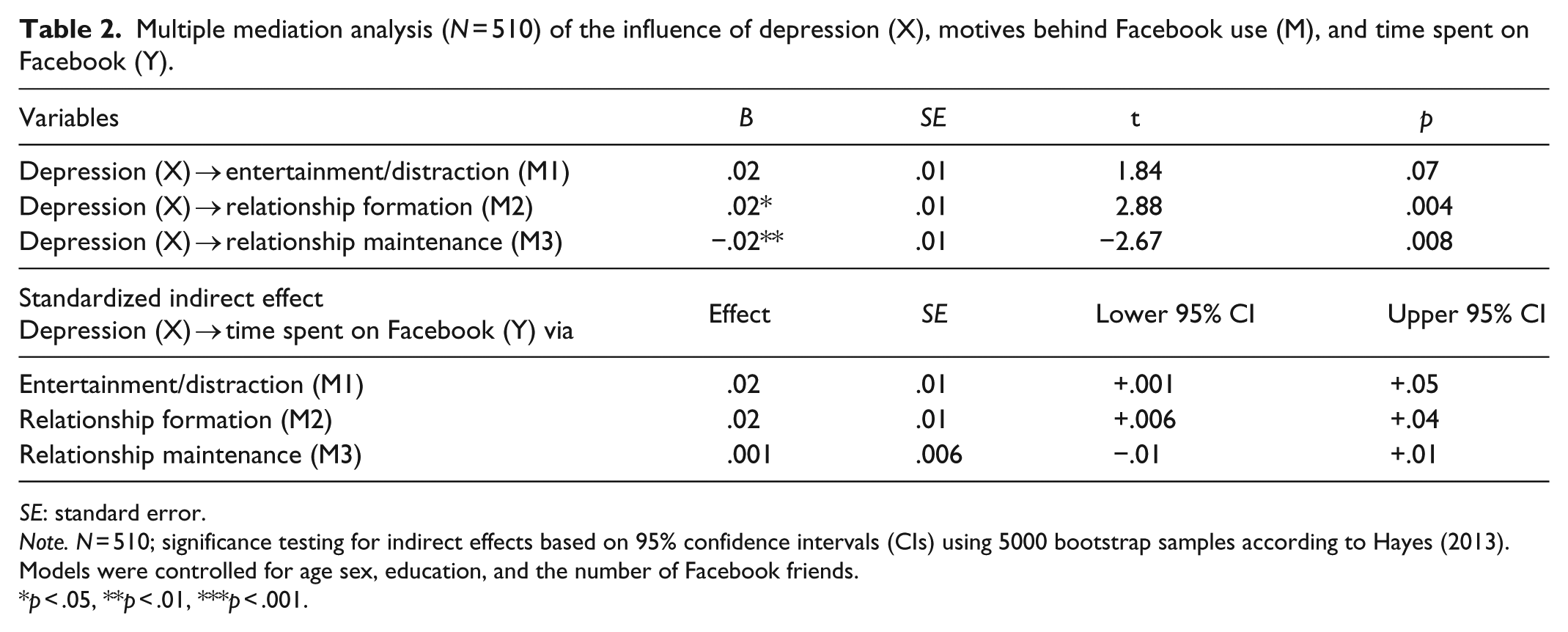
First, we examine the influence of depression (X) on the time spent on Facebook (Y) more closely. Thereby, we especially focus on the mediating role of the three motives entertainment/distraction (M1), relationship formation (M2), and relationship maintenance (M3). As depicted in Table 2, the time spent on Facebook is only influenced by depression if the motivation behind Facebook use is entertainment/distraction or forming new relationships, respectively. The standardized indirect effects of depression on the time spent on Facebook mediated by these two variables are small but reach commonly accepted levels of significance (M1: β = .02; 95% CI [+.001, +.05]; M2: β = .02; 95% CI [+.006, +.04]).
Multiple mediation analysis (N = 510) of the influence of depression (X), motives behind Facebook use (M), and time spent on Facebook (Y).
SE: standard error.
Note. N = 510; significance testing for indirect effects based on 95% confidence intervals (CIs) using 5000 bootstrap samples according to Hayes (2013). Models were controlled for age sex, education, and the number of Facebook friends.
p < .05, **p < .01, ***p < .001.
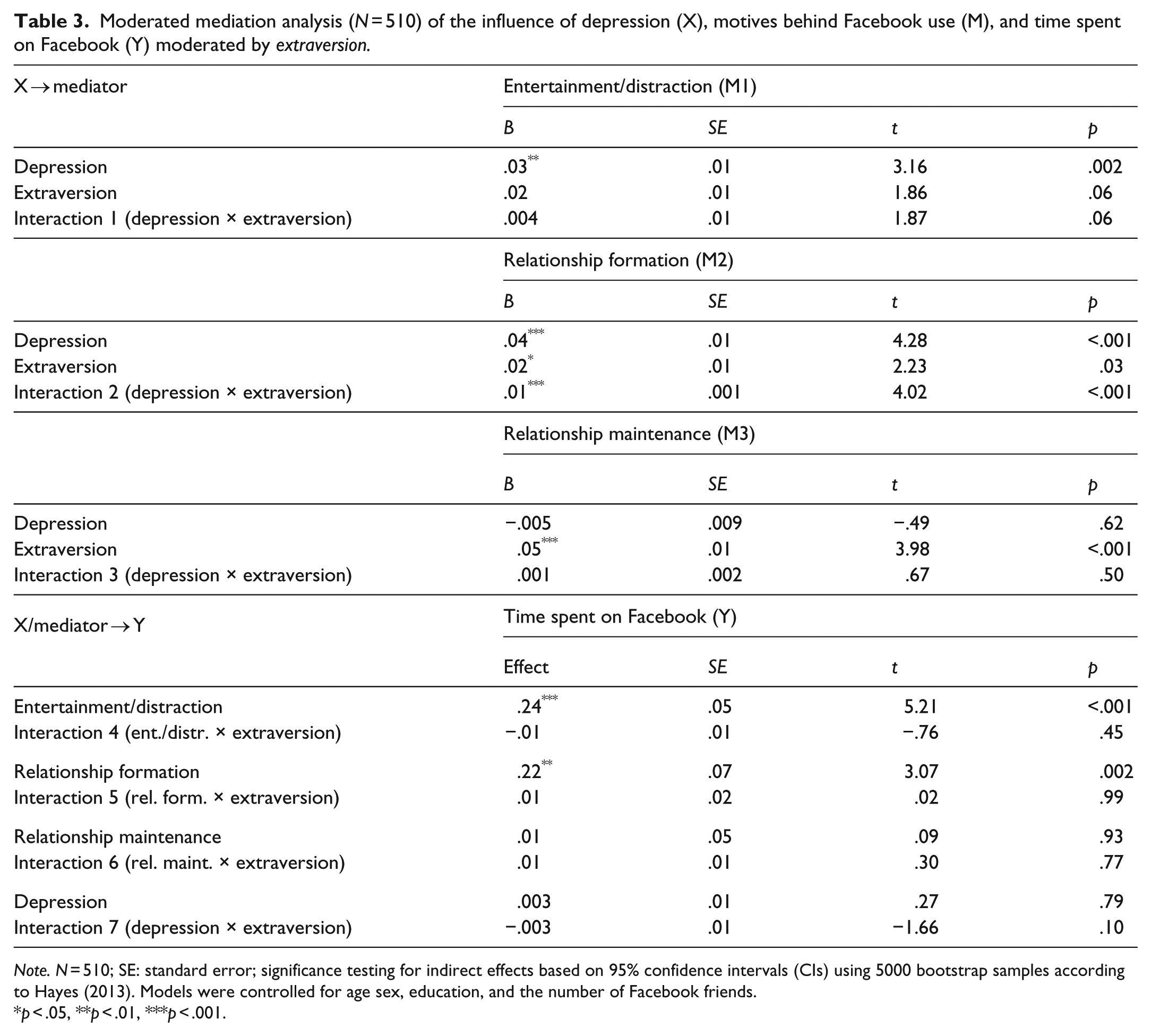
Second, to answer our research questions, we included neuroticism and extraversion as moderating variables in the mediation model. As a first step, we calculated the moderated mediation model for the moderator extraversion according to Hayes (2013), as depicted in Table 3, and, as a second step, we looked more thoroughly at different regions of significance, and therefore explored the conditional moderating effects of extraversion, as depicted in Table 4. The respective moderating influences of neuroticism are depicted in Table 5, with the conditional moderating effects of neuroticism shown in Table 6. As we explored three different mediators, our findings on the moderating personality influences are presented in the following three separate paragraphs for entertainment/distraction, relationship formation, and relationship maintenance.
Moderated mediation analysis (N = 510) of the influence of depression (X), motives behind Facebook use (M), and time spent on Facebook (Y) moderated by extraversion.
Note. N = 510; SE: standard error; significance testing for indirect effects based on 95% confidence intervals (CIs) using 5000 bootstrap samples according to Hayes (2013). Models were controlled for age sex, education, and the number of Facebook friends.
p < .05, **p < .01, ***p < .001.
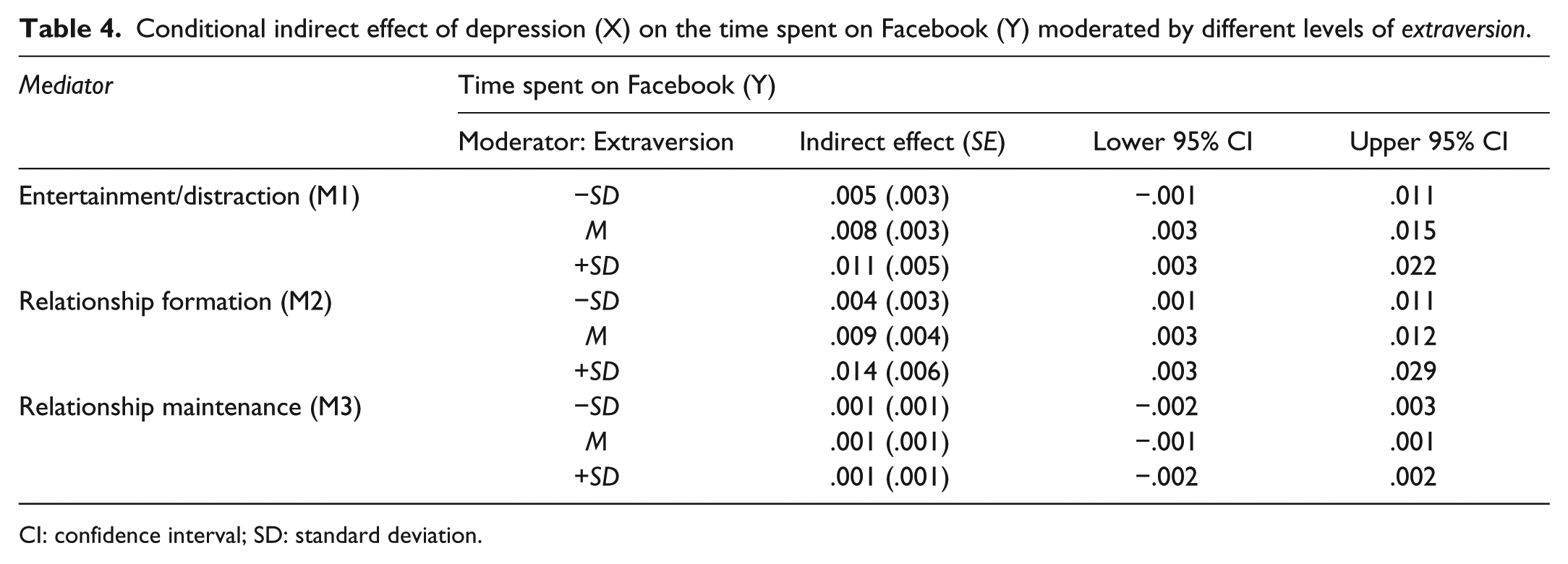
Conditional indirect effect of depression (X) on the time spent on Facebook (Y) moderated by different levels of extraversion.
CI: confidence interval; SD: standard deviation.
Moderated mediation analysis (N = 510) of the influence of depression (X), motives behind Facebook use (M), and time spent on Facebook (Y) moderated by neuroticism.

Note. N = 510; significance testing for indirect effects based on 95% confidence intervals (CIs) using 5000 bootstrap samples according to Hayes (2013). Models were controlled for age sex, education, and the number of Facebook friends.
p < .05, **p < .01, ***p < .001.
Conditional indirect effect of depression (X) on the time spent on Facebook (Y) moderated by different levels of neuroticism.

CI: confidence interval; SE: standard error.
Entertainment/Distraction Mediator
It is obvious that depression and extraversion do not exert combined influences on the entertainment/distraction motive (M1; β = .004, p = .06) in general (see Table 3). Moreover, as shown in Table 4, the indirect effect of depression on the time spent on Facebook, mediated by the entertainment/distraction motive, is only significant if the participants’ extraversion is average or is one standard deviation above the sample average (−1 SD: β = .005; 95% CI [−.001, +.011]; M: β = .008; 95% CI [+.003, +.015]; +1 SD: β = .011; 95% CI [+.003, +.022]).
Regarding the combined influences of depression and neuroticism on the entertainment/distraction motive, Table 5 shows that there are small negative effects (β = −.006, p = .01). The indirect effects of depression on the time spent on Facebook, mediated by the entertainment/distraction motive, are only significant if neuroticism is low, that is, one standard deviation below the sample average (−1 SD: β = .007; 95% CI [+.001, +.020]; M: β = .003; 95% CI [−.003, +.011]; +1 SD: β = −.004; 95% CI [−.013, +.003]). Taken together, these findings show that especially extraverted depressed people and depressed people scoring low on neuroticism use Facebook more for the purpose of entertainment or distraction.
Relationship-Formation Mediator
With regard to forming new relationships (M2), analyses show that depression and extraversion together foster the motive of relationship formation on Facebook (β = .01, p < .001), as shown in Table 3. The analysis of conditional effects (Table 4) shows that the indirect effect of depression on the time spent on Facebook mediated by the motive of relationship formation is stronger, the more extraverted the participants are (−1 SD: β = .004; 95% CI [+.001, +.011]; M: β = .009; 95% CI [+.003, +.012]; +1 SD: β = .014; 95% CI [+.003, .029]).
For neuroticism, Table 5 shows that neuroticism together with depression has a negative effect on relationship formation (β = −.005, p = .003). Conditional moderating effects analyses (Table 6) show that the indirect effect of depression on the time spent on Facebook via the motive of relationship formation is only significant for a medium level of neuroticism. Both for higher and lower levels of neuroticism (± 1 SD), there is no moderated mediation effect (−1 SD: β = .005; 95% CI [−.002, +.019]; M: β = .006; 95% CI [+.001, +.014]; +1 SD: β = .002; 95% CI [−.002, +.010]).
Relationship-Maintenance Mediator
Table 3 shows that extraversion together with depression does not exert an influence on the motive of using Facebook for maintaining relationships (M3; β = .001, p = .50). Moreover, the analysis of conditional moderating effects (Table 4) shows no significant moderating effects of extraversion either (−1 SD: β = .001; 95% CI [−.002, +.003]; M: β = .001; 95% CI [−.001, +.001]; +1 SD: β = .001; 95% CI [−.002, +.002]).
Looking more thoroughly at the moderating influences of neuroticism, we could not find any interaction effects of depression and neuroticism on the motive of using Facebook for maintaining relationships, as depicted in Table 5 (β = .001, p = .77). Moreover, Table 6 shows that neuroticism had no significant moderating influence on the indirect effect of depression on the time spent on Facebook mediated by the motivation to maintain social contacts (−1 SD: β = −.001; 95% CI [−.010, +.001]; M: β = .001; 95% CI [−.002, +.004]; +1 SD: β = .001; 95% CI [−.001, +.007]).
Discussion
This study examined the direct and indirect effects of depression and different motives for using Facebook on the time spent on the SNS, and moreover, explored the moderating role of the personality traits of extraversion and neuroticism. Most importantly, although depression has been associated with lowered activity levels in general, this study found that people with more depressive symptoms showed more Facebook activity, that is, they posted more status updates, and specifically, the more that depressive symptoms were prevalent, the more they posted status updates for negative reasons, and the less they posted them for positive reasons. As the reasons behind Facebook activity can be manifold (Ellison et al., 2007; Hollenbaugh & Ferris, 2014; Kneidinger, 2010; Nadkarni & Hofmann, 2012; Sheldon, 2008; Tosun, 2012; Yang & Bradford Brown, 2013) and as they also depend on personality traits (Amichai-Hamburger & Vinitzky, 2010; Caci et al., 2014; Kneidinger, 2010; Moore & McElroy, 2012; Ross et al., 2009), this study more thoroughly explored the mediating role of different motives and personality traits. In the context of depressive tendencies, especially the motives of using Facebook for relationship formation and entertainment/distraction become more important, while relationship maintenance is mostly uncorrelated with depression. With regard to the influence of personality traits in the context of depression, the study found effects especially for the motives of using the SNS; less effects were found on the time spent on Facebook. Thereby, the influence of neuroticism was stronger than the influence of extraversion in general. With regard to indirect effect patterns, the study shows that extraversion especially enhances using Facebook for entertainment/distraction and relationship formation motives, while no clear patterns for neuroticism could be identified. Nevertheless, we observed the tendency that neurotic depressed people use Facebook less for entertainment/distraction or for relationship formation. Therefore, the study is among the first to show that interaction patterns between depression and personality can be relevant in the context of why and to what extent Facebook is used, even if these effects might be small in nature.
The findings can be explained by the fact that depressed people might use Facebook like a diary, in which they can express themselves without specifically talking to someone specific. This interpretation would be in line with findings from the Moreno et al. (2011b) study. Interestingly, by integrating neuroticism in our study, we are able to specify our explanation: As depressed people show higher levels of neuroticism, it seems more likely that they will especially use their own Facebook wall for social interaction, as suggested by Ross et al. (2009) as well as by Ryan and Xenos (2011). Moreover, the fact that depressed people post status updates more often for negative reasons seems plausible, as depressed users should experience negative affect more often. Facebook could therefore be used as a sort of valve to cope with negative thoughts. The extent to which personality traits such as neuroticism or extraversion are prevalent especially influences the association between depression and the motive of using Facebook for relationship formation. It seems perfectly logical that more extraverted people tend to form new relations more easily (Asendorpf & Neyer, 2012). Alternatively, depressed Facebook users could also see the SNS as a chance to improve their own situation by using it to build up a social network that will stand by their side during an episode of depression. For instance, Yang and Bradford Brown (2013) found that people used Facebook more for making new friends when they were lonelier and felt less socially adjusted, which should generally apply to depressed people, too. Finally, our findings are in line with SDT (Deci & Ryan, 2000; Ryan & Deci, 2000), as the present study shows that the time spent on Facebook is positively correlated with depressive symptoms, and that relationship formation on Facebook is more of a motive for using the SNS among depressed users (as depicted in Table 1). Similar to the findings of a study by Sheldon et al. (2011), our findings suggest that depressed people experience less social contact offline, and therefore, look to compensate for this online.
Limitations and Conclusion
As with other empirical studies, there are important limitations that have to be kept in mind when interpreting the findings. First of all, by conducting an online survey, we could not control for the situation in which the survey questions were answered and to what degree participants were able to accurately self-assess their Facebook behaviors. It might be the case for some users that they were not sufficiently aware of their own Facebook behaviors, for example, because of insufficient memory regarding their behaviors, or because their own Facebook use was simply not strongly reflected in their answers. Some of the questions might also have evoked socially desirable answers, for example, with regard to the time spent on the SNS, even though the context of an online survey would offer sufficient anonymity for unbiased answers to such questions. Future studies should therefore think of using an (online) diary approach, comparable to the one Dillman Carpentier et al. (2008) employed in their study. Nevertheless, instead of ex post facto measurement, future studies could, for instance, also apply an in situ approach via (mobile) telephone or messaging. Thereby, Facebook activities would no longer remain hypothetical but could be measured for real. Yet another interesting research design would be to look at the longitudinal relationships between the variables; by doing so, causality between depression and Facebook use could be further carved out, and moreover, the question of what consequences for depression might in turn evolve from Facebook activities could be answered via this route. It would be particularly interesting to see different forms of Facebook behavior over the course of different phases of depression. With regard to the motives behind using Facebook, future studies could integrate more elaborate motive catalogs (see Papacharissi & Mendelson, 2011; Smock et al., 2011), which are continuously being developed and influenced by new applications and features integrated into Facebook. Finally, with regard to the demographic structure of our sample, it is obvious that this study used an especially homogenous group of participants that was to a large extent female, younger, and more highly educated than the general population. Moreover, the prevalence of depressive symptoms in the sample was low as compared to other studies that used different instruments to measure depression, or different sampling methods, and in which the prevalence of depression was between 8% and 25% (see Busch, Maske, Ryl, Schlack, & Hapke, 2013; Scherr, 2016). In this study, only about 5% were considered as having severe depressive symptoms, whereas 46% of the sample did not show any symptoms at all. This points to the general difficulty of sample- and method-specific variance when assessing depression. Therefore, the observed effects should be even stronger in clinical samples. Nevertheless, with regard to the first empirical test of our hypothetical model, we considered our sample acceptable.
Usually, people suffering from depression do not have the drive to improve their situation. This seems to be different in Facebook. The SNS is obviously a kind of lower level hurdle for depressed people to overcome in order to seek help and to exchange with others. As this is oftentimes the main obstacle within therapy, the findings of the study presented here might be of greater practical relevance for the treatment of depression (see also Scherr, 2015). Nevertheless, dealing with potential depressive symptomatology expressed on SNSs is a delicate task: What if the depressive symptoms are an expression for something else, such as suppressed anger, and how much monitoring do we actually need? For instance, drug companies could use that information to target vulnerable people to advert for antidepressants, as well as employers might be alerted and suspend people from work when particular medical conditions are indicated, for example, in the public transport sector (see the discussion after the Germanwings plane crash in 2015). Alternatively, family groups on Facebook could be helpful for monitoring depressive symptoms on SNS with less privacy concerns involved.
Based on our findings, new digital and effective approaches for therapy could be developed, including the search for indicators of depression-specific Facebook use, to identify depressed users. As so many people use Facebook with utmost regularity every day, an early warning system for users, family members, and therapists could be developed that signals or provides immediate help services when there is an indication of an elevated depressive symptomatology.
Footnotes
Declaration of Conflicting Interests
The author(s) declared no potential conflicts of interest with respect to the research, authorship, and/or publication of this article.
Funding
The author(s) received no financial support for the research, authorship, and/or publication of this article.