




Abstract
Two studies investigated (a) how public figures’ interaction with their followers on social network sites (SNS) affects individuals’ impressions about and attitudes toward them, and (b) how individuals’ interpersonal orientation moderates such effects, if any. In Study 1, participants viewed either a famous actor’s Twitter page or a news article merely relaying his Tweets. Exposure to the Twitter page (vs. news article) induced stronger feelings of actual conversation (i.e., social presence) among less affiliative individuals, whereas the reverse was true for more socially proactive ones. Social presence, in turn, facilitated parasocial interaction with the target and heightened the participants’ willingness to watch his movie, with limited effects on their overall evaluation of the target. Study 2, which employed a lesser known local politician using a different microblogging service, replicated the advantage of SNS communication over the news article for socially reserved individuals, with no corresponding effect for more affiliative ones.
Defined as “web-based services that allow individuals to (1) construct a public or semipublic profile within a bounded system, (2) articulate a list of other users with whom they share a connection, and (3) view and traverse their list of connections and those made by others within the system” (boyd & Ellison, 2008, p. 211), social network sites (SNSs) seem to mark one of the most prominent changes in today’s ever-evolving media landscape. As has been the case with every “new” medium, communication scholars have attempted to understand the popularity of SNSs and their social implications by focusing on who is more likely to use such services (e.g., Hargittai, 2008; Wilson, Fornasier, & White, 2010), for what purposes (e.g., Park, Kee, & Valenzuela, 2009; Raacke & Bonds-Raacke, 2008), and with what effects (e.g., Ellison, Steinfield, & Lampe, 2007; Valenzuela, Park, & Kee, 2009). While focusing on the antecedents to SNS usage, whether it be profiling user characteristics or identifying specific gratifications sought, and counting its social and psychological consequences, what people might actually experience when communicating through SNSs seems to remain relatively understudied (see Walther, Van Der Heide, Hamel, & Shulman, 2009; Walther, Van Der Heide, Kim, Westerman, & Tong, 2008, for notable exceptions).
In addition to this apparent disregard for the very nature of communication processes, the extant literature seems to privilege the casual and relational side of SNS-based communication. Although there is no question that the primary motivations of SNS use concern relationship building and maintenance, as well as self-expression, it also merits note that “some people connect to celebrities and bands they do not know personally, or to people they simply find cool” (Utz, 2009, p. 222). Put differently, just as people watch entertainment programs or talk shows to see their favorite stars up close and personal, they want to be linked to celebrities through this nascent venue and closely “follow” and “befriend” them. From the celebrities’ viewpoint, by creating a profile on SNSs and exchanging messages with their followers, however selectively and strategically so, they may present themselves as an approachable, down-to-earth person. Likewise, politicians have also realized the potential of SNSs as an effective means of soft campaign (Utz, 2009), through which they can reduce psychological distance and establish a personal rapport with voters. Not only has then-candidate Barack Obama’s victory in the 2008 U.S. presidential election been attributed to his team’s skillfully orchestrated SNS use to heighten his visibility and mobilize volunteer efforts (e.g., “Facebook Politicians,” 2010) but many lesser-known politicians have also actively adopted SNSs to stay in touch with their constituency and publicize their service activities (e.g., “New Jersey Mayor,” 2010).
Among various forms of SNSs, the present research focused on the microblogging services and examined (a) how public figures’ direct interaction with their supporters on such platforms might shape people’s overall impressions of and attitudes toward them, and (b) what psychological mechanism might underlie such effects. In so doing, we aimed to extend the previous literature in the following respects. First, we compared individuals’ reactions to the target’s SNS page with those to a news article merely quoting his or her SNS posts, adding virtually no information. That way, we could probe if there is any medium effect, over and above the effects of the very act of communication or the message content. Second, drawing upon the literature on social presence (e.g., Lee, 2004; Lombard, Reich, Grabe, Bracken, & Ditton, 2000), we aimed to account for why medium effects might emerge, if any. Given that the short, informal conversational style is the very signature characteristic of microblogging, we suspected that the exposure to the actual SNS page would foster a stronger sense of nonmediated interpersonal contact with the target (i.e., social presence) than reading a news article would, even when the news article contains the original posts unaltered, which in turn might affect subsequent judgments. Lastly, unlike previous studies highlighting the role of individual characteristics as predictors of SNS use (i.e., who is more or less likely to use SNSs), we conceptualized individuals’ interpersonal orientation as a potential moderator of its effects (i.e., how the effects of SNS communication vary depending on an individual’s interpersonal orientation). Specifically, by examining how an individual’s affiliative tendency (Mehrabian, 1994) might alter the ways in which people respond to the public figures’ interaction with their supporters through SNSs, we aimed to identify the potential boundary of the medium effects and better understand their nature.
To do so, two web-based experiments were conducted. In Study 1, we examined how people respond to a famous actor’s Twitter communication, as compared to a news article reporting his Twitter use, in terms of (a) the imagined intimacy with him (i.e., parasocial interaction; Horton & Wohl, 1956), (b) their overall evaluation of him, and (c) the intention to engage in a supportive action. Study 2 was designed to assess the generalizability of the findings from Study 1 and further elucidate the relationships between social presence and the dependent variables, featuring a low-profile local politician as the target, who uses a different microblogging service, me2DAY.
Study 1
What sets the celebrities’ SNS communication apart from more traditional means by which lay people come into contact with them is its (perceived) authenticity and reciprocity. Even in the past, people would try to form emotional connections with celebrities, either through more direct attempts to contact them, like joining fan clubs and writing letters, or by consuming celebrity-related products, such as collecting mementos and magazine clipping (Caughey, 1985). Still, what is seen of celebrities in the media is most likely to be deliberately crafted and rehearsed, and therefore, might not truthfully reflect their “real” self. Moreover, when people attempt to contact their favorite stars, the chance of getting a hold of their attention, let alone having them respond, was very slim in most cases. Although there is still no guarantee that celebrities indeed compose their SNS posts as they claim to do, people nonetheless generally expect that their messages are coming directly from their mouth without preparation, and thus, more genuine than what can be expected of their media representation (Levinson, 2011). Similarly, even though most followers tend to remain as silent lurkers without actually contributing messages, the absence of official gatekeepers who control the flow of messages seems to be powerful enough to induce an illusion of “direct” communication. As such, people might “fail to perceive or acknowledge the existence of a medium” and “respond as they would if the medium were not there” (Lombard et al., 2000, p. 77). In that sense, social presence, which refers to the feelings of being together with mediated others (Biocca, Harms, & Burgoon, 2003), seems pivotal to understand the attraction of celebrities’ SNS interaction.
Social Presence: Attraction of SNS Communication?
One of the most studied constructs in computer-based communication, social presence has long been at the center of scholarly discussion. In what is now a classical definition, Short, Williams, and Christie (1976) conceptualized social presence as “the degree of salience of the other person in the interaction and the consequent salience of the interpersonal relationships” (p. 65) and operationalized it in terms of how “sociable, warm, sensitive, and personal” (p. 66) people perceive the communication medium to be. At the same time, their scale has also been widely adopted to measure individuals’ perception of mediated partners, including nonhuman entities like virtual agents. For example, Gong (2008) systematically varied the degree of anthropomorphism in computer-generated facial images, and found that the more human-like the computer representation appeared, the higher social presence people attributed to the agent. Similarly, even though the virtual partners performed the identical function during the interaction, those told that they were interacting with other participants rated their partners higher on social presence than those believing that their partners were computer agents (Lee & Nass, 2002). Collectively, these findings suggest that people tend to equate “social presence” with “human-likeness.”
As compared to this view underscoring the social, as opposed to asocial, nature of the interaction (i.e., “social” presence), with an inherently positive connotation attached, other researchers have placed a greater emphasis on the perceived immediacy or proximity of the interactants (i.e., social “presence”) when studying this elusive construct. In this view, social presence refers to the psychological distance between the interactants and is concerned primarily with how strongly a person feels as if she were “with” the communication partner in a given situation (e.g., Lee & Nass, 2005; Skalski & Tamborini, 2007). Although they used a different label, Walther and Bazarova’s (2008) electronic propinquity also taps into this feeling of copresence and was measured by how remote and disconnected individuals felt about their mediated partners, which varied as a function of the channel bandwidth, information complexity, and the users’ communication skills.
Despite slight variations in their conceptual foci, the previous studies appear to concur that social presence refers to the degree to which a given interaction approximates nonmediated communication with a “real person” rather than an “abstract, anonymous person” (Kreijns, Kirschner, Jochems, & van Buuren, 2004, p. 160). When social presence is defined as how closely mediated interaction emulates face-to-face encounter (Biocca et al., 2003), or how much “virtual” interaction is experienced as “actual” interaction (Lee, 2004), remediation of celebrities’ SNS messages in a news article is likely to lower social presence for the following reasons.
First, although the actual SNS page and the news article are both text-only, and thus, do not differ in sensorial richness, the former might still make it easier to vividly imagine the source and the conversation he or she carries with other followers. Just as indirect speech (i.e., reporter summaries) in a news article attenuated the effects of exemplars on the readers’ perceptions of opinion distribution as compared to direct speech (i.e., live interviews; Brosius & Bathelt, 1994), reading the SNS posts as being relayed by the news reporter is likely to render the mediated nature of the experience more salient, which interferes with presence (Lombard & Ditton, 1997).
Second, reading SNS posts on their original platform is likely to make its interactive nature more transparent, as the conversational threads are being unfolded as if they were occurring here and now. By contrast, a news article treats the same verbal exchange as a past event over which the readers have no control; that is, its readers are positioned as passive consumers of mass-oriented information, rather than potential participants who can engage in the ongoing social transaction at their own will. Given that vividness and interactivity are viewed as the two most prominent determinants of presence (Steuer, 1995), the live broadcast quality of microblogging services, as succinctly encapsulated in the official question of Twitter (“What’s happening?”), is likely to heighten the sense of interactivity, and hence, presence. Taken together, the following hypothesis was drawn to examine if celebrities’ Tweets induce different levels of social presence depending on the channel through which the messages are seen.
Hypothesis 1 (H1): Participants will experience a higher level of social presence when viewing a celebrity’s Twitter page than reading his Tweets in a news article.
Heightened presence of the target might in turn affect the individual’s perceptions and evaluations of the target. First, by making the mediated experience seem more real and immediate, social presence may prompt parasocial interaction with the target, as Lombard and Ditton (1997) speculated. Often referred to as “intimacy at a distance” (Horton & Wohl, 1956, p. 215), parasocial interaction occurs when the media audience develops the illusion of intimacy with media personalities, such as news anchor and TV show host, in the complete absence of direct interpersonal encounter. Even though media personalities’ interaction with the audience is inherently one-sided and nonreciprocal, by duplicating “the gestures, conversational style, and milieu of an informal face-to-face gathering,” they can still “claim and achieve an intimacy with what are literally crowds of strangers.” (pp. 216-217) If skilled media personalities can manage to forge such illusory personal relationships with the remote audience by using direct address and informal speech styles, celebrities’ Twitter communication might well accomplish the same insofar as it makes people feel as if they were having a face-to-face encounter with them. That is, the subjective experience of conversing (virtually) with the celebrity might foster pseudofriendship with him or her they do not really know in person, which consists of empathy, personal interest, and attributional confidence (Rubin, Perse, & Powell, 1985).
In addition to the imagined intimacy with the celebrity target, social presence might also shape their evaluation of the target as well. For example, Bente, Ruggenberg, Kramer, and Eschenburg (2008) compared how social presence, defined as perceived closeness and connectedness in mediated communication, varies across four different communication modes (i.e., text-chat, audio, audio-video, avatar) and found that (a) text-chat condition reported a lower level of intimateness and copresence than the other three conditions, and (b) intimateness was positively related to the perceived competence and trustworthiness of the partner, while copresence was positively associated with perceived trustworthiness. Similarly, while interacting with a computer agent, participants experienced a higher level of the agent’s presence when allowed to exercise greater control over the message presentation, and increased presence prompted more positive thoughts about the agent (Skalski & Tamborini, 2007).
Such positive effects of social presence have also been observed with corporate web sites. For example, Kelleher and Miller (2006) compared organizational blogs and traditional web site and found that the stronger the perception of “conversational human voice,” the higher the site visitors’ ratings of trust, satisfaction, and commitment; that is, when the web site was perceived as using conversational-style communication and inviting their participation, it educed more positive reactions. Likewise, Cyr, Hassanein, Head, and Ivanov (2007) reported that the behavioral intention to revisit the web site or to make a purchase from it in the future (i.e., e-loyalty) increased in proportion to the extent to which the site conveyed human-likeness, such as human warmth and personalness. Taken together, these studies suggest that the feelings of real, two-way conversation with the target might lead to more favorable overall evaluations of the target and a stronger intent of supportive action.
Hypothesis 2a-c (H2a-c): The level of social presence will be positively associated with (a) parasocial interaction with the target, (b) overall evaluation of the target, and (c) the willingness to perform a supportive action.
Affiliative Tendency as a Moderator of Channel Effects
In exploring the effects of celebrities’ Twitter communication, we also considered the possibility that individuals might be differently predisposed for interpersonal engagement with celebrities. Specifically, given that both parasocial interaction and social interaction are rooted in the attachment instinct (Giles, 2002), we suspected that an individual’s affiliative tendency might well affect individuals’ perceptions of and responses to celebrities’ SNS communication. Defined as “generalized positive expectations in social relationships” (Mehrabian, 1994, p. 98), affiliative tendency is positively associated with preference for attachments (vs. independence) and group activities (vs. individual activities). In addition, highly affiliative individuals are not only outgoing and friendly but they also make greater efforts to affiliate with others and are more willing to talk to strangers (Miller, Rossbach, & Munson, 1981). As such, affiliative tendency might moderate the processes outlined above in two different ways.
On the one hand, the effect of communication channel on social presence might be more pronounced for those low in affiliative tendency than highs. Not being highly motivated to engage in social encounters, less affiliative individuals might be more prone to ignore social cues, unless the conversation threads are shown in their original context, making it more difficult to dismiss. Whereas, those chronically craving for social opportunities might heed the celebrities’ personal stories and become drawn to them, even when they are presented in a matter-of-fact manner by the news reporter. In addition, those low in affiliative tendency might be less able to mentally reconstruct the virtual conversation the target carried, especially when its remediation by a news reporter dilutes its vividness and immediacy. Just as extraverts are better at decoding nonverbal cues accurately in social settings because of more social practice and a stronger desire for sensory stimulation (Akert & Panter, 1988), socially reserved individuals might find it more difficult to experience the target’s presence when his SNS messages are buried in a news article than when shown on the original platform. Taken together, socially reserved individuals might be more likely to report varying degrees of the target’s presence depending on how closely the given stimulus approximates the look and feel of a dynamic conversation. By contrast, more socially motivated and practiced individuals might be less affected by the script format, due to their chronic acuity for social cues.
On the other hand, the effects of social presence on subsequent judgments might also vary as a function of affiliative tendency. Given that affiliative tendency was negatively correlated with the Social Avoidance and Distress Scale, which assesses the extent to which individuals avoid social contacts as well as the amount of discomfort and anxiety they experience in the presence of others (Mehrabian, 1994), a communication channel that affords a higher level of social presence might instigate negative reactions from those shunning social opportunities, who might find the increased presence rather aversive. In contrast, that fact that affiliative individuals not only hold more favorable attitudes toward social interaction but they also value the same trait in others (e.g., “I prefer a leader who is friendly and easy to talk to over one who is more aloof and respected by his followers”; Mehrabian, 1994, p. 98) suggests that heightened presence is likely to elicit positive judgments about the target from more socially proactive individuals. Notwithstanding, with no prior research to derive specific hypotheses from, the following research questions were proposed in lieu of directional hypotheses.
Research Question 1 (RQ1): Will the effect of communication channel on social presence vary depending on an individual’s affiliative tendency?
Research Question 2a-c (RQ2a-c): How will an individual’s affiliative tendency moderate the effects of social presence on (a) parasocial interaction with the target, (b) overall evaluation of the target, and (c) the willingness to perform a supportive action?
Method
Participants
A total of 143 adults (78 male, 65 female; age M = 29.71, SD = 7.17) were recruited through an online survey company in South Korea. Once stratified by gender and age, the participants were randomly assigned to either the SNS or the news condition.
Procedure
Upon accessing the study web site, participants were first presented with questions
concerning demographic information and their SNS usage and then taken to the stimulus
page. For the SNS condition, a mock-up Twitter page was shown, featuring a famous Korean
actor, Joong-Hun Park’s timeline (see Figure 1). Known as one of the most avid celebrity Twitterians, he boasted of
more than 43,000 followers and had logged nearly 2,800 Tweets at the time when his
Twitter page was captured. His Tweets included trivial on-site episodes concerning the
movie he was then filming, a note about the basketball championship game involving a
team led by his high school buddy, and a thank-you message to his followers for their
moral support. For example, he said, Action movies are tough on the body because they are physically demanding. Comedies
can be mentally draining because they require much thinking. Director Lim’s movie
makes my heart leap because it forces me to think hard about life. Nothing seems to
be easy.
To his follower’s cheering comment, he responded, “Looks like you’ve got a knack for making people feel better. Thank you.”
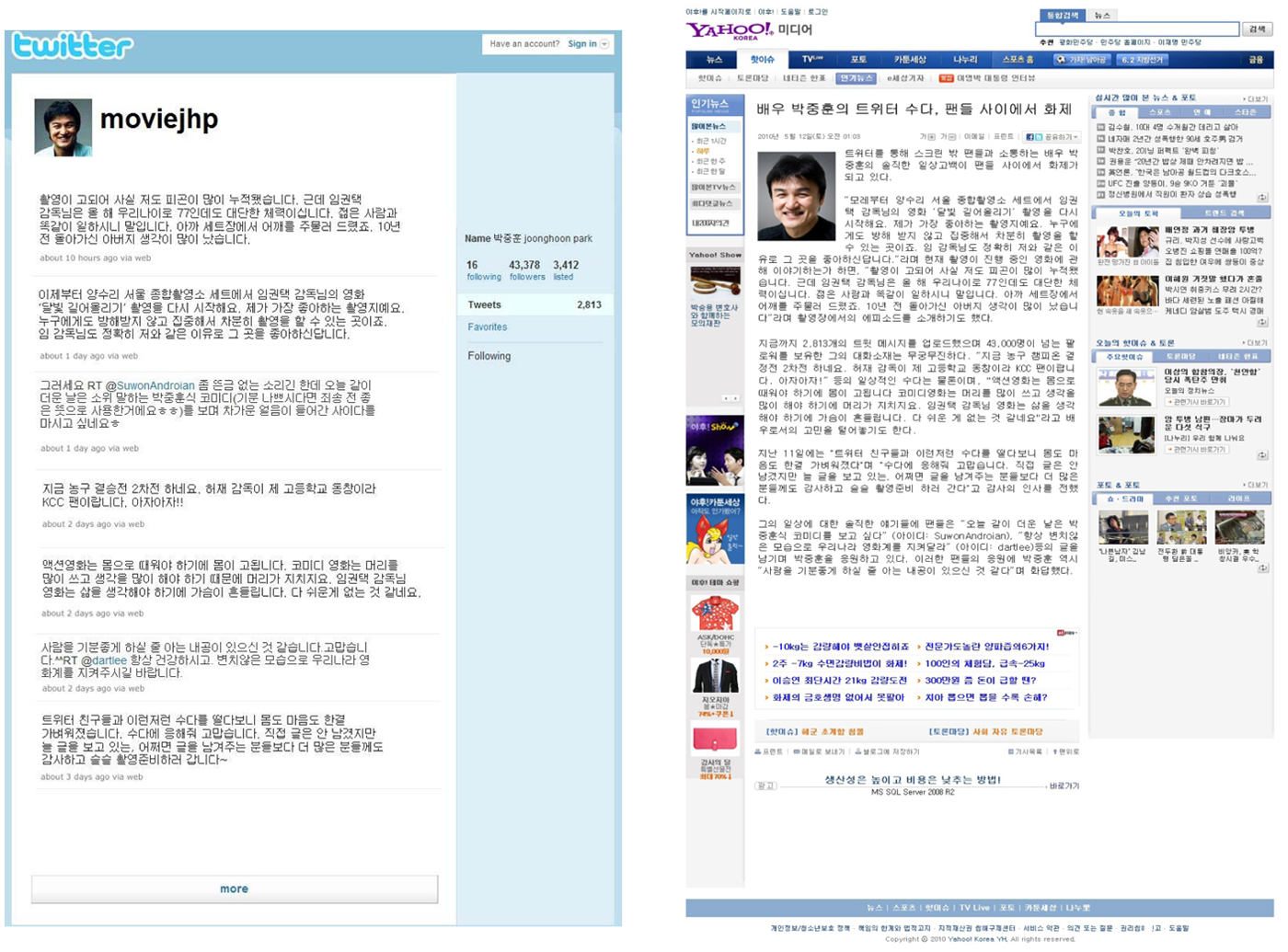
Screenshots of Twitter timeline and news article: Study 1
On the other hand, those in the news condition read a news article placed within the layout of the Internet news portal, Yahoo! Media. We used the news article condition as a comparison group for two reasons. First, we wanted to avoid the potential confounds between the channel effect and that of the very act of celebrities’ Twitter use. That is, by informing the participants in both conditions of the actor’s Twitter communication with his fans, we attempted to rule out the possibility that people come to espouse more positive attitudes about the target, who seems to be technology-savvy and endeavors to stay connected to his fans. Second, celebrities’ Twitter messages frequently get picked up by the news media in South Korea, rendering the news article an ecologically valid comparison condition. Recently, for example, an actor’s Tweets about “Korean wave” in Europe were reported by some newspapers and generated heated reactions from the fans of rival bands that he ended up closing his Twitter account (http://news.mt.co.kr/mtview.php?no=2011061711335261867&type=2).
The news article, entitled “Actor Joong-Hun Park’s Tweets have drawn his fans’ attention,” consisted mostly of the direct quotes of the messages shown to the SNS condition. Other than some brief, redundant remarks, such as “Actor Joong-Hun Park was seen on Twitter conversing with his fans,” which merely reiterates what should be evident from his Twitter page, the message content was identical to that of the SNS condition. Additional information contained in the Twitter page, such as the actor’s head shot and the number of followers, was also inserted in the news article to ensure comparability. After viewing the stimulus, participants completed the questionnaire.
Measures
To control for the participant’s previous experience with microblogging services, participants were given a list of SNSs and asked to indicate which service they had used (Twitter use: 0 = No, 1 = Yes; M = .29, SD = .45). After viewing the stimulus, participants indicated how well each of the following statements described their feelings (1 = Describes very poorly; 7 = Describes very well), adapted from Lee and Nass’s (2005) Social Presence Scale: “I feel as if he were speaking directly to me,” “It feels as though I were talking with him in person,” “I could imagine him vividly.” Responses were then averaged (see Table 1 for descriptive statistics).
Descriptive Statistics and Intercorrelations of Key Variables: Study 1
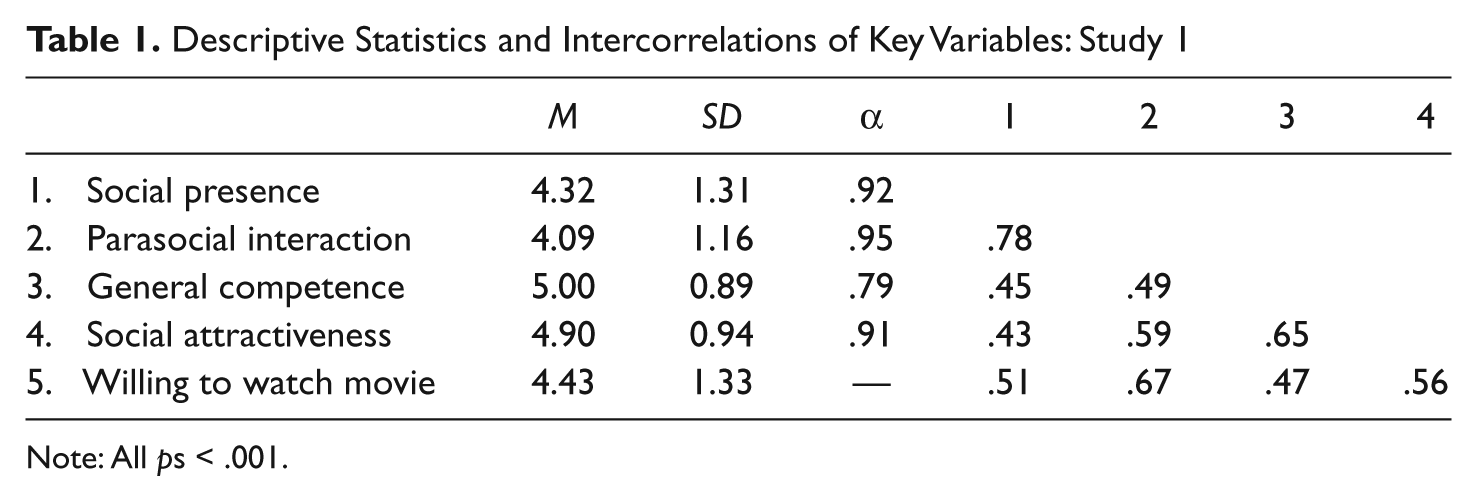
Note: All ps < .001.
Parasocial interaction was measured using seven items from the Parasocial Interaction Scale (Rubin et al., 1985; Rubin & Purse, 1987). Since both the original scale and the short version were created with TV newscasters or soap opera characters in mind, some items were not well-suited for the current target, a movie star. Therefore, the items either presuming regular exposure to the target (e.g., “I miss seeing my favorite soap opera character when he or she is ill or on vacation”) or presupposing a particular program format or content (e.g., “When the newscasters joke around with one another it makes the news easier to watch”) were excluded. Specifically, participants indicated how well each of the following statements described their feelings (1 = Describes very poorly; 7 = Describes very well); “I think I can understand what kind of person he is,” “He makes me feel comfortable, as if I am with friends,” “I see him as a natural, down-to-earth person,” “I look forward to hearing more news about him,” “If there were a story about him in a newspaper or a magazine, I would read it,” “I would like to meet him in person,” “I feel as if I have known him for a long time.” Scores were then averaged to create the PSI index.
For source evaluation, participants were shown a list of adjectives and indicated how well each word described the actor on a 7-point bipolar scale, with higher scores representing more favorable evaluations. A factor analysis yielded a two-factor solution. One factor represented the target’s character and was comprised of the following six items: dishonest—honest, unpleasant—pleasant, selfish—unselfish, unlikable—likable, unattractive—attractive, unfriendly—friendly (Eigenvalue = 5.36, % of variance accounted for = 59.57). Ratings were averaged to create the social attractiveness score. The other factor captured the actor’s general competence, consisting of the remaining three adjectives: uninformed—informed, unintelligent—intelligent, incompetent—competent (Eigenvalue = 1.00, % of variance accounted for = 11.14). For the intent of supportive action, participants were asked how willing they were to watch the film the actor mentioned in his Tweets (1 = Not at all willing, 7 = Very much willing).
To measure affiliative tendency, we used a revised version of Mehrabian’s (1970) original scale, adapted for Korean respondents (Cha & Cheong, 1990). Participants indicated how well each statement represented themselves (1 = Represents me very poorly; 7 = Represents me very well); “When I’m not feeling well, I would rather be with others than alone,” “I like to make as many friends as I can,” “I prefer independent work to cooperative one,” “I like hanging out with others because it helps me make friends,” “I prefer individual activities such as crossword puzzles to group ones,” “I would rather read a book or go to a movie than spend time with friends.” (α = .70, M = 4.21, SD = .96)
Results
To examine if exposure to the actual Twitter page induces a stronger sense of presence than the news article containing the identical messages (H1) and how an individual’s affiliative tendency might moderate such effect (RQ1), a moderated hierarchical regression analysis was conducted (West, Aiken, & Krull, 1996). First, three demographic variables (sex, age, education) and Twitter use were entered in the control block. Given that active Twitter users tended to be more educated males in their 20s and 30s (Koreanclick, 2009; Lee, Cha, & Park, 2010), the potential effects of these demographic variables on the participants’ expectations of and/or attitudes toward the service, which might not have been fully reflected in the binary Twitter use data, were statistically controlled. Next, two main effect terms, communication channel (0 = News, 1 = SNS) and mean-centered affiliative tendency constituted the second block. Lastly, the interaction term, computed by multiplying the two variables, was added.
Results showed that the control variables had no significant effects on perceived presence of the target (−.07 < bs < .34, all ts < 1.35, ΔR 2 = .02, ΔF < 1). The addition of the main effect terms significantly increased the variance accounted for (ΔR 2 = .04, ΔF = 3.17, p < .05), but only the affiliative tendency had significant effect on social presence, with those higher in affiliative tendency reporting a stronger sense of the target’s presence (b = .30, t = 2.52, p = .01). The experimental condition (SNS vs. News) had no significant effect on social presence (b = .06, t < 1). Therefore, H1 was not supported. Instead, a significant interaction emerged between communication channel and affiliative tendency (ΔR 2 = .07, ΔF = 10.97, b = −.79, t = −3.31, p = .001). Simple slopes plotted for two levels of the affiliative tendency (one SD below and above the mean) showed that the exposure to the Twitter page significantly enhanced the feelings of presence, as compared to the news story (H1), only when affiliative tendency was relatively low (b = .79, t = 2.58, p = .01; see Figure 2). For those with high affiliative tendency, the slope was in the opposite direction, with the news article rendering the target’s presence more salient than the Twitter page (b = −.72, t = −2.28, p = .02). 1
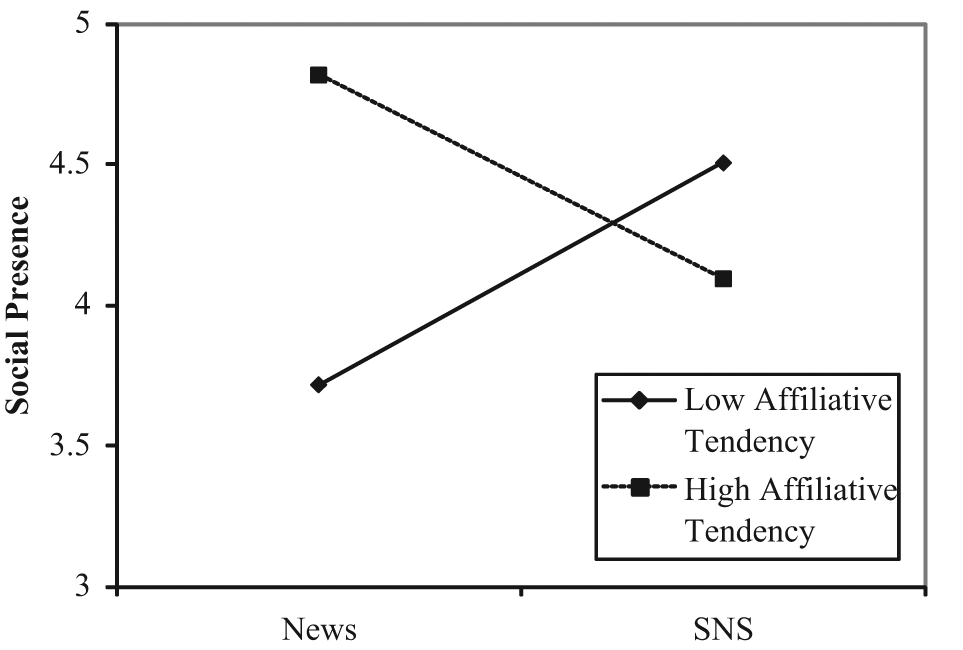
Interaction between communication channel and affiliative tendency on social presence: Study 1
To examine if social presence mediates the effects of communication channel on DVs (H2a-c) and how affiliative tendency moderates such effects (RQ2a-c), we used MODMED macro (Preacher, Rucker, & Hayes, 2007), with affiliative tendency as a potential moderator affecting both the relationship between IV and social presence and that between social presence and DVs (Model 5). First, no significant interaction was found between social presence and affiliative tendency on parasocial interaction (b = −.04, t < 1), and thus, a reduced model was run without the interaction term (Model 2). Results showed that social presence had a significant main effect on parasocial interaction, amplifying the illusion of intimacy with the target they never personally met (see Figure 3). Therefore, H2a was supported. Moreover, the conditional indirect effect of communication channel on parasocial interaction through social presence was statistically significant, but in opposite direction for more and less affiliative individuals. Specifically, for those whose affiliative tendency score was −1 SD from the mean or lower, the exposure to the Twitter page led to greater perceived intimacy with the actor than reading the news article (bs > .59, Zs > 2.56, ps < .01), but more affiliative individuals (+1 SD from the mean or higher) felt closer to him after viewing the news story than the Twitter timeline (bs < −.49, Zs < −2.06, ps < .04).
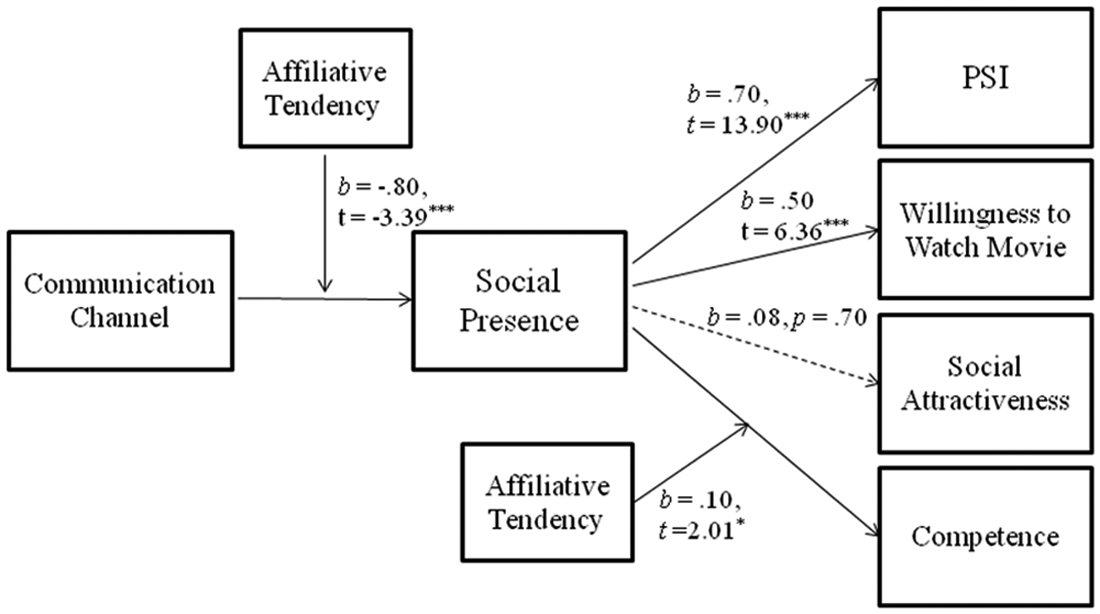
Moderated mediation model for indirect effects of communication channel: Study 1
When the same analyses were repeated for source evaluation (H2b, RQ2b), social presence had no significant main or interaction effects on perceived social attractiveness (bs < .09, ts < 1). It is possible that an indirect effect is statistically significant even when one of its paths is not (Hayes, 2009), but the conditional indirect effect of communication channel on perceived social attractiveness was mostly nonsignificant. For general competence, however, a significant interaction emerged between social presence and affiliative tendency (b = .10, t = 2.01, p < .05), such that the effect of social presence was more pronounced among those higher in affiliative tendency. In addition, the conditional indirect effect of communication channel on perceived competence was statistically significant only for those whose affiliative tendency score was +1 SD from the mean or higher (bs < −.28, Zs < −2.00, ps < .05); that is, more socially active individuals attributed greater capability to the target after reading a news article than the Twitter page. Although their less affiliative counterparts displayed the opposite tendency, it did not reach statistical significance (.30 < Zs < 1.88, .76 < ps < .07). Taken together, H2b was only partially supported for perceived competence among more affiliative individuals.
Lastly, we evaluated if social presence mediated the effects of communication channel on the willingness to perform a supportive action (H2c). Given the lack of significant interaction between social presence and affiliative tendency (b = −.02, t < 1), a reduced model was computed and yielded a significant main effect of social presence (b = .50, t = 6.36, p < .001), lending support to H2c. Just like parasocial interaction, communication channel exerted a significant indirect effect on the willingness to watch the actor’s movie, but in the opposite directions for more and less affiliative individuals. For socially reserved individuals, whose affiliative tendency score was −1 SD from the mean or lower, the Twitter page aroused greater interest in the movie than the news did (bs > .41, Zs > 2.49, ps < .02), whereas more affiliative individuals (+1 SD from the mean or higher) became more willing to watch it after reading the news (bs < −.36, Zs < −2.09, ps <.04).
Discussion
In sum, the celebrity’s Twitter page promoted the feelings that the participants were actually having a two-way conversation with him, as compared to the news article merely relaying his Tweets, but only for those who normally shy away from social interaction. Those placing greater value on social interaction and more actively pursuing social opportunities exhibited the opposite tendency, experiencing the target’s presence more vividly while reading the news article. One possible explanation for this counterintuitive finding might be expectancy violation. Although readers of celebrity Tweets would generally expect more of the private life of the celebrity on Twitter than in traditional media (Levinson, 2011), such a tendency might be more characteristic of highly affiliative individuals who have stronger craving for interpersonal contact. To these individuals, Park’s Tweets might not have seemed sufficiently personal and invited disappointment. Another possibility pertains to the absence of feedback mechanism. Not having the means by which they can participate in the interaction might have felt unnatural to those more willing to engage in social activities and even caused frustration.
Although social presence indeed mediated the effects of communication channel on parasocial interaction with the target and the intent of supportive action, its influence on source evaluation was rather limited, either nonsignificant (social attractiveness) or contingent on the affiliative tendency (general competence). Considering that social presence taps into a fleeting, transient judgment of the interaction, while source evaluation represents relatively stable and holistic judgments about the interactant (Biocca et al., 2003), such findings might simply indicate the disjunction between the two types of judgments of different temporality and scope. At the very least, however, the null effect of social presence on social attractiveness seems to contradict some previous findings, which demonstrated positive outcomes of heightened presence (e.g., Bente et al., 2008; Kelleher & Miller, 2006; Skalski & Tamborini, 2007). One explanation for such discrepancy concerns the nature of the interactant. Unlike previous studies employing unknown CMC partners (Bente et al., 2008) or a computer agent (Skalski & Tamborini, 2007), about whom participants had no prior attitudes or expectations, we had a well-known celebrity as the object of evaluation. As such, participants might have had more or less fixed impressions about the target, leaving little room for change in the first place. Moreover, when the target was a nonhuman being, such as a computer agent (Skalski & Tamborini, 2007) or a company running a web site (Kelleher & Miller, 2006), the attribution of social presence might in itself reflect positive attitudes toward the object, inflating its correlation with individuals’ evaluations of the target. That said, it merits note that social presence exerted a significant impact on perceived competence among more affiliative individuals. At least for those who prefer social activities and value social skills, the sense of direct interaction with the target was powerful enough to induce more favorable assessments of his competence.
Although the current findings illuminate when and how celebrities’ Twitter communication evokes positive reactions, since we only used one celebrity with a fixed set of messages on a single Twitter page, it remains unknown how valid and generalizable our conclusions are. For example, more and less affiliative individuals might hold different expectations of and/or attitudes toward the Twitter brand, and thus, responded differently to the actor’s Twitter page (vs. news article), which may or may not extend to other SNSs. Another potential threat posed by the idiosyncrasy of our stimulus concerns the positive effects of social presence on DVs. Given that the more vivid the target’s presence in the immediate environment, the more salient he or she becomes in one’s mind, one might suspect that social presence fostered parasocial interaction and the movie-watching intention because the participants were in general positively predisposed toward the actor (Skalski & Tamborini, 2007). Put differently, social presence might not be inherently positive, but rather amplify whatever attitudes people already have toward the target. Study 2 was conducted to address these concerns.
Study 2
The primary aims of Study 2 were threefold. First, it employed a local politician as the target. Although SNSs, especially Twitter, have become immensely popular among Korean politicians as a privately owned publicity channel through which they can broadcast their opinions on current affairs and/or reveal their personal side (Park, 2010), little is known about their efficacy. Potentially germane to the present research, Utz (2009) found that participants expressed more favorable attitudes when the candidate actually responded to the voters’ comments on a SNS, albeit the effect was observed only for the right-wing candidate. While assuring that politicians could engender more positive public evaluations using SNSs, her study did not examine if SNSs as a campaign channel, not the variation in their use (e.g., high vs. low interactivity), have any independent effects. Study 2 aimed to fill this void. Second, by using a lesser-known target, we attempted to control for the potentially contaminating effects of participants’ predispositions in investigating the relationships between social presence and subsequent judgments. Since participants did not know the target prior to the experiment, we could examine if social presence, in and of itself, would still bring about positive outcomes as in Study 1, when no preexisting attitude serves as an anchor. Third, to rule out the possibility that the Twitter brand might have somehow primed the participants’ reactions, we chose an alternative platform with virtually identical functions and features to Twitter: me2DAY. Being an indigenous microblogging service, me2DAY was launched in February 2007 and is among the most popular SNSs in South Korea, with more than 7 million users as of September 2011. By replicating Study 1 with a different SNS, we attempted to assess the robustness and generalizbility of its findings.
Method
Procedure
A total of 100 participants (53 men, 47 women, age M = 29.33, SD = 8.04) were recruited through the same online survey company used in Study 1, who were randomly assigned to either the news or the SNS condition. The procedure was identical to that of Study 1, except that a screen snapshot of me2DAY page was shown in the SNS condition, featuring Yoon-Hee Lee who ran for a provincial election in 2010 as an independent candidate. He presented his pledge, mentioned his connection with the world-famous soccer player Ji Sung Park while rooting for the Korean team in a match against Japan, solicited opinions for local issues (e.g., creating an official public forum for the city on me2DAY), and gave tips for a good grade based on his experience as a college professor, with a couple of his “friends” responding to his posts (see Figure 4). The news article was entitled, “A candidate for Su-Won mayor election enjoys online talks with voters, drawing public attention,” and no substantial information was added.
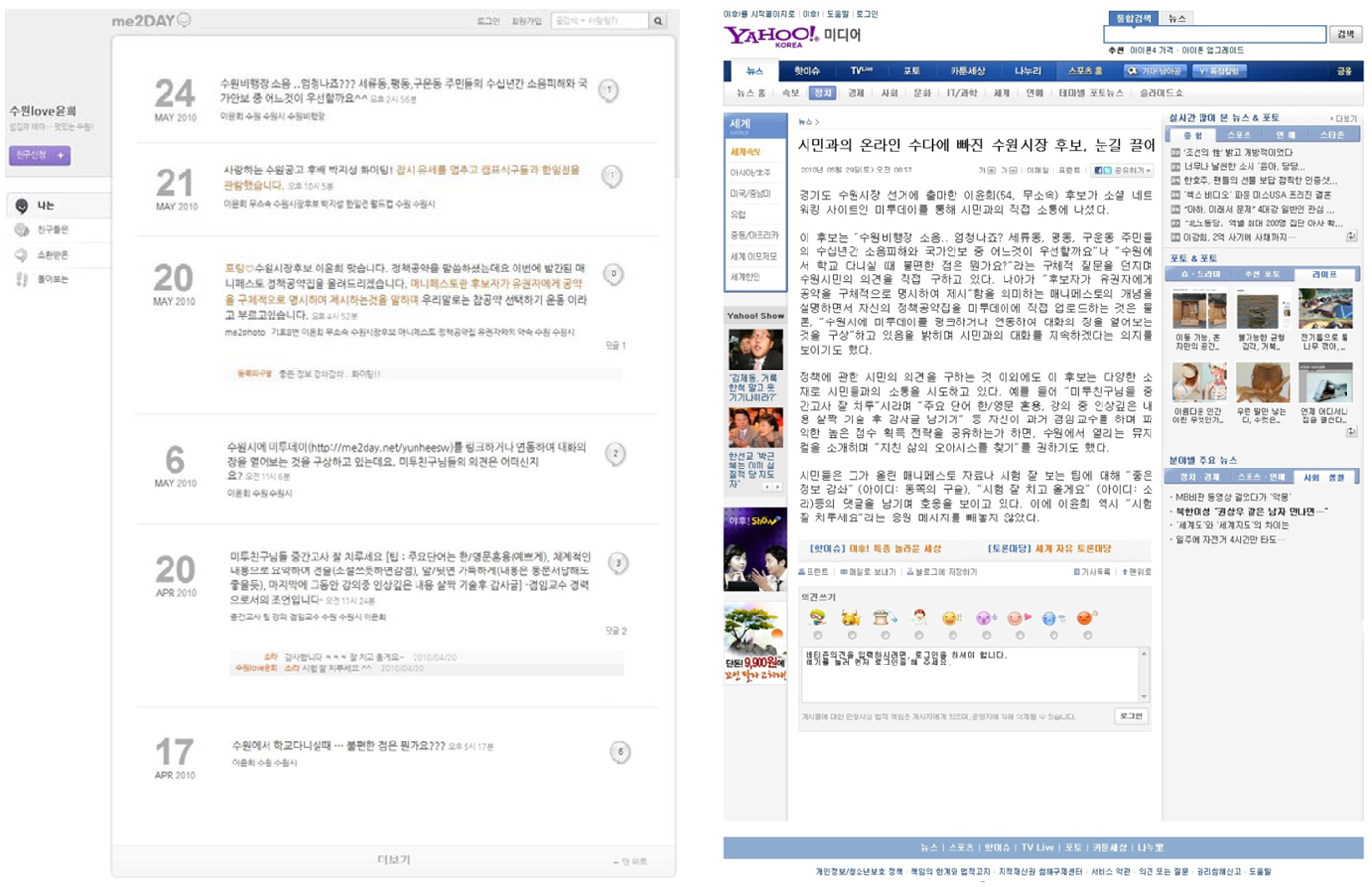
Screenshots of me2DAY page and news article: Study 2
Measures
All the variables were measured using the same scales as in Study 1, with three exceptions (see Table 2 for descriptive statistics). First, instead of Twitter use, me2DAY use was used in the analyses (0 = No use, 1 = Use; M = .11, SD = .31). Second, for the intent of supportive action, participants were asked how willing they were to vote for the target, if given an opportunity (1 = Not at all willing, 7 = Very much willing). Third, a factor analysis of source evaluation items yielded a single-factor solution, with social attractiveness and general competence clustered together (Eigenvalue = 6.34, % of variance accounted for = 70.46). Therefore, source evaluation score was computed by averaging the participants’ ratings across the nine items.
Descriptive Statistics and Intercorrelations of Key Variables: Study 2
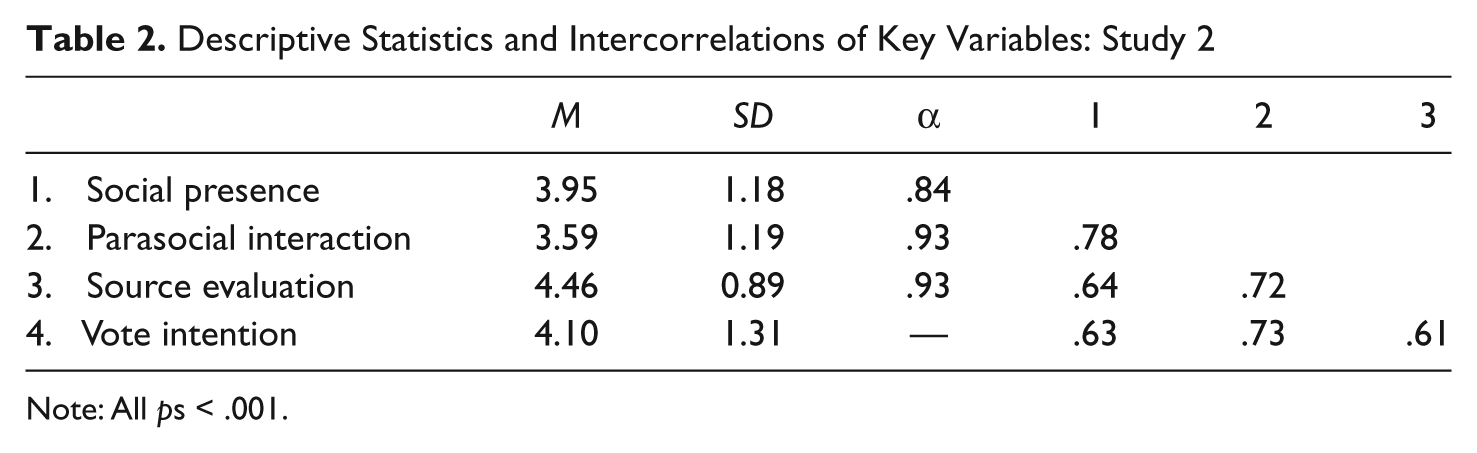
Note: All ps < .001.
Results
To examine if seeing an actual SNS page of a political candidate heightens social presence as compared to a news article (H1) and how an individual’s affiliative tendency moderates the effect (RQ1), we ran a moderated hierarchical regression analysis. First, demographic variables (sex, age, education) and me2DAY use were entered in the control block. Next, communication channel (0 = News, 1 = SNS) and mean-centered affiliative tendency constituted the second block, followed by the interaction term between the two.
Neither the control variables (ΔR 2 = .005, ΔF = .13, p = .97) nor the main effect terms (ΔR 2 = .007, ΔF = .31, p = .73) significantly increased the variance accounted for, failing to support H1. However, a significant interaction was found between communication channel and affiliative tendency (ΔR 2 = .05, ΔF = 5.30, b = −.62, t = −2.30, p = .02; see Figure 5). Simple slopes tests for two levels of the affiliative tendency (one SD below and above the mean) showed that exposure to the me2DAY page elicited a stronger sense of presence than the news article only for those low in affiliative tendency (b = .69, t = 1.97, p = .05). For more affiliative individuals, there was no significant difference between the SNS and the news conditions (b = −.38, t = −1.11, p = .27). 2
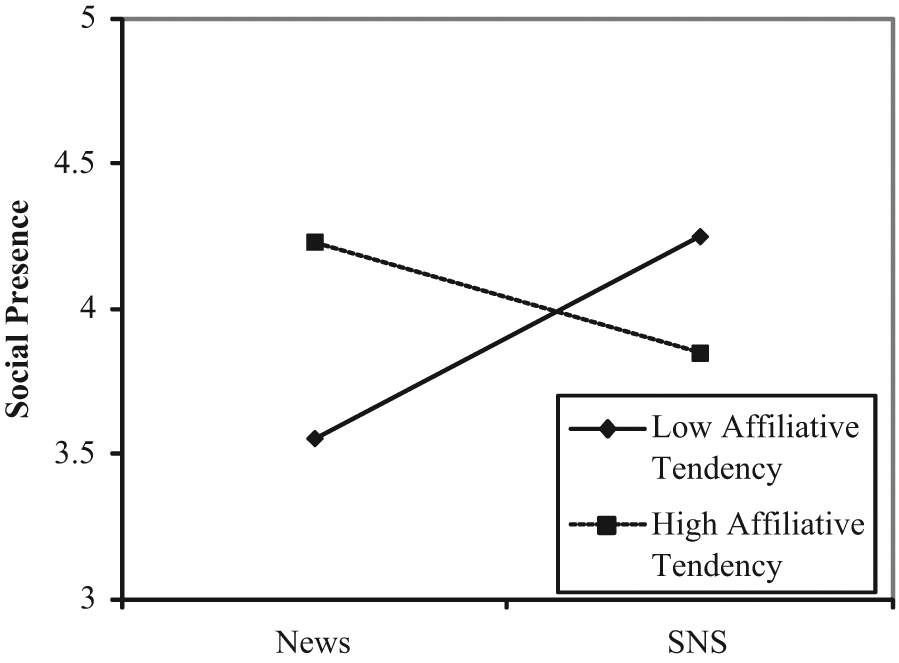
Interaction between communication channel and affiliative tendency on social presence: Study 2
The conditional indirect effects of communication channel on DVs (parasocial interaction, source evaluation, vote intention) through social presence were tested using MODMED macro (Preacher et al., 2007). Because the interaction between the mediator (social presence) and affiliative tendency was not significant for any of the DVs (all ts < 1), a reduced model was run without it (Model 2). Consistent with H2a, social presence facilitated parasocial interaction with the target, heightening perceived intimacy with the unacquainted politician (see Figure 6). Conditional indirect effect of communication channel on parasocial interaction was statistically significant for those whose affiliative tendency score was one SD below the mean or lower (bs > .56, Zs > 2.04, ps < .05), which indicates that the mere exposure to the SNS page (vs. news article) can create the illusion of friendship with the otherwise unknown candidate among less affiliative individuals, through increased feelings of direct conversation.
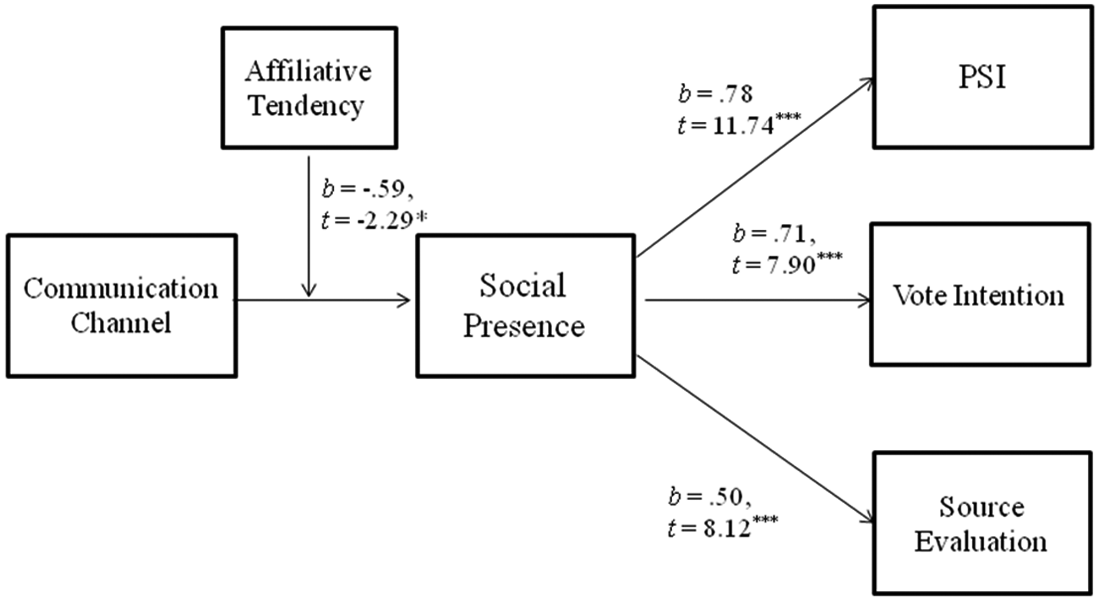
Moderated mediation model for indirect effects of communication channel: Study 2
Likewise, social presence had a positive main effect on source evaluation and vote intention (see Figure 6), lending support to both H2b and H2c. In addition, the conditional indirect effects of communication channel through social presence were significant only for those low in affiliative tendency (−1 SD from the mean or lower) for both source evaluation (bs > .35, Zs > 2.03, ps < .05) and vote intention (bs > .50, Zs > 1.96, ps < .05); that is, those less fond of interpersonal affiliation rated the target more highly and became more supportive of him after seeing his me2DAY page than reading his posts in a news story, with no corresponding differences among more affiliative individuals.
Discussion
Replicating Study 1, exposure to SNS communication promoted the “as if” feelings of being together with the target only for more socially reserved individuals. Once induced, however, heightened social presence facilitated pseudofriendship with the target, improved source evaluations, and enhanced vote intention, regardless of the participant’s affiliative tendency. Such results attest that the positive effects of social presence observed in Study 1 cannot be attributed solely to the participants’ favorable predispositions toward the actor. Even when there was no preexisting attitude toward the target, the feelings of direct conversation still induced more favorable impressions and behavioral intention, suggesting that social presence can do more than merely amplifying the already existing sentiment.
At the same time, some deviations from Study 1 were also noted. For those with more positive interpersonal orientation, perceived salience of the target did not vary whether the candidate’s words were preserved in the original context or buried in a news article. That is, they did not feel less of the target’s presence while viewing his SNS page as those in Study 1 did. As speculated previously, it might have to do with the gap between the participants’ expectancy and the actual communication in terms of message intimacy, such that even those with higher expectations about how “personal” SNS communication should be might have found the candidate’s posts sufficiently personal. Unfortunately, because we did not vary the message content, this post hoc conjecture cannot be tested with the current data, but it seems worthwhile to examine how affiliative tendency might interact with the message content to determine the level of social presence. Considering that the feedback capacity was still disabled, we can at least rule out the possibility that the inability to talk back to the target caused negative reactions to the SNS page from more affiliative individuals in Study 1.
When asked to assess a previously unknown target after reading several short microblogging messages, the participants’ source evaluations were not as fine-grained as when they judged a well-known (if not personally so) celebrity target. Not only were their impressions about the target less detailed, with no clear distinction between social attractiveness and general competence but they also seemed to be more easily swayed; that is, in the absence of a reasonable basis for judgments, the feelings of having a conversation with the target were sufficient to warrant positive overall evaluations of the candidate, regardless of the participant’s affiliative tendency.
Alternatively, the positive association between social presence and source evaluation might have to do with the target’s role. That is, the participants might have thought that the efforts to converse directly with ordinary citizens are more laudable or even compulsory for a political leader than for a movie star. As such, when they felt as if they were having a one-on-one conversation with the target, it might have primed their evaluation in a positive direction. By varying the role (actor vs. politician) and the existence of prior impression (known vs. unknown) independently, future research should clarify under what conditions social presence becomes more or less likely to influence general evaluations of the source.
General Discussion
The present experiments investigated if public figures’ SNS communication with their followers would foster a false sense of intimacy and produce more positive judgments about them, and if so, through what psychological mechanism. Even though the news article faithfully relayed a public figure’s microblogging posts, the communication channel through which the participants came into contact with the messages significantly altered the extent to which they felt the presence of the target, but only in conjunction with their interpersonal orientation. Specifically, those less predisposed toward social contacts were more likely to feel as if they were actually conversing with the target when exposed to the captured image of a microblog page than a news article, whereas their more socially proactive counterparts showed either the opposite tendency (Study 1) or no differentiation between the channels (Study 2). Perceived presence of the target, in turn, facilitated parasocial interaction with him and bolstered the participants’ willingness to perform a supportive action, but its influence on overall source evaluation was attenuated with the celebrity target (Study 1), possibly due to relatively well-entrenched preconceptions.
Theoretical Implications
First of all, the current results indicate that the medium matters, at least for some individuals. Although the role (actor vs. politician) and the status (celebrity vs. noncelebrity) of the target, as well as the SNS platform (Twitter vs. me2DAY) were varied across the two studies, communication channel (SNS vs. news article) had the similar effects on perceived presence of the mediated source and subsequent judgments about him, especially for more socially reserved individuals. Even though the news article conveyed the target’s and their followers’ SNS messages in direct quotes, when the messages were shown in the “he-said” manner, those less interested in social engagement experienced less of the target’s presence than when encountering the same messages on their original platform, with no one else standing in between the target and themselves.
Perhaps one of the most elusive concepts in the CMC literature, social presence has been generally discussed in relation to various structural properties of the medium, such as the capacity to transmit multiple cues and allow immediate feedback (i.e., cues-filtered-out perspective; Walther & Parks, 2002). Holding face-to-face interaction as the gold standard of human communication, which affords the highest level of social presence, researchers have investigated how mediation by technology “degrades” social interaction. Extending previous studies comparing nonmediated and mediated interaction, we examined the effects of remediation of SNS-mediated messages. Although the number of cues and feedback capability were held constant, doubly mediated messages significantly alter the message recipients’ subjective experiences, suggesting another dimension to consider in future scholarly quests for the determinants of social presence.
With respect to remediation, although we focused on the cases in which a public figure’s personal messages were redistributed by a mass media, reverse examples seem to abound. For example, numerous Internet users upload some segments of their favorite TV shows on YouTube or post a link to a news article on their personal blogs, prompting the question of how people might respond differently when they are led to the same content through a different route. Obviously, such questions go well beyond the concept of social presence per se, but it appears to point to a fruitful venue for future research in this era of media convergence.
Unlike previous studies that conceptualized social orientations, such as extraversion and the need to belong, as predictors of SNS use (e.g., Wilson et al., 2010), we demonstrated that the affiliative tendency can serve as a moderator of its effects. Specifically, both studies suggest that this new communication venue can be strategically utilized to reach out to less socially active individuals to cultivate perceived intimacy and improve their public images. By highlighting the role of social orientations as a moderator of its effects, we aimed to draw attention to the reception (vs. production) side of SNS communication, a relatively undertheorized domain so far. In fact, the null main effect of affiliative tendency on social presence in Study 2 seems to suggest that we need to take more nuanced approaches to the dispositional differences in social media use and its effects.
Limitations and Future Directions
Some limitations of the present research merit note. First, our sample did not include many current Twitter/me2DAY users, and thus, previous Twitter/me2DAY use was statistically controlled. However, prior experience with microblogging services might alter the channel effects observed herein in one way or another. For example, active microblog users might feel as much presence of the target when reading a news article quoting his microblog messages as when viewing his actual microblog page, by virtue of their familiarity with the service. Moreover, even among those who are equally dependent on a particular SNS, their perceptions of what the medium is for (i.e., media appropriateness; Rice, 1993) can vary, and those who see the service as an inherently interpersonal medium might experience a higher level of social presence than those utilizing it mostly for information-seeking purposes.
Second, our participants simply viewed the target’s SNS communication as a third-party observer, as opposed to active participants. Although this was necessary to ensure comparability with the news condition, it remains unknown how participants’ reactions might change when they are given the opportunity to engage in the message exchange. For example, when they are made to compose a message to the target, even if it does not garner any reactions from him or her, it might still promote more favorable attitudes toward the target, possibly through the changes in self-perception (“I must be fond of him; otherwise I would not have sent a message to him”). Such strategic value of this two-way communication channel seems quite worthwhile to explore in the future investigation.
Given that parasocial interaction was originally conceptualized as a psychological state conditioned by repeated encounters with media personalities over an extended period of time (Horton & Wohl, 1956), the concept might not seem well-suited in the current context, as participants’ reactions were measured immediately following a brief, single exposure to the target person’s SNS messages. Despite the apparent deviation from its original definition, however, at least one study (Rubin et al., 1985) found a negative association between the news viewing level and PSI, leading to the conclusion that “a history and consistency of the viewing experience” are not necessary for “the development of parasocial relationship” (p. 175). In fact, although they made no explicit reference to PSI, quite a few CMC studies have considered attributional confidence and personal interest, the key components of PSI, as main outcomes of one-shot technology-mediated interaction (e.g., Bargh, McKenna, Fitzsimons, 2002; Tanis & Postmes, 2003; Tidwell & Walther, 2002). Still, it would be interesting to see how repeated exposure to public figures’ SNS messages might affect the public’s evaluations of and attitudes toward them.
Conclusion
In their now classic work, Horton and Wohl (1956) noted that “the illusion of face-to-face relationship with the performer” is “one of the striking characteristics of the new mass media—radio, television, and the movies” (p. 215). More than five decades later, as an increasing number of celebrities and politicians begin to broadcast their mundane daily routines and innermost feelings and thoughts using various SNSs, one might think that such illusion is now turning into reality—they seem to be closer to us than ever.
Technologically speaking, there is indeed no reason for public figures’ SNS-based interaction with their followers to remain at the parasocial level. Practically, however, such interaction is most likely to be asymmetrical in nature, with the vast majority of “followers” or “friends” silently listening to the profile owner’s personal reports that are often too trivial, controversial, and/or self-promotional to draw the attention of the mainstream media. As such, can SNSs truly revolutionize the ways in which public figures communicate with their supporters and establish rapport with them? Or are they simply being exploited as an additional publicity channel through which those in need of public spotlight and support strive to create a false sense of intimacy and positive impressions? What appears to be the fastest-diffusing communication technology in human history, SNSs seem to urge communication researchers to revisit this aged concept, drawing our attention to the question of what makes social interaction truly social, not just para-social.
Footnotes
Authors’ note
The research reported herein was conducted while the second author was at Seoul National University.
Declaration of Conflicting Interests
The authors declared no potential conflicts of interest with respect to the research, authorship, and/or publication of this article.
Funding
The authors received no financial support for the research, authorship, and/or publication of this article.
Notes
Bios