



Abstract
This paper presents a framework implementing the Psychology Board of Australia’s Competency 8 through an Indigenous Rights-Based Approach (IRBA), recognising that effective cultural competency requires Indigenous expert leadership rather than models developed without Indigenous guidance. Centring Indigenous Sovereignty, self-determination, and reciprocal partnerships with Indigenous experts, the framework emphasises sustained relationships rather than episodic training. The three-tiered structure—Active Engagement, Adapting Practice, and Synthesis and Integration—guides practitioners from foundational understanding to systemic leadership, addressing colonial legacies within educational systems. It provides practical applications across all seven Competency 8 subsections, including culturally responsive care, trauma-aware practices and consultation frameworks, underpinned by pedagogically informed approaches. Critically, this paper addresses how implementation of Competency 8 risks placing another “colonial load” on Indigenous people expected to fix colonial systems without addressing the fundamental systemic flaws. The framework advocates for structured, Indigenous-expert-led supervision and reflective practice incorporating Indigenous ways of being, knowing, and doing, supporting professional growth of both Indigenous and non-Indigenous psychologists. By centring Indigenous rights, it provides actionable guidance for creating culturally safe environments that honour Indigenous students’ identities, aspirations, and inherent capabilities, contributing to decolonising psychological practice and fostering equity within Australian educational contexts.
Keywords
Introduction
School psychology in Australia operates at the convergence of professional obligations, educational systems and Indigenous rights. Australia’s endorsement of the United Nations Declaration on the Rights of Indigenous Peoples (UNDRIP, United Nations, 2007) established fundamental principles for Indigenous self-determination, cultural preservation, and equitable access, creating critical foundations for understanding Indigenous rights. The Psychology Board of Australia’s (PsyBA, 2024b). Competency 8 addresses historic inequities by mandating human rights and health equity approaches when working with Aboriginal and Torres Strait Islander clients . Moving beyond cultural awareness towards structural change requires frameworks grounded in the Indigenous Rights-based principles.
Competency 8 requires practitioners to address colonisation’s ongoing impacts, systemic educational inequities, and rights-based practice through culturally responsive care, trauma-informed approaches, and self-determined decision-making (PsyBA, 2024b). However, colonial legacies continue shaping institutional practices, creating implementation gaps (Dudgeon, Rickwood, et al., 2014; Herbert, 2012). Existing professional development resources offer generalised principles that fail to address the fundamental repositioning required for rights-based work.
Competency 8 in Education Settings
School psychologists face challenges beyond role clarity, resource constraints, and system navigation (Castillo et al., 2014; Eklund et al., 2019; Jimerson et al., 2008.) They must navigate educational ecosystems historically functioning as instruments of cultural assimilation (Hickling-Hudson & Ahlquist, 2003; Ma Rhea, 2015a), identified as “educative trauma,” the intergenerational repercussions of harmful educational policies (P. J. Anderson et al., 2024). Contemporary practices often perpetuate deficit narratives, positioning Indigenous learners as problems to fix rather than sovereign individuals with inherent capabilities (Fforde et al., 2013; Fogarty, 2015).
These challenges create an urgent need for frameworks to guide school psychologists towards genuine rights-based practice. An Indigenous Rights-Based Approach (IRBA) provides a transformative bridging methodology that transcends surface-level cultural awareness to challenge the epistemological foundations of professional practice. However, translating Competency 8 principles into the specific context of school psychology requires sustained collaboration between Indigenous leadership and disciplinary experts to navigate the unique intersections of psychological practice and educational systems.
This gap prompted collaboration when Howe and Fox, researching barriers to school psychologists’ practice, approached Anderson and Diamond, who had developed IRBA for initial teacher education (P. J. Anderson et al., 2024). IRBA provides pathways for understanding Competency 8 as embodied rights-based principles. Anderson’s leadership guided operationalisation of rights-based competencies, shaped by analysis of Indigenous leadership across multiple disciplines (P. Anderson et al., 2025), proposing five IRBA elements: challenging deficit narratives; establishing ethical reciprocal relationships, validating Indigenous epistemologies; ensuring outcomes serve Indigenous priorities; and addressing systemic barriers.
This paper demonstrates how Indigenous leadership in dyadic collaboration with non-Indigenous disciplinary experts can advance rights based psychological service delivery. (P. Anderson et al., 2025). Without such frameworks, implementation risks increase colonial load (Weenthunga Health Network, 2023) through episodic professional development that does not allow for the necessary personal and systems-level transformation required.
Through this dialogic approach, co-constructing knowledge where Indigenous rights guide the interrogation of colonial norms within the profession established foundations translating abstract Indigenous rights principles into concrete professional practices guiding school psychologists working with Aboriginal and Torres Strait Islander students, families, and communities, ensuring that self-determination can be realised through reciprocity and partnership.
Terminology Statement
This paper employs specific terminology aligned with Indigenous rights-based practice:
Indigenous/Aboriginal and Torres Strait Islander Peoples: Recognises two distinct groups of Australia’s First Peoples. We capitalise these terms when referring to First Peoples, their cultures, knowledge systems, and communities, and when referencing international frameworks such as UNDRIP (2007, 2022).
Sovereignty: The inherent rights of Aboriginal and Torres Strait Islander Peoples predating and surviving colonisation, encompassing self-governance, self-determination, and authority over lands, waters, and cultural practices. We recognise Sovereignty as a living principle informing all professional practice.
Colonial load: The inappropriate burden placed on Indigenous Peoples to educate non-Indigenous professionals without reciprocal institutional commitment (Weenthunga Health Network, 2023).
Competency 8: Psychology Board of Australia’s (2024b) eighth competency area, requiring psychologists to work with knowledge of Aboriginal and Torres Strait Islander Peoples, mandating rights-based practice grounded in Indigenous self-determination.
Background
The Methodological Foundation
IRBA represents a fundamental departure from conventional cultural competency approaches, functioning as decolonising methodology and transformative professional development, challenging Western academic disciplines’ epistemological foundations (P. Anderson et al., 2025). Unlike Critical Race Theory, (Delgado & Stefancic, 2023) examining how race and racism are embedded in systems, IRBA addresses sui generis (unique, inherent) rights of Indigenous peoples predating colonisation, prioritising Indigenous-led governance, perspectives, and knowledge systems.
The Dyadic Dialogic Partnership Model: Discipline-based Positionality
Central to this methodology is a dyadic dialogic partnership between Indigenous and non-Indigenous experts, where Indigenous leadership guides processes while building authentic capacity for culturally safe practice. This collaborative model establishes protocols ensuring partnerships built on reciprocity, respect, and shared authority (P. Anderson et al., 2025). Our partnership united Anderson (Aboriginal higher education expert), Diamond (IRBA co-developer), and two non-Indigenous colleagues—psychology and behavioural science experts—developing discipline-specific applications for Competency 8. Through dialogue, the methodology identified disciplinary barriers to Indigenous rights realisation while developing specific IRBA applications, documenting how Indigenous rights principles integrate into psychological practice while maintaining Indigenous Sovereignty over cultural knowledge.
Key Transformative Insights From Sustained Indigenous Leadership
The collaboration revealed three critical transformations: First, examining professional foundations exposed how Western psychological paradigms perpetuate deficit narratives. Even strengths-based approaches maintain assumptions that students require professional intervention to develop presumed lacking capabilities. Second, fundamental repositioning emerged through understanding self-determination as recognising Indigenous students’ inherent capabilities rather than empowering them. While empowerment concepts gained favour in the 1980s (Rappaport, 1981), community psychologists questioned psychologists empowering others (Riger, 1993). Through IRBA, we shifted professional focus from fixing perceived deficits to addressing systemic barriers preventing students from exercising existing rights and capabilities. Third, Anderson guided reconceptualisation of professional development from discrete competencies to a transformative journey, revealing how psychology practitioners can respect Indigenous authority whilst mobilising professional expertise serving Indigenous self-determination. These insights demonstrate that implementing Competency 8 requires sustained Indigenous leadership and ongoing critical reflection rather than episodic training.
Methodological Implications
Ensuring Competency 8 reflects Indigenous Rights-based understanding requires practical frameworks. Conventional cross-cultural competency approaches—cultural awareness training or sensitivity workshops—fall short of fundamental epistemological shifts required for genuine rights-based practice (Fish et al., 2023; Gray et al., 2025). As traditional professional development models often perpetuate colonial power dynamics (Dudgeon & Pickett, 2000; Westerman, 2010).
IRBA methodology demonstrates meaningful engagement with Indigenous rights requires ongoing commitment to learning, relationship-building, and systemic change, rather than achieving predetermined benchmarks (P. Anderson et al., 2025; Wilson, 2008). Approaches lacking this commitment risk perpetuating colonial load. IRBA establishes clear protocols for Indigenous leadership within structured partnerships, ensuring Indigenous Sovereignty remains central while non-Indigenous practitioners assume responsibility for their learning (P. Anderson et al., 2025). This differs fundamentally from conventional training, treating Indigenous knowledge as content to learn rather than an active process facilitating fundamental shifts in professional identity and practice (P. Anderson et al., 2025; Kovach, 2021; Wilson, 2008)
Competency 8 in Context: The Framework
While Competency 8 represents significant advancement, this complex work must occur within challenging educational ecosystems. Existing resources offer generalised principles failing to address how practitioners authentically enact competencies while working within systems perpetuating dynamics they seek to transform.
The framework translates theoretical and methodological insights into actionable guidance through a three-tiered developmental structure—Active Engagement, Adapting Practice, and Synthesis & Integration—acknowledging Indigenous rights-based practice as a transformative journey rather than discrete skills. Each tier encompasses Competency 8’s seven specific areas (PsyBA, 2024b) while reframing them through an Indigenous rights-based lens
Table 1 details Competency 8 implementation. The framework addresses seven competency areas through Active Engagement (Foundational Level), Adapting Practice (Intermediate Level), and Synthesis & Integration (Advanced Level), reflecting dynamic, developmental approaches to professional learning aligned with adult education, psychological practice, and pedagogical design theories.
Implementation guide for enacting competency 8 through indigenous rights-based practice in school psychology.
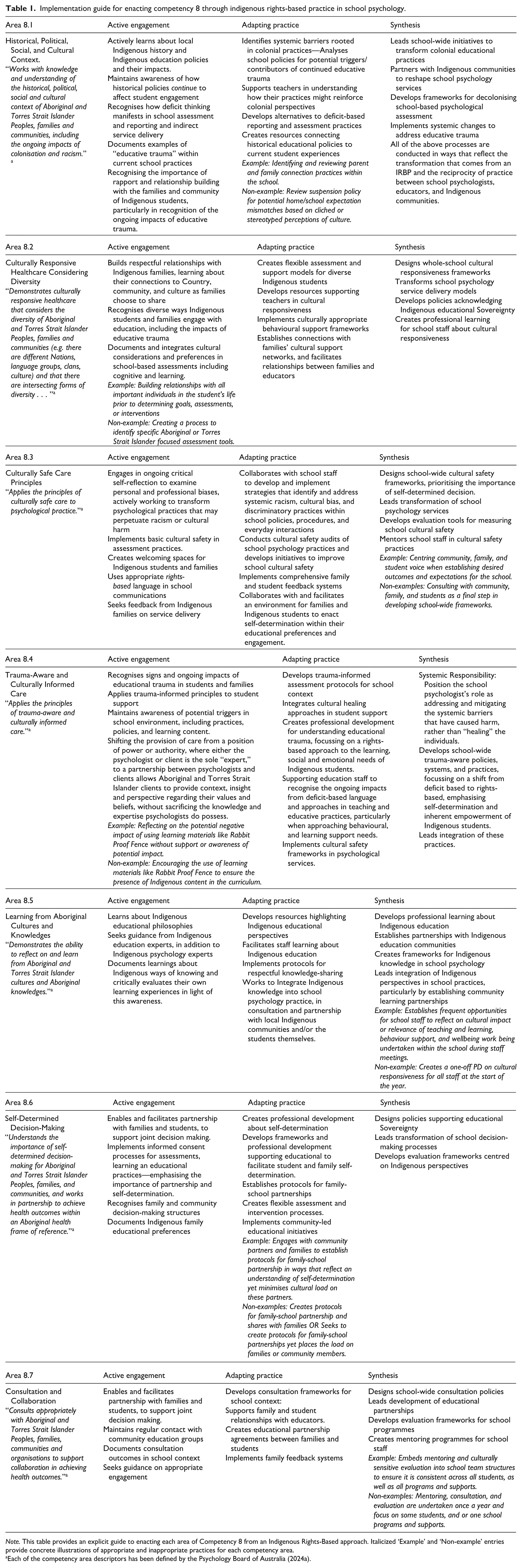
Note. This table provides an explicit guide to enacting each area of Competency 8 from an Indigenous Rights-Based approach. Italicized ‘Example’ and ‘Non-example’ entries provide concrete illustrations of appropriate and inappropriate practices for each competency area.
Each of the competency area descriptors has been defined by the Psychology Board of Australia (2024a).
The Foundational Level draws on Knowles’ (1980) andragogy principles, emphasising self-directed learning and experiential engagement through situated learning (Lave & Wenger, 1991). The Intermediate Level reflects Vygotsky’s (1978) sociocultural theory and zone of proximal development, where learners refine competencies through scaffolded challenges. Professional development literature underscores reflective supervision, case-based learning, and iterative feedback importance (Falender & Shafranske, 2017). Mezirow (1991) highlights transformative learning through critical reflection on assumptions. The Advanced Level embodies integrative pedagogy (Tynjälä, 2008), where learners synthesise theoretical, practical, and self-reflective dimensions into coherent expertise—epistemic fluency (Markauskaite & Goodyear, 2017), navigating multiple knowledge systems. The developmental structure aligns with constructive alignment (Biggs & Tang, 2011) and contemporary lifelong learning models (Clegg, 2008), recognising psychologists’ growth as non-linear, contextually mediated, and deeply relational.
Active Engagement (Foundation Level) establishes essential awareness through building respectful relationships with Indigenous families, learning local Indigenous history and educative trauma impacts, and developing basic cultural safety. Activities include documenting educative trauma examples, recognising diverse Indigenous family engagement, and implementing informed consent, emphasising partnership and self-determination.
Adapting Practice (Intermediate Level) moves beyond awareness to active practice modification. Practitioners identify systemic barriers rooted in colonial practices, develop culturally appropriate assessments, and create resources supporting teacher cultural responsiveness through cultural safety audits, family feedback systems, and trauma-informed protocols.
Synthesis and Integration (Advanced Level) involves leading systemic transformation through designing school-wide frameworks, developing cultural safety evaluation tools, and mentoring others in rights-based practice. Practitioners lead initiatives transforming colonial educational practices and establish partnerships with Indigenous communities to reshape services.
Implementation in the School Context
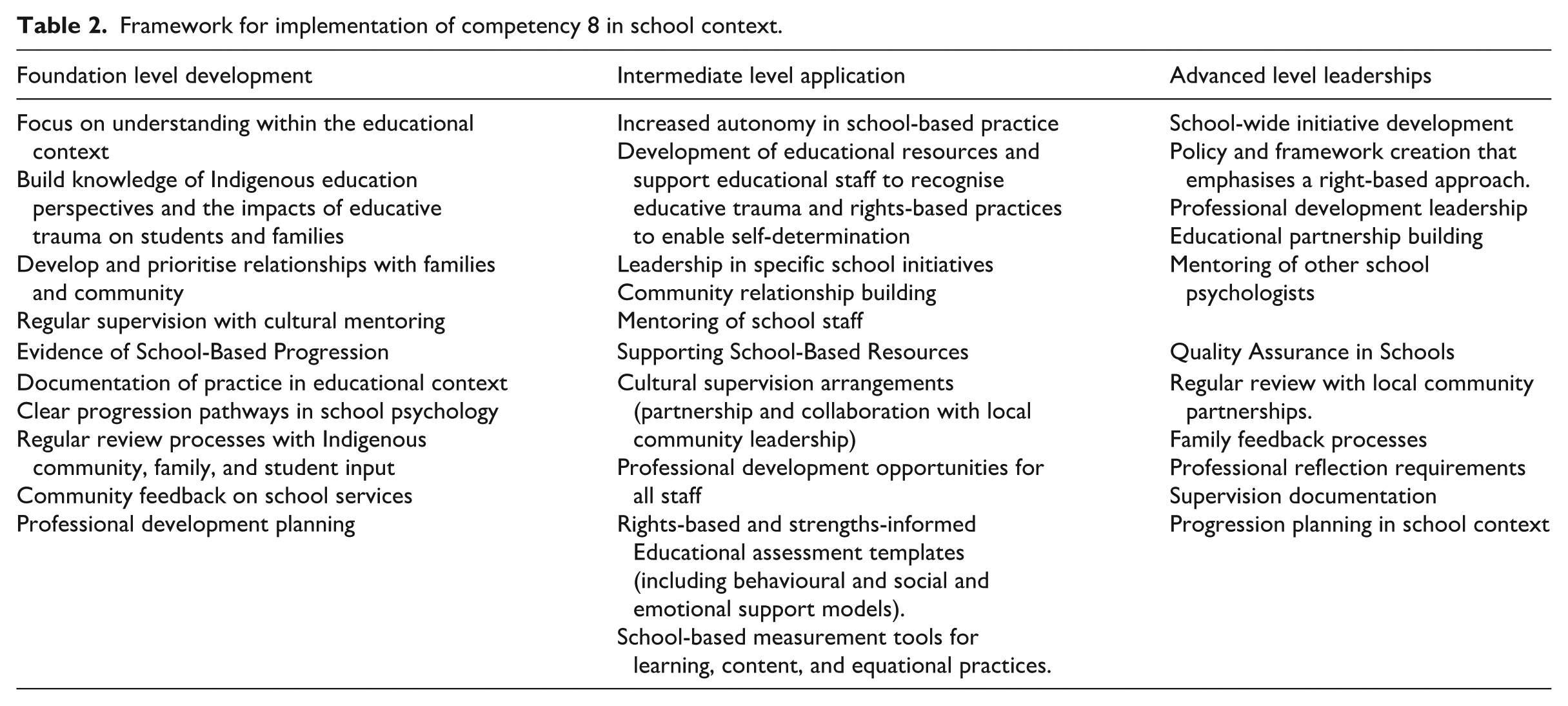
Genuine rights-based practice requires systemic support within school contexts. Table 2 outlines supporting structures across three dimensions: developmental progression purpose, supporting resources importance, and quality assurance measures. Supporting resources include Indigenous leadership through negotiated partnerships, professional development for all staff, rights-based assessment templates, and school-based measurement tools, providing concrete implementation tools while avoiding colonial load. Quality assurance mechanisms—regular community partnership reviews, family feedback processes, professional reflection requirements, supervision documentation, and progression planning—ensure sustained, authentic implementation aligned with Indigenous community priorities and rights-based principles
Framework for implementation of competency 8 in school context.
Critical Implementation Features
Several features distinguish this framework from conventional approaches:
Progression as Journey: The three-tiered structure acknowledges developing Indigenous rights-based practice as transformative professional journey requiring ongoing learning and reflection, not discrete competency acquisition.
Systemic Focus: The framework emphasises systemic change, developing school psychologists as transformation agents.
Partnership with Indigenous Experts: Implementation requires genuine Indigenous expert partnership, with regular reviews ensuring alignment with Indigenous Peoples’ rights and priorities rather than institutional agendas.
Rights-Based Foundation: All activities grounded in Indigenous rights, moving beyond cultural sensitivity training to fundamental professional practice repositioning.
Practical Application: The framework provides concrete examples and non-examples for each competency area, clarifying what to do and avoid.
This comprehensive framework provides structured pathways for authentic Competency 8 implementation while maintaining Indigenous Sovereignty and addressing educational practice complexities, honouring Indigenous peoples through Indigenous leadership rather than non-Indigenous interpretation
Discussion
Addressing Practice Translation Gaps Through Sustained Indigenous Leadership
The framework embodies a fundamental reconceptualisation of school psychologists’ roles in supporting Indigenous rights. Through dyadic dialogic methods, we discovered current professional development misunderstands Indigenous rights-based practice by treating it as a discrete competency rather than a transformative journey reshaping professional identity and exposing colonial mindsets underlying psychology. Indigenous experts commonly face non-Indigenous practitioners immobilised by guilt and shame. Without Indigenous leadership, well intentioned practitioners risk causing further harm. The framework acknowledges these phenomena through scaffolded pedagogical approaches. Guilt-remorse experienced by non-Indigenous individuals recognising privileged status within racially stratified systems represents normative identity evolution stage confronting complicity in systemic racism (Helms, 1995). While guilt may initially motivate ethical conduct, competence, and justice require continual self-examination, collaborative learning, and adaptation. Our dyadic, dialogic work allowed Indigenous wisdom to shape navigation of shame and guilt manifestations, fostering genuine change through ongoing dialogue, reflexive supervision, and crucially, centring Indigenous rights and epistemologies—not white practitioners’ emotional comfort (Tuck & Yang, 2012)
Insights from our collaborative partnership revealed fundamental inadequacies extending beyond insufficient professional development approaches to critical gaps in translating rights-based principles into accountable, actionable practice within educational systems (P. J. Anderson et al., 2024; Dudgeon, Milroy, & Walker, 2014).
Theoretical Complexity in Professional Practice
Enacting Competency 8 requires school psychologists to fundamentally question field assumptions and theoretical foundations of practice. This requires Indigenous psychology experts to lead examination of how psychological theories, knowledge, and assessments historically privileged Western paradigms over Indigenous ways of knowing and being. This aligns with Gray et al. (2025) advocating “epistemic pluralism,” elevating Practice-Based Evidence rooted in Indigenous leadership. Indigenous knowledge becomes central to navigating transitions from “functional competencies” to transformative practice genuinely serving Indigenous rights (P. J. Anderson et al., 2024).Skills Development for Engaging in Systemic Change
Meaningful change requires school psychologists to identify structural obstacles and colonial legacies within educational frameworks while developing innovative strategies prioritising Indigenous rights. This framework acknowledges “educative trauma” enduring effects (P. J. Anderson et al., 2024) while reshaping understanding of psychological service delivery. Achieving systemic change requires recognising social and political intricacies of educational environments. School psychologists can prioritise fostering relationships with Indigenous families and communities, implementing psychoeducation and educator consultations disrupting entrenched hierarchies sidelining Indigenous voices. This work requires navigating tensions between Indigenous Rights-based practices application, colonially embedded institutional regulations, and colonial legacy educational framework functioning, whilst advocating transformative change.
Developing Reciprocal Partnership
The dyadic dialogic partnership at the heart of this research exemplifies collaborative approaches necessary for authentic rights-based practice. School psychologists must partner with Indigenous communities, recognising that intersecting lived experiences and professional expertise is crucial for advancing school-based psychological practices. This reciprocal knowledge exchange model provides templates for practitioner engagement while avoiding colonial load (Weenthunga Health Network, 2023).
Partnerships mitigate risks of non-Indigenous professionals perpetuating colonial load when seeking guidance. Colonial load increases when engagement is transactional and tokenistic rather than meaningful, critical reflection and professional development, for example, seeking Indigenous knowledge solely for NAIDOC or Reconciliation Week, or one-off workshops.
School psychologists further perpetuate colonial load when seeking guidance on trauma-informed practices without acknowledging school systems’ historical role in intergenerational trauma, or burdening Indigenous students with educating peers, staff, and psychologists about Indigenous knowledge, systems, and protocols. While student voices are invaluable, primary responsibility for developing Indigenous rights-based approaches rests with psychologists as professionals. This is addressed through ongoing Indigenous supervision, genuine community engagement, and systematic Indigenous knowledge systems integration into professional practices. School psychologists must work closely with Indigenous students, staff, families, leadership, and local communities, fostering partnerships where knowledge exchange is valued, reciprocal, and respectful
Structural Change Supporting Reflective Practice
The transformative journey documented through ongoing dialogical dyadic collaboration and critical reflection demonstrates how reflective practice functions as mechanism through which theoretical insights become embodied understanding. This reflective process must be embedded in school psychologists’ professional development for Competency 8, Indigenous expert engagement and substantial systemic with necessary financial arrangements enabling ongoing Indigenous professional development leadership. The Psychology Board of Australia must lead Indigenous expert group development, guiding Competency 8 implementation with sufficient resources, enabling effective professional accountability.
School psychologists must commit to ongoing reflective practice through structured examination of professional identity practices and impact. This included regularly evaluating assumptions, biases, and professional practices through individual reflection and collaborative supervision, with ongoing Indigenous leadership in dialogic exchange. Psychologists must seek Indigenous education and psychology expert input, engaging in structured individual and peer supervision while genuinely valuing Indigenous rights. Actively engaging in reflective practices could involve systematic methods whereby psychologists maintain practice journals and shareable case notes, forming ongoing dialogic accountability with Indigenous experts, promoting Indigenous rights-based perspectives while ensuring responsibility lies with practitioners.
Ongoing structured reflective practice enables school psychologists to acquire professional insight for informed clinical decisions about Aboriginal and Torres Strait Islander students’ rights. By integrating reflective practice with clinical judgement and ethical decision-making, school psychologists employ systematic approaches meeting competency 8.
Key reflective questions supporting this process include:
Professional Context and Capacity:
- What is your current role and scope of practice?
- How do personal and professional experiences influence your approach to Indigenous students?
- What resources and support systems are available, and how can they support Indigenous rights-based practice?
Practice Implementation:
- How does your practice style align with Indigenous ways of knowing and being?
- What adaptations might better support Indigenous rights?
- How can you utilise ethical decision-making frameworks, navigating tensions between institutional requirements and Indigenous rights-based practice?
These reflective questions should be analysed across different levels and practice aspects in Tables 1 and 2. By addressing these questions through clinical judgement and ethical decision-making perspectives, school psychologists deepen understanding of how to evolve practice while upholding professional standards and supporting Indigenous rights, moving beyond acquiring isolated competency skills towards establishing integrated, rights-based foundations for professional work.
Conclusion
Competency 8 implementation represents a transformative opportunity for school psychology moving towards practice centred on Indigenous rights. This requires school psychologists to develop a profound commitment to rights-based practices, moving beyond cultural awareness.
A rights-based approach through this framework represents a significant evolution beyond traditional empowerment, cultural awareness, and strengths-based practice models. While these approaches contributed to more inclusive psychological care, they remain limited by focussing on individual capacities without addressing structural and relational justice dimensions. Rights-based frameworks foreground Indigenous Sovereignty, self-determination, and collective rights (UNDRIP, 2007), shifting emphasis from cultural sensitivity to accountability and systemic transformation. This approach aligns with Dudgeon, Rickwood, et al. (2014), arguing culturally responsive practice must embed recognition of historical trauma, ongoing colonisation, and genuine partnership with Indigenous communities. This helps avoid tokenistic cultural awareness training, supporting decolonising methodologies centring Indigenous epistemologies and relational accountability (Sherwood, 2013). By integrating Indigenous-led frameworks such as Dadirri (Ungunmerr-Baumann, 2002) and the Social Emotional Well Being (SEWB) model (Gee et al., 2014), Indigenous strengths situate within broader resistance, resilience, and cultural continuity narratives rather than deficit-framed service paradigms, enabling profound practitioner reflexivity, relational ethics, and structural change commitment. Psychologists become not only cross-culturally competent but ethically engaged and politically aware. Such shifts reflect direct, practical responses to Indigenous scholars’ urgent calls for decolonised, culturally safe psychology achieving “epistemic pluralism” required to genuinely serve all communities (Gray et al., 2025).
The transformative journey outlined, progressing from Active Engagement to Adapting Practice and ultimately Synthesis and Integration, recognises Indigenous rights-based practices as an ongoing commitment to learning and systemic change. This journey requires school psychologists to critically examine their profession’s theoretical foundations, address systemic barriers, and actively create educational environments where Indigenous students thrive.
As we progress, implementing Competency 8 success will be evaluated by individual skill development and extent to which it fosters systemic transformation within educational contexts. School psychologists, working alongside educators and Indigenous communities, have distinctive opportunities to redefine how psychological services are delivered to Indigenous students. By prioritising Indigenous rights, school psychologists can create educational environments where Indigenous students’ identities, cultures, and ways of knowing are honoured, and their academic experiences are shaped by their aspirations.
The journey towards fully implementing Indigenous rights-based practices in school psychology requires courage, commitment, and willingness to engage with complexity. It calls for transformation in practice and perspective, recognising the work is not about prevention and behaviour management approaches to problems faced by Indigenous students, but addressing systems that have historically failed them.
Footnotes
Acknowledgements
We would like to acknowledge the pioneering work of Professor Patricia Dudgeon, University of Western Australia and Dr Tracy Westerman, Jilya Institute and the Australian Indigenous Psychologists Association.

Ethical Considerations
Not applicable.
Consent to Participate
Not applicable.
Funding
The authors received no financial support for the research, authorship, and/or publication of this article.
Declaration of Conflicting Interests
The authors declared no potential conflicts of interest with respect to the research, authorship, and/or publication of this article.
Data Availability Statement
Not applicable.