



Abstract
This paper examines the emerging professional expectation that school psychologists will be able to demonstrate competency in delivering services to Indigenous students. We argue that achieving this competency requires an underpinning Indigenous rights-based perspective embedded in professional education and practice. We discuss the historical context of psychology in Australia, the competencies needed for psychologists and the critical role psychologists might play in advocating for the rights and self-determination of Indigenous Peoples both internationally and specifically in Australia. Additionally, we explore the challenges within the Australian education system, the deficit perspectives surrounding Indigenous students and the need to shift to rights-based approaches to support these students effectively. The paper also covers topics such as the cultural competency of teachers, the impact of settler colonial education policies on Indigenous youth and the intersection of Indigenous rights and psychology. Overall, the paper provides insights into the evolving role of school psychologists in the requirements of Competency 8 and argues for the significance of an Indigenous rights-based approach to providing professional services in education.
Keywords
Introduction
The rights of Indigenous Peoples have gradually become recognised internationally through mechanisms such as the United Nations Declaration on the Rights of Indigenous Peoples (2007) International Labour Organisation 169, and in psychology through declarations such as the International Declaration on Core Competencies in Professional Psychology (International Union of Psychological Science, 2021) that focusses on the importance of understanding the impact of culture on psychological work. The IUPS Declaration’s guidance encourages knowledge of historical, political, social and cultural contexts, cultural humility, respect for diversity and effective communication with diverse audiences. Such international perspectives in psychology are supported by emerging literature, such as Blume et al. (2020), who explicitly examined Indigenous perspectives on the practice of psychology and the intersection of psychology with human rights. These international policy and professional conversations are beginning to be recognised in Australia’s psychology profession’s development.
Proposed revision of the competencies regarding Indigenous peoples in Australia
Under the Health Practitioners Regulation National Law Act (HPRNLA, 2009), the Australian Psychological Accreditation Council and the Psychology Board of Australia must regularly review the standards and graduate competencies to ensure they are contemporary and relevant. Changes to the National Law Act throughout 2022 specifically identified the importance of cultural safety as a guiding principle and professional practice competency for all Australian health practitioners (HPRNLA, 2022). This resulted in the Psychology Board of Australia (PsyBA) proposing revisions to their graduate competency areas (PsyBA, 2024), identifying Competency 8 as a specific requirement where all registered psychologists would be required to be able to demonstrate a health equity and human rights approach when working with Aboriginal and Torres Strait Islander peoples, families and communities (Australian Health Practitioners Regulation Agency [AHPRA], 2023, p. 14).
The proposed revisions mark a significant step towards ensuring that all psychologists are equipped with the necessary knowledge, skills and abilities to work effectively with Aboriginal and Torres Strait Islander peoples, families and communities.
. . . the ongoing critical reflexivity of health practitioner knowledges, skills, attitudes, actions, practising behaviours and power differentials in delivering safe, accessible and responsive healthcare free of racism and discrimination. It includes, but is not limited to, the history, spirituality, and relationship to land, and other cultural and social determinants of health and wellbeing in Aboriginal and Torres Strait Islander communities. Cultural safety is determined by Aboriginal and Torres Strait Islander individuals, families and communities. (PsyBA, 2024, p. 17)
The need for psychologists to exhibit the competency of cultural responsiveness is highlighted in the revised document to reflect the expectation that psychologists exercise reflexivity and critically evaluate their practice, professional interactions and personal biases or assumptions, in addition to understanding the history and biases present within the field of psychology (PsyBA, 2024). Rather than competency, Responsiveness emphasises the importance of psychologists engaging in ongoing learning that ensures continued competence within their professional practice when working with individuals from diverse groups. These definitions highlight the need for psychologists to continuously improve and adapt their practice to ensure positive health outcomes for Aboriginal and Torres Strait Islander peoples.
The newly developed revisions to the Professional Competencies for Psychologists proposed from national consultations outline expectations about the professional competencies for psychologists in Australia, found explicitly in Competency 8, when working with Aboriginal and Torres Strait clients (see Table 1.; Australian Practitioner Health Regulation Agency [AHPRA], 2023, pp. 14–15).
Competency 8: demonstrates a health equity and human rights approach when working with aboriginal and Torres Strait Islander peoples, families and communities.
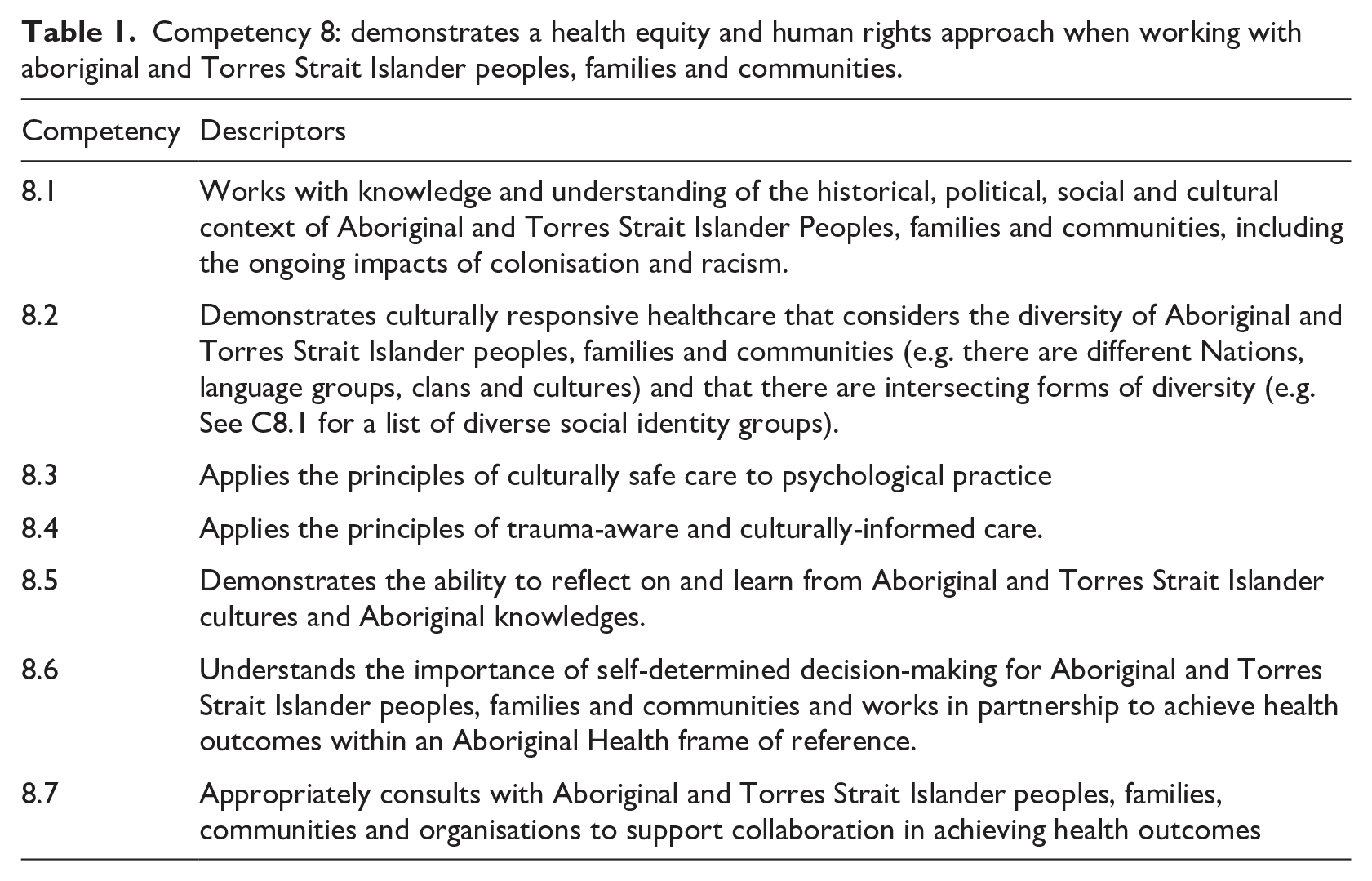
In summary, the AHPRA and the IUPS guidelines prioritise cultural competence, cultural humility, cultural safety and cultural responsiveness when working with specific cultural groups, such as Indigenous populations. They advocate for psychologists to continuously educate themselves, collaborate with Indigenous communities and provide respectful services that are empowering and culturally appropriate.
Ensuring that both pre-service and in-service psychologists are supported to develop and achieve the expectations of Competency 8 requires a connection to underpinning approaches that genuinely reflect the rights of Aboriginal and Torres Strait Islander peoples. Each of the standards outlined above involves foundational and functional competency development and represents a significant body of work for psychologists to engage with. While functional competencies reflect the practical tasks and work of psychologists, such as interventions or assessments, foundational competencies are referred to as the underpinnings ‘of what psychologists do’ (Rodolfa et al., 2005, p. 351). These foundational competencies can form the assumptions underpinning a psychologist’s practical work. This represents a critical area of focus, as one’s assumptions come before their analysis and decision-making (Hayes, 1998). In this way, a psychologist’s knowledge, attitudes and values serve as the foundation for functional competencies and the overall professional practice of psychologists (Kaslow et al., 2004). As such, for psychologists to appropriately and competently demonstrate a health equity and human rights approach when working with Aboriginal and Torres Strait Islander peoples, communities and families, they must cultivate a rights-based foundation rather than simply acquire or enact functional and isolated competency skills. We propose that grounding this work in an Indigenous Rights-based perspective will support psychologists in engaging with professional development that transforms their knowledge, skills, attitudes and values and lays a foundation for their competent professional practice.
Professional psychological practice and the school psychologist
A growing evidence base linking the school environment, child and adolescent well-being and positive outcomes beyond the classroom has resulted in increased attention on psychologists employed within the school context (Fiess et al., 2019; Graham et al., 2016; Noble et al., 2008; Powell et al., 2018). Typically drawing from educational, developmental and clinical psychology backgrounds, these psychologists, often referred to as school psychologists, are focussed on addressing the unique needs of school environments by responding to the diverse challenges faced by students, families and educators. As the field of school psychology has grown within Australia, the professional role, expectations and practice of school psychologists have evolved to reflect the need within school settings, as well as the skills and competencies held by school psychologists (Campbell & Glasheen, 2017; Slee & Skrzypiec, 2016; Theikling & Terjesen, 2017). School psychologists apply their understanding of child and adolescent development and empirically based approaches to assessment and intervention within education systems (Barker & Carlson Berg, 2022). School psychologists also incorporate knowledge and practice drawn from areas of psychological practice such as clinical, counselling, community, cognitive and behavioural psychology to inform their work (Abuswer et al., 2023).
In recent years, school psychologists have been expected to be much less concerned with problem identification and intervention for students and, instead, more focused on the promotion of student well-being through professional collaboration with teachers, parents and other professionals within the school environment (Sheridan & Gutkin, 2000). In addition, school psychologists across Australia have been identified as playing a critical role in directly and indirectly meeting the increasingly complex and diverse student needs in the broader school community, with particular emphasis being placed on the well-being and support needs of Aboriginal and Torres Strait Islander students (Liebenberg et al., 2016). However, how this is done has sometimes been clearly articulated in both pre-service and in-service preparation for school psychologists. Within the APHRA (2023) document, important ideas about how a psychologist might demonstrate a health equity and human rights approach when working with Aboriginal and Torres Strait Islander peoples are presented: acknowledgment of systemic barriers, promotion of fairness and justice; cultural competence and responsiveness; understanding historical and cultural contexts; trauma-informed care; and collaboration and engagement with Aboriginal and Torres Strait Islander peoples. We argue that such guidance lacks a vital element of commonality, the Indigenous rights-based approach, that will require the profession of psychology and school psychology in particular, to reposition its underpinning domain ontology to achieve the aspirations of the health equity and human rights approach advocated by APHRA (2023).
Psychology and Aboriginal and Torres Strait Islander people
The field of psychology has been recognised as well-positioned to support the empowerment and self-determination of Aboriginal and Torres Strait Islander people (Dudgeon & Pickett, 2000). However, both the profession and academic discipline have historically played a unique role in the legitimisation of Australia’s colonial past (McConnochie, 2008), particularly the deficit framing of Aboriginal and Torres Strait Islander people against Western paradigms of health and wellbeing. In the Western world, professions were perceived as crucial for the modernisation of society (Evers, 1973; Nolin, 2008; Parsons, 1968), and those accomplished in these areas possessed a high level of knowledge (academic rigour) and skill (professional competency) that earned both trust and esteem (Pellegrino & Pellegrino, 1988). As a profession, psychology has been given significant autonomy and influence over both service provision and the distribution of information to the public (Kultgen, 1988), with this autonomy leveraged to inform the public’s understanding of human behaviour, mental health and wellbeing. This autonomy was provided with the implicit understanding that psychologists would be competent, altruistic, moral and commit themselves to applying their services for the betterment of society (Newton, 1988; Pellegrino, 2002). However, as many scholars have articulated, the orientation of psychology has predominantly centred within Western knowledge systems, often prioritising the individual and showing little regard for cultural, historical and political contexts within its assumptions. As a result, the norms and values that inform psychological practice have also been used to validate many oppressive and marginalising practices towards Indigenous Peoples and communities worldwide (Dudgeon et al., 2014; Dudgeon & Pickett, 2000; Fox & Prilleltensky, 1997).
Towards an Indigenous rights-based school psychology profession
Competency 8, which is grounded in universal human rights and health equities approaches, demands that all psychologists work to acknowledge and address historical and current structural inequities affecting Aboriginal and Torres Strait Islander people. However, we suggest that this approach is necessary but not sufficient for the self-determination of Aboriginal and Torres Strait Islander people, families and communities to be realised within the current educational systems and structures, which, more often than not, will have a differing understanding of self-determination than that of Aboriginal and Torres Strait Islander peoples and communities. Due to this, an Indigenous rights-based approach that transforms existing human rights frameworks within a foundation of Indigenous rights and self-determination principles is required. While a seemingly subtle shift, incorporating an Indigenous Rights-based approach, asks more profound questions that recentres and repositions how school psychologists are to understand and enact competency 8. We argue in this paper that with an Indigenous rights-based approach, it will be easier to achieve the goals and aspirations of Competency 8.
Central to the Indigenous rights-based approach is recognising and incorporating Indigenous perspectives, knowledge systems and cultural practices into mainstream educational curricula and research methodologies. While this forms a key component of Competency 8, there is the potential for psychologists to engage with these perspectives, knowledge systems and cultural practices in a way that reflects functional competencies rather than a transformation of their foundational competence. This shift in practice and approach towards an Indigenous rights-based perspective challenges the long-standing dominance of Western-centric paradigms that have historically marginalised Indigenous voices and experiences (Smith, 2012). By centering Indigenous epistemologies, the rights-based approach facilitates a more inclusive and culturally responsive educational environment. Moreover, this approach actively confronts systemic inequalities that have persistently disadvantaged Aboriginal and Torres Strait Islander students. It advocates for structural reforms to create equitable access to quality education and address the broader socio-economic factors that impact educational outcomes (Tomaševski, 2001). This rights-based lens necessitates critically examining existing policies and practices, calling for transformative changes beyond superficial adjustments to the current system, including the role and practices of the school psychologist.
A vital aspect of the rights-based approach is its emphasis on empowering Indigenous communities. It promotes their active participation in holistic educational and well-being decision-making processes, from policy formulation to curriculum development. This participatory model aligns with the principles of Indigenous self-determination and challenges the traditional top-down approach to educational governance (P. J. Anderson & Ma Rhea, 2018) and providing psychological services in schools.
Furthermore, the rights-based approach contributes significantly to the ongoing process of decolonising education and research in Australia. It interrogates and seeks to dismantle colonial legacies embedded in institutional structures, pedagogical practices, research methodologies and psychological interventions. This decolonial perspective is crucial for creating an educational system that respects and values Indigenous ways of knowing and being (Kovach, 2009). This approach emphasises ethical practices that prioritise Indigenous communities’ interests in research. It advocates for individual and whole-of-school processes that ensure free, prior and informed consent, promote Indigenous leadership and generate outcomes that directly benefit Indigenous communities. This ethical framework represents a departure from historical intervention practices that often exploited or misrepresented Indigenous peoples (P. J. Anderson & Ma Rhea, 2018).
The rights-based approach aligns with broader international movements recognising Indigenous rights, as exemplified by the United Nations Declaration on the Rights of Indigenous Peoples (UNDRIP, 2007). The Indigenous rights-based approach situates professional and systemic reform within a broader context of Indigenous rights and social justice by framing education and well-being as fundamental human rights and linking them to Indigenous self-determination. To understand the challenges facing the profession of school psychology as it seeks to address the aspirations of Competency 8, we return to an analysis of the development of school psychology and examine its applied practices in schools.
Indigenous rights-based psychological practice
Advocating for rights-based perspectives within modern-day psychology requires acknowledgment of the colonial legacies, contemporary consequences and historical practices that have harmed Aboriginal and Torres Strait Islander peoples. Psychology in Australia has had a critical influence in disseminating misinformation that has perpetuated various deficit-based stereotypes (Dudgeon et al., 2014; McConnochie, 2008) and supported the implementation of policies designed to re.move Aboriginal and Torres Strait Islander people from their culture, communities and ways of being. As articulated by the Psychology Board of Australia (PsyBA), psychologists within Australia must work with . . . knowledge and understanding of the historical, political, social, and cultural context of Aboriginal and Torres Strait Islander Peoples, families and communities, including the ongoing impacts of colonisation and racism (PsyBA, 2024, p. 17).
Whilst Indigenous Peoples across the world are characterised by significant diversity, many Indigenous populations share a common history of colonialism, disempowerment and persistent social, economic and health disadvantage (Brown, 2018; Mazel, 2018). In recent years, Indigenous scholars have explored the contemporary consequences of colonialism and have sought to advocate for the rights of Indigenous Peoples to self-determination, incorporating concepts such as cultural safety, competency and responsiveness, particularly when considering the wellbeing and welfare of Indigenous Peoples (United Nations General Assembly, 2007). These critical perspectives highlight how Western conceptions and paradigms of health and wellbeing, that once justified significant violence, dispossession and enforced cultural assimilation, are still in many ways embedded in our modern-day practices (Hickling-Hudson & Ahlquist, 2003a, 2003b). Without recognising the experiences of Aboriginal and Torres Strait Islander people, specifically within a system that has historically served to harm them, neither the profession of psychology nor its professionals can adequately incorporate a rights-based perspective into their practices.
Supporting Aboriginal and Torres Strait Islander students
Australia’s educational legacy
Recently, an understanding has emerged that recognises neither the education system nor the leaders or educators that exist within can positively respond to the needs and aspirations of Aboriginal and Torres Strait Islander students while remaining ignorant to the contemporary consequences of our past educational policies (P. J. Anderson & Ma Rhea, 2018; Australian Institute of Teaching and School Leadership [AITSL], 2020; Burgess et al., 2022; Fogarty, 2015). Herbert (2012) argues that to understand how Australia has contributed to what P. Anderson et al. (2024, p. 56) have described as Indigenous educative trauma stemming from the long colonial narrative that Aboriginal people were uneducable (Price, 2015). It is the uncomfortable truth of Australian educational history that Aboriginal and Torres Strait Islander peoples have been hugely diminished by what has been inflicted upon them in the name of Western enlightened education that needs recognition and acceptance (P. J. Anderson & Ma Rhea, 2018; P. Anderson et al., 2024; Bodkin-Andrews & Carlson, 2014). Like psychology, Australian education systems have historically perpetuated a deficit perspective surrounding Aboriginal and Torres Strait Islander students (Fforde et al., 2013; Fogarty, 2015; Guenther & Osborne, 2013; O’Bryan, 2016) in which the students themselves have been identified as the problem. For example, excuses such as a student’s lack of English language, poor health and low self-esteem have all been argued as the cause of educational disadvantage, with more recent arguments attributing a lack of school readiness, motivation to succeed or the student home environment as causes (Dunnett, 2021; Martin et al., 2021). While Aboriginal and Torres Strait Islander education policies have been the focus of the Australian political agenda for decades (Harrison et al., 2019; Herbert, 2012; Ministerial Council on Education, Employment, Training and Youth Affairs [MCEETYA], 2008), a sense of urgency for change in educational outcomes for Aboriginal and Torres Strait Islander students was widely recognised a pivotal in response to the Closing the Gap agenda of 2009 (AITSL, 2020). The campaign, initially aimed at Closing the Gap between Indigenous and non-indigenous Australians life expectancy, identified improved access to quality education as a critical determinant to achieving equality for Aboriginal and Torres Strait Islander people across various health, social and economic outcomes (Council of Aboriginal Reconciliation, 2017; Dunnett, 2021). Initiatives that followed have continued to predominantly focus on the accountability and readiness of the student, with an outpour of resources aimed at improving areas such as student attendance and engagement, skills in literacy and numeracy and the school readiness of Indigenous students in early education (Biddle, 2007; Martin et al., 2021).
Despite acknowledging the need for a responsive and supportive education system and a commitment to Closing the Gap, the Australian government has been largely unsuccessful in improving the inequalities faced by Aboriginal and Torres Strait Islander peoples (P. J. Anderson et al., 2023). P. J. Anderson et al. (2023) argue that the inability of the education system to respond positively to Aboriginal and Torres Strait Islander students is due to its entrenchment within a longstanding colonial mindset that continues to perpetuate a deficit perspective. While Indigenous educational disadvantage is acknowledged as a persistent problem, the framing of policies within the context of a Closing the Gap (2005 to present) discourse has consistently positioned Aboriginal and Torres Strait Islander students as the problem within a narrative of deficit, dysfunction and disempowerment (P. J. Anderson et al., 2023). The dominant focus across education policies on improving attributes and factors within Aboriginal and Torres Strait Islander students has been argued to reflect the contemporary consequences of embedded systemic racism within our educational structures (P. J. Anderson et al., 2023; Hickling-Hudson & Ahlquist, 2003b) in which, this deficit perspective has continued to preserve an unequal distribution of power, privilege and resources (Buxton, 2017) and pathologised Indigenous culture as the problem for student disadvantage (P. J. Anderson et al., 2023). As critiqued by P. J. Anderson et al. (2023), many educational policies have centred on concepts such as a perceived lack of school readiness, placing the burden and responsibility for success on Aboriginal and Torres Strait Islander students. However, this approach has failed to acknowledge the systemic issues that have prevented our education system from being school ready (P. J. Anderson et al., 2023) and instead has continued to maintain an overarching narrative of inferiority.
Hickling-Hudson and Ahlquist (2003) articulate that our educational approaches need to be adequately located in place, time or space and reflect a lack of connectedness to local, national and global realities, simply serving to maintain the status quo. Similarly, with a note to the Indigenous students’ experience, MCEETYA (2008, p. 93) articulates that,
. . . For the past two hundred years, formal education has been not only Australian society’s tool for change and the mechanism of domination and colonisation. No Indigenous student ever escapes this realisation, and all feel its pressure.
Without challenging the entrenched consequences and legacies of Australia’s past educational responses, a responsive, safe and equal education for Aboriginal and Torres Strait Islander students cannot be developed (AISTL, 2020; Fforde et al., 2013). School psychologists must critically recognise and challenge the legacies of education and psychology to employ a rights-based perspective within their practice to ensure the provision of culturally safe and responsive practice (AISTL, 2020; Fforde et al., 2013).
Psychologists as agents of an Indigenous rights-based perspective in schools
While incorporating a rights-based perspective has been articulated as necessary across many professions, it has yet to be articulated as a perspective that school psychologists can and should adopt to guide their practice and shape their understanding of Competency 8. Although the goals of Competency 8 are necessary and vital, without the integration and adoption of a rights-based perspective, we argue that school psychologists are likely to experience fear and uncertainty within their practice. P. J. Anderson and Ma Rhea (2018), who highlighted a similar fear among teachers, noted that teachers felt concerned about causing offence due to a lack of sufficient knowledge and inadequate preparation, arguing that unless teachers adopted a rights-based approach, they would continue to perpetuate this fear and lack of understanding within their future practice. Similarly, without embracing a rights-based framework, school psychologists risk reinforcing these same fears, leading to ongoing challenges in effectively supporting Indigenous students and communities and failing to meet the ambitions of Competency 8.
According to the Australian Psychological Society (APS, 2016), school psychologists are uniquely positioned to provide direct, indirect and whole-school level support to assist schools in addressing barriers to student academic success, psychological health and social-emotional wellbeing. The role and expectations of school psychologists have transitioned from exclusively focussing on individual academic and cognitive intelligence assessments (Merrell et al., 2022) to a much broader focus on the proactive advancement of a healthy school environment, particularly by enhancing the capacity of educators to meet the needs of their students (Alsoqiah et al., 2017). According to Farrell (2010), school psychologists possess a wide range of knowledge and skills drawn from theory and practice, allowing them to make distinctive contributions to the school environment. Rather than working exclusively with individual students, school psychologists have been argued as pivotal members of the ecology within which the children, educators and school communities function (Sheridan & Gutkin, 2000) and have been identified as critical agents in addressing the various educational, societal and developmental barriers present within the school (Armstrong, 2021). School psychologists have been positioned at the forefront of initiatives, programmes and policies designed to strengthen the capacity of school communities and educators to meet increasingly complex and diverse student needs (Liebenberg et al., 2016). For example, they have been progressively expected to promote and facilitate inclusion and equity for students (Beltman et al., 2016; Dunlosky, 2013), support educators’ resilience, flexibility and adaptability and connect and strengthen relationships between staff, families and leadership. Their expertise and unique positioning in supporting students, staff and the wider school community have been argued as critical to creating culturally safe and inclusive environments (Farrell, 2009, 2010).
Many Aboriginal and Torres Strait Islander communities have voiced a well-founded mistrust of the institutions that have historically and continually caused significant harm. The consequences of Australia’s educational policies and practices have contributed to intergenerational educative trauma that has dramatically impacted the relationships and trust developed between Aboriginal and Torres Strait Islander families, the educational system and the professionals who work within schools.
In employing a rights-based perspective to their professional practice, the following examples can demonstrate the sort of changes that we envisage in the work of the school psychologist:
An Indigenous rights-based perspective enables school psychologists to centre their professional practice on the principles of self-determination. It ensures they are supported to enact the aspirations of Competency 8 rather than contributing to or risking the continuation of educative trauma.
Employing a rights-based perspective enables school psychologists to recognise the external/systemic barriers that hinder/impact the enactment of Aboriginal and Torres Strait Islander student’s self-determination.
School psychologists become uniquely positioned to be able to recognise and respond to ongoing educative trauma instead of framing this mistrust as a deficit within Aboriginal and Torres Strait Islander students or families themselves.
Supporting school psychologists to employ a rights-based perspective
As noted earlier, the recent changes to Competency 8 are welcomed and necessary, yet only sufficient with an explicit emphasis on ensuring these are enacted from a foundation of an Indigenous Rights-based perspective. In many ways, this perspective has the potential to transform not just Competency 8 but all competency areas, reshaping how school psychologists view and apply their knowledge, skills and practices. By adopting an Indigenous rights-based approach, school psychologists enhance their ability to support Indigenous students and families and establish a foundational framework that grounds all areas of their practice in the principles of self-determination. Rather than superficial semantic differences, this transformation ensures that assumptions of Indigenous Rights and self-determination are at the centre of all practical steps in school psychologists’ preparation, placements, supervision and practice. As such, enacting Competency 8 from an Indigenous rights-based perspective requires more from policymakers, regulatory bodies, higher education providers and school systems.
Preparation
Pre-service school psychology providers must critically assess how their programmes provide learning experiences and opportunities to engage with each of the points identified within Competency 8. While these experiences have the potential to be intellectually and experientially rich, they often remain disconnected from a rights-based perspective. For example, focussing on the acquisition of knowledge or skills through the presentation of examples and case studies often perpetuates a deficit-oriented, categorical or binary representation of specific types of Indigenous clients. Implementing an Indigenous rights-based approach should not be confined to isolated lessons, individual weeks, readings, specific content or guest lectures. While these elements may contribute to the learning process, they are insufficient. Instead, an Indigenous rights-based perspective must be embedded holistically into what is taught, how it is taught and by whom it is taught. Isolating such learning to fragmented experiences significantly burdens Indigenous leaders and Elders, referred to as the Colonial Load (Weenthunga Health Network, 2023). This burden arises from the expectation that institutions and leadership often place on Indigenous people to shoulder the responsibility of educating colleagues, staff or students to challenge restrictive colonial legacies.
Although developing a rights-based understanding is essential for pre-service psychology students to meet the goals of Competency 8, it must be truly integrated into the core of the educational and training experience to prevent fragmented, surface-level learning and safeguard against the potential for ongoing harm to Indigenous peoples. Adopting and integrating an Indigenous rights-based perspective will encourage and enable critical reflection and meaningful discussion at any stage of the preparation process, rather than isolating this learning to specific activities, workshops or speakers that function like islands. In this way, an Indigenous rights-based approach can transform any learning experience into an opportunity to address the broader, systemic impacts. This approach allows school psychology students to be empowered to reflect on how all processes, practices and tools they are learning about to engage in direct and indirect service delivery within school settings can work to enhance or diminish Indigenous rights and self-determination. For example, Westerman’s (2010) and Dudgeon et al.’s (2014) work laid the foundation for the existence of an Indigenous psychological consciousness, arguing for the urgent need for theoretical developments in psychology. These developments have led to arguments for specific professional practices that do no further harm to Indigenous clients. Fish et al. (2023) developed an Indigenous strengths-based approach to developmental science, arguing that their work can be more holistically, deeply understood and reflectively applied rather than only being understood professionally as effective tactics to achieve an acceptable outcome. Equally, the broader evidence-based psychological and educational practices that form the basis of preparation courses can be understood more broadly through an Indigenous rights-based perspective. Trainees can be empowered to reimagine practices in collaboration with Indigenous Australians in the service of Indigenous rights and self-determination.
Practice and supervision
There are significant implications for practitioners engaging in school-based practice and supervising provisional school-based practitioners. Practitioners should seek ongoing professional development relating to Competency 8 from providers who explicitly identify their work as underpinned by an Indigenous Rights-based perspective and actively embody this perspective in all aspects of their professional development. Engaging in professional development underpinned by this perspective is likely to provide functional knowledge, practices and competencies that have been transformed by and are in service of Indigenous rights. Furthermore, such learning experiences have the potential to extend and transform existing human rights frameworks that may already be familiar to practitioners (e.g. Convention on the Rights for People with Disabilities [UNCRPD]), empowering them to engage in culturally responsive practice.
Practitioners with positions of supervisory responsibilities with provisional psychologists practising in school settings can model an Indigenous rights-based approach as part of their supervision processes with supervisees. Furthermore, reflection and questioning that focus on building the foundational knowledge of supervisees may enable supervisors to transform their supervisees’ functional and practical knowledge, skills and experiences to serve the development of Indigenous rights and support their ability to influence the teachers, school leaders and systems within which they are working.
Policy and professional governance
Embedding an Indigenous Rights-based approach to school psychology practice through the actions described above requires systems-level change. Specifically, the changes to the competency framework outlined for Competency 8, along with oversight and regulation of the field in Australia, would benefit from an explicit and thoroughgoing description of Indigenous Rights as the foundational shift in domain ontology for practice in Australian schools. This change will have significant implications for how tertiary courses are designed, delivered and evaluated, along with cascading implications for providers of professional development and ongoing assessments of practice. Such a shift is necessary to honestly reassess and transform existing systems and structures, mobilise individuals, organisations and larger systems to serve Indigenous rights and self-determination and demonstrate Competency 8 that is indeed embodied.
School systems
To see Competency 8 embodied in practice by school psychologists and lead to meaningful change within and across school settings, school and system leaders must consider the implications of an Indigenous rights-based approach and the implications for the broader systems that employ and deploy school psychologists. Education systems within Australia have been created and continue to function as Colonial-legacy systems that, at their core, have been designed and continue to operate in ways that are at odds with an Indigenous rights-based perspective (P. J. Anderson & Ma Rhea, 2018). P. J. Anderson et al. (2023) flipped the narrative and representation of student school readiness by assessing the degree to which Australian schools and school systems were ready to support Indigenous achievement effectively. Noting a lack of school readiness, P. J. Anderson et al. (2023) specifically identified an overall lack of teacher readiness, curriculum readiness, pedagogical readiness and, ultimately, school climates and cultures that are not ready to support and ‘. . .successfully educate Indigenous students to their full potential’ (p. 1153). The work to ensure schools are ready is ongoing, and the need for transformation remains. We suggest that by engaging in the practices and learning experiences described above, school psychologists can embody Competency 8 and play a critical role in supporting the development of overall school readiness by collaborating effectively with teachers and school leaders, advocating for an Indigenous rights-based approach to educational and psychological supports and by supporting a reflective, relational and connected approach to the support of students across all domains of school life.
In addition, school and system leaders must consider the nature and purpose of the work of school psychologists within schools. As noted earlier, school psychologists have historically been used as agents of testing and intervention for students experiencing learning, social and behavioural challenges. Currently, school and system leaders have the potential to perpetuate the use of school psychologists in this way. This will likely limit school psychologists’ ability to pursue the broader systems-level change required to ensure school readiness (see above), as well as serving to shape their practice away from the Indigenous rights-based perspective necessary to see Competency 8 truly fulfil its promise within Australian schools. For example, the focus on testing, counselling and intervention for individual Indigenous students may inadvertently – or explicitly – maintain their position as the problem or as students that need fixing (P. J. Anderson & Ma Rhea, 2018). While school psychologists could be well positioned to support the changes required in schools to ensure readiness for Indigenous students’ success, school and system leaders will require a deeper understanding of the Indigenous rights-based perspective. Leveraging this understanding may allow school and system leaders to use school psychologists more effectively to support teachers, families, communities and students by advocating for best practice approaches within existing systems whilst modelling and explicitly describing how the Indigenous rights-based approach has transformed these practices.
Footnotes
Acknowledgements
We would like to acknowledge the pioneering work of Professor Patricia Dudgeon, University of Western Australia and Dr Tracy Westerman, Jilya Institute and the Australian Indigenous Psychologists Association.
Data availability statement
Not applicable.
Declaration of conflicting interests
The author(s) declared no potential conflicts of interest with respect to the research, authorship, and/or publication of this article.
Funding
The author(s) received no financial support for the research, authorship, and/or publication of this article.
Ethical approval and informed consent statements
Not applicable.
