




Abstract
In this article, we argue that current assessment practices in higher education require urgent examination and should be re-imagined in culturally responsive ways to ensure fairness for all. From sociocultural and social justice perspectives, we highlight examples of cultural and linguistic bias in assessment that disadvantages many First Nations students. Incorporating a constructivist viewpoint, we argue that assessment practices must keep pace with culturally responsive pedagogical practices to improve assessment validity for First Nations students and to maintain constructive alignment between learning, teaching, and assessment. Based on qualitative interviews with stakeholders in the On Country Teacher Education program, we describe how university lecturers changed their approaches to assessment and modified their assessment tasks to enact and create culturally responsive assessments. These practices, whilst beneficial for First Nations students, are viewed as being ‘responsive’ rather than ‘proactive’. Recommendations include shifting to a ‘proactive’ stance by evaluating the validity of student learning outcomes and assessment design from the onset.
Keywords
Introduction
In educational systems, assessments determine students’ academic success, which is tied to economic and social outcomes beyond schooling and university (Hout, 2012). The far-reaching consequences that assessment practices hold mean they should be held to the highest standard and must be valid assessments for all, not just for those students who are from Anglo-Australian backgrounds. However, this is not often the case. Many assessments – both classroom-based and standardised – are culturally and linguistically biased (Freeman, 2013; Klenowski, 2014; Wigglesworth et al., 2011). They favour western knowledge systems and methods of assessment and English-based modes of communication (Steele et al., 2022). Consequently, such assessment practices are inherently unfair to students from diverse cultural and linguistic backgrounds, including Aboriginal and Torres Strait Islander students in Australia. In this way, assessments are political acts that can perpetuate and re-produce unequal systems of power in society.
This article explores the creation and enactment of culturally responsive assessments for a group of First Nations students who are undertaking a Bachelor of Primary Education degree to become teachers as part of an On Country Teacher Education (OCTE) program delivered by one university in partnership with the Department of Education (DoE), Western Australia (W.A.). First, we situate this study within the theoretical framework of sociocultural, social justice (Gipps & Stobart, 2009; Klenowski, 2014; Messick, 1988), and constructivist perspectives (Biggs & Tang, 2011) of assessment and culturally responsive pedagogies before describing culturally responsive assessment practices. We then present our findings that describe the ways university educators have changed their approaches to assessment and modified their assessment tasks in response to the cultural and linguistic backgrounds of First Nations students. From these findings, we conclude that culturally responsive assessment exists both in the creation of the assessment task but also in the way that the task is enacted. Finally, proactive approaches to assessment design and implementation are recommended. However, we do acknowledge the systemic constraints of neoliberal (and bureaucratic), western, colonial higher education institutions that both limit the potential for educators to realise the decolonial intentions of culturally responsive approaches to assessment and constrain innovative and flexible approaches to learning, teaching, and assessment. Ultimately, change at this level is required.
Assessment for First Nations students: Sociocultural and social justice perspectives
There is a growing body of research describing the myriad ways First Nations students across all levels of education – primary, secondary, and tertiary – are disadvantaged by current assessment practices that favour western knowledge systems methods of assessment and English-based modes of communication. In some cases, assessments are inaccessible for students due to their standard English language demands and, consequently, do not measure the knowledge intended (Macqueen et al., 2018; Wigglesworth et al., 2011). Additionally, many assessment items and test stimuli lack cultural familiarity for First Nations students, especially those from remote parts of Australia (Dobrescu et al., 2021). Moreover, the ‘correct’ answer to test items may be at odds with the cultural norms of other groups in society (Freeman, 2013). Further, dominant written assessment modes and test formats are incongruent with the transmodal communicative practices of many First Nations societies (Steele et al., 2022).
Sociocultural and social justice theorists argue that assessment is a socially embedded activity that cannot be separated from its social and cultural contexts (Gipps & Stobart, 2009; Klenowski, 2014; Messick, 1988). For example, consider what a NAPLAN test designed by First Nations peoples might look like and how non-Indigenous students might perform. It is likely that the ‘fairness’ of such a test would be questioned, if not moral outrage ensue. Messick’s (1988) widely cited definition of validity draws together content, criterion, and construct validities with a consideration of the social consequences, intended or otherwise. In this ‘unified’ approach, validity cannot be met in part, and the social consequences of assessment must be evaluated.
For First Nations students, the social consequences are significant. The educational performance of First Nations students across the sector has been widely publicised contributing to the emergence of ethnic stereotypes and deficit narratives related to Indigeneity (Patrick & Moodie, 2016; Vass, 2013). Furthermore, poor assessment performance has been linked to reduced assessment participation for First Nations students amongst other groups (Lu et al., 2023). Thus, assessment can act to institutionalise failure and embed notions of educational disadvantage for First Nations students in the Australian education system. The outcomes extend beyond educational achievement to economic opportunities and broader social outcomes (Hout, 2012).
Culturally responsive pedagogies
Culturally responsive pedagogies align with sociocultural and social justice perspectives to highlight that students’ social, cultural, and linguistic identities are crucial to learning and teaching, and therefore, assessment. American academic Gloria Ladson-Billings (1995a, 1995b) coined the term ‘culturally relevant pedagogy’ to refer to pedagogies that generate academic success, cultural competence, and a critical consciousness to challenge the social order (Ladson-Billings, 1995b, p. 160). Geneva Gay (2010) shifted the terminology from ‘relevant’ to ‘responsive’ and described such pedagogies as being validating, comprehensive, multidimensional, empowering, transformative, and emancipatory. In the Australian context, Morrison et al. (2019) build on the work of Ladson-Billings (1995a, 1995b) and Gay (2010) to suggest the following definition: We use the term culturally responsive pedagogy to refer to those pedagogies that value, and mobilise as resources, the cultural repertoires and intelligences that students bring to the learning relationship. Such pedagogies are taken to be intrinsically dialogic and critically conscious, opening up generative and decolonising possibilities. This conceptualisation rests on the premise that all curriculum and pedagogy are culturally based. (Morrison et al., 2019, p. 1-2)
Since then, the concept of culturally sustaining pedagogies has emerged (Paris, 2012; Paris & Alim, 2017), alongside culturally proactive pedagogies (Garcia & O’Donnell-Allen, 2015). With a focus on First Nations students, Lowe et al. (2021) draws heavily on the work of Paris and Alim (2017) to propose an Australian model of culturally nourishing schooling with four tenets: learning from Country, cultural inclusion, epistemic mentoring, and teacher professional change. The model ‘centres Indigenous sovereignty, knowledges, ways of being and understanding’ (Lowe et al., 2021, p. 471) and enacts culturally nourishing pedagogies.
These more recent approaches (i.e. culturally sustaining pedagogies, culturally proactive pedagogies, and culturally nourishing pedagogies) critique the term ‘responsive’ suggesting it is akin to being ‘tolerant’ rather than transformative (Paris & Alim, 2014). Instead, these pedagogies represent a shift in stance that actively highlights the role of educator agency in enacting socially just ways of teaching. Whilst all theoretical positions are actions-based, for us, there is a difference between being ‘responsive’ and being ‘proactive’. In our conceptualisation of culturally responsive assessment, we are drawn to the notion of being ‘proactive’ in our approaches and strongly advocate for this. This semantic preference derives from our experiences and those of others (as described in this paper) of feeling that we are only able to respond to students’ cultural and linguistic backgrounds in limited ways, and not proactively plan for them. Whilst acknowledging student diversity, and the need to always be responsive to students’ learning contexts, we argue that many aspects of learning, teaching, and assessment in higher education could be significantly improved through proactive processes rather than responsive ones. Here, we point to system level change, that beyond the control of individual educators, as a crucial part of being ‘proactive’.
At the same time, there has also been a shift in policy responses towards culturally responsive approaches in the Australian education system with a focus on First Nations students. For example, in the schooling system, the Building a culturally responsive Australian teaching workforce report and subsequent Capability Framework (Australian Institute for Teaching and School Leadership [AITSL], 2022a; 2022b), which mirrors the earlier Aboriginal Cultural Standards Framework developed by the Department of Education (DoE) Western Australia (2015), aims to guide staff towards cultural responsiveness. Likewise, in the university sector, Universities Australia has developed a National Best Practice Framework for Indigenous Cultural Competency in Australian Universities (Universities Australia, 2011a) alongside Guiding Principles for Developing Indigenous Cultural Competency in Australian Universities (Universities Australia, 2011b). However, despite strong policy impetus, it has been argued that little has changed in higher education (Bodkin-Andrews et al., 2019, 2022), whilst future policy directions in teacher education may also signal further limitations for educator agency (Ellis, 2024).
In the uptake of culturally responsive pedagogies, the role of assessment is often neglected. The definition presented by Morrison et al. (2019), like most, highlights that ‘all curriculum and pedagogy are culturally based’ (p. 2), but this point needs to be extended to: all curriculum, pedagogy and assessment are culturally based. Assessment practices must keep pace with recent developments in culturally responsive pedagogies to ensure they are constructively aligned with teaching and learning (Biggs & Tang, 2011). Assessments should be based on what was taught and, in turn, inform future learning and teaching. Moreover, what is assessed and how it is assessed communicates the values of the education system – that is, what is deemed to be important. If approaches to teaching are culturally responsive, but assessment is not, a powerful message is communicated about what really counts.
Culturally responsive assessment
It is widely acknowledged in the literature that culturally responsive assessment remains underexplored both as a theory and a practice, especially when compared to its counterpart – culturally responsive pedagogies (see, for instance, Burns et al., 2019; Mills, 2022). This imbalance requires further attention; however, a body of research is beginning to emerge.
Of greatest relevance to the current study is Snow et al.’s (2021) description of culturally responsive assessments for Inuit populations. In the reported approaches, the authors distinguished between modifying current assessments to become more culturally responsive and reconstructing assessment to align with Inuit values. Modifications included the addition of culturally relevant content, alternative assessment options, ensuring suitable tools and resources were selected, and changing the relative weighting of external examinations (Snow et al., 2021). When reconstructing assessments, there was a focus on mastery learning guided by formative assessment practices, individual progress, flexibility, and forming relationships with the assessor (Snow et al., 2021). In another First Nations learning context, Carjuzaa and Ruff (2010) considered whether it is fair for an instructor who holds a Western worldview to evaluate an assessment written from an Indigenous paradigm. They argue for renegotiating assessment standards to ensure that differences in worldviews and communicative styles are treated equally. In their proposed approach, which can be described as transformative, student voices are centred and equitable, and dialogical relationships between educators and students are formed. With reference to First Nations students in Australia, Klenowski (2009, 2014) calls for a more balanced approach to assessment, shifting away from dominant standardised tests to a greater use of formative assessment and alternative assessment practices that better cater for student diversity through embracing different ways of knowing, being, and doing.
Echoing these perspectives, but with a focus on minoritized, multicultural, and multilingual populations generally, Montenegro and Jankowski (2017) argue for greater collaboration with students (i.e. students as partners) to make assessment more culturally responsive. In multicultural higher education settings, Burns et al. (2019) propose five ‘principles’ for culturally responsive assessment: multicultural validity, construct validity, language, dimensions of cultural differences, and lecturers/supervisors as researchers of their students and themselves. From a constructivist perspective, Levy-Feldman and Libman (2022) suggest shifting towards qualitative methods of assessment that represent assessment ‘for’ and ‘as’ learning to situate assessments within the specific and unique contexts of individual learners. In addition to these suggestions, Mills (2022) also asks educators to consider the role of self-reflection and self-regulation, providing opportunities for students to engage in civic citizenship, and incorporating principles of universal design for learning (UDL). The UDL principles include ensuring multiple means of representation, expression, and ways of engaging in assessment. However, overall, there is a lack of empirical data on how these principles might be enacted in real-life learning, teaching, and assessment. Without such examples, we risk getting stuck in de-contextualised discussions, which would undermine the potential impact on practices and policies.
Research context
The current study is part of a larger research project documenting the On Country Teacher Education (OCTE) program, which is an Initial Teacher Education (ITE) program (i.e. a Bachelor of Primary Education degree) delivered by Curtin University in partnership with the DoE, W.A., since 2020 (for further details, see Gower et al., 2022). The program caters for Aboriginal and Islander Education Officers (AIEOs) who are employed by the DoE, W.A., and would like to become qualified teachers. There are several features unique to the program, which include a course delivery that incorporates academic and student support, two-way learning, flexibility, and mixed mode learning (including working as AIEOs and remaining ‘On Country’). In this program, university educators (referred to as ‘lecturers’) work closely with the small cohort of students and with the program staff. Together, they visit students ‘On Country’ in their communities and schools to provide further support. This approach prioritises the relationships between the program staff, lecturers, and students and provides lecturers with opportunities for two-way learning, which in turn has informed their learning, teaching, and assessment practices. Students complete the four-year degree over the course of a five-year period, studying in trimesters, mainly online from their mostly remote communities and with intensive week-long on-campus workshops. Despite these differences in program delivery, the learning outcomes, teaching content and assessments mirror those in offered to all students in the university’s Bachelor of Primary Education degree. The program is Indigenous-led by the second author who supports and guides staff in their roles. The first author is a non-Indigenous university educator who has taught in the program four times between 2021 and 2024. The third author is a non-Indigenous research officer who assists the second author with the research component of the program.
Research question
This study aims to contribute towards a theoretically based and empirically substantiated understanding of culturally responsive assessment practices. We do this by examining stakeholders’ perspectives on how university educators created and enacted culturally responsive ways of assessing First Nations students in a higher education setting. Hence, we address the following question: How can culturally responsive assessment practices be developed and enacted in First Nations student assessment in a higher education setting?
Method
Participants
As part of the ongoing program evaluation, the experiences and perspectives of key stakeholders were sought. By the end of 2022, this included First Nations students enrolled in the ITE program (n = 25), lecturers (n = 15), and principals (n = 14) of the schools where the students were employed as AIEOs. There were 14 participating schools. The students in this study mostly reside in rural and remote parts of W.A. and represent a range of ages from early 20s to 50s. They are all from First Nations cultural backgrounds with strong affiliation with Country, cultural understandings, language, protocols, and stories. Not all reside on their Country (although most do) and their community roles and expectations may vary (i.e. some participate in traditional cultural events and ceremonies while others engage with family and community networks). However, all in their roles as AIEOs in their schools have strong community ties, engage in highly relational work, and promote Indigenous ways of knowing and relating to the world; an area in which they advise schools and teachers about. To date, all lecturers and principals have been from non-Indigenous backgrounds. Some lecturers had little prior knowledge and experience working closely with First Nations peoples, whilst others had extensive experiences in First Nations educational contexts. Lecturers were both continuing staff members (ranging from Lecturer to Associate Professor) and sessional academics; some had doctoral qualifications and others did not. Principals were mostly highly experienced and had spent many years working in those communities.
Ethics
Ethics approval to conduct the research was gained from the DoE, W.A. (ethics approval number D20/0417770), and the university (ethics approval number HRE2020-0269), and all participants provided informed consent. Additionally, the four principles of Indigenous self-determination, Indigenous leadership, impact and value, sustainability and accountability set out in the Australian Institute of Aboriginal and Torres Strait Islander Studies (AIATSIS) (2020) Code of Ethics for Aboriginal and Torres Strait Islander Research were upheld throughout the study. Particular care and consideration were given to ensuring voluntary and informed consent and respect for First Nations participants through the use of Indigenous research methodologies as described in the procedure below.
Procedure
A qualitative approach was used which comprised bi-annual interviews with the students (where possible), and annual interviews with school principals and university staff members involved in the program, to allow for triangulation. The triangulation of the data from multiple perspectives acts to validate the research findings, whilst also ensuring that the voices of the First Nations students are heard (Donovan, 2015). From the start of the program in 2020, both interviewers – the Project Lead [Author 2] and the Research Officer [Author 3] – established rapport with the participants and created a friendly supportive atmosphere to share experiences and suggestions for the program in a safe environment. The interviews took the form of yarning, which allows participants to tell stories of their learning experiences and researchers to document these experiences in a relational, respectful, and responsible way (Barlo et al., 2021; Bessarab & Ng’andu, 2010; Shay, 2021). Throughout the program, the participants witnessed the comprehensive changes made to all aspects of the program in response to their feedback. This was appreciated and encouraged further engagement with the interviews in the following rounds. In total, 103 interviews were conducted in the first 3 years of the program from 2020 until 2022 (the dataset used for this study) with an average duration of 25 minutes. Interviews were conducted individually online and face-to-face depending on participants’ preferences and availability and were audio-recorded.
Data analysis
All interviews were transcribed and added to NVivo software. Despite not being an explicit question in the program evaluation, Authors 2 and 3 had identified culturally responsive assessment practices as an emergent theme. To explore this theme, Author 3 conducted a keyword search in NVivo using the terms, ‘assessment’, ‘assignment’, and ‘feedback’ to collect relevant interview data for analysis. Additionally, Author 3 who was highly familiar with the data conducted a manual search to identify any further quotes that related to culturally responsive assessment that the keyword search may have missed. Relevant data for analysis was identified from seven students, six lecturers, and one principal.
The data were analysed by Author 1 using reflexive thematic analysis (Braun & Clarke, 2019), and findings were cross-checked with Authors 2 and 3. Reflexive thematic analysis follows the 6 steps of thematic analysis initially set out by Braun and Clarke (2006) but also acknowledges the interpretive analytical process and the active role the researcher plays. This is particularly relevant to us as our data analysis encompasses the unique but also diverse insights we hold as participants in the program with various roles. Thus, in our iterative and organic process of data analysis, we moved thoughtfully between the literature, the data, and our own understandings that have developed through our involvement in the program. First, we identified the main themes from the literature as described in the section on ‘culturally responsive assessment’. The data were read with these themes in mind and notes were made to the interview transcripts highlighting the points of connection. Next, the data were read to identify the dominant themes and were coded accordingly. From this, the codes were thematically grouped together in the following structure: • Identify the cultural underpinnings of assessment/accept multiple valid interpretations/and make these explicit. • Value the knowledges and experiences of students in assessment/adding cultural content. • Flexible approaches to assessment. • Enact transmodal and transcultural assessment – connected to technology and choice/multiple modes of assessment/a focus on student learning outcomes. • Consider the role of language. • Assessment for, and as, learning and feedback. • Relationships.
Quotes from the interview data were then added to each of these themes depending on which they mostly strongly aligned to. This was re-read to make sense of what the data was telling us and categorised according to whether it constituted a change to the assessment itself or whether it was a change to the ways that assessment was approached. Lastly, the themes were further collapsed into a single theme that best represented the data with the view to develop a cohesive representation of what culturally responsive assessment practices look like in the context of the OCTE program, as presented in the findings.
Findings
Our findings suggest that lecturers enacted and created culturally responsive assessments in two main ways: through their approaches to assessment (i.e. how culturally responsive assessment can be enacted) and through their assessment design (i.e. how culturally responsive assessment can be created). We position ‘enacted/approach’ before ‘created/design’ as it appeared to be dominant in stakeholder responses. Culturally responsive approaches included making the assessment requirements explicit for students, engaging in relational approaches to assessment, and treating assessment ‘as’ learning through the provision of high levels of feedback. Culturally responsive modifications to the assessment design included changes to the cultural content and the modes of assessment. In the findings, the participant quotes provided are followed by the indication in brackets of the participant group, participant number, and year of the program when the interview was conducted (e.g. Student 15, Year 3; Lecturer 4, Year 2).
Approaches to assessment
Making implicit cultural expectations explicit
One approach to assessment that students found to be particularly helpful was when the lecturers made the implicit cultural expectations in assessments explicit to them. Assessments are inherently cultural products (Gipps & Stobart, 2009; Klenowski, 2014; Messick, 1988). Yet, the knowledge assessed and the values espoused through assessment are often treated as universal truths. Dominant western worldviews, cultural knowledge, and values are rarely questioned and instead are manifested in the design and implementation of assessment. In transcultural environments where multiple interpretations can ensue, the implicit cultural underpinnings and assessment expectations must be identified and made explicit to ensure student success. Using a test of reading comprehension, Sharifian et al. (2015) showed how First Nations and non-Indigenous students recorded different interpretations of the events in the book and the message contained therein. The authors concluded the results reflected the cultural schema and worldview of each group; both interpretations were valid in their own cultural context, but in a western schooling assessment, one would be deemed incorrect.
Students in the OCTE program appeared highly cognisant of the prospect of being marked incorrectly based on their own epistemological standpoint and consistently provided the feedback that they would like clear, explicit guidance with assessment. One student explained: Quote 1: ‘Then we’re on the same page. And then you know, like we won’t get in trouble or anything. We know what we are doing, and don’t have to keep ringing and stuff you know’. (Student 20, Year 2)
The student perspective in quote 1, which has potentially emanated from the student’s own experiences of schooling, expresses a concern about getting it wrong (‘get in trouble’), but also a desire for independence and autonomy in their learning which can only be achieved if the expectations are clear.
Other students similarly expressed how capable they felt (opposed to feeling fearful of getting in trouble) when the assessment requirements and expectations were made explicit: Quote 2: ‘It was just so basic, easy for us to go bang, bang, bang, and they’ve broke it down for us. Like, they knew our understanding about everything in context. So, they broke it down for us, and we just like, went in and just... We’ve done it all’. (Student 20, Year 2) Quote 3: ‘We kind of knew what to write as well as how to set it out, where we should—how we should be setting out academic writing for, like a standard for—it was just short, sharp, sweet for each section which I think was good’. (Student 10, Year 3)
Lecturers were able to put this feedback into practice through the development of templates, instructional videos, and the provision of worked examples to support students to complete the assessment. In doing so, lecturers made their implicit cultural understandings and expectations surrounding their assessment tasks explicit for students.
Relationality
Building and developing relationships for learning was another key component to culturally responsive assessment that was highlighted by students and the lecturers. Relationality is central to First Nations peoples’ ways of knowing, being, and doing (Martin & Mirraboopa, 2003). Consequently, relational approaches to learning, teaching, and assessment need to be adopted in educational settings for First Nations students (Bishop et al., 2021; Moodie, 2020). For the lecturers involved in the program, the process of building relationships with students was a novel and enjoyable experience; one that stood in stark contrast to the opportunities for personal interaction and relationship building under current neoliberal funding models, as described by a lecturer in quote 4. Quote 4: ‘It’s a shame that we cannot have this kind of personal relationship with more groups of our students and we’re just kind of, 75 in a group. Just do it’. (Lecturer 12, Year 1)
It was these relationships that enabled staff to develop assessments that were culturally responsive to the lives of students, as another lecturer explains in quote 5. Quote 5: ‘Connecting with the students who live in the land and live in these remote communities is also unique because it gives you very good insight, and ... I made the assessment related more to the students and the Aboriginal community, instead of putting it from a white perspective. I think that’s something the students really appreciated as well’. (Lecturer 16, Year 3)
By having the lecturers teach the group multiple times across the degree, they were able to form better relationships with students. In quote 6, one lecturer explains how the continuity of staffing improved their ability to meet students’ learning needs and therefore better meet the assessment outcomes. Quote 6: ‘The other thing that’s made it significantly easier is that I already have a relationship with the students. The first time it was quite difficult because I didn’t know who they were, and how to respond to their specific needs. I didn’t have that student knowledge or context which is so important in teaching… how I work with them differs according to who they are’. (Lecturer 7, Year 3)
However, given this is not how staff in university settings traditionally operate, it is not surprising that one student reported assessments were not always approached in a relational manner. In Extract 1, a student describes the experience of unexpectedly receiving a ‘fail’ grade through the university learning management system.
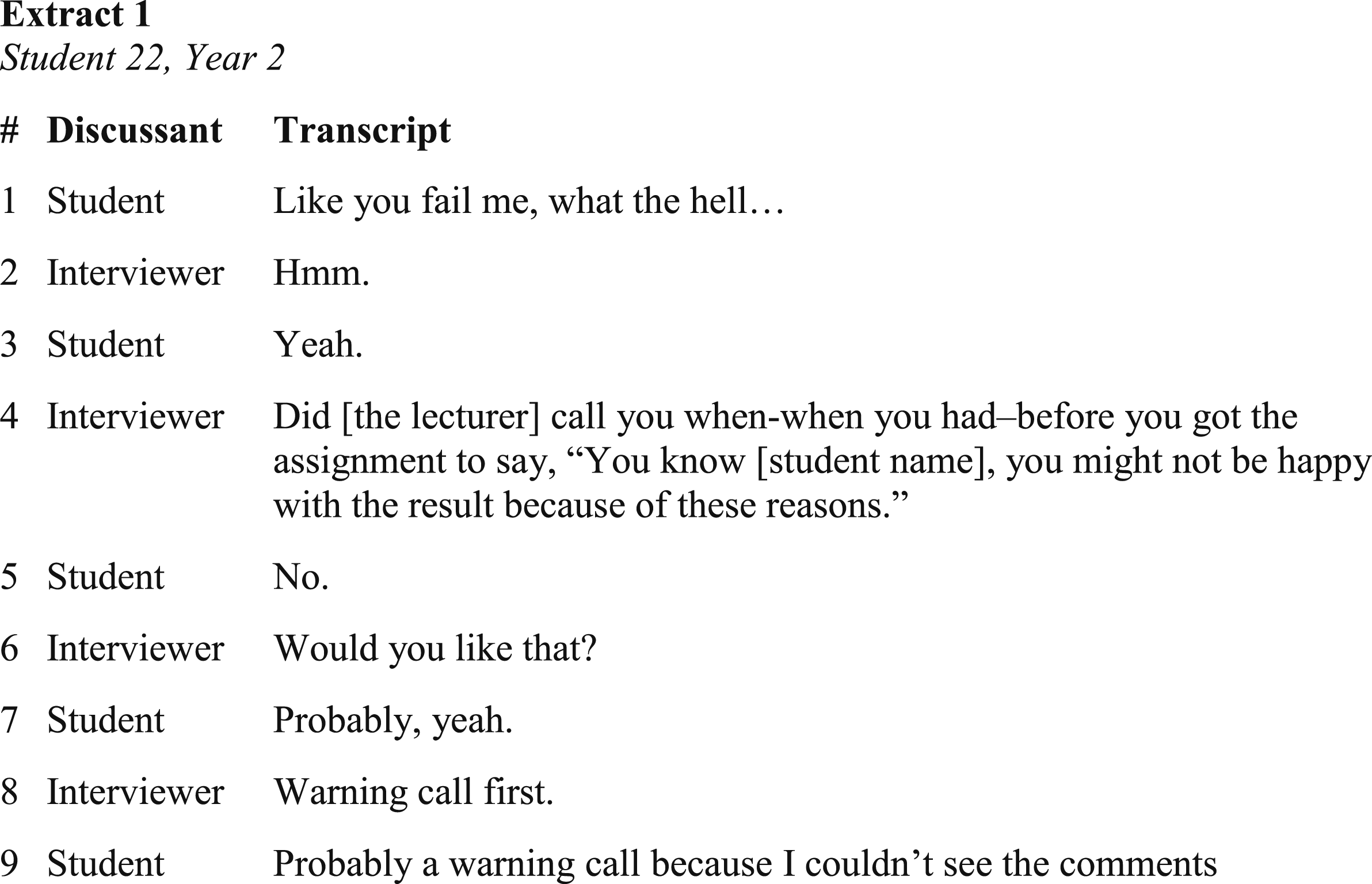
In this interaction, there is an expectation from the First Nations student that grades should not come as a shock and that any shock should be mitigated by the relationship with the assessor who is able to explain the result. Instead, the approach to assessment in the above case can be described as ‘transactional’: where an assessment is submitted, and a result delivered without any interaction between the two parties. The relational approaches that students seek, and expect, have since been adopted by other non-Indigenous lecturers who, despite sometimes being the bearers of bad news, have found it rewarding to support students through the process to ensure growth in their learning. Relationality is also evident in the way that lecturers approached assessment ‘for’ and ‘as’ learning with feedback playing an integral role.
Assessment ‘for’ and ‘as’ learning and the role of feedback
The last aspect of culturally responsive approaches to assessment that was specifically identified by the lecturers was the important role of feedback and the use of assessment ‘as’ and ‘for’ learning rather than ‘of learning’. University level assessments are mostly approached as assessment ‘of’ learning, and often there are little to no opportunities for students to receive feedback until after the assessment task has been completed when the result is given. Without necessarily using the terminology, lecturers described shifting their practices towards an assessment ‘for’ and ‘as’ learning approach. Instead, this was frequently described as ‘learning through the assessment’ (quote 7) or using an ‘integrated’ (quote 8) or ‘incorporated’ (quote 9) approach to assessment. This approach required lecturers to alter the way that learning content was delivered on the learning management system. Quote 7: ‘So that they’re doing their learning through the assessment and so that differs from how I normally teach it because normally its, uhm, assessment of learning and here is the learning set out in these weeks’. (Lecturer 7, Year 2) Quote 8: ‘The assignment needs to be integrated through the whole unit so that each week contributes somehow to the assignment’. (Lecturer 15, Year 3) Quote 9: ‘So, it’s like, okay, this is the content I want you to know that you can learn through doing your assessment. And that way you’re making sure it’s known and it’s uh, incorporated into what they’re doing’. (Lecturer 7, Year 2)
In the quotes, these lecturers – without using the word – point to constructive alignment as a fundamental principle to high-quality and valid assessment (Biggs & Tang, 2011) and, in this case, culturally responsive assessment.
The role of feedback was viewed as a crucial component of this approach to learning and assessment. In quote 10, the lecturer’s views align with current research that feedback should be timely, task-specific, and a dialogic process to guide student learning, which is also reflected in the literature on culturally responsive assessment practices (Black & Wiliam, 2009; Hattie, 2012; Mills, 2022; Snow et al., 2021). Quote 10: ‘So, it’s through that feedback, putting it into practice that they’re learning, rather than just saying this is the assessment, do it. And then, well, that’s wrong, which doesn’t give the opportunity for growth’. (Lecturer 7, Year 2)
Another lecturer (quote 11) pointed to the level of commitment required from both the lecturer and the student to engage with feedback for learning. Quote 11: ‘Lots of backwards and forwards emails. I think I reviewed their assignment eight times—between six and eight times—to provide feedback. Yeah, just not giving them the answers, but leading them in the right direction. That’s why I went backwards and forwards so many times. ‘Well done’ to that student for persisting’. (Lecturer 15, Year 3)
The iterative method of feedback described in quote 11 highlights the relational and dialogic process. Mills (2022) suggests relationships are integral to the provision of effective feedback in transcultural contexts.
Assessment design
Cultural content – valuing the knowledges and experiences of students in assessment
When it came to assessment design, all stakeholders noted the importance of valuing the knowledges and experiences of students and of ensuring that assessments were designed in a cultural inclusive or responsive way, representing a ‘funds of knowledge’ approach (Moll et al., 1992). The lecturers described changing the assessment tasks to value the knowledges and experiences of students. In some cases, the assessments were re-written with the students in mind, and in others, assessments were modified to become more inclusive and provide students with the opportunity to connect their knowledge to theory. These changes did not deviate from the unit learning outcomes, which lecturers frequently returned to as a means of validating or justifying the changes made (see quote 14 as an example).
One inclusive approach that lecturers used was to invite students to share their own knowledge through assessment. In quote 12, a lecturer describes an assessment where students were invited to share their own experiences to illustrate their understanding of the theory. The lecturer reflected on the value of this approach for students in quote 12. Quote 12: ‘I think the opportunity for students to write about their own experiences of schooling was-was probably, you know, something that students might think is a positive’. (Lecturer 4, Year 2)
Through this approach, lecturers do not need to know students’ cultural and linguistic backgrounds but can create space for students’ knowledges to be shared, respected, and validated in assessment contexts.
In another example, the lecturer re-wrote the assessment task to enable students to complete a science assessment based on their local environment. Some examples the students chose to focus on included dugongs, turtles, and the local lake. Students reported the following: • I enjoyed it more as the task had local relevance. • I could speak to community members and gain their knowledge. • I felt more comfortable/confident doing the assignment as I had prior knowledge of the topic. • I felt that the task was more meaningful, for example, I could use the information in a future lesson. • It was a great opportunity to learn more about a subject of interest.
The value of including First Nations’ cultural knowledge and perspectives in assessment tasks extended beyond students’ engagement and the greater content validity that inclusive assessment designs hold – in this case, the assessment itself became legitimate and valued source of information. One principal shared how a student’s assessment task formed the basis of professional development for the school and was added to the staff handbook: Quote 13: ‘She’s shared with us her last assignment… and she’s going to present that to our staff as a professional learning, to her colleagues… the written part of her assignment about the ways of knowing, we’re gonna put in the staff handbook’. (Principal 3, Year 2)
Quote 13 illustrates how the consequences of assessment (Messick, 1988) – intended and unintended – can be positive for First Nations peoples, if the assessment design is conducive to this. Through embracing First Nations peoples’ knowledges, experiences, and ways of learning, assessment can lead to the creation of cultural artefacts, with purpose and use beyond the completion of the task itself. This also speaks to the authenticity of the assessment design.
Modes of assessment
The second and equally important aspect of assessment design alongside the cultural content was the mode of assessment. Students and lecturers both reflected on the need to shift beyond dominant written modes of assessment, especially essay forms, in higher education. For example, Street et al. (2009, p. 195) argue ‘print literacies’ that currently dominate educational practices are not keeping pace with the global realities of contemporary communication dominated by digital technologies. Lecturers acknowledged this (e.g. in quote 15 below, ‘that’s another problem too with our assignments’) and frequently changed the assessment tasks to become more culturally responsive by incorporating a greater range of communicative modes and styles, through offering choice, and by utilising technology (quotes 14 and 15). Often this was done to mediate students’ language backgrounds and communicative preferences, as described in quote 15. Quote 14: ‘I don’t think it substantively changed the assessment and certainly the learning outcomes remained the same, but we allowed students to do a recording of their stories and to submit an audio recording… For the On Country students, we added the option that they could tell this story, record their story, and then transcribe it’. (Lecturer 4, Year 2) Quote 15: ‘They had some choice. I was trying to do that, anyway, but I think for this cohort, I thought that it would be better because I knew there were some that had literacy issues who, you know, weren’t so happy with writing and, and that’s, I mean, that’s another problem too with our assignments… And so, and so you’d have a written work as well but at least then you’re trying to address some of the different learning preferences that people have and their strengths because you want people to be able to show their strength, share the knowledge in the way that is the best way for them to show’. (Lecturer 5, Year 2)
Despite creating culturally responsive forms of assessment that accounted for students’ language backgrounds and communicative preferences, dominant discourses about ‘literacy issues’ continue to prevail. Rather than recognising that the forms of literacy encountered at the university level are new for students, and represent styles, genres, and modes that need to be learned, literacy is presented as an issue. Although a culturally responsive assessment was created, it was not necessarily enacted. Through culturally responsive approaches, there should be a commitment to ‘opening up generative and decolonising possibilities’ (Morrison et al., 2019, p. 2).
Students appreciated the choice offered in assessment tasks. In quote 16, a student highlights how shifting assessment designs to non-traditional modes, such as interviews, provided an enriching learning opportunity. Quote 16: ‘I’ll think like with the Literacy one, I asked so you had to interview somebody, and I asked if I could email a person with the questions. And I did it that way, and the woman’s reply was amazing. Like she just... she was amazing her reply to all my questions and it was... It made it so much more easier for me to compare my situation with her situation because she went into such great detail. So [inhales] yeah’. (Student 11, Year 2)
In the example provided in quote 16, the modified assessment design catered for the student’s communicative preferences and provided the opportunity for a relational experience through the assessment which led to greater self-reflection.
However, the use of technology alone did not ensure assessments were culturally responsive; technology needs to be incorporated in culturally appropriate ways. For one assessment task, students were asked to video record a dramatic performance of themselves, alone. While this assessment was based on storytelling, a highly salient and culturally important communicative practice in Aboriginal societies (Shay et al., 2022), its western expectations and performance measures made it a culturally unsafe experience for students. In their feedback, they explained that in Aboriginal cultures, storytelling or ‘yarning’ is carried out in front of an audience, and in this regard, it is relational (Wilson, 2008). They felt awkward filming without anyone watching and would have preferred being filmed with a class or group of students. Related to this point, students felt anxious about who the audience would eventually be. They did not feel comfortable creating a permanent record of the performance which could ultimately be played to an unknown audience. This was highly antithetical to storytelling in Aboriginal cultures where the social function of storytelling is strong, and audience is crucially important (Wilson, 2008). This also contributed to feelings of ‘shame’ for students who were not comfortable with ‘putting yourself on show’. Despite creating a multimodal assessment design incorporating technology, the assessment lacked cultural authenticity. It was culturally inappropriate because the storytelling was devoid of social function and without a purpose beyond assessment.
Limitations
There are two main limitations of the study: its generalisability and location within a broader research program. First, the findings from this small-scale qualitative study are highly contextual and specific to the student cohort and institutional context and therefore lack direct generalisability. However, they do echo the literature on culturally responsive assessment, and on effective assessment principles and practices generally, and can therefore, offer helpful insight that can be used to create a picture of culturally responsive assessment across contexts. Second, the study design did not specifically garner information about stakeholders’ experiences with assessment, relying instead on this emerging as a theme from a larger data set. Whilst this represents an inherent limitation as not all stakeholders spoke about assessment, nor could the same specific question be asked of each participant, it does, however, highlight how important university assessment is to the program stakeholders and generates useful data about what matters most to them (without being prompted).
Discussion and conclusion
In this article, we have offered some empirically based and theoretically grounded ways of enacting and creating culturally responsive assessment that have been validated by the First Nations students who experienced these strategies. These findings demonstrate some of the ways that culturally responsive assessment can be enacted through the approaches surrounding assessment or created through the assessment design process.
The culturally responsive assessment practices described align with sociocultural and constructivist views of assessment. From a sociocultural perspective, the lecturers responded to the cultural and linguistic backgrounds of students in their approaches to assessment and assessment design. From a constructivist viewpoint, lecturers have ensured learning, teaching, and assessment are constructively aligned in culturally responsive ways and have utilised an assessment ‘for’ and ‘as’ learning approach to achieve this. They adopt highly effective assessment strategies including the provision of targeted task-based feedback and high levels of scaffolding through explicit guidance using clear criteria and instruction (Black & Wiliam, 2009; Hattie, 2012). Interestingly, it is in these ways assessments were reconstructed to align to Inuit culture in the study by Snow et al. (2021). Together, this indicates alignment between assessment ‘best-practice’ across cultures and theoretical perspectives.
One aspect that is potentially unique to assessment practices in First Nations contexts is relationality. From this perspective, the assessed and the assessor are in a learning relationship (Snow et al., 2021). Our findings suggest that approaching assessment in a relational and dialogical manner is central to enacting culturally responsive assessment. Carjuzaa and Ruff (2010), however, poignantly ask the extent to which an assessor from a western cultural background can fairly assess student’s work that represents a different worldview. Applying this critique to our study, it can be argued that even though the assessments were modified to become more culturally responsive, and lecturers enacted culturally responsive ways of approaching assessment, their deep-rooted and often implicitly realised cultural beliefs and knowledge systems differ in ways that will impact the validity and fairness of assessment (see also Klenowski, 2009). Moreover, in our study, the student learning outcomes and assessment rubrics were not changed and remained embodiments of western epistemology. Consequently, it is argued that: [E]ducators at all levels must go beyond modifying instructional strategies to meet the needs of diverse learners and providing a representative view of multiple cultures. To achieve equity, educators must question the standards being used to evaluate student understanding by considering multiple paradigms in addition to the dominant worldview. (Carjuzaa & Ruff, 2010, p. 69)
Overwhelmingly, the literature suggests that it is through relationships that this can be achieved (Carjuzaa & Ruff, 2010; Mills, 2022; Montenegro & Jankowski, 2017; Snow et al., 2021). By positioning students as partners in the learning process, Mills (2022, p. 403) suggests that rubrics should be co-constructed with students to ensure they are fair. For others, this is not enough, and it is the student learning outcome that must be questioned. Carjuzaa and Ruff (2010) suggest that learning standards should be renegotiated through ‘sincere dialogue between members of different cultures who possess differing epistemologies’ (p. 74). It was noted in our study that most staff were from white western cultural backgrounds. To achieve this aim, there needs to be greater diversity of staff in higher education institutions and institutions need to engage students, and other representative groups, to renegotiate and co-construct the measures for student achievement.
Thus, whilst not intending to diminish or devalue the efforts of the lecturers who went above and beyond their roles (and workload) to enact and create culturally responsive assessments for students in the OCTE program, these practices only meet the criteria for being culturally responsive in part. Their assessment practices were validating, comprehensive, multidimensional, and empowering, but not necessarily transformative and emancipatory (Gay, 2010). They valued and mobilised ‘the cultural repertoires and intelligences that students bring to the learning relationship’ but did not create ‘generative and decolonising possibilities’ (Morrison et al., 2019, pp. 1-2). The lecturers achieved what they could within the parameters of the system to which they were bound. However, these strategies remain at the periphery of the western, colonial higher education system, tinkering at the edges without changing the core. To realise the decolonial intentions of culturally responsive approaches as described by Morrison et al. (2019), there needs to be a shift from being ‘responsive’ to being ‘proactive’. That is, student learning outcomes and the ways that students’ achievement is measured should be co-designed with diverse representatives to become culturally embracing and nourishing. This in turn will facilitate more comprehensive approaches to developing assessments, beyond alternative methods of asking the same questions. Ultimately, systemic change is needed, but educators can be a driving force behind this change.
Footnotes
Acknowledgements
We acknowledge we live and work on unceded Whadjuk Noongar Boodja (Country) and pay our respects to Whadjuk Noongar peoples, past, present, and emerging. We would like to extend our respects to all First Nations peoples across Australia. We acknowledge the sophisticated knowledges that First Nations peoples across Australia hold and work towards ensuring assessment practices embrace these knowledges. Our heartfelt thanks go to the participants who generously shared their experiences. We are grateful to the anonymous reviewers and the editor for their valuable feedback. Any errors are our own.
Declaration of conflicting interests
The author(s) declared no potential conflicts of interest with respect to the research, authorship, and/or publication of this article.
Funding
The author(s) received no financial support for the research, authorship, and/or publication of this article.
