



Abstract
Public opinions are divided on the relative benefits versus harms of allowing mobile phones in schools. When debating the consequences of mobile phones in schools, politicians often argue that students’ use of mobile phones distract from their learning, increase cyberbullying and lead to poor mental health outcomes. We conducted a scoping review of the global literature, followed the Preferred Reporting Items for Systematic reviews and meta-Analyses extension for scoping reviews (PRISMA-ScR) and pre-registered our protocol with the Open Science Framework (OSF). Our search and screening process identified 22 studies that met our inclusion criteria and shed light on our research questions: whether mobile phone use in schools impacts academic outcomes, mental health and wellbeing and cyberbullying. We found an absence of randomized controlled trials with evidence resting on a small number of studies with different designs, samples, operational definitions of mobile phone bans (i.e. partial, or complete bans) and outcome measures, making reconciliation of findings challenging. Nonetheless, we provide a synthesis of the latest evidence for decision-makers tasked with deciding for or against mobile phone bans in schools. Directions for future research are provided and practical implications for schools are discussed.
Introduction
Across Australia, and in other industrialized nations, mobile phone usage by school-aged students has been demonized as harmful to engagement, mental health, disruptive to learning and a contributor to cyberbullying and excessive internet use (Bennett, 2020; Duke & Montag, 2017; Elhai et al., 2016; Škařupová et al., 2016). Politicians argue that students’ use of mobile phones distract from their learning, increase cyberbullying and lead to poor mental health (Selwyn & Aagaard, 2021). Based on these beliefs and oft in the absence of research evidence, education departments (most recently, including many within Australia) have enacted policies to ban the presence of mobile phones in classrooms. As schools are tasked with preparing students for what will be technologically saturated lives, decisions to restrict mobile phone usage at school seem at odds with educators’ obligations to teach students the responsible use of technology and in turn address bullying, cyberbullying and student wellbeing in the contexts and on the devices in which they occur. The present scoping review provides a much-needed examination of the evidence for and against mobile phone bans in schools.
Mobile Phone Use in Children
Mobile phone ownership has become an almost ubiquitous part of young people’s lives. In Australia, a survey by the Australian Communication and Media Authority found 48% of children aged 6 to 13 either own or have access to a mobile phone, a number that has consistently risen since the annual survey was launched in 2013 (Sparkes, 2019). In the UK, the media regulator found 83% of children aged 12 to 15 years owned a smartphone, 37% in the 8 to 11 years age bracket and 5% of 3- to 4-year-olds owned smartphones (Kleinman, 2020). In Japan and India, first mobile phone ownership peaks at 15 to 16 years, in Egypt and Indonesia at 12 years and in Chile at 10 years (GSM Association & NTT DOCOMO, 2013, 2016). In South Korea, 89.5% of the population aged 3 and over used smartphones (Park, 2020).
Globally, many children both during and outside of school hours communicate and learn through mobile technology, wrongly leading adults to believe the current generation are digital natives (Goldsmith, 2014). While students may be competent at searching the internet, communicating on social media and switching efficiently and effortlessly between applications, they also report being overwhelmed by information and struggle with digital literacy (Neumann, 2016). As a result, what has emerged over the past decade is a body of literature on how schools can use mobile technology, including mobile phones, in the classroom to supplement learning (Bromley, 2012; Norris et al., 2011) and support student collaboration (Ferreira et al., 2018).
Mobile Phone Bans in Schools
Despite decades of largely uncontroversial support for the use of technology in education (Kessel et al., 2020), banning of phones is occurring in numerous educational jurisdictions across the globe. The first wave of bans was initiated in the late 1980s and early 1990s in North America, when many school sectors began to implement policies or laws to prevent students from using cell phones and pagers in school (Education World, n.d.). However, by the early 2002s many of these bans had been lifted (Wong, 2014). A second wave of banning commenced in earnest in schools elsewhere in the world from 2008 to 2012 – well after the first wave of efforts to re-allow them in multiple US states gathered impetus (Trucano, 2015). For example, India’s director of general education issued orders preventing mobile phone use in 2005, an order re-enforced in 2019 and which now applies to both students and teachers. In Japan, bans commenced in 2009, although these, too, were reversed in 2019 (Selwyn & Aagaard, 2021). More recently, bans were imposed in Israel, in 2016 (Selwyn & Aagaard, 2021); in France in 2017; in Shandong province, China, in 2018 (Environmental Health Trust, 2020); and in Ontario, Canada, in 2019 (Brown, 2019). Denmark, Sweden, Chile, England, Wales and Madrid and others are now considering similar mobile device restrictions (Selwyn & Aagaard, 2021). These restrictions are varied with some schools not allowing any device in the school ground, others who require students to put the phone in a locked bag, while others allow students to have their phones in their bags or pockets but are not allowed to use them. Furthermore, a consequence of any decision to ban mobiles in schools is that the responsibility for learning digital literacy is left to families, many of whom feel ill-equipped to help their child become digitally literate (Strider et al., 2012). Nonetheless, the banning of mobile phones in schools appears to be gathering momentum despite historically these decisions being reversed a few years later. What is driving the renewed interest in educational mobile phone policies?
The impetus for phone policy changes at school are often championed by politicians responding to community concerns (Selwyn & Aagaard, 2021). Community concerns are amplified by the media, creating moral panics about issues for which little-to-no evidence exists – and to which banning then becomes a seemingly necessary and politically popular response (Orlando, 2019; Selwyn & Aagaard, 2021). Justification based on such policies adopting a child protection stance also dominate funded research in this area, with ‘[m]ost of the funded research begins with . . . how to keep children safe from technology’ (Orlando, 2019, p. 8). While protection of children is important, it is not the only lens through which the use and impacts of children’s technological experiences can be viewed. Another reason could be there is emerging evidence that mobile phones are a distraction to learning in university or college settings with self-report data and using designs that produce correlations rather than causes (Bjornsen & Archer, 2015; Chen & Yan, 2016; Kates et al., 2018; Lepp, 2015). A meta-analysis of 39 studies exploring the relationship between mobile phone use and educational outcomes for university students (Kates et al., 2018) concluded there appeared to be a consistent, but small, negative effect on educational achievement (e.g. GPAs, test scores) if students were distracted by their mobile phones during lectures.
Theoretical Underpinnings
As a basis for understanding the impact of school-based mobile phone restrictions on children’s learning and mental health outcomes, our scoping review was underpinned by the social developmental model (SDM; Catalano & Hawkins, 1996). SDM is a multi-modal theoretical framework that emphasizes the nested social ecology of health and wellbeing outcomes (Bronfenbrenner, 1989; Fleming et al., 2010), mastery of skills and confidence to tackle adverse events, transitions and milestones (Bandura, 1977), and connectedness to others as being central to mental health (Catalano et al., 2004). The SDM incorporates risk and protective factors as predictors of problematic behaviour. As such, children’s behaviour can be seen as being shaped by risk and protective factors across multiple social systems, including peer groups, education institutions and communities (Fleming et al., 2010). In accord with SDM, we propose that children’s mobile phone behaviour and associated outcomes are affected not only by each system, but by synergies and tensions across these systems. We suggest that while mobile phones in schools may present as a risk for some outcomes, they may be a protective factor for other outcomes. For example, the distraction that mobile phones might cause in the classroom could be a risk for poorer academic outcomes. On the other hand, children’s learning outcomes may be enhanced by the increased use of a variety of smartphone-based technologies which might strengthen their confidence to keep pace in a rapidly evolving tech-based world. A further example is the possibility that mobile phones in schools presents as an increased risk for cyberbullying harming students’ mental health. However, given that children’s psychological wellbeing is shaped by their sense of connection or belongingness to prosocial groups and institutions, mobile phones may be a protective factor for children’s mental health.
Current Review
Given the popularization of implementing restrictive mobile phone policies in schools, and the tendency for increasing numbers of regions and countries following suit, there is a need to identify the existing empirical evidence of the effects of mobile phones in schools. We conducted a robust scoping review (see Munn et al., 2018) of the global empirical literature for banning mobile phones in schools. Our aim was to examine whether student mobile phone usage at school is beneficial or disruptive to engagement and learning and investigated the impact of using mobile phones at school on academic outcomes, mental health and wellbeing and cyberbullying. Therefore, our findings offer the scientific evidence for policy makers charged with making decisions about mobile phone usage in schools and draws inferences for educators regarding the importance of teaching the responsible use of mobile technologies in schools.
Method
Literature Search
We used Arksey and O’Malley’s (2005) five-stage framework for scoping reviews: (1) identifying the research questions; (2) identifying relevant studies; (3) study selection; (4) charting the data; and (5) summarizing and reporting the results. Our reporting process follows the Preferred Reporting Items for Systematic reviews and Meta-Analyses extension for Scoping Reviews (PRISMA-ScR; Tricco et al., 2018). The data extraction and synthesis plan were preregistered with the Open Science Framework (OSF; see https://osf.io/aqgfp)
Identifying the Research Questions
The focus of our review was to understand the existing empirical evidence for the effects of banning mobile phones in schools in relation to academic outcomes, mental health and wellbeing and cyberbullying. To ensure our scoping review covered the full range of literature on topics, the following research questions were used to guide our search:
Does mobile phone use at school impact on academic outcomes (including learning, distractibility, cheating)?
Does mobile phone use at school impact students’ mental health and wellbeing?
Does mobile phone use at school impact rates of cyberbullying?
Identifying Relevant Studies
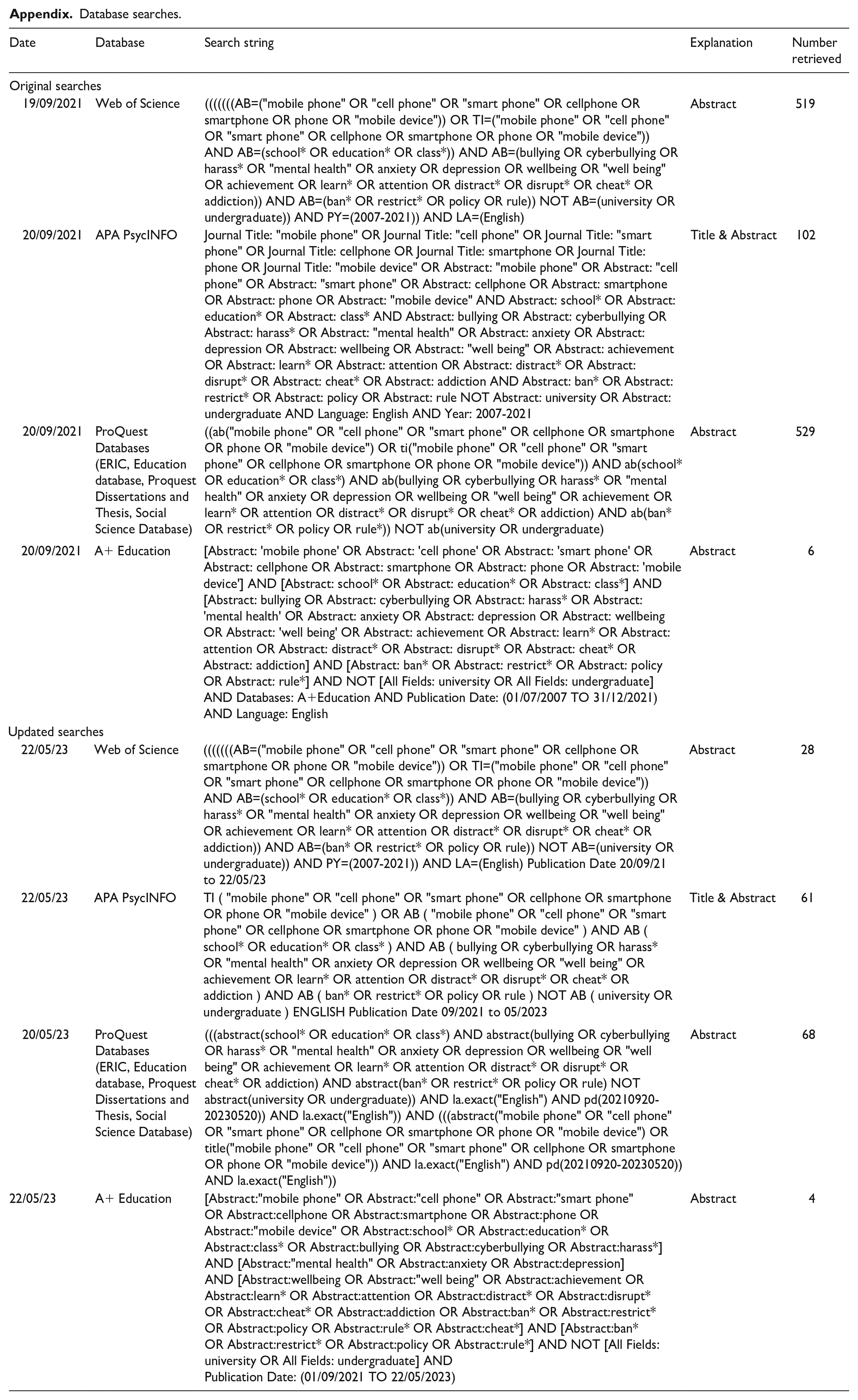
Following consultation with an academic librarian and to be as wide-reaching as possible, we searched databases in the field of education and psychology: Web of Science, APA PsycInfo, A+ Education and Databases on the Proquest platform (Education Collection: Education Database and ERIC; Proquest Dissertations and Thesis Global and Social Science Database; see Appendix). Database searches were conducted between September 19 to 20, 2021 and were updated May 20 to 22, 2023. We used a broad operationalization of key terms (Arksey & O’Malley, 2005): mobile phone OR cell phone OR smart phone OR cellphone OR smartphone OR phone OR mobile device AND school* OR education* OR class* AND bullying OR cyberbullying OR harass* OR mental health OR anxiety OR depression OR wellbeing OR well being OR achievement OR learn* OR attention OR distract* OR disrupt* OR cheat* OR addiction AND ban* OR restrict* OR policy OR rule NOT university OR undergraduate. All search terms were of interest as keywords in the title and abstract (see Appendix for search strings). Inclusion and exclusion criteria are shown in Table 1.
Inclusion and exclusion criteria.
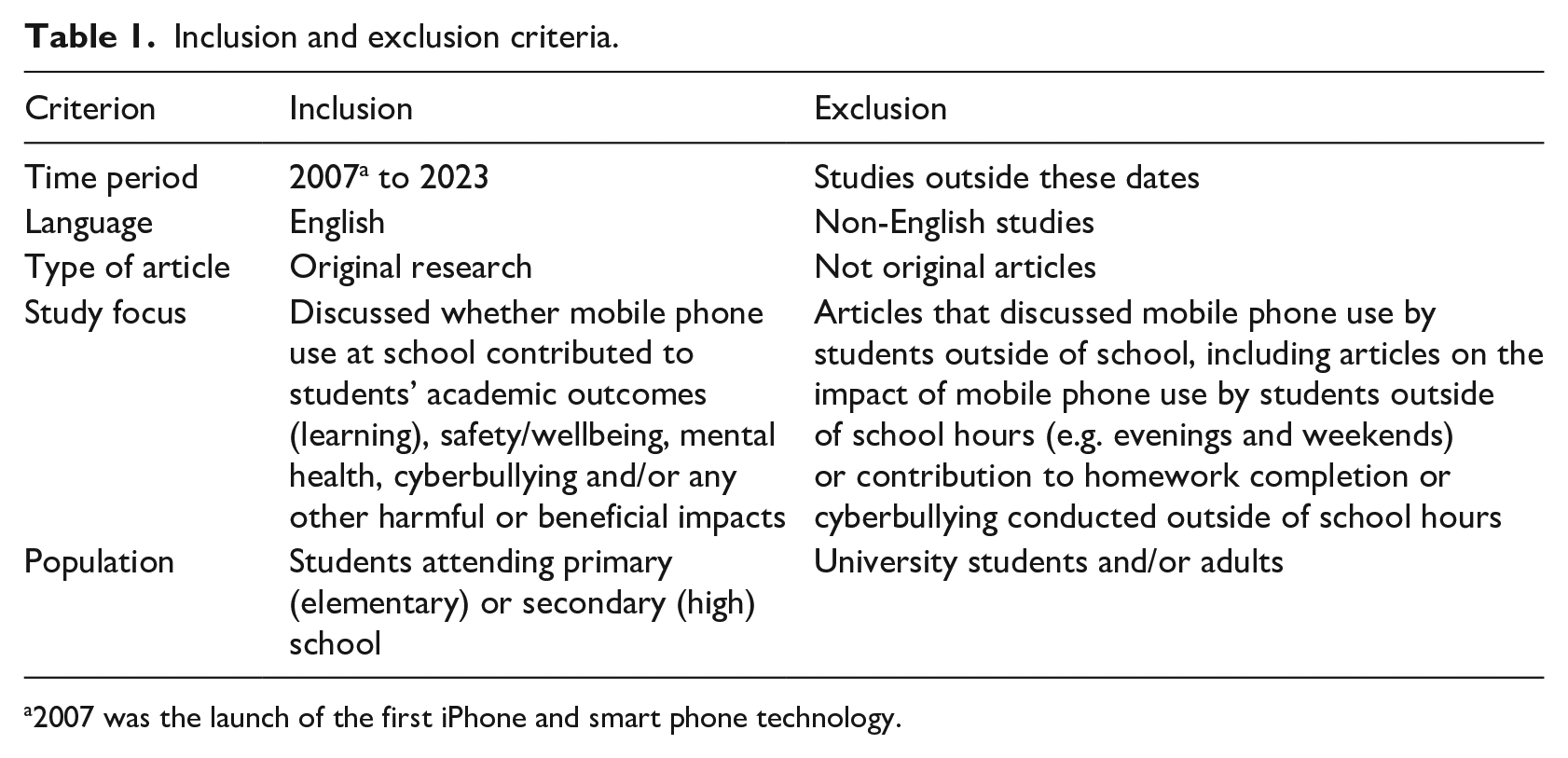
2007 was the launch of the first iPhone and smart phone technology.
Study Selection
The first phase of the search identified 1,317 articles (see Figure 1). In the second phase of the search, we identified 53 articles by a hand search of the reference lists of theoretical papers, reviews and/or meta-analyses and articles identified in the earlier phase (i.e. snowballing). The title and abstract and full-text screening was conducted using Covidence online software (see Harrison et al., 2020 for review). Following removal of duplicates, 1,121 articles were screened at the title and abstract level revealing many articles that were not relevant to the topic, therefore after their removal 73 articles were identified for full-text screening. Full-text versions of each article was read by two authors to confirm relevancy for the current review. Conflicts were resolved by a third author who did not conduct the initial screening. Articles that did not meet the inclusion criteria were removed (n = 51). A total of 22 articles met criteria for inclusion (cf. Figure 1).
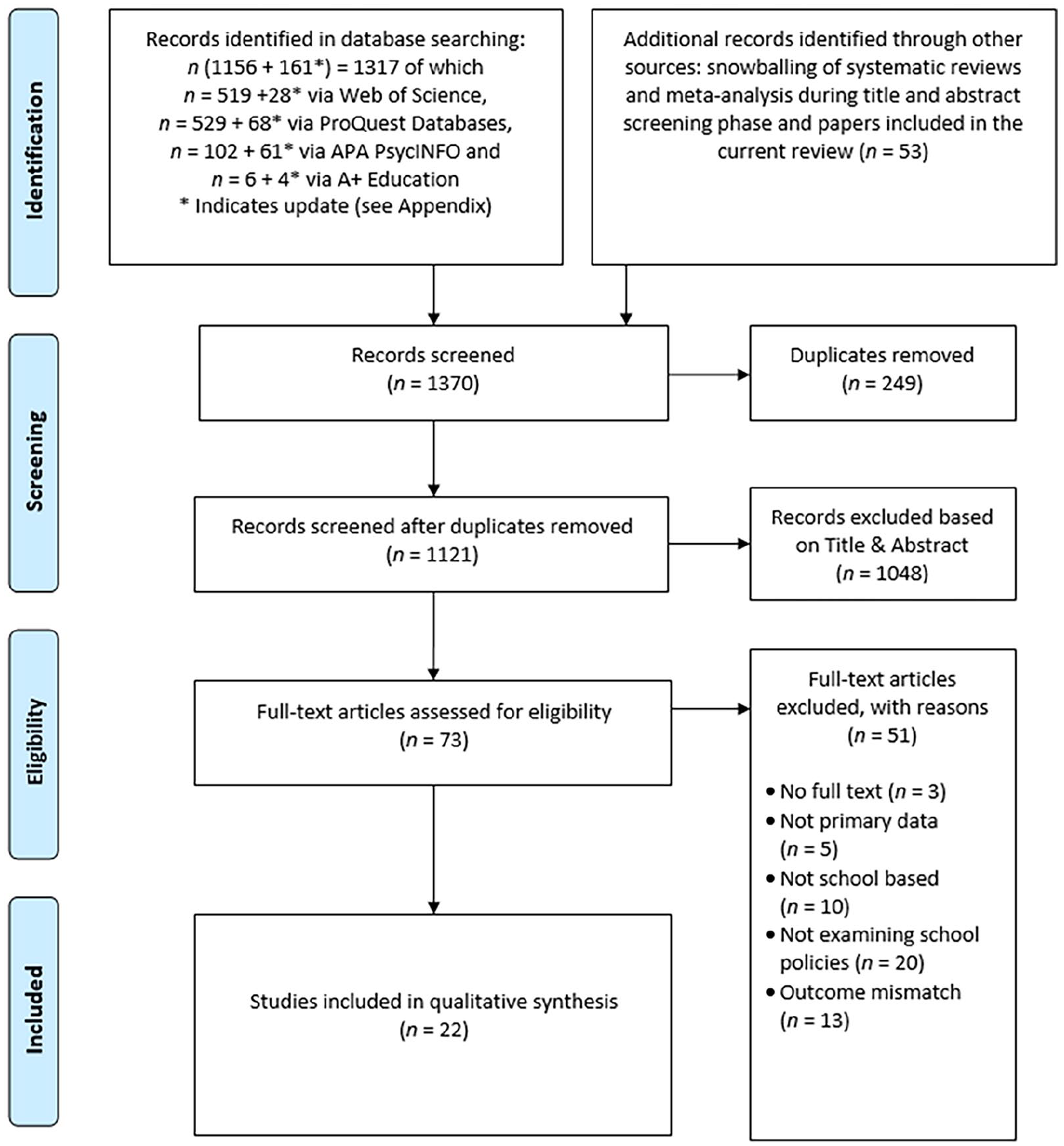
PRISMA flow chart.
Charting the Data
Data were extracted from the final identified studies using a predetermined form including author/year, location, aims, participants, design, outcome measures and main findings (see Table 2). As shown in the table, studies were conducted and/or published between 2013 and 2022 (12 were unpublished).
Summary of included studies (N = 22).
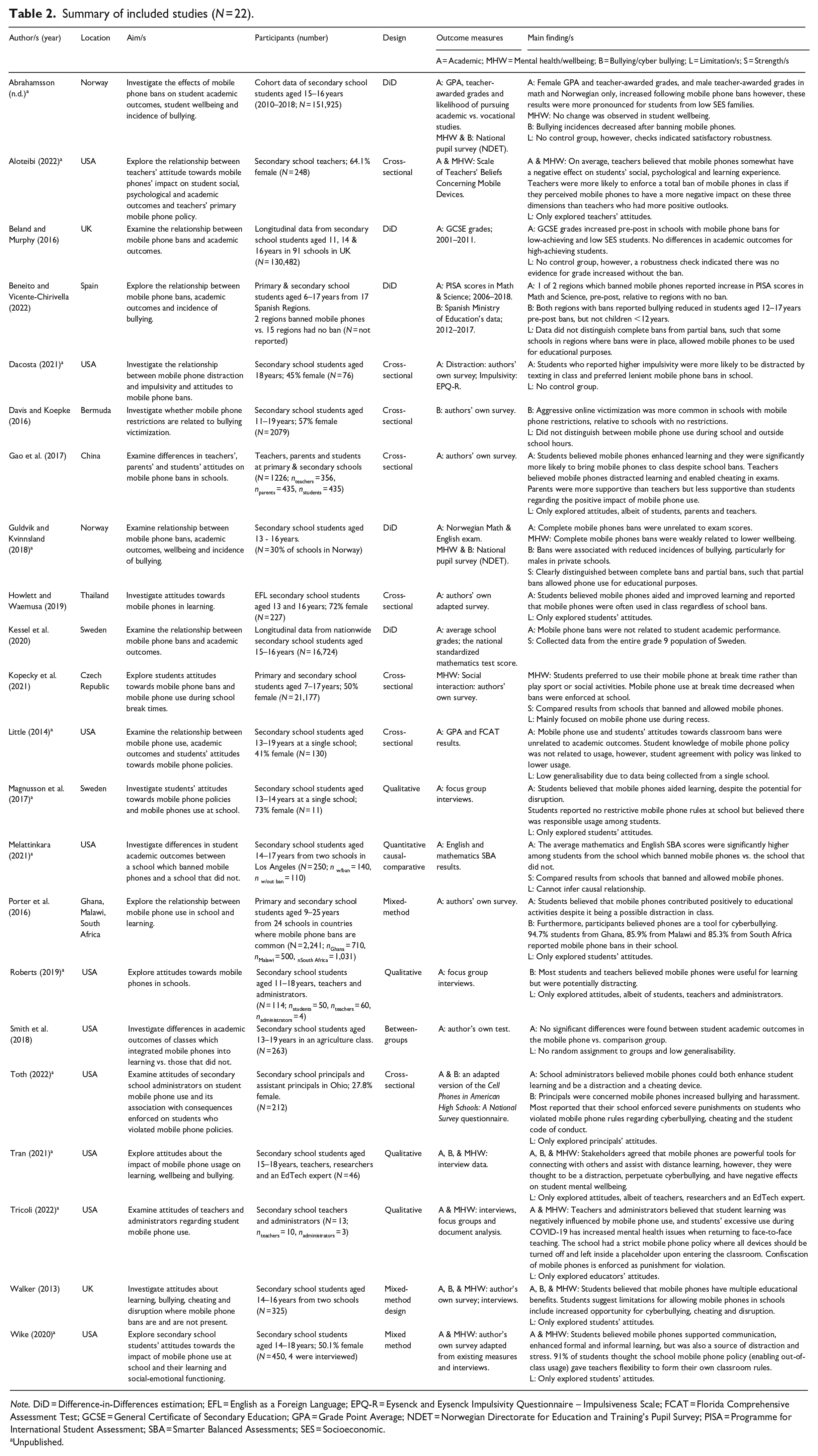
Note. DiD = Difference-in-Differences estimation; EFL = English as a Foreign Language; EPQ-R = Eysenck and Eysenck Impulsivity Questionnaire – Impulsiveness Scale; FCAT = Florida Comprehensive Assessment Test; GCSE = General Certificate of Secondary Education; GPA = Grade Point Average; NDET = Norwegian Directorate for Education and Training’s Pupil Survey; PISA = Programme for International Student Assessment; SBA = Smarter Balanced Assessments; SES = Socioeconomic.
Unpublished.
Summarizing and Reporting the Results
Due to the heterogenic nature of the methods and outcomes of the identified studies, we used a narrative synthesis to answer our research questions and provide practical implications and directions for future research. As such, we provide a qualitative synthesis of findings regarding the benefits (for) and/or harm (against) mobile phone use in schools, in line with our OSF registration.
Results
Our scoping review identified 22 studies conducted in 12 countries (Bermuda, China, Czech Republic, Ghana, Malawi, Norway, South Africa, Spain, Sweden, Thailand, UK, USA). We did not find research on mobile phone bans from the Oceania region. A range of research designs were used: difference-in-differences (DiD) estimation (n = 5), between-groups comparison (n = 1), quantitative causal-comparative (n = 1), cross-sectional (n = 8), qualitative (n = 4) and mixed-methods (n = 3). There was a marked absence of rigorous, randomized and controlled studies comparing academic outcomes, mental health and wellbeing and cyberbullying before or after mobile phone bans or with or without restriction policies in schools. To answer our research questions (see section ‘Identifying the Research Questions’) we present findings on the impact of mobile phone use on academic outcomes (n = 7) and the relationship between mobile phone use and learning (n = 14; section ‘Mobile Phone Use and Academic Outcomes’), student mental health and wellbeing (n = 6; section ‘Mobile Phone Use and Mental Health and Wellbeing’) and cyberbullying (n = 7; section ‘Mobile Phone Use and Cyberbullying’; Note: some papers covered more than one outcome). It is important to note that only papers that examined the impacts of mobile phone bans in schools were included in our scoping review. However, we found that studies had different operational definitions of a mobile phone ban, that is, complete or partial bans (see section ‘Implications for Future Research and Practice’).
Mobile Phone Use and Academic Outcomes
Effects of Mobile Phone Bans on Academic Outcomes
Seven studies explored the effects of mobile phone bans on academic outcomes (i.e. causal relationship) using different methodological designs, namely DiD estimation (Abrahamsson, n.d.; Ashenfelter, 1978; n = 5; Beland & Murphy, 2016; Beneito & Vicente-Chirivella, 2022; Guldvik & Kvinnsland, 2018; Kessel et al., 2020), between-groups comparison (n = 1; Smith et al., 2018) and quantitative causal-comparative (n = 1; Melattinkara, 2021). Four studies reported increases in academic outcomes as evidence to support mobile phones bans in schools (Abrahamsson, n.d.; Beland & Murphy, 2016; Beneito & Vicente-Chirivella, 2022; Melattinkara, 2021) while three studies reported no differences in student academic achievement regardless of bans (Guldvik & Kvinnsland, 2018; Kessel et al., 2020; Smith et al., 2018). Studies using the DiD estimation method found mixed results with three papers revealing bans improved academic achievements (Abrahamsson, n.d.; Beland & Murphy, 2016; Beneito & Vicente-Chirivella, 2022) and two papers showing no academic differences (Guldvik & Kvinnsland, 2018; Kessel et al., 2020). In other work, Smith et al. (2018) compared the differences in agriculture students’ ability to identify tree leaf with and without smartphone support and found no significant differences in test scores between the group which employed smartphone support and the control group that used printed material, suggesting that incorporating mobile phones into pedagogical practices does not diminish students’ learning experience.
Reconciliation of results was challenging, and findings should be treated with caution given differences in methods and measures, and discrepancies in operational definitions of the bans themselves. For example, the results of two studies supporting bans for improved academic outcomes were restricted to low-achieving students from low socioeconomic (SES) backgrounds (Abrahamsson, n.d.; Beland & Murphy, 2016). That is, they found that high-achieving and economically advantaged students were less likely to benefit academically from mobile phones use in class, as compared to their disadvantaged peers. Beland and Murphy (2016) examined exam scores in secondary school students and found that in schools which imposed a mobile phone ban, exam scores improved by an average 0.07 standard deviation, pre- to post-ban. Importantly, this effect was driven by the finding that students in the lowest quintile of prior academic achievement made a gain of approximately 14.23% of a standard deviation in test scores, while for students in the top quintile, test scores were unrelated to the ban. Beland and Murphy suggested that the most likely explanation for this difference was that low-achieving students may have poorer self-control and become distracted by the presence of mobile phones, while high-achievers might be more focused in the classroom irrespective of the mobile phone policy. Abrahamsson (n.d.) reported that female students’ GPA and teacher-awarded grades and male students’ teacher-awarded grades in math and Norwegian only, increased following mobile phone bans; however, these results were more pronounced for students from low SES families. Specifically, Abrahamsson found no positive effects of mobile phone bans on the grades of male students from high SES families.
Two other studies providing evidence supporting bans for increasing academic outcomes were ambiguous on whether mobile phones were banned completely or were allowed to be used in class for learning purposes (Beneito & Vicente-Chirivella, 2022; Melattinkara, 2021). Specifically, Beneito and Vicente-Chirivella (2022) reported a positive effect of mobile phone bans on student PISA scores in one of two regions that equated to advancing 0.6 to 0.8 years of learning in math and science. However, Beneito and Vicente-Chirivella did not differentiate between complete bans and partial bans (allowed phones for learning purposes). It is therefore unclear whether the school reporting the increase in academic outcomes allowed mobile phones to be used during class for learning. Melattinkara (2021) found students from schools prohibiting mobile phones scored higher in mathematics and English compared to students from schools with lenient mobile phone policies. However, Melattinkara noted that teachers’ decision to either ban or incorporate mobile phone technology into individual classrooms, regardless of schools’ overarching policy, was not accounted for as a potential factor influencing student academic outcome. As such, it is unclear whether the increases in academic outcomes can be attributed to mobile phone bans or the flexibility with which teachers permitted phones to be used as learning tools.
Conversely, three studies found no relationship between mobile phone bans and academic achievement (Guldvik & Kvinnsland, 2018; Kessel et al., 2020; Smith et al., 2018). Kessel et al. (2020) replicated Beland and Murphy’s (2016) study and found no evidence for the positive or negative impact of mobile phone bans on students’ academic outcomes measured by school grades and math test scores. Notably, Kessel et al. (2020) collected data from the entire country’s population of ninth graders, unlike Beland and Murphy who sampled only four cities. In other work, Guldvik and Kvinnsland (2018) reported no differences in secondary students’ math and English test scores in schools that strictly banned mobile phone use throughout the school day. Together, these studies (Guldvik & Kvinnsland, 2018; Kessel et al., 2020; Smith et al., 2018) provide no evidence for the implementation of mobile phones bans in schools for the purpose of improving academic outcomes.
Relationship Between Mobile Phone Use and Learning
Research capturing the relationship between attitudes to mobile phone usage (i.e. correlational relationship) and student learning are mixed. Ten studies found that students, teachers, parents and administrators were concerned about students’ distractibility when mobile phones were permitted in schools (Aloteibi, 2022; Gao et al., 2017; Magnusson et al., 2017; Porter et al., 2016; Roberts, 2019; Toth, 2022; Tran, 2021; Tricoli, 2022; Walker, 2013; Wike, 2020) and four studies reported that students, teachers and administrators believed that allowing phones in class might perpetuate cheating (Gao et al., 2017; Toth, 2022; Tricoli, 2022; Walker, 2013). There was a general consensus among most studies of a perceived negative influence of mobile phones on student learning. One study surveyed students, teachers and parents across primary and secondary schools on their perception of schools’ mobile phone policies (Gao et al., 2017) and noted reasons for stricter regulation of mobile phone use at school were: disruption to learning, disturbance during resting periods and a tool for cheating during exams. Three studies reported similar perceptions among teachers and administrators (Aloteibi, 2022; Toth, 2022; Tricoli, 2022). While teachers were found more likely to hold a negative view of mobile phone use at school (Gao et al., 2017), some studies suggest students are also highly aware of the distraction mobile phones may bring during learning periods (Magnusson et al., 2017; Porter et al., 2016; Roberts, 2019; Tran, 2021; Walker, 2013; Wike, 2020), highlighting a perceived concern for allowing phones into the classroom.
Two studies used cross-sectional designs to examine the relationship between mobile phone use and aspects of learning. Dacosta (2021) found higher mobile phone distractibility was related to greater students’ impulsivity. However, Little (2014) found no relationship between mobile phone use and academic outcomes indexed using GPA.
Eleven studies with students and educators showed a broadly accepted belief the mobile phones are valuable devices for supporting teaching and learning (Aloteibi, 2022; Gao et al., 2017; Howlett & Waemusa, 2019; Magnusson et al., 2017; Porter et al., 2016; Roberts, 2019; Toth, 2022; Tran, 2021; Tricoli, 2022; Walker, 2013; Wike, 2020). For instance, one study with adolescents reported benefits of mobile use in schools as: rapid, easily transportable and convenient internet access; replacement for searching when laptops were slow; being able to photograph work on boards; enhanced organizational capability; and being a compact, all-encompassing tool for learning (e.g. calculators, fitness indicators; Walker, 2013). Walker (2013) also reported that 70% of students in the study (irrespective of whether a ban was in place at their school) felt they would be happy to have their phones accessible in class. Another study found over 82% of student participants were utilizing their mobile phones for research which enhanced their formal and informal learning experiences (Wike, 2020). Interestingly, three studies conducted in different settings, revealed that students prefer to be autonomous with their mobile phone use at school regardless of policies, with many reporting to be using their devices in spite of bans (Gao et al., 2017; Howlett & Waemusa, 2019; Walker, 2013; Wike, 2020).
Mobile Phone Use and Mental Health and Wellbeing
Studies exploring the evidence to support mobile phone bans in schools for protecting student mental health and wellbeing are inconclusive. Six studies explored the relationship between mobile phone use and student mental health and wellbeing. Two studies used DiD estimation (Abrahamsson, n.d.; Guldvik & Kvinnsland, 2018), one study used cross-sectional methods (Aloteibi, 2022), two studies used qualitative methods (Tran, 2021; Tricoli, 2022) and one study used mixed method (Wike, 2020). Two studies provided anecdotal support for banning mobile phones (Aloteibi, 2022; Tran, 2021), such that teachers and researchers expressed their concerns for mobile phones’ negative influence on students’ mental health. Specifically, Aloteibi (2022) reported that teachers believed that when bans were in place, they noticed an increase in student socialization and collaboration, contributing to improvements in student social wellbeing. The relationship between mobile phone bans and student well-being was also thought to be mediated by cyberbullying using mobile phones (Aloteibi, 2022; Tran, 2021). However, it should be highlighted that this finding is speculative and remains to be tested. Evidence of the impact of mobile phone use and cyberbullying is outlined in the next section on mobile phone use and cyberbullying.
Alternatively, four studies (Abrahamsson, n.d.; Guldvik & Kvinnsland, 2018; Tricoli, 2022; Wike, 2020) found no evidence to support banning mobile phones in school to enhance student mental health and wellbeing. In particular, Tricoli (2022) reported that teachers and administrators observed students mentally break down due to being separated from their mobile phones after a period of heavy reliance on these personal devices to study online during the COVID-19 pandemic. Likewise, Wike (2020) noted that students reported not having access to their mobile phone was a source of anxiety. Tricoli and Wike’s findings suggest that removing phones might increase student discomfort and anxiety. In two DiD estimation studies, Guldvik and Kvinnsland (2018) measured lower secondary students’ social wellbeing (i.e. the extent to which students were enjoying school) pre-post ban and found a trend for mobile phone bans to negatively impact student wellbeing outcomes. Further, Abrahamsson (n.d.), found that students’ social wellbeing remained stable pre-post ban; suggesting no causal relationship between mobile phone bans and wellbeing. Notably, both these studies (Abrahamsson, n.d.; Guldvik & Kvinnsland, 2018) categorized schools with bans as having strict prohibition of mobile phones where students were either not allowed to bring their devices onto school grounds or had to keep their phones locked up during school time.
Mobile Phone Use and Cyberbullying
Research supporting mobile phone bans for reduction in bullying and cyberbullying is also divided. Five studies supported mobile phone bans for reduction of bullying and cyberbullying (Abrahamsson, n.d.; Beneito & Vicente-Chirivella, 2022; Guldvik & Kvinnsland, 2018; Porter et al., 2016; Toth, 2022). Beneito and Vicente-Chirivella (2022) investigated the impact of banning mobile phones on bullying incidences among students in regions where bans were imposed, compared to regions where they were not. They used DiD estimation in conjunction with synthetic control method to compare the effects pre- versus post-ban. They found mobile phone bans were unrelated to number of bullying cases in students under 12 years old, however bans were estimated to be linked 15% to 18% reduction in bullying among children aged 12 to 14 years, and a decline of 9.5% to 18% in 15 to 17 years age group. Studies using similar estimates methods reported comparable results. For example, Abrahamsson (n.d.) found a slight decrease (0.24–0.31 standard deviation) in bullying incidences after 2 to 3 years of ban enforcement predominantly among girls, and Guldvik and Kvinnsland’s (2018) found bans were associated with reduced bullying, particularly for males in private schools. Using qualitative research, Porter et al. (2016) found students believed that mobile phones facilitated cyberbullying, and Toth (2022) reported that administrators believed that mobile phone bans decreased bullying and harassment. Taken together these quasi-experiments (Abrahamsson, n.d.; Beneito & Vicente-Chirivella, 2022; Guldvik and Kvinnsland, 2018) and qualitative studies (Porter et al., 2016; Toth, 2022) support mobile phone bans for decreasing incidences of bullying and cyberbullying.
On the other hand, two studies showed mobile phone bans at school was associated with higher rates of online victimization (Davis & Koepke, 2016; Walker, 2013). Davis and Koepke (2016) explored demographic risk factors contributing to likelihood of adolescents experiencing cyberbullying and found the chances of receiving nasty and aggressive online communications was higher at schools which had mobile phone restrictions. Likewise, Walker (2013) found that online victimization and harassment were more prevalent in a school that banned mobile phones in comparison to a school that did not.
Discussion
The current scoping review explored the impact of mobile phone use in schools and academic outcomes, mental health and wellbeing, and cyberbullying to draw inferences for and against banning mobile phones in schools. Twenty-two relevant studies were identified that provided inconclusive evidence to support the banning of mobile phones in schools.
Impact of Mobile Phone Use on Academic Outcomes
Many studies in the present review investigated the relationship between mobile phone restrictions in schools, student learning and academic achievements. However, differences in research designs, samples, operational definitions of bans (i.e. partial, or total bans) and measures used to capture changes in academic outcomes made reconciliation of findings challenging. Due to this complexity, interpretation of results informing policy requires a nuanced approach.
While four studies claimed increases in academic outcomes as a direct effect of mobile phone bans relative to no restrictions (Abrahamsson, n.d.; Beland & Murphy, 2016; Beneito & Vicente-Chirivella, 2022; Melattinkara, 2021), their findings are by no means clear-cut. First, Beneito and Vicente-Chirivella (2022) and Melattinkara’s (2021) studies did not differentiate between partial bans and complete bans, therefore it is possible that students in schools with bans in place were in fact using their phones for learning purposes. This explanation is supported by Guldvik and Kvinnsland (2018) who found no differences in academic outcomes in schools that strictly banned mobile phone use throughout the school day. Second, Abrahamsson (n.d.) and Beland and Murphy’s (2016) results were restricted to students from disadvantaged backgrounds and those who had poorer academic achievements. The danger of accepting that mobile phone usage contributes to poorer academic achievement based on Abrahamsson and Beland and Murphy’s evidence is that it is likely that other characteristics in students from low socioeconomic backgrounds and/or those who were struggling academically may have also contributed to the learning outcomes. For example, it is possible that this group of students were more impulsive and/or distractible and thus more vulnerable to the presence of mobile phones in the classroom. This explanation concurs with Aloteibi’s (2022) findings that teachers believed under-achieving students struggled more with distractibility from their phones in comparison to their more-able peers and Dacosta’s (2021) suggestion that students who were more impulsive tended to be more adversely affected by using mobile phones in class. Further, it is possible that students with academic problems received variations in learning support across schools at the time the bans were imposed. Third, three studies reported no differences in student academic achievement regardless of bans (Guldvik & Kvinnsland, 2018; Kessel et al., 2020; Smith et al., 2018). Strengths across these studies suggest results to be more reliable and generalizable. For instance, Guldvik and Kvinnsland (2018) and Kessel et al. (2020) used large samples, 30% of schools in Norway (students 13–16 years) and entire cohort in Sweden (aged 15–16 years), respectively, and measured academic achievement using national standardized exams. While Smith et al. (2018) conducted a smaller study (students aged 13–19 years), they manipulated mobile phone availability between groups and found no differences on a recall test.
Students, parents, teachers and administrators, hereafter, educational stakeholders, were divided in their attitudes towards whether mobile phone usage in schools impacts learning. Where studies reported educational stakeholders’ concerns or articulated disadvantages such a distractibility and facilitation of cheating, the same studies reported expressed advantages such as convenient internet access to support learning (e.g. Aloteibi, 2022; Gao et al., 2017; Magnusson et al., 2017; Porter et al., 2016; Roberts, 2019; Toth, 2022; Tran, 2021; Tricoli, 2022; Walker, 2013; Wike, 2020). We suggest that it is likely the politicians voicing concerns about mobile phone use distracting students from learning and arguing for mobile phone bans in schools (Selwyn & Aagaard, 2021) are reflective of these subjective beliefs rather than evidence.
Despite the variability of findings, it seems that in some circumstances there are some negative, although small, impacts of mobile phone use on academic outcomes. This suggests that restrictions on mobile phones in schools might be beneficial for some students’ academic achievement but make no difference to others. Policymakers, therefore, must focus on initiatives that return large effect sizes, which is not the case in studies identified here. It is feasible that the integration of mobile phones into classrooms as learning tools, coupled with education around responsible use, might reverse any negative impacts of mobile phone use.
Impact of Mobile Phone Use on Student Mental Health and Wellbeing
Several studies in the current review explored educational stakeholders’ attitudes towards mobile phone usage as it relates to student mental health and well-being. In terms of informing mobile phone policies, the evidence suggested possible benefits alongside disadvantages. More specifically, while some stakeholders believed mobile phones had a negative impact on students’ mental health (Aloteibi, 2022; Tran, 2021), other studies reported students are likely to feel anxious if they are not able to check their phones regularly (Toth, 2022; Wike, 2020) and that such problem was particularly evident as schools re-opened after COVID-19 (Tricoli, 2022). Two quasi-experimental investigations, nonetheless, reported no significant effects of mobile phone bans on student social wellbeing (Abrahamsson, n.d.; Guldvik & Kvinnsland, 2018).
Indeed, nomophobia (fear of ‘no mobile phone’) is reported to be a growing phenomenon among Gen Z and thought to contribute to all kinds of negative consequences (Gentina et al., 2018). For example, research has shown that mobile phone problems, such as nomophobia and excessive use, are associated with social anxiety (Edwards et al., 2022), social phobia (King et al., 2017), depression (Thomée et al., 2011) and suicide (Twenge & Campbell, 2018). Future research is needed to examine if mobile phone bans reduce or exacerbate students’ anxiety and stress over time and investigate whether targeted initiatives to educate students on responsible mobile phone use can protect against any negative mental health consequences.
Impact of Mobile Phone Use on Cyberbullying
The evidence for banning of mobile phones on the grounds of reducing cyberbullying was mixed. It is worth emphasizing that we chose to explore the impact of mobile phone use on both bullying and cyberbullying in our review despite them not being synonymous but given that cyberbullying accounts for only about 1.1% of bullying experiences (Thomas et al., 2017). Several studies found a small reduction in bullying incidents (pre-post) in schools that imposed mobile phone bans especially in older students (Abrahamsson, n.d.; Beneito & Vicente-Chirivella, 2022; Guldvik & Kvinnsland, 2018; Toth, 2022). Other work showed that educational stakeholders believed that mobiles phones in schools facilitate cyberbullying (Porter et al., 2016; Toth, 2022), however two studies showed that incidents of online victimization and harassment was greater in schools that imposed mobile phone bans than schools that did not (Davis & Koepke, 2016; Walker, 2013). The finding that students may be higher risk of being victimized online if their school prohibited mobile phones was interesting (Davis & Koepke; Walker). One possible explanation may be because schools enforcing strict mobile phone rules were promoting a punitive environment for students, thereby reinforcing a negative school climate that has been found to be related to higher cyberbullying incidences (Davis & Koepke).
It is crucial to recognize that banning mobile phones and not banning other available internet-connected devices in schools is a simplistic solution which seems unlikely to have meaningful impact. If students want to cyberbully, they could use any tool available to them at school, such as laptops, tablets, smartwatches or library computers. Cyberbullying usually happens outside of school hours and away from school grounds (Smith et al., 2008). It may begin in school in face-to-face encounters and be transferred online after school. Banning phones also has the risk of driving bullying behaviour underground or making them more devious (Brewer, 2014). Considered collectively, removing mobile phones from schools is unlikely to have significant impact on cyberbullying.
Reconciling with Theory
The present scoping review was guided by SDM (Bronfenbrenner, 1989; Fleming et al., 2010); therefore, our review would not be complete without reconciling our findings with the theory. Several findings aligned with SDM. We found that views of educational stakeholders typically acknowledged the benefits of allowing mobile phones in classrooms and schools (see section ‘Relationship Between Mobile Phone Use and Learning’). From an SDM perspective learning enhanced by technology, including mobile phones, represents a valuable adjunctive tool with the added benefit of enhancing confidence in students capability to adapt to future technological advancements. In the same way it strengthens our suggestion for schools to incorporate responsible use of mobile phones as part of school curricula. We also found some evidence to suggest that banning mobile phones in schools reduced bullying (see section ‘Mobile Phone Use and Cyberbullying’). However, while technology may facilitate how young people are being bullied, it is also how young people remain connected to their friends. Therefore, in accord with SDM, allowing children to feel a sense of connectedness and belonging to prosocial groups would likely buffer any negative impacts of mobile phone use on mental health and wellbeing. Hence, we suggest that based on SDM’s principle of nested social ecologies, if young people feel more connected with their peers online than offline, then using institutional policy to remove such technology from their lives could indeed be harmful (McLoughlin et al., 2019). Interestingly, the findings that greater victimization and harassment occurs in schools with mobile phone bans relative to schools without restrictions (Davis & Koepke, 2016; Walker, 2013) might be representative of this account.
Implications for Future Research and Practice
Our scoping review showed that there is limited robust evidence to support the mobile phone ban debate. There was also a lack of studies able to demonstrate cause and effect, such that many were either cross-sectional or qualitative designs, and over half of the identified studies were unpublished papers and therefore lack the rigour of the peer-review process. However, in order to be inclusive as possible with the very small number of studies, we did include unpublished papers which we acknowledge as a limitation. Many studies used a DiD estimation technique to examine the causal relationships between mobile phone use and academic achievement. Although DiD estimation helps address the challenge of establishing causal relationships by using a quasi-experimental design, it relies on the assumption of parallel trends, which in this case means that it assumes schools with and without mobile phone bans would have followed similar trends over time (Bertrand et al., 2004). Which may or may not be the case. DiD estimation is also vulnerable to spillover effects which can bias results. More precisely, where partial phone bans (allowing phones to be used for learning purposes) were considered to be the same as complete bans represents a spill over into the condition where no bans were in place (Bertrand et al.). It is therefore imperative that more rigorous studies (e.g. randomized controlled trails) are conducted to determine the potential benefits and/or negative effects of mobile phone bans on student outcomes; academic, mental health and wellbeing and cyberbullying. It is the task of educational researchers to take on this challenge.
While research ‘catches up’, there is opportunity for policymakers and school administrators to emphasize the importance of teaching critical digital literacy and responsible device use in schools. Without the necessary education and support to safely navigate this digital space, providing children with unrestricted and unfiltered access to mobile devices and technology may place them at greater risk of harm from digital predators or unfiltered content. As evidenced in both quantitative and qualitative studies in the current review, students’ demographics and developmental pathway contribute to how they regulate mobile phone use at school. Additionally, we have shown that students are cognisant of the benefits and challenges of mobile phone use at school, meanwhile, bans may only be pushing students to be using their mobile devices in secret. For example, our review highlighted the high possibility of students using mobile phones in school, even with an understanding of its negative influences and regardless of bans (Gao et al., 2017; Howlett & Waemusa, 2019; Walker, 2013). Such finding raises important questions about the realistic success rates of implementing mobile phone bans at school. It further hints at an opportunity for teachers to consider harnessing the benefits of mobile technology whilst mitigating its negative effects through educative efforts directed at students, rather than reverting to outright bans. Taken together, we recommend educating students in responsible phone use is a more sustainable and wholistic attempt to address problematic usage rather than enacting whole-of-school banning policies.
Conclusion
The present review identified 22 relevant studies to answer questions about the impact of mobile use on academic outcomes, mental health and wellbeing and cyberbullying. Studies were included if they examined outcomes related to mobile phone bans and/or restrictions. We synthesized the results to draw inferences for and/or against school mobile phone bans. Our consolidated findings showed little to no conclusive evidence that ‘one-size-fits-all’ mobile phone bans in schools resulted in improved academic outcomes, mental health and wellbeing and reduced cyberbullying. Findings were nuanced and complex.
While banning mobile phones in schools has taken different approaches and rationalized from either positive or negative standpoints, we have shown a significant lack of robust evidence on which to base sound decisions. Given that technology is increasingly ingrained into the lives of young people, decisions about the parameters of their mobile phone usage is critical. We argue that schools are ideally placed for educating and safeguarding young people from the challenges related to new technology. Thus, we call schools to action to educate students in responsible engagement with mobile phones.
Footnotes
Appendix
Database searches.
| Date | Database | Search string | Explanation | Number retrieved |
|---|---|---|---|---|
| Original searches | ||||
| 19/09/2021 | Web of Science | (((((((AB=("mobile phone" OR "cell phone" OR "smart phone" OR cellphone OR smartphone OR phone OR "mobile device")) OR TI=("mobile phone" OR "cell phone" OR "smart phone" OR cellphone OR smartphone OR phone OR "mobile device")) AND AB=(school* OR education* OR class*)) AND AB=(bullying OR cyberbullying OR harass* OR "mental health" OR anxiety OR depression OR wellbeing OR "well being" OR achievement OR learn* OR attention OR distract* OR disrupt* OR cheat* OR addiction)) AND AB=(ban* OR restrict* OR policy OR rule)) NOT AB=(university OR undergraduate)) AND PY=(2007-2021)) AND LA=(English) | Abstract | 519 |
| 20/09/2021 | APA PsycINFO | Journal Title: "mobile phone" OR Journal Title: "cell phone" OR Journal Title: "smart phone" OR Journal Title: cellphone OR Journal Title: smartphone OR Journal Title: phone OR Journal Title: "mobile device" OR Abstract: "mobile phone" OR Abstract: "cell phone" OR Abstract: "smart phone" OR Abstract: cellphone OR Abstract: smartphone OR Abstract: phone OR Abstract: "mobile device" AND Abstract: school* OR Abstract: education* OR Abstract: class* AND Abstract: bullying OR Abstract: cyberbullying OR Abstract: harass* OR Abstract: "mental health" OR Abstract: anxiety OR Abstract: depression OR Abstract: wellbeing OR Abstract: "well being" OR Abstract: achievement OR Abstract: learn* OR Abstract: attention OR Abstract: distract* OR Abstract: disrupt* OR Abstract: cheat* OR Abstract: addiction AND Abstract: ban* OR Abstract: restrict* OR Abstract: policy OR Abstract: rule NOT Abstract: university OR Abstract: undergraduate AND Language: English AND Year: 2007-2021 | Title & Abstract | 102 |
| 20/09/2021 | ProQuest Databases (ERIC, Education database, Proquest Dissertations and Thesis, Social Science Database) | ((ab("mobile phone" OR "cell phone" OR "smart phone" OR cellphone OR smartphone OR phone OR "mobile device") OR ti("mobile phone" OR "cell phone" OR "smart phone" OR cellphone OR smartphone OR phone OR "mobile device")) AND ab(school* OR education* OR class*) AND ab(bullying OR cyberbullying OR harass* OR "mental health" OR anxiety OR depression OR wellbeing OR "well being" OR achievement OR learn* OR attention OR distract* OR disrupt* OR cheat* OR addiction) AND ab(ban* OR restrict* OR policy OR rule*)) NOT ab(university OR undergraduate) | Abstract | 529 |
| 20/09/2021 | A+ Education | [Abstract: 'mobile phone' OR Abstract: 'cell phone' OR Abstract: 'smart phone' OR Abstract: cellphone OR Abstract: smartphone OR Abstract: phone OR Abstract: 'mobile device'] AND [Abstract: school* OR Abstract: education* OR Abstract: class*] AND [Abstract: bullying OR Abstract: cyberbullying OR Abstract: harass* OR Abstract: 'mental health' OR Abstract: anxiety OR Abstract: depression OR Abstract: wellbeing OR Abstract: 'well being' OR Abstract: achievement OR Abstract: learn* OR Abstract: attention OR Abstract: distract* OR Abstract: disrupt* OR Abstract: cheat* OR Abstract: addiction] AND [Abstract: ban* OR Abstract: restrict* OR Abstract: policy OR Abstract: rule*] AND NOT [All Fields: university OR All Fields: undergraduate] AND Databases: A+Education AND Publication Date: (01/07/2007 TO 31/12/2021) AND Language: English | Abstract | 6 |
| Updated searches | ||||
| 22/05/23 | Web of Science | (((((((AB=("mobile phone" OR "cell phone" OR "smart phone" OR cellphone OR smartphone OR phone OR "mobile device")) OR TI=("mobile phone" OR "cell phone" OR "smart phone" OR cellphone OR smartphone OR phone OR "mobile device")) AND AB=(school* OR education* OR class*)) AND AB=(bullying OR cyberbullying OR harass* OR "mental health" OR anxiety OR depression OR wellbeing OR "well being" OR achievement OR learn* OR attention OR distract* OR disrupt* OR cheat* OR addiction)) AND AB=(ban* OR restrict* OR policy OR rule)) NOT AB=(university OR undergraduate)) AND PY=(2007-2021)) AND LA=(English) Publication Date 20/09/21 to 22/05/23 | Abstract | 28 |
| 22/05/23 | APA PsycINFO | TI ( "mobile phone" OR "cell phone" OR "smart phone" OR cellphone OR smartphone OR phone OR "mobile device" ) OR AB ( "mobile phone" OR "cell phone" OR "smart phone" OR cellphone OR smartphone OR phone OR "mobile device" ) AND AB ( school* OR education* OR class* ) AND AB ( bullying OR cyberbullying OR harass* OR "mental health" OR anxiety OR depression OR wellbeing OR "well being" OR achievement OR learn* OR attention OR distract* OR disrupt* OR cheat* OR addiction ) AND AB ( ban* OR restrict* OR policy OR rule ) NOT AB ( university OR undergraduate ) ENGLISH Publication Date 09/2021 to 05/2023 | Title & Abstract | 61 |
| 20/05/23 | ProQuest Databases (ERIC, Education database, Proquest Dissertations and Thesis, Social Science Database) | (((abstract(school* OR education* OR class*) AND abstract(bullying OR cyberbullying OR harass* OR "mental health" OR anxiety OR depression OR wellbeing OR "well being" OR achievement OR learn* OR attention OR distract* OR disrupt* OR cheat* OR addiction) AND abstract(ban* OR restrict* OR policy OR rule) NOT abstract(university OR undergraduate)) AND la.exact("English") AND pd(20210920-20230520)) AND la.exact("English")) AND (((abstract("mobile phone" OR "cell phone" OR "smart phone" OR cellphone OR smartphone OR phone OR "mobile device") OR title("mobile phone" OR "cell phone" OR "smart phone" OR cellphone OR smartphone OR phone OR "mobile device")) AND la.exact("English") AND pd(20210920-20230520)) AND la.exact("English")) | Abstract | 68 |
| 22/05/23 | A+ Education | [Abstract:"mobile phone" OR Abstract:"cell phone" OR Abstract:"smart phone" OR Abstract:cellphone OR Abstract:smartphone OR Abstract:phone OR Abstract:"mobile device" OR Abstract:school* OR Abstract:education* OR Abstract:class* OR Abstract:bullying OR Abstract:cyberbullying OR Abstract:harass*] AND [Abstract:"mental health" OR Abstract:anxiety OR Abstract:depression] AND [Abstract:wellbeing OR Abstract:"well being" OR Abstract:achievement OR Abstract:learn* OR Abstract:attention OR Abstract:distract* OR Abstract:disrupt* OR Abstract:cheat* OR Abstract:addiction OR Abstract:ban* OR Abstract:restrict* OR Abstract:policy OR Abstract:rule* OR Abstract:cheat*] AND [Abstract:ban* OR Abstract:restrict* OR Abstract:policy OR Abstract:rule*] AND NOT [All Fields: university OR All Fields: undergraduate] AND Publication Date: (01/09/2021 TO 22/05/2023) |
Abstract | 4 |
Author’s Note
There were no participants in this work.
Author Contributions
Declaration of Conflicting Interests
The author(s) declared no potential conflicts of interest with respect to the research, authorship and/or publication of this article.
Funding
The author(s) received no financial support for the research, authorship and/or publication of this article.
