




Abstract
Traditional contract architectures and structures do not address indigenous communities’ needs and can hinder them from accessing justice. As indigenous communities have a growing stake in current business deals and structures, they have been misrepresented in negotiation and contracting processes. Access to justice does not only mean the right to file a lawsuit or go to court, but for a person to effectively understand and exercise their own rights. Therefore, traditional standard contracts are not proper business instruments to deal with the growing business opportunities presented to indigenous communities today. Those standards have historically been created to cover corporate needs, generally comprising a homogeneous group of people. Therefore, such contracting instruments keep such communities from accessing justice. This article explores the resources that legal design techniques present to create more accessible documents as a tool for social justice. By using a different and innovative contract architecture, design features, and user experience (UX) principles, documents may increase empathy for their users, diminish sales cycles, and avoid conflicts during negotiations. Legal design techniques applied to a carbon credit generation agreement during a negotiation between a Colombian company and a Brazilian indigenous community led to the closing of a fair deal, respecting the community's interests. This article explores the resources used in the contract and its results. The analysis also explores a prior attempt to use a standard document version, which created resistance from the community's leaders to negotiate the deal due to its structure and language. The language and structure used in the traditional contract model led to misinterpretation, mistrust, and communication problems between the parties, hindering them from closing a deal. Such a case demonstrates that legal design can benefit any group in which legalese can represent a barrier to the full understanding of a document. By using UX and design principles to better organize content and make it clearer to a document's user such resources help them fully exercise their rights. In addition, this case advocates for the use of legal design for documents that aim at other minority groups as their end users.
The need for change in contract design
Legal documents have long been criticized for their difficulty in conveying their core message to users. Studies have found that lawyers’ common language tends to impair laypeople's comprehension of a document's content. Some of the problems are related to the use of low-frequency jargon, exaggerated separation of subject/verb/predicate in a sentence, passive voice structures, nonstandard capitalization, and archaic language, among other features that make it harder for a person to understand the document.
The main reason for this struggle in creating understandable documents is that lawyers tend to write to other lawyers, and inadvertently end up ignoring the end users of such documents. Most lawyers write the documents assuming the recipient will be another lawyer. However, the document should not focus on another lawyer, but on those who will need to abide to the document and be bound by it. In general, documents will deal with the rights and obligations of people and organizations that are not from the legal field. Therefore, lawyers are hired by them to ensure that they are acting in accordance with the law. So, it is important that the document makes sense to those people who will need to comply with it.
In the case of a contract, two or more parties are interested in regulating the rights or obligations they will be bound to in a specific deal. In the case of a compliance document, a company may want its stakeholders to comply with a set of rules. The same happens with laws, but in this case, it establishes a relationship between citizens and the government. Lawyers are intermediaries who need to convey the message in an acceptable and clear way under the terms of the law without using language that may impair the recipients’ understanding of such documents.
There is a growing trend of abolishing legalese and creating legal documents with plain language. 1 Allegedly, by using a universally shared language, such documents can convey their message to their end-users. However, this is not always the case. As we will show in this applied case of legal design, the use of plain language is an advance compared to the old-fashioned way of writing documents. Still, it does not represent a silver bullet that will solve all the problems with traditional legal writing.
There is still not a common concept for legal design within the academia, but for the purposes of this article, we will consider it a user-centered approach to designing legal documents.
In addition, lawyers are trained to use legalese and create a market barrier through their specialized language since law school. Thus, trying to drop such jargon becomes difficult. 2 However, the problem lies not only in the jargon but also in the way lawyers usually structure phrases. For instance, it is common to find paragraph-long sentences; inverted subject-predicate sentence structures; double negatives; and passive voice instead of active voice, among other commonalities in the legal field. 3
To truly address the needs of end-users, lawyers must adopt a user-centered approach to legal writing. This means placing the end users’ needs and characteristics at the center of the document design process. Some even argue that personalized contracts may increase the document's success rate. 4 Addressing the user's needs instead of only focusing on plain language ensures that a clear message will be conveyed to whom documents are intended. In the case of indigenous communities and other minority groups, plain language may still not be sufficient to convey the intended message of a legal document due to profound cultural differences. An even more personalized contract has proven to be more effective.
Therefore, to ensure communication, lawyers must consider the unique characteristics of the users to create more assertive and effective documents. An indigenous person may not understand plain language, as it does not necessarily mean something to them. Different cultures, languages, ways of learning and communicating, and shared symbols and meanings are vital in conveying a message to a person. By putting the needs of the end users at the forefront of the design process, lawyers can ensure that their documents serve their intended purpose and are accessible and understandable to all who engage with them.
In conclusion, lawyers must shift their focus from writing to other lawyers to writing to the end-users of legal documents. By adopting a user-centered approach and implementing a legal writing process, lawyers can create legal documents that are more accessible and understandable to their intended audience. The legal profession has a responsibility to ensure that the law is accessible to all, and this begins by crafting legal documents that are user-friendly and understandable.
Poorly designed documents underperform
Moving away from the social aspects of language and user-centered writing argument, on another perspective poorly designed documents may have lower performance when compared to documents that use a legal design approach. It is not only a matter of social justice, but of achieving the expected results. 5
For instance, if a person wants to close a deal and presents another person with a 30-page document full of legalese and hard-to-read language, such a document will probably take longer to read. The longer time to read, by its turn, will likely have a negative impact on its sales cycle, making it harder to close such deal. It may also result in more back and forth between the parties until they reach a common ground. Depending on the language, it may even bring about compliance problems and corresponding default of obligations since the document may not be easily understandable, thus leading to litigation.
Studies conducted in Brazil show that a company had a 96% win rate in lawsuits that used legal design features. 6 On the other hand, a judge was able to reduce by almost 50% the challenges of her sentencing by the parties. 7 These are relevant data that move the advocacy for legal design from mere social justice to increase in results.
Assessments such as the Flesch Readability Test are able to assess results of legal design techniques to a document. The Flesch Readability Test measures the easiness of understanding a text by analyzing the length of sentences and the complexity of words. Therefore, if one of the pillars of legal design is to convey communication properly to the document's users, it can be helpful to measure how easy it is to understand a text. Thus, the Flesch Readability Score is expected to increase when applying methods such as plain language writing or a user-centered approach to writing a document. In this way, it is possible to measure the improvement in the performance of the document through the Flesch Readability Score.
Even though the Flesch Readability Test is one way of measuring the outcomes of a legal design document's results, other metrics may be used as well. It all depends on the expected outcomes that one wants to assess. For example, in the case analyzed by this article, the Flesch Readability Test alone would not be the most indicated metric to determine the project's success since the document's end-users had some strong and specific characteristics to be accounted for.
Plain language alone would be unable to ensure the expected results due to such important characteristics that had to be borne in mind. In this case, visual aids played an essential role in the document. Overall, these resources enabled people who otherwise would have a hard time understanding a legal document to engage with it and independently comprehend its meaning. 8 In other words, such resources generally make it easier for people to understand their rights and obligations, improving their ability of making good judgements on the responsibilities they undertaking.
Accessing user's needs
One can achieve a user-centered approach in document writing in different manners. The main factor in ensuring this approach is to have a method or process that fosters such focus on the user. However, one method that is often used for such ends is design thinking.
Design thinking conventionally consists of a five steps process:
Empathize: Understand the needs and perspectives of the users through research and observation. Define: Identify the problem to be solved and create a problem statement. Ideate: Generate a wide range of creative ideas to solve the problem. Prototype: Create physical or digital representations of the ideas to test and iterate on. Test: Gather feedback on the prototypes and use it to improve and refine the design.
In such a process, one can understand the end user's needs, wants, and limitations throughout the problem-solving process. By continually considering the user's perspective, design thinking ensures the final solution is tailored to meet their specific needs and will be more likely to be adopted and used effectively. This approach helps to ensure that the solution is not just technically feasible but also desirable and helpful to the user.
Design thinking, however, is not limited to the legal field. Moreover, the process will not change due to its application in the legal field. Therefore, it is a tool that can be used in different study fields, and the legal area is one of them.
The design thinking process begins with a person analyzing another person's needs or problems. Usually, the observer will try to put himself in the other person's position to understand the issues from the user's point of view. During this process, the observer will be able to understand the user's problems and precisely define the main issue that demands a solution. After determining the problem, a process of creating ideas begins. This process usually relies on brainstorming potential solutions to solve the issue.
Only after collecting all ideas is it possible to rate them in terms of difficulty of implementation, costs, potential outcomes, and any other relevant criteria. Those ideas will then be prototyped based on the priority attributed to them. After prototyping, the relevant ideas will be tested and rated. Metrics will then show whether a prototype was successful or not. The learning through such a process is then applied to the next process cycles to improve the newly built prototype.
In the case of writing legal documents, by using such technique, one may notice that maybe foreigners, indigenous communities, illiterates, and even other groups may not even understand plain language. Even though plain language can be something useful for certain users, for another set of users it may be irrelevant. Only a user-centered approach can lead to this kind of conclusion.
That is why design thinking may be useful for legal design—even though it is not the only user-centered tool available. It is important to state that the legal design process is not dependent on design thinking. One may use different user-centered methodologies to ensure documents are drafted according to the user's needs. Design thinking is only one of the tools that can be used.
In the specific case analyzed by this article, design thinking was used to reach an agreement between the indigenous community and the foreign company in relation to their proposed carbon credit development program. Biofix and VRA law firm immersed themselves into an indigenous community's daily life for two weeks to better understand their needs and negotiate the agreement that would establish a partnership between them seeking to develop a carbon credit program.
Legal design as a means for access to justice
Indigenous communities have a growing stake in current business deals and structures, as programs such as the UN's REDD + and carbon credit development initiatives incentivize their involvement. However, traditional contract architectures and structures do not address their needs. As a result, they are often prevented from having full access to justice. Access to justice is not just about the right to file a lawsuit or go to court but also the ability to effectively understand and exercise one's own rights. This problem is not only limited to indigenous communities but also affects society as a whole. The issue is so wide that it is a part of the United Nations Sustainable Development Goals (No. 16—“provide access to justice for all”).
As mentioned before, traditional contract structures and language are not understandable to most people. That may result in poor understanding and representation of their interests in business deals. Use of legalese hinders laypeople from understanding a document's content and such hindrance may become more intense when dealing with minority groups. Particularly with those groups who have a different cultural background.
To address this issue, lawyers can use legal design techniques as a tool for social justice to create more accessible documents for indigenous communities, other minority groups, and any other person or group unfamiliar with legalese. Legal design is an interdisciplinary field that uses design thinking and user-centered design principles to create legal documents that are more understandable and accessible to the general public. Using a different and innovative contract architecture, design features, and user experience (UX) principles, legal design may increase user empathy, reduce negotiation cycles, and avoid conflicts during negotiations.
One example of the application of legal design techniques is seen in the carbon credit generation agreement between the Colombian company and the Brazilian indigenous community discussed in this article. In this case, legal design techniques were used to create a more understandable and accessible document that respected the indigenous community's interests. This case study also illustrates how legal design may improve the negotiation process and increase the chances of reaching a mutually beneficial agreement.
The case for the carbon credit development in indigenous communities
This article describes the case for a carbon credit generation agreement between a Colombian company and a Brazilian indigenous community, drafted by VRA Advogados, Biofix, and Bits Academy.
Biofix is a Colombian company that intended to develop a carbon credit project with indigenous communities under the REDD + program. REDD + stands for a framework created in the UNFCCC Conference of the Parties (COP) to guide efforts in the forest industry that aim to lower deforestation and forest degradation emissions, as well as support sustainable forest management and preservation of forest carbon stocks in developing nations.
Inititives such as REDD + rise as the transition toward a low-carbon economy become part of the global agenda. However, such transition has only been advocated for when it is understood as a “just transition.” The concept of just transition focuses on the need to reach a fair and equitable shift toward a low-carbon economy that accounts for the needs of different communities, environment, and workers. It is based on planning for and investing in a transition to environmentally and socially sustainable jobs, sectors and economies. 9 Such goal requires a collaborative effort from different stakeholders, including the private sector, governments, and even traditional communities. Programs like REDD + contribute to that goal since it aims to reduce emissions from deforestation, promotes sustainable management of forests, conservation, and enhancement of forest carbon stocks in developing countries. At the same time, it depends on the different stakeholders that need to be involved in the process.
Due to indigenous peoples’ historical contribution to the maintenance of forest stocks, REDD + projects have been developed with such groups. 10 This is the reason why, their involvement in REDD + programs is essential to ensure that those initiatives are carried out in a manner that respects their rights and cultural practices.
Given this context, the relationship with legal design becomes clearer. For some, social dialogue is the cornerstone for just transition 11 and legal design promotes better communication. Society cannot rely on scientific language . Applying legal design to documents within the context of REDD + and more specifically with traditional communities can help clarifying the terms of the agreements to all the parties involved. It promotes trust, transparency and facilites the negotiation and implementation of such programs.
Although many are unaware, several traditional and indigenous peoples live in Brazilian territory. The communities are comprised of different groups with their own cultures, rituals, languages, and ways of life. Indigenous territories are home to many people from different ethnic groups, making it even more important to respect each of them regarding their specificities. It is common for people to overlook the culture of these communuties or even try to merge their cultural differences into an “indigenous culture” instead of considering that there are many kinds of ethnic groups and, therefore, cultures when one talks about indigenous groups.
Even before discussing the specific immersion moment considered in this paper, it is important to consider some additional data and information. In this case, the contract was negotiated with three ethnic groups: Karajá, Javaé, and Awa. At first, the contractual discussion began remotely, in virtual meetings. Another relevant point to be considered is that Portuguese (the official Brazilian language) is not the mother tongue of any of those communities. The mother tongue is Inyrybe (Inãrybé). Therefore, in addition to the initial difficulty with conversations carried out online, there was also a language barrier.
Since Brazil adhered to the ILO Convention 169, ratified by Brazil on July 25, 2002 some processes had to be followed during the negotiation. ILO Convention 169 is a document that deals with the rights of indigenous and tribal peoples in the Member States where they live and the responsibilities of governments to protect these rights. Within this perspective, one of the procedures required by this norm is the prior consultation and involvement of the indigenous people themselves in the decisions that refer to their community (art. 6, § 1). In this process, the consultation procedure began in 2021 and had the involvement of several indigenous entities such as INDTINS (Indigenous Institute of Tocantins), CONJABA (Council of Indigenous Organizations of the Javaé People of Bananal Island), ICAPIB (Institute of Chiefs and Peoples Bananal Island Indigenous Peoples) and APAWA (Association of the Ãwa People). Governmental bodies such as the National Indigenous People Foundation (FUNAI) and the Federal Prosecutor's Office were also called to take part in the process, even though not legally required for this matter. In this way, the autonomy and the process of self-determination of this population were respected during the negotiation.
Once the parties had a face-to-face conversation, it was also challenging to assess the level of understanding all involved parties had of each other. Sometimes, facial expressions or even words can have different meanings when dealing with different cultures. This applies to indigenous communities, Biofix's and VRA Advogados’ staff, and other people involved in the negotiation.
Jeronimo Roveda, a lawyer from VRA Advogados, immersed himself in the community for 2 weeks to understand their needs and negotiate the contract on behalf of Biofix. On average, meetings took 3 to 4 h. Biofix and VRA Advogados teams had an actual immersion in indigenous territories to implement the complex project that dealt with the generation of carbon credits. At a certain point in the negotiation, after dozens of hours explaining the contract drafted by VRA Advogados to the indigenous communities, the feeling was that this kind of effort was still insufficient to lead to the signing of a beneficial agreement for all parties. Due to the nature of the project, VRA Advogados’ team did not foresee a possibility in which one or more parties would not understand or feel comfortable with the contract.
Despite Biofix and VRA Advogados’ best efforts, there was an abyss in the language, which impaired the logical understanding between the parties. This kind of situation triggers a series of feelings such as insecurity, lack of focus, impatience, and misrepresentation. At a certain point, it became clear that the indigenous communities did not see themselves represented in the document presented to them. Such lack of identification in that complex, arid, and tiring document led to resistance by the indigenous communities. Any additional effort to continue the negotiation became arduous if the traditional structure should be kept.
The contractual negotiation process initially focused on a 17-page document written in a traditional fashion, filled with legalese. However, a comment from an indigenous community member became the turning point: “They will not understand even if you made drawings in the contract!” This simple comment completely changed the perception and made people more sensitive to the issues, resulting in the change in the form of that document without losing its meaning, content, and intent.
From that perception, the team talked to some community members and suggested that the document could have flowcharts, images, and other design resources that could help interpreting what was written in it. Moreover, the text could be improved to be presented in plain language and even using their own language. There was an understanding that these legal design techniques could be a solution to avoid stalled negotiations that were taking place due to the lack of clarity of the traditional fashion of the initial contract presented to them. After validation of this method with the indigenous communities, the idea was validated with Biofix. So, the entire agreement was rewritten using legal design techniques.
Rewriting the document using legal design techniques did not imply in any costs for the indigenous community. With a simpler version of the document the indigenous community members immediately saw the benefits of the technique. Narubia Werreria, one of the community's leaders, said it benefits traditional communities such as theirs because it respects the diversity of culture and language in the Brazilian population. According to her, traditional contracts are too technical and therefore are not understood by most Brazilians. In addition, she mentioned that having contracts in the way that this legal design document was presented to them is ideal to deal with traditional communities.
Due to confidential information reasons, trade secrets, specific rights regulated in the agreement and intellectual property rights the content of the document cannot be fully disclosed within this article. Therefore, we will not explore its content in this essay—besides being irrelevant for the purposes of this analysis.
In this case, images representing the different situations depicted in the contract were introduced as visual aids to help understanding of the text by the different users of the document. Furthermore, tests and “in loco” interviews were carried out to ensure that certain symbols and flowcharts were understood. Beyond that, expressions in their mother tongue were used for each title headline in the agreement. All this effort enabled them to better absorb the information in the text through images and simplified language, creating a sense of belonging to see themselves represented in the images and a sense of security when reading the expressions in their native language. In short, this new format improved transparency and created equality for all parties.
Undeniably, it is a practical application of the ESG (Environmental, Social, and Governance) principles, especially concerning the issue of Governance, as it reveals greater contractual loyalty, which can prevent conflicts related to contracts. Therefore, the existence of a modern and egalitarian legal system that will not only guarantee rights but also prevent conflicts represents the most current concept of justice.
Identifying the initial difficulties in understanding the technical and complex language used in the contract, Bits Academy was able to use legal design techniques together with a cultural understanding to draft a new document easily accessible to all, facilitating the negotiation and leading to the signing of the contract.
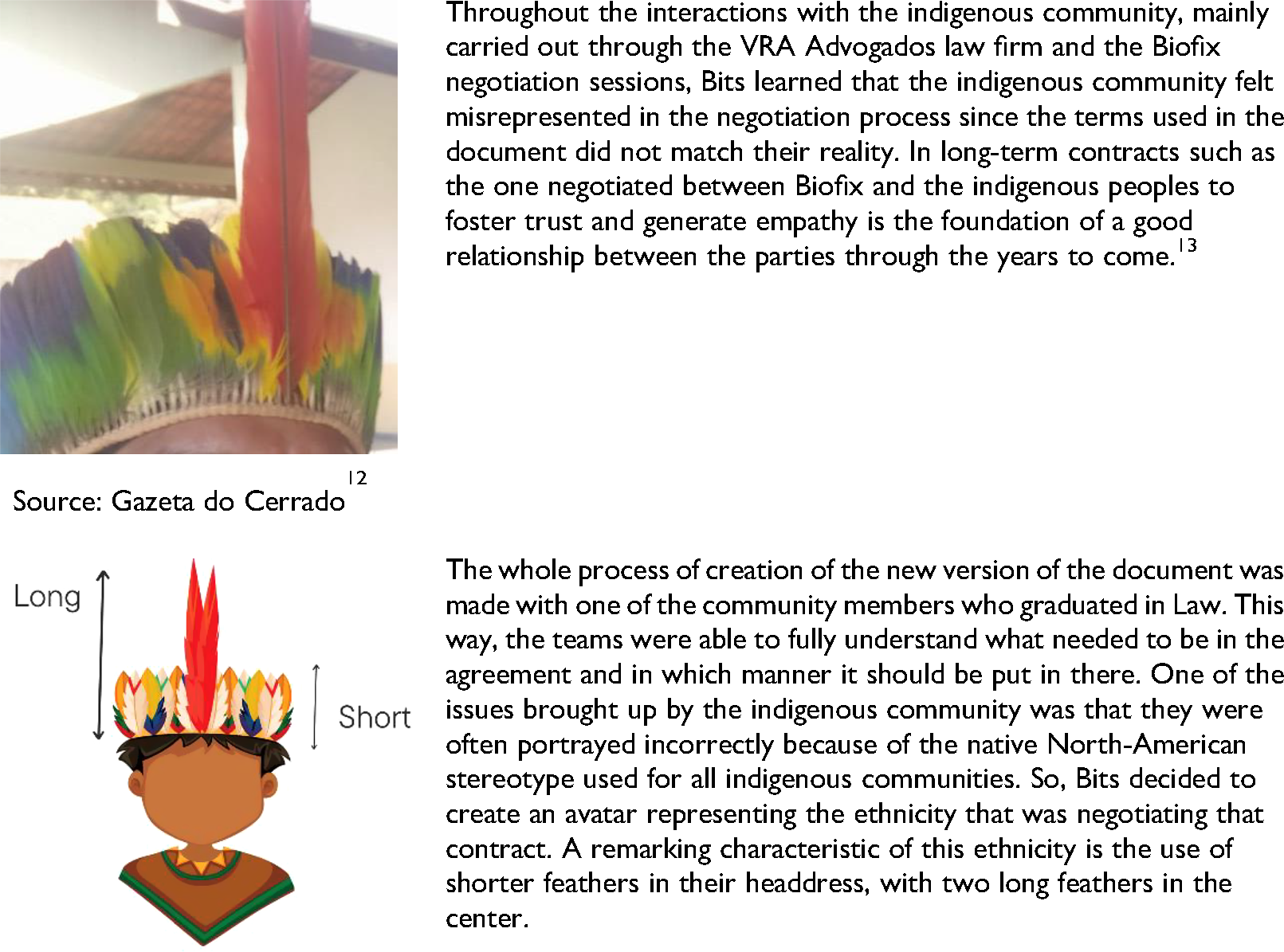
At the same time, Bits researched national libraries of native languages to translate specific terms in the contract into the mother tongue used by that community. The indigenous leaders then analyzed the translation to ensure the terms were applied correctly.
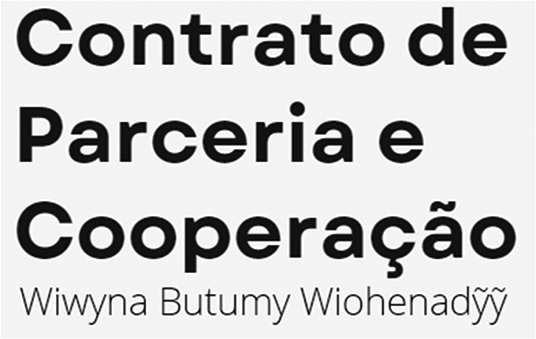
Some texts along the document have indigenous language as a sort of subtitle
Additionally, many images and colors were applied to the document, as indigenous peoples consider themselves “imagery people.” In other words, they learn and communicate through images. Along the process, every feature, image, and design resource was validated with the members of the indigenous communities to ensure they would be interpreted in the manner intended. In some cases, such as with the indigenous “avatar” and even some other images the team had to replace or even create specific illustrations to ensure they were accepted by the indigenous community.
Conclusion
Taking specific user traits into account when creating a document may come a long way. Legal design is not about esthetics but more about serving the purpose of a document. In this sense, understanding the users’ context, their beliefs, how they feel about the document, and if they actually understand it in depth makes it more efficient. Hence, the document achieves its overall goals.
Within this analysis, minority groups may benefit the most from this approach since they usually have specific cultural and social backgrounds that play an essential role in negotiation efforts and contracting.
Even though traditional contract layouts and language are the current standard, most people do not understand them. It is therefore strange that this have been the standard for so long and that users agree to that.
If a particular document is created to regulate a specific situation, it should convey its message clearly to those who will be bound by it. Therefore, using different resources without being limited to an archaic or intricate use of language may help communicate clearly and objectively to a document's users.
Final design of the Indigenous Communities Legal Design Project
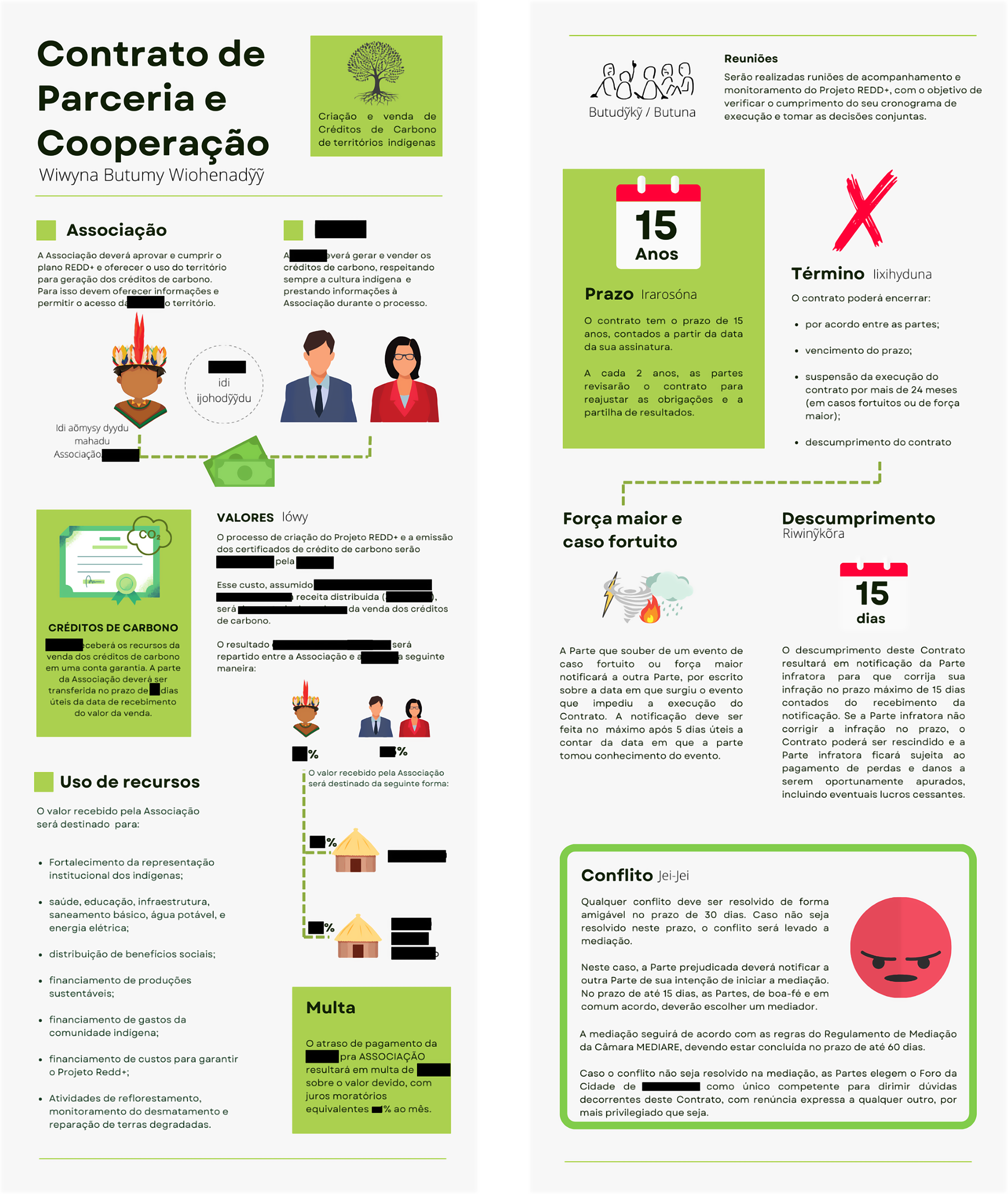
Cases such as The Vendor Project, Clemen Gold's Labor Contract, and this case (the carbon credit development project) show that legal design can benefit all the parties bound by a legal document. Moreover, by considering the users’ needs and perspectives, legal design can promote access to justice and respect for people's rights. Once a person is finally able to understand their rights and obligations under the Law, they reach acess to justice as seeked under the United Nations Sustainable Development Goal 16 (provide access to justice for all).
Footnotes
Declaration of conflicting interests
The authors declared no potential conflicts of interest with respect to the research, authorship, and/or publication of this article.
Funding
The authors received no financial support for the research, authorship, and/or publication of this article.
