




Abstract
Proactive contracting is a practice-oriented research stream, and scholars focused on proactive contracting have suggested fundamental changes for corporate contracting. Researchers have proposed that companies should improve their contracting capabilities and corporate lawyers should serve business objectives instead of preparing for possible litigation. The research reported in this paper focuses on two key areas of proactive contracting: the purpose of the project contracts; and the role of lawyers contributing to project contracts. The research goal was to find out whether business managers and corporate lawyers recognize a need for evolution in project contracting as suggested by the proactive contracting literature. The research data were collected using a survey of commercial contracting professionals, and the research results indicate that managers and lawyers share the same view – that contracts are made for business objectives and benefits. However, it was found that the perspectives of managers and lawyers differ with regard to the role of lawyers in preventing and resolving disputes.
Keywords
Introduction
For a profitable and sustainable project business, reaching the objectives set for the projects, both monetary and non-monetary, is a priority. However, despite comprehensive research and the development of project management techniques, a significant number of projects still fail to meet their objectives (Barros et al., 2004; Charette, 2005; Cruz and Marques, 2013; Ruuska et al., 2011). Scholars have therefore started to look at solutions beyond project management for the problems that many projects encounter. For example, there are interesting issues in project governance (Ruuska et al., 2011), contractual governance of inter-firm exchange (Lumineau and Oxley, 2012), and a proactive approach to strategic contracting (Berger-Walliser et al., 2011; Boyer and Newcomer, 2015; Cummins, 2015; Haapio, 2006a, 2013). In this paper, we contribute to the discussion on the proactive approach; specifically, proactive contracting.
Representatives of the emerging proactive law have suggested that one solution for the challenges projects face could be to adopt a more proactive approach to contracts (Barton, 2008; Nystén-Haarala et al., 2010; Siedel and Haapio, 2010). Proactive contracting is a practice-oriented research stream on contracting, contracting processes and the organizational capabilities of contracting. The stream is multidisciplinary, aiming to provide academic research and practical knowledge on how well-prepared strategic contracting can support ‘successful trading relationships, their formation and management’ (Cummins, 2015). Scholars promoting proactive contracting have suggested fundamental changes to the corporate approach to contracting (Siedel and Haapio, 2010; Tayyeb, 2014). They also suggest that companies should improve their contracting capabilities in order to produce better contracts, and that corporate lawyers should serve business objectives instead of preparing for possible litigation (Haapio, 2013; Nystén-Haarala et al., 2010; Siedel and Haapio, 2011). Scholars of law and strategy similarly see law as a tool not only for controlling risk but also for creating value (DiMatteo, 2010). For example, Bagley (2008; 2010) links ‘legal astuteness’ to competitive strategy, and Bird (2007; 2011) sees law as a resource in transforming the operations of the entire organization to create additional value.
Scholars suggest that the proactive contracting approach could be applied in project contracting to increase cooperation, enhance communication and reduce the number of disputes between the project parties (Haapio, 2013; Pohjonen and Visuri, 2008). Scholars argue that this approach would also lead to a collaborative climate between the project parties and facilitate the generation of increased co-creational value in the project (Siedel and Haapio, 2010; Tayyeb, 2014). In addition, proactive contracting redefines the role of lawyers in business and suggests that, traditionally, the role of lawyers has been to make strict contracts and safeguard a company’s interests against other contracting parties; thus, there is unused potential in using the contribution of lawyers in achieving business objectives (Barton, 2015; Haapio, 2006b; Nystén-Haarala et al., 2010; Siedel and Haapio, 2010, 2011).
Two claims can be identified from the proactive contracting literature. First, it is suggested that currently contracts are more focused on traditional legal objectives of controlling and safeguarding than on fulfilling business objectives (Haapio, 2013; Siedel and Haapio, 2010; Tayyeb, 2014). Second, the lawyers’ potential contribution towards achieving business objectives has been under-utilized (Barton, 2008; Haapio, 2006a; Nystén-Haarala et al., 2010). Thus, this study focuses on: (a) the purpose of the project contracts; and (b) the role of lawyers contributing to project contracts. We were interested in finding out whether business managers and corporate lawyers recognize a need for evolvement in project contracting as suggested by the proactive contracting literature. Currently there is little empirical evidence on whether lawyers, who recognize the need, also manage to support business to succeed.
The study was conducted as a survey of professionals working in commercial contracting. The sample included global coverage, but most of the respondents were located in Europe and North America. The sample also covered a wide range of industries and thus provided insight into the development of project contracting in project business. The key research questions for this paper were: What is the objective of project contracts as seen by business managers and corporate lawyers?; and How is the role of lawyers who contribute to project contracts seen by business managers and corporate lawyers?
An additional research interest was to find out if there were differences between managers’ and lawyers’ perspectives on these issues.
This paper is organized as follows. The history of proactive contracting and similar approaches aimed at increasing the value of lawyer’s involvement are covered briefly. The empirical part of the study is based on a review of current research on proactive contracting, focused on the purpose of contracts and lawyers’ roles in project contracting. Next, the methodology, research design and survey setting are discussed in more detail. This is followed by presentation and discussion of the research results; and, finally, the findings are presented, with suggestions for further research.
The emergence of proactive contracting
The term ‘proactive contracting’ was first introduced by Helena Haapio in a conference paper ‘Quality improvement through proactive contracting: Contracts are too important to be left to lawyers’, as follows: Proactive contracting, as used in the title of this session, refers to recognizing and making use of contracts and contracting processes as planning tools to guide and support the success of your business. It provides the support needed to identify opportunities in time to take advantage of them – and potential problems in time to take preventive action. Proactive contracting provides tools and techniques for the early detection of gaps, traps, and problems and the prevention of negative surprises. (Haapio, 1998)
While some legal scholars have focused on proactive contracting and better legal practice, other scholars have taken proactive law further, in various directions. Berger-Walliser (2012) discussed the development of the proactive law movement and concluded that there was a need for research identifying best practices, and concrete methods and tools to turn proactive law into practice. One step in this direction is a recent study by Berger-Walliser and Shrivastava on how proactive law could be used to impel and regulate corporations to use principles of sustainable development in the US (Berger-Walliser and Shrivastava, 2015).
Both proactive law and preventive law belong to a new research stream which regards the law as an underused means in exploring opportunities in strategic planning and creating value. Proactive law, mainly in the corporate environment, has types of objectives similar to those of preventive law in the private, individual context. The focus of both approaches is an ex ante consideration of contracts and planning of exchange relationships.
Various views in the literature on the purpose of contracts
There are several perspectives on contracts and on the purpose of contracts in the project contracting literature. One of the most common views is based on transaction cost economics – TCE (Williamson, 1979, 1985). Williamson (1975) studied commercial organizations in the market and identified factors that can be harmful to a company’s position in a transaction. These factors included bounded rationality of a company’s employees managing a transaction in a complex environment with many uncertainties (Williamson, 1975), and opportunism, which may occur in transactions especially when there is a limited selection of choices in the market (Williamson, 1975). Although Williamson’s research field was economics, and his research was more about a micro-analysis of economic organizations than management, TCE was soon applied in management. In project research, TCE is often a dominant perspective when project contracting and project contracts are studied (e.g., Argyres and Mayer, 2007; Turner, 2004; Turner and Simister, 2001). The dominant TCE perspective on project contracting usually emphasizes the need to control and monitor other project parties and safeguard one’s position against risks (uncertainty) and opportunism by other parties (e.g., Turner, 2004).
Another widely discussed perspective on contracts in the project literature is relational contracting, which is based on legal research which found that companies rarely litigate or enforce contracts in court (e.g., Lumineau and Oxley, 2012; Macaulay, 1963; Macneil, 1978). Instead of taking disputes to mediation or publicly to court, companies rely on their relational capabilities to settle disputes and agree on the way forward. Companies seem to respect the history of the business relationship (‘shadow of the past’) and do not want to ruin any emerging business opportunities by gaining a bad reputation (‘shadow of the future’: see, for example, Lumineau and Oxley, 2012 and Poppo et al., 2008). The relational contracting perspective on project contracting usually emphasizes the cooperative norms developed over the course of an extended relationship, interorganizational collaboration dynamics and future business opportunities (Gil, 2009; Henisz et al., 2012; Lumineau and Oxley, 2012; Matthews and Howell, 2005).
Some authors of proactive law apply the TCE perspective as a background theory for governing contractual relations (Nystén-Haarala, 1998). The drawback of this perspective is that the focus is placed on controlling contracting parties and networks (Haapio, 2013; Nystén-Haarala, 1998). However, relational capabilities are rarely developed as a process and documented as an operational policy (Nystén-Haarala et al., 2010). Relational capabilities are based and personalized in managers; relational contracting thus appears to be undocumented in contracts and occurs in the personal relationships between the contracting parties (Haapio, 2013; Nystén-Haarala, 1998; Poppo and Zenger, 2002). Although proactive contracting emphasizes the contract as being more than a document, it also highlights the importance of capturing relational aspects in the contract document itself (Nystén-Haarala et al., 2010). According to proactive contracting scholars, the intention to cooperate and create value together in a project should be presented clearly in the contract document, with concrete steps for taking action (Pohjonen and Visuri, 2008; Tayyeb, 2014). Proactive contracting therefore views the contract as a practical tool for cooperation between the project parties, as Berger-Walliser et al. stated: A proactive contract is crafted for the parties, especially for the people in charge of its implementation in the field, not for a judge who is supposed to decide about the parties’ failures. Instead of providing the most advantageous solution for one of the parties, in case of the failure of the other party to comply with its contractual obligations, the proactive contracting process and documents seek to align and express the interests of both sides of the contract in order to create value for both.(Berger-Walliser et al., 2011) Facilitation of cooperation; Co-creation of value; Clear communications; Concrete agreement of responsibilities; and Efficient management of changes.
The lawyer’s role in project contracting
A classical view of contracts is that a contract is a detailed agreement of the responsibilities, including safeguarding clauses for protecting a company’s position in the event of conflicts and failures (Nystén-Haarala, 1998). This view emphasizes the need for legal knowledge and capabilities in order to predict court decisions in legal disputes (Haapio, 2013). It places lawyers in the central position in drafting and making contracts and does not consider contracting as a contextual business phenomenon (Nystén-Haarala, 1998). This traditional view on contracting increases the tendency of lawyers to prepare for ex post interpretation of contracts in court; in essence, to prepare for the worst-case scenario of the commercial transaction in question. However, businesses have often been, and often still are, run without the involvement of lawyers, in the past and the present (Macaulay, 1963; Nystén-Haarala et al., 2010). Furthermore, lawyers can be seen as a hindrance for running businesses efficiently and making deals between business people and between companies (Macaulay, 1963; Nystén-Haarala et al., 2010).
In their interview-based study of American corporate lawyers and managers, Nelson and Nielsen (2000) found a variety of professional, legal roles. They identified three types of professional roles, ranging from limiting advice to legal mandates to combining legal and business advice and, finally, giving priority to business objectives exactly as proactive law recommends. Nelson and Nielsen (2000) suggested that lawyers limited their traditional gatekeeping functions in order to present themselves as enthusiastically committed to corporate objectives, because changes in the business and managerial environment required such a position.
Proactive contracting promotes an agenda of revising business lawyers’ behaviour: in summary, this consists of leaving some of the safeguarding and preparation for litigation and starting to contribute to business objectives and facilitating the co-creation of value in projects (Pohjonen and Visuri, 2008). This perspective emphasizes the importance of managers and lawyers working together in order to identify the most important business issues and risk factors, taking care to include these issues in contracts and collaborating on these areas with the other contracting parties (Haapio, 2013; Siedel and Haapio, 2011; Tayyeb, 2014). Proactive contracting emphasizes that a contract should be seen as a value-creating agreement between the project parties and not merely a legal weapon to be used against other parties in court if disputes arise. This approach requires a change in the role of business lawyers: their focus must shift from possible court cases to business objectives and opportunities.
The shift in business lawyers’ perceptions and behaviour, which proactive law is promoting, also relates to the work of Richard Susskind (2008). He criticized the costly business model of a traditional law firm, and suggested that legal services were going to change radically in the near future. The development of IT technology has made it easier for lawyers’ traditional safeguarding functions to be divided into smaller parts, to be fulfilled as remote, online work. According to Susskind (2008), legal advice had become too expensive for companies and thus new, leaner business models would take over. This suggests that if the law remains considered as technical safeguarding by managers, proactive legal approaches may seem too expensive, because of their immediate costs, in spite of their long-term benefits in lowering unanticipated costs and adding value.
Research design and survey methodology
Based on the theoretical setting presented above, a survey was designed in order to gain an understanding of how contracting professionals perceive the roles of contracts and lawyers in project business. The survey was conducted in the first quarter of 2014 among the members of an international association focused on managing commercial contracting. The members of the association are mainly lawyers, executives and managers, and a variety of specialists such as engineers, industry analysts, technical consultants and advisors. We wanted to use the members of the association as a study population for three reasons. (1) Because the association is dedicated to developing contracting capabilities in the industrial context further, it can be assumed that new directions in contract management are recognized and adapted first among the association members. This assumption is based on the fact that the members of the association are part of the community seeking to develop contracting practices and they have access to knowledge to do so. (2) Working with the association, we reached professionals working on contracting globally. This would have been very challenging to achieve otherwise. (3) Working with the association, we surveyed professionals who work on contracting and contract management.
The questionnaire was designed by a group of five researchers, and the survey functionality was tested using a closed group of respondents. The questionnaire was presented on a dedicated Internet page where respondents could answer the questions and submit their completed questionnaires. The invitation to participate in the survey was delivered to the members by the association. There were 355 respondents, a response rate of 1.6%. Because the research questions focused on the perceptions of lawyers and managers, demographic information was used to exclude other disciplines from the research data. After the collected data were processed, research data from 170 respondents were used in the analysis: 31 lawyers and 139 managers. The demographic information of the sample is presented in Figures 1 and 2.
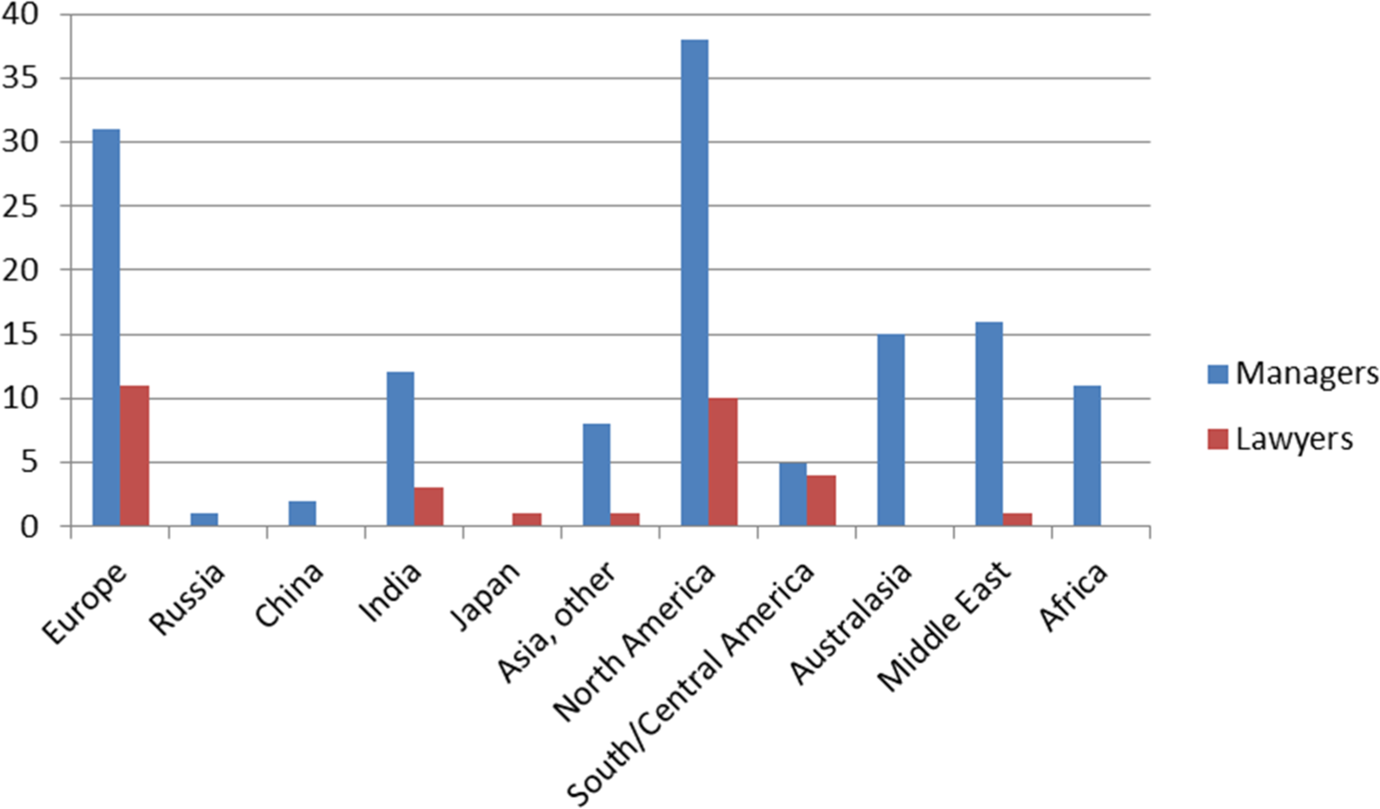
Geographic area of operations (in absolute values).
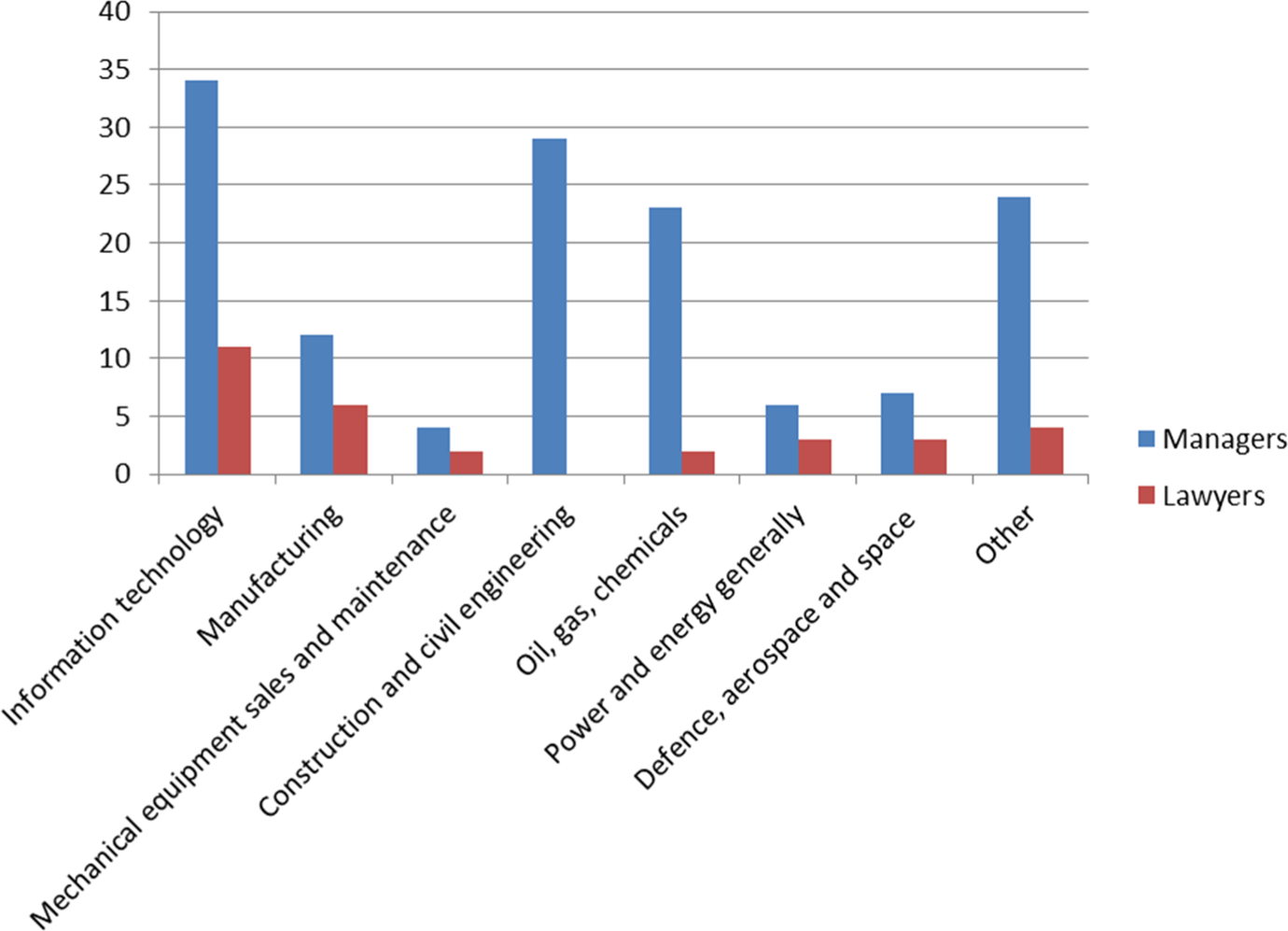
Industries represented in the sample (in absolute values).
Analysis and discussion
Purpose of the project contracts
Three questions in the survey identified the respondents’ views of the purpose of project contracts. The managers’ and lawyers’ perspectives are illustrated in Figure 3, which presents the proportional summary of each group’s responses, including the p-values of the Mann-Whitney U test for each statement.
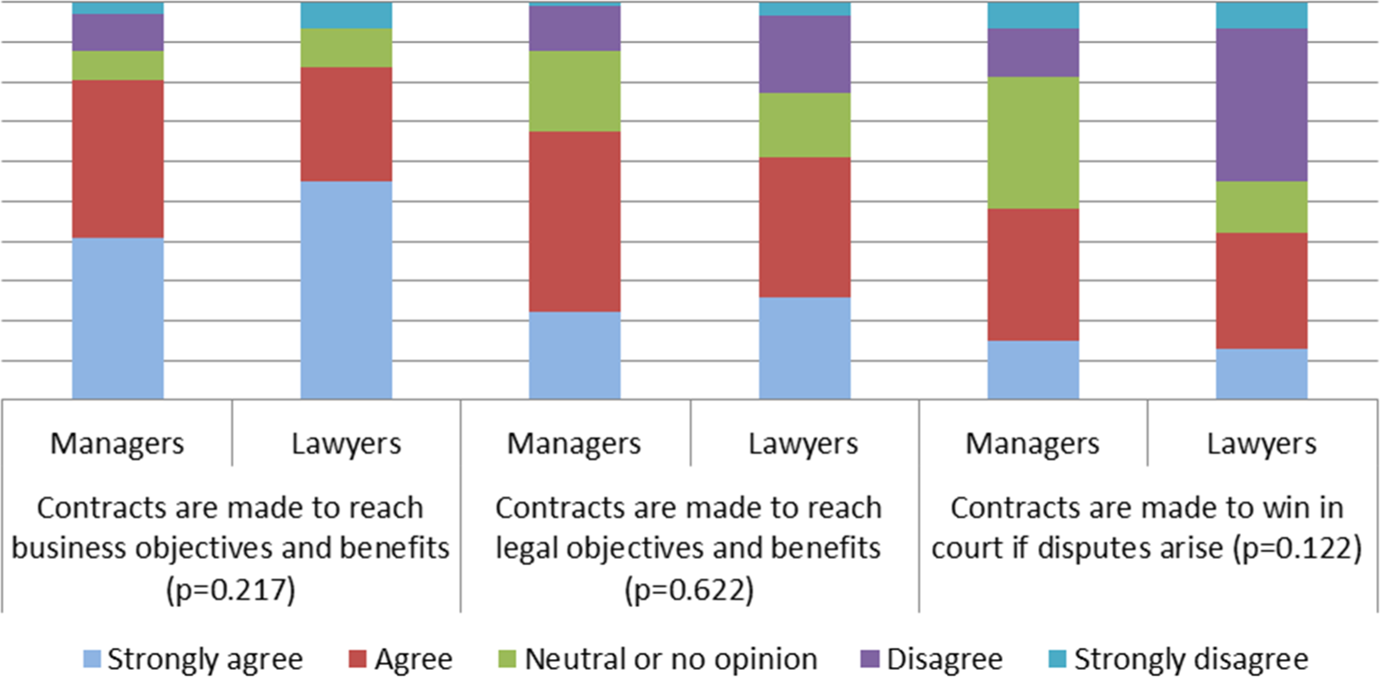
Purpose of project contracts: perceptions of managers and lawyers.
There were no statistically significant differences between the respondent groups. Managers and lawyers mostly shared the same view on the purpose of project contracts: 81% of managers and 84% of the lawyers agreed that contracts are made for business objectives and benefits. Regarding the statement ‘Contracts are made to win in court if disputes arise’, 42% of lawyers agreed and 45% disagreed with the statement. In comparison, 48% of the managers agreed and 19% disagreed with the statement.
Based on the results, there seems to be a clear agreement between managers and lawyers that contracts are made to support and achieve business objectives – as the proactive contracting literature suggests (Berger-Walliser et al., 2011; Pohjonen and Visuri, 2008; Tayyeb, 2014). This supports our initial assumptions about managers’ perspectives on the purpose of contracts, but does not support the claims that lawyers do not recognize the business objectives of contracts. However, the majority (61%) of the lawyers agreed that contracts are also made to achieve legal objectives, and 42% agreed that contracts are made to win in court in case of a serious dispute. An interpretation of these results is that while lawyers considered safeguarding to be an important function of contracts, they also felt that contracts are mainly concerned with the business objectives. This suggests that lawyers are more business-oriented than expected. However, we must be careful when drawing such a conclusion, because the respondents were members of an association that seeks to drive change toward efficient contracting. Because of the resulting possible bias, the results may not be transferable to other groups of corporate lawyers and may indicate no more than merely the beginning of a change in lawyers’ attitudes on contracting. It would be helpful to conduct a similar study among the members of a more traditional lawyers’ association, to determine whether the perspectives deviate.
We also analyzed the results geographically and between industries. First, we compared the results between Europe and North America. The respondents from North America tended to be slightly more in favour of safeguarding than the respondents from Europe, but the difference was minor; there were no statistically significant differences between these two groups of respondents. We then separated the data from the information technology industry and compared the results to the data from other industries. There were no statistically significant differences between the industries.
The roles of lawyers and managers contributing to project contracts
In the survey, nine questions were related to the role of managers and lawyers contributing to project contracts in drafting contracts, proactively preventing disputes in projects, and resolving disputes. The distribution of responses between managers and lawyers, and the p-values of the Mann–Whitney U-test for each statement are presented in Figures 4 and 5.
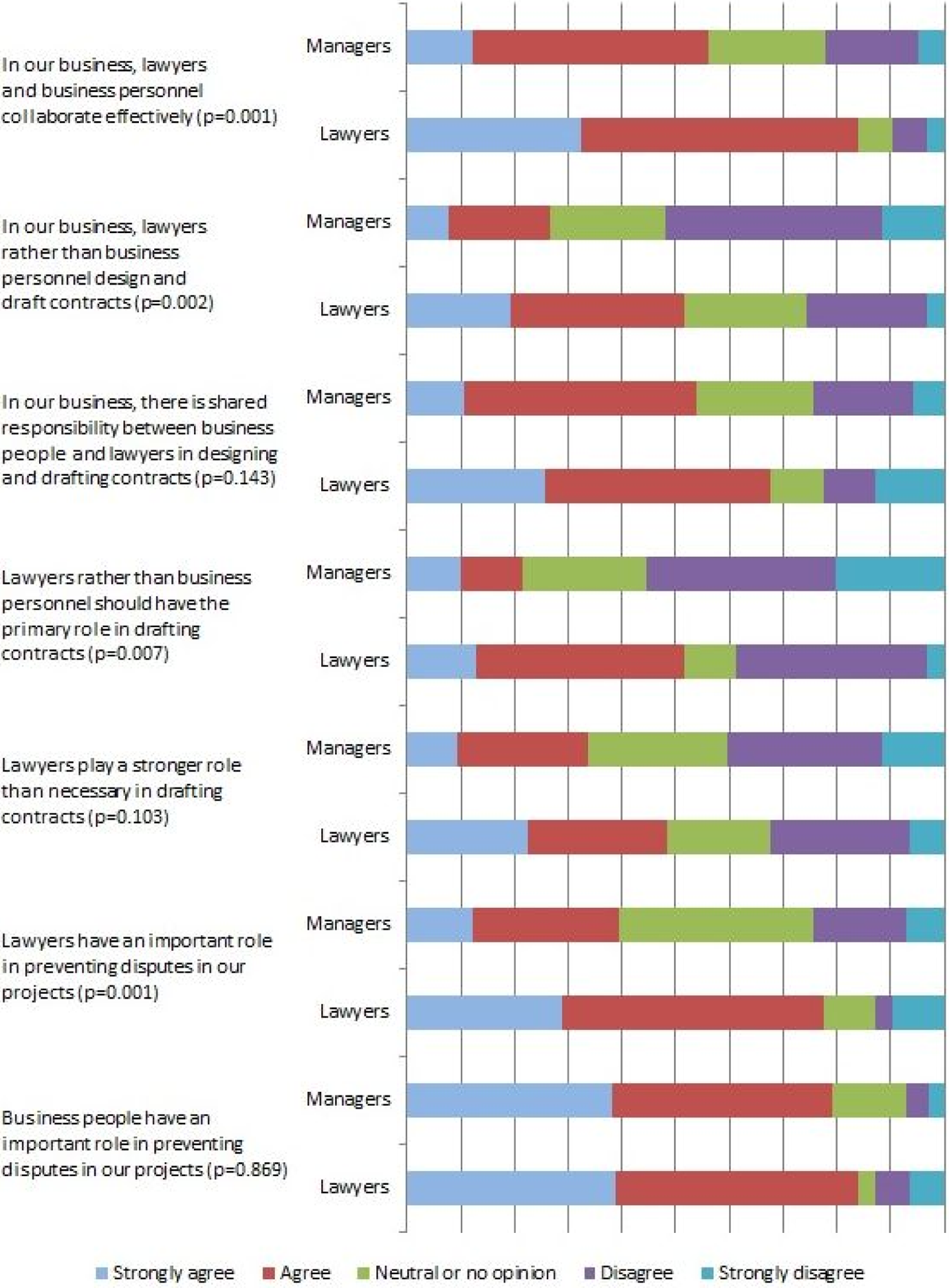
Roles of lawyers and business people who contribute to project contracts: perceptions of managers and lawyers.
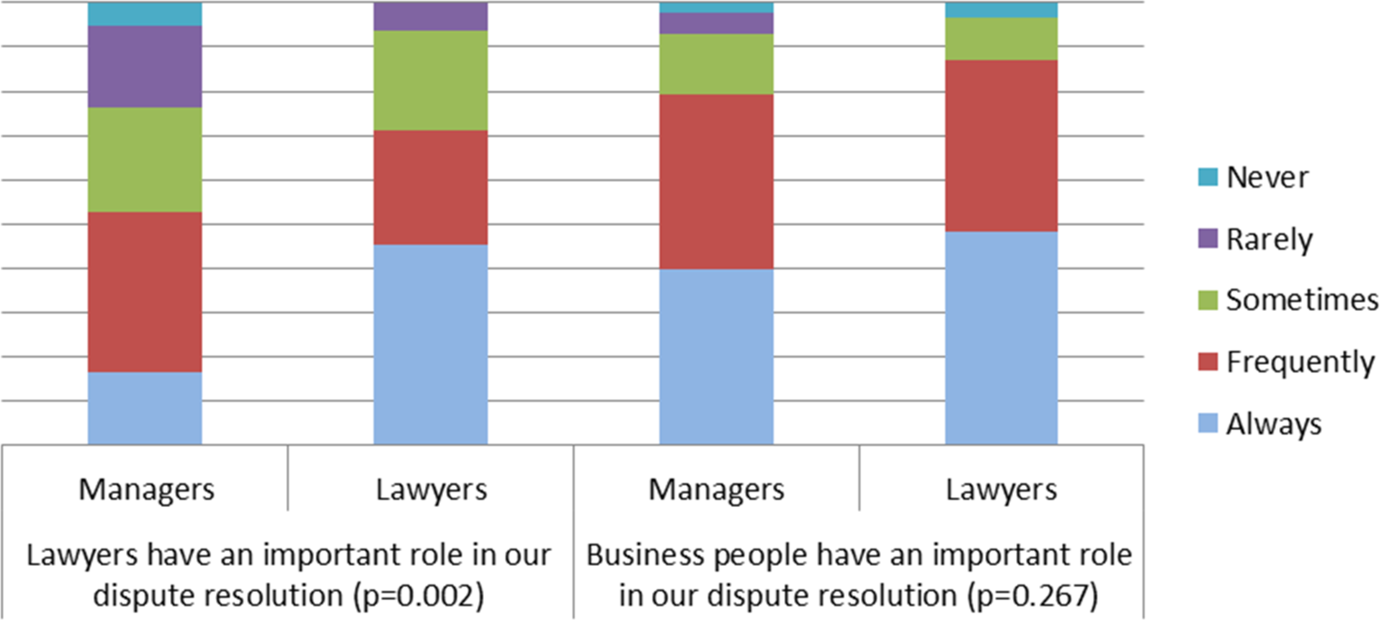
Roles of lawyers and business people in resolving disputes: perceptions of managers and lawyers.
The answers reflect the opinions of managers and lawyers regarding the contracting process and the role of various disciplines in the process. Related to the statements about contribution to contracts and collaboration between business people and lawyers in drafting contracts, there were clear differences in the perspectives of the managers and the lawyers. The responses about the effectiveness of collaboration between business people and lawyers differed significantly (p = 0.001): 84% of the lawyers agreed that business people and lawyers collaborate effectively, whereas 56% of the managers agreed. This indicates either that managers and lawyers experience the current situation differently, or that they have different expectations of how the collaboration should work. Similar findings have also been reported elsewhere. Nystén-Haarala et al. (2010) found that lawyers are often invited to participate in the contracting process too late, and when they finally do become involved the rest of the organization feels that the lawyers delay the process. Another explanation could be that lawyers collaborate but managers expect them to contribute even more than they currently do.
A larger proportion of lawyers than managers agreed with the statement, ‘In our business, lawyers rather than business personnel design and draft contracts’ (52% and 27% respectively, p = 0.002) and with the statement, ‘Lawyers rather than business personnel should have the primary role in drafting contracts’ (52% and 22% respectively, p = 0.007) in the business in which they operate. There is a clear conflict between the two groups regarding the expectations of the lawyer’s role. The lawyers saw their role as more essential in contract drafting than the managers. This might indicate that managers do not think lawyers have the business-context competence needed to contribute to contracts that support business objectives. Lawyers, however, might see themselves contributing to achieving business objectives by drafting provisions that facilitate business success. Lawyers’ perceptions might also be related to the changed expectations for corporate lawyers; there has been discussion about the need for changes in the business lawyer’s role and contribution in the corporate context (e.g., Cummins, 2008; Haapio, 2006b; Henderson, 2011). In the future, lawyers will be expected to have more business-context competences and capabilities in order to drive collaboration rather than focusing solely on safeguarding one’s position in the commercial exchange.
There seems to be general agreement on the role of business people in preventing disputes and contributing to resolving disputes. The majority of respondents (managers and lawyers) agreed with the statements that business people have an important role in avoiding and solving disagreements with project parties. In contrast, there were statistically significant differences in the responses regarding the role of lawyers in preventing disputes (p = 0.001) and resolving disputes (p = 0.002). In both cases, a larger proportion of lawyers than managers saw their role as essential in preventing and resolving disputes. This might imply that lawyers see dispute-related actions as legal tasks and that managers see these actions as relational tasks. This classical difference between the disciplines has been reported at least since Macaulay (1963) quoted a businessman as saying, ‘You can settle any dispute if you keep the lawyers and accountants out of it’. More recently, Lumineau and Oxley (2012) discussed how companies settle disputes. They found that, in complex disagreements, companies involve lawyers in negotiations but prefer business solutions to litigation.
Limitations
This study has several limitations. First, instead of being random, the sample was based on the membership of an international association focused on managing commercial contracting. This choice has several drawbacks. Because membership of the association is voluntary and the association drives innovation and development of contracting, the members might share professional characteristics that are different to those of non-members, and this might affect the transferability of some results in this research.
Another possible limitation is the low response rate. To be able to understand whether the low rate affects the generalizability of the results throughout the population, we compared our sample demographics with the association’s member demographics. There were no remarkable differences between the distributions. We therefore believe that the low response rate did not create a serious misrepresentation in the research data or results.
The last acknowledged limitation of the study is that we did not examine any contracts objectively; but the respondents evaluated their contracts to determine whether or not the contracts focused more on business objectives or legal objectives. This evaluation is subject to a respondent’s personal perception and thus prone to bias.
Conclusions
Previous research on proactive contracting has resulted in suggestions that companies should improve their contracting capabilities and that corporate lawyers should serve business objectives instead of preparing for possible litigation. This article contributes to this discussion by examining how managers and lawyers view the role of lawyers and contracts in project business. The literature review dealt with proactive contracting and other similar approaches emphasizing contracts as a tool in creating value. The possible impact of proactive contracting on project contracting and contracts has been discussed, as have the different views on the lawyer’s contribution in fulfilling business objectives. A survey based on this theoretical setting was conducted among industry professionals in contracting and the responses were analyzed in order to compare the perceptions of managers and lawyers with the outcomes reported in the earlier proactive contracting literature.
The results of the study suggest that managers and lawyers shared the same view – that contracts are made to achieve business objectives and benefits. They also mainly agreed on the purpose of contracts. However, managers and lawyers had different perspectives on the lawyer’s role in contributing to the contracting process and contracts. The lawyers saw their role as more essential in contracting than did the managers. The majority of the lawyers also felt that collaboration between business people and lawyers works well in contracting, but managers were somewhat reluctant to agree to this perspective. Most lawyers also felt they have an important role in resolution of disputes: the managers did not agree with this.
This study has identified core concepts of proactive contracting and confirmed that some of these have received support in the empirical setting. There was also an indication that there are differences between managers and lawyers in the expectations of the role of a business lawyer. Managers expect lawyers to have a supportive role in contracting: lawyers, in contrast, would prefer a leading role. These controversial expectations were suggested by the existing proactive contracting literature and were confirmed by the empirical results of this study.
Additional research on the adoption of a proactive approach in managing contracts in project business is needed. It would be beneficial to understand why managers and lawyers have the perspectives they have; this would require qualitative research – for example, a focus group or case studies. Furthermore, it will be helpful and important to conduct a similar study using a random sample among professionals who work on contracting, to confirm the results of this study. In addition, it would be interesting to gain insight on whether and how companies manage the change towards proactive approaches to contracting and how the related capabilities are built in organizations.
Footnotes
Acknowledgements
We would like to thank all of the people who completed the survey for this survey, and the International Association for Contract and Commercial Management for supporting the survey arrangements. We are grateful to CEO Tim Cummins (IACCM) and Professor Thomas D. Barton (California Western School of Law) for their participation in survey design. We also would like to express our gratitude to Doctor, Researcher and Contract Coach Helena Haapio (University of Vaasa) and Professor Jaakko Kujala (University of Oulu) for important insights in proactive contracting and project contracting during the several discussions we had while working on this research paper. In addition, we are grateful for the feedback we received for the early draft of this paper in the PhD workshop of the Scandinavian Academy of Industrial Engineering and Management Conference 2014. Furthermore, we would like to express our thanks to the editors and anonymous reviewers for their constructive feedback.
Declaration of Conflicting Interests
The author(s) declared no potential conflicts of interest with respect to the research, authorship, and/or publication of this article.
Funding
The author(s) disclosed receipt of the following financial support for the research, authorship, and/or publication of this article: This research was initiated in the multidisciplinary research network “Flexibility in business contracting”, which was funded by Finnish Cultural Foundation (2011–2013). This research was conducted as part of the research project “Value co-creation in agile project development”, which was mainly funded by Tekes – the Finnish Funding Agency for Innovation (2015–2017).