



Abstract
Objective
This study evaluated the quality and reliability of unassessed DDH health information for parents on prominent short video platforms like Bilibili and TikTok, where accurate data is crucial for early intervention.
Methods
We conducted a cross-sectional study, analyzing 125 eligible DDH-related short videos from Bilibili and TikTok. Video characteristics, author types, and interaction metrics were extracted. Content quality was assessed by medical professionals using the modified DISCERN (mDISCERN) and Global Quality Score (GQS) tools. Ordinal logistic regression identified factors influencing quality.
Results
Significant inter-platform differences were found in video characteristics and engagement. While both platforms showed generally high quality, Bilibili slightly outperformed TikTok. Author professionalism (GQS OR=4.025; mDISCERN OR=5.585) and video duration (GQS OR=1.010; mDISCERN OR=1.010) were significant positive predictors of quality. Critically, a negative correlation existed between higher interaction metrics (likes, comments, shares, views) and perceived video quality.
Conclusion
While short video platforms significantly impact DDH health information, quality varies, with author professionalism and video duration predicting higher standards, yet popular videos often lack scientific rigor, highlighting an urgent need for enhanced quality control and expert-driven content.
Introduction
Developmental dysplasia of the hip (DDH) is one of the most common skeletal developmental disorders in children, with a particularly high incidence among newborns and infants. 1 Although advances in early screening and diagnostic techniques have influenced the reported prevalence in recent years, DDH remains a major condition affecting pediatric musculoskeletal health. If left untreated, DDH can lead to severe motor dysfunction and progressive joint degeneration, substantially increasing the likelihood of total hip arthroplasty in adulthood. 2 Therefore, early recognition and timely intervention are critical, and improving parental awareness and understanding of DDH plays a pivotal role in optimizing prognosis and reducing the long-term disease burden.
In the digital era, the proliferation of short video platforms has profoundly transformed the way the public accesses health information. 3 Platforms such as TikTok and Bilibili, characterized by brevity, vivid visual presentation, and interactive features, have emerged as important channels for disseminating medical knowledge. By simplifying complex health topics into accessible formats, these platforms provide parents with convenient opportunities for self-education and facilitate early disease recognition. Nevertheless, the quality of health information shared on such platforms remains highly variable. Due to the absence of peer review and rigorous professional oversight, some videos lack scientific accuracy or even contain misleading content, which may distort parental understanding and delay timely diagnosis and treatment of DDH.4,5
To address these concerns, the present study aims to systematically evaluate the quality of DDH-related health information disseminated on two widely used short video platforms in China, Tiktok and Bilibili. This study seeks to assess the scientific accuracy, reliability, and educational value of DDH-related videos, and to explore their potential impact on parental awareness and public health education. We hypothesized that while short video platforms facilitate health information dissemination, the quality of content varies significantly by creator type, and higher user engagement does not necessarily correlate with higher medical accuracy. By providing evidence-based and comprehensive analyses, our findings are expected to contribute to improving the quality of health information on short video platforms and to inform future strategies for content regulation and health communication.
Materials and methods
Search strategy and data extraction
This cross-sectional study was conducted in Nanjing, China, with data collection and analysis performed between September 12, 2025, and September 18, 2025. This study systematically retrieved short video data on DDH from Bilibili (https://www.bilibili.com) and TikTok (Douyin, https://www.douyin.com). These two platforms were selected because they represent the most influential short-video ecosystems in China, collectively accounting for over 80% of the national market share according to recent industry reports (e.g., QuestMobile), thereby ensuring high sample representativeness. Furthermore, TikTok and Bilibili represent the two dominant yet distinct models of content delivery: TikTok is characterized by its algorithm-driven recommendation of short-form content, while Bilibili serves as a primary hub for community-driven, longer-form, and professional-generated educational content.
Unified Chinese search terms including “developmental dysplasia of the hip”, “pediatrics”, and “hip dislocation” were utilized across both platforms. To minimize personalization bias, all searches were performed using new accounts in incognito mode. The top 100 default-sorted videos from each platform—simulating the most common user search behavior—were initially collected. Inclusion criteria required direct relevance to DDH etiology, diagnosis, treatment, or prevention, and public accessibility. Conversely, advertisements, irrelevant content, videos uploaded within the last week (to ensure metric stability), and duplicates were excluded. Key extracted variables included video platform, upload date, author type, video type, interaction metrics (likes, comments, shares, saves, views), and video duration. Author types were categorized into four levels based on professional expertise, with professional individuals and institutions identified via official platform verification. Video types were classified as basic knowledge, case reports/discussions, or treatment processes. All data were meticulously extracted manually to ensure accuracy and consistency.
Video quality assessment
The reliability and quality of collected videos were assessed using a modified DISCERN tool and the Global Quality Score (GQS). The modified DISCERN (mDISCERN) tool evaluated five criteria (clarity, relevance, traceability, rigor, impartiality), summing to a 0-5 point score. 6 The GQS utilized a 5-point Likert scale (1=very poor to 5=excellent) to assess overall quality, professionalism, comprehensiveness, and clarity. For practical interpretation, mDISCERN scores <3 denoted low reliability, while GQS scores <3 indicated low quality. Two independent healthcare professionals, including a pediatric orthopedic doctor and other medical practitioners, conducted all the assessments. They both have over 5 years of clinical experience in pediatric hip disorders. To minimize bias, all videos were randomized and identifiers were removed where possible. The two raters evaluated the videos independently over a two-week period. To prevent fatigue, they assessed no more than 20 videos per day. Any discrepancies in scoring were resolved through discussion with a third senior consultant.
Statistical analysis
Descriptive statistics and non-parametric tests were employed for data analysis. Categorical variables were presented as frequencies and percentages, while continuous variables were described using medians and interquartile ranges. Chi-square or Fisher’s exact tests assessed differences in platform distribution, and Mann-Whitney U tests compared interaction metrics and quality scores between Tiktok and Bilibili. Inter-rater agreement for mDISCERN and GQS scores was quantified using Cohen’s kappa coefficient (kappa ≥ 0.8 indicated excellent agreement). Spearman’s rank correlation analyzed the relationship between GQS and mDISCERN scores. Given the highly significant differences observed in our primary outcomes (often p < 0.0001), the results were considered robust against Type I error inflation, and thus post-hoc corrections were deemed unnecessary for the main exploratory analysis. Additionally, due to the skewed distribution of interaction metrics (confirmed by wide IQRs), non-parametric tests (Mann-Whitney U test) were strictly employed. All statistical analyses were performed using IBM SPSS Statistics 27.0, with visualizations generated by GraphPad Prism 10.4. A significance threshold of p < 0.05 was adopted, and no Bonferroni correction was applied for post-hoc comparisons to retain exploratory statistical power.
Results
Video characteristics
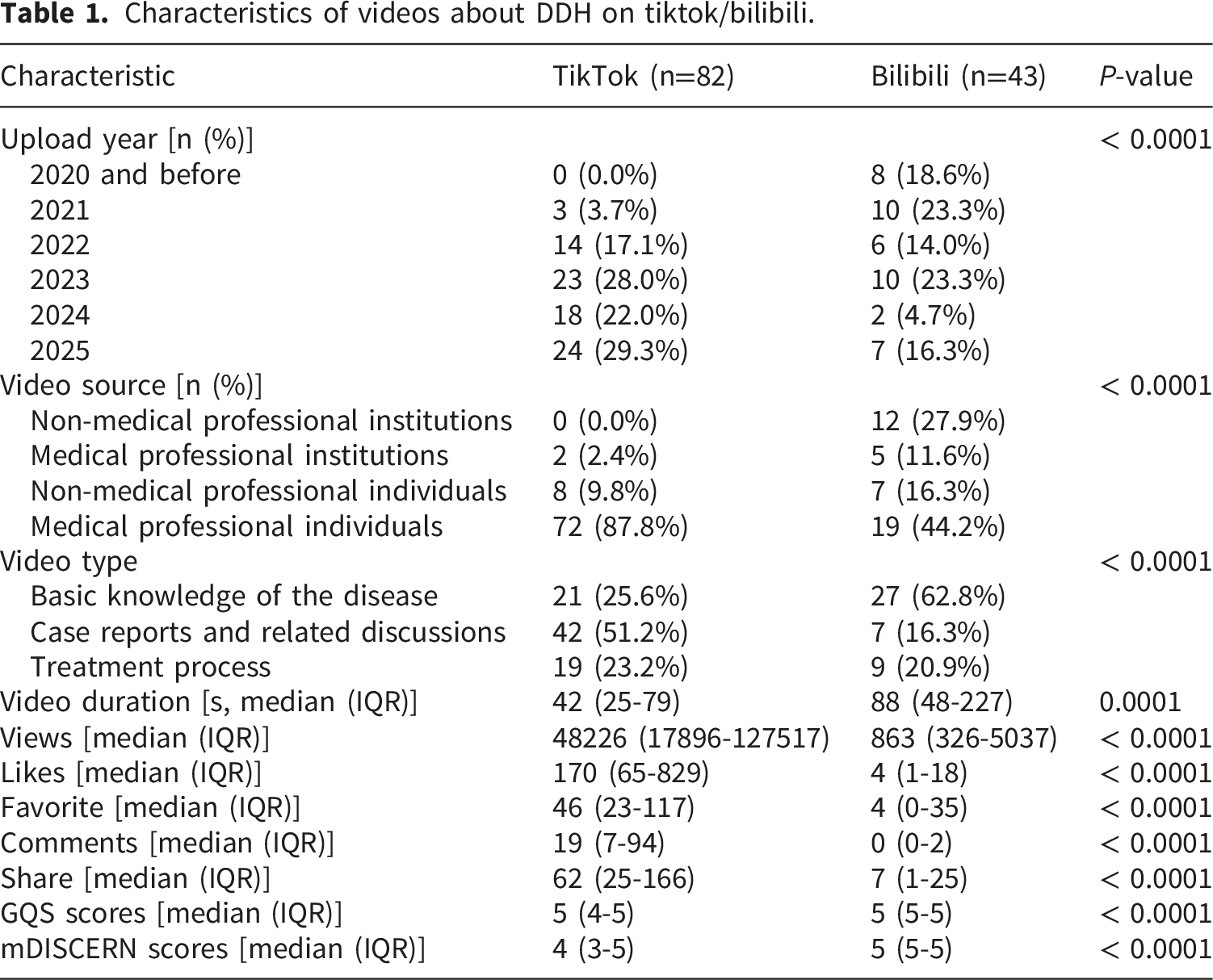
A total of 125 short videos on DDH from TikTok (82 videos) and Bilibili (43 videos) were analyzed (Figure 1), revealing significant inter-platform differences across various characteristics (Table 1). TikTok videos were predominantly created by individual medical professionals (87.8%) and focused on “Case reports and related discussions” (51.2%), while Bilibili featured a more diverse authorship, with 44.2% from individual medical professionals and 27.9% from non-medical institutions, predominantly covering “Basic knowledge of the disease” (62.8%) (Figure 2). Search strategy for videos on DDH. Characteristics of videos about DDH on tiktok/bilibili. The distribution of DDH videos by video source and video type. (a) Distribution proportion of TikTok videos in video sources. (b) Distribution proportion of Bilibili videos in video sources. (c) Distribution proportion of TikTok videos in video types. (d) Distribution proportion of Bilibili videos in video types.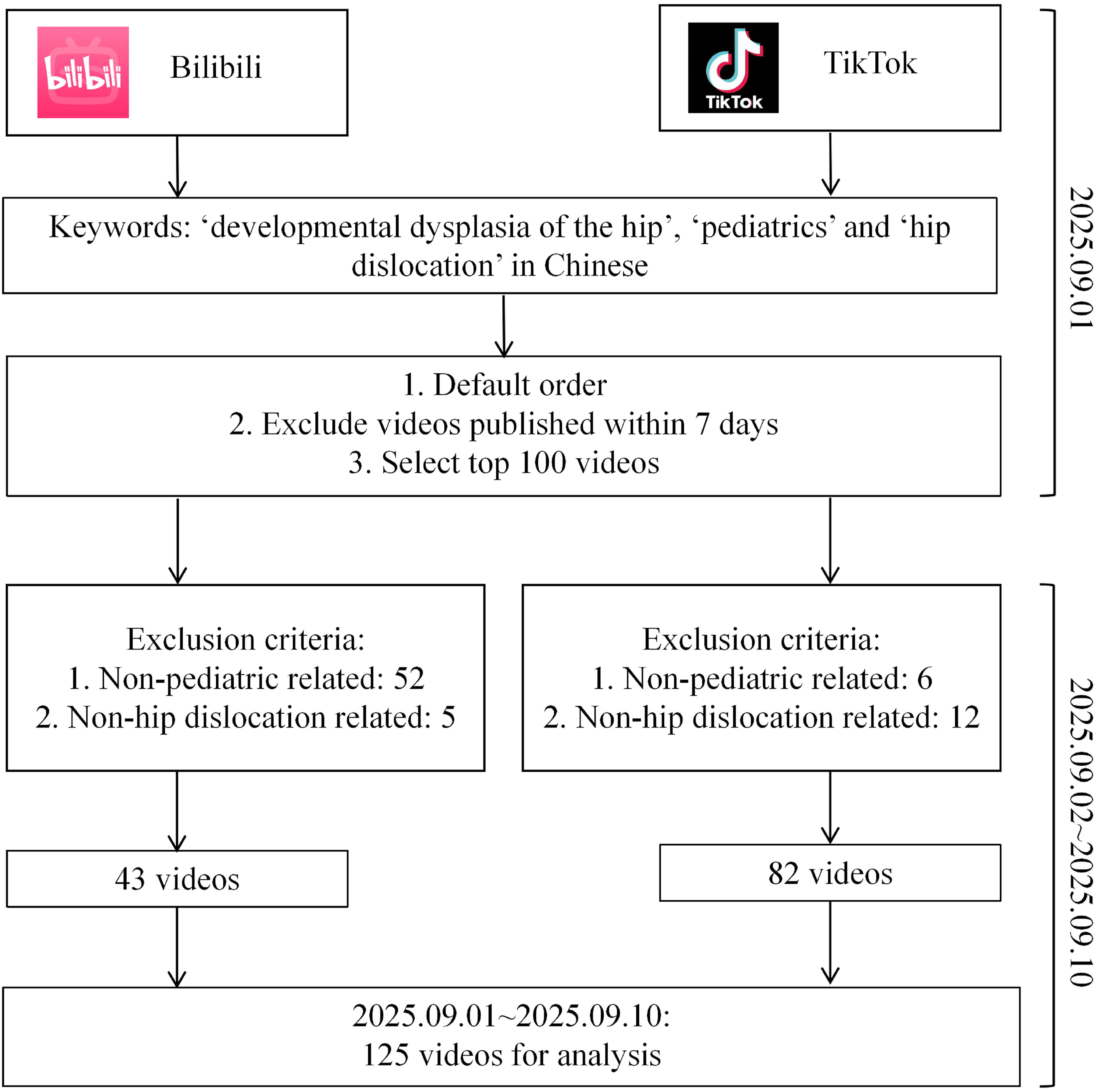

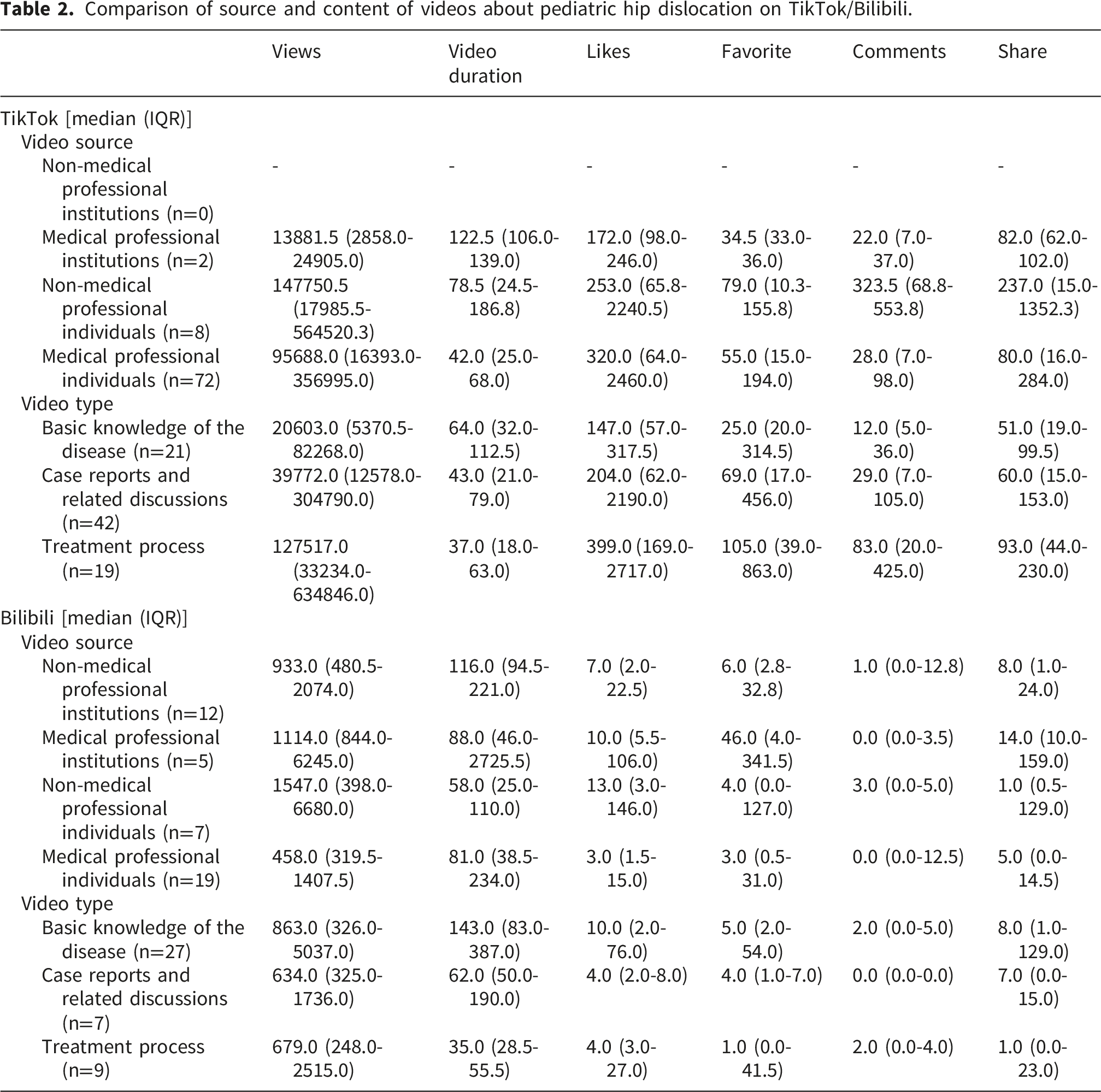
Detailed interaction metrics by video source and type
Comparison of source and content of videos about pediatric hip dislocation on TikTok/Bilibili.
Video quality assessment by source and type
Figure 3 shows the distribution of videos on TikTok and Bilibili across different GQS and mDISCERN scores. A detailed analysis of video quality, categorized into low, middle, and high levels based on these scores, revealed distinct patterns across platforms, video sources, and types (Table 3). On TikTok, medical professional (MP) sources had significantly higher quality, with more high GQS (p=0.041) and high mDISCERN (p=0.002) videos compared to non-medical professional (NP) sources. NP sources had a higher proportion of low GQS videos (p=0.003). For video types on TikTok, significant differences were found in middle mDISCERN scores (p=0.006), but not in GQS (all p >0.05). On Bilibili, there were no significant differences between NP and MP sources for GQS or mDISCERN (all p >0.05). However, “Treatment process” videos had a significantly higher proportion of low-quality videos for both GQS and mDISCERN (p=0.023 for both), indicating that content type, rather than creator background, may affect quality on this platform. The distribution of videos on TikTok and Bilibili platforms across different GQS and mDISCERN scores. (a) Distribution of videos from different video sources in TikTok by GQS scores. (b) Distribution of videos of different video types in TikTok by GQS scores. (c) Distribution of videos from different video sources in Bilibili by GQS scores. (d) Distribution of videos of different video types in Bilibili by GQS scores. (e) Distribution of videos from different video sources on TikTok in mDISCERN scores. (f) Distribution of videos from different video types on TikTok in mDISCERN scores. (g) Distribution of videos from different video sources on Bilibili in mDISCERN scores. (h) Distribution of videos from different video types on Bilibili in mDISCERN scores. The vertical axis: score; the horizontal axis: video numbers. Quality comparison between TikTok and Bilibili. The correspondence between scale scores (GQS and mDISCERN) and quality level: 1-2 points are defined as low, 3 points as middle, and 4-5 points as high. NP: Non-medical professional video source. MP: Medical professional video source. BK: Basic knowledge of the disease. CRD: Case reports and related discussions. TP: Treatment process. The bold data indicates p < 0.05.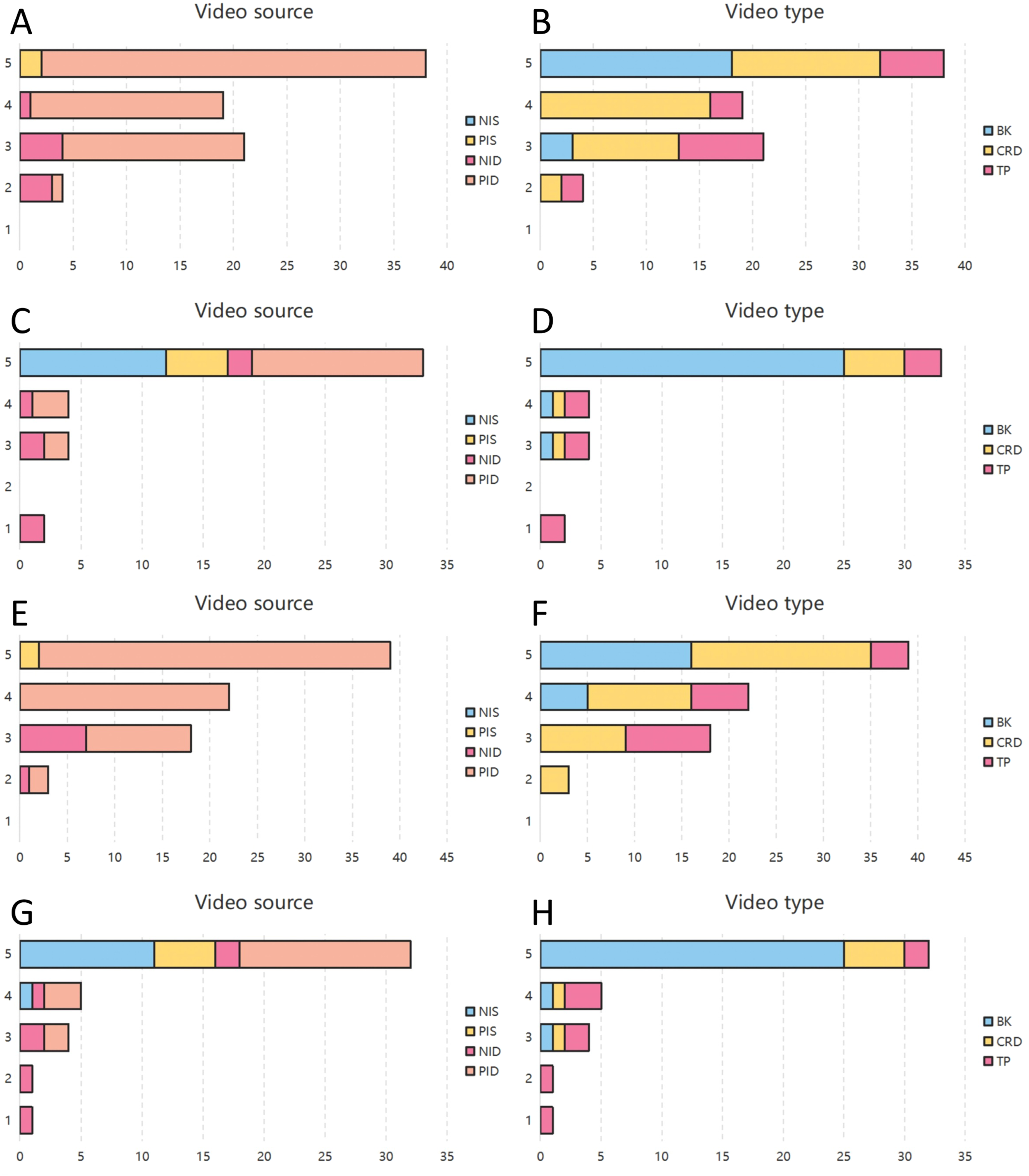

Factors influencing video quality: Ordinal logistic regression analysis
Results of ordinal logistic regression analysis examining the influence of video characteristics on GQS and mDISCERN quality levels.

The bold data indicates p < 0.05.
Correlation analysis of video characteristics and quality
Pearson correlation analysis (Figure 4) revealed a significant positive correlation between author’s professionalism and both GQS (r = 0.42, p < 0.001) and mDISCERN levels (r = 0.43, p < 0.001), indicating that professional creators are associated with higher quality content. Expectedly, GQS and mDISCERN levels were highly inter-correlated (r = 0.82, p < 0.001). Interestingly, both GQS and mDISCERN levels showed significant negative correlations with several interaction metrics: GQS with Likes (r = -0.19, p = 0.032) and Comments (r = -0.24, p = 0.007), and mDISCERN with Likes (r = -0.27, p = 0.002), Comments (r = -0.26, p = 0.003), Share (r = -0.19, p = 0.030), and Views (r = -0.28, p = 0.002). This suggests that higher engagement metrics often correspond to lower perceived video quality. Furthermore, while interaction metrics themselves were strongly inter-correlated (all p < 0.001), video duration did not significantly correlate with either video quality levels or any interaction metrics. Correlation analysis of video characteristics and quality.
Discussion
The most important finding of this study is the significant inverse relationship between video popularity and scientific quality regarding DDH information on short video platforms. DDH remains a significant challenge in pediatric orthopedics, underscoring the critical need for accurate health information dissemination to parents for early identification and intervention. Our study systematically evaluated the quality of DDH-related health information on two prominent short video platforms, TikTok and Bilibili, providing crucial insights into the dynamics of online health education. Analyzing 125 videos, we uncovered significant inter-platform differences in content characteristics, authorship, and user engagement. Critically, author professionalism and video duration positively correlated with content quality (GQS and mDISCERN scores). Paradoxically, higher user engagement metrics often associated with lower perceived video quality, highlighting a dichotomy between popularity and scientific accuracy in digital health information.
The observed discrepancies between TikTok and Bilibili reflect the diverse ecosystem of short video platforms, consistent with findings from other health conditions. 7 TikTok videos (82/125) were typically shorter (median 42 seconds), predominantly created by medical professional individuals (87.8%), and focused on “Case reports and related discussions” (51.2%), aligning with its fast-paced, digestible content model. In contrast, Bilibili (43/125) featured longer videos (median 88 seconds) with a more diverse authorship, including non-medical professional institutions (27.9%). Notably, on Bilibili, non-medical professional institutions frequently leveraged 3D animation technology to explain complex concepts with greater vividness and detail, thereby enhancing viewer comprehension. Bilibili also emphasized “Basic knowledge of the disease” (62.8%). Although both platforms generally exhibited high quality, Bilibili slightly outperformed TikTok in median GQS (5 vs. 5) and mDISCERN (5 vs. 4) scores. This suggests Bilibili’s environment might be more conducive to comprehensive explanations, supporting our finding that longer videos often demonstrate higher quality. These platform-specific trends in content presentation and author distribution appear generalizable across various health topics. 8
Author professionalism was identified as the most critical determinant of video quality, with professional authors significantly more likely to produce videos scoring highly on GQS and mDISCERN. This finding aligns with established health communication principles that underscore the importance of expert credibility. 9 Similar trends have been observed in studies concerning other health topics and platforms, such as polycystic ovary syndrome exercise and adolescent abnormal uterine bleeding, where professionally produced content consistently demonstrated superior quality, despite the pervasive nature of highly-viewed yet unreliable non-professional videos.10,11 On TikTok, medical professional sources also yielded significantly higher GQS and mDISCERN scores than non-medical sources. This highlights a critical issue: while non-medical practitioners often garner high user engagement, their content frequently lacks scientific rigor, potentially misleading parents and delaying appropriate diagnosis and treatment. Therefore, ensuring the scientific and evidence-based dissemination of health information on short video platforms is crucial. 12 Moreover, video duration emerged as a significant positive predictor of quality. Although the odds ratio (OR = 1.010) might appear modest when calculated per second, this effect accumulates substantially; a video lasting just one minute longer is nearly twice as likely to achieve a higher quality score. This statistical insight aligns with the clinical reality that complex orthopedic conditions like DDH require more extensive explanations than brief formats typically allow. The brevity inherent in many short videos often necessitates oversimplification, which can be detrimental in a health education context. This relationship likely explains why Bilibili’s longer video format contributed to generally higher quality, particularly for ‘Basic knowledge.’ However, it is worth noting that ‘Treatment process’ videos remained challenging to simplify without compromising accuracy, regardless of the allowed duration.
Perhaps the most thought-provoking finding was the significant negative correlation between interaction metrics (likes, comments, shares, views) and both GQS and mDISCERN scores. This indicates that highly engaging videos frequently possess lower perceived quality, a phenomenon consistently observed in social media health information research. This counterintuitive trend suggests that sensationalized or overly simplified content, despite lacking scientific depth, often attracts greater attention from a broader audience. While nuanced, evidence-based medical explanations are vital for informed decision-making, they may be perceived as less “viral.” This poses a severe public health dilemma: the most widely disseminated information may not be the most reliable, necessitating a strategic re-evaluation of how public health campaigns leverage these platforms to prioritize trustworthy, high-quality information. 13
The implications for parental awareness and DDH public health education are substantial. Short video platforms, despite their unparalleled reach, represent a double-edged sword. 5 While offering accessible information, the variable content quality, particularly the prevalence of popular but potentially misleading videos, poses significant risks. Parents seeking quick answers may encounter misinformation, leading to anxiety, inappropriate self-management, or, more severely, delayed diagnosis and treatment, thereby worsening DDH outcomes. 14 This challenge is not unique to DDH, with similar concerns existing for other medical conditions. Thus, robust, multifaceted strategies are required to enhance health information quality. Healthcare providers and public health organizations must actively engage, producing accurate, evidence-based, and accessible content. Platforms bear the responsibility of implementing stricter content moderation, verifying health content creators’ credentials, and refining algorithms to prioritize scientifically reliable information over mere virality, thereby fostering an informed public. 15
Clinicians should be aware of the misinformation prevalent on these platforms. Specifically, pediatric orthopedists should not only create content but also curate structured “recommended lists” or QR code directories of verified educational videos for parents during clinic visits, integrating digital health education into routine care pathways. Furthermore, healthcare institutions may leverage Bilibili’s support for longer video durations and advanced visual tools such as 3D animation to develop standardized, evidence-based educational modules. Such structured content can more effectively counterbalance the oversimplified and potentially misleading “viral” material commonly amplified by algorithm-driven platforms like TikTok. By bridging online dissemination with offline clinical practice, these approaches may enhance parental understanding while mitigating misinformation-related risks.
Despite its valuable contributions, this study has several limitations. First, our research was restricted to two specific platforms, TikTok and Bilibili. Consequently, our findings may not be generalizable to other social media ecosystems or cultural contexts due to varying content algorithms, user demographics, and moderation policies. Second, inherent selection biases exist within our search strategy. By relying on the platforms’ default sorting algorithms and excluding very recent uploads to ensure metric stability, we may have missed the most current viral trends. Additionally, while strict disease-specific keywords (e.g., ‘DDH’) ensured content relevance, excluding broader terms like ‘infant’ or ‘hip’ might have omitted some videos that parents effectively view. Third, although GQS and mDISCERN are validated tools, their application to short video formats involves inherent subjectivity; however, this was mitigated by independent assessments and high inter-rater agreement (Cohen’s Kappa > 0.80). 16
Conclusion
Our analysis of DDH health videos on TikTok and Bilibili revealed that author professionalism and video duration positively correlate with content quality, while high user engagement often inversely relates to scientific accuracy. These findings emphasize the urgent need for strategic collaborations between healthcare providers and short video platforms to prioritize evidence-based content dissemination and protect parents from misleading health information.
Content for publication
During the preparation of this paper, the author did not use AI to improve the readability and language quality of the manuscript. Authors review and edit content as needed and take full responsibility for the content of the publication.
Footnotes

Ethical considerations
This study did not involve the use of clinical datasets, biological samples, or experimental animals. All data from Bilibili and TikTok used in the analysis are publicly available and do not raise any privacy concerns. All data in this study has been de-identified, and no individual users, videos, or screenshots can be identified. Therefore, ethical review was not required.
Author contributions
PY and LH designed the study, participated in the data quality control, analyzed the data, and drafted the paper. PY and YT participated in the data quality control, analyzed the data, and revised the paper. All authors read and approved the manuscript.
Funding
The authors disclosed receipt of the following financial support for the research, authorship, and/or publication of this article: The funding for this study was provided by Children’s Hospital of Nanjing Medical University Incubation projects before the transformation of scientific and technological achievements (ZHQFH2025004) and General Project of Science and Technology of Nanjing Medical University (NMUB20220023).
Declaration of conflicting interests
The authors declared no potential conflicts of interest with respect to the research, authorship, and/or publication of this article.