



Abstract
Background
Osteosarcoma is a rare and aggressive bone malignancy, yet public awareness remains insufficient. As social media platforms have become key sources of health information, this study aims to evaluate the quality and reliability of osteosarcoma-related videos on these platforms.
Methods
This study collected 100 osteosarcoma-related videos from each platform, TikTok and Bilibili, based on their default ranking, resulting in 200 videos initially screened and 183 included after exclusions. Video characteristics were collected, including duration, likes, saves, comments, and shares. The Global Quality Scale (GQS) and Modified Discrimination Score (mDISCERN) were used to assess video quality and reliability. The completeness score (CS) was applied to evaluate five key aspects of the disease: etiology, clinical manifestations, diagnosis, treatment, and diagnosis. Finally, correlation analysis is carried out to explore the relationship among video features, audience engagement indicators, and video quality.
Results
A total of 183 osteosarcoma-related videos were included. Clinical manifestations, treatment, and diagnosis were the most frequently addressed topics, whereas etiology and prognosis received comparatively less attention. TikTok videos had a median GQS of 2(Q1 = 2.00, Q3 = 3.00), a median mDISCERN of 3 (Q1 = 2.00, Q3 = 4.00), and a median CS of 4 (Q1 = 2.00, Q3 = 4.00). In contrast, Bilibili videos demonstrated higher quality, with a median GQS of 3 (Q2 = 2.00, Q3 = 3.00), a median mDISCERN of 3 (Q1 = 3.00, Q3 = 4.00), and a median CS of 4 (Q1 = 3.00, Q3 = 6.00). Videos produced by healthcare professionals achieved significantly higher scores compared to those uploaded by non-professionals (p < 0.01). Spearman correlation analysis revealed no significant association between video features and quality scores.
Conclusion
In conclusion, the overall quality and reliability of osteosarcoma-related videos on short video platforms were low. Videos uploaded by healthcare professionals and those on the Bilibili platform demonstrated relatively higher quality. These findings highlight the necessity of strengthening the regulation of health-related content on short video platforms and promoting greater involvement of healthcare professionals.
Introduction
Osteosarcoma is a rare and highly aggressive bone cancer that primarily affects adolescents and young adults. 1 Epidemiological data indicate that the annual incidence of osteosarcoma in children and adolescents is 3–4.5 cases per million people. According to a 2021 study based on the SEER database, the overall incidence of primary malignant bone tumors in the United States is approximately 0.9 cases per 100,000 individuals per year. 2 Osteosarcoma accounts for about 35% of all primary malignant bone tumors. Incidence rates vary significantly across different regions of the world. For example, some Asian countries report higher rates of osteosarcoma compared to Western countries. 3 Despite the severity of the disease, public awareness remains limited. High-grade osteosarcoma is prone to metastasize, with the lungs being the most common metastatic site, followed by distant bones. Although survival rates for osteosarcoma have significantly improved with advances in chemotherapy and surgical techniques, particularly due to early diagnosis, late-stage diagnosis remains a major challenge. Patients diagnosed at later stages generally have a poor prognosis. 4 Given the rarity and severity of the disease, early public education is crucial. Effective health awareness campaigns can help the public better understand the pathophysiology and clinical manifestations of osteosarcoma, promote timely diagnosis and treatment, and ultimately improve patients’ quality of life.
With the increasing prevalence of internet technology, electronic information has progressively replaced traditional paper-based formats, leading people to increasingly turn to online video platforms for accessing medical information. 5 Short video health communication has been widely integrated into health interventions, serving various functions in health promotion.6,7 Social media platforms, especially short video platforms such as TikTok and Bilibili, have experienced rapid growth in recent years. These platforms provide a unique opportunity to disseminate health-related content in a visually engaging and easily understandable format. Recent studies have shown that social media-based interventions play a crucial role in cancer prevention and treatment.8,9 As a leading short video platform, TikTok has achieved global reach, with over 1 billion active users across more than 150 countries and regions. 10 Similarly, Bilibili, known for its convenience, interactivity, and content diversity, attracts millions of active users every month. 11 However, previous analyses of the quality and reliability of short videos on topics such as hypertension, 12 thyroid eye disease treatment, 13 pancreatitis, 14 and cataracts 15 have shown that the quality and reliability of videos on short video platforms are generally average, which has raised concerns.
Despite the rapid development of science popularization short videos and the rich content related to diseases, however, there has been limited research on the quality assessment of osteosarcoma-related videos. To assess the quality and reliability of such content on short video platforms, a comprehensive evaluation was conducted using the Global Quality Scale (GQS) and the modified Discrimination Score (mDISCERN) instrument. The DISCERN tool was developed in 1999 through a collaboration between the University of Oxford and the UK National Health Service, 16 designed to evaluate the quality of treatment-related information. The modified version of DISCERN, adapted by Singh et al. in 2012, 17 was specifically created to assess the quality of video completeness. This tool has since been widely applied in the evaluation of medical video quality. 18 The GQS, developed by Bernard et al. in 2007 and later adapted by Singh et al. in 2012 for video evaluation, primarily assesses three aspects: the overall quality of the video, its usefulness to patients, and its smoothness. The GQS uses a 5-point scale, where scores of 1–2, 3–4, and 5 correspond to poor, moderate, and high quality, respectively.
For cancer patients, an important part of managing the disease is understanding it. 19 Especially in the context where the primary audience of short videos is young people, and combined with the high epidemiological incidence of osteosarcoma, medical science popularization should conduct in-depth needs analysis for these groups. This study aims to analyze osteosarcoma-related TikTok videos, assess their content, quality, and reliability, and provide recommendations for improving future osteosarcoma health communication strategies using three validated tools, GQS, mDISCERN, and completeness score (CS).
Materials and methods
Search strategy and methods
This is a cross-sectional study based on digital media. The study was conducted from 12 July to 14 July 2024 to evaluate the quality of osteosarcoma-related videos on two short video sharing platforms, TikTok and Bilibili. The Chinese term “骨肉瘤” (osteosarcoma) was utilized as the search keyword on both platforms. Based on the comprehensive ranking, 100 videos were selected from each platform, TikTok and Bilibili, for a total of 200 videos. After applying the exclusion criteria, 183 videos were included in the analysis (Figure 1).
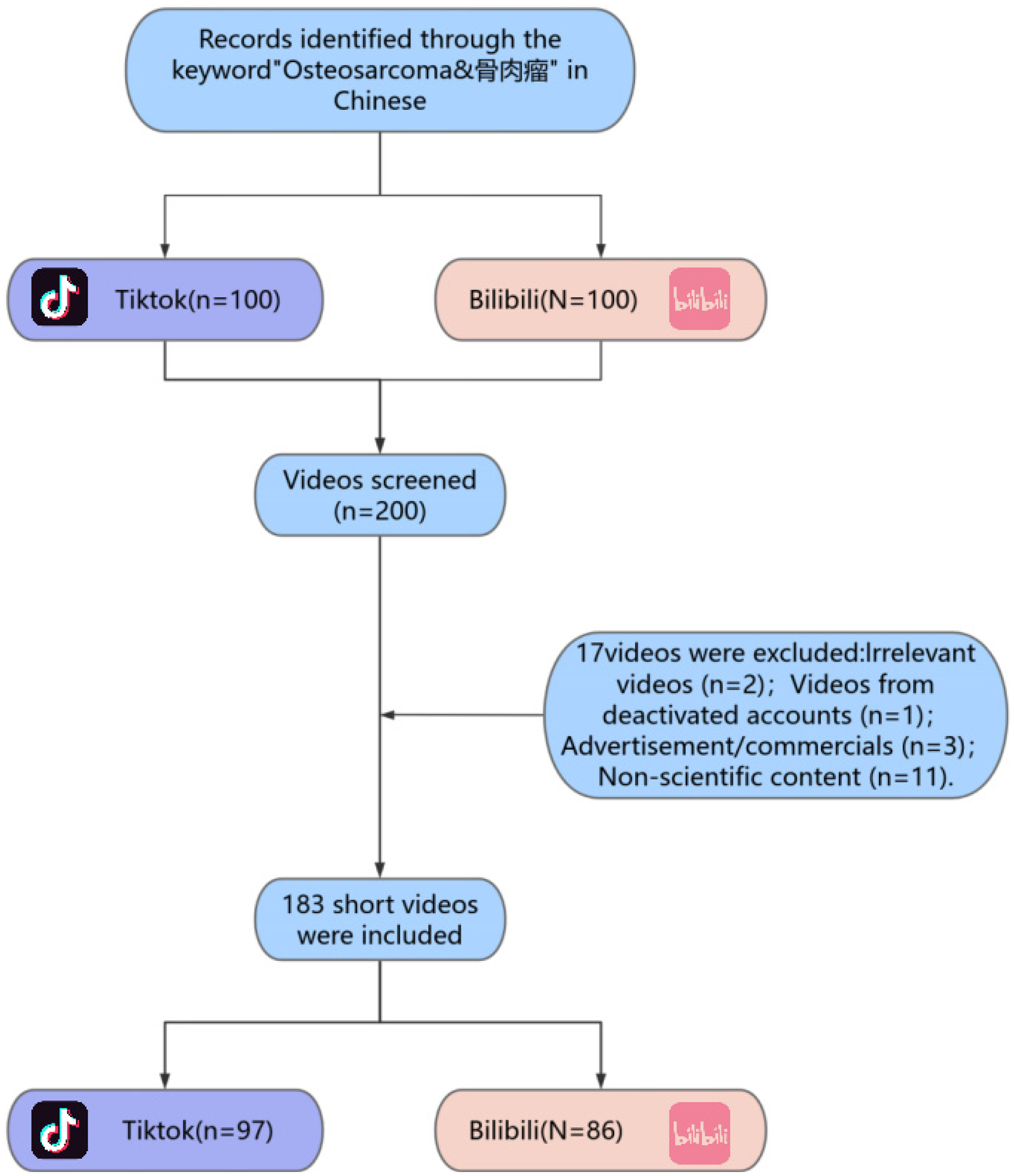
Search strategy and video filtering program.
Inclusion criteria: Videos that were publicly accessible, osteosarcoma-related, in Chinese language, and met the search parameters were included in the study.
Exclusion criteria included: (1) duplicate videos, (2) videos not directly related to osteosarcoma, (3) videos from deactivated accounts, (4) non-educational advertisement videos, and (5) videos not in the Chinese language.
For each video, the following data were meticulously recorded: title, uploader's identity verification status, publication date, video duration, content description, and the number of likes, shares, and saves. Additionally, any videos that disseminated incorrect information regarding osteosarcoma were documented in detail.
Uploader characteristics
Based on literature research12,13 and discussions within our group, we initially divided video uploaders into seven categories: (1) doctors, (2) medical students, (3) technicians and others, (4) patients or family members, (5) ordinary users, and (6) scientific communicators. However, due to the limited number of videos in some categories (< 5), we combined the groups to divide uploaders of videos into (1) health professionals and (2) non-health professionals. This categorization was further refined based on the professional certification markers provided by the platforms, where individuals with a health professional verification badge were classified as health professionals, and the rest were categorized as non-health professionals. This approach ensures adequate sample size and enhances the stability of statistical analysis.
Evaluation methodology and procedure
To assess the quality and reliability of the short videos, this study employed the GQS, mDISCERN, and CS evaluation tools. These tools are widely recognized for their application in evaluating medical and health-related information. The GQS was categorized into five levels, as detailed in the Table 1.The mDISCERN quality criteria includes five items, which are described in detail in the Table 2. Two orthopedic specialists carefully reviewed the videos and utilized these scales to assess the content. Prior to the scoring process, all assessors receive standardized training to ensure consistency and minimize bias in assessments. If there is a significant difference in ratings between the two orthopedic specialists, a third orthopedic specialist is consulted for arbitration.
The global quality score (GQS) quality criteria.

The modified DISCERN (mDISCERN) quality criteria.

mDISCERN: Modified Discrimination Score.
Researchers manually extracted the following information for each ##video: uploader type (e.g. Orthopedic surgeon, individual users), video duration (in seconds), number of likes, comments, shares, collections, and the content categories addressed in the video (e.g., etiology, clinical manifestations, diagnosis, treatment, prognosis).
We divided the video content into five aspects: etiology, clinical manifestations, diagnosis, treatment, and prognosis, giving priority to preliminary statistics. If the above content is involved, 1 point will be given, and if it is not involved, 0 point will be given. After excluding video content with a score of 0, we gave a final score of video integrity by CS. 20 Each aspect was scored as follows: 0 for no mention, 1 for brief mention, and 2 for detailed description. The overall CS was interpreted as follows: a score of 0–1 indicates little valuable information, a score of 2–3 indicates most information is missing, a score of 4–5 indicates partial information is missing, a score of 6–7 indicates little information is missing, a score of 8–9 indicates most key information is discussed, and a score of 10 indicates complete coverage and detailed explanation.
Statistical analysis
All data processing and analyses were performed using R software (version 4.3.2). Categorical variables were expressed as frequencies and percentages. For normally distributed continuous variables, data were presented as mean ± standard deviation and compared using Student's t-test. For non-normally distributed continuous variables, data were expressed as median and interquartile range (IQR) and analyzed with the Mann–Whitney U test. Spearman correlation analysis was used to evaluate associations between variables. A two-tailed p < 0.05 was considered statistically significant.
Results
Content and general characteristics of osteosarcoma-related videos
A systematic search on TikTok and Bilibili was conducted using “骨肉瘤” (osteosarcoma) as the keyword, initially identifying a pool of videos. After a rigorous selection process, 17 videos that did not meet the inclusion criteria were excluded, resulting in a final dataset of 183 videos for analysis (Figure 1). The videos were further categorized based on the identity of the uploader into health professionals (medical professionals, including doctors, medical students, technicians, etc.) and non-health professionals (people other than medical professionals, including patients, non-professional creators, etc.).
Analysis of video sources revealed that certified medical professionals contributed the majority of videos on both platforms (n = 89.07%). A further breakdown of categories showed the following distribution: on TikTok, physicians accounted for 91%, patients 8%, and non-professional creators 1%. On Bilibili, physicians accounted for 85%, medical students 2%, patients 5%, and non-professional creators 8%. Overall, health professionals were the predominant creators of osteosarcoma-related educational short videos across both platforms (Figure 2). Furthermore, five videos were identified as containing misinformation. These videos conflated osteosarcoma with “bone cancer,” presented outdated treatment options, or provided inaccurate descriptions of diagnosis and prognosis.

The distribution percentage of video uploaders’ identities on TikTok and Bilibili.
Short video quality and reliability assessments
As shown in Table 3, the median values of video quality scores (GQS, DISCERN, and CS) on the two platforms are 3 (Q1 = 2.00, Q3 = 3.00), 3 (Q1 = 2.00, Q3 = 4.00), and 4 (Q1 = 2.00, Q3 = 5.00), respectively. In Table 4, the median GQS score for TikTok was found to be 2.00 (Q1 = 2.00, Q3 = 3.00), with an average score of 2.36 (SD = 0.75). In contrast, Bilibili had a median GQS score of 3.00 (Q1 = 2.00, Q3 = 3.00) and an average score of 2.71 (SD = 0.85).
General information, video content, and video quality of the osteosarcoma-related health short videos.

Abbreviations: n: number; IQR: interquartile range; GQS: Global Quality Scale; mDISCERN: modified Discrimination Score; CS: completeness scores.
General information, video content, and video quality of the osteosarcoma-related health short videos on TikTok and Bilibili.

Abbreviations: n: number; IQR: interquartile range; SD: standard deviation; GQS: Global Quality Scale; mDISCERN: modified Discrimination Score; CS: completeness scores.
Regarding the mDISCERN score, TikTok reported a median of 3.00 (Q1 = 2.00, Q3 = 4.00) with an average of 2.71 (SD = 1.13), while Bilibili had a median of 3.00 (Q1 = 3.00, Q3 = 4.00) and an average score of 3.12 (SD = 0.95). Figure 3 shows the distribution of GQS, mDISCERN, and CS scores between TikTok and Bilibili, highlighting the differences between platforms and between different groups (health professionals vs. non-health professionals). Compared to TikTok, Bilibili typically showed higher GQS scores, with the mDISCERN and CS scores being largely comparable between the two platforms. On the other hand, health professionals consistently scored higher on all three metrics, indicating better reliability and quality of health-related content. Table 5 further demonstrates that the median video quality scores (GQS, DISCERN, and CS) for health professionals were 3 (Q1 = 2.00, Q3 = 3.00), 3 (Q1 = 3.00, Q3 = 4.00), and 4 (Q1 = 3.00, Q3 = 5.00), respectively. In comparison, the median scores for non-health professionals were substantially lower, at 1 (Q1 = 2.00, Q3 = 2.00) for GQS, 1 (Q1 = 1.00, Q3 = 2.00) for DISCERN, and 1.5 (Q1 = 0.00, Q3 = 3.50) for CS. This indicates that videos uploaded by healthcare professionals consistently received higher quality scores than those from their non-health counterparts. Despite these differences in quality scores, no significant variations were observed in terms of likes, shares, comments, and saves among the different platforms and groups (p > 0.05).

Mountain plots of GQS, mDISCERN, and CS scores. (a) Distribution of GQS for TikTok and BiliBili. (b) Distribution of mDISCERN for TikTok and BiliBili. (c) Distribution of CS for TikTok and BiliBili. (d) Distribution of GQS for health professionals and non-health professionals. (e) Distribution of mDISCERN for health professionals and non-health professionals. (f) Distribution of CS for health professionals and non-health professionals. GQS: Global Quality Scale; mDISCERN: Modified Discrimination Score; CS: completeness score.
General information, video content, and video quality of the osteosarcoma-related health short videos on health professionals and non-health professionals.

Abbreviations: n: number; IQR: interquartile range; SD: standard deviation; GQS: Global Quality Scale; mDISCERN: modified Discrimination Score; CS: completeness scores.
Further statistical analyses revealed that the videos on Bilibili exhibited superior quality and reliability compared to those on TikTok (Figures 4A and 5A). Additionally, videos uploaded by healthcare professionals showed higher GQS and mDISCERN scores than those from non-health professionals (Figures 4B and 5B). Further subgroup analyses revealed that videos from healthcare professionals consistently achieved higher GQS and mDISCERN scores compared to videos from non-healthcare professionals on both platforms (Figures 4C-D and 5C-D).
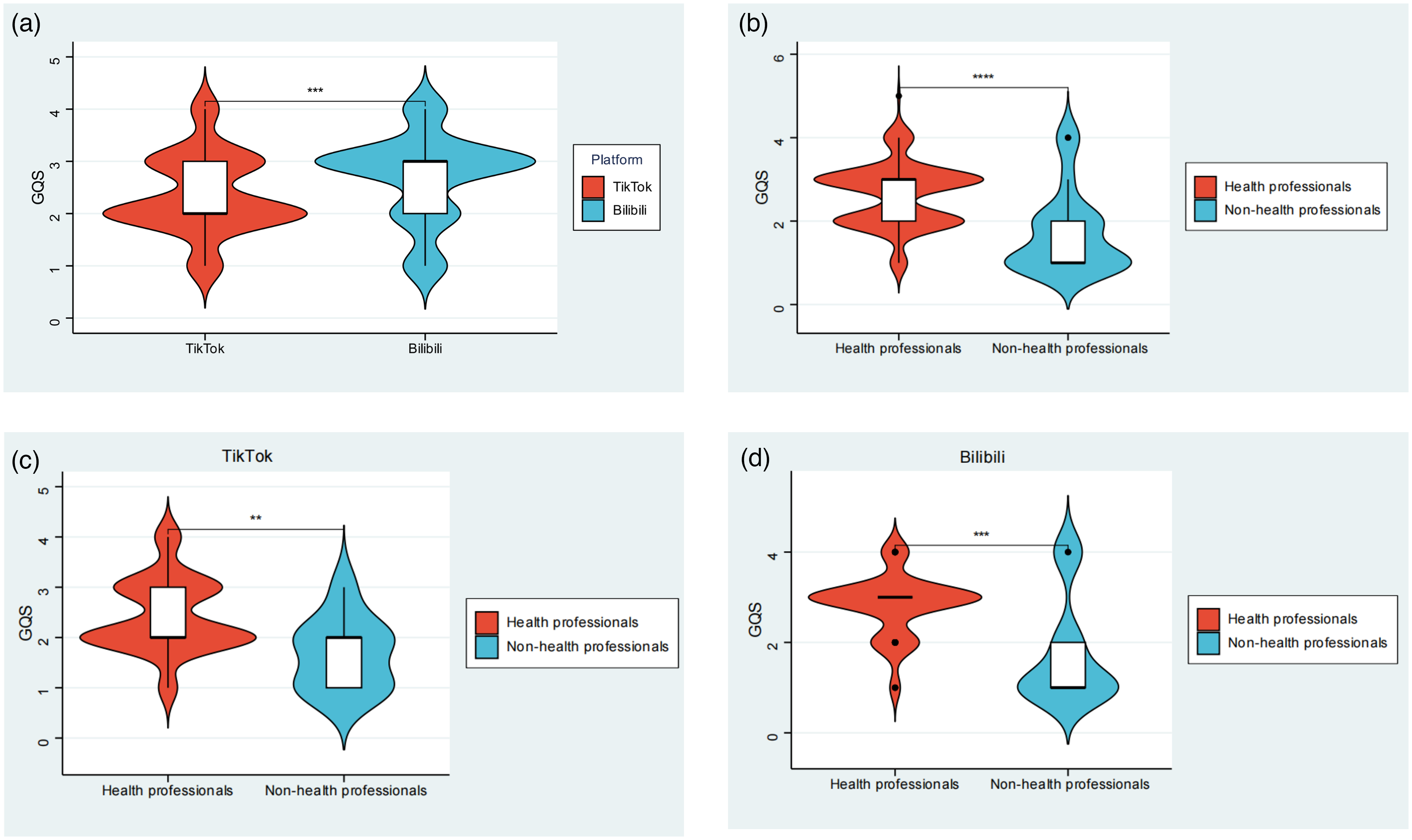
The GQS of videos related to osteosarcoma on TikTok and BiliBili. (a) Comparison of GQS between TikTok and BiliBili videos. (b) Comparison of GQS between health professionals and non-health professionals. (c) Comparison of GQS between health professionals and non-health professionals on TikTok. (d) Comparison of GQS between health professionals and non-health professionals on BiliBili. *p < 0.05, **p < 0.01, ***p < 0.001, ****p < 0.0001. GQS: Global Quality Scale.

The mDISCERN of videos related to osteosarcoma on TikTok and BiliBili. (a) Comparison of mDISCERN between TikTok and BiliBili. (b) Comparison of mDISCERN between health professionals and non-health professionals. (c) Comparison of mDISCERN between health professionals and non-health professionals on TikTok. (d) Comparison of mDISCERN between health professionals and non-health professionals on BiliBili. *p < 0.05, **p < 0.01, ***p < 0.001, ****p < 0.0001. mDISCERN: Modified Discrimination Score.
Short video completeness analysis
Video integrity was assessed across five categories: etiology, clinical manifestations, diagnosis, treatment, and prognosis, with higher scores indicating better content quality. As presented in Table 3, the three most frequently addressed content categories across both platforms were clinical manifestations, treatment, and diagnosis. In contrast, the topics of etiology and prognosis were mentioned less often, with proportions of 42.62% and 31.17%, respectively.
In Table 4, we report the CS scores from different platforms. The median CS for TikTok was 4.00 (Q1 = 2.00, Q3 = 4.00), with an average score of 3.57 (SD = 1.58). In comparison, the median CS for Bilibili was also 4.00 (Q1 = 3.00, Q3 = 6.00), but with a slightly higher average score of 4.23 (SD = 2.50). Figure 6B illustrates that the quality of content uploaded by health professionals is consistently superior to that produced by non-health professionals, a trend that holds true across both platforms, as highlighted in Figure 6C and D.
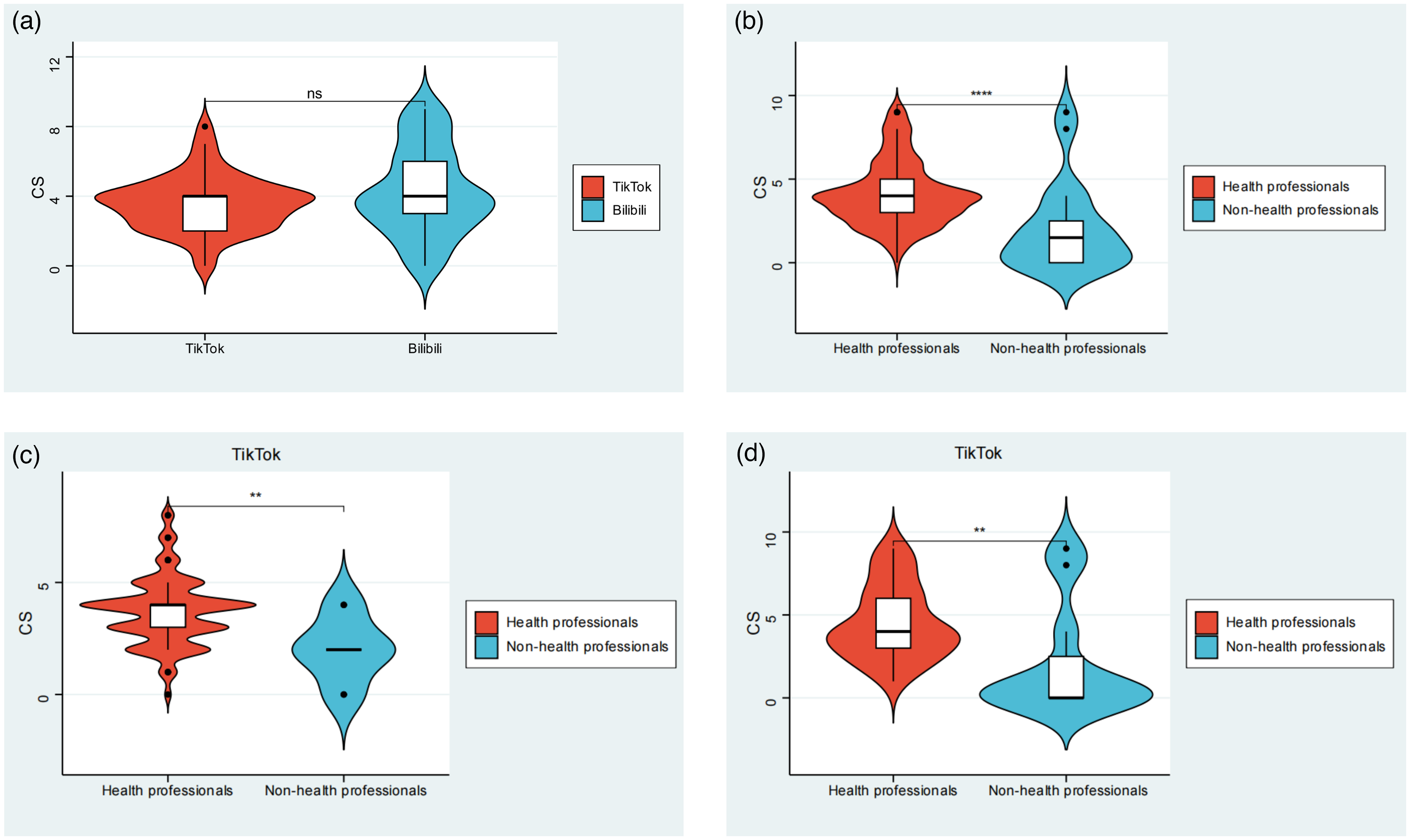
The CS of videos related to osteosarcoma on TikTok and BiliBili. (a) Comparison of CS between TikTok and BiliBili videos. (b) Comparison of CS between health professionals and non-health professionals. (c) Comparison of CS between health professionals and non-health professionals on TikTok. (d) Comparison of CS between health professionals and non-health professionals on BiliBili. *p < 0.05, **p < 0.01, ***p < 0.001, ****p < 0.0001. CS: completeness score.
Spearman correlation analysis
We conducted spearman correlation analysis to explore the relationships between different video variables, GQS, mDISCERN scores, and CS in osteosarcoma-related short videos across two major platforms. The results indicated significant positive correlations between likes, comments, shares, and saves on both TikTok and Bilibili. Specifically, the correlations between likes, comments, shares, and saves were strong, with correlation coefficients ranging from 0.79 to 0.95. On TikTok, the highest correlation was observed between likes and saves (0.95), while on Bilibili, the highest correlation was between likes and saves (0.9).
Additionally, on TikTok, the correlation between video duration and likes, comments, shares, and saves was weak. The correlation coefficients between video duration and likes, saves, comments, and shares were 0.31, 0.31, 0.32, and 0.23, respectively. On Bilibili, the positive correlations were stronger, with correlation coefficients for video duration with likes, saves, comments, and shares being 0.51, 0.6, 0.57, and 0.64, respectively.
However, no significant correlations were found between GQS, mDISCERN scores, and CS with video variables such as video likes, comments, saves, and shares. The specific correlation coefficients for both platforms are shown in (Figure 7A and B).

Spearman correlation coefficients between GQS, mDISCERN, and CS. (a) Spearman correlation analysis heatmap of osteosarcoma-related videos on TikTok. (b) Spearman correlation analysis heatmap of osteosarcoma-related videos on Bilibili. The color intensity indicates the strength of the correlation, with darker shades representing stronger positive correlations, lighter shades indicating weaker or no correlation, and negative correlations shown in cooler colors. The values in the heatmap range from −1 to +1, where +1 indicates a perfect positive correlation, −1 represents a perfect negative correlation, and × indicates no correlation. GQS: Global Quality Scale; mDISCERN: Modified Discrimination Score; CS: completeness score.
Discussion
Research overview and clinical importance
Osteosarcoma, a malignant bone tumor, has a particularly high incidence among younger populations. 21 While early diagnosis and treatment are crucial for improving prognosis,22,23 public awareness of the disease remains alarmingly low. Many individuals mistakenly view osteosarcoma as a less serious condition, which delays timely medical intervention. The rise of social media platforms has revolutionized health communication, with short videos emerging as a key medium for spreading health information. 24
For cancer patients, understanding the treatment process is essential for disease management.25,26 However, inaccurate information can mislead patients into making misguided decisions, potentially impacting their clinical outcomes. 27 This knowledge gap not only impedes early detection but also contributes to adverse health outcomes. Low-quality information can lead to patient confusion, delay in seeking timely medical attention, and increased anxiety, as patients may not have access to accurate or comprehensive knowledge of the disease. Understanding the quality of osteosarcoma-related health videos is essential for ensuring that social media can be an effective tool for improving public knowledge and encouraging early detection.
Quality of osteosarcoma-related health videos
In this study, evaluating osteosarcoma-related content on TikTok and Bilibili reveals substantial differences in video quality between the two platforms. TikTok, with its emphasis on entertainment and short-form content, generally features lower quality videos, scoring poorly across several quality metrics including GQS, mDISCERN, and CS. This trend may be attributed to TikTok's platform design, which prioritizes viral content over educational value. The brevity of videos and the platform's diverse creator base result in content that is often superficial, with frequent inaccuracies such as confusing osteosarcoma with general bone cancer, or disseminating outdated medical information. Moreover, the platform's minimal content regulation and low barriers for content creation exacerbate the spread of misinformation. 28 In contrast, Bilibili typically features longer, more systematic, and academically oriented content, which contributes to higher quality scores. The platform's emphasis on in-depth, structured content is likely a significant factor in the observed differences in video quality between TikTok and Bilibili.
Our analysis also highlights the impact of the creator's professional background on video quality. Videos produced by healthcare professionals generally exhibit higher quality compared to those created by non-professionals. This underscores the essential role of healthcare professionals in delivering accurate and reliable health education.29,30 The superior quality of healthcare professional-produced content may be attributed to their expertise in osteosarcoma, clinical experience, adherence to established guidelines, and familiarity with the latest research. In contrast, non-medical creators, such as patients or independent science communicators, often rely on personal experiences or subjective perspectives, which can introduce bias and compromise the accuracy of the information presented.
Integrity of healthy video content
One limitation of current research on health education short videos is the lack of comprehensive explanations of the full disease process.31,32 A complete explanation typically requires addressing aspects such as treatment options, clinical manifestation, management, and prognosis.33,34 To improve the comprehensiveness of our study, we performed a basic content integrity assessment of osteosarcoma-related videos. We observed that most osteosarcoma-related content mainly focused on clinical symptoms and treatment options, with limited attention to the etiology or prognosis of the disease.
To further assess content completeness, we scored the integrity of the videos. The completeness ratings revealed that videos produced by healthcare professionals generally received higher CS scores across both platforms. This finding aligns with previous research,35,36 which suggests that expert-created content tends to be more comprehensive, reliable, and capable of providing more accurate guidance to patients, thus resulting in higher scores. From the perspective of cancer patients, understanding the entire treatment process is crucial for effective disease management. The lack of such comprehensive content may lead to knowledge gaps, which can ultimately impact patients’ decision-making and overall health outcomes.25,26,37 Furthermore, the absence of vital information, such as prognosis or treatment options, can cause unnecessary anxiety or confusion for patients, affecting their ability to make informed decisions. This underscores a significant gap in the educational value of health-related videos, especially in addressing critical aspects of the disease. These findings suggest the need for targeted digital health education strategies to ensure the delivery of accurate, comprehensive, and patient-friendly information, ultimately supporting better health outcomes.
The paradox of quality vs. popularity in health videos
Spearman correlation analysis was conducted to examine the relationship between video variables, GQS, mDISCERN scores, and video integrity. In comparing the popularity and quality of content on short video platforms, our findings highlight a significant paradox. Despite their lack of scientific rigor, entertainment-focused health videos tend to generate significantly higher engagement, including more likes, shares, and comments. Specifically, our study found that while TikTok videos scored lower on quality assessments compared to Bilibili, TikTok videos garnered considerably higher interaction rates, with increased likes, shares, saves, and comments. In contrast, Bilibili, which emphasizes academic rigor and content depth, featured higher quality videos but saw fewer interactions. This disparity can largely be attributed to the distinct characteristics of each platform. 38 TikTok's entertainment-driven nature, coupled with its short-form video format, appeals primarily to a broad, younger demographic, which gravitates towards trend-oriented, attention-grabbing content. Previous research suggests that users often prefer engaging,39,40 easily digestible videos, even when scientific accuracy is compromised. While this preference drives higher engagement on TikTok, it raises concerns regarding the spread of misinformation, especially when content is not subjected to professional scrutiny.
This paradox is especially evident in videos produced by healthcare professionals. While these expert-created videos provide scientifically accurate and reliable health information, they often lack the entertainment value that drives widespread attention on social media platforms. As a result, they typically receive fewer views and interactions, placing them at a disadvantage in terms of visibility and engagement. In contrast, videos created by non-professional creators—particularly those sharing personal experiences or patient stories—tend to generate higher engagement rates. Despite occasional lapses in scientific rigor, these videos resonate emotionally with audiences, evoking empathy and encouraging greater interaction. 41 This pattern is not exclusive to osteosarcoma-related content; similar trends have been observed in other health contexts, where patient-generated content often surpasses expert content in terms of audience engagement.42,43
Future directions
The paradox between the popularity of low-quality health content and the limited engagement with expert-driven, scientifically accurate videos underscores a critical challenge in health communication on short video platforms: how to balance the need for accuracy with the demand for engaging, shareable content. Based on the findings of this study, one key actionable strategy would be for healthcare professionals to create more targeted, informative videos that combine expert knowledge with audience engagement techniques such as storytelling or visual appeal. This approach can help bridge the gap between educational value and audience interest, ensuring that accuracy is maintained while enhancing engagement.
Recently, the Chinese government released guidelines aimed at improving the quality of health science content across media platforms, highlighting a national focus on addressing this issue. 44 Moving forward, efforts should focus on combining the scientific rigor of expert-created content with engaging elements like storytelling and emotional appeal. By incorporating patient narratives and personal experiences, videos can remain both accurate and compelling, ensuring that critical health information resonates with a broader audience. Healthcare professionals should also take an active role in content creation, collaborating with media experts to produce videos that are not only scientifically accurate but also relatable and engaging. Such collaboration can bridge the gap between clinical knowledge and public understanding, resulting in more impactful health communication.
Moreover, platforms should implement more robust content moderation and quality control measures to prioritize educational content. This could be achieved by adjusting platform algorithms to give greater visibility to high-quality, evidence-based health information, rather than sensational or viral content that may lack scientific accuracy. This shift would improve the visibility of reliable health content, making it more accessible to a larger audience.
Equally important, health videos must provide a holistic understanding of the disease process. Many videos focus solely on individual aspects, such as diagnosis or treatment, while neglecting critical topics like prognosis, psychological support, and long-term care.45,46 To facilitate informed decision-making, videos should cover the entire disease trajectory, especially for complex conditions such as cancer. This comprehensive approach will equip viewers with a more complete understanding of the disease and empower them to make better-informed decisions regarding their health.
In conclusion, improving the dissemination of high-quality health videos requires a collaborative approach across stakeholders. By focusing on concrete steps such as content creation by healthcare professionals, algorithmic adjustments on platforms, and comprehensive coverage of disease information, we can enhance the public's access to accurate, reliable health information, ultimately promoting better health outcomes.
Limitations
One significant limitation of this study is the relatively small sample size, as it only includes videos from two popular short video platforms in China-TikTok and Bilibili. This narrow focus may limit the generalizability of our findings to other platforms, such as Red Note, WeChat Video, and Kwai, which were not part of our analysis. Additionally, while we employed validated tools like the GQS and mDISCERN scores to evaluate video quality, the assessment process nonetheless introduced an element of subjectivity. Although our evaluators are all senior orthopedic surgeons with extensive expertise, variations in individual experiences and medical subfields may lead to differing interpretations of video content. An important limitation of this study is that short video platform algorithms and dynamic content updates could affect search results and video rankings over time, which may impact the reproducibility and generalizability of the findings. Despite these limitations, we conducted thorough content completeness ratings and performed detailed statistical analyses, striving to provide a more comprehensive and objective evaluation of the videos. These efforts not only enhance our study's rigor but also lay a solid foundation for future research in this important area.
Conclusions
This study analyzes osteosarcoma-related content on short video platforms in mainland China, focusing on content quality, engagement, and dissemination. While platforms like TikTok and Bilibili have the potential to spread valuable health information, they face challenges in balancing quality with user engagement. Videos created by healthcare professionals are more reliable but tend to receive less interaction, highlighting the urgent need for greater professional involvement in digital health content creation. Additionally, there is a pressing need for clearer regulation of medical information on social media platforms to ensure the accuracy and reliability of health content.
To improve health content dissemination, strategies such as adjusting algorithms to prioritize educational content, fostering collaborations between healthcare professionals and content creators, and enhancing medical science communication are recommended. Further research is needed to optimize digital platforms’ effectiveness in health education and improve the quality of cancer-related medical content.
Footnotes
Acknowledgements
The authors would like to express their gratitude to the participants who participated in the study.

Ethical approval
No clinical data, human specimens, or laboratory animals were used in this study. All analyzed data were sourced from publicly available TikTok and Bilibili videos. Data collection fully complied with the terms of service of both TikTok and Bilibili platforms. No personally identifiable information was collected or processed, and no interaction with users occurred. As no private information was involved, and the study did not involve human participants, clinical data, laboratory animals, or histological research, ethics approval was not required.
Author contributions
Conceptualization or design by JC and XXC. CSH and JCZ collected the data, and JC and ZXL carried out statistical analysis. Funding acquisition by HL. Original draft written by ZXL and WYL. Manuscript editing by JC. Supervision and draft review by XXC and PL. All authors contributed to the article and approved the final manuscript.
Funding
The authors disclosed receipt of the following financial support for the research, authorship, and/or publication of this article: This work was supported by the Guangdong Postgraduate Education Innovation Plan Project, Guangdong Province Science and Technology Innovation Strategy Project, the Natural Science Foundation of Guangdong Province, Project of Beijing Medical Award Foundation, PSM Guangdong Pharmaceutical Science Popularization Research Fund (Simcere Fund) Project, Guangdong Medical University Clinical + Basic Science and Technology Innovation Special Program(grant number No.2024JGXM_081, No.2019A141403009, No.2025A1515011841, No.YXJL-2025-0106-0117, No.2025KP10, No.GDMULCJC202500).
Declaration of conflicting interests
The authors declared no potential conflicts of interest with respect to the research, authorship, and/or publication of this article.
Data availability
Derived data supporting the findings of this study are available from the corresponding authors on request.
Guarantor
Hao Lin and Xinxin Chen.