



Abstract
Objective
Myocardial infarction (MI) is one of the leading causes of death and disability worldwide. Short-video platforms play an increasingly important role in disseminating health information; however, the quality and reliability of MI-related short videos remain unclear.
Methods
Using “myocardial infarction” as the keyword, we analyzed 228 MI-related videos from TikTok and Bilibili. After extracting basic characteristics, we evaluated video quality, reliability, and transparency using the Global Quality Score (GQS), modified DISCERN (mDISCERN), JAMA benchmark, and the Video Information and Quality Index (VIQI). Nonparametric statistics were used for group comparisons, and Spearman's rank correlation was applied to assess associations between engagement metrics and quality scores.
Results
Video content primarily addressed clinical presentation, etiology, and treatment, with relatively little on epidemiology and prevention. Topic distribution was as follows: clinical presentation (22.06%), etiology (22.71%), treatment (19.93%), diagnosis (16.01%), prevention (15.03%), and epidemiology (4.25%). Overall video quality was moderate: GQS 3.0 (IQR: 2–3), mDISCERN 2.0 (IQR: 2–3), JAMA 2.0 (IQR: 2–3), and VIQI 11.0 (IQR: 10–13). Videos uploaded by cardiologists received the highest quality scores (p < .05). No significant correlations were observed between engagement metrics and quality scores.
Conclusions
MI-related short videos on TikTok and Bilibili demonstrate moderate overall quality with incomplete content coverage. Future efforts should encourage greater participation of cardiologists in health communication, enhance inclusion of epidemiology and prevention content, and support platforms in developing quality accreditation systems and optimizing recommendation algorithms to improve the scientific accuracy, transparency, and communicative value of health information.
Keywords
Introduction
Myocardial infarction (MI) is one of the leading causes of death and disability worldwide, and represents one of the most severe acute events within the spectrum of cardiovascular diseases 1 According to reports from the Global Burden of Disease (GBD) Study, cardiovascular diseases cause more than 17 million deaths annually, with MI accounting for a substantial proportion, imposing a heavy burden on both public health and socioeconomic systems. 2 Early symptom recognition, shortened reperfusion time, and continuous risk factor management are key measures to reduce mortality and improve long-term outcomes. 3 However, epidemiological studies have shown that public awareness of MI symptoms, risk factors, and preventive strategies remains insufficient, often leading to delays in seeking care and inappropriate treatment. 4 Therefore, enhancing public scientific awareness of MI through the accurate, timely, and accessible dissemination of health information holds the potential to reduce delays, standardize treatment, alleviate disease burden, and improve clinical outcomes.
In recent years, social media has profoundly transformed the production and dissemination of health information. Short-video content, exemplified by platforms such as TikTok and Bilibili, has rapidly emerged, becoming an important source of health information for the public due to its visual appeal, fragmentation, and algorithm-driven recommendation features.5,6 In this study, we focused on TikTok and Bilibili because they are currently the most widely used and influential short-video platforms in mainland China, with high user penetration and engagement. TikTok primarily functions as a large-scale, algorithm-driven platform, whereas Bilibili is characterized as a community- and interest-driven platform, thereby representing two distinct short-video ecosystem models. Restricting our analysis to these two platforms improves comparability by minimizing confounding related to platform architecture, user demographics, and platform culture. Although YouTube plays an important global role in disseminating health information, its accessibility and user coverage in mainland China are limited. Given the geographic context and research objectives of this study, TikTok and Bilibili therefore provide more relevant and representative platforms for examining the quality of short-video health information. Previous studies have demonstrated the potential of social media in promoting health knowledge dissemination and disease management, such as improving adherence among patients with chronic conditions and fostering healthier behaviors. 7 However, the openness and entertainment-oriented nature of short videos also present risks: content may be homogeneous, lack evidence-based support, or even contain misinformation, thereby diminishing its educational value.8,9
Research on the quality of health information in short videos has been conducted in some diseases, such as Colorectal Polyps, 10 ankle sprains, 11 and thyroid eye disease. 12 The results suggest that the content quality on platforms is uneven, with insufficient transparency and reliability. Furthermore, high interaction levels do not necessarily equate to scientific rigor or educational value. However, the evaluation of MI-related short videos, despite MI being one of the most burdensome cardiovascular emergencies worldwide, remains lacking. In particular, key issues such as cross-platform differences (TikTok vs. Bilibili), uploader categories (professional vs. non-professional), content dimension coverage, and the relationship between engagement metrics and quality have not been fully explored. Considering MI's critical role in both emergency care pathways and long-term management, clarifying the scientific rigor, transparency, and educational value of related content on short-video platforms holds important theoretical and practical significance.
This study aims to fill the existing gap in research on the quality of MI-related short videos, particularly by evaluating the content quality and reliability of videos on TikTok and Bilibili platforms. Using validated tools such as GQS, mDISCERN, JAMA, and VIQI, we conducted an in-depth analysis of different uploader types (professional vs. non-professional), platform differences, and the relationship between video quality and interaction metrics (e.g., likes, comments, saves, and shares). The significance of this study lies in its provision of data to support platform content governance and creators, promoting the standardized dissemination of health information. Ultimately, the study hopes to enhance the public's scientific understanding of MI, reduce delays in seeking medical attention, standardize cardiovascular risk factor management, and improve long-term patient outcomes.
Methods
Study design and setting
This study was designed as a cross-sectional observational content analysis of short videos related to MI on two major Chinese short-video platforms, TikTok and Bilibili. The study was conducted at the [First Clinical Medical College, Shandong University of Traditional Chinese Medicine, Jinan, China]. Data collection was performed on 24 August 2025, and video evaluation was carried out between 25 and 28 August 2025.
Inclusion and exclusion criteria
Videos were screened based on the following inclusion criteria: (a) primarily focused on MI-related medical information; (b) presented in Chinese; and (c) publicly accessible at the time of data collection. Videos were excluded according to the following criteria: (a) unrelated content (including news reports or entertainment videos) (TikTok: n = 22; Bilibili: n = 26); (b) duplicates (TikTok: n = 9; Bilibili: n = 15). A total of 228 videos were included in the final analysis.
Data collection and evaluation method
This study used “myocardial infarction” as a search keyword to retrieve videos from both TikTok and Bilibili platforms. To minimize the impact of personalized recommendation algorithms, all searches were conducted in an incognito mode without logging in, as a guest. On 24 August 2025, the overall data of video features, interaction indicators, and uploader identity were collected using the Chinese keyword “myocardial infarction.” For each platform, the top 150 videos returned under the default sorting order were initially identified (total n = 300). For all videos that met the eligibility criteria (see inclusion and exclusion criteria), we extracted video duration, interaction metrics (likes, comments, collections, and shares), and video content dimensions. Uploaders were categorized into four groups: cardiovascular specialists, noncardiovascular specialists, individuals, and official institutions. Cardiovascular specialists and noncardiovascular specialists were grouped as professionals, while individuals and official institutions were categorized as nonprofessionals (Figure 1).

Flowchart of video selection for myocardial infarction-related short videos.
All selected videos were independently evaluated by two assessors with a medical background, who underwent standardized training before scoring to ensure consistency and reduce bias. The GQS, mDISCRON, JAVA, and VIQI scores for myocardial infarction related videos were mainly completed between 25 and 28 August. Following methods from previous research, the study employed four validated scales for comprehensive evaluation: Global Quality Score (GQS), modified DISCERN tool (mDISCERN), JAMA Benchmark, and Video Information and Quality Index (VIQI). GQS 13 assesses video quality on five levels, ranging from 1 (poor) to 5 (excellent) (Supplementary Table 1). The mDISCERN 14 score, initially designed for written health information, was modified to assess the reliability of video content. It includes five questions with scores ranging from 1 to 5, where higher scores indicate higher reliability. Detailed scoring criteria are provided in the supplementary materials (Supplementary Table 2). The JAMA 15 benchmark evaluates four key dimensions—attribution, timeliness, content effectiveness, and disclosure compliance—resulting in a composite score from 0 to 4 (Supplementary Table 3). VIQI 16 is used to assess the quality of structure, content completeness, visual presentation, and consistency. The scoring was conducted independently by two cardiovascular specialists, with the final decision made by the chief cardiovascular specialist in case of significant discrepancies between the two assessors. Prior to scoring, all assessors underwent standardized training to ensure consistency and minimize bias.
Statistical analysis
All statistical analyses were performed using SPSS version 26.0 and R version 4.3.0. Continuous variables were expressed as medians with interquartile ranges (IQR), while categorical variables were expressed as frequencies and percentages. Differences in video characteristics and quality scores (GQS, mDISCERN, JAMA, VIQI) between platforms (TikTok vs. Bilibili) and among different uploader categories were assessed using the Mann–Whitney U test (for two-group comparisons) or the Kruskal–Wallis H test (for multiple-group comparisons). The effect size (r) for the Mann–Whitney U test was calculated from the Z values using the formula
Results
Video characteristics
After applying the exclusion criteria, a total of 228 videos from TikTok and Bilibili were included in the study, with 119 videos from TikTok (52.19%) and 109 videos from Bilibili (47.81%). The video characteristics of both platforms, including video length and audience interaction (likes, comments, bookmarks, and shares), were analyzed. (Table 1) shows significant differences between TikTok and Bilibili in these aspects (p < .001), with TikTok videos being noticeably shorter than Bilibili videos. TikTok videos demonstrated superior audience interaction, receiving the highest number of likes (median: 825, IQR: 211.5‒3983, r = .55), collections (median: 272, IQR: 53‒1558, r = .27), comments (median: 44, IQR: 12‒246.5, r = .53), and shares (median: 201, IQR: 29‒1037.5, r = .38). In contrast, Bilibili videos showed lower values across all interaction metrics. Table 2 provides a detailed analysis of video characteristics based on the uploader's identity. Compared to other uploaders, videos uploaded by individuals were significantly longer in duration. Additionally, videos uploaded by cardiologists performed better in terms of interaction metrics, while those uploaded by individuals or official institutions showed poorer performance in these metrics. Table 3 further reveals that videos uploaded by professionals were shorter than those uploaded by non-professionals but exhibited higher levels of interaction.
Comparison of different short-video platforms.

Comparison of different uploader identity.

Comparison of video characteristics: professionals versus non-professionals on TikTok and Bilibili.

Uploader characteristics
In this study, video uploaders were primarily categorized into cardiologists (53.51%), non-cardiologists (18.42%), individuals (21.05%), and official institutions (7.02%), as shown in Figure 2(a). On Bilibili, individual uploaders dominated, accounting for 41% of the videos, followed by cardiologists, with non-cardiologists and official institutions having smaller shares. In contrast, on TikTok, cardiologists were the primary uploaders, making up 71% of the content, followed by non-cardiologists, with official institutions and individuals contributing less, as shown in Figure 2(b). Figure 2(c) reveals that professionals uploaded 71.93% of the videos, while non-professionals contributed 28.07%. Figure 2(d) further illustrates that on Bilibili, professionals contributed 49% of the content, while non-professionals contributed 51%. On TikTok, however, professionals contributed 93% of the content, while non-professionals accounted for only 7%. This highlights that professionals are the main content providers on both platforms, especially on TikTok.

Distribution of uploaders on TikTok and Bilibili: (a) Overall distribution of different uploader types in the entire sample; (b) Comparison of uploader type distribution between TikTok and Bilibili; (c) Proportions of professional versus non-professional uploaders in the overall sample; (d) Comparison of professional versus non-professional uploader distribution between TikTok and Bilibili.
Video content
In Figure 3(a), we analyzed the content of 228 videos. These videos were categorized as follows: Epidemiology (n = 26 [4.25%]), Etiology (n = 139 [22.71%]), Clinical Manifestations (n = 135 [22.06%]), Diagnosis (n = 98 [16.01%]), Treatment (n = 122 [19.93%]), and Prevention (n = 92 [15.03%]). Figure 3(b) displays the distribution of video content across different platforms. Compared to other categories, TikTok videos had a higher proportion of content related to Clinical Manifestations, Treatment, and Etiology, while the proportion of Prevention content was notably higher than that on Bilibili. However, the proportion of Diagnostic content was lower on TikTok compared to Bilibili. Bilibili, on the other hand, primarily featured Clinical Manifestations, Diagnosis, and Etiology. Further analysis (Figure 3C) revealed that videos uploaded by individual users were more focused on Etiology and Clinical Manifestations, with a clear lack of content related to Prevention. Overall, Clinical Manifestations, Etiology, and Treatment were the most common themes, while Epidemiology and Prevention content were relatively scarce. This phenomenon suggests that although short videos on MI cover various dimensions, there is still room for improvement in the comprehensive dissemination of health information. Inter-rater reliability for the four quality assessment instruments was high (Supplementary Table 4). The kappa coefficient for GQS was 0.786 (95% CI: 0.706‒0.866; Z = 16.98; p < .001), indicating substantial agreement. Agreement for mDISCERN was almost perfect, with a kappa of 0.982 (95% CI: 0.958‒1.000; Z = 26.55; p < .001). For the JAMA benchmark, kappa was 0.697 (95% CI: 0.603‒0.790; Z = 15.00; p < .001), also reflecting substantial agreement. The VIQI score similarly demonstrated almost perfect agreement, with a kappa of 0.905 (95% CI: 0.850‒0.960; Z = 37.77; p < .001). Overall, these results support the reliability of the video quality ratings used in this study.

Content distribution of myocardial infarction-related short videos on TikTok and Bilibili: (a) Overall distribution of video content categories in the entire sample; (b) Comparison of video content categories between TikTok and Bilibili platforms; (c) Comparison of video content categories uploaded by professional versus non-professional creators.
Video quality
As shown in Table 1, the median GQS score for both TikTok and Bilibili was 3.00 (TikTok IQR: 2‒3; Bilibili IQR: 2‒3) (r = .36, p = .008). In the mDISCERN scores, TikTok's median was 3.00 (IQR: 2‒3), while Bilibili's median was 2 (IQR: 2-3) (r = .10, p = 0.176), The JAMA score indicated that both TikTok and Bilibili had a median of 3.00 (TikTok IQR: 2‒3; Bilibili IQR: 1‒2) (r = .18, p < .001). TikTok's VIQI median was 12 (IQR: 11‒14), while Bilibili's median was 11 (IQR: 9‒12)(r = .12, p < .001). Figure 4(a, b, c, and d) shows significant differences between TikTok and Bilibili in GQS, JAMA, and VIQI scores, indicating that TikTok videos are of higher quality. However, the difference in mDISCERN scores between the two platforms was not statistically significant.Regarding video quality comparison by uploader identity type (Figure 5), cardiologists performed better across all quality metrics (GQS, mDISCERN, JAMA, and VIQI), with statistically significant differences, as shown in Table 2. The kernel density distribution plot (Figure 6) further reveals the quality distribution of videos from different uploaders. The results show that videos uploaded by cardiologists generally had higher quality scores in GQS, mDISCERN, JAMA, and VIQI, compared to those uploaded by non-cardiologists, who performed better than individuals and official institutions. Videos uploaded by individuals and official institutions primarily fell into lower-quality score ranges.When the analysis was merged into “professionals vs. non-professionals” (Table 3), the results showed that professionals had higher median scores for GQS, mDISCERN, JAMA, and VIQI than non-professionals.

Comparison of quality and reliability scores of myocardial infarction-related short videos between TikTok and Bilibili: (a) GQS score; (b) mDISCERN score; (c) JAMA score; (d) VIQI.

Comparison of quality and reliability scores of myocardial infarction-related short videos across different uploader types: (a) GQS score; (b) mDISCERN score; (c) JAMA score; (d) VIQI.

Distribution of quality and reliability scores of myocardial infarction-related short videos across different uploader types: (a) GQS score; (b) mDISCERN score; (c) JAMA score; and (d) VIQI.
Correlation analysis
Spearman correlation analysis was used to explore the relationship between video interaction metrics (likes, comments, bookmarks, shares) and video quality scores (GQS, mDISCERN, JAMA, VIQI), with the results shown in Figure 7. The analysis revealed significant positive correlations between different interaction metrics. For instance, the correlation coefficients between likes and bookmarks, comments, and shares were (r = .92, p < .05), (r = .93, p < .05), and (r = .90, p < .05), respectively. In contrast, the correlation between interaction metrics and the quality scores (GQS, mDISCERN, JAMA, and VIQI) was weak, indicating that video engagement levels were not strongly associated with the quality or reliability of the content.
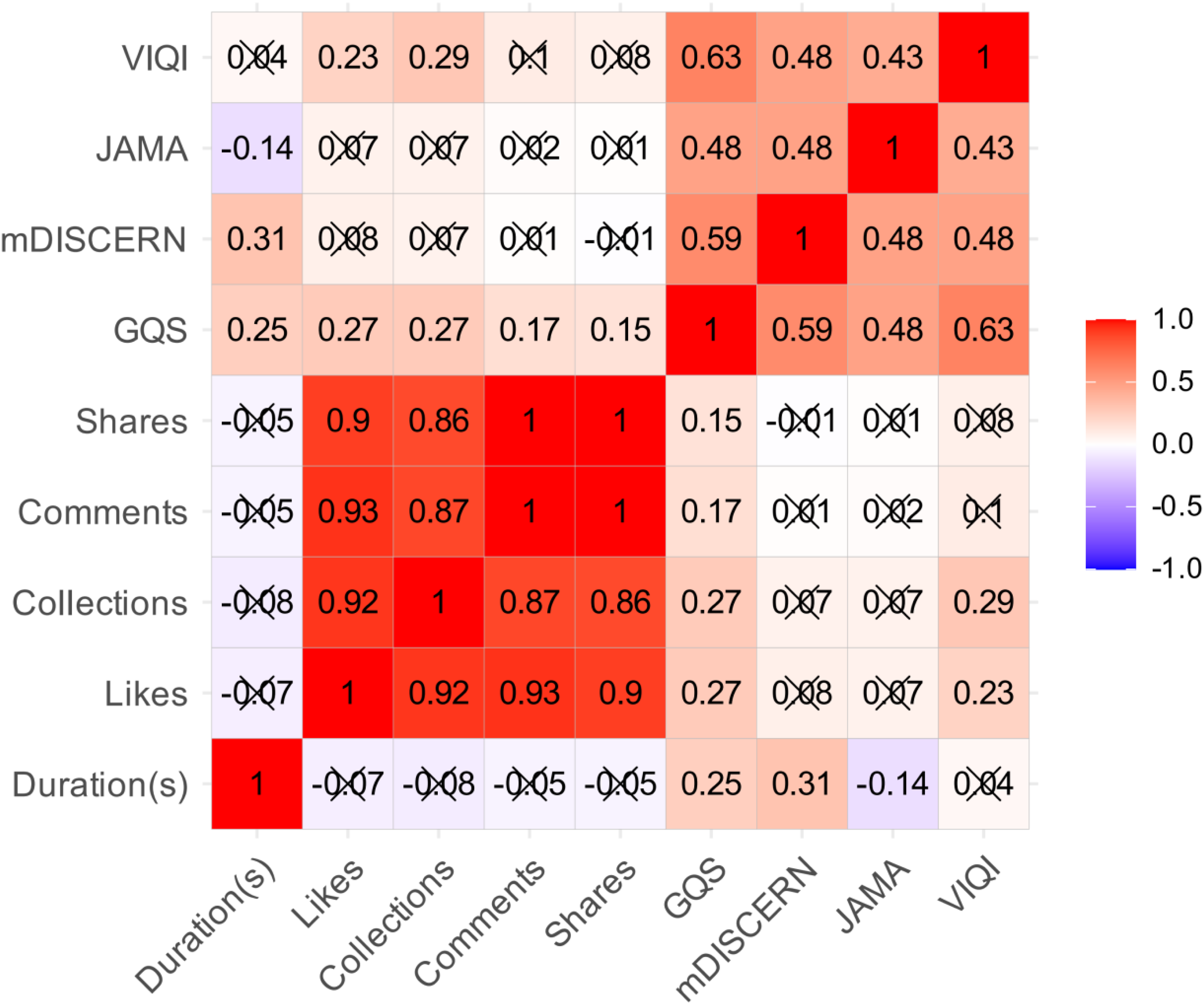
Correlation analysis between video features, content, and quality scores of myocardial infarction-related short videos.
Discussion
MI is among the most prevalent and fatal cardiovascular diseases worldwide, placing a heavy burden on both public health and socioeconomic systems. 17 Rapid recognition and timely treatment during the acute phase, coupled with long-term management of risk factors, are essential for reducing mortality and improving outcomes. However, public awareness of MI remains limited, with notable deficiencies in risk factor management and prevention. 18 In recent years, social media has emerged as an important channel for health information dissemination. 19 TikTok and Bilibili, both widely used platforms in China, have the potential to become valuable tools for medical education and health communication.20,21 Nonetheless, the quality and scientific rigor of medical short videos vary considerably, and in some cases may even promote misinformation, highlighting the urgent need for systematic evaluation. 22
This study compared MI-related short videos on two major short-video platforms. The results showed that videos on the algorithm-driven platform were shorter in duration but achieved higher levels of engagement. Consistent with previous work, 23 these videos received more likes and comments, which may be partly related to recommendation mechanisms and editing tools that facilitate fast-paced, visually appealing content. 24 By rapidly matching content to users’ inferred interests, the recommendation system enables highly engaging videos to reach a wide audience, which aligns with the logic of “fragmented attention” in contemporary media consumption. 25 In contrast, the more community-oriented platform appears to place greater emphasis on long-form content and community-driven engagement. Its recommendation logic tends to favor videos that attract sustained interaction, such as longer viewing duration and community-based features (e.g., bullet-screen comments). While this focus on prolonged engagement may support the delivery of more in-depth content, it can also result in lower immediate responsiveness in terms of likes, comments, and shares compared with the algorithm-driven platform. In this context, content that fosters prolonged interaction rather than quick bursts of engagement may be amplified, which may help explain the lower levels of immediate interaction observed on this platform.
Further analysis of uploader identity differences revealed that videos uploaded by cardiologists performed better in terms of engagement metrics than those uploaded by non-professional accounts. This pattern may reflect viewers’ greater trust in professional sources and the general visibility mechanisms for content that rapidly accumulates interaction. However, because the internal recommendation algorithms were not directly examined in this study, these interpretations should be considered hypothesis-generating rather than definitive evidence of algorithmic preference for expert content. This finding nevertheless suggests that professional knowledge and clinical experience have advantages in building trust and increasing engagement with viewers. Videos uploaded by individuals and official institutions, however, had lower engagement, possibly due to a less engaging narrative style or mismatched audience targeting with the platform's culture. Notably, videos uploaded by individuals were often longer in duration but did not receive higher engagement, indicating that video length does not have a linear relationship with interaction. Information density, presentation strategies, and emotional appeal may serve as more critical mediators in this regard. Additionally, the overall shorter videos uploaded by professionals had higher interaction levels, suggesting that professional content combined with shorter durations aligns better with current user consumption habits. This pattern is also consistent with the notion that short-form, expert-labelled content can more easily trigger peripheral processing in short-video environments, as further discussed below in light of the Elaboration Likelihood Model.26,27 This suggests that future creators should find a balance between short duration and high professionalism to maximize the reach and educational value of health information.
These two platforms differ significantly in terms of uploader composition: TikTok is predominantly populated by professionals, especially cardiovascular specialists, while Bilibili features more content from individual users, with a near-equal balance between professional and non-professional contributors. This difference likely reflects the platforms’ cultural orientation and audience targeting—TikTok tends to emphasize “expert-authority” figures, whereas Bilibili emphasizes community-driven and diverse expressions. This distinction has profound implications for the quality of health information. On the one hand, the dominance of professionals on TikTok suggests that the content is more likely to be scientifically rigorous and reliable, aligning with the findings of this study's quality analysis. On the other hand, Bilibili's higher proportion of individual uploaders, while enhancing content diversity and relatability, also increases the risks of information heterogeneity and potential misinformation. In line with research by Wenjie He et al. 28 on the quality of cerebral palsy videos, Tejas Subramanian et al. 29 on spinal surgery information, and Gavisha Waidyaratne et al. 30 on irritable bowel syndrome, there is a consistent and significant gap between professional and non-professional content in terms of evidence-based support, content transparency, and educational value. This study's results further corroborate this trend.
There is a clear imbalance in the content dimensions of short videos related to MI, with clinical presentations, causes, and treatments being the most common themes, while epidemiology and prevention-related information is notably lacking. 31 This suggests that short videos focus more on immediacy and symptom-oriented content, aiming to meet the public's needs for “how to identify” and “how to respond,” while neglecting long-term prevention and risk management. According to the Uses and Gratifications Theory (U&G), 32 this preference reflects users’ tendency to prioritize “immediate usability” and “instant action guides,” while showing little interest in long-term management and prevention-related information. The platform recommendation mechanisms further amplify this disparity. TikTok features a higher proportion of prevention-related content than Bilibili, indicating its greater emphasis on “action-oriented” health education; while Bilibili is more focused on diagnostic information, aligning with its audience's interest in technical details. Videos uploaded by professionals typically cover multiple medical dimensions, providing a more systematic knowledge framework, while those uploaded by individuals tend to focus on a single topic, which can lead to fragmented information.
This imbalance in content not only weakens the public's awareness of the severe consequences of MI but also potentially diminishes understanding of the risks associated with its complications. Serious complications such as cardiogenic shock, 33 mechanical complications,34,35 and arrhythmias 36 remain major causes of MI-related death. Additionally, left ventricular thrombus (LVT) remains common after large anterior MI, with recent studies showing that about 7% of patients form thrombi within 6 months, which is closely linked to an increased risk of ischemic stroke, emphasizing the public health importance of “early identification and reperfusion.”37,38 Public education should not only focus on the recognition and treatment of the acute phase but should also strengthen the dissemination of information on complications and severity. For instance, short videos could be used to promote the types of complications, typical symptoms, and timelines for seeking medical attention (such as the “door-to-balloon time” quality standard of <90 min for STEMI), thus enhancing public awareness of “time is muscle, time is life.” 39 Platforms and content creators should include MI complications and severe outcomes as part of the “core health information package,” delivering key messages through visual prompts. Additionally, platforms should increase the weight of complication-related content in their recommendation algorithms to prevent the public from overlooking the risks of complications.
The correlation analysis in this study reveals a significant positive relationship between interaction metrics such as likes, comments, collections, and shares. However, the correlation between these interaction indicators and video quality scores (GQS, mDISCERN, JAMA, and VIQI) is extremely weak. These results suggest that the popularity of a video is often more dependent on platform algorithms, content presentation style, and emotional appeal than on its scientific rigor, transparency, or educational value. This finding can be explained through the Elaboration Likelihood Model (ELM). 26 In the short video environment, viewers tend to rely more on peripheral cues (such as visual impact, rhythm, and the identity markers of the uploader) rather than processing the video's evidence-based foundation and scientific accuracy through the central route. Drawing on the ELM, our findings suggest that platform recommendation algorithms may amplify this tendency by preferentially promoting content with high engagement metrics (e.g., likes, shares, and comments), thereby increasing the visibility of emotionally engaging or visually attractive videos that do not necessarily possess higher scientific rigor. This dynamic underscores a key challenge for algorithmic recommendation in the context of health communication: balancing high interaction with the accuracy and educational value of the disseminated content. As a result, even low-quality content can garner significant interaction due to “entertainment packaging” or “emotional resonance.” Meanwhile, high-quality videos, despite their educational value, may fail to attract sufficient attention in the highly competitive information flow if they lack adequate visual appeal and dissemination strategies.
Compared to existing research, the results of this study align with the trend observed in some health-related short video studies, where the correlation between interaction and quality is weak. 40 However, this contrasts with the phenomenon found in certain disease areas (such as hypertension) where a “positive correlation between likes and quality” was observed. 41 The weak correlation observed in our study has important public health implications: under engagement-driven recommendation systems, sensational, incomplete, or misleading content may receive disproportionate exposure, accelerating the spread of low-quality yet highly popular information, deepening public confusion during health crises, eroding trust in evidence-based sources, and ultimately compromising population-level health decision-making. To counter these risks and encourage the prioritization of evidence-based content, platforms could consider incorporating verified professional certification and detectable citations of peer-reviewed literature or official guidelines as explicit quality signals within recommendation algorithms. 42 In addition, the introduction of transparent health information quality labels through combined algorithmic and expert evaluation—similar to ongoing initiatives on YouTube43,44—may help align content visibility more closely with scientific rigor rather than mere emotional appeal.
This result suggests that if the public and platforms rely solely on engagement metrics to judge the scientific accuracy of videos, it may amplify the risk of disseminating “low-quality, high-heat” information. To improve this situation, platforms should integrate quality signals into their recommendation algorithms (e.g., professional certification, quality badges) and incorporate information prompts into the user interface (e.g., source disclosure, evidence levels). These measures would help users distinguish between “high engagement” and “high quality,” ensuring that videos with scientific rigor and educational value are more prominently featured, even if they do not generate the same level of immediate interaction as more emotionally engaging or sensational content.
Limitations
This study has several important limitations that must be carefully considered. First, data were collected on a single day (August 24, 2025), providing only an extremely brief cross-sectional snapshot of a rapidly evolving ecosystem. Short-video platforms exhibit high content turnover and frequent algorithmic updates; consequently, our findings reflect the state of health information quality on that specific day and cannot capture temporal trends, seasonal variations, or changes following platform interventions or policy updates. Longitudinal studies or repeated cross-sectional assessments at multiple time points are essential future directions to address this critical limitation. Second, the study was restricted to only two Chinese platforms—TikTok and Bilibili—and relied on a specific set of search terms at a single time point, introducing substantial selection bias and limiting generalizability. Content moderation practices, recommendation algorithms, real-name requirements, and sociocultural contexts in the Chinese internet environment differ fundamentally from those of global platforms such as YouTube, Instagram Reels, or the international version of TikTok. Direct extrapolation of our results to other countries, cultures, or platforms should therefore be performed with extreme caution. Third, although validated instruments and rater training were employed, quality evaluation retained an element of subjectivity; inter-rater reliability statistics have now been reported to enhance transparency (see Results and Supplementary Table 4).
Conclusion
This study analyzed MI-related short videos on TikTok and Bilibili using GQS, mDISCERN, JAMA, and VIQI. The results indicate that although TikTok has a higher proportion of professionals and performs better in presentation quality, the overall video quality remains at a moderate level, with common issues such as insufficient source citation, lack of transparency, and incomplete content coverage. Correlation analysis further revealed that while video interaction metrics are highly correlated with each other, they show only a very weak correlation with quality scores, suggesting that “popularity” cannot be equated with scientific rigor and reliability. Future research should focus on maintaining video simplicity while enhancing evidence-based content and source disclosure. At the platform level, exploring the establishment of quality certification mechanisms, optimizing recommendation algorithms, and reducing the spread of low-quality content are essential. Such measures will help improve the accuracy and reliability of MI-related health information, ultimately benefiting public health education and disease prevention efforts.
Supplemental Material
sj-docx-1-dhj-10.1177_20552076261420887 - Supplemental material for Quality and reliability assessment of myocardial infarction short videos on Bilibili and TikTok: A cross-sectional study
Supplemental material, sj-docx-1-dhj-10.1177_20552076261420887 for Quality and reliability assessment of myocardial infarction short videos on Bilibili and TikTok: A cross-sectional study by Juan Tao, Yiming Lin, Kaidi Zhao, Haogeng Wang and Yang Shi in DIGITAL HEALTH
Footnotes
Acknowledgments
The authors would like to express their gratitude to the participants who participated in the study.

Ethical considerations
This study did not involve human participants, clinical data, laboratory animals, or histological research. All data analyzed were obtained from publicly available TikTok and Bilibili videos, and the data collection was conducted in full compliance with their terms of service. No private or personally identifiable information was collected or processed, and no interaction with users was conducted. Therefore, ethical approval was not required.
Informed consent
This study involved no clinical data, human participants or samples, or animal subjects. All information was obtained exclusively from publicly available TikTok and BiliBili videos, contained no identifiable personal data, and involved no user interaction; therefore, ethics review was not required.
Authors contributions
Yiming Lin did conceptualization, data curation, formal analysis, and writing–original draft and validation. Juan Tao did data curation, formal analysis, writing–original draft, and investigation. Kaidi Zhao did data curation, methodology, formal analysis, writing–original draft, and supervision. Haogeng Wang did formal analysis, investigation, and software. Yang Shi participated in writing–original draft, supervision, writing–review and editing, and validation.
Funding
The authors received no financial support for the research, authorship, and/or publication of this article.
Declaration of conflicting interests
The authors declared no potential conflicts of interest with respect to the research, authorship, and/or publication of this article.
Data availability
The datasets generated or analyzed in this study are available from the corresponding author upon reasonable request.
AI declaration
During the preparation of this article, the author did not use generative artificial intelligence or artificial intelligence-assisted technology.
Guarantor
Yang Shi
Supplemental material
Supplemental material for this article is available online.