



Abstract
Background
Knee osteoarthritis (KOA), a prevalent degenerative joint disease, burdens global health. Amid the digital era, patients increasingly seek KOA-related information on TikTok and Bilibili, but its quality is scarcely studied, raising accuracy, and reliability concerns.
Aim
To systematically evaluate the reliability and quality of KOA educational videos on TikTok and Bilibili using validated tools (modified DISCERN and Global Quality Score, GQS), and to analyze associations between content quality, uploader types, and user engagement metrics.
Methods
Using “Knee Osteoarthritis” as the keyword, the top 100 videos from each platform were retrieved. After excluding duplicates and irrelevant videos, 164 were analyzed. Videos were classified by uploader type and content. Two senior orthopedic physicians evaluated their reliability and quality via a modified DISCERN tool and GQS. Nonparametric statistical methods were applied for data analysis.
Results
Bilibili had a significantly higher proportion of high-quality videos (GQS ≥4: 38.0% vs. 11.8%; DISCERN ≥4: 49.3% vs. 24.7%, P < 0.05). Professional institutions’ videos ranked highest, while TikTok was mostly run by professional uploaders (with medical or healthcare-related qualifications) (98%). Disease knowledge and treatment were the main content types. Engagement metrics were intercorrelated but not with quality scores.
Conclusion
Bilibili hosted more high-quality KOA videos than TikTok (GQS ≥4: 38.0% vs. 11.8%, DISCERN ≥4: 49.3% vs. 24.7%, P < 0.05), with professional institutions showing the highest reliability. Engagement metrics did not correlate with quality. To mitigate misinformation, targeted strategies—such as platform-specific guidelines for health content and integration of video quality discussions into clinical consultations—are needed.
Introduction
Knee osteoarthritis (KOA) is a degenerative joint disease affecting over 364 million people globally,1,2 with a well-documented age distribution: the prevalence rises sharply after 60 years, and approximately 30% of individuals aged 65 + are affected, though middle-aged populations (40–60 years) are increasingly impacted due to obesity and sedentary lifestyles. 3 As a prevalent orthopedic condition, KOA imposes a significant health burden on both patients and healthcare systems, 4 with projections suggesting this burden will escalate due to aging populations and rising obesity rates. 5 This underscores the critical need for effective patient education and self-management strategies. 6 Traditionally, healthcare providers have been the primary source of medical information, but the digital revolution has shifted this dynamic, with patients increasingly turning to online platforms for health-related guidance.7,8
In recent years, short-video platforms such as TikTok and Bilibili have emerged as influential sources of health information, offering easily accessible, and engaging formats for information dissemination. Not only do these platforms attract millions of users seeking health advice—including those with KOA and other diseases—but they also deliver visually engaging, easily digestible content that makes them appealing for medical knowledge dissemination. 9 These platforms attract millions of users seeking health advice, including those with KOA and other diseases.10–12 Moreover, these platforms offer visually engaging, easily digestible content, making them appealing for the dissemination of medical knowledge. 13 Notably, however, the two platforms differ significantly in user demographics: TikTok's user base is mostly younger (70% aged 16–35), with content focused on brevity and entertainment, whereas Bilibili has a broader age range (30% aged 30–50) and users more open to in-depth, educational content like health topics. 14 However, the absence of stringent content regulation raises concerns regarding the accuracy and reliability of health information on these platforms. 15 Prior studies have documented widespread misinformation on short-video platforms regarding conditions such as diabetes, cancer, and COVID-19, with a significant proportion of videos containing misleading or unverified claims.16,17
Despite the growing popularity of short-video platforms in health communication, the quality of KOA-related content remains understudied. Existing research has focused primarily on text-based or long-form video content, leaving a gap in understanding how short videos address KOA—including its etiology, symptoms, diagnostic criteria, treatment options, and rehabilitation strategies. 18 Given the rising reliance on short-video platforms for health information—particularly among those with chronic conditions like KOA, who depend on digital resources for self-management—and the potential risks of misinformation, assessing the quality of KOA content on TikTok and Bilibili is essential to guide stakeholders and ensure patients receive accurate, evidence-based guidance. 19
To address the existing research gap regarding the quality of KOA-related information on short-video platforms, this study conducts a cross-sectional content analysis on KOA-related videos from TikTok and Bilibili. Specifically, we use validated tools like the DISCERN instrument and Global Quality Score (GQS) to assess the quality and reliability of these short videos. Through this in-depth analysis of platform content, we aim to pinpoint the deficiencies in current health communication practices. Furthermore, we hypothesize that (1) content quality differs between platforms due to variations in user demographics and algorithms; (2) videos uploaded by professional institutions will have higher-quality scores than those from nonprofessional sources; and (3) user engagement metrics (e.g. likes and shares) will not correlate with objective quality scores.
Methods
Search and data collection
In this study, “Osteoarthritis Knee” served as the search keyword. We retrieved the top 100 videos from TikTok and an equivalent number from Bilibili, accessing each platform as a guest user. The videos were selected based on their rankings to minimize bias from personalized recommendation algorithms. Duplicate videos and those irrelevant to our research topic were excluded (specifically, 7 videos were removed from the TikTok dataset and 29 from the Bilibili dataset, as depicted in Figure 1). Our analysis was restricted to the top 100 videos, a limitation supported by previous studies. These studies have shown that videos ranked lower than 100 have a negligible impact on the analysis. 20 We documented the detailed information about the selected videos. These details included the video title, the uploader's name, the content it presented, as well as the video's duration, number of likes, collections, and shares. All extracted data were recorded in a Microsoft Excel spreadsheet.

Search strategy and video filtering program.
Classification of videos
The videos were categorized into four groups according to the uploader type, defined as follows:
Professional individuals: Persons with formal medical or healthcare qualifications (e.g., licensed physicians, physical therapists, and so on) or relevant academic backgrounds (medical researchers specializing in orthopedics, and so on). Nonprofessional individuals: Persons without formal medical/healthcare training (e.g., KOA patients sharing personal experiences, fitness enthusiasts without clinical credentials, and so on). Professional institutions: Organizations with explicit medical or healthcare mandates (hospitals, academic medical centers, national health agencies like the Chinese Center for Disease Control and Prevention, and so on). Nonprofessional institutions: Organizations without a primary focus on healthcare (general media outlets, fitness brands, community groups unrelated to medical practice, and so on).
Based on the content of the videos, they were further classified into:
Advertisement and others (commercial promotions for supplements, unrelated lifestyle content, and so on); Disease knowledge (etiology, symptoms, diagnostic criteria of KOA, and so on); Prevention (strategies to reduce KOA risk, such as weight management, and so on); Rehabilitation training (nonsurgical interventions for KOA management, including exercise therapy, physical modalities, and lifestyle adjustments; excluding postsurgical rehabilitation after procedures like knee replacement); Traditional Chinese Medicine (acupuncture, herbal remedies for KOA); Treatment (pharmacological therapies, surgical options like arthroplasty).
Evaluating methodologies
In the present study, we employed a modified DISCERN tool (Supplemental File 2) to evaluate the overall reliability of the video content. Widely recognized in the academic realm, the DISCERN instrument is commonly used in research to assist consumers and healthcare providers in appraising the quality of health-related information.21–23 It has been extensively used in studies examining online health information across conditions such as cancer, arthritis, and chronic diseases. The modified version in this study retained the core criteria of the original tool, adapted to the short-video format.24,25 The DISCERN tool assesses the quality of video content according to five specific criteria. Clarity pertains to the clarity, conciseness, and comprehensibility of the video. Relevance is about the content's pertinence to the subject matter. Traceability refers to the citation of valid sources. Robustness concerns the comprehensiveness and balance of the presented information. Fairness ensures that the content is presented without bias. Each of these criteria is scored on a binary scale: a “yes” response is awarded 1 point, and a “no” response, 0 points. As a result, the cumulative score for a video can span from 0 to 5 points, offering a quantitative metric for evaluating the video's reliability.
We use the GQS (Supplemental File 1), 26 which was utilized to gauge the overall quality of the video content. This metric is a widely acknowledged instrument for assessing the reliability and quality of health-related information disseminated on digital video platforms. Employing a 5-point rating scale, a GQS score of 1 designates low-quality content, whereas a score of 5 corresponds to content of exceptional quality.
Evaluation process
The video evaluations were conducted by two senior orthopedic physicians (reviewer A: HZ; reviewer B: CZ), both with over 10 years of clinical experience in treating KOA and affiliated with the Department of Orthopedics at a tertiary teaching hospital. Before evaluation, both reviewers underwent standardized training on the modified DISCERN tool and GQS, including joint calibration using 10 pilot videos to ensure consistent interpretation of scoring criteria.
Each reviewer independently assessed all 164 videos, documenting scores for each DISCERN criterion (clarity, relevance, traceability, robustness, and fairness) and the overall GQS. Discrepancies were defined as a ≥ 1-point difference in total DISCERN score or GQS. In such cases, the two reviewers first compared their evaluations to identify the source of disagreement (e.g. differing interpretations of “robustness” or “clinical accuracy”). If consensus was not reached, a third evaluator—an orthopedic expert with 40 + years of experience in KOA management (JH)—was consulted. This senior expert reviewed the video and both initial evaluations, facilitated a discussion, and finalized the score based on alignment with clinical guidelines and evidence-based practice.
Statistical analysis
Considering the nonparametric nature of the data distribution, the values will be reported as the median and interquartile ranges (IQRs). For pairwise group comparisons, the Mann–Whitney test will be applied. The Kruskal–Wallis H test will be used when comparing three or more groups. In comparing GQS score as well as DISCERN score scores, we used Fisher's exact test. Cohen's kappa coefficient will be calculated to assess inter-rater agreement.
Due to the non-normal distribution of the data, Spearman correlation analysis will be performed to investigate the associations among various video-related variables, as well as their relationships with the scores. Statistical significance will be defined as a P-value <0.05.
Result
Video characteristics and uploader types
We analyzed 164 videos from BiliBili and TikTok, finding that among these, 71 (43.3%) were in the Bilibili group and 93 (56.7%) in the TikTok group. The median number of likes was lower in the Bilibili group than in the TikTok group (73.5 vs. 369). Similarly, the median video duration was longer in the Bilibili group (304 vs. 74 s), which indicated a significant difference between the two groups. No statistically significant differences were observed between the groups in the median number of collections (126 vs. 105) or shares (64 vs. 40). The general characteristics of the videos are summarized in Table 1.
Characteristics of the videos on TikTok and Bilibili.

Among the 164 videos, there were 13 nonprofessional individuals (accounting for 7.9%), 7 nonprofessional institutions (4.3%), 130 professional individuals (79.3%), and 14 professional institutions (8.5%). This suggests that professionals play a leading role in creating and disseminating videos related to osteoarthritis of the knee. Furthermore, on TikTok, 98% of videos related to KOA are uploaded by professional individuals, with other uploader types making up only 2%, indicating concentrated sources. In contrast, Bilibili has a more diverse uploader distribution: professional individuals account for 55% (still the main group), nonprofessional individuals 18%, professional institutions 17%, and nonprofessional institutions 10%, with a higher proportion of nonprofessional uploaders than TikTok as shown in Figure 2.

General information on KOA-related videos from TikTok and Bilibili. (a) Circular Pie chart showing the percentage of uploader types on all platforms (b), percentage stacked bar chart showing the percentage of uploader types on different platforms (TikTok and Bilibili). KOA: knee osteoarthritis.
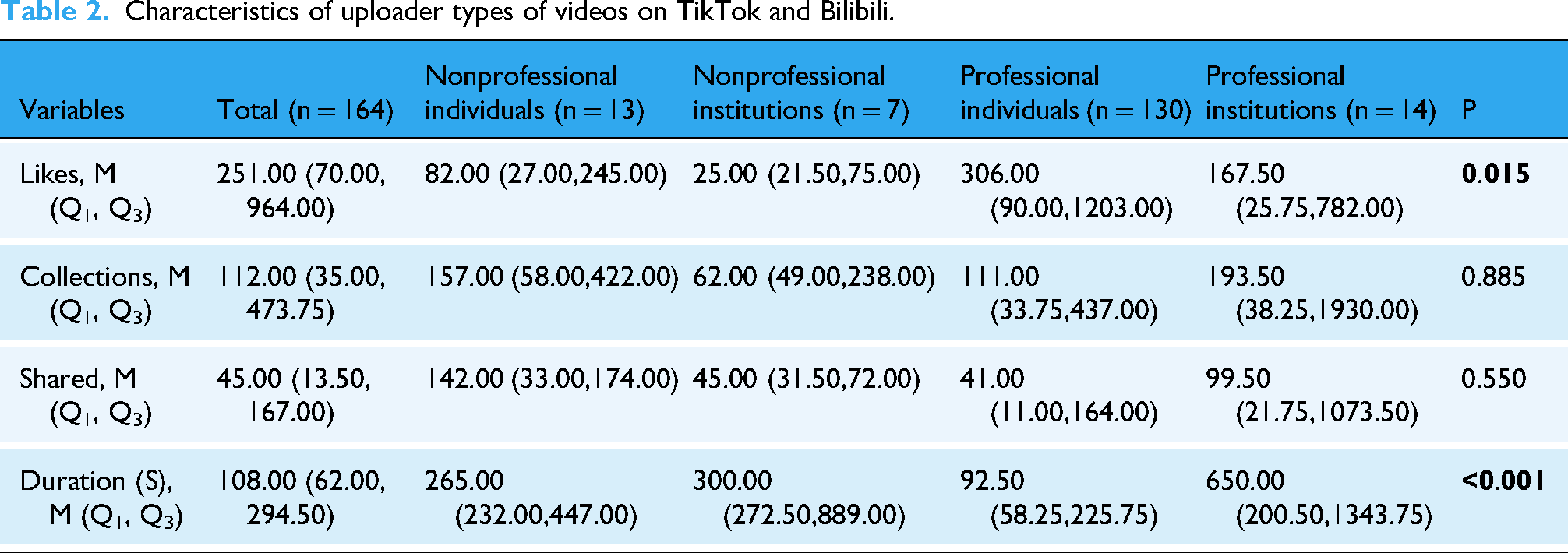
The median number of likes varied among different groups, with the overall median being 251.0; that of nonprofessional individuals was 82.0, nonprofessional institutions was 25.0, professional individuals was 306.0, and professional institutions was 167.5. No significant differences between groups were found for the number of collections or shares. The median duration of the videos showed significant differences (overall: 108 s; nonprofessional individuals: 265 s; nonprofessional institutions: 300 s; professional individuals: 2.5; professional institutions: 650 s) in Table 2. There were significant differences between groups, similar to the video characteristics, regarding the number of likes and the duration.
Characteristics of uploader types of videos on TikTok and Bilibili.
Video content analysis
In Figure 3, we analyzed the content of 164 videos. These videos were categorized as follows: advertisement/other (n = 6 [3.7%]), disease knowledge (n = 76 [46.3%]), prevention (n = 3 [1.8%]), rehabilitation training (n = 12 [7.3%]), traditional Chinese medicine (n = 18 [11.0%]), and treatment (n = 49 [29.9%]). Moreover, Figure 3 also indicated that on TikTok, disease knowledge and therapeutic content had relatively larger proportions compared to other categories. On Bilibili, disease knowledge also held a significant share, similar to TikTok. However, Bilibili featured a more prominent proportion of therapeutic content and a sizeable amount of Chinese medicine-related content. Additionally, rehabilitation training and preventive content were also present, indicating Bilibili's relatively diverse content. In Table 3, median (IQR) engagement metrics were as follows: likes, 251.0 (70.0–964.0); collections, 112.0 (35.0–473.8); shares, 45.0 (13.5–167.0); and duration, 108.0 s (62.0–294.5). No statistically significant between-group differences were observed for likes, collections, or shares. Video duration differed significantly across groups, with the longest duration in the rehabilitation training group (median 272.5 s) and the shortest in the prevention group (79.0 s).

Information about KOA-related video content from TikTok and Bilibili. (a) Circular Pie plot showing the percentage of uploaded content types across all platforms; (b) Fan plot showing the percentage of uploaded content types on TikTok. (C) Fan plot showing the percentage of content types uploaded by Bilibili. KOA: knee osteoarthritis.
Characteristics of content of videos on TikTok and Bilibili.

A comparative study of GQS and DISCERN score distribution of Bilibili and TikTok platforms
We have graded the GQS and DISCERN scores. Scoring levels were categorized as low, mid, and high. The low-score range was defined as 1 to 2, the mid-score was set at 3, and the high-score range was 4 to 5. For the reviewer A (GQS) score, the distribution differed significantly, with a higher proportion of Bilibili videos scoring 4 (38.0% vs. 11.8%) and a higher proportion of TikTok participants scoring 2 (16.1% vs. 4.2%) and 3 (68.8% vs. 53.5%). A similar pattern was observed for the reviewer B (GQS) score, with Bilibili videos more frequently scoring 4 (28.2% vs. 9.7%) and TikTok videos more frequently scoring 2 (21.5% vs. 7.0%). For the reviewer A (DISCERN score), the distribution differed significantly, with Bilibili videos more often scoring 4 (49.3% vs. 24.7%) and TikTok videos scoring 3 (57.0% vs. 39.4%). The reviewer B DISCERN score also showed significant differences, with Bilibili videos more likely to score 4 (45.1% vs. 26.9%) and TikTok videos more likely to score 3 (52.7% vs. 43.7%), as shown in Table 4. Moreover, in Figure 4, we use the box plot to see more clearly the concentration of the two reviewers’ ratings.

GQS and DISCERN score of KOA-related videos from TikTok and Bilibili. (a) Box plot showing the centralized trend of reviewer A's GQS score; (b) Box plot showing the centralized trend of reviewer A's DISCERN score. (c) Box plot showing the centralized trend of GQS score for reviewer B. (D) Box plot showing the centralized trend of DISCERN score for reviewer B. GQS: Global Quality Score; KOA: knee osteoarthritis.
Ratings of TikTok and Bilibili by different reviewers.

In addition, in Table 5, we also analyzed the differences in scores among different types of uploaders. Thirteen (7.9%) were nonprofessional individuals, 7 (4.3%) were nonprofessional institutions, 130 (79.3%) were professional individuals, and 14 (8.5%) were professional institutions. Significant differences were observed in reviewer A (GQS score) across groups (3.0 for nonprofessional individuals, 3.0 for nonprofessional institutions, 3.0 for professional individuals, and 4.0 for professional institutions). Similarly, the reviewer B (GQS score) differed (3.0, 3.0, 3.0, and 3.5, respectively). The reviewer A (DISCERN score) also varied (4.0, 4.0, 3.0, and 4.0), whereas the reviewer B (DISCERN score) did not reach statistical significance (3.0, 4.0, 3.0, and 4.0).
Ratings by different commenters for different types of uploaders on TikTok and Bilibili.

Spearman correlation analysis
Spearman correlation analysis was used to explore the correlation among different video variables, the GQS and DISCERN scores in KOA-related videos. There were strong positive correlations among likes, shares, and Collections. However, duration(s) had very weak correlations with other variables, with correlation coefficients mostly around 0.04 to 0.06. Notably, both the GQS score and DISCERN score by reviewer A and reviewer B had weak correlations with user-interaction variables such as likes, shares, and Collections. The correlation coefficients between the scores by reviewer A and reviewer B for the GQS and DISCERN scores were relatively high, indicating good consistency between the two reviewers. The specific correlation coefficients are shown in Figure 5.

Spearman correlation analysis among different video variables, GQS, and DISCERN score concerning KOA videos. GQS: Global Quality Score; KOA: knee osteoarthritis.
Discussion
In the current digital age, the rising prevalence of KOA 27 and the increasing reliance on social media for health information have emerged as one of the crucial channels for the public to access health information. 28 This study examined KOA-related short videos, assessing their information quality and identifying key issues with significant implications for patients, healthcare providers, and platform operators.
Short-video platforms as sources of KOA health information
In recent years, the number of users on short-video platforms has witnessed explosive growth. Platforms such as TikTok and Bilibili, which are integral parts of social media, have been playing an increasingly important role in disseminating health information.29,30 This aligns with the broader trend that social media plays an increasingly important role in healthcare, with approximately 80% of Internet users seeking health information online.31,32 For KOA, a prevalent condition that impairs quality of life, numerous related videos are widely disseminated on these platforms, providing patients and the public with a convenient way to obtain disease-related knowledge, thus meeting their needs for understanding the disease to a certain extent. 33 However, despite the significant role these platforms play, our analysis found that while professional individuals dominated video uploads (79.3%), the overall quality and reliability of KOA-related content were inconsistent. Bilibili exhibited a higher proportion of videos with a high GQS (4–5) compared to TikTok (38.0% vs. 11.8%). This may be because TikTok's predominantly younger user base (70% aged 16–35) may explain its focus on brief, engaging content, which often prioritizes accessibility over depth, consistent with our finding that 98% of its KOA videos are uploaded by professional individuals but only 11.8% achieve high GQS scores. In contrast, Bilibili videos are longer than TikTok videos, potentially covering a wider range of knowledge content in greater depth and breadth. Furthermore, most young people prefer to use Bilibili to learn knowledge, which may result in a higher proportion of high-quality videos (38.0% of videos have a GQS score of ≥4). This aligns with previous studies indicating that platform algorithms and user demographics influence content quality. 34 Nevertheless, the median DISCERN scores (3–4) indicate that many videos still lack robust scientific citations and balanced information, which is concerning given the potential for misinformation to influence patient decision making,15,35,36 the situation is exacerbated by the fact that on TikTok and Bilibili, there is no strict regulation for content uploads. This lack of regulation leads to significant variability in the quality and reliability of videos. For example, nonmedical expert-created videos could spread false information or simplify complex medical ideas oversimplify.17,37 Moreover, research on medical information on social media has shown that numerous health-related videos on platforms like TikTok and Bilibili might not draw on scientific evidence, and as a result, these videos tend to convey inaccurate information. 38 For example, Simon et al. evaluated the atopic eczema-related videos on short-video platforms, which showed that more than 1/3 of the content in videos contained potentially harmful information. 39 Furthermore, a study assessing the quality of psoriasis-related videos found that over half of them spread misleading information. 40 However, conversely, Our research found that the low quality of content shared by nonprofessionals, their videos garnered significantly more likes, saves, and comments compared to those from professionals and professional institutions, indicating higher user engagement. Furthermore, across both platforms, content focusing on popular, easily understandable knowledge—rather than specialized scientific information—was more readily accepted by users and received greater numbers of likes. Therefore, balancing user preferences and scientific knowledge is a difficult task.
To address this, the regulation should be customized to platform specifics. First, we recommend collaborating with orthopedic associations to create a “verified professional” badge, highlighting content from credentialed uploaders and prioritizing it in search results, using the platform's algorithmic focus on visibility. Second, platforms already have feature more educational content, which could establishing a dedicated “KOA health hub” with curated videos (endorsed by medical institutions) could boost high-quality material. Finally, professionals can collaborate with science communicators, where the former contribute rigorously validated scientific content and the latter deliver it in a simplified, accessible, vivid, and engaging manner. This synergy ensures the content retains scientific rigor while being both interesting and easy to comprehend, thereby enhancing public engagement.
Information quality of KOA short videos
First, in our study, we evaluated short videos related to KOA and found that most failed to meet high scientific standards—a finding consistent with previous research.41–43 This phenomenon is primarily attributed to the inherent characteristics of the short-video format: its brevity and singular presentation style restrict both the scope and depth of content that can be conveyed. Consequently, users of these platforms typically prioritize intuitive, easily digestible information over in-depth scientific understanding. For educational content specifically, the limited duration often makes it challenging to comprehensively expound on a disease. 24 However, this does not mean such videos are entirely irrelevant. Many low-scoring videos still provided practical, user-friendly guidance (e.g. basic diagnostic tips) that addressed patients’ immediate needs. The key issue lies not in the simplicity of the content itself, but in the coexistence of useful information with misleading claims—a combination that undermines overall trustworthiness.
Secondly, we hope that high-quality KOA short videos can accurately and comprehensively cover all aspects of the disease, such as etiology, symptoms, diagnostic methods, treatment options, rehabilitation training, and preventive measures. Such videos are usually produced by professional medical staff or institutions. With their profound professional knowledge and rich clinical experience, they can provide scientific and reliable information to the audience. However, our study reveals that in the DISCERN score, professionals received lower ratings 31 compared to nonprofessional institutions or individuals, except for professional institutions, whose ratings were equal to or higher. In the GQS score, professional institutions had overall higher ratings than nonprofessional ones. This difference can be attributed to several factors. Professional institutions possess richer professional resources, more professional talents, and extensive clinical experience. Their video content, often created by professional medical staff, is more scientific, accurate, and comprehensive. Additionally, they have a stricter internal review mechanism, with content undergoing multiple rounds of reviews from planning to release to ensure accuracy. Nonprofessional individuals or institutions might obtain higher ratings by relying on reliable professional information. As for professional individuals, their relatively low ratings could stem from varying professional levels. Although they have professional knowledge, they may lack completeness and standardization compared to professional institutions.
Therefore, professional specialists and institutions should be encouraged to produce higher-quality KOA science popularization videos. Such content can enhance the public's accurate understanding of KOA, leveraging social media's potential to promote public health, consistent with studies showing that specialized knowledge accumulation is critical for effective healthcare information videos.44,45 For platforms, while direct monetary incentives to filter quality content may be limited, they have compelling indirect reasons to prioritize reliable health information. First, our data confirms user demand for credible content: 79.3% of KOA videos are uploaded by professional individuals or institutions, reflecting audiences’ preference for authoritative sources. This aligns with the platform's core strategy of catering to user needs. Second, regulatory compliance provides a strong incentive: as global oversight of health misinformation intensifies, platforms risk penalties, or reputational harm if they host misleading claims. 46 In summary, this highlights the importance of proactive content filtering to prevent noncompliance.
Correlation between video quality and video characteristics
The study found that there was no significant correlation between the quality of KOA short videos and variables such as the number of likes, comments, and shares. This result is consistent with some previous studies on other disease-related videos.47,48 It is generally believed that videos with a large number of likes, comments, and shares may have higher quality and attractiveness, but this is not the case in the field of KOA short videos or others. Research has indicated that TikTok audiences struggle to differentiate between high- and low-quality videos. 49
Moreover, the results may be linked to TikTok users’ characteristics. As a lifestyle-entertainment app, TikTok's users favor entertaining videos. Highly credible videos, though, aren't popular. Professional content often lacks entertainment and can be dull, making it hard to draw audiences and gain popularity. 49 Moreover, Other research has revealed that viewers might be more inclined to look for video content that diverges from standard treatment plans. 50 Hence, experts should factor in people's requirements and inclinations while uploading videos. They are encouraged to adopt plainer language and integrate visual effects, animations, and other components. Moreover, platforms should set up a video filtering mechanism to give precedence to professional and top-notch videos in search outcomes, thereby ensuring the spread of precise knowledge.
Spearman correlation analysis revealed that Likes, Shares, and Collections exhibited very high correlations, indicating that videos with more likes also tend to be shared and saved frequently. This aligns with prior studies showing that user engagement metrics are interdependent on short-video platforms. 45 Video is a form of communication that presents complex information about osteoarthritis of the knee more visually and understandably than text. Patients, especially those with chronic conditions such as osteoarthritis of the knee, often rely on the Internet for information on disease self-management. 13
Advantages and significance of clinical daily practice
Firstly, it comprehensively and systematically collected KOA-related videos from two major short-video platforms, TikTok and Bilibili, avoiding the limitations of single-platform research and being able to more widely reflect the overall situation of KOA information on short-video platforms. Secondly, multiple authoritative scoring tools were used to evaluate video quality, making the research results more objective and accurate. In addition, multiple variables of the videos were analyzed to deeply explore the relationship between video quality and various variables.
The significance of this study is profound. For patients, the research results can help them identify high-quality and reliable KOA information from a large number of short videos, enabling them to better understand the disease and actively participate in self-management. Lately, the Chinese government has released directives concerning the release and spread of scientific health knowledge across diverse media platforms. Patients, especially those with chronic conditions such as osteoarthritis of the knee, often rely on the Internet for information on disease self-management.13,51 Consequently, visual - content - based social media is increasingly becoming a crucial information source for patients. Moreover, these platforms could potentially serve as channels for healthcare practitioners to engage with patients, given their widespread use for sharing KOA-related content. Our study found that 62.2% of KOA videos focus on disease knowledge or treatment, which aligns with the type of educational content practitioners might provide. However, although platforms like TikTok and Bilibili show potential for healthcare practitioner-patient engagement, current evidence of their effectiveness for health education remains limited. Most existing studies examine structured social media interventions52,53 rather than organic platform use. Some research, including observations from our data, suggests healthcare professionals are increasingly utilizing these platforms to engage with audiences. 54
Additionally, the findings have implications for clinical practice: although Bilibili hosts a higher proportion of high-quality KOA videos, both platforms show inconsistent quality, 55 prompting clinicians to address patients’ potential exposure to unreliable information. Since professionals upload 79.3% of videos, clinicians should actively ask patients about their reliance on these platforms, as misleading content—such as oversimplified treatments or unproven remedies—may influence self-management choices. 56 The disconnect between engagement metrics (likes, shares) and quality scores further highlights the need to guide patients toward credible sources and teach critical evaluation of short-video content during consultations. Moreover, the underrepresentation of prevention content (1.8% of total videos) points to a missed opportunity for clinical-community collaboration. Healthcare systems could partner with platforms to create targeted short videos on modifiable risk factors—like obesity and joint overuse—aligning with preventive care goals and reducing future clinical burdens. Such initiatives would not only enhance information quality but also empower patients to pursue early interventions, 57 ultimately easing the load on orthopedic clinics managing advanced KOA cases. In essence, these short videos increasingly shape patient expectations and behaviors; clinicians must recognize their influence, proactively address misinformation, and leverage high-quality content to improve patient education and adherence to evidence-based treatment.
Limitations
Our study has several limitations that warrant consideration. First, the cross-sectional design captures a snapshot of content at a single time point, and the rapid evolution of short-video platforms means that quality trends may shift over months. Future longitudinal studies could track changes in content quality, particularly after interventions like platform-specific guidelines for health videos. Second, our analysis focused solely on Chinese-language videos, limiting generalizability to other regions where cultural or linguistic differences (e.g., Western vs. Eastern approaches to KOA management) may influence content. Cross-cultural comparisons, perhaps between TikTok's global and Chinese versions, could reveal broader patterns in health information dissemination. Third, while we used validated tools (DISCERN, GQS) and achieved substantial inter-rater reliability (κ = 0.75–0.78), subjective judgment remained in scoring criteria like “fairness” or “robustness.” It is worth noting that these tools were primarily developed for evaluating traditional text-based or longer-form health information, and their full applicability to the unique format of short videos—such as the emphasis on visual brevity and rapid information delivery—may require further examination. This does not negate their utility in our analysis but suggests that updates tailored to short-video characteristics, or complementary tools designed specifically for this medium, could potentially enhance the nuance of quality assessment. Integrating patient perspectives—for example, surveying KOA patients on how video content influences their decision making—could add a critical dimension to quality assessment.
Conclusion
In this study, the information quality of 164 videos related to KOA from two short-video sharing platforms (TikTok and Bilibili) was evaluated. While short-video platforms offer a valuable avenue for KOA education, the current quality of content is inconsistent. Bilibili outperforms TikTok in reliability, but both platforms host substantial amounts of suboptimal material. Collaboration among platforms, healthcare providers, and users is essential to improve information quality and mitigate misinformation risks. Future research should explore longitudinal trends and cross-cultural comparisons to further refine health communication strategies.
Supplemental Material
sj-docx-1-dhj-10.1177_20552076251366390 - Supplemental material for Evaluating the reliability and quality of knee osteoarthritis educational content on TikTok and Bilibili: A cross-sectional content analysis
Supplemental material, sj-docx-1-dhj-10.1177_20552076251366390 for Evaluating the reliability and quality of knee osteoarthritis educational content on TikTok and Bilibili: A cross-sectional content analysis by Jiakuan Tu, Chaoxiang Zhang, Hao Zhang, Likan Liang and Jianhua He in DIGITAL HEALTH
Supplemental Material
sj-docx-2-dhj-10.1177_20552076251366390 - Supplemental material for Evaluating the reliability and quality of knee osteoarthritis educational content on TikTok and Bilibili: A cross-sectional content analysis
Supplemental material, sj-docx-2-dhj-10.1177_20552076251366390 for Evaluating the reliability and quality of knee osteoarthritis educational content on TikTok and Bilibili: A cross-sectional content analysis by Jiakuan Tu, Chaoxiang Zhang, Hao Zhang, Likan Liang and Jianhua He in DIGITAL HEALTH
Footnotes

Ethical approval
This study did not utilize clinical data, human specimens, or laboratory animals. All information was sourced from publicly available TikTok and Bilibili videos, and the data did not raise any personal privacy issues. Moreover, as the study did not entail any interaction with users, an ethics review was not required.
Contributorship
JT was involved in writing—conceptualization, data curation, methodology, and writing—original draft; CZ and HZ in writing—original draft; and LL and JH was writing—review & editing.
Funding
The authors received no financial support for the research, authorship, and/or publication of this article.
Declaration of conflicting interest
The authors declare that the research was conducted without commercial or financial relationships that could create a conflict of interest.
Data availability
Raw data were generated at The First Department of Orthopedics, Jiangxi Provincial Hospital of Integrated Traditional Chinese and Western Medicine. Derived data supporting the findings of this study are available from the corresponding authors on request.
Guarantor
JH and LL.
Publisher's note
All claims expressed in this article are solely those of the authors and do not necessarily represent those of their affiliated institutions, or those of the publisher, the editors and the reviewers. Any product that may be evaluated in this article, or claim that may be made by its manufacturer, is not guaranteed or endorsed by the publisher.
Supplemental material
Supplemental material for this article is available online.
References
Supplementary Material
Please find the following supplemental material available below.
For Open Access articles published under a Creative Commons License, all supplemental material carries the same license as the article it is associated with.
For non-Open Access articles published, all supplemental material carries a non-exclusive license, and permission requests for re-use of supplemental material or any part of supplemental material shall be sent directly to the copyright owner as specified in the copyright notice associated with the article.
