



Abstract
Background
Stroke is a leading cause of long-term disability, and wearable technologies have emerged as promising tools in motor rehabilitation. This study presents a bibliometric and visual analysis of global research on wearable devices for stroke motor recovery, aiming to map knowledge structures, identify research hotspots, and reveal emerging trends.
Methods
A total of 564 English-language publications from 2005 to June 2025 were retrieved from the Web of Science Core Collection, with trend and burst analyses conducted through 2024. Using CiteSpace, VOSviewer, RStudio, and OriginPro, we analyzed publication trends, country and institutional contributions, author collaboration, co-citation networks, keyword co-occurrence, clustering, and burst terms.
Results
Over the past two decades, the number of publications has increased steadily, with the United States and China being the most productive. Core themes include gait analysis, upper-limb recovery, and sensor-based monitoring, while recent bursts highlight the growing exploration of data-driven and AI-assisted approaches to personalized rehabilitation.
Conclusion
This study provides a comprehensive overview of research development in this domain and offers insight for future interdisciplinary and data-driven rehabilitation innovations.
Introduction
Stroke remains one of the leading causes of long-term disability and mortality worldwide, with an estimated 12.2 million new cases occurring annually based on 2023 global epidemiological data. 1 A significant proportion of stroke survivors experience persistent motor impairments, including hemiparesis, gait dysfunction, and balance deficits, which severely compromise their quality of life. 2 The accumulating evidence from research indicates that rehabilitation is the most effective means of reducing disability and a vital component of stroke management.3,4 Traditional rehabilitation approaches, however, are often limited by subjective clinical judgments, and inadequate real-time feedback. 5 To address these limitations, there is an urgent need for objective, quantifiable, and continuous monitoring tools in rehabilitation practice.
Wearable rehabilitation technologies commonly integrate inertial measurement units (IMUs), surface electromyography (sEMG) sensors, and pressure sensors to capture motion parameters and muscular activity, enabling real-time tracking of motor performance, gait parameters, and physical activity levels.6,7 Numerous studies have investigated the application of wearable sensors in monitoring gait kinematics, upper and lower limb function, balance control, and overall motor recovery.8–10 The rapid growth of wearable sensors technologies has expanded their applications in neurological rehabilitation. Research demonstrates that wearable sensors, when coupled with AI-driven models, can enhance early detection of prodromal stroke signatures, reflecting progress in data-driven monitoring.11,12 Moreover, research indicates soft robotic gloves integrated with EMG sensors can detect even minimal muscle activation in stroke patients with severe paresis. 13 Meanwhile, the integration of machine learning algorithms and mobile health platforms has further enhanced the functionality of wearable systems, supporting experimental efforts toward personalized monitoring and automated progress tracking. Current wearable systems primarily serve monitoring, assessment, and real-time feedback functions, while their therapeutic integration is still in early investigative stages. Nonetheless, these capabilities may help enhance patient engagement and adherence to rehabilitation programs. 14
Although the application of wearable sensors in stroke rehabilitation has gained traction, most studies focus on technical feasibility, device validation, or specific use cases in small clinical samples. 15 While these studies undoubtedly contribute valuable insights, laying the groundwork for understanding how wearables can quantify motor deficits, deliver real-time feedback, and enhance traditional rehabilitation. 16 However, they often fail to provide a systematic synthesis of the field's broader development, structural landscape, and evolutionary trajectory. This fragmentation hinders the ability to identify critical knowledge gaps and discern overarching patterns that could guide future innovation. Therefore, a bibliometric and visualization analysis is both timely and necessary to fill these critical gaps. This analysis systematically quantifies publication trends, maps collaborative networks, visualizes keyword co-occurrence, and traces the evolution of research hotspots, providing a structured overview of the literature. It also supports evidence-informed decision-making for researchers, clinicians, and technology developers alike.
This study aims to conduct a comprehensive bibliometric and visual analysis of the global research landscape on wearable technologies in stroke motor rehabilitation. Based on publications indexed in the Web of Science Core Collection (WoSCC) from 1 January 2005 to 30 June 2025, it uncovers the current state, key hotspots, and future trends in the field, offering insights for future research directions and interdisciplinary applications.
Methods
Data source and search strategy
The bibliometric data for this study were retrieved from the WoSCC, which is widely regarded as one of the most authoritative databases for scholarly literature. 17 Although complementary databases such as Scopus, PubMed, or IEEE Xplore could potentially broaden coverage, particularly for engineering and computer science literature, the present study restricted the dataset to English-language records indexed in WoSCC. This decision was made to ensure data quality, citation consistency, and cross-study comparability, as well as compatibility with widely used bibliometric tools such as CiteSpace and VOSviewer. English-language filtering was applied because English remains the dominant lingua franca of scientific communication, enabling standardized terminology and reliable bibliometric processing that supports reproducible global trend analysis. The search covered publications from 1 January 2005 to 30 June 2025. The following Boolean search query was used: TS = ((“stroke” OR “post-stroke” OR “poststroke” OR “ischemic stroke” OR “cerebral infarction” OR “cerebral hemorrhage”) AND (“wearable device*” OR “wearable technolog*” OR “smart wearable*” OR “sensor*” OR “accelerometer*” OR “gyroscope*” OR “inertial measurement unit*” OR “IMU” OR “smart textile*” OR “wearable system*”) AND (“rehabilitation” OR “recovery” OR “motor function” OR “physical function” OR “movement” OR “motor ability” OR “mobility” OR “walking” OR “gait” OR “upper limb” OR “lower limb” OR “balance” OR “physical therapy”)). A total of 8747 records were initially retrieved. Records were imported into EndNote X9 and de-duplicated using the software's default duplicate-detection algorithm. Subsequently, non-article types (e.g. book chapters, conference proceedings, early-access papers), retracted publications, and irrelevant studies were excluded through title and abstract screening. The screening process was performed independently by two reviewers to ensure reliability, with discrepancies resolved through discussion and adjudication by a third scholar if necessary. Ultimately, 564 publications were included, comprising 517 research articles and 47 review articles. All of these publications were peer-reviewed and formally indexed in WoSCC. The search strategy is depicted in Figure 1.

Flow chart of the bibliometric search and analysis process.
Data analysis and visualization
This study utilizes CiteSpace 6.4.R1, OriginPro 2025 V10.2, RStudio 2024.04.2, VOSviewer v1.6.20 to comprehensively analyze the bibliometric characteristics of research on wearable sensors in stroke motor rehabilitation. Prior to visualization, all retrieved records were carefully standardized to ensure data integrity and analytical consistency. Institutional names were harmonized by consolidating variants into a uniform short form, for example, “Chinese Academy of Sciences” was unified as “chinese acad sci.” Author names were standardized in the format “LastName Initials” (e.g. lang, ce; kwakkel, g). Keyword normalization followed a frequency- and consensus-based merging principle. To maintain semantic consistency, the most frequent or domain-recognized term within a concept cluster was selected as the root label. For instance, “wearable device(s),” “wearable technology,” and “smart wearable(s)” were consolidated under the unified term “wearable sensors” to ensure terminological consistency and to facilitate clearer network clustering in bibliometric visualization tools. Although these terms differ in technical meaning within engineering contexts, they describe functionally related components of sensor-enabled wearable systems in rehabilitation research. This consolidation helped minimize the dispersion of closely related terms in the keyword network. All normalization and synonym merges were implemented using custom thesaurus files in VOSviewer v1.6.20 and CiteSpace 6.4.R1 to minimize redundancy and enhance clarity of network visualization. To ensure that all visualizations are accessible to readers with color vision deficiencies, color-blind-friendly palettes (e.g. from ColorBrewer's qualitative schemes) were applied throughout.
First, the time trends of publication were analyzed based on the annual number of publications after applying the screening criteria. The visualization was conducted using OriginPro 2025 V10.2. A second-order polynomial (quadratic) fit was applied to the cumulative publication curve to capture the overall growth pattern and to explore the potential trajectory of research development in this field. 18
Second, after data extraction and screening, the countries contributing to the research publications were identified and their publication counts were aggregated. The results were visualized using RStudio 2024.04.2 to generate intuitive and visually appealing geographic maps. These maps illustrated the spatial distribution and relative contribution of each country to the field, enabling a clear understanding of the global research landscape.
Third, VOSviewer v1.6.20 was utilized to construct and visualize various bibliometric networks. Specifically, this software was employed to generate enhanced network maps depicting institutional co-occurrence, author co-authorship, journal co-citation, reference co-citation, author co-citation, and keyword co-occurrence. The parameters were set as follows: the minimum occurrence frequency of keywords was 5; association strength was used for normalization; the resolution of the clustering analysis was set to 1.0, and the minimum cluster size was 1. The visualization maps allowed for intuitive identification of core contributors, thematic clusters, and structural relationships within the literature. These visualizations provided insights into the academic landscape, highlighting significant journals, leading institutions, and key authors in the research field. 19
Fourth, to analyze keyword clustering and detect emerging trends, CiteSpace 6.4.R1 was used to process and visualize bibliometric data. The time slicing was set from January 2005 to June 2025 (1 year per slice), and node types included country, institution, author, keyword, reference, cited author, and cited journal. The g-index (k = 25) was applied as the node selection criterion, with Top 50 per slice used to identify the most representative nodes in each time interval. The “Pathfinder” pruning algorithm was applied to simplify the co-occurrence network and highlight the most significant links. Network density and modularity Q values were examined to ensure the robustness of the resulting clusters. Visual networks of keyword clustering and citation bursts were generated, providing a comprehensive understanding of the intellectual structure, research hotspots, and evolving trends in the field. 20 It is worth noting that CiteSpace was also used to generate tables of collaborations among countries, institution, and authors, as well as co-cited journals, references, and authors. In these analyses, the full counting method was applied. This approach reflects the participation of each contributing entity in collaborative publications and aligns with standard bibliometric practice, thereby facilitating cross-study comparison. However, this approach may overrepresent outputs from large research consortia, which should be considered when interpreting country- and institution-level rankings.
Results
Publication trends over time
Figure 2 illustrates the annual publication and cumulative trends related to wearable sensors in stroke rehabilitation from 2005 to 30 June 2025. Overall, the number of publications shows a notable upward trajectory, particularly accelerating after 2015. The annual output remained relatively low and stable before 2012, with fewer than 10 publications per year. However, a significant surge began in 2018, and the growth became more pronounced from 2020 onward. The year 2024 marked the highest annual output, reaching 85 publications, reflecting increasing scholarly attention in the intersection of wearable technology and post-stroke motor rehabilitation. Although the number of publications in 2025 appears lower than the previous year, this is likely due to the cut-off date of June 2025, and not indicative of an actual decline in research activity. The cumulative number of publications, represented by the blue line, exhibits a nearly exponential increase. The goodness of fit, as indicated by a coefficient of determination (R2) of 0.994, demonstrates a strong adequacy of the model. This trend suggests that wearable technology has become an increasingly vital component in stroke recovery research, particularly with applications in intelligent rehabilitation and remote monitoring systems.

Annual publication and cumulative growth trends of studies on wearable sensors in stroke rehabilitation (January 2005–June 2025). Data source: WoSCC. Search cut-off: 30 June 2025. Visualization: OriginPro 2025 (V10.2). The cumulative publication curve was fitted using a second-order polynomial (R2 = 0.994) to model long-term growth trends. The blue line represents cumulative publications, and orange bars denote annual outputs. Note: Colors were selected using a color-blind-friendly palette. WoSCC: Web of Science Core Collection.
Distribution of countries
Table 1 illustrates the betweenness centrality of national contributions in the field of wearable sensors for stroke motor rehabilitation. A total of 10 countries stood out as leading contributors in the international collaboration network. The United States ranked first in publication count (n = 132) and showed the highest betweenness centrality value (0.37), indicating its pivotal role as a global connector in the research collaboration network. In bibliometric networks, betweenness centrality reflects the extent to which a node serves as a bridge connecting otherwise unlinked countries or clusters, thus indicating its role in facilitating international knowledge flow. 21 China, although ranking second in publication volume (n = 123), exhibited a relatively low centrality score (0.07), suggesting a high research output but relatively limited international collaboration links. Italy (n = 48) and the Netherlands (n = 39) also contributed significantly to the literature. Notably, countries such as Canada (centrality = 0.22), England (0.19), and Australia (0.16) demonstrated certain influence in facilitating global research collaboration despite having lower publications. Figure 3 presents the global distribution of publications on wearable sensors in stroke motor rehabilitation, visualized using RStudio. In terms of global distribution, North America, East Asia, and Western Europe dominated the research landscape. The relatively limited output from regions such as Africa, Central Asia, and South America suggests potential opportunities for international collaboration and the expansion of wearable technology research.

Global distribution of publications on wearable sensors in stroke motor rehabilitation. Data source: WoSCC; search cut-off: 30 June 2025. Visualization conducted using RStudio 2024.04.2. Color intensity corresponds to the number of publications per country, with darker shades indicating higher research output. WoSCC: Web of Science Core Collection.
The top 10 productive countries regarding the research on wearable devices for stroke motor rehabilitation.

Data source: WoSCC; search cut-off: 30 June 2025. Country-level collaboration analysis was performed using CiteSpace 6.4.R1 (time slicing: 2005–2025, node type: country, g-index k = 25, Top N = 50 per slice, Pathfinder pruning). The number of publications represents national research output, while centrality indicates the extent of each country's collaboration influence within the global research network. WoSCC: Web of Science Core Collection.
Analysis of contributing institutions
The top 10 institutions contributing to research on wearable sensors in stroke motor rehabilitation are listed in Table 2. The Chinese Academy of Sciences stands out as the most prolific institution, contributing 23 publications, although its betweenness centrality score is 0, suggesting limited engagement in international institutional collaborations. In contrast, institutions such as the University of British Columbia and Shirley Ryan Ability Lab, despite having fewer publications (n = 9 each) exhibit higher centrality values (0.10 and 0.11, respectively), indicating a greater bridging role in global research networks. The University of Zurich and its affiliated Zurich Hospital also demonstrated substantial productivity (n = 14 and 11), with moderate centrality values. Harvard University (n = 10, centrality = 0.06) and Fudan University (n = 10, centrality = 0.04) exemplify strong academic outputs with modest inter-institutional connectivity. The network visualization (Figure 4) highlights a diverse and globally distributed collaboration pattern, with several tightly-knit institutional clusters. Notable contributors also included National Taiwan University, Northwestern University, and the Swiss Federal Institutes of Technology Domain, forming part of collaborative clusters with visible interlinkages. These institutional collaborations elucidate the emergence of geographically and thematically organized research alliances, particularly across North America, East Asia, and Western Europe.
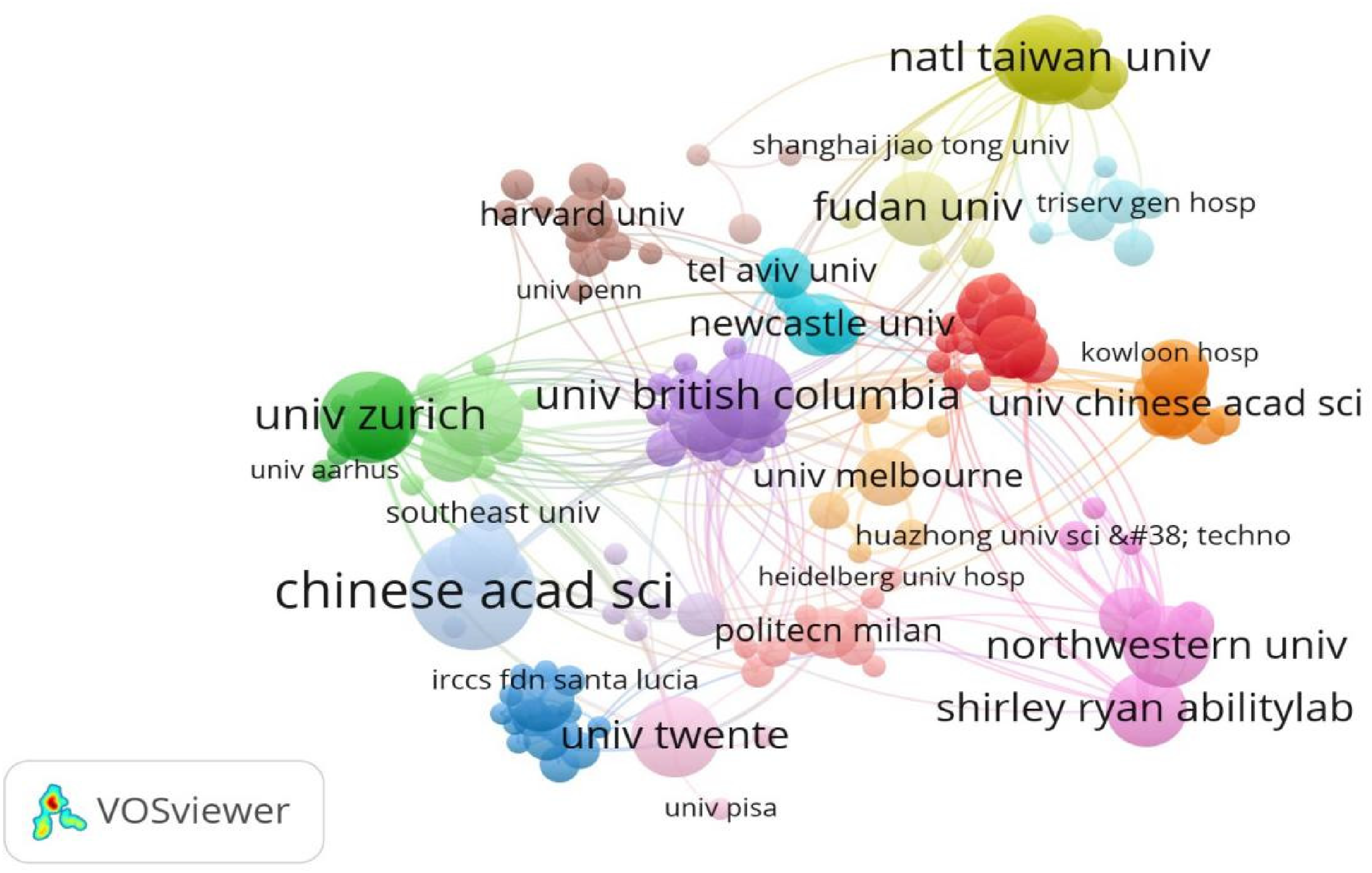
Institutional co-authorship network in the field of wearable sensors for stroke motor rehabilitation. Data source: WoSCC; search cut-off: 30 June 2025. Visualization was performed using VOSviewer v1.6.20 with association-strength normalization, minimum occurrence = 5, and resolution = 1.0. Each node represents an institution, node size corresponds to publication volume, node color denotes cluster membership based on co-authorship strength, and link thickness indicates the intensity of collaborative relationships. WoSCC: Web of Science Core Collection.
The top 10 productive institutions regarding the research on wearable devices for stroke motor rehabilitation.
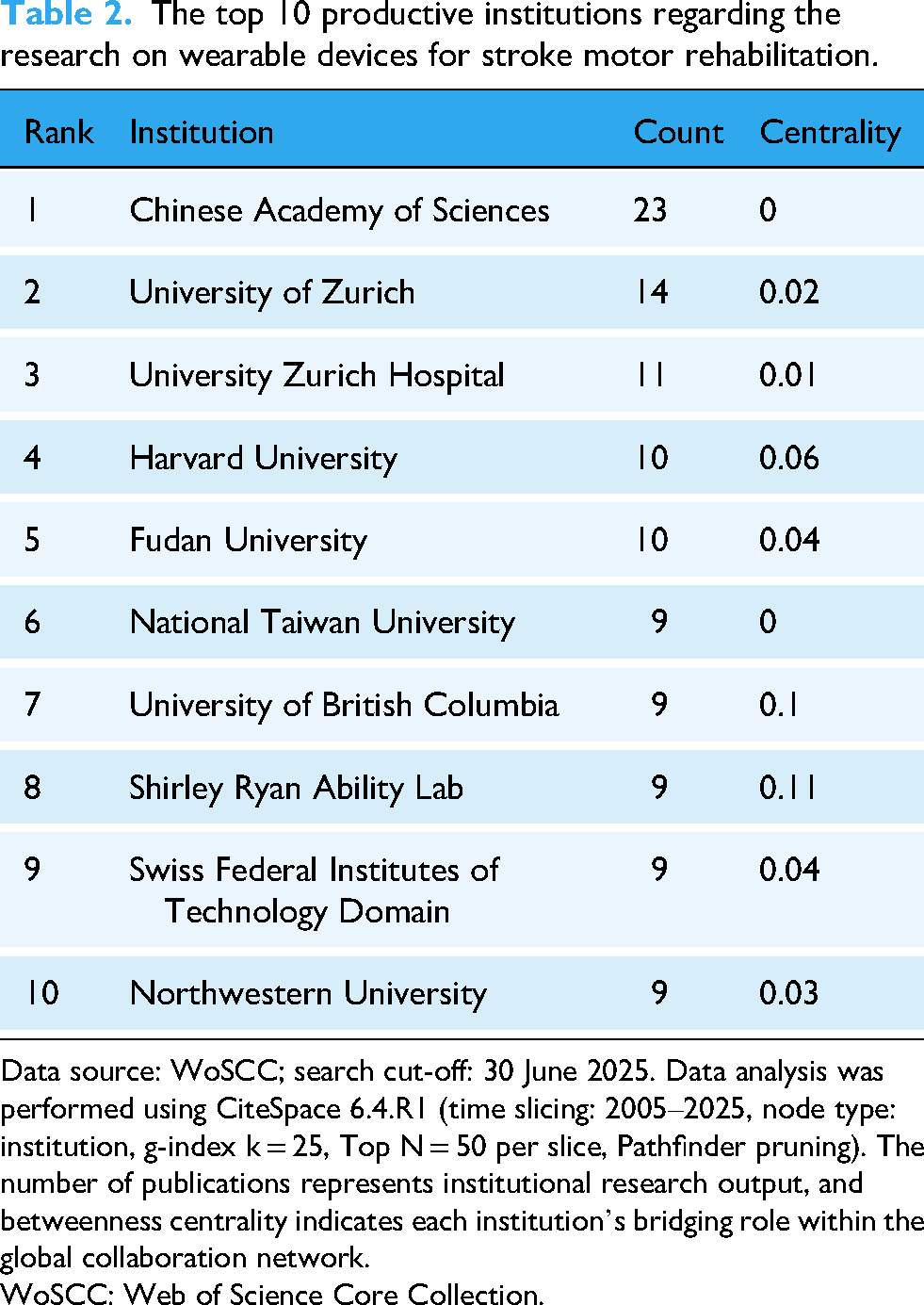
Data source: WoSCC; search cut-off: 30 June 2025. Data analysis was performed using CiteSpace 6.4.R1 (time slicing: 2005–2025, node type: institution, g-index k = 25, Top N = 50 per slice, Pathfinder pruning). The number of publications represents institutional research output, and betweenness centrality indicates each institution's bridging role within the global collaboration network.
WoSCC: Web of Science Core Collection.
Author co-occurrence analysis
Table 3 lists the top 10 most productive authors based on publication count, total citations (TC), average citations per publication (ACPP), and H-index. Janice J. Eng from Canada leads with 8 publications and an outstanding citation record (TC = 20,088, H-index = 76), underscoring her longstanding influence in the stroke rehabilitation field. Although much of her citation impact did not derive from wearable sensor research per se, her work on clinical assessment frameworks and functional recovery has been widely referenced by studies employing sensor-based approaches. Other influential figures include Wang Jiping, Guo Liquan, and Xiong Daxi from China as well as Giovanni Morone from Italy, each contributing significantly to wearable technologies in stroke motor rehabilitation. Notably, authors such as Masoud Abdollahi, Arun Jayaraman, and Louis N. Awad from the United States demonstrated not only steady productivity but also high average citation impact. This reflects the increasing integration of engineering, rehabilitation, and clinical expertise in North American research teams. Figure 5 displays the author co-occurrence network in the field of wearable sensors for stroke motor rehabilitation. Andreas R. Luft emerged as the most central figure in the network, with dense linkages to other authors such as Geert Verheyden, Roman R. Gonzenbach, and Fabien Masse, indicating his significant role in both publication output and international collaboration. Another prominent cluster was formed around Jeremia P.O. Held and Peter H. Veltink, both of whom play key roles in sensor-based rehabilitation research, especially in Europe.

Author co-authorship network in the field of wearable sensors for stroke motor rehabilitation. Data source: WoSCC; search cut-off: 30 June 2025. Visualization was performed using VOSviewer v1.6.20 with association-strength normalization, minimum occurrence = 5, and resolution = 1.0. Each node represents an author, node size corresponds to the number of publications, node color indicates cluster affiliation based on co-authorship relations, and link thickness reflects the strength of collaborative connections. WoSCC: Web of Science Core Collection.
The top 10 productive authors regarding the research on wearable devices for stroke motor rehabilitation.

Data source: WoSCC; search cut-off: 30 June 2025. Author-level bibliometric indicators were analyzed using CiteSpace 6.4.R1 (time slicing: 2005–2025, node type: author, g-index k = 25, Top N = 50 per slice, Pathfinder pruning). Publication count represents the number of papers authored; total citations (TC) reflect overall impact; average citations per publication (ACPP) indicate per-paper influence; and H-index denotes combined productivity and impact within the field. WoSCC: Web of Science Core Collection.
Journal co-citation and source analysis
Table 4 summarizes the 10 most highly co-cited sources together with their Journal Citation Reports quartile and latest impact factor. The multidisciplinary journal Stroke heads the list with 263 co-citations, underscoring its crucial role in shaping current evidence. Close behind are Archives of Physical Medicine and Rehabilitation (co-citations = 261) and Neurorehabilitation and Neural Repair (co-citations = 236). The presence of Sensors (Q2, IF = 3.4) illustrates the growing influence of engineering-oriented venues that publish sensor design and validation studies. Engineering journals such as IEEE Transactions on Neural Systems and Rehabilitation Engineering (co-citation = 144, IF = 4.8) bridge biomedical engineering advances with clinical application, reinforcing the transdisciplinary nature of contemporary research. Figure 6 depicts the journal co-citation network, which reveals two dominant clusters for research on wearable devices in stroke motor rehabilitation. One cluster gravitates around neurologic and rehabilitation journals such as Neurorehabilitation and Neural Repair, Physical Therapy, and Topics in Stroke Rehabilitation, emphasizing clinical outcome assessment. A second cluster links engineering and technology journals such as IEEE-ASME Transactions on Mechatronics and Sensors, highlighting contributions from wearable sensing, signal processing and human—machine interface. Dense links between these clusters suggest that clinical and engineering communities increasingly reference each other's work, facilitating integrated development of intelligent rehabilitation technologies.

Journal co-citation network in the field of wearable sensors for stroke motor rehabilitation. Data source: WoSCC; search cut-off: 30 June 2025. Visualization was performed using VOSviewer v1.6.20 with association-strength normalization, minimum occurrence = 5, and resolution = 1.0. Each node represents a journal; node size corresponds to the frequency of co-citations; node color denotes cluster membership based on co-citation patterns; and link thickness indicates the strength of co-citation connections. WoSCC: Web of Science Core Collection.
Top 10 co-cited journals in wearable device stroke rehabilitation research.
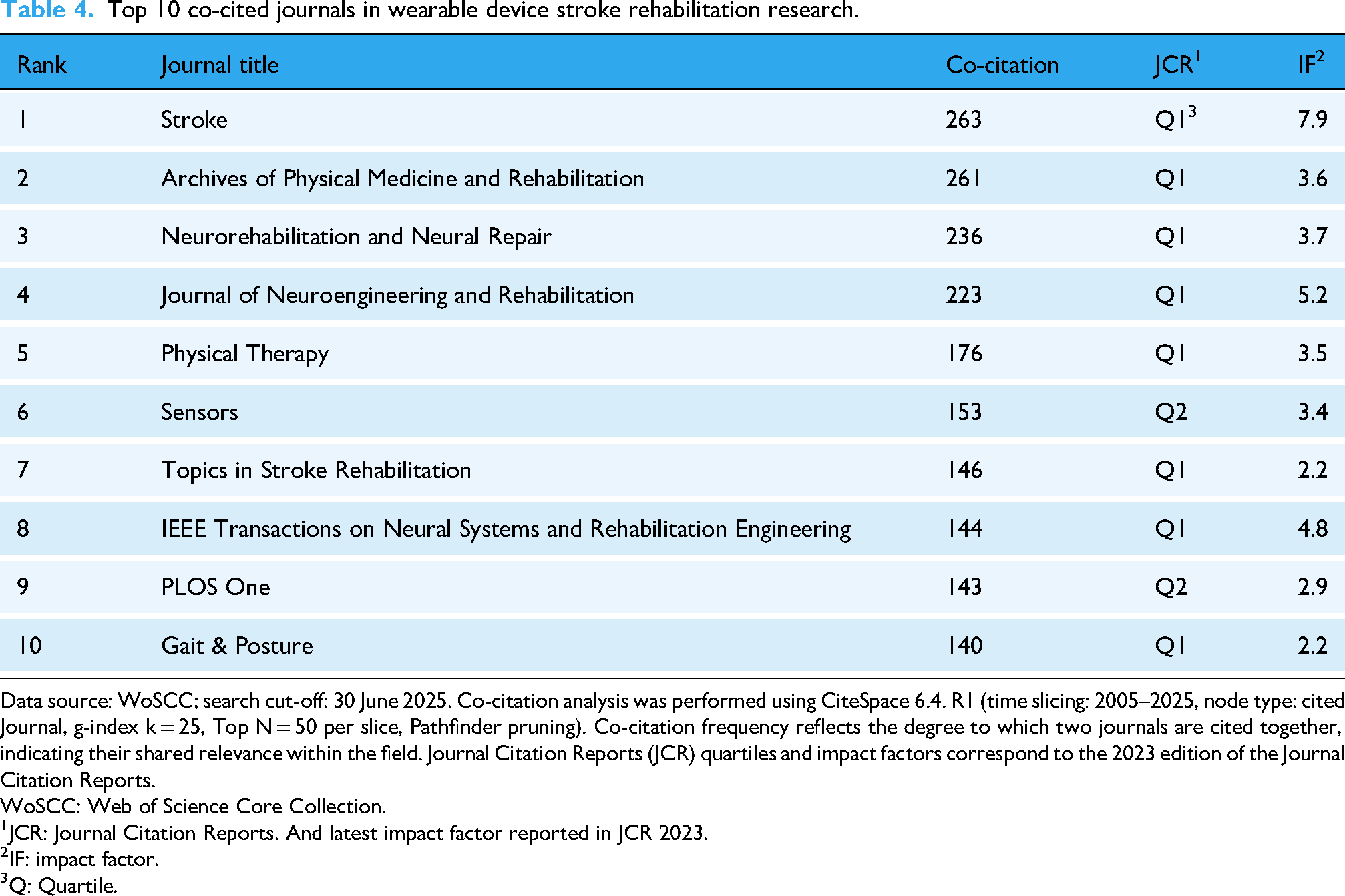
Data source: WoSCC; search cut-off: 30 June 2025. Co-citation analysis was performed using CiteSpace 6.4. R1 (time slicing: 2005–2025, node type: cited Journal, g-index k = 25, Top N = 50 per slice, Pathfinder pruning). Co-citation frequency reflects the degree to which two journals are cited together, indicating their shared relevance within the field. Journal Citation Reports (JCR) quartiles and impact factors correspond to the 2023 edition of the Journal Citation Reports. WoSCC: Web of Science Core Collection.
JCR: Journal Citation Reports. And latest impact factor reported in JCR 2023.
IF: impact factor.
Q: Quartile.
Co-cited references analysis
The co-citation reference analysis reflects the intellectual foundation and core knowledge structure of the research on wearable technologies in stroke rehabilitation. According to Table 5, the most frequently co-cited reference was authored by Maceira-Elvira P (2019), with a co-citation frequency of 11. This study focused on the application of wearable technology for upper-limb motor impairment assessment and has exerted a significant influence in the field. Other highly co-cited references include Mohan, Dhanya Menoth (2021), Adans-Dester, Catherine (2020), and Bailey, Ryan R. (2015), each cited at least 10 times. This indicates the rising interest in sensor-driven gait analysis, machine learning-assisted motor tracking, and real-world upper-limb activity measurement. As shown in Figure 7, the references illustrate the interdisciplinary nature of wearable technology research in stroke rehabilitation, integrating topics such as sensor-based monitoring and upper-limb functional recovery.

Reference co-citation network in the field of wearable sensors for stroke motor rehabilitation. Data source: WoSCC; search cut-off: 30 June 2025. Visualization was performed using VOSviewer v1.6.20 with association-strength normalization, minimum occurrence = 5, and resolution = 1.0. Each node represents a cited reference; node size reflects its co-citation frequency, node color denotes cluster membership, and link thickness indicates the strength of co-citation relationships. WoSCC: Web of Science Core Collection.
Top 10 co-cited references in the field of wearable devices for stroke motor rehabilitation.

Data source: WoSCC; search cut-off: 30 June 2025. Reference co-citation analysis was conducted using CiteSpace 6.4.R1 (time slicing: 2005–2025, node type: cited reference, g-index k = 25, Top N = 50 per slice, Pathfinder pruning). Co-citation frequency indicates how often two studies are cited together, reflecting their conceptual linkage and shared influence in the knowledge base of wearable technology-assisted stroke rehabilitation research. WoSCC: Web of Science Core Collection.
Co-cited authors
As shown in Table 6, the most frequently co-cited author was Kwakkel, Gert (Netherlands), with a total of 70 co-citations, followed by Gitendra Uswatte (USA, 58 co-citations), and Catherine E. Lang (USA, 46 co-citations). Notably, several high-impact authors such as Pamela W. Duncan, Bruce H. Dobkin, and Edward Taub also ranked among the top contributors. These authors are primarily from the United States and Europe, reflecting the dominance of Western institutions in this research area. Their work spans key topics such as upper-limb motor recovery, constraint-induced movement therapy, and outcome measures development. The network visualization (Figure 8) clearly illustrates the knowledge structure, where large nodes such as Kwakkel G, Uswatte G, and Lang CE represent central figures with substantial academic influence.

Author co-citation network in the field of wearable sensors for stroke motor rehabilitation. Data source: WoSCC; search cut-off: 30 June 2025. Visualization was performed using VOSviewer v1.6.20 with association-strength normalization, minimum occurrence = 5, and resolution = 1.0. Each node represents a cited author; node size reflects the frequency of co-citation, node color indicates cluster membership, and link thickness corresponds to the strength of co-citation relationships. WoSCC: Web of Science Core Collection.
Top 10 co-cited authors in the field of wearable devices for stroke motor rehabilitation.

Data source: WoSCC; search cut-off: 30 June 2025. Author co-citation analysis and bibliometric evaluation were conducted using CiteSpace 6.4. R1 (time slicing: 2005–2025, node type: cited author, g-index k = 25, Top N = 50 per slice, Pathfinder pruning). Co-citation frequency indicates how often an author's works are cited together with others, reflecting their intellectual influence and network centrality. Total citations (TC) denote cumulative citation impact, average citations per publication (ACPP) represent per-article influence, and H-index combines productivity with citation performance to indicate overall research influence within the field. WoSCC: Web of Science Core Collection.
Keyword co-occurrence and clustering analysis
To further explore the research focus and thematic structure of wearable sensor studies in stroke rehabilitation, VOSviewer was employed to construct a keyword co-occurrence network (Figure 9). Each node represents a frequently occurring keyword, with node size indicating occurrence frequency and line thickness denoting the strength of co-occurrence between terms. The color gradient corresponds to the average publication year (2019–2021), ranging from purple to yellow. It provides a temporal perspective on the evolution of research topics. Frequently occurring keywords include “stroke,” “rehabilitation,” “recovery,” “gait,” “accelerometry,” “wearable sensors,” and “upper extremity,” highlighting attention toward wearable sensors, accelerometers, machine learning, and motor recovery in recent years.

Keyword co-occurrence network of studies on wearable sensors in stroke motor rehabilitation. Data source: WoSCC; search cut-off: 30 June 2025. Visualization was performed using VOSviewer v1.6.20 with association-strength normalization, minimum occurrence = 5, and resolution = 1.0. Each node represents a frequently occurring keyword, node size indicates occurrence frequency, and line thickness denotes the strength of co-occurrence between terms. Node color corresponds to the average publication year (2019–2021), with a gradient from purple (earlier) to yellow (recent), providing a temporal view of topic evolution. WoSCC: Web of Science Core Collection.
Keyword co-occurrence networks were clustered using the log-likelihood ratio (LLR) algorithm in CiteSpace. According to the clustering map, nine major clusters were identified, including #0 gait, #1 inertial measurement unit, #2 physical activity, #3 motor assessment, #4 activities of daily living, #5 stroke rehabilitation, #6 upper extremity, #7 machine learning, and #8 wearable sensors. The modularity (Q) > 0.3 indicates a reasonable clustering structure, and silhouette value (S) > 0.5 suggests good internal consistency within the cluster. 22 In this research, Q = 0.3805 and S = 0.6946 indicate moderate clustering reliability and acceptable internal consistency (Figure 10). A sensitivity analysis was conducted by varying the g-index parameter (k = 15–30), with Top 50 per slice as the upper bound. The results confirmed the stability of major clusters and overall network topology. The modularity Q values ranged from 0.3756 to 0.4151, underscoring the robustness and reliability of the bibliometric mapping. In addition, comparison of the LLR-based labeling with Latent Semantic Indexing label extractions showed high thematic consistency, further reinforcing the reliability of the identified clusters. Overall, these clusters reflect research emphasis on sensor technologies, movement analysis, and AI-assisted rehabilitation evaluation.

Keyword clustering map of studies on wearable sensors in stroke motor rehabilitation. Data source: WoSCC; search cut-off: 30 June 2025. Visualization was performed using CiteSpace 6.4.R1 (1-year per slice; time span: January 2005–June 2025). Node types included keywords, and the g-index (k = 25) was applied as the node selection criterion, with the Top 50 per slice used to identify the most representative items. The “Pathfinder” pruning algorithm was adopted to simplify the co-occurrence network and highlight significant connections. Each node represents a keyword; node size indicates occurrence frequency; link thickness denotes co-occurrence strength; and node color represents cluster membership. WoSCC: Web of Science Core Collection.
Keyword burst analysis
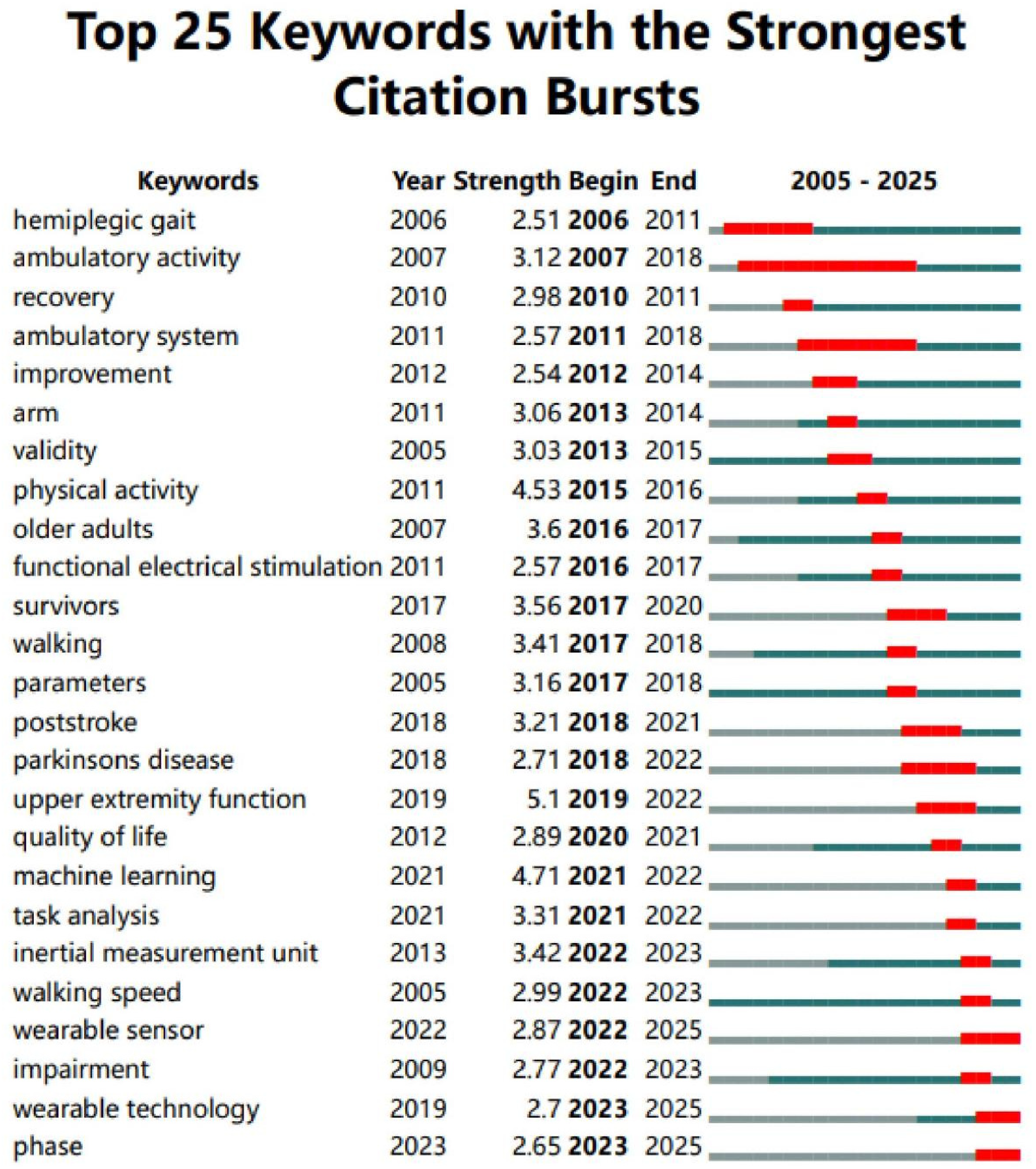
To mitigate potential bias from the incomplete indexing of 2025 publications, records from that year were excluded from the primary burst analysis. The robustness of the identified trends was subsequently assessed through a sensitivity analysis comparing results obtained with and without the inclusion of 2025 data. This comparison revealed a largely consistent burst structure and thematic trajectory between the two datasets. These findings confirm that the temporal trends identified in the primary analysis (2005–2024) are robust and minimally affected by the inclusion of incomplete 2025 data. The comparative results are presented in Figures 11 and 12.
Keyword burst detection of studies on wearable sensors in stroke motor rehabilitation. Data source: WoSCC; data analyzed: January 2005–June 2025 (retrieval cut-off: 30 June 2025). Visualization was conducted using CiteSpace 6.4. R1 with burst detection settings of Top N = 50 per slice. Each horizontal line represents the active period of a keyword, with red segments indicating periods of strongest citation burst and blue segments representing lower intensity. WoSCC: Web of Science Core Collection.

Keyword burst detection of studies on wearable sensors in stroke motor rehabilitation. Data source: WoSCC; data analyzed: January 2005–December 2024 (retrieval cut-off: 30 June 2025). Visualization was conducted using CiteSpace 6.4. R1 with burst detection settings of Top N = 50 per slice. Each horizontal line represents the active period of a keyword, with red segments indicating periods of strongest citation burst and blue segments representing lower intensity. WoSCC: Web of Science Core Collection.
Based on the validated dataset, keywords bursts analysis was conducted to identify keywords that have received significant attention during specific time periods. As shown in Figure 12, a total of 25 keywords exhibited strong citation bursts from 2005 to December 2024. The red bars indicate the years with the highest burst strength, while the blue bars indicate lower burst strength. The most recent bursts began around 2021 and include terms such as “machine learning,” “task analysis,” “inertial measurement unit,” “walking speed,” and “wearable sensor.” These emerging keywords indicate a growing research focus on the application of sensor-based technologies, quantitative movement analysis, and artificial intelligence in stroke rehabilitation research. However, most related studies remain at exploratory stages, and their clinical integration is still limited. Meanwhile, earlier bursts such as “hemiplegic gait” and “ambulatory activity” reflect the foundational concerns related to motor function and mobility assessment.
Discussion
Analysis of current research status
This study is the first to conduct a comprehensive bibliometric and visual analysis of wearable sensors in the field of post-stroke motor rehabilitation from 2005 to 30 June 2025, revealing key trends and developments. Over the past two decades, the number of publications on the field has generally exhibited an upward trajectory. In the 2005–2015 period, the field experienced slow growth. Despite advances in wearable technologies, traditional methods still dominate in stroke rehabilitation, likely due to their limited technological maturity and low clinical adoption. 15 Beginning in 2016, annual publications started to increase steadily, indicating growing academic interest and technological advancement. A notable surge occurred between 2020 and 2022, possibly reflecting rapid innovation in sensor technology, the expansion of digital health platforms, and a heightened need for remote rehabilitation tools during the COVID-19 pandemic. 23 Although there was a slight drop in the number of publications in 2025, this is attributable to the cut-off point for data collection being June 2025, rather than reflecting a genuine decline in research activity. This trend suggests a strong and increasing research momentum in the domain, with the potential for further expansion as wearable technologies become more integrated into clinical rehabilitation settings.
The analysis of country contributions and geographical distribution revealed that the United States holds a dominant position in the field of wearable sensors applied to stroke motor rehabilitation. It not only ranked highest in terms of publication volume but also demonstrated high centrality in collaborative networks, indicating its role as a global hub of research and innovation. This global leadership reflects the United States’ substantial investment in neuroscience and neurotechnology, fostering an environment that supports innovation and widespread dissemination of research findings. China followed closely in total output, reflecting its rapidly growing interest in integrating digital technologies into rehabilitation practices. Other major contributors included the United Kingdom, Germany, and Italy, each of which demonstrated both considerable publication counts and participation in international collaborations. As the field of wearable sensors in stroke motor rehabilitation continues to evolve, establishing cross-regional research networks and sharing data and technical standards, especially between countries with differing research capacities, will be essential for accelerating advancements.
At the institutional level, the collaboration network revealed a relatively scattered structure, with only a few institutions exhibiting high centrality. Among the top contributors were the Chinese Academy of Sciences, whose research in this field has focused on human–computer interaction systems and sensor-based rehabilitation technologies. The institution has conducted a series of clinical validation studies exploring upper and lower limb motor recovery in stroke patients. These findings represent an important reference for promoting home- and community-based rehabilitation.24–26 Shirley Ryan Ability Lab has a high centrality despite publishing fewer papers. This indicates that the institution occupies a key hub position in the field's academic network. Its research results and collaborative relationships also have a strong bridging effect. Through interdisciplinary collaboration and demand-driven innovation, the institution has established a comprehensive framework linking technology development, clinical evaluation, and standardization of wearable neurorehabilitation devices.27,28 Its research contributes to the advancement of rehabilitation technology and offers methodological references for the international adoption of wearable medical devices. However, the overall institutional connectivity appeared fragmented, particularly across regions. This indicates an opportunity for enhancing global collaboration and interdisciplinary integration in this domain.
According to the publication data, Eng, Janice J from Canada stands out as the most prolific author, contributing eight publications, with an H-index of 76. The wearable hand sensor system developed by her team utilizes multimodal data fusion of IMUs, sEMG, and pressure sensors to capture real-time finger joint angles, muscle activation status, and grip strength in stroke patients.29–31 Notably, Wang Jiping, Guo Liquan, and Xiong Daxi, all based in China, each contributed six publications, though with comparatively lower H-indices, indicating developing academic influence. Authors such as Morone, Giovanni (Italy) and Jayaraman, Arun (USA) also ranked among the top 10. The co-authorship network demonstrates a relatively fragmented collaboration structure, with limited cross-national or cross-institutional author clusters. This may indicate that while many researchers are active, collaborative integration remains insufficient, especially between leading countries such as China and the USA. Strengthening interregional partnerships could foster a more cohesive research ecosystem and accelerate innovation in wearable rehabilitation technologies. The co-citation analysis highlights foundational scholars whose work has significantly shaped the field. Kwakkel, Gert (Netherlands) ranks first with 70 co-citations, followed by Uswatte Gitendra, Lang Catherine E., and Duncan Pamela W, all from the United States. These authors possess high ACPP and H-index values, underlining their profound academic impact. This group of highly co-cited authors primarily focuses on neurorehabilitation frameworks, functional recovery assessment, and evidence-based intervention strategies, which form the backbone of wearable technology development for stroke survivors.32–34 Their works are frequently referenced, serving as critical theoretical and methodological support for subsequent studies. The divergence between prolific authors and highly co-cited scholars suggests a temporal or thematic lag: newer researchers have not yet established broad citation impact, while foundational contributors maintain long-term influence. Future studies might benefit from bridging this gap by promoting mentorship, and collaborative writing.
Co-citation analysis of journals reveals the foundational sources and preferred publication venues in the field of wearable technologies for stroke motor rehabilitation. As shown in the ranking table, the most frequently co-cited journal was Stroke (n = 263), with a high-impact factor (IF = 8.8), indicating its authoritative status in neurology and stroke research. Following closely were Archives of Physical Medicine and Rehabilitation (n = 261, IF = 3.7) and Neurorehabilitation and Neural Repair (n = 236, IF = 4.9), which are both Q1 journals focusing on neurorehabilitation practices and technologies. Other core journals include Journal of NeuroEngineering and Rehabilitation (n = 223), Physical Therapy (n = 176), and Sensors (n = 153). These journals cover a broad spectrum, ranging from clinical rehabilitation to biomedical engineering and sensor technologies. This reflects the multidisciplinary nature of wearable sensors. Such multidisciplinary characteristics require the integration of three key aspects: engineering technology for developing intelligent systems, neuroscientific theory to understand post-stroke motor rehabilitation, and clinical medical foundations to ensure intervention safety and efficacy.
Co-citation analysis of references identifies core literature that has played a pivotal role in shaping the knowledge structure of wearable sensors in post-stroke motor rehabilitation. 35 The most frequently co-cited article was authored by Maceira-Elvira et al. (2019), titled “Wearable technology in stroke rehabilitation: towards improved diagnosis and treatment of upper-limb motor impairment,” which received 11 co-citations. This article provides a systematic review of the application of wearable technology in the rehabilitation of post-stroke upper-limb movement disorders. It also highlights the potential of wearable technology to serve as a valuable adjunct to conventional rehabilitation approaches. This potential is realized through data-driven, personalized interventions and remote management. 36 Other pivotal works included Mohan et al. (2021) on gait assessment using technology-driven approaches, Adans-Dester et al. (2020) on precision rehabilitation using wearable sensors and machine learning, and Bailey et al. (2015) who focused on real-world upper-limb usage in stroke survivors.37–39 These studies highlight the transition from traditional clinical assessments to data-driven, continuous, and real-life performance monitoring facilitated by wearable technology. The presence of Rand et al. (2012) also underscores the longstanding interest in the gap between functional recovery and real-life use of limbs in stroke patients, a challenge that wearable tools seek to bridge. 40 Overall, these co-cited references collectively underscore a paradigm shift in post-stroke rehabilitation research: moving toward integrating objective, sensor-based metrics to enhance therapeutic precision, monitor recovery trajectories, and ultimately, improve patient outcomes in real-world settings.
Analysis of research hotspots and trends
This study provides a comprehensive analysis of the keyword trends of wearable sensors in stroke motor rehabilitation, revealing critical insights into the evolving landscape of this field. Through the analysis of keyword co-occurrence, clustering, and burst patterns, we have identified key research hotspots, emerging trends, and shifts in the focus of wearable sensors applications for stroke motor management and rehabilitation. These findings not only highlight the current state of research but also offer directions for future investigation. 41
Keyword co-occurrence analysis serves as a foundational method for identifying the intellectual structure and thematic foci within a research field. Among all nodes, “stroke,” “rehabilitation,” “recovery,” “movement,” “gait” and “upper limb” emerged as the most prominent keywords, forming the conceptual core of the network. These keywords collectively reflect the clinical context and functional targets of wearable device applications. This core keyword network aligns with existing research: Andrés et al. notes that “rehabilitation robots,” “upper limb,” “stroke,” and “wearable robots” are high-frequency keywords. 42 Li-Fong LIN et al. demonstrated that IMU-based wearable sensors significantly improve upper-limb activity. This confirms that upper-limb function recovery and gait improvement are key rehabilitation goals, with wearable sensors playing a critical role in achieving them. 43 This further indicates that recovery of upper-limb function and gait are important goals of rehabilitation therapy, and wearable sensors. Notably, “accelerometry,” “wearable sensors,” “validity,” and “performance” are frequently clustered around core nodes, indicating a growing interest in quantitative assessment tools and sensor-based performance metrics. Such sensors, especially accelerometer-based IMUs, gyroscopes, and sEMG sensors, are now widely used to monitor motor performance and daily activities. For example, one study developed a low-cost wearable device to collect acceleration data from stroke patients, which was used to evaluate functional movements and identify compensation strategies. Another study highlighted the ability of these sensors to provide real-time feedback, thereby enhancing home-based rehabilitation outcomes.44–46 This trend reflects the increasing adoption of objective, real-time data collection tools in post-stroke rehabilitation, supporting exploratory efforts toward more objective and data-informed rehabilitation assessments. The color overlay of keywords reveals their chronological progression. Early-stage studies (purple nodes) focused on gait, movement, and functional assessment, relying heavily on traditional rehabilitation methods—effective to some extent but limited by long assessment times, subjectivity, and poor remote monitoring capabilities.47,48 In contrast, recent research (yellow nodes) emphasizes wearable sensor technology, machine learning, and automated mobility tracking, exploring how these tools improve the objectivity and continuity of rehabilitation assessment. 49 This shift highlights a paradigm transition toward intelligent and automated rehabilitation approaches, where traditional subjective scales are increasingly complemented or replaced by continuous, sensor-derived data streams.
To further explore the structural composition and evolving subthemes of research on wearable technologies in stroke rehabilitation, a keyword clustering analysis was conducted. A total of nine clusters were identified, which can be broadly categorized into three dimensions:
(1). Technology-driven support systems, encompassing #1 IMUs, #7 machine learning, and #8 wearable sensors. Wearable sensors, such as IMUs, are widely used in stroke motor rehabilitation to collect real-time motion data via embedded signal processing and wireless communication modules.
50
These data enable quantitative assessment of movement patterns and support remote monitoring capabilities.
51
Furthermore, studies often integrate wearable sensors with machine learning algorithms to analyze complex datasets, identify hidden movement patterns, and personalize rehabilitation strategies.
14
(2). Functional assessment, involving #2 physical activity, #3 motor assessment, and activities of daily living. Researchers have focused on capturing not only structured rehabilitation activities but also spontaneous physical activity and real-world performance in daily life scenarios.52,53 This shift highlights a more holistic understanding of recovery trajectories, aligning with the emerging paradigm of community-based and patient-centered rehabilitation, and reflects a growing emphasis on ecological validity and longitudinal tracking of recovery outside the clinical setting.
54
(3). Clinical application focus, particularly highlighting #0 gait, #5 stroke rehabilitation, and #6 upper extremity. This classification not only clarifies the technical foundations and functional objectives of wearable technology-based stroke rehabilitation but also mirrors the emerging interdisciplinary paradigm that integrates engineering technologies with clinical rehabilitation science. Specifically, gait adjustment and upper-limb motor recovery in stroke patients have increasingly become core focal points of technology-assisted rehabilitation interventions.55–57 These underscore a growing clinical interest in leveraging wearable technologies to address mobility impairments and enhance post-stroke functional independence, ultimately promoting more personalized and effective rehabilitation strategies across real-world settings.
Technology-driven provides tools for functional evaluation, and the resulting evaluation outcomes serve as a foundation for clinical applications. This interconnected system—linking sensor design, functional evaluation, and therapeutic application—reflects a dynamically evolving research ecosystem at the intersection of engineering innovation and clinical rehabilitation. These clusters collectively reflect a research field that is dynamically integrating technological innovation with clinical practice.
Burst keywords have enabled researchers to quickly identify emerging areas of research within a specific field and guide the development of intelligent sensing systems and data-driven rehabilitation solutions. 58 A burst keyword analysis based on data from 2005 to December 2024 indicates a sharp increase in attention to specific keywords over time. This analysis revealed 25 burst keywords, with upper extremity function and machine learning displaying the strongest bursts, signifying rapid expansion and academic interest in these directions in recent years. According to Figure 12, topics evolved in three distinct phases:
Early bursts (2005–2015): foundation building. Keywords such as validity, hemiplegic gait, and ambulatory activity dominated the early phase, reflecting foundational research on measurement reliability and basic locomotor function.59–61 These laid the groundwork for the subsequent technological integration.
Transitional bursts (2016–2020): expansion of context. Keywords like survivors, functional electrical stimulation and older adults started gaining attention.62,63 This period witnessed a shift from purely biomechanical measurements toward broader population inclusion and more complex functional domains.
Recent and ongoing bursts (2021–2024): innovation-driven frontiers. Upper extremity function, the strongest burst, highlights the growing focus on fine motor recovery and the restoration of daily activities. 50 Simpson Additionally, IMU and walking speed emphasize the push toward quantitative, objective motion metrics in free-living settings, especially with low-cost sensors and tele-rehabilitation solutions. 64
The burst analysis unveils a continuing evolution in the field, evolving from traditional evaluation approaches toward data-driven, context-aware, and personalized rehabilitation approaches. This trajectory indicates future research may advance along three interrelated directions: (1) Sensor intelligence integrated with human context, involving context-aware data collection and user-specific calibration; (2) Functional task embedding with real-time feedback, enabling personalized and task-specific rehabilitation strategies in naturalistic settings; And (3) closed-loop systems for sensing-analysis-adaptation, where sensor platforms dynamically adjust interventions based on continuous data streams and predictive models. Collectively, these directions illustrate how the field is transitioning from data collection to intelligent interpretation and adaptive intervention, marking a meaningful move toward more context-aware rehabilitation systems.
Limitation
Several limitations should be acknowledged. First, this study exclusively retrieved records from WoSCC. Although WoSCC is widely recognized for its data quality and citation integrity, it does not cover certain publications indexed in databases such as PubMed, Scopus, or IEEE Xplore. This may have led to an under-representation of engineering and computer science literature. Consequently, as noted in the Methods section, our findings may not fully reflect the depth of technological innovation in sensor hardware or algorithm development, thereby potentially skewing the perceived research landscape toward clinical applications. Future bibliometric studies in this highly interdisciplinary field may benefit from a multi-database strategy to achieve more comprehensive coverage. Second, limiting the search to English-language publications may introduce geographic bias and overlook valuable research published in other languages, particularly from East Asian countries such as China, Japan, and South Korea. As a result, relevant evidence from these regions may be under-represented, and the overall research landscape may appear more Western-centric than it actually is. This under-representation may also obscure region-specific innovations in wearable technologies, rehabilitation models, and clinical implementation strategies. Future studies could incorporate multilingual or region-specific databases to achieve more comprehensive coverage. Third, methodological and tool-related factors may contribute to potential biases in the collaboration and network analyses. The use of the full counting method in our collaboration analyses may inflate the quantitative contributions of institutions or countries involved in numerous multi-author publications. This may, in turn, distort network centrality metrics by overemphasizing highly collaborative entities, potentially leading to an overestimation of their relative influence within the collaboration structure. In addition, the analysis relied on tools such as CiteSpace 6.4.R1 and VOSviewer 1.6.20, each with distinct clustering algorithms and visualization thresholds. Minor discrepancies in output such as differences in author or journal rankings may arise due to parameter sensitivity and normalization techniques. Finally, it should be noted that certain recent trends may not be fully reflected in the current dataset, primarily due to delays in database indexing.
Conclusion
This bibliometric analysis provides a visualized overview of the research landscape of wearable sensors in stroke motor rehabilitation over the past two decades. The findings indicate a steady increase in research output, with the United States and China emerging as the major contributors. The Chinese Academy of Sciences published the largest number of papers, reflecting its leading research productivity. The most prolific authors included Eng, Janice J.; Wang, Jiping; and Guo, Liquan. The journals Stroke, Archives of Physical Medicine and Rehabilitation and Neurorehabilitation and Neural Repair emerged as the most influential publications in this domain. Keyword analysis revealed a shift from traditional gait assessment toward the incorporation of wearable sensor technology, data-driven approaches, and real-time monitoring. Notably, although interest in machine learning and AI-assisted evaluation has increased, the co-citation and burst analyses suggest that these approaches remain emerging exploratory themes. Overall, this study establishes a structured reference for understanding the current research status and highlights key frontiers that are beginning to take shape. Future efforts should focus on strengthening cross-disciplinary collaboration and conducting rigorous clinical validation to bridge the gap between technological innovation and large-scale clinical application.
Footnotes
Acknowledgments
The authors extend our gratitude to the researchers and authors in the field of wearable sensors whose published works have greatly contributed to this analysis. The authors also acknowledge the efforts of the software engineers who developed the visualization tools that enabled us to present our findings more effectively. Their dedication and contributions have been invaluable in the completion of this article.

Ethical approval
Because this study did not involve humans or animals, and the underlying data were obtained from public databases, ethical approvals and informed consent were not required.
Author contributions
LX conceptualized the study, developed the methodology and search strategy, performed the literature search, data extraction, and primary screening, conducted data analysis and visualization, and drafted and revised the manuscript. YH conducted independent duplicate screening and cross-checked data accuracy. LR assisted with data processing and visualization. LX assisted in resource coordination and supervision. WJ served as the corresponding author, supervised the entire study, resolved screening discrepancies, and provided funding acquisition. All authors have read and approved the final version of the manuscript and agree to be accountable for all aspects of the work.
Funding
The authors disclosed receipt of the following financial support for the research, authorship, and/or publication of this article: This research was funded by Open Fund Project of Sichuan Provincial Key Laboratory of Philosophy and Social Sciences for Smart Medical Care and Elderly Health Management in 2024, grant number: ZHYYZKYB2406.
Declaration of conflicting interests
The authors declared no potential conflicts of interest with respect to the research, authorship, and/or publication of this article.