



Abstract
Objective
Current studies lack a comprehensive understanding of the environmental factors influencing type 2 diabetes, hindering an in-depth grasp of the overall etiology. To address this gap, we utilized network science tools to highlight research trends, knowledge structures, and intricate relationships among factors, offering a new perspective for a profound understanding of the etiology.
Methods
The Web of Science database was employed to retrieve documents relevant to environmental risk factors in type 2 diabetes from 2012 to 2024. Bibliometric analysis using Microsoft Excel and OriginPro provided a detailed scientific production profile, including articles, journals, countries, and authors. Co-occurrence analysis was employed to determine the collaboration state and knowledge structures, utilizing social network tools such as Gephi, Tableau, and R Studio. Additionally, theme evolutionary analysis was conducted using SciMAT to offer insights into research trends.
Results
The publications and themes related to environmental factors in type 2 diabetes have consistently risen, shaping a well-established research domain. Lifestyle environmental factors, particularly diet and nutrition, stand out as the most represented and rapidly growing topics. Key focal hotspots include sedentary and digital behavior, PM2.5, ethnicity and socioeconomic status, traffic and greenspace, and depression. The theme evolutionary analysis revealed three distinct paths: (1) oxidative stress–air pollutants–PM2.5–air pollutants; (2) calcium–metabolic syndrome–cardiovascular disease; and (3) polychlorinated biphenyls (PCBs)–persistent organic pollutants (POPs)–obesity.
Conclusions
Digital behavior signifies a novel approach for preventing and managing type 2 diabetes. The influence of PM2.5 and calcium on oxidative stress and abnormal vascular contraction is intricately linked to microvascular diabetes complications. The transition from PCBs and POPs to obesity underscores the disruption of endocrine function by chemicals, elevating the risk of diabetes. Future studies should explore the connections between environmental factors, microvascular complications, and long-term outcomes in diabetes.
Keywords
Introduction
Prevention and control of type 2 diabetes—a major non-communicable disease—has emerged as a public health priority worldwide because of its effect on mortality, morbidity, and quality of life.1,2 There will be a projected 629 million individuals living with this lifelong chronic disease in 2045. 3 The disease burden of type 2 diabetes, which accounts for 90–95% of all diabetes cases, has increased globally and is still increasing in most countries.4,5 From 1990 to 2019, the age-standardized mortality rate attributable to type 2 diabetes rose from 16.7 to 18.5 per 100,000 person-years; the age-standardized disability-adjusted life years (DALYs) rate has risen from 628.3 to 801.5 per 100,000 person-years. 4 The key population-attributable factors contributing to type 2 diabetes-related deaths and DALYs are high body mass index (BMI) and environmental risk factors in countries of all income tiers. 4
Research has established that the development of type 2 diabetes is a result of a combination of genetic and environmental factors. 6 Despite the undeniable impact of genetic predisposition, it remains a realm where our ability to intervene directly is constrained. Therefore, it becomes imperative to turn our attention to the modifiable aspects—the environmental factors—that play a crucial role in the type 2 diabetes equation. Epidemiological research suggests that environmental risk factors—for example, unfavorable lifestyle—were associated with an increased risk of incident type 2 diabetes regardless of genetic risk.7,8 For example, a study conducted within the UK Biobank revealed that individuals with a poor lifestyle faced a more than 10-fold increased risk of developing incident type 2 diabetes, even in individuals with a low genetic risk. 7 This information is critical to identifying modifiable and/or environmental factors like diet, smoking, and physical activity for type 2 diabetes prevention and management.
The magnitude of environmental risk exposure for type 2 diabetes is astounding, with each piece of research having its scope focus or topic. Indeed, environmental risk factors for type 2 diabetes comprise the built environment (i.e. greenspace and walkability), social environment (e.g. income/financial status, social support, and educational level), physico-chemical environment (e.g. air pollution, chemicals, and climate), lifestyle environment (e.g. diet and nutrition, physical activity, smoking, and alcohol use), and psychological environment (i.e. psychological health).9,10 The global population explosion and accompanying human-induced disturbances have resulted in rapid and large-scale environmental changes and problems. However, it is unclear whether trends in the distribution of environmental risk factors for type 2 diabetes have changed over the past decade, preventing individuals from achieving optimal outcomes for type 2 diabetes prevention. Simultaneously, whether the aforementioned factors are well controlled through health policy—for example, the implementation of taxes on sugar-sweetened beverages or tobacco—or through necessary health care access and resources like educational activities, optimal health care coverage and services, and pharmacological interventions, it is essential to track the trends in risk exposures over time.11,12 Accordingly, the complex barriers at the individual and contextual levels to identifying environmental risk factors for type 2 diabetes need to be better understood.
The impact of environmental factors on type 2 diabetes entails intricate and multi-faceted relationships, requiring a thorough exploration of associations among various factors to construct a comprehensive knowledge structure for a holistic understanding of the overall etiology. 13 Traditional research methods, including original studies, meta-analyses, and systematic reviews, offer valuable insights into specific aspects of type 2 diabetes causes. However, these methods often adopt a singular or localized perspective, concentrating on individual factors and potentially overlooking broader systemic interactions.14–16 To bridge this research gap, we conducted a thorough analysis utilizing bibliometric and network science tools, providing insights and a visual perspective on hotspots, knowledge structures, and thematic trends related to various environmental factors influencing type 2 diabetes. This process involved identifying internal connections, recognizing key factors, and evaluating whether they manifest, disappear, or change over time. While bibliometric, social network, and theme evolutionary analyses have become prevalent in the medical and health fields in recent years,17,18 as far as our knowledge extends, there has been no research conducted specifically on environmental risk factors for type 2 diabetes using these methodologies. In this regard, our macro and global-level overview of the past decade of type 2 diabetes research on environmental risk factors presents a comprehensive developmental image of the research status, publication trends, and theme evolution within this field. Our study also lays a foundation for designing future research on environmental factors for type 2 diabetes.
In light of the intricate and multi-faceted relationships between environmental factors and type 2 diabetes, our study seeks to perform an exhaustive analysis using bibliometric and network science tools. This analysis aims to elucidate correlations among different factors, establish a comprehensive knowledge structure, track the dynamic evolution of themes, and provide insights into the overall etiology of type 2 diabetes.
Methods
Search strategy and data extraction
The search strategy was not restricted by language. Between 1 January 2012 and 19 April 2024, the Web of Science database was searched using terms relating to type 2 diabetes. The search strategy combined the following relevant terms: diabet* AND (Type II OR Type 2 OR Noninsulin-Dependent OR Ketosis-Resistant OR Ketosis Resistant OR Non Insulin Dependent OR Non-Insulin-Dependent OR Stable OR Noninsulin Dependent OR Maturity-Onset OR Maturity Onset OR Slow-Onset OR Slow Onset OR Adult-Onset OR Adult Onset) OR T2D OR T2DM OR NIDDM.
Studies were eligible if they were (1) article type, (2) human studies, and (3) involved with environmental risk factors for type 2 diabetes research. The literature acquired from the database search was combined to obtain a total of 207,475 studies. These studies were managed using NoteExpress software (version 3.5.0.9054). Two independent authors (XC and SYG) reviewed the titles and abstracts to identify any relevant studies. The full texts of potentially eligible studies that met the inclusion criteria were obtained and independently evaluated by two reviewers (JQ and HXY). Any disagreement was settled by consensus among all authors. A standardized, pre-designed spreadsheet was used to extract data from the included studies. The following data were recorded in the spreadsheet: authors, title, abstract, year of publication, source journals, affiliations, keywords, and Web of Science id.
Bibliometric performance analysis
Bibliometric analysis is a multi-system approach that combines philology, statistics, and mathematics. It provides a quantitative overview of science by making sense of large volumes of unstructured data in rigorous ways. The main technique for bibliometric analysis is performance analysis, which examines the publication trends and contributions of research constituents (i.e. authors and journals) to a given field. 19 The analysis—which is descriptive-is the hallmark of bibliometric studies. 20 It is commonly acknowledged that the impact factor (IF), h-index, 21 number of publications, and number of citations play significant roles in assessing the influence of a researcher or a country's scientific research. The h-index is defined as the number of publications with a citation count greater than or equal to h. This metric can be expanded to assess impact not only at the individual but also at the national and institutional levels. The imported data was analyzed using Microsoft Excel 2016, and charts were generated using OriginPro 2021.
Social network analysis
Social network analysis characterizes the structure of a complex system and can be used to elucidate the underlying relationships among the constituent actors. 22 To describe the complex network, we constructed a co-occurrence matrix by calculating the co-occurrence frequency for each pair of research objects using R studio (version 3.1.292). Co-occurrence network visualization was conducted using Gephi software (version 0.9.2). 22 Co-occurrence means that when two objects appear in the same subgroup, it suggests a specific internal relationship between them. The high frequency of co-occurrence for each object pair indicates a high degree of correlation among them. 23 A co-occurrence network provides a representation of nodes and lines between these nodes, wherein the nodes represent the research objects (e.g. authors, countries, and keywords) and the lines between the nodes represent a significant co-occurrence relationship among them. We analyzed the structural properties of the networks by calculating the degree centrality, a measure of the strength of connections for each node. Degree centrality was computed as the sum of direct connections between a given node and all other nodes in the network. 24 Nodes with a high degree of connection to others are hubs of the network. The thicknesses of the lines correspond to the strength of the connection between nodes. Nodes are clustered into communities according to the Louvain community detection algorithm, 25 identifying densely connected subgraphs based on short random walks. A visualization of worldwide scientific production was created using Tableau software (version 2021.3.9).
Theme evolutionary analysis
We used the Science Mapping Analysis Tool (SciMAT, version 1.1.04) to analyze the structural and dynamic evolution of the included publications from a longitudinal perspective. SciMAT is an open-source knowledge mapping tool that supports various functions such as data preprocessing, network simplification, clustering, and visualization. 26 Different visualization outputs are available: an overlapping map, a strategic diagram, and an evolution map. The longitudinal analysis is presented in the form of an overlapping graph and evolution graph. The analysis mainly studies the instantaneous keywords and new keywords in each period as well as the changes in keywords shared in two consecutive periods to detect the dynamic evolution of clusters in different periods. 26 The stability index was calculated to assess the stability status of themes in different periods. Law et al. first proposed strategic diagram analysis in 1988 as a two-dimensional graph composed of x- and y-axes to plot theme clusters according to their centrality and density. 27 Centrality measures the external interaction among themes, which can be understood as the relevance value of themes, while density measures the internal cohesion of themes, which should be interpreted as the measurement standard of theme development. 28 The parameter configuration of theme evolutionary analysis was provided in Appendix A.
Study design
We utilized network science tools to conduct a comprehensive bibliometric study on the environmental factors influencing type 2 diabetes. Our methodical search in the Web of Science database focused on identifying original research articles pertaining to environmental risk factors associated with type 2 diabetes. Through a rigorous screening process, we meticulously selected eligible samples based on stringent inclusion criteria. Subsequently, bibliometric analysis was applied to quantitatively assess and analyze the scientific research output, employing metrics such as publication counts, citation counts, journal impact factors, etc. This analysis provided valuable insights into the scholarly landscape and the dynamics of research dissemination within this field. Additionally, we employed social network analysis visualization to explore patterns of countries’ collaboration, co-authorship, and knowledge structure, identifying influential research groups and hotspots in environmental risk factors. Lastly, theme evolutionary analysis was utilized to track annual changes in research themes, uncovering shifts in research focus, emerging themes, and evolving research trajectories over time (Figure 1).

Study design.
Results
Scientific production profile
Through a thorough search on Web of Science, a total of 207,475 records were initially identified. Subsequently, after assessing their eligibility, 90,410 records were considered for further analysis. From this pool, 1439 studies were ultimately identified for inclusion in the analysis (Figure 2). We adopted the classification method proposed by Beulen et al. in 2022, which categorizes environmental impact factors into five classes: lifestyle environment, social environment, physico-chemical environment, psychological environment, and built environment.9,10 Each of the five major classes was further sub-divided for subsequent analysis. An overview of specific categories of research topics for environmental factors is shown in Table 1. Lifestyle environment dominates studies on type 2 diabetes (68.9%, n = 991), notably in “diet and nutrition” (72.7%, n = 720). In second place, social environment (14.8%, n = 213), “social support” stands out (40.8%, n = 87). For more specific detail on environmental risk factors for type 2 diabetes, see Appendix B.

The detailed process of literature retrieval, study selection, and analysis.
An overview of the five categories of research topics for environmental risk factors for type 2 diabetes (n = 1,439).

Publication number of total specific category/1439.
Publication number of specific category/total specific category.
During the period from 2012 to 2023, scientific research on environmental risk factors for type 2 diabetes exhibited a sustained upward trend. Particularly, the number of publications related to lifestyle environmental factors steadily increased from 53 in 2012 to 95 in 2019, peaking at 122 in 2020 (refer to Figure 3(a)). However, it is noteworthy that the output related to lifestyle factors began to decline after 2020. Meanwhile, scientific research on social environmental factors showed relatively low and slow growth in publications over the past few years but exhibited a significant upward trend after 2021. These two findings suggest a decreasing focus of the scientific community on lifestyle environmental factors, while highlighting the increasing importance of social environmental factors. This shift may be attributed to a growing awareness of the significant role of social factors in disease development, prompting more research in this area. Analyzing the median (IQR [interquartile ranges]) of publication numbers across environmental categories, the distribution was as follows: lifestyle (70, IQR 53 to 104), social (11, IQR 9 to 14), physico-chemical (10, IQR 8 to 19), psychological (7, IQR 4 to 11), and built (1, IQR 0 to 3) (Figure 3(b)). This progression underscores the growing scholarly interest in environmental risk factors for type 2 diabetes.

The number of publications for five categories of research topics for environmental risk factors for type 2 diabetes. Time trend from 2012 to 2024 (a) and Box plots (b).
Journal analysis
The dataset included articles distributed across 423 distinct journals. Especially, the top ten journals, accounting for 27.9% (n = 402) of the published papers, exhibited IF ranging from 2.9 to 16.2, played a crucial role in the dissemination of research. Diabetes Care emerged as the leading contributor, publishing the highest number of environmental-related papers (n = 74), with an IF of 16.2 in 2022. Following closely were Nutrients (n = 59, IF = 5.9) and PLoS One (n = 45, IF = 3.7), as illustrated in Figure 4.
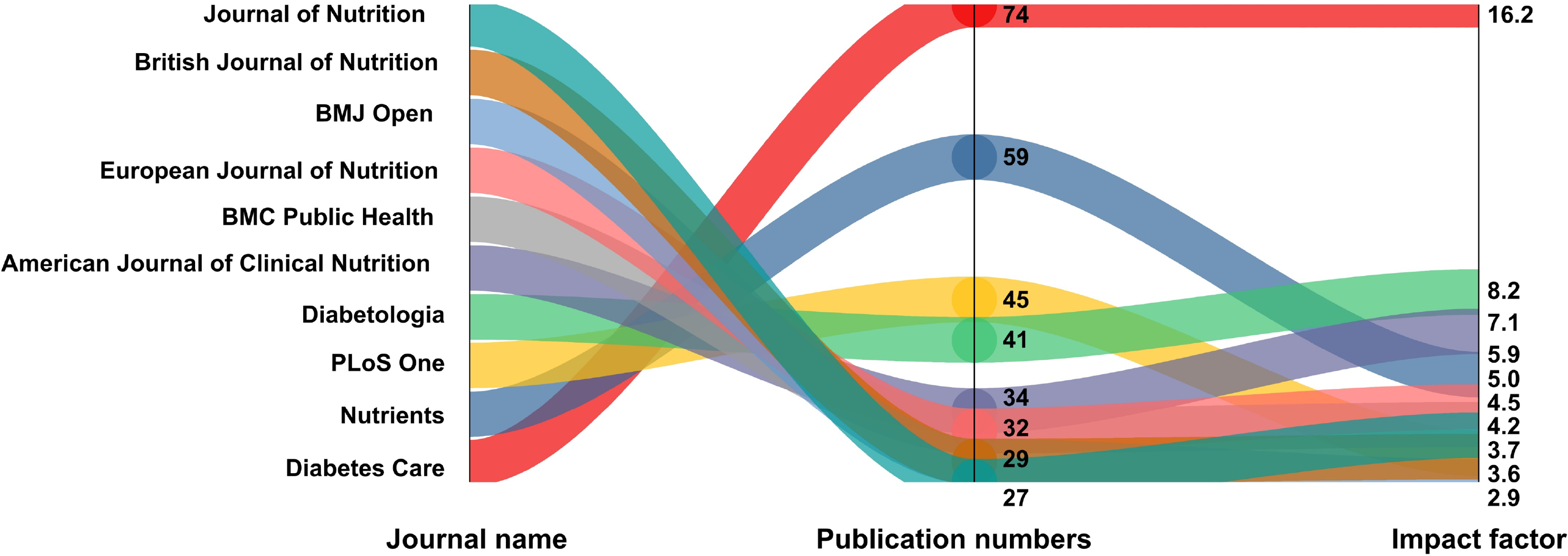
The publication number and impact factor of the ten top-ranking journals.
Collaboration networks
Countries’ collaboration networks
In the analyzed articles, a total of 92 countries were identified and ranked based on both the total number of publications and their importance, as measured by the h-index (Appendix C). The global distribution of research on environmental risk factors for type 2 diabetes was prominently led by the United States (30.6%, n = 440). Significant contributions were also observed from China (the People's Republic of China), accounting for 22.9% (330), and England with 12.4% (179). However, Africa demonstrated limited representation in this research landscape, which may reflect lower participation in type 2 diabetes research in the region or a lack of effective international collaboration mechanisms. Figure 5(a) provides a detailed visual representation of the geographical distribution of environmental risk factors for type 2 diabetes across different countries. We utilized the h-index, considering both publication quantity and impact, to evaluate the importance of a country's publications. This metric offers a balanced assessment by incorporating both aspects of scholarly output. The findings revealed that the United States (h-index, 53), China (h-index, 50), and England (h-index, 33) consistently maintained top positions in the rankings (Figure 5(b)). Germany (h-index, 28) ascended to fourth place by the h-index. Finland no longer appeared among the top 10 countries; it was replaced by Denmark (h-index, 24). This indicates that Denmark's publications had greater importance by this metric despite having fewer publications overall.

World scientific production and collaboration network for environmental risk factors for type 2 diabetes: the geographical distribution of publications by country. (Note: regions with no colors on the map have no available data.) (a); Top 10 countries measured by h-index (b); Visualization for collaborations among countries. Node's size is proportional to the degree of centrality. Line thickness indicates collaboration strength, with a set threshold above 12.8 for edge weight (c).
Building upon the individual country analysis, we delved into the intricate network of international collaboration. A total of 508 articles were co-authored by authors from different countries (n ≥ 2), forming the basis for the collaboration networks among countries (refer to Appendix D for details). Community detection algorithms were employed to identify clusters of countries engaged in frequent collaborations, 22 revealing patterns that often mirror regional partnerships, thematic focus areas, or shared research interests. The collaboration network, determined by the inter-connectedness of these modules, was subsequently categorized into five distinct communities (Figure 5(c)). In this network, the most influential community revolves around the United States, showcasing its pivotal role in international collaborations on environmental factors related to type 2 diabetes. The influence extends to China and Australia, forming a triad of major contributors. The second most influential community, led by England, represents a European hub, with significant participation from the Netherlands, France, Spain, Germany, and Sweden.
Co-authorship networks
In our study, multi-author collaborative publications dominated the scholarly output, representing 99.0% (n = 1,424) of the published studies. Of these, the number of studies with co-authors (ranging from 6 to 10) made the largest contribution, 46.8% (n = 673) (Appendix E). Our exploration extended beyond sheer numbers, delving into the dynamics of high-frequency co-author groups. Employing a threshold of 16 co-occurrence frequencies between authors, we identified four distinctive clusters, each exemplifying unique research foci (Figure 6). The purple cluster, led by Tjønneland et al., centered around investigating the intricate relationship between dietary intake and type 2 diabetes risk, as evidenced by their work in the EPIC-InterAct Case-Cohort Study. 29 The green cluster, headed by Hu et al., primarily focused on assessing diet and nutrition risks for type 2 diabetes across three US prospective cohorts. 30 Azizi and Mirmiran led the orange cluster, specializing in evaluating dietary risk factors associated with type 2 diabetes in the Tehran Lipid and Glucose Study. 31 The blue cluster, guided by Mao and Wang, concentrated on the multifactorial nature of type 2 diabetes, exploring the interaction between dietary, air pollution, and chemical factors in rural Chinese populations, as evidenced by the findings of the Henan Rural Cohort Study. 32
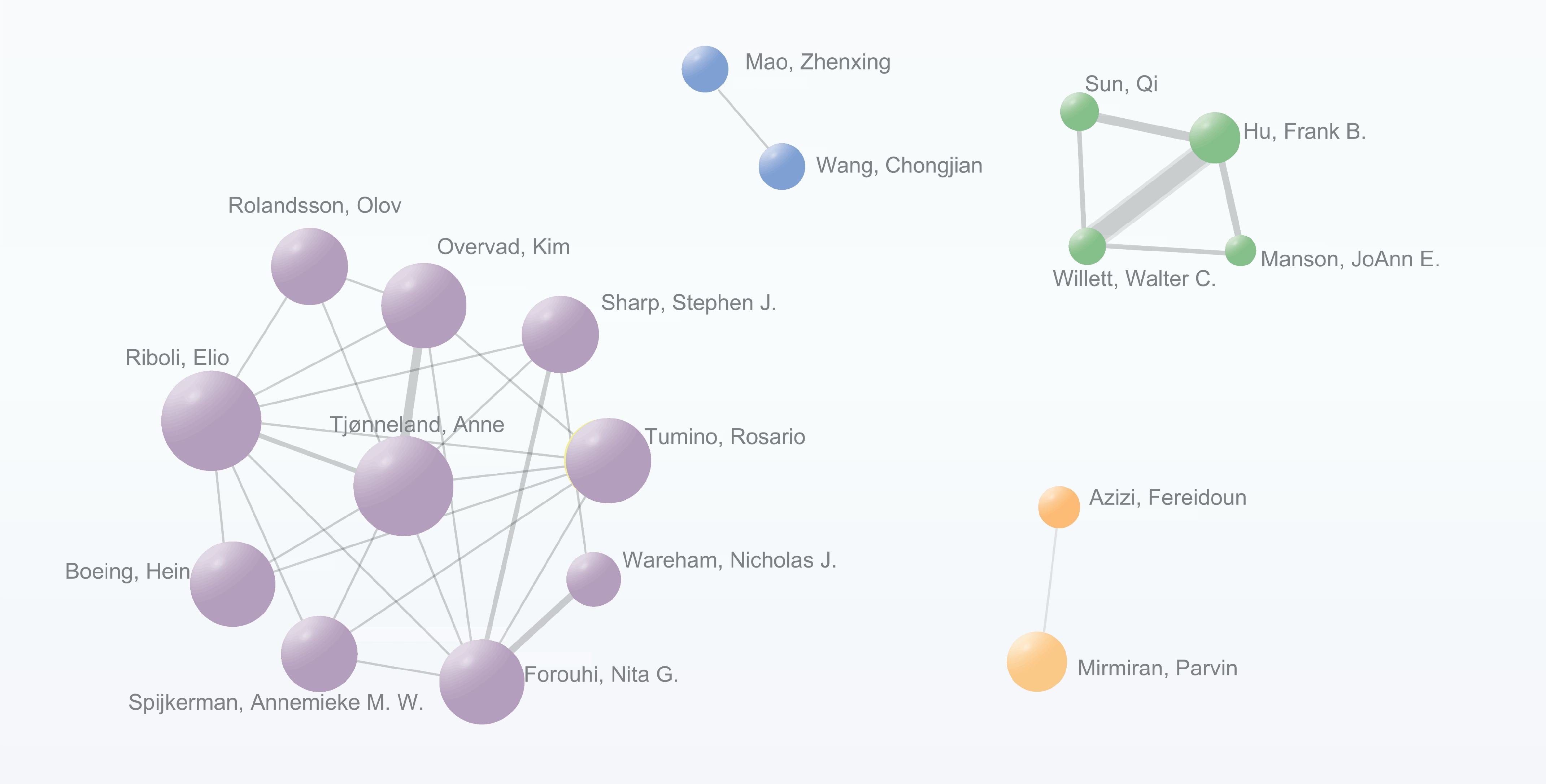
Collaboration network based on high-frequency co-occurrence between authors.
Knowledge structure
The knowledge structure, a visual representation of the intricate organization and relationships among various research topics, unfolds within the scientific network. In our study, we delved into the knowledge structure of environmental risk factors for type 2 diabetes, focusing on the specific categories of research topics (Figure 7). Conspicuously, the central position occupied by the “physical activity” topic was further emphasized by robust connections with other lifestyle environmental factors, including diet and nutrition, smoking, alcohol use, and sleep quality. This inter-connectedness underscored the multi-faceted nature of lifestyle behaviors and their collective influence on health outcomes, particularly in the context of type 2 diabetes risk management. Additionally, the results revealed a close association between physical activity and educational level. This association may be attributed to various factors, including access to resources, health literacy, and socioeconomic status. Hence, interventions promoting physical activity should consider educational disparities and target strategies to overcome barriers, particularly among disadvantaged populations.

Network visualization of the specific categories of research topics for environmental risk factors for type 2 diabetes. Nodes indicate research topics; lines indicate mutual relation between them. The size and color of the nodes are scaled to the degree centrality. The parameters used were: max size = 200 and min size = 20. The thickness of the line represents the strength of connections among research topics.
In general, keywords are characterized by a high conceptual level of abstract concepts, which represent topics of wide concern for researchers in a field. 33 The keyword co-occurrence network is usually used to highlight the most significant focus and knowledge structure in the research field. 34 In our study, we applied a keyword co-occurrence network methodology to elucidate the central themes and knowledge structure in the domain of environmental risk factors for type 2 diabetes. Illustrated in Figure 8, this network visually portrayed the inter-connectedness among keywords, employing a community detection algorithm to categorize them based on the distinct environmental risk factors they signify. This systematic approach enhances discerning prevailing themes and areas of interest. Color-coded categories, determined through the algorithms, provide a nuanced understanding of diverse environmental risk factors. The ten top-ranking keywords with high degrees of centrality were calculated to discover the most important keywords within the network (Appendix F).

Keywords co-occurrence network for environmental risk factors for type 2 diabetes.
We optimized the readability of the knowledge structure by setting two thresholds in the graph (degree centrality ≥ 9, publication number ≥5), aiming to provide a clearer representation of the interrelations among the keywords and to focus on keywords of significant influence and importance (Figure 9). In the lifestyle environment network, the keyword “physical activity” was found to occupy a central position, closely associated with factors such as sedentary and digital behavior. Additionally, we observed a closely associated subgroup formed by dairy products, cheese, yogurt, and calcium. This may suggest the similarity of these foods in daily diet and their potential shared impact on the development of type 2 diabetes, especially in relation to calcium. In the physico-chemical environment network, we identified two closely linked clusters: one comprising air pollution, particulate matter, PM2.5, and another including persistent organic pollutants (POPs) and polychlorinated biphenyls (PCBs). Importantly, the clustering of the latter is intricately linked to dietary factors found in fish. This underscores the substantial impact of air pollution, chemical exposure, and dietary factors on the development of type 2 diabetes. The social environment network highlighted key hubs formed by relationships between ethnicity and socioeconomic status. The built environment network demonstrated the interconnectedness between traffic and greenspace, while the psychological environment network centered around depression and anxiety. These intricate structures at network hubs underscore the pivotal influence of these factors in the intricate landscape of type 2 diabetes development.

Knowledge structure and heatmap for environmental risk factors for type 2 diabetes. Knowledge structure (a) and Heatmap (b).
Theme evolution
Thematic overlapping map
The utilization of the overlapping map acts as a dynamic lens into the evolving landscape of research themes, providing a nuanced exploration of both shifts and stability within the research field (Figure 10(a)). The spheres represent the subperiods and number of associated themes. The horizontal arrow represents the number of themes shared by both subperiods; the stability index is shown in parentheses. The upper incoming hand represents the number of new themes in a subperiod, and the outgoing upper hand represents the themes presented in this but not in the next subperiod. We set the criteria for configuring the period—focused on the original period—with a similar number of publications. Therefore, the whole period (2012–2024) was divided into four consecutive periods: 2012–2015, 2016–2019, 2020–2021, and 2022–2024, with 397, 500, 432, and 359 themes, respectively. The number of themes was used as a reference for the intensity of correlation between subperiods. The findings indicated fluctuations in the number of research themes across different time windows, showing a trend of gradual increase followed by a subsequent decrease. Additionally, the stability index across consecutive years gradually increased, suggesting a tendency towards stability in research themes. In the initial two time windows, there were more newly introduced themes than themes that disappeared. However, in the latter two time windows, the opposite trend was observed, with fewer new themes emerging compared to the number of themes disappearing.
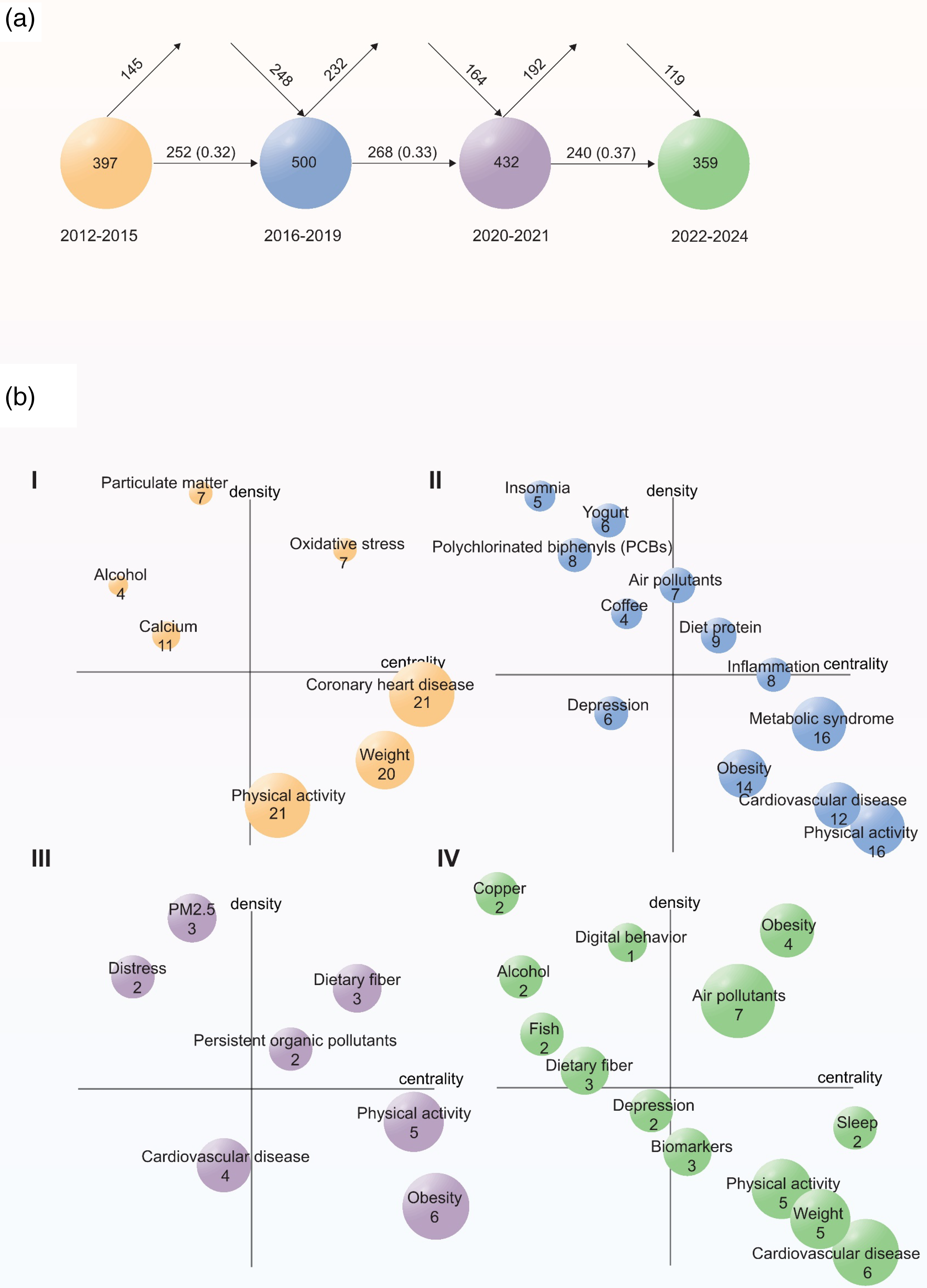
Thematic overlapping map and strategic diagrams for environmental risk factors for type 2 diabetes. Thematic overlapping map (a) and Strategic diagrams (b). Strategic diagram during four periods: 2012–2015, 2016–2019, 2020–2021, and 2022–2024 (I–IV).
Strategic diagrams
The results of the thematic evolution were visually presented in Figure 10(b), offering an insightful interpretation and highlights the thematic evolution across four subperiods (2012–2015, 2016–2019, 2020–2021, and 2022–2024). Each sphere within the diagram symbolizes a thematic element, with its size proportionate to the h-index. The diagram's horizontal axis denotes centrality, reflecting the extent of connections with other themes. A rising centrality value indicates a growing network of connections. Meanwhile, the vertical axis represents density, signifying internal cohesion within themes. An increasing density value suggests strengthened connections among components within a theme. The strategic diagrams depict four distinct quadrants, each defined by its position on the map. In the upper-right quadrant (Quadrant I), the motor theme cluster stands out as a well-developed cluster with significant influence on others and robust evolutionary potential. Quadrant II comprises highly developed but isolated clusters, characterized by high development and low influence. Quadrant III represents themes with low maturity and a marginal position, indicating emerging or declining clusters. Quadrant IV hosts basic and transversal clusters, suggesting themes related to a specific research field that are not yet fully developed but possess considerable development potential. In the first subperiod, themes characterized by high centrality and density, referred to as motor themes, primarily revolved around oxidative stress. These themes evolved in subsequent subperiods, with a shift towards diet protein in the second period. The focus further transitioned during the third period, centering on dietary fiber and POPs, while the fourth period emphasized issues related to air pollution and obesity. These shifts underscore the evolving significance of environmental factors throughout the study period, emphasizing the crucial role of diet, pollutants, and environmental conditions in shaping the research landscape and pointing towards promising avenues for future exploration. For detailed performance indicators depicted in the strategic diagrams, please refer to Appendix G.
Thematic evolution map
The dynamic evolution of themes refers to the continuous and changing patterns of focus, development, and interrelation among key themes within a specific field or area of study. 28 It entails the systematic tracking of conceptual shifts, advancements, and connections among main themes across varying periods of time. Aligned with this approach, we undertook a thorough thematic evolution analysis, with a specific focus on the conceptual evolution of the main themes. Based on the results of content analysis spanning four distinct periods, the thematic areas central to environmental risk factors for type 2 diabetes were identified. Figure 11 illustrates the results of the thematic evolution, where lines denote thematic connections, and thicker lines indicate stronger relationships. Solid lines indicate two themes sharing the main keywords, signifying the primary development direction, while dotted lines denote shared secondary keywords, revealing the direction of development for tributary themes. The isolated node in the diagram symbolizes a theme exclusive to a specific period, devoid of connections with themes from preceding or subsequent periods. These standalone nodes can be indicative of newly emerging themes within the evolving landscape. The primary clusters in each of the four subperiods were physical activity, cardiovascular disease, physical activity, and air pollutants. From a horizontal perspective, as research content accumulates, it naturally leads to the development of new branches. In this context, three distinct thematic evolution paths have been identified: (1) oxidative stress—air pollutants—PM2.5—air pollutants; (2) calcium—metabolic syndrome—cardiovascular disease; and (3) PCBs—POPs—obesity. Particularly, the newly emerging themes in the most recent subperiod, including digital behavior, sleep, copper, and fish, exhibit no connections with the themes of the previous periods.

The thematic evolution map for environmental risk factors for type 2 diabetes.
Discussion
To the best of our knowledge, our study is the first to present a comprehensive visual overview of environmental risk factors for type 2 diabetes, utilizing bibliometric performance, social network, and theme evolutionary methodologies. The relationship between type 2 diabetes and environmental factors involves multiple variables. Traditional research methods, such as literature reviews, meta-analyses, and systematic reviews, may be limited by a singular or localized perspective, focusing on specific aspects while overlooking a comprehensive systemic analysis. This limitation hinders a thorough understanding of the environmental factors influencing type 2 diabetes, potentially leading to an insufficient grasp of the overall etiology. Utilizing network science tools to analyze complex relationships among variables enhances the understanding of their mutual interactions. This aids in identifying crucial environmental factors and interlinking mechanisms. By revealing key nodes and associations within the network, it guides future research directions and addresses current research gaps. Additionally, it significantly reduces the time spent by professionals on information gathering, facilitating efficient navigation and swift comprehension of the current research landscape. This, in turn, provides valuable reference directions for future research. Our primary research findings are detailed below.
Dynamic maturation of environmental factor research
The gradual increase in annual publications from 2012 to 2024 signals a growing interest in environmental risk factors for type 2 diabetes within the scholarly community. This trend emphasizes an enhanced awareness of the complex relationship between environmental factors and the development of diabetes. Additionally, despite fluctuations in the number of research themes across different time windows, there has been a continuous increase in the stability index of research themes. This indicates that in the early stages, researchers may have been more inclined to explore new research areas and topics, resulting in significant fluctuations in the number of themes. However, over time, the field of research has gradually formed some core themes or stable research directions, indicating the maturation of the discipline. Furthermore, the increase in stability index also implies an increase in academic exchanges and collaborations. When researchers reach consensus on specific topics and develop common research interests, they may be more inclined to collaborate with other researchers to delve deeper into the subject, thereby promoting the development and advancement of the discipline. Together, these trends highlight the dynamic and influential landscape in environmental factor research for type 2 diabetes, positioning it as a pivotal area in scholarly exploration and public health consideration.
Hotspots environmental risk factors
Among the predefined five categories of research topics related to environmental risk factors for type 2 diabetes, our analysis revealed a notable emphasis on lifestyle environmental factors, with a particular focus on diet and nutrition, followed closely by physical activity. Additionally, our investigation identified key hotspots within each category through social network analysis. Remarkably, sedentary and digital behavior, PM2.5, ethnicity and socioeconomic status, traffic and greenspace, and depression emerged as the most critical areas of research, signifying their prominence and significance in the current research on type 2 diabetes.
The mechanism for type 2 diabetes prevention and control at the individual and population level mainly involves modifying lifestyle factors.12,35 Unhealthy diet and physical inactivity are significant drivers of the global epidemic of type 2 diabetes.8,12 In 2020, the Lancet Commission on diabetes recommended creating health-enabling environments that promote healthy eating and physical activity to reduce the risk of type 2 diabetes. 8 Decades of rapid urbanization and associated socioeconomic transformations have resulted in a concurrent shift in consumption patterns and food sourcing that promotes changes in dietary preferences and sedentary lifestyles. 36 For example, in high-income countries, traditional home-cooked meals and dietary patterns are disappearing and have shifted to ready-to-eat food and takeaways from outlets that sell high-calorie and processed foods, soft drinks, alcohol, and other beverages that are low in nutritional value and even harmful. 37 In low-income and middle-income countries (LMICs), the rapid uptake of technologies and automobiles as the primary mode of transportation have caused individuals to move from a physically active, agrarian lifestyle to a sedentary lifestyle. 38
In the investigation of environmental factors impacting type 2 diabetes, digital behavior emerges as a prominent theme among lifestyle factors. This finding reflects the significant impact of the proliferation of digital technology in modern life on health. Digital behavior encompasses activities such as smartphone usage, social media interaction, and online shopping, which are becoming increasingly common in people's daily lives and profoundly influencing their lifestyles and health behaviors. By delving into the relationship between digital behavior and type 2 diabetes, we can better understand the mechanisms through which modern lifestyles affect health. Additionally, research on digital behavior can provide new perspectives and methods for preventing and intervening in type 2 diabetes. Previous research indicated that designing health intervention programs based on digital technology can more effectively promote changes in health behaviors, thereby reducing the risk of developing the disease.39,40 Therefore, digital behavior, as a prominent theme among lifestyle factors, not only reflects contemporary societal trends but also provides important research directions for the study and prevention of type 2 diabetes.
Other risk factors like air pollution, traffic, depression, poverty, and social disparity might also be notable underlying risk associations of type 2 diabetes, especially in LMICs. 12 Over three in four adults with diabetes live in LMICs, 41 and the prevalence of the disease in high-income countries is higher among ethnic minorities or people living in areas with higher deprivation. 42 The prominent research themes with potential for development on the topic of the physico-chemical environment were PM2.5—representing the research paradigm of air pollution as a risk factor (and target for risk reduction) for type 2 diabetes. Trends in type 2 diabetes deaths and DALYs attributable to air pollution have shown marked increases from 1990 to 2019. In 2019, approximately a fifth of the global burden of type 2 diabetes was attributable to PM2.5 exposure, with a death rate of 3.78 deaths per 100,000 population and a DALYs rate of 167 per 100,000 population. 43 Therefore, air pollution mitigation might play an essential role in reducing the global disease burden resulting from type 2 diabetes. 44
Theme evolution and trends
Our theme evolutionary analysis has unveiled three prominent paths tracing environmental risk factors in relation to type 2 diabetes. In the following paragraphs, we delve into each pathway, elucidating the environmental risk factors involved and their specific contributions to the development of type 2 diabetes.
Our study emphasized a significant association between oxidative stress and type 2 diabetes, intricately linked with particulate matter and PM2.5. This finding aligns with previous research suggesting that oxidative stress induced by exposure to particulate matter, especially PM2.5, may contribute to microvascular complications. 45 Oxidative stress is recognized for its detrimental impact on blood vessels, potentially resulting in complications like retinopathy and nephropathy in individuals with type 2 diabetes. 46 Therefore, further exploration into the intricate relationship between oxidative stress and PM2.5 in diabetes is crucial. Strengthening this inquiry will enhance the understanding of how environmental-induced oxidative stress may influence microvascular complications.
Our evolutionary analysis also revealed a significant interplay among calcium, metabolic syndrome, and cardiovascular disease in the onset and progression of type 2 diabetes. Metabolic syndrome is a key risk factor for type 2 diabetes mellitus and cardiovascular diseases. 47 Calcium plays a critical role in the development of metabolic syndrome and cardiovascular diseases. Calcium ions interact with actin-myosin complexes, leading to contraction within cells. In vascular smooth muscle cells, calcium ions activate myosin light chain kinase (MLCK), promoting the phosphorylation of myosin and subsequent contraction of the myofilament chain. 48 Prolonged abnormal vascular contraction can contribute to the development and progression of cardiovascular diseases. Aberrant vascular contraction is common in patients with type 2 diabetes and is closely associated with microvascular complications. 49 Dysfunctional vascular contraction leads to increased microvascular permeability, restricted blood flow, and the occurrence of inflammatory responses, thereby facilitating the progression of these complications. 50
The evolutionary pathway from PCBs and POPs to obesity underscores the influence of environmental chemicals on type 2 diabetes. PCBs and POPs have been linked to metabolic disorders and obesity, disrupting normal endocrine function and affecting fat metabolism and energy balance, leading to weight gain and obesity. 51 Exposure to POPs and PCBs may also impact obesity-related hormone levels, such as insulin and leptin, thereby influencing appetite, energy expenditure, and fat storage processes. 52 These alterations in hormone levels may exacerbate obesity and increase the risk of developing type 2 diabetes. 53 These findings provide insights into the mechanisms through which environmental pollution affects obesity and type 2 diabetes, offering crucial evidence for the development of effective prevention and management strategies.
Implications and future research directions
Taken together, promoting a holistic approach to diabetes prevention is essential. This encompasses a comprehensive consideration of various environmental factors and acknowledging their combined influence. Given the multidimensional nature of environmental factors related to type 2 diabetes, a blend of personal and societal strategies is imperative to mitigate the risk of the disease and its associated complications, both in the general population and among high-risk individuals.38,54 Policymakers, managers, and researchers should implement health-related policies through intersectoral, interdepartmental, and interdisciplinary collaborations by strengthening education and health literacy, controlling air pollutant emissions, improving food and water safety and quality, imposing taxes on sugar-sweetened beverages and transport modes, reducing the cost of healthy foods, controlling tobacco sales and designating tobacco-free public areas, and creating healthy cities with increased greenspace to promote physical activity and recreational activities.2,6,54 More work is required to address the professional knowledge gaps regarding the relationships between environmental exposure and type 2 diabetes risk. Future studies should focus on the associations between combined environmental and microvascular complications and long-term outcomes among individuals with diabetes to provide important evidence for diabetes prevention and management.
This study had several strengths. To our knowledge, this is the first comprehensive study—based on a combination of bibliometric performance, social network, and theme evolutionary methods and tools—to capture and identify the most common and evolving themes in published research on environmental risk factors for type 2 diabetes over a decade and the first to present a visualization and evaluation of trends. Another notable strength of our study lies in the meticulous design of our search strategy, ensuring comprehensive coverage of relevant literature. We systematically collected and downloaded all Web of Science data pertaining to type 2 diabetes research from 2012 to 2024. Based on this, we selectively screened studies focusing on environmental risk factors, avoiding potential limitations associated with using specific environmental factor terms as search keywords that might lead to incomplete retrieval. This approach safeguards a multivariable spectrum and newly emerging risk factors for this field, laying a solid foundation for designing health policies and guiding prevention efforts.
However, it's crucial to acknowledge potential limitations. Firstly, our exclusive reliance on the Web of Science database for data collection, while renowned in scientific literature, may introduce constraints. Despite its broad coverage, it may not capture all relevant publications, leading to gaps or biases in our dataset and affecting the comprehensiveness and representativeness of our findings. Additionally, variations in indexing practices across databases might result in disparities in the identification and inclusion of relevant studies, further impacting the scope and accuracy of our analysis. Therefore, future studies could benefit from employing a more diverse range of databases to ensure a comprehensive and robust assessment of the research landscape. In addition to the aforementioned constraints, our study was confined to papers classified specifically as article type and published within a delimited timeframe. This selection criteria may inadvertently neglect other pertinent forms of scholarly output, such as reviews, conference proceedings, and the like. Such diverse literature types frequently encapsulate pivotal insights and discoveries pertinent to the research domain. Similarly, the methodological limitations of bibliometric analyses arise from reliance on indicators like citation counts, journal impact factors, and the h-index. These indicators are based on assumptions about the significance and quality of scholarly outputs. However, they may not fully represent scholarly impact or relevance, leading to oversimplified or misinterpreted assessments of research influence. Furthermore, social network analysis may oversimplify scientific interactions, and thematic evolution analysis is susceptible to interpretation bias. Despite these drawbacks, these methods remain valuable when complemented with other research approaches.
Conclusions
In conclusion, our study on environmental factors influencing type 2 diabetes reveals notable findings. Digital behavior emerges as a significant lifestyle factor, indicative of modern technology's substantial influence on health behaviors and potential for novel intervention strategies. Key research themes such as PM2.5 and calcium play crucial roles in elucidating the mechanisms underlying microvascular complications in type 2 diabetes, particularly oxidative stress and abnormal vascular contraction. The progression from PCBs and POPs to obesity underscores environmental chemicals’ disruption of endocrine function and fat metabolism, contributing to diabetes risk. To advance our understanding, addressing knowledge gaps is imperative, including investigating dose-response relationships of calcium, scrutinizing the prolonged effects of PM2.5, PCBs, and POPs, and exploring potential synergies associated with type 2 diabetes. Future research should specifically target the interplay of environmental factors with microvascular complications and their impact on long-term outcomes in individuals with diabetes.
Supplemental Material
sj-docx-1-dhj-10.1177_20552076241271722 - Supplemental material for An overview of environmental risk factors for type 2 diabetes research using network science tools
Supplemental material, sj-docx-1-dhj-10.1177_20552076241271722 for An overview of environmental risk factors for type 2 diabetes research using network science tools by Xia Cao, Huixin Yu, Yu Quan, Jing Qin, Yuhong Zhao, Xiaochun Yang and Shanyan Gao in DIGITAL HEALTH
Footnotes
Acknowledgments
The authors would like to thank the National Key R&D Program of China, the Doctoral Start-up Foundation of Liaoning Province, and the 345 Talent Project of Shengjing Hospital of China Medical University for offering grants for this work.
Consent statement
All contributing authors of this manuscript have given the submission consent. In addition, patient consent is not necessary for this manuscript, as it is a bibliometric study.
Contributorship
Xia Cao and Shanyan Gao performed the bibliometric and visualized analysis and wrote the manuscript. Jing Qin and Huixin Yu conducted the literature search and screening. Yu Quan performed the visualization. Yuhong Zhao, Xiaochun Yang, and Shanyan Gao spearheaded the research design, methodology, research supervision, and funding acquisition. All authors participated in the revision and finalization of the manuscript, and read and agreed to the published version of the manuscript.
Declaration of conflicting interests
The authors declared no potential conflicts of interest with respect to the research, authorship, and/or publication of this article.
Ethical approval
Not applicable, because this article does not contain any studies with human or animal subjects.
Funding
The authors disclosed receipt of the following financial support for the research, authorship, and/or publication of this article: This work was supported by the National Key R&D Program of China (2023YFC3604600), the Doctoral Start-up Foundation of Liaoning Province (2021-BS-120), the 345 Talent Project of Shengjing Hospital of China Medical University (M0334).
Guarantor
SG.

Supplemental material
Supplemental material for this article is available online.
References
Supplementary Material
Please find the following supplemental material available below.
For Open Access articles published under a Creative Commons License, all supplemental material carries the same license as the article it is associated with.
For non-Open Access articles published, all supplemental material carries a non-exclusive license, and permission requests for re-use of supplemental material or any part of supplemental material shall be sent directly to the copyright owner as specified in the copyright notice associated with the article.
