




Abstract
Background
Stroke is one of the leading causes of mortality and long-term disability worldwide. In recent years, integrated rehabilitation models that combine virtual reality (VR) technology with standardized exercise therapy have emerged, demonstrating promising potential in improving recovery outcomes.
Objective
This bibliometric review systematically analyzes global literature on virtual reality combined with exercise therapy for stroke rehabilitation to map the knowledge landscape, identify research hotspots and evolutionary trends, and inform future research, clinical practice, and policy.
Methods
Relevant studies on VR combined with exercise therapy for stroke rehabilitation were retrieved from the Web of Science database, covering the period from database inception to 2025. Bibliometric and visualization analyses were conducted using CiteSpace and VOSviewer to assess publication trends, country, institutional contributions, authors and co-cited authors networks, highly cited references, core journals, and the evolution of research hotspots.
Results
A total of 1,687 articles were identified, showing a steady upward publication trend. China ranked first in publication volume, while the United States had the highest total citation count. Researchers such as Calabrò, De Luca, and Naro from the IRCCS Centro Neurolesi in Messina, Italy, made notable contributions, particularly in VR-robotics combined rehabilitation. The Journal of NeuroEngineering and Rehabilitation published the largest number of articles in this field. Keyword burst analysis indicated two distinct phases: before 2021, research primarily focused on conventional rehabilitation methods and clinical trials; after 2021, attention shifted towards the integration of emerging technologies in stroke rehabilitation, including machine learning and immersive VR, reflecting growing scholarly interest in novel rehabilitation strategies.
Conclusions
This study provides a comprehensive bibliometric analysis of VR combined with exercise therapy in stroke rehabilitation, identifying key research hotspots, emerging trends, and existing limitations. The findings could offer theoretical insights and data-driven evidence to support future research and clinical applications in this field.
1. Introduction
Stroke, as an acute cerebrovascular disease, has become one of the leading causes of death and long-term disability worldwide. According to the latest data from the World Stroke Organization, stroke ranks as the second leading cause of death and the third leading cause of disability globally. 1 The substantial health and socioeconomic burden it imposes exerts a sustained and escalating pressure on healthcare systems worldwide. In 2019, there were over 12.2 million new cases of stroke globally, with more than 100 million survivors. In terms of mortality, approximately 6.5 million people die from stroke each year, accounting for 11.6% of all deaths in 2019. 2 More alarmingly, the impact of stroke extends far beyond mortality, resulting in the loss of over 143 million disability-adjusted life years (DALYs) annually. This metric quantifies the years of healthy life lost due to premature death and disability, underscoring the profound and lasting disruption stroke inflicts on human well-being. 2 Economically, the global cost of stroke exceeds USD 721 billion, equivalent to approximately 0.66% of the world Gross Domestic Product, placing a significant financial strain on societies. 1
Stroke survivors frequently experience severe sequelae, particularly motor impairments. It is estimated that up to 80% of patients exhibit varying degrees of limb motor dysfunction, 3 manifesting as muscle weakness and impaired coordination. These physical impairments, affecting the trunk as well as the upper and lower limbs, severely compromise capacity of patients for daily activities and self-care, thereby substantially diminishing their quality of life. 4
Conventional rehabilitation approaches, such as physical therapy and occupational therapy, remain the cornerstone of functional recovery, yet their effectiveness is often hindered by intrinsic limitations. Neuroscientific evidence indicates that neural functional reorganization depends on high-intensity, high-repetition, task-oriented training. 5 Although traditional rehabilitation methods can enhance muscle strength and mobility, they are characterized by significant constraints: they are resource-intensive (requiring specialized equipment and therapists), time-consuming,6,7 and monotonous, which frequently leads to reduced patient motivation and adherence, ultimately limiting long-term outcomes. 8 These limitations often result in a plateau in functional improvement after a certain rehabilitation period. Therefore, there is an urgent need for novel rehabilitation strategies capable of overcoming the constraints of traditional approaches.
Against this backdrop, virtual reality (VR) technology has been introduced into the field of stroke rehabilitation as an emerging rehabilitation method, aiming to promote the reorganization of neural motor pathways and alleviate motor dysfunction. 9 VR is typically defined as an interactive computer simulation system that can track the movements of users in real time and create an immersive experience through multimodal feedback such as visual and auditory cues. 3 This characteristic not only significantly enhances intrinsic motivation and engagement, enabling patients to unconsciously complete training volumes far exceeding those of traditional therapies, but also provides immediate, quantifiable motor feedback, and dynamically adjusts task difficulty based on patient ability, thereby optimizing motor learning efficiency. 10 More importantly, VR is not only a tool to enhance training motivation but also an effective “driver” for stimulating neural plasticity. Research indicates that when patients engage in high-intensity, repetitive training in a virtual environment and receive rich multisensory feedback, the neural networks responsible for motor planning and execution in the brain are continuously and efficiently activated, thereby promoting the reorganization and functional compensation of damaged neural pathways.11,12 However, the standalone application of VR still has limitations, such as the lack of individualized exercise prescriptions and insufficient physiological feedback. In recent years, a new rehabilitation model combining VR technology with standardized exercise therapy has emerged and shown potential for improving rehabilitation outcomes.
Clinical research evidence indicates that compared to conventional rehabilitation alone, combining VR training can significantly enhance therapeutic efficacy. For example, a systematic review found that adding VR training to conventional occupational therapy significantly improved upper limb motor function, functional independence, and activities of daily living in stroke patients. 13 Another study demonstrated that VR also has positive effects on the recovery of upper and lower limb function, gait, and balance, with more significant efficacy when combined with traditional therapy. Additionally, limited evidence suggests that VR may also have positive effects on patients with cognitive impairments. 14 However, the rapid development in this field is accompanied by high heterogeneity among studies: significant differences exist in VR system types, intervention protocols, and participant characteristics across studies, leading to inconsistent results and posing challenges for clinical application and the determination of future research directions.
Bibliometrics provides an objective and quantitative analytical tool for this purpose. By systematically analyzing author, institutional, keyword, and citation information from a large-scale academic literature corpus, knowledge maps can be constructed to identify research hotspots and emerging trends. 15 Based on this, the study aims to apply bibliometric methods to systematically review the global literature on the application of VR combined with exercise therapy in stroke rehabilitation, with the goal of mapping the knowledge landscape in this field, identifying research hotspots and evolutionary trends, and providing theoretical reference for future scientific research, clinical practice, and policy-making.
2. Materials and methods
2.1. Search strategy
The data for this study were sourced from the Web of Science database. As an internationally recognized authoritative academic database, Web of Science has become one of the most favored data sources in the field of bibliometric research due to the high quality and broad coverage of its included literature.16–18 Additionally, articles related to the study topic were retrieved from the Science Citation Index Expanded (SCIE) and Social Sciences Citation Index (SSCI) databases within the Web of Science Core Collection (WOSCC) from its inception to June 15, 2025. SCIE and SSCI are sub-databases of WOSCC, comprising journals in the field of basic scientific research globally, and cover neuroscience and medical research relevant to the study topic. To obtain literature explicitly using relevant terminology, the search query was set as follows: “(((((((((((((((((TS=(Strokes)) OR TS=(Cerebrovascular Accident)) OR TS=(Cerebrovascular Accidents)) OR TS=(Cerebral Stroke)) OR TS=(Cerebral Strokes)) OR TS=(Cerebrovascular Apoplexy)) OR TS=(Brain Vascular Accident)) OR TS=(Brain Vascular Accidents)) OR TS=(Cerebrovascular Stroke)) OR TS=(Cerebrovascular Strokes)) OR TS=(Apoplexy)) OR TS=(CVA (Cerebrovascular Accident))) OR TS=(CVAs (Cerebrovascular Accident))) OR TS=(Acute Stroke)) OR TS=(Acute Strokes)) OR TS=(Acute Cerebrovascular Accident)) OR TS=(Acute Cerebrovascular Accidents)) AND ((((((((((((((TS=(Exercises)) OR TS=(Exercise)) OR TS=(Physical Exercise)) OR TS=(Physical Exercises)) OR TS=(Aerobic Exercise)) OR TS=(Aerobic Exercises)) OR TS=(Isometric Exercises)) OR TS=(Isometric Exercise)) OR TS=(Acute Exercise)) OR TS=(Acute Exercises)) OR TS=(Training)) OR TS=(Trainings)) OR TS=(Physical Activity)) OR TS=(Physical Activities)) AND (((((((((((TS=(Virtual Reality)) OR TS=(Educational Virtual Realities)) OR TS=(Educational Virtual Reality)) OR TS=(Instructional Virtual Realities)) OR TS=(Instructional Virtual Reality)) OR TS=(VR)) OR TS=(Virtual Environment)) OR TS=(Immersive Virtual Reality)) OR TS=(Non-Immersive Virtual Reality)) OR TS=(Simulation)) OR TS=(Serious Games))”. Additionally, in this study, “exercise therapy” refers to exercise-based stroke rehabilitation interventions, including structured exercise, physical training, and task-oriented forms of physical activity. Similarly, “virtual reality” denotes computer-generated, interactive rehabilitation environments that simulate or augment real-world tasks. In the bibliometric analysis, this category encompasses immersive and non-immersive virtual reality, virtual environments, simulation-based systems, and serious games.
2.2. Inclusion and exclusion criteria
All included studies were peer-reviewed publications. An initial screening was conducted by reviewing the titles and abstracts, followed by a full-text assessment to determine eligibility based on the inclusion criteria. The exclusion criteria were as follows: (1) studies that did not involve VR combined with exercise therapy; (2) studies focusing on diseases unrelated to stroke; (3) publications in the form of letters, commentaries, conference abstracts, or retracted articles; (4) articles not published in English.
2.3. Bibliometric and visual analysis
Articles retrieved from the Web of Science database, including full records and cited references, were exported in plain text format with the filename “download_X.txt.” After data deduplication and merging, the plain text files were imported into VOSviewer (version 1.6.18) and CiteSpace (version 6.3.R1) for subsequent analysis and visualization.
2.4. Statistical analysis
In this study, statistical indicators include publication year distribution, country and institutional contributions, author and co-cited authors relationships, journal analysis, reference analysis, and keyword analysis. For each category of indicator, first conducted frequency-based analysis, then utilized visual maps to illustrate the strength of relationships and developmental trends among different nodes. Interrelationships between indicators were primarily reflected through node size and line thickness: node size represented the frequency of occurrence or citation frequency of that indicator, while line thickness indicated the strength of co-occurrence or co-citation relationships.
2.5. Ethical considerations
This study falls within the scope of bibliometric research. As it is classified as a bibliometric analysis, formal ethical approval was not required. Bibliometric studies involve quantitative analyses of publicly accessible scholarly outputs, such as journal articles, patents, and conference proceedings, and do not entail: (1) direct interaction with human participants; (2) collection of personal, sensitive, or identifiable information; or (3) intervention in human behavior or health. According to international guidelines (e.g., the Declaration of Helsinki) and institutional policies, studies of this nature are generally exempt from ethical review, as they pose no risk to privacy, autonomy, or well-being.
3. Result
3.1. Trends in the number of publications
A total of 1,934 records were retrieved from the WOSCC database. After excluding non-academic publications, non-English literature, and studies outside the scope of the research objectives, 1,687 articles were finally included (Figure 1 presents the literature search and screening flowchart). Among these, 1,406 were original research articles and 281 were review papers. The literature search and screening flowchart.
Although the search period covered publications from the database’s inception to June 15, 2025, Figure 2 shows that this topic first appeared in 2011. Overall, research on VR combined with exercise therapy in stroke rehabilitation has demonstrated a steadily increasing publication trend, with a particularly rapid growth from 2019 to 2022. The number of publications peaked in 2022, reaching 200 articles. However, the annual output declined from 2023 to 2025, especially in 2025, likely because the year was incomplete at the time of the search, resulting in some articles not yet being published or indexed. Number of articles published.
3.2. Distribution of countries
Statistical analysis revealed that research on VR combined with exercise therapy in stroke rehabilitation has been published across 85 countries. For clarity of presentation, the top 34 countries were visualized (Figure 3). The top 10 countries in terms of publication are listed in Table 1. The results show that China leads with 354 publications, followed by the United States with 330. The number of publications from other countries drops significantly thereafter, with Italy at 153 and South Korea at 136. In terms of total citations, the United States leads with 10,999 citations, followed by China (5,331 citations) and Italy (4,666 citations). Notably, in terms of citations per paper, Australia leads with 65.62 citations, followed by the England (49.29 citations) and the United States (33.33 citations). Country distribution of VR combined exercise therapy in stroke rehabilitation. Top 10 countries/regions contributing to publications on VR and exercise in stroke.

In the visualized network, different colors represent different clusters, and the lines indicate cooperative relationships between countries, with thicker lines indicating closer cooperative relationships. The results show that the United States and China have the closest cooperative relationship, forming an important hub in the academic cooperation network in this field.
3.3. Analysis of institutions
Top 10 institutions contributing to publications on VR and exercise in stroke.


Collaborative networks between institutions.
3.4. Analysis of authors and co-cited authors
Based on the author collaboration network (Figure 5(a)) and author co-cited network (Figure 5(b)), the global research landscape of VR combined with exercise therapy for stroke rehabilitation was analyzed. Table 3 presents the top 10 authors ranked by both publication output and co-cited counts. The three most prolific authors were Calabro, Rocco Salvatore (35 publications), De Luca, Rosaria (24 publications), and Naro, Antonino (18 publications). In terms of co-cited, Laver, K.E. ranked first with 365 citations, followed by Saposnik, G. (339 citations) and Kwakkel, G. (317 citations). (a) Active authors. (b) Active co-cited authors. The top 10 authors and co-cited authors.

3.5. Analysis of journals
The top 10 journals that published articles.

Note. JCR: Journal Citation Reports; IF: impact factor; Q: Quartile; IEEE: Institute of Electrical and Electronics Engineers.

Co-citation analysis clustering map of journal.
3.6. Cited reference analysis
The number of citations for an article reflects the level of interest researchers have in the topic. The more citations an article receives, the more important it is considered to be. Figure 7 shows a visual analysis of the references. Nodes represent the authors and years of the articles, with node size indicating citation frequency. Lines between nodes indicate that two articles were cited together, with line thickness indicating the strength of the relationship. Table 5 presents the top 10 most cited articles. Among them, Laver K (2011) has the highest number of citations, with 191 citations; Saposnik G (2011) has 125 citations, involving original research and meta-analyses on VR in stroke rehabilitation. Co-citation analysis of cited references. The top 10 cited references.

3.7. Analysis of keywords
As integral article labels, keywords not only enable readers to rapidly grasp the main theme and core content of a study, but also serve as a crucial basis for identifying research hotspots and emerging trends within a field.
19
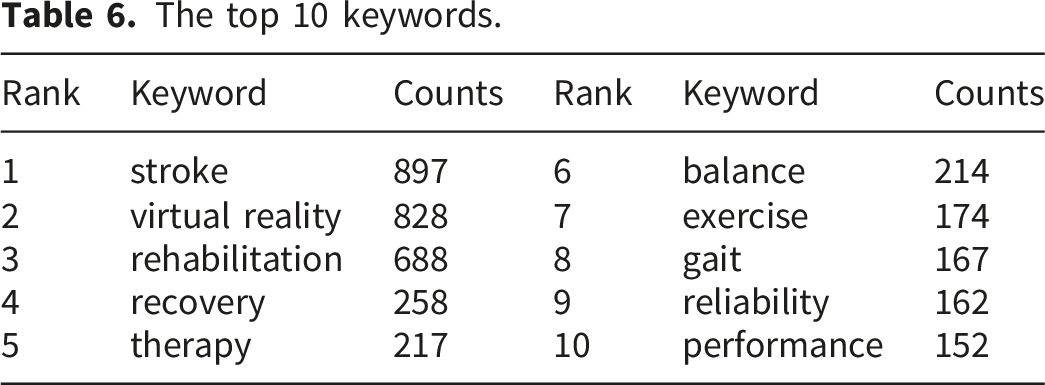
Analyzing keywords thus facilitates a more comprehensive understanding of the developmental trajectory of the relevant discipline. In this study, VOSviewer was employed to conduct co-occurrence and clustering analyses of the keywords of article (Figure 8). The results revealed that the keywords were categorized into four clusters, among which the red, blue, and green clusters were the most prominent. Specifically, the red cluster primarily pertains to the anatomical regions targeted by the application of VR in stroke rehabilitation; the green cluster relates to the characteristics of the patient population and the evaluation indicators used in stroke rehabilitation; and the blue cluster focuses on the methodologies employed in stroke rehabilitation. Table 6 lists the top 10 important keywords. Stroke was the most frequently used term, appearing 897 times, followed by virtual reality (828 times) and rehabilitation (688 times). Keywords co-word network and clustering. The top 10 keywords.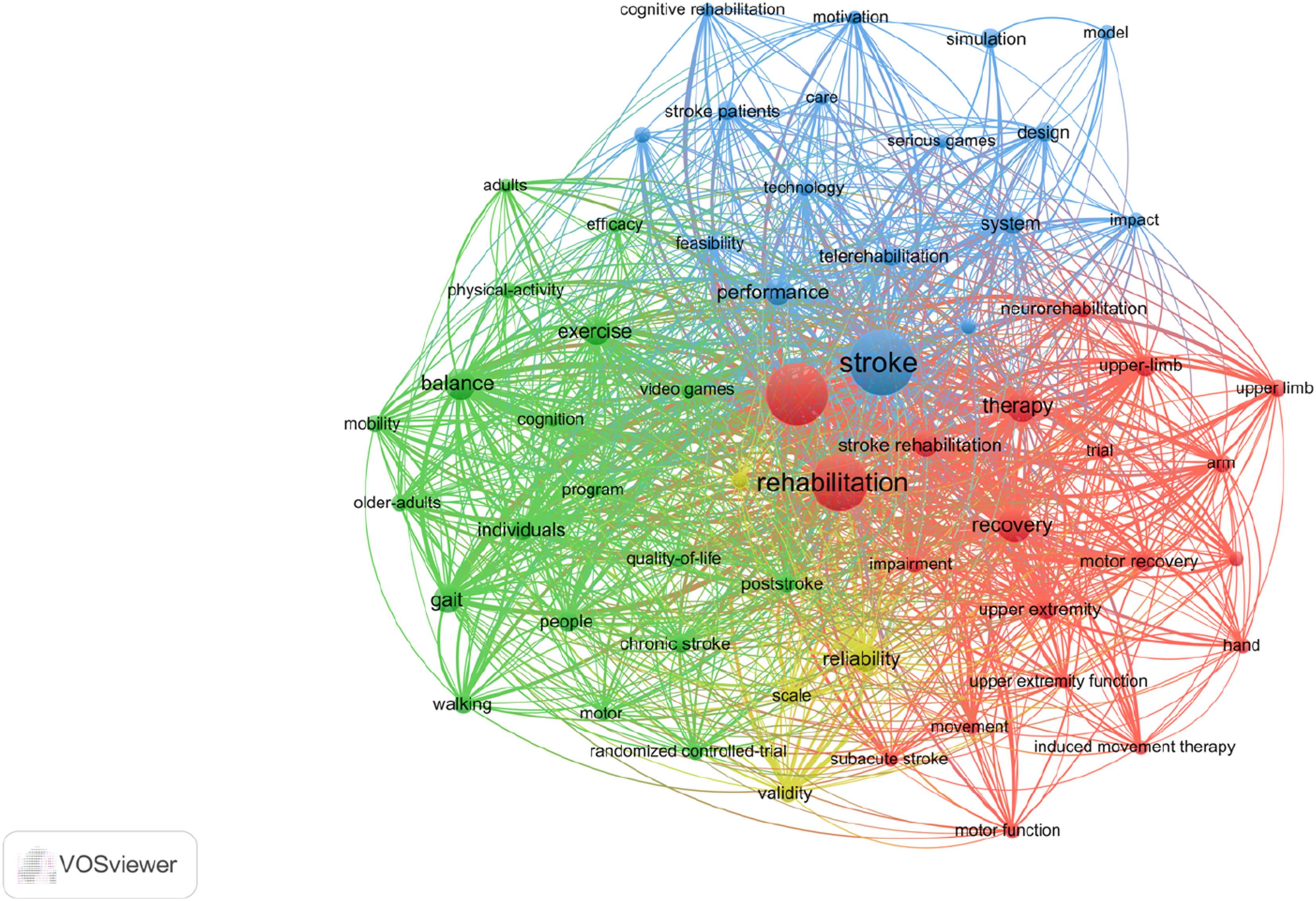
With the continuous development of this research field, its hotspots have evolved over time. Solely relying on keyword clustering analysis presents certain limitations, as it cannot reveal temporal variations in keyword usage. Keyword bursts refer to a marked increase in the frequency of a given keyword within a specific time period. Analyzing keyword bursts provides valuable insights into the developmental trajectory of VR combined with exercise therapy in stroke rehabilitation, as well as the identification of stage-specific research focuses. In the present study, CiteSpace was employed to perform a keyword burst analysis, and the top 20 burst keywords are presented in Figure 9. Among them, “ambulation” and “postural balance” exhibited the longest burst durations, lasting nearly six years. Furthermore, results indicated that before 2021, burst keywords were predominantly associated with conventional rehabilitation methods and clinical trials. After 2021, however, research attention shifted toward the application of emerging technologies in stroke rehabilitation, including machine learning, immersive VR, and game, suggesting a growing scholarly emphasis on the exploration and adoption of novel rehabilitation techniques. Keywords with bursts.
4. Discussion
CiteSpace and VOSviewer software were utilized in this study to conduct a systematic analysis of the current state of research on VR combined with exercise therapy in stroke rehabilitation. From the establishment of the database to 2025, a total of 1,687 relevant literature were retrieved, including 1,406 original studies (83.34%) and 281 review articles. Contemporary research predominantly focuses on clinical trials to validate the therapeutic efficacy of this intervention in stroke rehabilitation. Over the past 15 years, the number of publications in this field has shown an overall upward trend. The earliest application of VR in stroke rehabilitation dates back to 2001, when D. Jack et al. introduced it into hand function rehabilitation training for stroke patients. The results showed that most hand parameters improved significantly during training, and patients reported positive subjective evaluations, 20 marking the beginning of VR research in stroke rehabilitation. Notably, research on VR combined with exercise therapy was not formally published until 2011. According to the results in Figure 2, the development of this topic was relatively slow from 2011 to 2018, but entered a rapid growth phase starting in 2019. This may be closely related to the advent of the AI era, the significant reduction in VR hardware and software development costs, and the improved standardization of exercise therapy combination models. By 2022, the number of related publications reached 200; although there was a slight decline in 2023 and 2024, the numbers remained higher than in previous years, indicating that this field will maintain a high level of interest in the foreseeable future.
Regarding geographical distribution, although related research spans 85 countries worldwide, underscoring the widespread global interest in this interdisciplinary field, there remains a significant disparity in research productivity and academic impact. This pattern not only reflects differences in research and development investment levels among countries but also reveals the divergent paths and priorities adopted by different nations in addressing public health challenges, formulating science and technology development strategies, and building innovation systems. The findings of this study reveal that the field presents a multipolar landscape spearheaded by China and the United States, with active participation from multiple countries. As shown in Table 1, China ranks first with 354 papers, followed closely by the United States with 330 papers, with the two countries constitute the primary echelon of research output in this field. The concentration of research outcomes within a select few countries suggests that the field has relatively high technical and resource barriers to entry. Research combining VR with exercise therapy not only requires advanced VR technology and equipment but also the deep integration of multidisciplinary fields such as neuroscience, rehabilitation medicine, biomechanics, and computer science, as well as sufficient research funding and clinical trial resources.
China leads the world in the number of publications in this field, a phenomenon driven by profound social and policy factors. Its substantial research output can be understood as a response to a severe public health crisis, strongly supported by national strategic initiatives. Specifically, the significant clinical demand serves as the fundamental driving force behind research development. Currently, China bears the highest global burden of stroke. 21 Stroke has become the leading cause of premature death and DALYs loss among the Chinese population.22,23 As the rapid acceleration of population aging, this burden is expected to continue to worsen. Additionally, the national strategic planning provides strong “top-down” policy support and resource allocation for this demand. The Chinese governments “Healthy China 2030” planning outline elevates national health to a national strategic level, proposing to strengthen health science and technology innovation to drive improvements in healthcare quality and equity through technological progress. Under this macro policy framework, the prevention, treatment, and rehabilitation of major chronic diseases such as stroke have become key areas of development. In contrast, the United States leverages its mature neuro-rehabilitation research system, long-term stable biomedical funding mechanisms, interdisciplinary collaboration platforms, and robust methodological capabilities to gain significant advantages in research design, mechanism exploration, hardware equipment, standard development, and high-impact output. Consequently, China excels in “clinical demand-driven approaches” and “large-scale application validation,” while the United States holds a central position in “theoretical innovation, technological integration, and high-quality evidence production.” This structural complementarity enables both nations to more readily establish hub status within international collaborative networks.
From the perspective of academic influence (measured by citation data), the data shows that scholarly impact is not strictly linearly correlated with the quantity of research output but reflects the unique research ecosystems and strategic priorities of different countries. The United States leads significantly in total citation frequency with 10,999, far exceeding the 5,331 of China, reflecting its strong influence. The United States leadership is rooted in its long-term, large-scale, and sustained investment in biomedical research. As the largest public biomedical research funding agency globally, the National Institutes of Health allocates tens of billions of dollars annually, laying a solid foundation for scientific breakthroughs and innovative therapies. 24 Meanwhile, Australia and England demonstrate a model of high-impact efficiency. Australia leads the world with an average citation frequency of 65.62 per paper, followed closely by the England at 49.29, both significantly higher than the United States (33.33) and China (15.06). This outstanding performance stems from the meticulous design of national research strategies. For example, the Australian Medical Research and Innovation Strategy, guided by the Medical Research Future Fund (MRFF), aims to promote research translation and impact, as well as health and economic benefits through innovative research. This “impact-oriented” funding approach tends to support research projects with significant transformative potential, fostering a culture of “quality over quantity” within the research community.
In the field of stroke rehabilitation, research on VR combined with exercise therapy has been primarily driven by a small number of highly productive authors and their teams. Bibliometric analysis reveals that Calabrò, De Luca, Naro, and others at the Messina IRCCS Brain Injury Center in Italy exhibit high publication activity, suggesting a degree of team concentration in knowledge production within this domain. Further analysis of institutional distribution reveals that Italy research teams focus more on VR combined with robotic training and neurorehabilitation technologies, 25 while teams from Canada and Australia concentrate more on randomized controlled trial designs, rehabilitation assessment, and evidence-based reviews.26–28 These findings indicate that distinct research specializations have emerged among different countries and institutions in this field, with these variations collectively shaping the current structure and developmental trajectory of research topics.
A bibliometric analysis shows that research on combined VR and exercise therapy in stroke rehabilitation is concentrated in a small number of institutions and author cohorts. Statistically, Calabrò (35 publications) is the most prolific author, with other high-output authors including De Luca and Naro, who are affiliated with Italian institutions. Co-author analysis reveals that top authors form several closely collaborating clusters, characterized by frequent intra-institutional and domestic partnerships. For example, members of the Messina IRCCS team (e.g., Calabrò, De Luca, Naro) frequently collaborate as co-authors; while the McGill and Toronto teams (e.g., Levin, Saposnik) focus on Canadian projects. Based on the above, the collaborative networks formed by authors and their institutions significantly shape both research themes and analytical depth: Italian teams primarily focus on VR-assisted robotic training and cognitive rehabilitation, while Canadian teams tend toward large-sample RCTs and systematic reviews. Collaboration networks are highly concentrated internally but relatively limited internationally. Therefore, future research should encourage broader collaboration among teams from different countries and disciplinary backgrounds to enhance the external validity of evidence and reduce research bias arising from single-team dominance.
Co-occurrence analysis of keywords shows that terms such as “stroke,” “virtual reality,” “rehabilitation,” “recovery,” and “therapy” appear most frequently, reflecting the core research themes of the field. The results of keyword clustering divide the keywords into several thematic clusters, with the cluster related to rehabilitation methods (blue) being the most prominent. CiteSpace keyword burst analysis indicates that from 2011 to 2021, research hotspots were concentrated on traditional rehabilitation methods and related clinical assessments; however, after 2021, emerging technologies such as “immersive virtual reality,” “machine learning,” and “game” began to appear frequently. This trend indicates that research focus in this field is gradually shifting from traditional training models toward immersive interaction, gamified interventions, and data-driven intelligent rehabilitation.29–34 This evolutionary pathway demonstrates that current research no longer limits itself to validating single intervention formats, but instead places greater emphasis on digital technology integration, personalized rehabilitation, and multimodal intervention strategies.
Specifically, the emerging technology clusters that emerged after 2021 essentially represent a response to the limitations of traditional VR applications. While early VR rehabilitation research demonstrated certain therapeutic effects, its clinical adoption has long been constrained by several issues. First, traditional VR systems primarily feature pre-set scenes and fixed tasks, resulting in limited motion engagement, reduced realism in task scenarios, and inadequate adaptability of training content. This leads to insufficient patient immersion and diminished motivation for training. 35 Second, early VR placed greater emphasis on visual feedback and task completion. While this enhanced training engagement, it provided insufficient support for upper limb fine motor skills, postural control, movement quality monitoring, and functional transfer. 36 Third, many traditional VR interventions rely on specialized venues and high costs, and lack sufficient capabilities for continuous training and remote monitoring, thus limiting their value in long-term rehabilitation management. 36 In addition, traditional systems are mostly based on preset uniform programs, which cannot be dynamically adjusted according to the patient functional level and rehabilitation progress, making it difficult to formulate precise individualized plans.
Against this background, the emergence of emerging directions such as immersive VR, robotics, gamified interventions, and machine learning actually corresponds to clinical gaps at different levels. Immersive VR enhances presence and environmental interaction through head-mounted displays and multimodal feedback, helping to improve patient attention engagement, motor participation, and task scenario realism. This addresses the shortcomings of traditional screen-based VR in terms of insufficient immersion and training motivation decay. 37 The integration of robotics with VR not only delivers more stable, repeatable high-intensity training but also improves dose control and movement quality management through force feedback, path constraint, and motion assistance. These features compensate for the limitations of single VR in physical guidance and fine kinematic adjustments. 38 The value of gamified intervention lies not only in increasing enjoyment, but also in its convenience, reward mechanisms, instant feedback, task upgrades, and challenge structures, which enable long-term rehabilitation management and enhance patient motivation for sustained training.39,40 A systematic review of 169 studies conducted between 2019 and 2023 found that various gamified rehabilitation devices, not only promote recovery of motor and cognitive functions but also significantly improve patient mood, social engagement, and satisfaction. 41
The machine learning and artificial intelligence enables rehabilitation systems to transition from uniform program-driven approaches to data-driven individualized interventions. For instance, by analyzing motion data, sensor signals, and training performance, these systems can identify patient capability thresholds, dynamically adjust task difficulty, predict recovery trajectories, and assist in developing more precise and personalized rehabilitation plans.42,43 A review of 704 publications revealed that artificial intelligence applications have evolved beyond proof-of-concept stages to encompass diverse technologies, including supervised learning, neural networks, and natural language processing. In upper limb functional assessment, sensors and deep learning models enable detailed analysis of patient movements, thereby supporting the development of personalized rehabilitation plans. 44
The development of emerging technologies is not merely a simple overlay on traditional VR, but rather an evolution toward greater personalization, intelligence, compliance, and real-world functional recovery. From a clinical translation perspective, this technological evolution holds significant practical implications. A core challenge in stroke rehabilitation lies in the high heterogeneity of patient recovery processes. Factors such as lesion location, disease stage, cognitive status, and family support levels significantly influence training responses, making standardized rehabilitation protocols often inadequate for individual needs. The emergence of emerging technology clusters indicates researchers are attempting to establish more adaptive rehabilitation systems. Their goal extends beyond improving short-term scale scores to enhancing patient movement execution, participation capacity, and long-term self-management abilities in real-life environments. Particularly in settings with uneven rehabilitation resource distribution, shortages of specialized therapists, and challenges in long-term follow-up, digital rehabilitation technologies, with their potential for remote monitoring, data feedback, and personalized adjustments, may offer new implementation pathways extending stroke rehabilitation from hospitals to communities and homes. Therefore, the value of these emerging research directions lies not only in enhanced therapeutic efficacy but also in their potential to reshape the organizational structure and delivery models of stroke rehabilitation services.
It is worth further emphasizing that the clinical translation of machine learning and artificial intelligence in stroke rehabilitation faces a critical bottleneck: insufficient explainability. When artificial intelligence models are applied to assess movement quality, adaptively adjust task difficulty, and predict treatment efficacy during VR training, clinicians require not only “what conclusions the model provides” but also an understanding of “why the model reached those conclusions.” Otherwise, black-box outputs struggle to establish clinical trust and limit their application in real-world scenarios. Consequently, recent research has shifted from solely pursuing predictive performance toward incorporating explainable AI (XAI) frameworks. This enables model outputs to provide transparent, auditable evidence chains aligned with clinical logic. For instance, studies have combined ensemble learning with feature optimization and statistical significance analysis, further integrating interpretative methods like SHAP and LIME to identify key features and enhance decision transparency, achieving explainable high-performance prediction. 45 Similarly, a combined strategy of “hybrid modeling and multiple interpretability tools (e.g., SHAP, LIME, or ICE)” has also been employed to enhance the credibility and comprehensibility of health-related predictive tasks.46–48
Meanwhile, explainability approaches are expanding from traditional data models to deep learning. Visualization techniques like Grad-CAM or Grad-CAM++ can highlight key regions or patterns relied upon by deep model decisions, providing visual evidence for complex models. 49 This trend holds significant implications for VR stroke rehabilitation: As visual tracking, pose estimation, and high-dimensional kinematic data increasingly apply to movement therapy assessment and dosage regulation, understanding which action segments or movement features models focus on will become crucial for therapists to validate, correct, and adjust intervention plans. In the future, artificial intelligence-based VR movement therapy hybrid models are likely to extend further into community and home settings. Training data will exhibit characteristics such as continuous collection, remote transmission, and cross-scenario usage, thereby highlighting privacy protection requirements. Research integrating privacy protection mechanisms with explainable prediction frameworks offers a viable pathway to balance privacy and transparency in health monitoring and risk assessment. 50 Overall, incorporating XAI holds promise for advancing this field from an accurate yet opaque algorithmic paradigm toward intelligent rehabilitation systems with enhanced clinical credibility, auditability, and deployability.
In summary, the current literature emphasizes the research trend of using technological innovation to enhance the effectiveness of exercise therapy, offering novel paradigms and translational potential for clinical practice in stroke rehabilitation. Despite employing a relatively comprehensive methodology, this study has certain limitations. First, constrained by the strict requirements of bibliometric visualization tools regarding data formats and citation links, we conducted statistical analysis only on literature from the WOSCC database. While WOSCC holds high authority in bibliometrics, reliance on a single database may overlook clinical trial literature published exclusively in specialized rehabilitation or clinical journals indexed solely in PubMed or Scopus. Consequently, this limitation may introduce bias into “research hotspots” and “keyword emergence” analyses, potentially skewing existing trends toward publications related to engineering techniques and methodology. This could, to some extent, underestimate research dynamics concerning clinical efficacy. Future studies may consider supplementary analyses in specialized clinical databases to cross-validate these trends. Second, the inclusion criteria were limited to English-language literature, which may have resulted in some degree of publication bias. Third, our search strategy only covered peer-reviewed articles and reviews, excluding academic monographs, conference proceedings, and gray literature from the analysis, which may have omitted some valuable information. Future research should focus more on literature from multiple databases and languages to provide a more comprehensive and accurate representation of the current state of research in this field.
5. Conclusion
This study utilized CiteSpace and VOSviewer software to conduct a comprehensive analysis and visualization of the application of VR-combined exercise therapy in the field of stroke rehabilitation from 2011 to 2025. A comprehensive summary was conducted by focusing on aspects such as the countries of publication, institutions, number of papers, authors and co-cited authors, journals, keywords, and high citation rates. The data showed that the number of papers has been increasing year by year, with China and the United States leading in terms of the number of papers published. It is worth noting that most of the included studies were published in journals with relatively low IF, indicating that future research needs to further improve innovation and comprehensive standardized scientific experiments. In addition, through the analysis of literature on VR combined exercise therapy in the field of stroke rehabilitation, this study highlights the latest research trends and future research directions. These insights will help researchers gain a deeper understanding of the development trends and hot spots in this field, as well as potential future research directions.
Footnotes

Consent to participate
This article does not contain any studies with human or animal participants.
Funding
The authors disclosed receipt of the following financial support for the research, authorship, and/or publication of this article: This work was supported by The Special Project of Science and Technology Research of Sichuan Provincial Administration of Traditional Chinese Medicine (No. 25MSZX269); Xinglin Scholar Research Premotion Project of Chengdu University of TCM (No. CCCX2024008).
Declaration of conflicting interests
The authors declared no potential conflicts of interest with respect to the research, authorship, and/or publication of this article.