




Abstract
Background
Virtual reality (VR) has emerged as a promising technology in endoscopic procedures, though the research landscape remains fragmented across multiple domains. This study aims to analyze the evolution and current state of VR applications in endoscopic medicine through bibliometric analysis.
Methods
Publications from 1991 to 2024 were retrieved from the Web of Science Core Collection using a systematic search strategy. Multiple bibliometric tools, including VOSviewer, CiteSpace, and the R package “bibliometrix,” were utilized to analyze publication trends, research collaborations, and emerging themes.
Results
A total of 540 articles were included, showing consistent growth, with peak publication activity identified in 2019. The greatest number of publications were from the United States (n = 152), followed by Japan (n = 43) and China (n = 41). The University of Toronto emerged as the most prolific institution in terms of publication volume in this field. Author De Suvranu had the highest total publications and fractional publication count. Surgical Endoscopy and Other Interventional Techniques was the most influential journal, contributing 70 articles. Keyword co-occurrence analysis revealed five research clusters: clinical applications, training assessment tools, performance measurement, procedural training, and validation frameworks. Among the most frequent keywords were “performance,” “skills,” and “validation.” Emerging trends include augmented reality, navigation systems, and validation frameworks.
Conclusion
This bibliometric analysis provides the first comprehensive mapping of endoscopic VR research, revealing distinct research clusters and emerging trends. Key priorities include standardized assessment protocols and integrating mixed-reality surgical guidance into endoscopic medicine.
Introduction
Endoscopic procedures have become fundamental in modern medical practice, with over 75 million procedures performed annually worldwide. 1 These procedures are critical for diagnosing and treating numerous gastrointestinal and related conditions. In particular, gastrointestinal endoscopy, including gastroscopy, colonoscopy, and related minimally invasive interventions, constitutes the primary field of application, although endoscopic techniques are also increasingly used in urology, pulmonology, and other specialties. 2 However, despite technological advances, endoscopic procedures present significant challenges in both training and execution, with complication rates ranging from 2.5% to 3.9% in diagnostic procedures and up to 8% in therapeutic interventions. 3 The complexity of endoscopic techniques, combined with the steep learning curve required for proficiency, has driven the search for innovative training and assistance methods. 4
Virtual reality (VR) technology has emerged as a promising solution for overcoming these challenges in endoscopic medicine. VR offers a secure, immersive, and interactive environment where clinicians can practice procedures without risking patient safety. Since its initial medical applications in the 1990s, VR has evolved from basic visualization tools to sophisticated platforms for surgical planning, simulation, and training. 5 For example, VR-based simulation training has demonstrated a significant potential in reducing procedural errors by up to 40% and decreasing training time by approximately 25%. 6
Beyond training, VR has also been integrated into clinical workflows as an adjunct to endoscopic procedures. Recent advancements, such as augmented reality (AR) overlays and mixed-reality (MR) systems, have enhanced visualization during complex surgeries, leading to improved patient outcomes and reduced complication rates. 7 Although these technologies have shown promise in both diagnostic and therapeutic endoscopy, as well as in surgical and robotic-assisted interventions, their most concrete achievements to date are observed in gastrointestinal endoscopy for polyp detection, lesion characterization, and procedural guidance. However, clinical implementation remains limited by challenges such as the lack of standardized assessment protocols, inconsistent adoption across institutions, and the high cost of VR systems. 8
The field of bibliometrics offers valuable tools for systematically analyzing research trends and development patterns in medical technology. By examining publication trends, citation networks, and research collaborations, bibliometric studies provide insights into the evolution and current state of scientific fields. 9 For instance, bibliometric analyses in related fields, such as robotic surgery and artificial intelligence (AI) in medicine, have identified emerging research frontiers, highlighted gaps, and guided future directions. 10
In the context of endoscopy, prior bibliometric studies have largely focused on either VR applications in general or specific aspects of endoscopic procedures,11,12 However, there remains a lack of comprehensive analysis specifically addressing VR applications in gastrointestinal endoscopy, where the most immediate and concrete clinical impacts, both in diagnosis (such as early detection of neoplasms) and therapy (such as endoscopic submucosal dissection), are anticipated. This gap is particularly significant given the rapid advancements in VR technology and its growing importance in both endoscopy training and clinical practice.
Several recent bibliometric studies have explored related topics, providing a foundation for this analysis. For example, Zuo et al. provided a detailed overview of VR applications in medicine, highlighting trends such as the integration of VR with AI for surgical navigation. 8 Similarly, Zhang et al. analyzed global trends in the use of AR, VR, and MR in surgical research, identifying key clusters like neurological research and rehabilitative medicine. 7 Another study by Wei Li et al. focused on the role of extended reality in surgical training, emphasizing the potential of immersive technologies to revolutionize medical education. 10
These studies collectively underscore the need for a targeted bibliometric analysis of VR applications specifically in endoscopic medicine. By identifying gaps, such as the lack of standardized VR training programs or limited evidence for long-term skill retention, this study aims to identify key research priorities and highlight emerging issues related to VR-based training and its clinical implementation. Ultimately, our analysis aims to clarify where VR is most likely to achieve concrete diagnostic and therapeutic advancements, with a primary focus on gastrointestinal endoscopy, while also considering relevant developments in surgical and robotic fields.
Materials and methods
Search strategy and data collection
This bibliometric analysis was conducted using the Web of Science Core Collection (WoSCC), a comprehensive academic citation indexing database that covers multiple scientific disciplines. 13 The literature search was performed on 14 October 2024, using the following search strategy: (TS = (“Virtual Reality” OR VR)) AND TS = (endoscopic OR endoscope* OR endoscop*). 14 To ensure consistency and avoid potential bias from database updates, all data retrieval was completed on a single day.
The research was restricted to articles published in English, and the publication type was limited to “article” to ensure a focus on peer-reviewed research. Duplicate records were identified and removed using the deduplication function in the R bibliometrix package. Keywords were standardized to unify synonyms, spelling variations, and acronyms, such as expanding “VR” to “Virtual Reality.” This process ensured consistency across the dataset and minimized the risk of bias from heterogeneous terminology. The final dataset was cross-checked with a random sample of WoSCC-exported records to validate completeness and accuracy.
The extracted bibliometric data included: publication year, author and institutional information, country/region of origin, journal metrics, citation counts, and keywords. Data validation procedures ensured reliability by resolving inconsistencies in keyword formatting and confirming the accuracy of bibliometric fields through random sampling.
Statistical analysis and visualization
For comprehensive bibliometric analysis, three complementary analytical tools were employed. VOSviewer (version 1.6.20) was used to analyze and visualize bibliometric networks, particularly focusing on co-authorship patterns, citation relationships, and keyword co-occurrence networks. 15 The key parameters for each network were as follows: 1) Minimum occurrence thresholds: Authors/Institutions: ≥5 publications; Keywords: ≥10 occurrences; 2) Layout/Clustering parameters: For each network visualization, three parameters were set (minimum occurrence threshold, layout parameter 1, layout parameter 2). For example, for the country collaboration network, parameters were set as (3; 3; −3; 32); for the author collaboration network, (2; 3; −3; 44); for the keyword co-occurrence network, (5; 3; −1; 102); 3) Clustering algorithm: LinLog/modularity algorithm with clustering resolution set to 1.0 for most visualizations, except for keyword clustering, where the minimum cluster size was set to 10; and 4) Normalization method: Association Strength, calculated as S = Cij / (Si * Sj), where Cij is co-occurrence frequency, and Si, Sj are the total frequencies of nodes i and j. This method balances high- and low-frequency nodes and is widely recommended in bibliometric analysis.
CiteSpace was used to detect emerging trends, with time-slicing criteria set to 1-year intervals to capture temporal variations in research activity. 16 For these analyses, the time-slicing parameter was set to 1-year intervals, covering the period from 1991 to 2024. The node type was designated as “keywords,” and for each time slice, the top five keywords were selected as thresholds. Network pruning was conducted using both the Pathfinder algorithm and the merged network pruning method to optimize cluster structure. Burst detection was performed with a minimum burst duration of 2 years, and the burst strength threshold was determined automatically by the software. The R “bibliometrix“ package (version 4.3.3) was employed to compute bibliometric indicators such as the h-index, M-index, and G-index, as well as to generate descriptive statistics of the dataset. 17 These indices provided insights into the scholarly impact of authors, institutions, and publications.
The choice of these tools was deliberate and based on their complementary strengths. VOSviewer provided clear visualizations of bibliometric networks, CiteSpace excelled in identifying emerging research trends through burst detection, and the R bibliometrix package offered robust statistical capabilities for calculating key bibliometric indicators. Together, these tools ensured a comprehensive and multi-dimensional analysis of the dataset, addressing both quantitative and qualitative aspects of bibliometric trends.
Multiple complementary indices were used to assess scholarly impact: the h-index, indicating that h publications have been cited at least h times; the M-index, calculated as h-index divided by the number of years since first publication to account for career length; and the G-index, which gives more weight to highly cited papers by requiring that the top g articles receive at least g2 citations collectively. 18 Journal impact was evaluated using the Journal Impact Factor (IF) 2023, which represents the average citation frequency of articles published in the preceding 2 years, 19 and Journal Citation Reports (JCR) 2023 quartile rankings, which categorize journals based on their IF within their respective subject categories. 20
Result
Overview and publication trends
This analysis included 540 English-language original research articles after systematically excluding reviews (n = 100), editorial materials (n = 20), meeting abstracts (n = 26), letters (n = 1), non-English publications (n = 27), and other document types (n = 60). The temporal distribution of publications from 1991 to 2024 revealed three distinct phases of research growth (Figure 1). Early in the field's history (1991–2000), research output was modest, with an average of 1–2 publications annually. A gradual increase in productivity occurred between 2000 and 2010, with annual publications rising steadily from 10 in 2000 to 22 in 2006. The most significant growth phase occurred between 2010 and 2020, peaking in 2019 with 35 publications (Figure 2). In the recent period (2020–2024), output has stabilized at approximately 25–27 articles annually. The growth trajectory of research output is described by the linear equation

Literature screening flowchart for endoscopic virtual reality research. The flowchart illustrates the systematic screening process for identifying eligible publications on endoscopic virtual reality research from 1991 to 2024, including inclusion and exclusion criteria.

Annual publication trends in endoscopic virtual reality research (1991–2024). This figure shows the number of publications per year, highlighting key growth phases in research output and the stabilization observed in recent years.
Analysis of countries’ research output
The geographical distribution of research output highlighted notable disparities in productivity and impact across countries (Figure 3A, Table 1). The United States led the field with 152 publications (28.1% of total) and the highest total citation count (5906 citations), reflecting its central role in advancing VR-based endoscopic research. Japan contributed 43 publications, followed by China and Germany (41 each) and Canada (35). Together, these five countries accounted for 57.8% of the total research output. Citation metrics revealed nuanced dynamics of research impact. The Netherlands demonstrated the highest average citation rate (40.4 citations per paper) among major contributors, while smaller nations like Austria (64.8 citations), Ireland (58.5), and Sweden (51.7) achieved high average citation rates despite lower publication volumes. These findings suggest that smaller countries are producing high-quality, impactful research. Collaborative patterns further illuminated international research dynamics. Canada led in multinational collaboration with 18 internationally co-authored publications (MCP), followed by Germany with 11. In contrast, countries such as Australia and Switzerland conducted exclusively domestic research, indicating a more localized approach to endoscopic VR studies.

Geographic distribution and international collaboration in endoscopic virtual reality research. (A) Global distribution map showing the number of publications by country/region. (B) International collaboration network visualization, where node size represents publication volume, and line thickness indicates the strength of collaborative relationships between countries.
Publication and citation profiles of leading countries.

This table presents publication and citation metrics for the top-performing countries in endoscopic virtual reality research. Metrics include publication volume, frequency (Freq), single-country publications (SCP), multi-country publications (MCP), multi-country publication ratio (MCP_Ratio), total publications (TP), total citations (TC), and average citations per article. Abbreviations: Freq: publication frequency as a proportion of total articles. SCP: single-country publications. MCP: multi-country publications. MCP_Ratio: ratio of multi-country publications to total publications. TP: total publications. TC: total citations.
The international collaboration network (Figure 3B, Table 2) revealed a complex web of partnerships, with distinct regional clusters. The United States occupied a central position, forming strong connections with countries across all clusters. European nations, including Sweden, Poland, and Scotland, formed a cohesive group, while Asian countries such as Japan and China maintained selective collaborations, often connecting with major research hubs but retaining significant independent output. These patterns underscore the centrality of the United States in global collaborations and the independent but high-impact contributions of European and Asian nations.
The strength of cooperation between countries.

This table ranks countries based on their collaborative contributions to endoscopic virtual reality research, including the number of documents, total citations, and the strength of links in international collaboration networks. Abbreviations: Documents: total publications by the country. Citations: total citations received by the country's publications. Total Link Strength: strength of collaborative ties between countries, based on bibliometric analysis.
Analysis of institutional contributions
A total of 32 institutions were identified as major contributors to the field, with a significant concentration of research output among leading centers (Figure 4A). The University of Toronto emerged as the most prolific institution with 69 publications, followed by Harvard University (46) and the University of Copenhagen (34). Other notable contributors included Kyushu University (33), McGill University (28), and the University of Texas System (24). These institutions represent a mix of North American, European, and Asian research hubs, highlighting the global nature of this research domain.

Institutional contributions and collaboration patterns. (A) Bar chart showing the distribution of publications among the top 10 contributing institutions. (B) Inter-institutional collaboration network visualization, with node size representing publication count and connecting lines indicating the strength of collaborative relationships.
The institutional collaboration network (Figure 4B) illustrated distinct partnership patterns. The University of Toronto formed a prominent cluster with strong ties to McGill University and other North American institutions. European institutions such as the Delft University of Technology, University of Amsterdam, and Leiden University formed a cohesive network, characterized by frequent inter-institutional collaborations. Medical institutions (e.g. Harvard Medical School and Mount Sinai Hospital) formed tightly linked communities focused on clinical applications, while technical universities (e.g. Rensselaer Polytechnic Institute and Delft University of Technology) collaborated on technological advancements in VR applications. This division between clinical and technical research reflects a dual focus within the field.
Analysis of journal distribution
Twenty prominent journals were identified as key publication venues for research on VR in endoscopy (Table 3). Surgical Endoscopy and Other Interventional Techniques was the most productive journal, publishing 70 articles and achieving the highest h-index (31) and g-index (50). The journal has maintained consistent output since 2002, establishing itself as a leading platform in the field. Other significant journals included Minimally Invasive Therapy & Allied Technologies, with 17 articles, and Endoscopy, which had the highest IF (11.5).
Bibliometric indicators of high-impact journals.
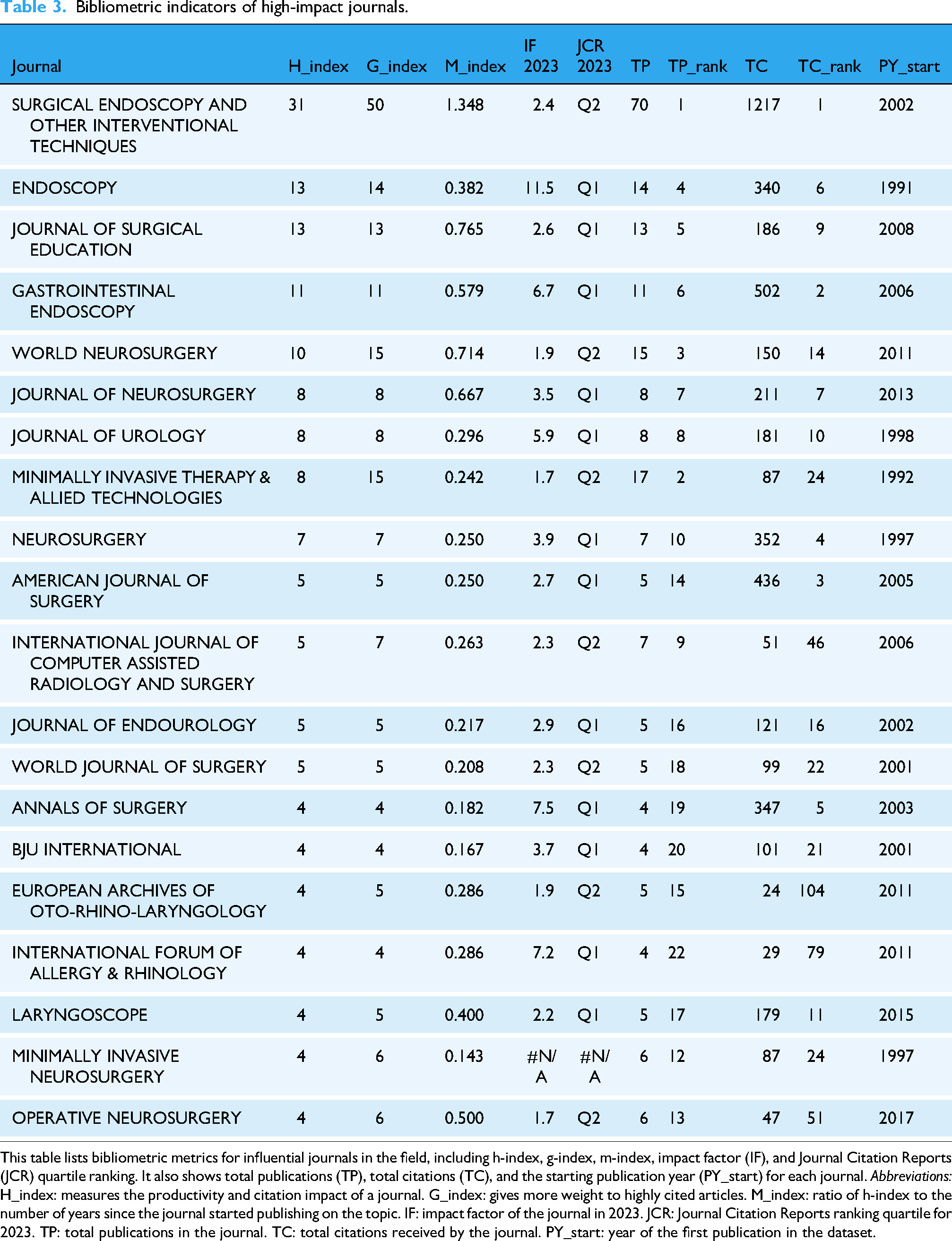
This table lists bibliometric metrics for influential journals in the field, including h-index, g-index, m-index, impact factor (IF), and Journal Citation Reports (JCR) quartile ranking. It also shows total publications (TP), total citations (TC), and the starting publication year (PY_start) for each journal. Abbreviations: H_index: measures the productivity and citation impact of a journal. G_index: gives more weight to highly cited articles. M_index: ratio of h-index to the number of years since the journal started publishing on the topic. IF: impact factor of the journal in 2023. JCR: Journal Citation Reports ranking quartile for 2023. TP: total publications in the journal. TC: total citations received by the journal. PY_start: year of the first publication in the dataset.
Journal impact metrics revealed a wide range of influence, with 11 journals ranked in the first quartile (Q1) of the 2023 JCR. Co-occurrence and coupling network analyses (Figure 5A, 5B) demonstrated strong interconnections among journals, with Surgical Endoscopy and Other Interventional Techniques, Gastrointestinal Endoscopy, and Endoscopy forming the central nodes in the network. These findings highlight the dominance of specialized surgical and endoscopy journals in disseminating VR research.

Journal analysis: co-occurrence and bibliographic coupling networks. (A) Co-occurrence network of journals based on citation patterns, highlighting the most influential journals in the field. (B) Bibliographic coupling network showing clusters of journals grouped by similar research themes.
Analysis of author contributions
The field is characterized by a diverse group of influential researchers (Table 4). In terms of citation impact, Darzi A and Grantcharov Teodor P were the most highly cited authors, each with 369 citations. De Suvranu emerged as the most productive author with 10 publications, followed by Konge Lars (8 publications) and Hashizume Makoto (7 publications). Impact metrics showed six researchers achieving an h-index of 6, with Konge Lars and Hashizume Makoto also demonstrating strong g-indices of 8 and 7, respectively.
High impact authors.

This table summarizes bibliometric indicators for leading authors in the field, including h-index, g-index, m-index, total publications (TP), fractional publications (TP_frac), and total citations (TC). Abbreviations: H_index: measures an author's productivity and citation impact. G_index: gives more weight to highly cited publications. M_index: ratio of h-index to the number of years the author has been active in the field. TP: total publications authored. TP_frac: FRACTIONAL contribution to total publications (accounting for co-authorship). TP_rank: rank based on total publications. TC: total citations. TC_rank: rank based on total citations.
Collaboration network analysis (Figure 6) revealed four major author clusters. The red cluster included Spanish-speaking researchers, while the yellow cluster centered on authors like Klopp Ann and Zhang Jinghua. The blue and green clusters represented distinct collaborative groups focused on specific research themes. Notably, these clusters operated largely independently, with limited cross-cluster collaboration. This fragmentation suggests a need for greater interdisciplinary collaboration to unify research efforts.

Author collaboration network in endoscopic virtual reality research. Visualization of the author collaboration network, where node size reflects the number of publications, and connecting lines represent co-authorship relationships.
Analysis of research topics and trends
The co-occurrence analysis identified five distinct thematic clusters in endoscopic VR research (Figure 7A). Cluster 1 contained 41 items and appeared in red in the visualization. This cluster included clinical and imaging-related terms such as “anatomy,” “augmented reality,” “endoscopy,” “surgery,” “ct,” “angiography,” and “bronchoscopy.” The terms in this cluster primarily related to medical procedures, imaging techniques, and clinical applications. Cluster 2 comprised 22 items and was shown in green. The cluster contained terms related to training assessment and simulation, including “colonoscopy simulator,” “endoscopy simulator,” “operating-room performance,” “feedback,” and “validation.” The keywords in this group focused on simulation tools and assessment methods. Cluster 3 consisted of 14 items displayed in yellow. This cluster contained terms such as “fundamentals,” “laparoscopic skills,” “operating-room,” “performance,” and “proficiency.” The keywords centered on performance measurement and surgical competency evaluation. Cluster 4 included 13 items and appeared in blue. The terms in this cluster included “acquisition,” “curriculum,” “laparoscopic surgery,” “learning-curve,” and “minimally invasive surgery.” These keywords related to procedural training and educational processes. Cluster 5 contained 12 items shown in purple. This cluster included terms such as “construct,” “objective assessment,” “psychomotor-skills,” “reliability,” and “validity.” The keywords in this group focused on assessment methodology and validation frameworks. In the network visualization, certain terms showed high link strength values: “performance” (417), “skills” (308), and “validation” (297). These terms appeared as central nodes with connections to multiple clusters in the visualization.
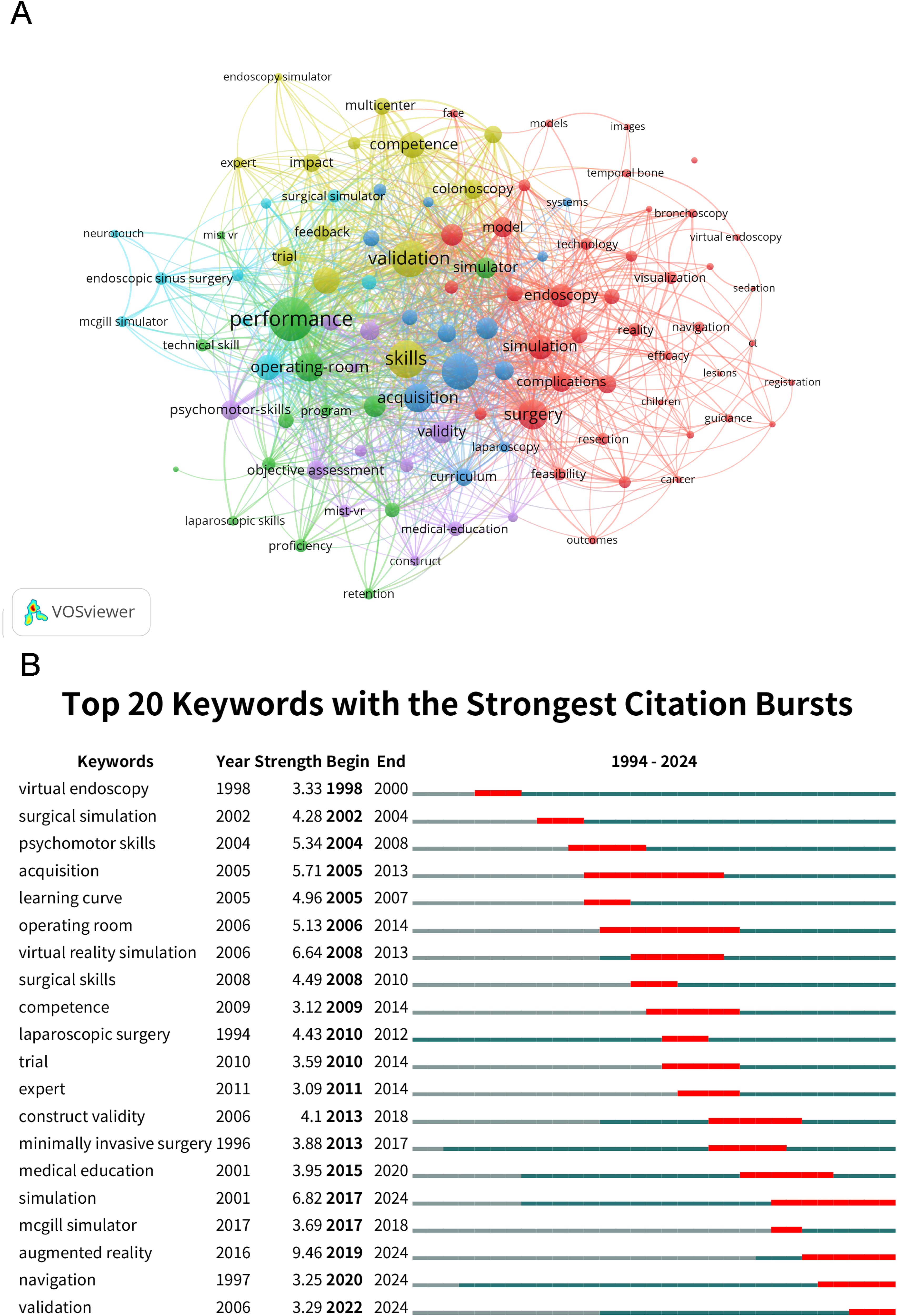
Keyword analysis: co-occurrence and citation burst trends. (A) Keyword co-occurrence network identifying major research themes in endoscopic virtual reality applications. (B) Timeline view of the top 20 keywords with the strongest citation bursts, illustrating the evolution of research priorities from 1991 to 2024.
The temporal evolution of research focus was evident through the keyword burst analysis spanning from 1994 to 2024 (Figure 7B). Early research emphasis (1998–2000) centered on “virtual endoscopy” with a burst strength of 3.33, followed by “surgical simulation” (2002–2004, strength 4.28). The middle period showed a significant interest in educational aspects, with “psychomotor skills” (2004–2008, strength 5.34) and “learning curve” (2005–2007, strength 4.96) emerging as key topics. The “operating room” implementation phase (2006–2014, strength 5.13) bridged technical development with practical application. Recent years (2020–2024) have witnessed the emergence of new research priorities. “Augmented reality” demonstrated the strongest burst strength (9.46) among recent keywords, maintaining prominence from 2019 to 2024. “Navigation” (2020–2024, strength 3.25) and “validation” (2022–2024, strength 3.29) also emerged as significant recent research focuses. “Simulation” maintained consistent interest with the second-highest burst strength (6.82) extending from 2017 to 2024.
Discussion
Key finding
This bibliometric analysis reveals a clear evolution in endoscopic VR research, progressing through distinct phases. The initial experimental phase (1991–2000) 21 explored the feasibility of VR for endoscopy, primarily within gastrointestinal diagnosis and therapeutic procedures. This was followed by its commercialization in the early 2000s, 22 driven by the development of simulation-based training programs, especially for gastrointestinal endoscopy and minimally invasive interventions. Significant growth occurred between 2010 and 2019, propelled by advancements in hardware, 23 adoption in surgical training, 24 and demonstrated reductions in error rates. 25 The recent stabilization observed between 2020 and 2024 indicates a maturing field with a shift toward specialized applications, not only in endoscopic medicine but also extending into robotic-assisted and minimally invasive surgery. This progression is reflected in the multidisciplinary publication landscape, with Surgical Endoscopy and Other Interventional Techniques leading in output and impact, alongside contributions from diverse specialized journals addressing complementary priorities.
Geographically, the United States leads in publication volume and total citations, while European institutions demonstrate superior citation efficiency, reflecting differing research approaches. For instance, Austria, Ireland, and Sweden achieve high average citations per article, likely due to a focus on high-impact, targeted studies. Institutionally, the University of Toronto has played a pivotal role with its comprehensive simulation centers, 4 Harvard University contributes through its surgical planning protocols, 26 and institutions such as Copenhagen, Kyushu, and McGill have developed specialized curricula. 27 However, author collaboration remains fragmented, with six largely independent clusters and limited cross-pollination of methodologies. Only a few bridging connections, such as the link between the yellow and blue clusters through Colbert Lauren, suggest sparse interdisciplinary integration, highlighting an opportunity to strengthen collaborative efforts across research groups.
Research topics and frontiers
Thematic analysis identified five distinct research clusters, each representing key areas of focus and technological advancement in the field and highlighting the scope of VR application in diagnosis and therapy, with the most concrete achievements observed in gastrointestinal endoscopy and growing promise in robotic-assisted and minimally invasive surgery.
Cluster 2 highlights training assessment and simulation tools, emphasizing the development of high-fidelity platforms for surgical education. Keywords such as “colonoscopy simulator,” “endoscopy simulator,” and “validation” underline the focus on creating realistic training environments. Early studies demonstrated that VR significantly improves technical skills and operating room performance, 24 and subsequent research has focused on validating these systems’ educational effectiveness. 29 The most sustained and standardized training applications have been within diagnostic and therapeutic endoscopy, with expanding adoption in laparoscopic and robotic surgery. Validation frameworks have been instrumental for establishing metrics to assess both technical capabilities and pedagogical outcomes. For example, Khan et al.'s Cochrane review confirmed VR's effectiveness across multiple specialties. 31 This cluster continues to drive innovation in simulation-based training, addressing challenges such as reduced residency work hours and the increasing complexity of surgical techniques.
Cluster 3 centers on performance measurement and surgical competency evaluation. Terms like “performance,” “proficiency,” and “fundamentals” highlight the emphasis on standardized metrics for assessing surgical skills. Performance emerged as the keyword with the highest link strength, reflecting its centrality across research domains. Multi-center studies have developed robust metrics linking simulator performance to clinical proficiency, 32 with programs like the Fundamentals of Laparoscopic Surgery (FLS) setting proficiency thresholds based on VR-based metrics. 33 Modern systems now incorporate parameters such as procedure time, instrument path length, and error rates, enabling objective and comprehensive assessments. 34 This emphasis on standardized evaluation has facilitated evidence-based approaches to surgical training and certification, ensuring trainees meet competency requirements before performing clinical procedures.
Cluster 4 addresses procedural training and educational processes, with terms such as “curriculum,” “learning curve,” and “minimally invasive surgery” reflecting the integration of VR into surgical education frameworks. Between 2015 and 2020, increased emphasis on competency-based education led to the widespread adoption of VR in medical curricula. 35 The McGill Simulator Program exemplifies this trend, contributing to the development of structured, evidence-based training methodologies. 36 This cluster highlights the transformative role of VR in addressing gaps in traditional training methods and improving procedural proficiency through immersive, hands-on learning experiences.
Cluster 5 focuses on assessment methodology and validation frameworks, emphasizing rigorous evaluation standards. The early emphasis on psychomotor skills (2004–2008) laid the groundwork for standardized protocols in laparoscopic procedures. 37 Contemporary validation frameworks (2022–2024) now encompass advanced technologies, including AR-enhanced navigation systems, which have been shown to improve surgical outcomes. 38 Recent studies in robotic and complex therapeutic endoscopy also report promising results, but the largest evidence base remains in gastrointestinal endoscopic training and simulation. This cluster reflects the field's commitment to methodological rigor, ensuring that VR-based systems are both reliable and effective for clinical and educational applications.
The temporal evolution of research priorities reveals distinct phases driven by technological advances and clinical needs. The initial focus on virtual endoscopy (1998–2000) coincided with developments in 3D visualization and the growing demand for non-invasive diagnostics. 39 This shifted toward surgical training applications following Seymour et al.'s landmark randomized study, 40 which demonstrated that VR-trained residents performed faster and with fewer errors compared to traditionally trained peers. This finding catalyzed interest in simulation (2002–2004) and psychomotor skills assessment (2004–2008), coinciding with the implementation of the FLS program. 41
The middle period (2006–2014) saw increased emphasis on education and safety, with keywords like “learning curve” and “operating room” reflecting efforts to optimize training efficiency and improve patient outcomes.42,43 These developments aligned with the introduction of competency-based education frameworks and quality improvement tools, bridging the gap between training and clinical application.
In recent years (2020–2024), the convergence of VR with AR, MR, and AI has driven innovation in areas such as navigation systems (burst strength 3.25) and high-fidelity simulation. 44 For example, Zhang et al.'s work on autostereoscopic 3D AR navigation for laparoscopic surgery demonstrates the potential of integrating advanced visualization with VR systems. 44 Similarly, validation frameworks are evolving to address these advancements, as seen in the development of high-fidelity VR courses for laparoscopic appendectomy. 45 While the greatest research output and clinical achievements are currently in gastrointestinal endoscopy, there is rapid progress in extending these methodologies to robotic-assisted and minimally invasive surgery, particularly for complex diagnostic and therapeutic interventions. These trends highlight the field's trajectory toward greater technological sophistication and clinical applicability.
Interconnections and future directions
The findings from this analysis reveal several opportunities to advance the field further. The fragmented nature of author collaboration suggests a need for greater interdisciplinary partnerships to integrate diverse methodologies and foster innovation. Strengthening cross-cluster collaboration could accelerate progress, particularly in areas like combining simulation with AR-enhanced systems. Additionally, as the field matures, there is a growing need to establish globally accepted, standardized evaluation frameworks that can adapt to the increasing complexity of VR-based tools. Moreover, future research should prioritize multi-center trials and clinical implementation studies, especially in gastrointestinal endoscopy, robotic-assisted surgery, and emerging therapeutic procedures, to confirm the clinical impact of VR technologies in both diagnosis and therapy.
Strengths and limitations
The strengths of this bibliometric analysis include its comprehensive examination of research trends across a significant timespan (1991–2024), providing insights into the evolution of VR applications in endoscopic procedures. The integration of multiple bibliometric indicators, including citation analysis, cooperation networks, and burst detection, offers a multi-dimensional understanding of research developments and collaborative patterns in this field.
However, this study has several limitations. First, the analysis was restricted to publications indexed in the WoSCC, excluding relevant studies available in other databases such as Scopus, PubMed, or IEEE Xplore. As a result, the findings may not fully represent the breadth of global research, particularly in disciplines or regions where WoS indexing is less common. This restriction may also exclude non-journal contributions, such as conference proceedings, which are often pivotal in technology-driven fields like VR.
Second, focusing exclusively on English-language publications introduces potential language bias, leading to the omission of important research published in non-English journals. This limitation could disproportionately affect findings from countries where English is not the primary language of academic dissemination.
Third, citation-based metrics, while valuable for identifying influential research, are subject to inherent biases. High citation counts may not always equate to high-quality or impactful work, as factors such as journal reputation, author prominence, and regional publication practices can influence citation patterns. Additionally, newer studies may be underrepresented in citation analyses due to the time lag required to accumulate citations. As a result, some recent advancements in VR applications for endoscopy may not yet be captured in this analysis.
Finally, while this study highlights collaborative patterns and institutional contributions, it does not directly evaluate the qualitative impact of these collaborations or delve into the specific content of research outputs. Future studies could address this gap by integrating more qualitative approaches, such as systematic reviews or meta-analyses, to complement the bibliometric findings.
Conclusion
This bibliometric analysis demonstrates the evolution of VR applications in endoscopic procedures, progressing from early visualization tools to advanced platforms for surgical training and guidance. The research landscape highlights five key clusters, with clinical applications, training assessment, and performance evaluation emerging as central areas. While the United States leads in output, European institutions excel in citation efficiency, and recent trends focus on AR, navigation systems, and validation frameworks. These findings offer actionable insights for future research and clinical applications. The growing integration of AR and AI presents opportunities to enhance surgical precision, patient safety, and training effectiveness. Prospective studies should investigate the clinical efficacy of these technologies through rigorous trials, particularly in minimally invasive and robotic-assisted procedures. Standardized assessment protocols and validation frameworks must be prioritized to ensure consistency across VR platforms and facilitate their adoption into clinical workflows. Interdisciplinary collaboration is essential to bridge gaps between technical, educational, and clinical expertise. By fostering such partnerships and advancing evidence-based methodologies, VR technologies can continue to transform surgical education and practice, ultimately improving patient outcomes.
Scope statement
This study conducts a bibliometric analysis to explore the evolution and current landscape of VR applications in endoscopic medicine from 1991 to 2024. An examination of 540 articles reveals a consistent growth trend, peaking in 2019, with the United States as the leading contributor. Analysis tools like VOSviewer and CiteSpace identify five primary research clusters: clinical applications, training assessment tools, performance measurement, procedural training, and validation frameworks. Key trends include an emphasis on AR, navigation, and performance validation methods. This research underscores the importance of establishing standardized assessment protocols and integrating MR surgical guidance, positioning itself as a significant contribution to the literature on VR in endoscopic procedures. The findings will guide future research directions, promoting advancements in both medical training and procedural efficacy.
Footnotes
Acknowledgment
None.

Ethical consideration
Not applicable.
Consent to participate
Not applicable.
Consent for publication
Not applicable.
Authors’ contributions
Conception and design was done by QiW; administrative support by DZ; data analysis and interpretation by QWYP and XC; manuscript writing was done by all authors; final approval of manuscript was done by all authors.
Funding
The authors received no financial support for the research, authorship, and/or publication of this article.
Declaration of conflicting interests
The authors declared no potential conflicts of interest with respect to the research, authorship, and/or publication of this article.
Data availability statement
All data generated or analyzed during this study are included in this published article.