



Abstract
Objective
To examine how Chinese doctors linguistically adapt to patients during online medical consultations using Communication Accommodation Theory (CAT), and how such strategies vary across clinical contexts.
Methods
We analyze N = 200 text-based doctor–patient consultations sampled from the MedDialog-CN dataset—the largest public corpus of Chinese online medical consultations. Dialogues were coded using CAT's five strategic categories: approximation, interpretability, discourse management, interpersonal control, and emotional expression. Each category was further divided into specific tactics through grounded theory. Quantitative frequency analysis and qualitative thematic analysis were employed to assess doctors’ communication patterns and associated patient responses.
Results
Across 200 consultations, doctors predominantly relied on maintenance (74.5%) within approximation, indicating limited linguistic adaptability. Responsiveness (58%) and clarification (30.5%) were common, while simplification (10%) and empathy (16%) remained underutilized. When further categorized along the acute–chronic axis (acute = 110; chronic = 90), acute consultations displayed a directive-and-clarifying profile—higher convergence, topic initiation, assertiveness, and situational empathy—whereas chronic consultations showed more continuity-oriented patterns emphasizing maintenance, topic shifting, and support offers. These contrasts highlight how accommodation varies with the immediacy and continuity demands of different medical conditions.
Conclusions
The findings reveal overreliance on stable, professionalized talk and underuse of adaptive, empathetic strategies, signaling a gap between current practice and patient-centered ideals. Incorporating CAT-based communication training could enhance linguistic flexibility, interpretive clarity, and emotional engagement in Chinese telemedicine, fostering clearer, more compassionate, and culturally attuned digital healthcare.
Keywords
Introduction
Effective communication is foundational to healthcare, directly influencing patient outcomes, satisfaction, and the overall quality of medical services.1–3 Clear, empathetic, and efficient communication improves patient understanding, adherence to treatment, and psychological well-being, 4 while also reducing medical errors and enhancing clinical outcomes. 5 These benefits underscore the central role of doctor–patient communication in delivering safe, high-quality care.
Traditional face-to-face consultations are supported by non-verbal cues—such as eye contact, body language, and spatial dynamics—that enhance interpersonal understanding. 6 However, the rise of telemedicine, accelerated by digital health innovations and healthcare reform in China,7,8 introduces new challenges. Without the support of non-verbal cues such as eye contact or body language, physicians must rely solely on text or screen-based communication, while pressures for efficiency further constrain opportunities for patient-centered interaction. 9
In China, these difficulties are compounded by distinctive contextual factors. First, physician shortages and high patient demand have fostered habitually brief consultations, leaving little room for detailed explanation or empathy. 10 Second, collectivist norms and high power distance promote deference to medical authority, which can suppress questioning and mask unmet communicative needs. 11 Third, persistent tensions in doctor–patient relationships—including mistrust and concerns about attitude, communication quality, and perceived empathy—may encourage more cautious or authoritative styles. 12 Together, these systemic and cultural dynamics make online medical communication particularly complex. It is a dynamic, co-constructed process shaped by the perceptions, emotions, and goals of both parties, and thus requires a framework that can capture both adaptation and misalignment.
Communication Accommodation Theory (CAT) offers such a framework. Rooted in social psychology, CAT explores how individuals adjust their speech, tone, and discourse to manage social distance and relational goals. 13 In clinical settings, CAT sheds light on how providers may adapt their communication—by simplifying language, mirroring patient speech, or expressing empathy—to foster trust and understanding. These adaptive strategies are particularly valuable in digital health, where traditional rapport-building cues are absent.
This study applies CAT to Chinese telemedicine, an underexplored setting. By analyzing real-life doctor–patient dialogues from the MedDialog-CN dataset, it identifies the communication strategies doctors use in online consultations and interprets their relevance to patient-centered care. In doing so, the study aims to (1) map the patterns of communicative adaptation in virtual consultations, and (2) generate practical insights for improving digital bedside manner through targeted training. Ultimately, this research seeks to contribute to the development of scalable, evidence-based tools that support clearer, more compassionate, and more effective communication in China's rapidly evolving digital healthcare landscape.
Effective communication in healthcare
In healthcare, effective communication goes beyond simple information exchange, significantly influencing treatment outcomes, patient satisfaction, and overall healthcare quality.14–16 While smooth communication among health professionals can facilitate better interprofessional collaboration17,18 and reduce miscommunication-related errors, 19 communication between doctors and patients plays an even more critical role throughout the medical treatment process and significantly impacts the final outcome. When patients feel comfortable conversing with doctors, they are more likely to disclose critical information regarding their symptoms, lifestyle, and medication adherence, enabling more accurate diagnoses and individualized treatment plans. 20 Research also indicates that communication clarity, empathy, and efficiency are key to enhancing patient understanding and adherence. 21 A transparent and two-way communication helps doctors understand the patients’ condition better and makes patients feel valued, hence improving diagnostic accuracy and treatment adherence.
In the evolving landscape of telemedicine, particularly through text-based online medical consultations, effective communication stands as both a cornerstone and a challenge. 22 The transition from face-to-face interactions to digital platforms necessitates a nuanced understanding of how best to maintain clarity, empathy, and personal connection. 23
Telemedicine typically refers to delivering medical care remotely through technologies such as voice calls, email, video calls, and text messaging. 24 Among them, communication through text messaging is often considered to be “quasi-synchronous,” or a “hybrid” of written and spoken language.25–27 In text-based consultations, the absence of vocal tone and body language complicates trust-building between doctors and patients. Therefore, fostering effective communication is crucial in bridging the digital divide and maintaining a sense of care and empathy in telemedicine. 27
Theoretical foundations: communication accommodation theory (CAT)
Communication Accommodation Theory (CAT), developed by Howard Giles in the 1970s, provides a robust framework for understanding how individuals adapt their communication in social interactions. 28 This theory, recognized for its broad applicability across communicative behaviors,29,30 suggests individuals adjust their speech, tones, and non-verbal cues either to accommodate or distance from their interlocutors, driven by motivations like seeking approval, enhancing interaction efficiency, or expressing identity. 31
In healthcare communication, CAT has been extensively applied to improve interactions between healthcare providers and patients. 32 For example, when applying the approximation strategy of CAT to the study in healthcare communication, studies have shown that convergence—where providers align their communication styles with patients—can enhance mutual understanding and trust, leading to higher patient satisfaction and better adherence to treatment plans. 33 On the other hand, divergence, where providers emphasize differences to assert authority, can sometimes hinder effective communication, particularly in settings where patients feel less empowered. 34 These processes are instrumental in healthcare, either facilitating or impeding effective patient-provider interactions.
CAT identifies five sociolinguistic strategies—approximation, interpretability, interpersonal control, discourse management, and emotional expression—that offer a multifaceted approach to improving healthcare communication. 35 For instance, the use of interpretability strategies, such as simplifying complex medical information, has been linked to improved patient understanding and satisfaction, particularly in populations with lower health literacy. 36 Emotional expression strategies, like showing empathy, have also been shown to reduce patient anxiety and increase trust in healthcare providers. 37 Each of these strategies plays a critical role in shaping the dynamics of interaction, particularly in settings like healthcare, where effective communication is essential for positive outcomes.
Despite its established applicability across various domains, CAT's exploration in online healthcare, especially in text-based consultations, remains sparse. Most research to date has focused on traditional, in-person healthcare settings, leaving a gap in understanding how CAT principles translate to digital environments.38,39 Moreover, existing literature on online healthcare often addresses only specific communication aspects, resulting in a fragmented view of digital healthcare interactions. 40
Applying CAT to online healthcare helps address the communicative nuances required in telemedicine, aligning healthcare providers’ strategies with patients’ expectations and needs. This alignment is crucial for fostering a patient-centered approach that is responsive to the unique dynamics of digital interactions.32,40 Given the challenges posed by the digital medium, employing CAT in this study allows for a systematic analysis of how accommodation strategies can mitigate the limitations of text-based communication, ultimately enhancing the efficacy of telemedicine. By explicitly linking CAT's strategies to the observed practices in online consultations, this research not only fills a significant gap in the existing literature but also provides practical insights for improving digital healthcare communication and patient outcomes.
While several frameworks illuminate clinical communication, CAT is uniquely suited to text-based telemedicine at scale. Patient-centered models articulate values (e.g., shared understanding, empathy) but offer less leverage for coding moment-by-moment linguistic adjustments across large corpora.41,42 Conversation analysis yields fine-grained sequential insight yet is not designed to aggregate accommodation patterns quantitatively. 43 Grounded theory clarifies how interlocutors achieve mutual understanding but foregrounds comprehension more than relational alignment. 44 Politeness theory explains facework and mitigation but does not model the bi-directional dynamics of convergence and divergence across lexical, syntactic, and discourse levels. 45 By contrast, CAT explicitly theorizes adaptation (approximation, interpretability, discourse management, interpersonal control, and emotional expression), maps cleanly onto observable text-based indicators in online consultations, and supports mixed-methods analysis linking tactic frequencies with patient-centered outcomes.28,32,46
Telemedicine amplifies the very conditions CAT targets: communicative distance, reduced nonverbal bandwidth, and rapid, quasi-synchronous turn-taking in text.47–49 Because text interactions are fully logged, CAT's tactics can be operationalized at the exchange level and aggregated to consultations and the corpus, enabling scalable, reproducible analysis with mixed methods. In the Chinese context, where hierarchical dynamics and expectations of efficiency are salient, CAT's interpersonal control and emotional expression dimensions are especially diagnostic, offering clearer levers for training and platform design than models centered solely on empathy or patient-centred ideals.
In clinical medicine, distinguishing between acute and chronic conditions is fundamental for understanding communication demands. Acute conditions have a sudden onset, short duration, and may require urgent attention (e.g., infections, injuries, asthma attacks) 1 , whereas chronic conditions progress slowly and persist for months or years (e.g., diabetes, hypertension, or arthritis) 2 . This acute-chronic axis has direct implications for telemedicine: acute consultations often require swift information exchange and decisive guidance, whereas chronic management depends on sustained dialogue, patient education, and trust-building. Because CAT models convergence and divergence as dynamic, bi-directional processes, it is well suited to capturing the communicative shifts demanded across this spectrum.
Using CAT as a framework, this study examines communication patterns between doctors and patients in Chinese online medical consultations. Specifically, it seeks to address two key research questions:
How do Chinese doctors employ Communication Accommodation Theory (CAT) strategies to adapt their communication in text-based online medical consultations? How do these strategies differ between acute and chronic consultations, and, in the full sample, what patient-response patterns (e.g., acknowledgements, follow-up queries) accompany their use?
Methodology
Data collection
This study draws on the MedDialog-CN dataset, 50 the most extensive publicly available collection of Chinese online medical consultation dialogues to date. MedDialog-CN's significance stems from three attributes that ensure its suitability for this study's objectives. First, it contains over 1.1 million dialogues and 4 million utterances, sourced from China's premier online consultation platform, Haodf.com, between January 2015 and December 2020. This extensive data volume provides a robust basis for comprehensive analysis across diverse interactions. Second, MedDialog-CN spans 29 general categories and 172 specialties, supporting relevance across general and specialist care. Third, it represents all 31 provincial-level regions of China (urban and rural), capturing heterogeneous patient experiences.
For this study, we focused on dialogues from the year 2020, a period markedly affected by the COVID-19 pandemic in China, which likely influenced both the volume and nature of online consultations. Rigorous scrutiny was applied to each dialogue, with criteria ensuring completeness and coherence. Dialogues that were truncated (e.g., if a patient exited the conversation prematurely) or disrupted due to technical issues (such as connection outages) were omitted from consideration. The sampling unit was the individual doctor–patient consultation. The refined frame comprised 418 dialogues; to align with Communication Accommodation Theory (CAT), which benefits from multiple turns, we removed transcripts with fewer than five exchanges, leaving 231 entries. From this pool, we drew a simple random sample without replacement to select N = 200 dialogues for full analysis. This carefully selected dataset underpins our analysis of telemedicine communication strategies.
In addressing ethical considerations, all consultation transcripts in MedDialog-CN are fully de-identified; no names, contact details, or other direct identifiers are included, and no attempt at re-identification was made. This anonymization upholds patient confidentiality and privacy and ensures that the analysis focuses solely on communication patterns rather than on individual patients. The study, therefore, constitutes minimal-risk secondary research using existing text-based data. Ethical approval, with a waiver of individual informed consent, was granted by the Ethics Committee of Shanghai Ninth People's Hospital, Shanghai Jiao Tong University School of Medicine (Approval/Waiver No.: SH9H-2023-T459-2). The committee confirmed that the present study is included under this protocol and that analysis of fully de-identified data is compliant with institutional and national regulations. All data were accessed in accordance with Haodf.com's terms of service.
Data analysis
We employed mixed quantitative-qualitative analysis to examine CAT-based communication patterns. Because MedDialog-CN consists of native text transcripts, no audio transcription was required and thus no transcription software was used. Dialogues were preprocessed to remove extraneous content and systematically coded in NVivo (version 12), which ensured consistency and efficiency for large-scale text data. The coding was undertaken by a pair of researchers trained in healthcare communication, with a preliminary pilot test conducted on a subset of dialogues to refine the coding schema.
The coding process focused on identifying the presence (yes/no) of CAT strategies—approximation, interpretability, discourse management, interpersonal control, and emotional expression. These strategies were further broken down into specific tactics, such as convergence, maintenance, and divergence within the approximation strategy, allowing for a detailed assessment of their frequency and distribution.
To ensure coding reliability, we calculated inter-coder agreement using Cohen's Kappa on a randomly selected subset of dialogues, consistently achieving values above 0.80, indicating substantial agreement. Discrepancies were resolved through discussion to maintain alignment with CAT's conceptual framework. Each CAT tactic was coded at the exchange level as present or absent, and these codes were then aggregated at the consultation and corpus levels to produce the counts and percentages reported in the Results. This categorical, descriptive content analysis enabled a systematic examination of communication strategies across multiple interactions.
Qualitative analyses, including content and thematic analysis, were then conducted to explore how doctors adapt their communication strategies in the virtual context to enhance patient care. These analyses focused on the impact of these communication strategies on patient outcomes such as understanding, satisfaction, and emotional engagement.
To support the subsequent comparative analysis of consultation types, all 200 dialogues were dichotomously labeled as acute (e.g., infections, injuries, asthma attacks) or chronic (e.g., diabetes, hypertension, arthritis). This classification was jointly conducted by three physician co-authors with first-hand experience on Haodf.com. Labels were assigned based on the presenting complaint and consultation content; disagreements were resolved through discussion to consensus. These labels were used solely for descriptive comparisons of CAT strategies across encounter types.
To validate the findings and ensure their practical relevance, an expert review was conducted with three practicing doctors from Haodf.com, the platform providing the dataset. Their expert feedback helped ground the analysis in real-world healthcare communication practices, enhancing the study's applicability and reliability.
Results
This study analyzes doctor–patient interactions in Chinese online medical consultations through the lens of Communication Accommodation Theory (CAT). By utilizing the comprehensive MedDialog-CN dataset, 50 we categorized communicative behaviors into specific tactics under CAT's five principal strategies: approximation, interpretability, discourse management, interpersonal control, and emotional expression. 28 The following section details each strategy and the specific tactics that emerged from our dataset, developed using grounded Theory.
To provide conceptual clarity, Table 1 summarizes the CAT strategies and tactics, alongside their classic definitions and how they were operationalized in this study. This table serves as a bridge between the theoretical framework and the dataset-specific coding, while Table 2 later reports their observed frequencies.
CAT strategies, textbook definitions, and their operationalization in Chinese online consultations.
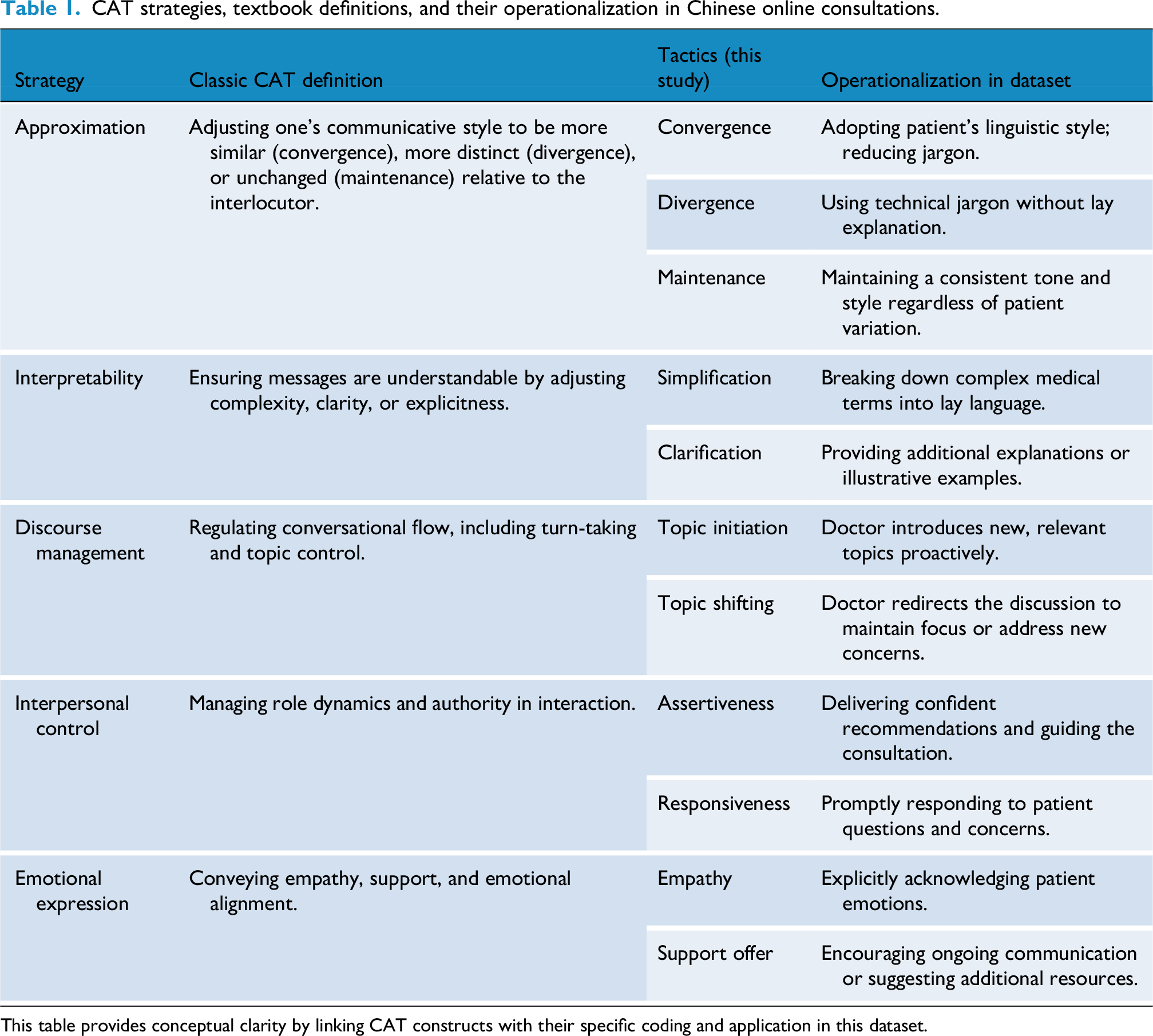
This table provides conceptual clarity by linking CAT constructs with their specific coding and application in this dataset.
Accommodation strategies observed in Chinese online medical consultations.
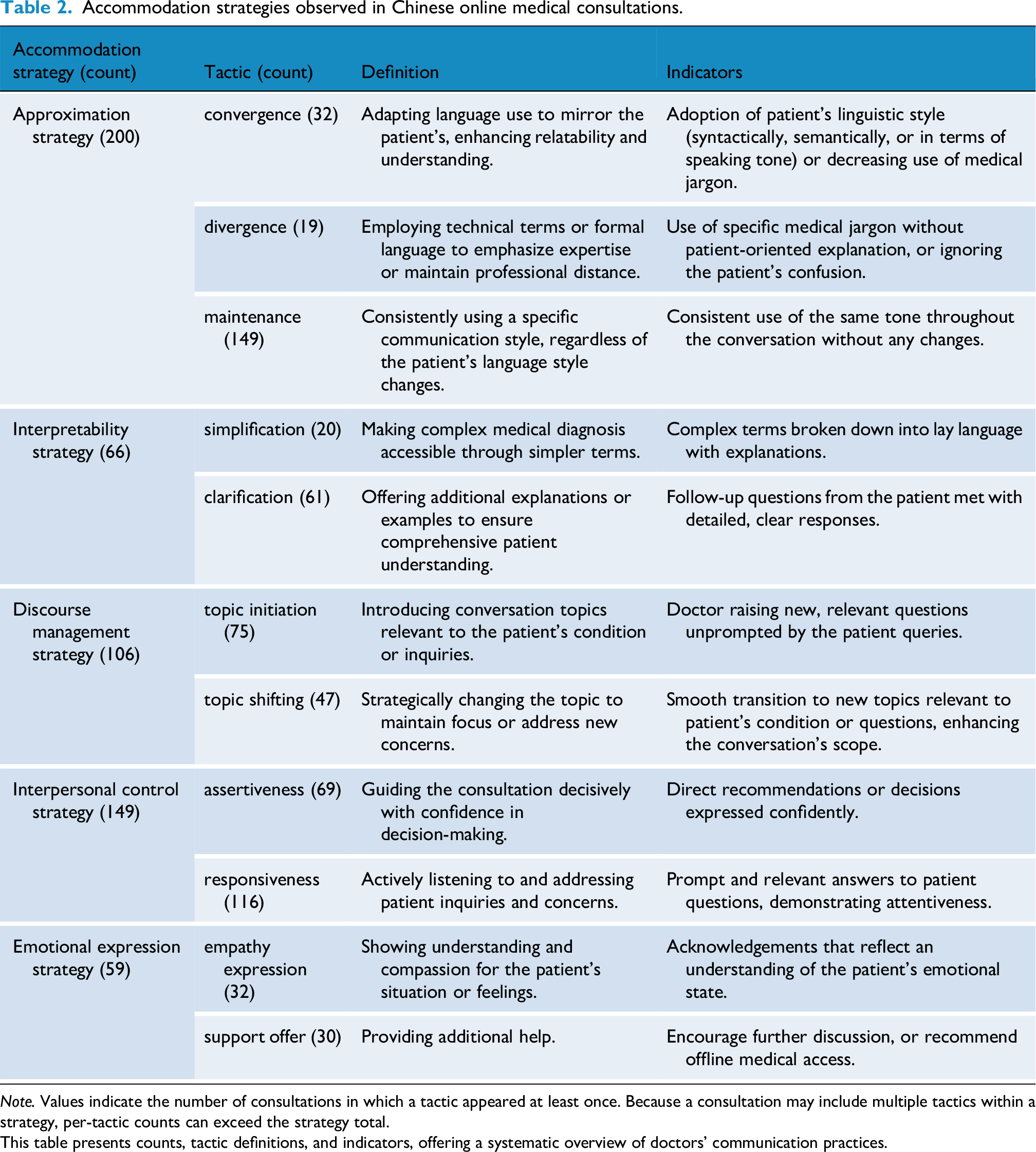
Note. Values indicate the number of consultations in which a tactic appeared at least once. Because a consultation may include multiple tactics within a strategy, per-tactic counts can exceed the strategy total.
This table presents counts, tactic definitions, and indicators, offering a systematic overview of doctors’ communication practices.
Approximation involves adjusting one's speech to be more similar (convergence), more distinct (divergence), or maintaining the same style (maintenance) as the interlocutor. In CAT, convergence refers to aligning one's communicative style with that of the interlocutor to foster understanding and rapport.51,52 In our dataset, convergence appeared in 32 instances, where doctors adopted patients’ linguistic style through syntactical or semantic adjustments and reduced medical jargon to make communication more accessible. Divergence, observed in 19 instances, occurred when doctors employed medical jargon without patient-oriented explanations. 53 Maintenance, the most common tactic with 149 instances, reflected doctors’ consistent tone and communication style throughout the consultation, 51 regardless of changes in patient language.
Interpretability aims to ensure messages are understandable to patients. In our dataset, simplification occurred in 20 instances, where doctors broke down complex terms into lay language to enhance comprehension.36,54 Clarification was more common, with 61 instances, where doctors provided additional explanations or examples to address patient queries. 35
Discourse management regulates conversational flow. Topic initiation was frequent (75 instances), as doctors proactively raised new, relevant questions. Topic shifting occurred in 47 instances, where doctors redirected the discussion to maintain focus or address new concerns. 55
Interpersonal control manages role dynamics and consultation flow. Assertiveness appeared in 69 instances, where doctors offered confident recommendations, while responsiveness was more frequent (116 instances), reflecting prompt attention to patient inquiries.
Emotional expression, critical for building rapport, was evident in 32 instances of empathy, where doctors acknowledged patients’ feelings, and in 30 instances of support offers, where doctors encouraged ongoing communication or suggested additional resources.
As shown in Table 2, maintenance within approximation was present in 149/200 consultations (74.5%), convergence in 32/200 (16.0%), and divergence in 19/200 (9.5%). For interpretability, simplification appeared in 20/200 (10.0%) and clarification in 61/200 (30.5%). Discourse management tactics were observed in 106/200 consultations, interpersonal control in 149/200, and emotional expression in 59/200, with tactic-level counts reported below.
Dominance of maintenance in approximation strategy
The analysis of CAT strategies employed in Chinese online medical consultations reveals a predominance of the maintenance tactic within the approximation strategy. Maintenance appeared in 149/200 consultations (74.5%), where doctors persisted in a relatively stable communication style regardless of changes in the patient's linguistic or contextual changes. Convergence occurred in 32/200 consultations (16.0%), in which doctors adopted patients’ linguistic style and reduced medical jargon, whereas divergence was observed in 19/200 consultations (9.5%), typically through the use of technical terms without lay explanation.
To examine how these approximation tactics related to patient behavior, we coded patients’ immediate responses following each tactics. Table 3 summarizes the main patient-response categories and indicators associated with convergence, divergence, and maintenance.
Patient responses to approximation tactics in Chinese online consultations.

As shown in Table 3, consultations coded as convergence were most often followed by acknowledgments of understanding and expressions of relief. Divergence frequently co-occurred with repeated questions on the same topic and explicit requests for simplification. Under maintenance, most consultations showed a steady pattern of responses, with only a small number coded as detached or minimally responsive.
Underutilization of interpretability and emotional expression strategies
The analysis also showed that interpretability and emotional expression strategies were used in 33% and 29.5% of consultations, respectively. Within interpretability, simplification was observed in 10% of consultations, while clarification was more common (30.5%), indicating that doctors more frequently elaborated or rephrased information than simplified medical terminology. To further understand the effects of these interpretability tactics, we examined patients’ responses as detailed in Table 4.
Impacts of the interpretability strategy on patients.

Similarly, emotional expression, including empathy (16%) and support offers (15%), was likewise observed in a relatively small proportion of consultations compared with approximation and interpersonal control strategies.
Interpersonal control and discourse management strategies
Within interpersonal control, assertiveness appeared in 69 out of 200 consultations (34.5%), where doctors provided direct and confident recommendations. Responsiveness was more frequent, occurring in 116 consultations (58.0%), in which doctors addressed patient questions and concerns in a timely manner.
For discourse management, topic initiation occurred in 75 consultations (37.5%), with doctors introducing new, clinically relevant topics. Topic shifting was identified in 47 consultations (23.5%), where doctors redirected the conversation to maintain clinical focus or to address emerging concerns.
These counts summarize the distribution of interpersonal control and discourse management tactics observed in the corpus.
Communication strategies across the acute-chronic axis
Given that the nature of a patient's medical condition strongly shapes communicative priorities, we further analyzed how doctors adjusted their accommodation strategies across the acute–chronic axis. This comparison explores whether the immediacy of acute care and the continuity demands of chronic management elicit distinct forms of linguistic adaptation in Chinese telemedicine. Drawing on the sub-corpus split (acute = 110; chronic = 90), several patterned differences emerged in doctors’ accommodation strategies.
Within approximation, maintenance remained dominant in both subsets but was slightly more frequent in chronic than in acute consultations (78.9% vs. 70.9%). Convergence occurred more often in acute consultations than in chronic ones (19.1% vs. 12.2%), whereas divergence remained relatively infrequent in both groups (11.0% vs. 8.9%). In discourse management, topic initiation appeared more often in acute than in chronic consultations (44.5% vs. 28.9%), while topic shifting occurred at similar rates (21.8% vs. 25.6%). Under interpersonal control, assertiveness was more frequent in acute consultations (39.1% vs. 28.9%), and responsiveness was high in both groups but somewhat higher in acute than in chronic consultations (61.8% vs. 53.3%). Within interpretability, both simplification and clarification were observed slightly more often in acute than in chronic consultations (10.9% vs. 8.9%; 32.7% vs. 27.8%). For emotional expression, empathy occurred more frequently in acute consultations (20.9% vs. 10.0%), whereas support offers were more prevalent in chronic consultations (25.6% vs. 6.4%).
Discussion
A central finding of this study is the predominance of the maintenance tactic within approximation, observed in 74.5% of consultations. While a consistent communicative style may support clarity and streamline online consultations, it also suggests a notable degree of under-accommodation in doctors’ communicative practices, which may be less effective in fostering a patient-centered approach. 28 The prevalent reliance on a standardized style may reflect a broader professional culture that prioritizes formality and consistency over adaptability, potentially driven by the desire to maintain professional authority and ensure accurate information delivery. 56 However, this rigidity in communication can impede the personalization crucial to patient-centered care, potentially diminishing patient satisfaction and engagement. 41 Prior work has shown that tailoring communication to individual patient preferences and contexts improves therapeutic outcomes, enhances patient satisfaction, and boosts adherence to treatment recommendations. 57
In contrast, convergence—adjusting communication to align more closely with the patient's language and needs—represents a more dynamic and responsive approach. Convergence facilitates deeper understanding and connection, which are pivotal in settings devoid of non-verbal cues, such as online consultations. The adaptability it demonstrated can partially compensate for the absence of physical presence and is crucial for establishing trust and rapport in digital modalities. 58
Overreliance on maintenance may be especially problematic in telemedicine, where the lack of non-verbal cues already poses a barrier to effective communication. This context demands enhanced linguistic flexibility, underscoring the importance of integrating more adaptive strategies, such as convergence, into the healthcare providers’ communication repertoire. 59 This persistent use of a consistent communication style, regardless of patient feedback or the evolving context of the consultation, raises concerns about the adaptability of doctor–patient interactions. Patient-centered care fundamentally advocates communicative flexibility, emphasizing the necessity for health professionals to tailor their interactions to each patient's unique needs and preferences. 60 The apparent dominance of maintenance suggests a possible disconnect from these principles, indicating a “one-size-fits-all” approach that overlooks the nuances of individual patient situations. 59 Such inflexibility may hinder the effective personalization of care, which is essential for enhancing patient engagement, satisfaction, and adherence to treatment plans. 61
To further understand how these approximation strategies shape patients’ healthcare experience, it is crucial to consider patient responses. As summarized in Table 3, patients generally show a high level of acceptance towards the predominant use of the maintenance strategy, indicating comfort with a consistent and formalized communication approach. This preference may stem from an expectation of professionalism and clarity that is deeply ingrained in the telemedicine contexts.
However, the responses to convergence—where doctors tailor their communication style to match the patient's level of understanding—were overwhelmingly positive. Patients exhibited increased engagement and comprehension when doctors employed this strategy, leading to fewer requests for clarification and more expressions of satisfaction and gratitude. These outcomes suggest that when doctors make an effort to align their communicative approach with patients’ needs, it significantly enhances the effectiveness of the consultation. Conversely, divergence, characterized by the use of complex medical jargon or a highly formal language style to assert authority, often resulted in patient confusion and increased requests for clarification, illustrating the potential barriers this strategy creates, especially in online settings where visual cues are absent.
These patient reactions reinforce the need for a more balanced approach in approximation strategies within online medical consultations. While professional demeanor is crucial, the data highlight the importance of adaptability and responsiveness to patient cues in improving the consultation experience. It also suggests that the principles of patient-centered care are not yet fully integrated or practiced within Chinese telemedicine. 62 Therefore, training programs for healthcare providers should not only focus on the technical aspects of medical communication but also emphasize the importance of adjusting communication styles to better meet the needs of patients. Implementing such training could significantly improve patient satisfaction and engagement, ultimately contributing to more successful healthcare outcomes in the realm of telemedicine. 63
Beyong approximation, our findings on interpretability and emotional expression further clarify where patient-centered communication remains underdeveloped in Chinese telemedicine. In online medical consultations, employing interpretability strategies like simplification and clarification is critical for enhancing patient understanding and satisfaction. Simplification, which involves breaking down complex medical jargon into understandable language, can significantly improve patient comprehension. Our data show that when doctors used simplification, patients had fewer follow-up questions and demonstrated a better grasp of medical information. Additionally, patients often respond positively to simplification, indicating that this strategy not only improves understanding but also boosts satisfaction by making information more accessible. 64
Clarification, another key interpretability strategy, involves the doctor providing further details or rephrasing information to ensure accuracy and understanding. Our findings indicate that when doctors responded with clarification to patient inquiries, there was a notable decrease in misunderstanding and a reduction in subsequent clarification requests by patients. 44 This suggests that effective clarification can preempt further queries and contribute to a more efficient consultation process, potentially increasing patient trust and adherence to treatment plans. 65
However, the underutilization of simplification in the interpretability strategy observed in this study raises important concerns about patient understanding during online consultations. Cognitive Load Theory offers a useful framework for interpreting these findings. According to this theory, human cognitive resources are limited, and when tasks or information become too complex, cognitive overload can occur, impairing learning and comprehension.66,67 In healthcare, when doctors use specialized medical jargon or overly technical language, they may unintentionally increase the patient's cognitive load, leading to confusion or misunderstanding.
Both simplification and clarification are particularly critical in managing the inherent limitations of text-based online consultations, where clear and precise communication must compensate for the lack of physical presence. 68 Future training programs for healthcare providers should emphasize the importance of these strategies, teaching skills that enhance the clarity and effectiveness of digital consultations. 67 By fostering a better understanding and facilitating a smoother communication flow, these interpretability strategies can significantly impact patient outcomes in virtual healthcare settings.
Similarly, emotional expression, which includes empathy and support, is essential for forging empathetic connections with patients.69–71 However, with only 16% of interactions showing empathy expression and 15% offering support, the data suggest substantial missed opportunities for deepening patient–provider relationships. This shortfall is particularly critical in online consultations, where the inability to convey empathy through non-verbal cues may lead patients to perceive a lack of emotional support, with potential negative effects on patient satisfaction and adherence. 72
Taken together, these findings suggest that while there is a foundational presence of responsive communication tactics, the full potential of interpretability and emotional expression remains untapped. Previous research has shown that improving these communication aspects may greatly enhance treatment outcomes by helping patients feel more understood and cared for, thereby increasing their engagement and adherence to medical advice. 57 Therefore, the integration of more robust interpretability and emotional expression strategies into online medical consultations is necessary. Training programs focused on these areas could provide healthcare providers with the skills needed to better meet patient needs, ultimately enhancing the quality of care in telemedicine settings. 56
Our analysis of interpersonal control and discourse management further extends this picture of partial, uneven accommodation in text-based consultations. In online medical consultations, the strategic implementation of interpersonal control and discourse management by Chinese doctors is pivotal in shaping effective doctor–patient communication. These strategies are essential for facilitating nuanced interactions that adhere to patient-centered care principles, even within the constraints of virtual consultations. Interpretability strategies, which involve simplifying complex medical terminology or treatment, are crucial for ensuring that patients fully understand their conditions and treatment options. Effective discourse management helps in maintaining a coherent conversation flow and ensures that all patient concerns are addressed in a timely way, which is vital for building trust and rapport in the absence of face-to-face interaction. 73
Our findings that doctors frequently adopted an assertive stance through direct and confident recommendations suggest an effort to establish authority and enhance trust in medical advice. 74 At the same time, the high occurrence of responsiveness—attentive, timely answers to patient questions—highlights an orientation toward engagement and two-way communication. 75 The interplay between assertiveness and responsiveness resonates with Brown and Levinson's Politeness Theory, which suggests that balancing these strategies can reduce conflicts and improve relational dynamics by meeting patients’ needs for appreciation and autonomy. 45 Such a balance can significantly improve communication effectiveness in telemedicine, as they cater to both the expressive and instrumental needs of patients.
Discourse management strategies, including topic initiation and topic shifting, further shape consultation dynamics. When doctors proactively introduce relevant topics, they help to structure the encounter and surface clinically important information; when they shift topics smoothly, they can keep the interaction focused while accommodating emerging concerns.67,68 These practices are central to maintaining direction and coherence in text-only encounters, where misunderstandings and fragmentation are easy to incur.
At the same time, our data indicate that these strategies are not consistently deployed across consultations, pointing to potential underutilization. While some doctors appear adept at managing the flow of information and maintaining professional control, others rely more narrowly on a limited set of tactics. This unevenness suggests that the principles of patient-centered care may not yet be fully integrated into routine communicative practice within Chinese telemedicine, 62 and that there remains substantial scope for training aimed at strengthening both interpersonal control and discourse management in digital settings.
Finally, comparing acute and chronic consultations helps to show how doctors tune their accommodation strategies to different clinical contexts. As summarized in Table 5, the acute-chronic comparison highlights how doctors modulate accommodation in response to different clinical demands. First, within approximation, maintenance remained dominant in both contexts and was only marginally higher in chronic consultations than in acute ones. In theory, chronic illness management often favors greater communicative stability to sustain trust over time. 4 Yet because all dialogues in this dataset represent first-time, single-encounter interactions, this pattern cannot be attributed to relational continuity. Rather, it likely reflects the institutional and technological constraints of first-contact teleconsultations, where physicians interact with unknown patients and rely on default, professionalized styles to project competence and efficiency; this defaulting toward standardized, informative talk in online Chinese settings has been observed in recent telemedicine research.76,77 The slightly higher rate of maintenance in chronic consultations may nonetheless indicate sensitivity to the informational complexity of chronic disease, prompting a measured, consistent delivery to reduce error and ensure accuracy. 78
Distribution of CAT-based communication strategies in acute (n = 110) and chronic (n = 90) online consultations.

Note: Values indicate the number of consultations in which a given tactic appeared at least once (percentage of total acute or chronic consultations).
Second, convergence appeared more frequently in acute cases, suggesting that when urgency and uncertainty dominate, doctors align more closely with patients’ language to expedite shared understanding. CAT predicts greater convergence under time pressure as interlocutors seek rapid common ground. 28 In contrast, restrained convergence in chronic cases may reflect the difficulty of tailoring tone to unfamiliar patients in text-based, first-contact exchanges.
Third, in discourse management, higher rates of topic initiation in acute encounters are consistent with front-loaded diagnostic questioning and directive guidance typical of urgent consultations; prior conversation-analytic work shows that physicians’ opening question formats shape problem presentation and triage in primary/acute care.78,79 Slightly higher topic shifting in chronic cases reflects physicians’ need to navigate multiple comorbid issues, lifestyle factors, and medication concerns within a single exchange.
Fourth, under interpersonal control, stronger assertiveness in acute consultations aligns with the expectation of decisiveness in time-sensitive situations. 80 Responsiveness remained high across both subsets, and slightly higher in acute consultations, indicating that even when doctors adopted directive tones, they remained attentive to patients’ immediate questions—patterns associated with better perceived competence and satisfaction in online care.48,76
Fifth, within interpretability, the somewhat higher use of clarification and simplification in acute consultations is consistent with evidence that plain language and clarifying moves enhance understanding and decision confidence, particularly when time is limited or health literacy is variable.81,82
Finally, in emotional expression, empathy was more frequent in acute consultations, whereas support offers—such as follow-up reminders or resource links—were notably higher in chronic cases. Acute empathy may mitigate anxiety during sudden, uncertain episodes, while supportive gestures in chronic consultations scaffold adherence and self-management over time.48,83
Taken together, the acute profile is best described as directive-and-clarifying—characterized by greater convergence, topic initiation, assertiveness, responsiveness, and situational empathy—reflecting the urgency of rapid problem-solving. The chronic profile, in contrast, is continuity-oriented even within single encounters, emphasizing measured maintenance, topic shifting, and supportive guidance that signal an awareness of long-term management needs. These patterns underscore CAT's premise that accommodation is goal-adaptive rather than purely relational and reveal how doctors adjust linguistic tactics in response to the temporal and cognitive demands of distinct medical contexts. While the acute–chronic classification is a simplification—intermediate categories such as subacute or recurrent conditions undoubtedly exist—it nonetheless offers a practical lens for designing CAT-based training and teleconsultation prompts attuned to case type.
Practical implications for digital health communication
The integration of CAT in examining doctor–patient communications within Chinese online medical settings provides both substantial theoretical insights and practical applications. The detailed framework devised in this study outlines five strategic categories of communication, each with specific tactics, positioning it as both an evaluative and developmental tool for telemedicine interactions.
By implementing the refined CAT framework as a structured evaluation tool, doctors can meticulously assess their communication skills against well-defined, actionable criteria. This structured approach facilitates targeted improvements, ensuring that communications are not only professional but also finely tuned to meet the diverse needs of patients, thus advancing patient-centered care.
Training programs derived from this CAT framework can incorporate practical exercises tailored to strengthen specific communicative skills. For example, training could focus on boosting emotional expression to foster rapport and empathy, which are vital in an environment devoid of non-verbal cues. Additionally, modules might be designed to refine interpretability and discourse management skills, critical for the clear and effective conveyance of medical information and for addressing patient concerns in depth.43,84
It is recommended that policymakers and healthcare organizations integrate these detailed training modules into the continuing education curricula for telemedicine practitioners, ensuring all professionals possess the communication skills necessary to meet the dynamic demands of digital health interactions. 85
Future research could explore the long-term effects of these training initiatives, particularly how enhancements in communication skills impact patient health outcomes and satisfaction within telemedicine. Such an investigation will inform continuous improvements to training programs and further align them with the goal of fostering patient-centered care in online consultations.
For implementation, CAT-based strategies can be translated into both training curricula and telehealth platform design. For example, modules could train physicians to practice simplification and clarification using role-play scenarios, while also incorporating structured “teach-back” methods to confirm patient understanding. Emotional expression skills could be developed through reflective exercises and feedback sessions, equipping doctors to convey empathy more consistently in text-based consultations. On the platform side, interface prompts could encourage clinicians to check comprehension or acknowledge patient emotions, thereby embedding CAT principles directly into routine practice. By fostering clearer explanations, responsive listening, and empathetic engagement, these interventions are likely to enhance patient satisfaction, strengthen trust, and improve adherence to treatment—contributing to better overall clinical outcomes.
Leveraging the CAT-based framework as a foundational element for training and assessment not only improves the clarity and effectiveness of doctor–patient interactions but also integrates a more empathetic and patient-tailored communication style into the fabric of digital healthcare. This approach ensures that telemedicine is not just a technological alternative to traditional care but a sophisticated, patient-first health communication platform.
While these implications highlight the potential value of applying CAT-informed strategies in digital health practice, it is also important to acknowledge the methodological boundaries of the present study. The MedDialog-CN dataset is de-identified and does not provide consistent, linkable demographic information such as age, gender, or profession, making subgroup comparisons infeasible. Our analysis was designed as a categorical, descriptive content analysis, focusing on the presence or absence of CAT tactics rather than assigning scalar scores or conducting inferential modeling. This approach offers a transparent overview of communicative patterns, while future research with richer metadata and appropriate study designs could incorporate subgroup analyses and statistical modeling to deepen understanding of how communication strategies vary across patient populations and influence health outcomes.
Additionally, because the dataset is text-based, the analysis could not account for nonverbal cues such as tone, gesture, or facial expression, which are integral to patient-centered communication. Beyond methodological considerations, our findings should be understood within the cultural context of Chinese healthcare. Collectivism and high power distance may explain doctors’ reliance on maintenance, as patients are often reluctant to challenge authority and physicians emphasize consistency to reinforce professionalism. The limited use of empathy and simplification may likewise reflect expectations that prioritize efficiency over emotional engagement. These patterns underscore that accommodation strategies are culturally embedded and may function differently in other contexts. In this setting, CAT's explicit attention to power, alignment, and adaptive linguistic choices offers clearer diagnostic and training leverage than frameworks focused solely on information transfer or facework.
Recent studies in Mandarin-speaking contexts further support this interpretation. For example, collectivist values and hierarchical norms have been shown to encourage physicians’ reliance on maintenance and assertiveness, while discouraging overt use of empathy and convergence.39,40,62 These findings suggest that the communicative patterns observed in our study are not merely individual choices but are embedded in broader cultural logics of efficiency, authority, and relational harmony. Situating CAT-based analyses within this cultural frame helps explain why certain strategies dominate in Chinese telemedicine and underscores the need for culturally tailored approaches to communication training.
Although high inter-coder reliability minimized subjectivity, qualitative interpretation inevitably carries some bias. Future research could mitigate this by triangulating coding with computational methods or involving a more diverse panel of coders. Moreover, due to the constraints of the MedDialog-CN dataset, this study could not account for other potentially influential factors such as patients’ health literacy, prior medical knowledge, age, or sex. These demographic and contextual variables were either unavailable or inconsistently reported, precluding meaningful subgroup or moderation analyses. Future studies integrating structured metadata could more precisely examine how such factors interact with accommodation strategies to shape communication outcomes.
Conclusion
This study applies Communication Accommodation Theory (CAT) to analyze doctor–patient interactions within Chinese telemedicine, offering empirical insight into how communication strategies influence the quality of digital care. Drawing on a mixed-methods analysis of 200 real-life online consultations, the findings reveal a predominant reliance on maintenance tactics within approximation, indicating limited linguistic flexibility. Although responsive behaviors and clarification efforts were relatively common, more adaptive strategies—particularly simplification and emotional expression—were notably underutilized.
These patterns suggest a general tendency toward communication stability rather than adaptability, which may inadvertently constrain personalization, clarity, and emotional resonance in virtual interactions. Importantly, when doctors did employ convergence and empathetic expression, patient understanding and satisfaction appeared to improve. Distinct profiles also emerged across consultation types: acute cases showed more directive-and-clarifying communication, whereas chronic cases favored stability and supportive guidance, reflecting the varying immediacy and continuity demands of each context.
By foregrounding these findings, this research contributes to the growing body of digital health communication research and underscores the need for targeted training that equips clinicians with adaptive, patient-centered communicative skills. The application of CAT in this context offers a theoretically grounded and practically relevant framework for improving online clinical interactions. As healthcare systems worldwide continue to digitize, such insights are vital for designing effective communication protocols that enhance patient experience, foster trust, and ultimately promote more equitable, human-centered care in digital health environments.
Footnotes

Consent for publication
Not applicable.
Contributorship
Conceptualization, F.W.; methodology, F.W.; validation, J.W. and H.H.; formal analysis, F.W.; investigation, F.W. and H.H.; resources, J.W. and H.H.; data curation, F.W. and J.W.; writing—original draft preparation, F.W.; writing—review and editing, H.H.; supervision, W.S.; project administration, W.S.; funding acquisition, H.H. and W.S. All authors have read and agreed to the published version of the manuscript.
Funding
The authors disclosed receipt of the following financial support for the research, authorship, and/or publication of this article: This research was funded by the Shanghai Eye Disease Research Center, grant number 2022ZZ01003.
Declaration of conflicting interests
The authors declared no potential conflicts of interest with respect to the research, authorship, and/or publication of this article.
Availability of data and materials
All data analyzed in this study were drawn from the publicly available MedDialog-CN corpus. The dataset was accessed in full compliance with the platform's and corpus providers’ terms of service.
Guarantor
HH.