



Abstract
Objective
Although technology-related cognitive determinants have been documented as predictors of behavioural intentions to use fitness applications (apps), research has given less attention to health-related cognitive factors. Examining these factors offers a fuller understanding of drivers of fitness app use. The temporal nature of weight management highlights the need for a time-oriented mindset to reinforce these relationships. This study integrates Consideration of Future Consequences (CFC), grounded in Construal Level Theory (CLT), as a higher-order framework linking health cognitions—perceived susceptibility (PSU), perceived severity (PSE), implicit theories of weight management (ITWM), and health consciousness (HC)—to intention to use fitness apps.
Methods
Using a cross-sectional design, data were collected from 302 Chinese fitness app users (43.7% male, 56.3% female) through a snowball sampling method. Hayes’ PROCESS macro was employed to test the mediation hypotheses.
Results
PSU (r = .230), PSE (r = .212), and HC (r = .523) were directly related to intention, whereas ITWM showed no significant relationship (r = .100). CFC partially mediated the relationships of PSU (0.183, 95% CI [0.107, 0.267]), PSE (0.249, 95% CI [0.164, 0.343]), and HC (0.253, 95% CI [0.154, 0.348]) with intention. However, CFC did not mediate the relationship between ITWM and intention (0.059, 95% CI [-0.003, 0.114]).
Conclusion
Integrating PSU, PSE, ITWM, and HC with CFC, this study advances a framework explaining how cognitive factors and future-oriented thinking shape the psychological mechanisms underlying intention to use fitness apps. Practically, developers can tailor features to health beliefs and CFC, while health communicators may emphasise long-term benefits to promote fitness technology.
Keywords
Introduction
The growing emphasis on preserving wellness is evident in the burgeoning health and fitness mobile applications (apps) industry. In January 2025, the foremost mobile fitness and workout apps witnessed over 25 million downloads worldwide. 1 This reflects the sustained popularity of these apps, driven by their convenience, enhanced in-app features, and the seasonal surge in fitness app usage at the beginning of the year. 1 The array of commendable features of the fitness apps encompasses effective information sharing, timely delivery of information, 2 progress tracking and feedback, assistance in setting based on encouragement and recommendations,3–5 and access to social and community support services.6,7 The accessibility of health apps, particularly on mobile devices, further accentuates the usefulness of these technologies. 8 Drawing on models of user acceptance, such as the Technology Acceptance Model (TAM), and the Unified Theory of Acceptance and Use of Technology (UTAUT), these features correspond to key constructs—perceived usefulness, perceived ease of use, and social influence—which have been shown to affect fitness app use.9–12 Collectively, these features contribute to the promising outcomes observed from their utilisation such as increased physical activity, substantial weight loss, metabolic improvements, and positive dietary changes across diverse populations.13–15
However, the increasing prevalence of apps for health and weight management, and the resulting behavioural changes, are not solely attributable to technology-related factors but rather to the confluence of health-related cognitive factors.16–19 According to Social Cognition Models (SCMs), these factors serve as indicators for distinguishing between those who engage in a behaviour and those who do not. 20 The cornerstone of these models lies in explaining how individuals’ cognitions (thoughts, beliefs, or perceptions) influence their future health-related behaviours, predicting or understanding behaviours through cognitive processes rather than directly addressing illness management. 20 Among health-related cognitive factors, perceived susceptibility and perceived severity - two primary elements of the Health Belief Model (HBM) - along with implicit theories and health consciousness, have been extensively documented as predictors of various health behaviours, including weight management,21–24 while evidence regarding their role in weight management technology use remains limited.17,18,25,26
Furthermore, the underlying mechanisms linking perceived susceptibility, perceived severity, implicit theories and health consciousness with the use of health technologies have predominantly been elucidated through technology-related cognitive factors such as performance expectancy, effort expectancy and perceived usefulness. 16 27–29 Although worthwhile, these relationships may encompass more profound underlying mechanisms associated with other health-related cognitive factors, particularly regarding specific health behaviours such as weight management, which requires future-oriented thinking.30,31 In line with this perspective, individuals who perceive a link between their current physical activity and future health outcomes, and who aim to achieve long-term benefits from their exercise, tend to use fitness apps to support this goal.32,33 This procedure is encapsulated in a cognitive construct, namely Consideration for Future Consequences (CFC) - the extent to which individuals consider and are influenced by the distant outcomes of their current actions. 34 The weight management journey entails the pursuit of a healthy weight programme through a deliberate, incremental approach characterised by “slow and steady” progress, 35 prioritising sustainable practices over rapid, short-term results, aimed at maintaining an ideal body weight while preventing weight regain.31,36 In the current study, we then propose that CFC could act as a mechanism linking health-related cognitive factors (perceived susceptibility, perceived severity, implicit theories, and health consciousness) to app use intentions. To support this assertion, we draw upon Construal Level Theory (CLT) that explains how temporal distance influences mental representations or construal; namely how we cognitively represent or perceive events.37,38 CLT helps us understand how people weigh immediate versus long-term health outcomes.31,39 Individuals who think abstractly and value distant outcomes - characteristics associated with high-level construal–are more likely to adopt tools that support long-term health goals,40,41 such as fitness apps. Given this, this study presents a framework where CFC, supported by CLT, explains how long-term thinking transforms health beliefs into technology use, guiding attention toward long-term goals like using apps for weight management.
Literature review and hypothesis development
Perceived susceptibility and perceived severity
Health belief model (HBM) is among the most widely applied models within the domain of social cognition theories. 42 The simplicity and clarity of HBM, its applicability in studying individual perceptions, and its predictive power have solidified this model as a foundational framework for explaining health behaviours. 42 According to HBM, health behaviours are driven by two cognitions, i.e., health threat perception and risk-reduction behaviour assessment. 43 The former consists of two beliefs, namely perceived susceptibility to diseases, which is reflected in how likely individuals perceive they are to have diseases, and perceived severity of diseases, captured in how serious the consequences of the diseases are that a person perceives.42,43 These two cognitive factors are significantly related to various health behaviours across diverse populations, including cancer screening, 44 COVID-19 preventive measures 45 like vaccination, 46 face mask usage, 47 and the use of contactless channels for shopping and delivery amid social distancing protocols, 48 as well as a healthy life style 49 and weight management.50,51 Overweight-related comorbidities such as Type 2 diabetes, 52 hypertension, 53 and cardiovascular diseases (heart disease, stroke) 54 were also found to be related to perceived susceptibility and severity. The determining role of these cognitive factors further extends to the adoption of health innovation technologies particularly mHealth,55,56 which encompasses telehealth services, 57 fitness smartwatches, 11 and app-based tools such as wearable activity trackers. 58 Guided by HBM and building on the reviewed empirical evidence linking perceived susceptibility and severity of diseases, this study proposes the following hypotheses:
H1: Perceived susceptibility to diseases associated with overweight (H1a) and perceived severity of diseases associated with overweight (H1b) have a positive relationship with the intention to use fitness apps.
Implicit theories of weight management
Implicit theories (also known as mindsets), derived from Carol Dweck's 59 work, are motivational cognitive factors that shape cognitive processes. They shape individuals’ perception of their ability to change health behaviours, determine goals and regulate efforts. 60 Furthermore, these theories can predict behavioural intentions. Dweck 59 specifically defined implicit theories as beliefs about attribute's stability, referred to as an entity, indicating they are unvarying and constant, or incremental, suggesting they are malleable and controllable. This also mirrored to the concepts of a growth mindset versus a fixed mindset. 61 Incremental theory facilitates possibilities for self-directed interventions and deliberate self-improvement.60,61 Belief in incremental theory promotes goal setting, operation, and monitoring that are essential for effective self-regulation. 62 The scope of implicit theories encompasses a wide range of characteristics that influence decision-making and behaviours, such as intelligence, wisdom, courage and health,63–65 as well as weight management. 66 Individuals with a higher Body Mass Index (BMI) who adhere to an incremental theory are more likely to report lower body shame, lower surveillance, and lower disordered eating compared to those subscribing to entity theory. 67 Similarly, individuals exhibiting higher scores in an incremental mindset in body weight tend to demonstrate more resilient behaviours and display weaker genetic causal beliefs about obesity. 67 Moreover, they tend to report increased involvement in a healthy life style through future self-continuity 68 and weight management initiatives such as healthy eating via self-control 69 and they tend to reduce avoidance of weight-related information. 70 Despite the existing literature, there remains limited empirical understanding of how implicit theories influence technology usage, 34 particularly in health-technology contexts such as fitness app use. Therefore, we propose the following hypothesis:
H2: Incremental weight management orientation has a positive relationship with the intention to use fitness apps.
Health consciousness
Health consciousness embodies cognitive appraisals and entails awareness of health risk, as well as knowledge about health behaviours and practices. 71 Health-conscious individuals exhibit proactive attention to health-related information and engage in self-reflection, such as critically examining their health status and behaviours.72,73 Health consciousness propels goal setting, self-regulation and health behaviour management. 74 Empirical evidence indicates that health-conscious individuals prioritise their dietary habits and overall nutritional well-being.75,76 They engage in home-based exercise, 77 and partake in infectious disease control measures, including COVID-19 vaccination. 78 They also demonstrated an appreciation towards health technologies such as mHealth, 55 including smart wearable devices, 79 distance-tracking smartphone apps, 80 and even more recent mobile health apps powered by Artificial Intelligence. 81 Moreover, health consciousness positively influences the perceived usefulness and perceived ease of use of fitness apps, 28 along with the future use intention of fitness apps.17,25 It is also correlated with satisfaction about mobile health apps 82 and continuance intention of using health and fitness apps.18,82 Underlying this literature, we formulate the following hypothesis:
H3: Health consciousness has a positive relationship with the intention to use fitness apps.
Consideration of future consequences and construal level theory
Time orientation, also known as Consideration of Future Consequences (CFC), refers to an individual's overall thoughts and attitudes towards the different time frames. 34 It has been well documented as a predictor of actions and behaviours.39,41 CFC is a cognitive construct that reflects the degree to which individuals contemplate the potential long-term outcomes of their actions and how these outcomes impact them.34,83 Individuals with low CFC prioritise immediate consequences, whereas those with high CFC place greater emphasis on future consequences. 34
Construal level theory (CLT) offers a theoretical framework to support the ontology of CFC. CLT is established on two principles: psychological distances and construal level. The distance individuals perceive between their direct experience and the event or target is defined as psychological distance. 84 Temporal distance is one of the psychological distances that addresses events now versus in the future or past. Construal level is generally defined as the way individuals mentally represent events. 84 Low-level construals are concrete, detailed, and contextualised, while high-level construals are abstract, general, and decontextualised. 85 There is a positive, reciprocal relationship between psychological distance and construal level. As the psychological distance to an event increases, it is represented at a higher, more abstract construal level. 38 This takes place because “directly experienced targets allow an observer to obtain extensive, detailed, and contextualised information. Increasing the psychological distance between the observer and the target decreases the available amount of information about the target, hence its mental representation requires a certain degree of abstraction; that is, a higher construal level.” 85
CFC is reminiscent of a high construal level. Individuals with a higher level of CFC prioritise future outcomes by engaging in high-level construal, framing distant goals abstractly (e.g., overarching health benefits) as psychologically proximate, thereby linking present actions with long-term objectives, whereas low-level construal (concrete, context-bound details) may paradoxically amplify resource expenditure by fixating on immediate logistical hurdles.84,85 In other words, high CFC's future-oriented focus stems from abstract, big-picture thinking (high construal), which increases efficient prioritisation of long-term goals, contrasting it with low construal's granular focus on immediate details.38,86 Individuals with high CFC are also likely to relinquish the short-term gratification or well-being to obtain prospective results 34 ; they may opt to engage in productive behaviours even despite incurring upfront costs such as time and effort.36,41
CFC serves as a reliable predictor of various important behavioural types such as risky behaviours like cigarette 87 and healthy behaviours including healthy eating, salt reduction and physical exercise.31,88,89 Supported by CLT, parents with high CFC demonstrated greater receptiveness to messages advocating COVID-19 vaccination for their children and reported higher risk perception in response to proximal rather than distal messages. 90 Psychological distance cues (close versus distant in time and space) also shape how individuals mentally construe climate change, with distant cues reinforcing more abstract construals. 91 Despite technological advancements and their potential intuitive connection to the principle of CFC, empirical evidence linking CFC to technology use remains scarce, with only limited research available in contexts such as mobile technology–enabled retirement engagement. 92 To our knowledge, no studies to date have investigated the relationship between CFC and health-related technologies, particularly fitness apps, leaving an important theoretical gap that the present study seeks to address.
Drawing on CLT and prior research on the role of CFC, we argue that individuals who reflect on how their present physical activities may shape future outcomes tend to place greater emphasis on long-term benefits. This forward-looking perspective predicts their likelihood of turning to fitness apps as a means of pursuing health-related goals. In light of this, we propose the following hypothesis:
H4: Consideration of future consequences has a positive relationship with the intention to use fitness apps.
Mediation effect of consideration of future consequences
Drawing on ordinal reasoning, which emphasises how people mentally connect present actions to future outcomes as “ordered along an underlying dimension,” 93 a growing body of literature shows that individuals rely on sequential cognitive mechanisms.94–96 In these mechanisms, some cognitive factors create a potential for action, whereas others, based on their nature, create the mechanism that actualises that potential to guide behaviours in diverse domains, including health.16,28,97,98 In light of this, the current study proposes CFC as an underlying mechanism, linking perceived susceptibility, perceived severity, implicit theories of weight management, and health consciousness with the intention to use fitness apps (Figure 1).
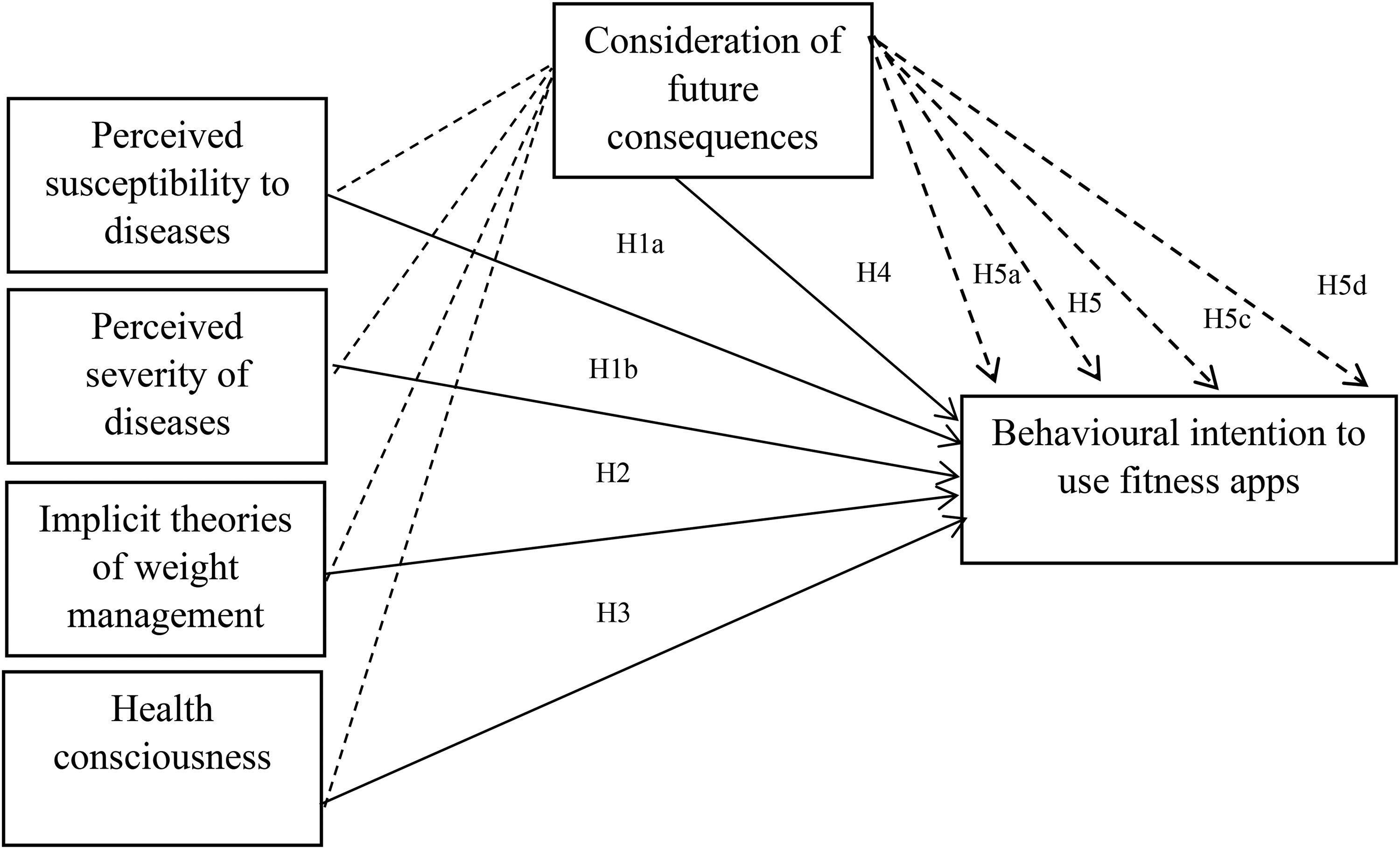
Research framework illustrating direct and indirect effects, along with corresponding hypotheses.
The existing empirical literature demonstrates that CFC is crucial in predicting health behaviours,31,83 particularly those associated with greater susceptibility and severity.99,100 CFC was found to interact with perceived risk, shaping the intention to engage in both personal and collective action regarding climate change, 101 as climate change is linked to health concerns, including mental health issues. 102 In parents, a high level of CFC also intensified the relationship between social media promotion of the HPV vaccine and greater parental support for vaccinating adolescent girls, partly by reducing perceived vaccine risk. 99 A stronger incremental theory of smoking was also found to heighten CFC, which, in turn, increases self-efficacy for behavioural change and subsequently strengthens intentions to quit smoking. 87
Although limited, these results establish the groundwork for further propositions, suggesting that perceived susceptibility, perceived severity, and health consciousness tend to orient individuals toward possible future health trajectories, while incremental implicit theories promote thinking about behaviour change as a sequence unfolding over time. According to CLT, the abstract, future-oriented thinking prioritises distal outcomes, making individuals more likely to adopt apps that emphasise long-term benefits,38,85 such as preventive tracking and goal setting. CLT highlights how these cognitive factors gain motivational potency when processed through high-level construal, which CFC amplifies by orienting individuals toward distant futures.83,86 In this way, CFC bridges present decisions and future consequences, explaining why individuals considering long-term health risks or endorsing incremental health beliefs are more likely to use fitness apps to achieve their health goals.31,39,41
Moreover, perceived susceptibility, perceived severity, and health consciousness encompass traits that are future oriented, and in the presence of CFC, further strengthen motivation to take proactive steps toward positive future outcomes.46,48,51 Individuals with high perceived susceptibility and perceived severity are predisposed to engage in preventive measures to avoid being confronted with diseases in the future.44,47,52 Similarly, health conscious individuals exhibit prudence, demonstrate a strategic mindset, and actively engage in life activities,75,77 showcasing a holistic and disciplined commitment to their well-being 103 and their “current and future health status.” 104 Moreover, those with a strong inclination towards incremental theory assume responsibilities for their actions and outcomes, 31 propelling them to take preemptive steps for their future. Consequently, individuals are expected to demonstrate an ability to anticipate and strategise for future events, thereby mitigating or preventing potential risks. Given these assumptions, CFC, where individuals contemplate the future outcomes of their current behaviour and are influenced by envisaged outcomes, serves as the tenet that connects health-related cognitive factors (i.e., perceived susceptibility, perceived severity, implicit theories, and health consciousness) to the intention to use fitness apps for weight management. This synthesis underscores the dynamic relationship between cognitive frameworks and the intentional use of fitness apps to attain health-oriented goals.
Based on the above assertions, the following hypotheses are developed:
H5. CFC mediates the relationships of the independent variables, i.e., perceived susceptibility to overweight-related diseases (H5a), perceived severity of overweight-related diseases (H5b), implicit theories of weight management (H5c), and health consciousness (H5d), with the dependent variable, i.e., intention to use fitness apps.
Method
Research design and data collection procedure
This cross-sectional study was conducted in China, with data obtained via an online-administered questionnaire over a three-week period, from October 23 to November 13, 2023. The study procedure was approved by the ethics committee of [the name of the institution removed for blind review purpose], ensuring compliance with ethical principles. The target population for the current study comprised Chinese adults who use fitness apps. The rationales for choosing this setting and demographic are overweight and obesity have emerged as substantial public health concerns in China. According to the 2022 Dietary Guidelines for Chinese Residents, published by the Chinese Nutrition Society, approximately 50.7 percent of Chinese adults are presently classified as overweight, with 16.4 percent falling into the obese category. 105 This trend spans across diverse age groups in both urban and rural areas in China. 106 Moreover, as of 2022, there were 154.6 million monthly active users of online sports and fitness services in China, increasing from 1.4 million in 2016. 107
Prior to commencing the main sections of the survey, participants were informed about the study's objective, potential risks and benefits, and assurances regarding confidentiality and anonymity of their identities and responses. Furthermore, participants were provided with a brief explanation about fitness apps (“fitness applications refer to mobile apps designed to help users manage and improve their physical activity, exercise routines, and overall health. Such apps often include features like activity tracking, personalised workout plans, coaching, goal setting, gamification, and feedback to encourage and sustain healthy behaviours.”) We obtained participants’ e-consent by ensuring their understanding of the information provided and their willingness to participate in the study. A positive response enabled participants to proceed to the subsequent section of the survey. Participants were also offered a small incentive (2.5 Chinese Yuan) via a WeChat red envelope, a feature that facilitates the transfer of monetary tokens, consistent with the study's ethics approval.
The questionnaire was translated into Chinese. To ensure the validity and quality of the translated version, we conducted back translation. 108 The cultural appropriateness of the back-translated items for the Chinese population was then reviewed by the authors, all of whom are native Chinese, thereby establishing content validity in the Chinese context. Following MacKenzie and Podsakoff's 109 recommendations, we addressed common method bias by employing both procedural and statistical remedies. For procedural measures, we ensured the absence of order effects in the questionnaire sections and maintained anonymity during data collection. In the statistical analysis, Harman's single-factor test revealed that the variance explained by a single factor was 33.18% across the 29 items, which is below the 50% threshold for total variance. This supports the conclusion that significant common method bias is absent, following the procedure of Podsakoff et al. 110 We enlisted the assistance of an undergraduate student from China to distribute the survey link within her WeChat network, a widely used Chinese social media platform. During data collection, the student assistant asked her contacts in China to share the survey link with their friends through WeChat, which served as the sole recruitment channel, utilising a snowball sampling method. This approach may have skewed the sample toward younger and student-heavy participants, introducing sample bias and limiting generalisability. Nevertheless, it was employed to efficiently reach participants within the target population. The data for this study was derived from a larger dataset associated with an extensive project. We applied data cleaning procedures by excluding cases with missing values and identifying and removing outliers. A post hoc power analysis demonstrated that the study had sufficient power (1 – β > 0.99) given the sample size, n = 302. The analysis indicated adequate sensitivity to detect medium effect sizes (Cohen's f² = 0.15).
Participants
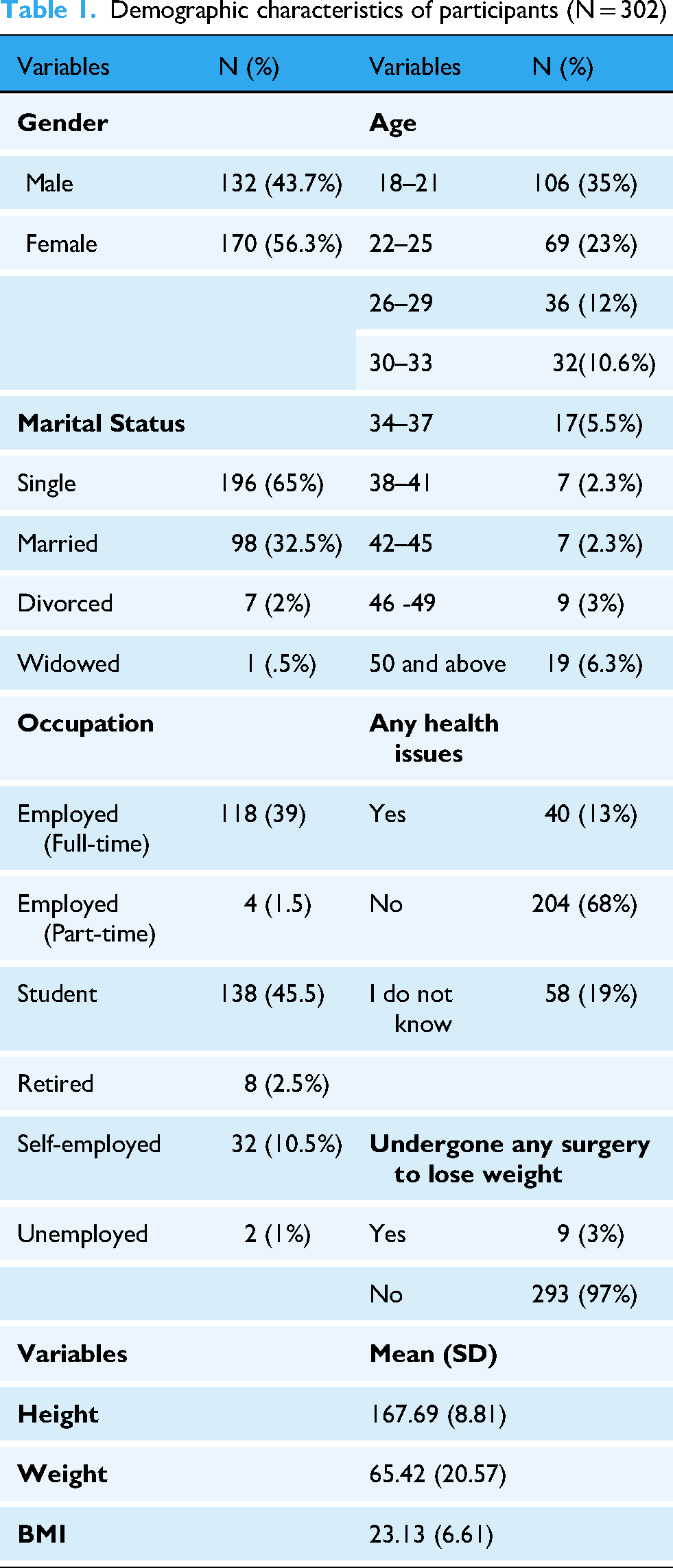
More than half of the participants in the sample were females, constituting 56.3%, while males were accounted for 43.7%. Approximately one-third of the participants (35%) were aged between 18 and 21. A majority of respondents (65%) reported they were single, while 32.5% were married. Concerning health status, slightly more than two-thirds of the sample (68%) indicated the absence of health issues, while merely 3% had undergone surgical procedures for weight loss. In terms of occupation, less than half of the sample (45.5%) were students, while a marginally lower percentage, 39%, were employed full-time. The mean BMI of our participants was 23.13, indicating a normal weight according to the World Health Organisation's classification of 18.5–24.9. 111 (Refer to Table 1 for further details)
Demographic characteristics of participants (N = 302)
Measurements
Perceived susceptibility to diseases and perceived severity of diseases
Perceived susceptibility and perceived severity were assessed using three items for each from the HBM Scale developed by Champion. 112 Items were adapted to contextualise them according to our study context, 113 which is diseases associated with being overweight, such as heart disease, diabetes, high blood pressure, and high cholesterol. An adapted sample item for perceived susceptibility is: “My chances of having some health issues associated with being overweight, such as heart disease, diabetes, high blood pressure, and high cholesterol in the future are great.” An adapted sample item for perceived severity is: “If I have some health issues associated with being overweight, such as heart disease, diabetes, high blood pressure, and high cholesterol, it would affect my daily life.” Participants rated all items on a five-point Likert-type scale (1 = strongly disagree to 5 = strongly agree), where higher scores indicate greater perceived susceptibility and severity. Past research reported acceptable internal consistency for perceived susceptibility (α = 0.93) and perceived severity (α = 0.80). 112
Health consciousness
We utilised the Health Consciousness Attitude Scale, with five items developed by Dutta-Bergman, 114 to gauge our participants’ health consciousness. All items (sample item: “Living life in the best possible health is very important to me”) were rated using a five-point Likert scale ranging from 5 (strongly agree) to 1 (strongly disagree), with a higher score denoting a higher level of health consciousness. Dutta-Bergman's 114 study supported the reliability of the scale (α = .72).
Implicit theory of weight management
We utilised six items from the Implicit Theory of Weight Management Scale, comprising three that measure incremental theories and three that evaluate entity theories, as developed by Burnette. 24 A sample item is “You have a certain body weight, and you can’t really do much to change it.” Participants expressed their level of agreement or disagreement using a five-point Likert scale, ranging from 1 (strongly disagree) to 5 (strongly agree). The results of entity theory items were reversed to represent incremental theories, with higher scores signifying a stronger inclination toward incremental beliefs about weight. The reliability of the scale demonstrated in Burnette's 24 study showed an acceptable level (α = .82).
Consideration of future consequences
We utilised 12 adapted items from the Consideration of Future Consequences Scale, as presented by van Beek et al., 31 which were originally developed by Strathman et al., 34 with five measuring CFC-Future and seven measuring CFC-Immediate. A sample item is “I think about how my current physical activity affects my future health.” Participants were required to rate the items using a five-point Likert scale, ranging from 1 (strongly disagree) to 5 (strongly agree). Following Strathman et al., 34 the scores of the CFC-immediate items were reversed to represent CFC-future. Higher scores on the CFC-future indicate a greater consideration of future consequences. Similarly, in van Beek et al.'s study “for calculation of full scale scores, CFC-immediate items were reverse-coded. Therefore, higher scores on the full scale indicate more consideration of future consequences.” 31 Strathman et al. 34 demonstrated that the CFC Scale had acceptable reliability, ranging from .80 to .86 in four samples. 115 Convergent validity was also demonstrated through empirical evidence of the unique relationship between the CFC Scale and other relevant individual-difference measures, such as willingness to delay gratification, locus of control, and psychological consequences related to anticipated regrets and emotions. 115
Intention to use fitness applications
We utilised three items adapted by Cho et al. 116 to gauge participants’ intention to use fitness apps. A sample item is “I expect that I will use fitness applications.” All items were evaluated using a five-point Likert-type scale (1 = strongly disagree to 5 = strongly agree), with higher score indicating a greater inclination for adopting fitness apps. The Cronbach's alpha value reported for this scale in Cho et al.'s 116 study was deemed acceptable (α = 0.96).
The internal consistency of the scales in the current study demonstrated satisfactory reliability, with Cronbach's alpha values exceeding .70 - a commonly accepted standard in behavioural science, 117 as shown in Table 2. All items used to measure the variables are provided in the supplementary file.
Partial correlations, means, standard deviations, Cronbach's alpha, normality indices, and multicollinearity

Note. This table presents means, standard deviations, partial correlations, normality indices (skewness and kurtosis), reliability (Cronbach's alpha), and multicollinearity (VIF) for all study variables. **p < .01, ***p < .001, ns = non-significant.
Abbreviations:
PSU = Perceived Susceptibility to Diseases Associated with Overweight
PSE = Perceived Severity of Diseases Associated with Overweight
ITWM = Implicit Theories of Weight Management
HC = Health Consciousness
CFC = Consideration for Future Consequences
IUA = Intention to Use Fitness Apps
M = Mean
SD = Standard Deviation
VIF = variance inflation factor
Data analysis
We employed Statistical Package for Social Sciences (SPSS) Version 29, to perform descriptive statistics including Frequency, Mean, and Standard Deviation. To assess the normality of data, Skewness and Kurtosis were used and Variance Inflation Factor (VIF) was used to verify the absence of multicollinearity issues. We conducted partial correlation analyses among all constructs of the research framework, controlling for the influence of gender, age, BMI, health issues, and surgical history. According to the existing literature, these factors are associated with fitness app usage: women, older adults, individuals with higher BMI, and those with serious health issues tend to show less interest, whereas individuals who have undergone weight-loss surgery report higher usage.118–121
We utilised PROCESS Macro, developed by Hayes in 2018, a computational tool for SPSS, for mediation analysis. In addition to ease of use, this tool uses bootstrapping to estimate confidence intervals for indirect effects. This method is more robust compared to traditional approaches like the Sobel test, as it does not assume normality in the sampling distribution of the indirect effect. We utilised Model 4 to test the mediation effect of CFC between independent variables (perceived susceptibility, perceived severity, implicit theories and health consciousness) and dependent variable, individually, while controlling for the effects of gender, age, BMI, health conditions, and surgical history.
Results
Descriptive results
As depicted in Table 2, data normality is not compromised, as the values of Skewness and Kurtosis fall within the recommended threshold of −1 and +1 for Skewness and −2 and +2 for Kurtosis. 122 Moreover, there is no issue with multicollinearity, as the VIF values range from 1.077 to 2.473, remaining well below the threshold of 5, which indicates the absence of multicollinearity. 123 Health consciousness has the highest average score (M = 4.105, SD = 0.813), suggesting that participants, on average, report being quite health conscious, with relatively consistent responses. Implicit theories of weight management show a slightly lower but still relatively high mean (M = 4.059, SD = 1.737), indicating that participants generally agree with beliefs related to implicit theories, although their responses vary widely. Moreover, intention to continue using fitness apps recorded a relatively high mean (M = 3.915, SD = 0.983), suggesting participants tended to agree with items related to intention. Considerations for future consequences showed a moderate mean score (M = 3.505, SD = 0.862), indicating average levels of consideration of future consequences with fairly consistent responses. Perceived susceptibility had a similar mean (M = 3.524, SD = 1.152), though with greater variability in responses. Perceived severity reported the lowest average score (M = 3.292, SD = 1.154), reflecting relatively lower agreement with items related to perceived severity and a wide spread of responses.
The results of the partial correlation analysis, accounting for gender, age, BMI, health issues, and any history of surgery, revealed that perceived susceptibility was positively associated with the intention to use fitness apps (r = .230, p < .001), supporting H1a. Similarly, perceived severity was positively associated with the intention (r = .212, p < .001), supporting H1b. Both effects reflect small-to-moderate associations. Implicit theories exhibited no significant relationship with the intention to adopt fitness apps (r = .1, p = .085), hence hypothesis H2 is not supported. As hypothesised, health consciousness was positively associated with the intention to use fitness apps (r = .523, p < .001), supporting H3. Similarly, consideration of future consequences was positively associated with intention (r = .558, p < .001), supporting H4. Both effects represent large associations.
Mediation effects
Mediation analysis was conducted using the PROCESS macro in SPSS with 5000 bootstrap resamples. As shown in Table 3, CFC partially mediated the relationships between perceived susceptibility and intention (completely standardised indirect effect = .183, 95% CI [.107, .267]) and between perceived severity and intention (completely standardised indirect effect = .249, 95% CI [.164, .343]), supporting H5a and H5b. Hypothesis H5d was also supported, as CFC significantly mediated the relationship between health consciousness and intention (completely standardised indirect effect = .253, 95% CI [.154, .348]). These indirect effects fall within the small-to-moderate range, indicating that consideration of future consequences explains a meaningful portion of these predictors’ influence on intention. In contrast, CFC did not significantly mediate the relationship between implicit theories and intention (completely standardised indirect effect = .059, 95% CI [−.003, .114]), leading to the rejection of H5c.
Mediation analysis of hypothesised relationships.

Note. Path
predictor on the outcome variable; Path
**p < .01, ***p < .001, ns = non-significant.
Abbreviations:
PSU = Perceived Susceptibility to Diseases Associated with Overweight
PSE = Perceived Severity of Diseases Associated with Overweight
ITWM = Implicit Theories of Weight Management
HC = Health Consciousness
CFC = Consideration for Future Consequences
IUA = Intention to Use Fitness Apps
BCI LL = Bias-Corrected Interval Lower Limit
BCI UL = Bias-Corrected Interval Upper Limit
Discussion
The results demonstrated that among health-related cognitive factors as independent variables, health consciousness influences the intention to use fitness apps for weight management most while perceived susceptibility and perceived severity exhibited significant impacts, albeit lesser. The significant relationship between health consciousness and the intention to adopt apps lends credibility to existing literature, emphasising health consciousness's crucial role in shaping health behaviours, 55 including fitness apps adoption.17,18,25 According to Gould, 124 health consciousness encompasses “health self-monitoring,” which can be attuned to the functionalities offered by fitness apps, such as tracking health metrics, 125 a key feature sought after by health-conscious individuals. This alignment reinforces a symbiotic relationship between user intent and technological capability. Hong 71 also posits that health consciousness is characterised by personal responsibility and health motivation. These attributes complement the motivational functions and features of fitness apps that help users stay accountable. Health alertness, coupled with specific preferences and needs about health, are equally coveted by those prioritising wellness. 77 Fitness apps accommodate this by allowing users to set personalised goals and adjust configurations based on their personal needs and preferences. 126 Fitness apps can also attract health-conscious individuals by providing information that aligns with their intrinsic motivation to sustain and enhance their health and well-being. 127
The significant relationship between perceived susceptibility, perceived severity, and the intention to adopt fitness apps corroborates evidence that these two cognitive factors are associated with various health behaviours44,46,128 including weight management. 51 The analogous findings demonstrate that health behaviours are mediated by neurocognitive substrates, attributable to perceptual constructs modulating behavioural responses, as delineated within the theoretical framework of HBM. 42 Perceived health risks can elicit considerations of vulnerability to disease and the severity of potential challenges it might entail. 43 These cognitive characteristics may potentially be amplified by individuals’ lower information avoidance and beliefs in unpredictability. 129 The discrepancies between this study and prior research on the relationship between perceived susceptibility, perceived severity, and the adoption of health technologies (e.g., mHealth apps or COVID-19 contact-tracing apps)55,130 may be attributed to differences in participants’ geographical and cultural contexts. 131 Furthermore, the specific characteristics of the current study sample - predominantly young Chinese WeChat users, mostly healthy with normal BMI and no health issues - may help explain the different patterns of health beliefs and technology use compared to older or more clinically diverse populations. Moreover, the accurate calibration of perceived susceptibility to diseases and perceived severity of diseases, whether overestimated or underestimated, may also significantly influence individuals’ propensity to adopt health behaviours. 132 This may explain the inconsistencies between the results of this study and those reported in the extant literature.
Contrary to the study's postulate, implicit theories did not show a relationship with the intention to use fitness apps. Although this result does not substantiate the existing literature on implicit theories that influence various preventive and proactive health behaviours,66,68,69 it could be a spark for future research. This non-significant relationship may stem from methodological limitations in measurement. Specifically, items that are superficially similar or conceptually overlapping could obscure a true relationship by failing to capture distinct constructs. Moreover, item phrasing might conflate distinct beliefs. Blending effort-based perceptions (weight is manageable through effort) with deterministic views (weight is fixed) might have enhanced the predictive power of the construct. The insignificant relationship may also be attributed to a mismatch between the theoretical frameworks of implicit theories of weight management and behavioural intentions toward fitness apps. The absence of theoretical commonality between these constructs, 133 one rooted in cognitive beliefs about weight malleability and the other on technology adoption behaviour, could explain the result.
This study also reveals that CFC is significantly correlated with the intention to adopt fitness apps for weight management. This result validates the existing literature across diverse domains, substantiating that individuals who invest efforts in long-term health benefits tend to have positive attitude towards health behaviours and engage in such behaviours.83,101 These findings imply that individuals with a cognitive orientation toward their health prioritise future outcomes over immediate ones.31,83,89 Given the scarcity of knowledge on the role of CFC in technology adoption, 92 our study adds new findings to the limited literature on health technology adoption correlates, specifically fitness apps use for weight management. Those who are future-oriented seek methods and devices to address their desire for long-term benefits, 34 and fitness apps incorporate behaviour change features such as goal setting, progress tracking, and reminders.2,80,125 These features can enable the realisation of their long-term health goals.
Additionally, the results indicate that CFC establishes a significant link between perceived susceptibility, perceived severity, and health consciousness with the intention to use fitness apps. These findings endorse the mediating role of CFC in the relationship between cognitive factors related to health and intention. The expectation of negative consequences associated with an event or outcome may prompt individuals to become more vigilant about health threats, such as overweight and obesity. 31 This vigilance in turn, stimulates them to embracing methods for maintaining a healthy weight.88,89 Furthermore, health-conscious individuals, driven by a commitment to maintain their well-being and engage in preventive measures, 76 exhibit a future-oriented mindset regarding their health. They generally peruse goal-oriented behaviours, 74 and fitness apps offer this flexibility to align with specific objectives necessary for personalised fitness regimens for future well-being.3,126,134 This characteristic compels them to adopt fitness apps in consonance with their health-oriented mindset. Moreover, these results are in line with CLT principle which suggests that future-oriented thinking enhances the translation of cognitive evaluations into sustained behavioural intentions.83,84 In this context, CFC functions as a self-regulatory mechanism that links individuals’ awareness of health risks, personal health motivations, and beliefs about weight management to their intention to engage with fitness apps. The mediation analysis also indicated that CFC did not significantly mediate the relationship between implicit theories of weight management and intention to use fitness apps, suggesting that individual's long-term orientation, while reflecting a general concern for future outcomes, does not function as a critical pathway linking beliefs about the malleability of weight management to the intention to adopt technology-based tools. This result could be attributed to a growth mindset for weight management, which may lead individuals to take immediate actions without considering long-term outcomes.
Theoretical implications
This study advances fitness app research by analysing how perceptions of disease susceptibility and severity linked to excessive weight, implicit weight management theories, and health consciousness relate to usage, while also pioneering an investigation of CFC's mediating role. We applied CLT, specifically the concept of high-level construal, to explain the mechanism of CFC and its role in mediating behavioural outcomes. CLT is particularly suited to explain the indirect relationships between perceived susceptibility and severity, health consciousness, and the intention to adopt fitness apps, as it provides a theoretical framework for understanding how individuals use their cognitions for health-related decisions. CFC shapes fitness apps adoption by determining whether individuals perceive weight management through a high-level construal (abstract, goal-oriented thinking focused on long-term health outcomes) or a low-level construal (concrete, detail-oriented thinking fixated on immediate costs). Individuals with high CFC tend to use high-level construal thinking, framing health threats such as perceived disease susceptibility and severity as psychologically distant, abstract risks that necessitate proactive, future-oriented strategies (e.g., preventive health tracking through apps). This corroborates CLT's premise that psychologically distant outcomes (long-term health) are represented abstractly, whereas immediate concerns (effort or time costs) are construed concretely. Health consciousness, characterised by goal-oriented perspective (high-level construal), predisposes individuals to prioritise CFC-driven app features, such as habit formation tools, by presenting long-term well-being as psychologically proximate and actionable. Moreover, by focusing on health-related cognitive factors as predictors of fitness app use, the current study also makes a notable theoretical contribution by extending the predominantly technology-focused literature (e.g., TAM, TPB, and UTAUT) to include health-related determinants. This approach enhances our understanding of the cognitive mechanisms underlying health-oriented technology adoption and provides a conceptual basis for future research exploring health behaviour–driven technology use.
Practical implications
This study's findings benefit health communication campaigners and advocates by shedding light on intrinsic cognitive drivers that activate individuals’ orientation toward health technology use. The results feature the critical role of time orientation in strengthening the link between health-related cognitive factors and the intention to use fitness apps. These findings offer strategic implications for promoting the fitness apps utilisation through CFC interventions. Moreover, CFC emerges as a central construct bridging health-related cognitive factors with behavioural intention. This suggests that while formulating and implementing communication strategies, practitioners can leverage on future time perspective and its benefits for health and well-being in weight management. Cultivating a future-oriented mindset for effective weight management while emphasising the long-term benefits of health behaviours could serve as an effective campaigning strategy to convince users to adopt weight management apps. By prioritising future rewards over immediate costs, campaigners need to promote future-oriented thinking to sustain users’ interest in health technologies. Apart from the long-term benefits (future gains) emphasised through CFC, the combination of perceived risk—covering susceptibility to weight-related diseases and their severity—together with health consciousness also suggests that campaigns linking future gains with concrete near-term cues may be more persuasive than either approach alone.
The findings also highlight the need for marketers and app designers in the fitness apps industry to acknowledge that cognitive factors shape users’ perceptions and intentions to use health apps. Designers can leverage the insight from this study to enhance app effectiveness by integrating users’ health-related cognitive profiles, including their perceptions of health, weight management beliefs, and time orientation, into the design process. For example, apps could incorporate features that correspond with users’ long-term goals, such as personalised progress tracking or reminders that reinforce future-oriented thinking.58,80,125 Given the study's emphasis on the importance of future orientation (e.g., prioritising long-term health outcomes), apps should not only captivate users initially but also sustain their interest over time. For this purpose, designers could implement reward mechanisms that acknowledge incremental progress in weight management, such as milestone badges or adaptive feedback associated to sustained habits, drawing on insights from behavioural economics and the habit of formation.135,136 The rewards for milestone achievement can focus on health-related products to amplify users’ sense of accomplishment and sustain the use of the apps. This approach will ensure long-term appeal by materialising users’ efforts to tangible benefits with rewards targeting the immediate state, without compromising the future-oriented benefits.137,138 By anchoring app design in users’ cognitive motivations, such as perceived health risks, health consciousness, and future-oriented thinking, developers can also create meaningful experiences that keep them engaged over time. Moreover, strategies that attune app functionality with these psychological drivers of behaviour change will not only attract users but also reinforce healthier lifestyles.
Limitations and suggestions for future research
There are several limitations that warrant attention for future research. Firstly, the study's design is limited to a cross-sectional approach, rendering results correlational rather than offering a cause-and-effect explanation. 139 This limitation underlines the necessity for future investigations that employ longitudinal and experimental designs to establish causal relationships for a greater understanding of the underlying factors that affect the use of fitness apps in health management. The sample in this study consisted exclusively of Chinese app users, predominantly young student users, which limit the generalisability of the findings to the wider global population. Therefore, future research is recommended to replicate the study with more diverse cultural and demographic groups to examine whether these findings hold across different contexts. Using snowball sampling via WeChat may also have introduced selection bias. 140 This method has certain constraints, including the potential overrepresentation of specific social networks and limited generalisability. 140 Therefore, future research could consider alternative sampling strategies, such as stratified, to improve representativeness and enhance the external validity of the findings.
Our findings did not identify a direct or indirect relationship between implicit theories with the intention to use fitness apps, leaving room for the replication of the present study. Introducing technology-related constructs such as perceived usefulness or effort expectancy can be introduced for future studies to bridge this gap. The use of fitness apps may be driven by individuals’ concerns about their appearance, presenting new avenues for further research where CFC-immediate can serve as a mediator to elucidate the indirect relationship between aesthetic drivers and the intent to use fitness apps.
Furthermore, features of a technology itself can influence technology use. Therefore, future research can incorporate technology-related attributes to develop a more comprehensive and inclusive model. Future research could also incorporate moderating variables related to technology-related factors, such as digital literacy, perceived technological competence, or prior fitness app experience, as these variables have been shown to influence the adoption of fitness apps.141,142 Since fitness app usage behaviour may vary across platforms (iOS vs. Android), future research should capture and control for this variable to provide more robust findings. Although the value from Harman's single-factor test did not exceed the 50 percent threshold, indicating no serious issue with common method bias, this test alone is not sufficient to fully rule out such bias. 143 Therefore, the rigor and validity of the measurements cannot be assumed to be entirely free from bias. Since the aim of the present study was to test specific hypotheses about certain paths rather than to simultaneously estimate a latent structural model, we used correlational analysis and the PROCESS macro, which was appropriate. Future research could extend this work by specifying and testing a full structural model using structural equation modelling (SEM).
Conclusion
This study was designed to investigate the direct and indirect relationships between perceived susceptibility, perceived severity, implicit theories of weight management, and health consciousness with intention to use fitness apps, while integrating CFC, grounded in CLT, as a mediating mechanism. By doing so, it moves beyond the technology-centred perspectives that dominate much of the fitness app adoption literature and highlights the role of health-related cognitions. The findings show that perceived susceptibility, perceived severity, and health consciousness all have a significant positive relationship with intention to use fitness apps, whereas implicit theories of weight management did not directly predict intention. When CFC was introduced, a clearer picture emerged: CFC partially mediated the effects of perceived susceptibility, perceived severity, and health consciousness, but did not mediate the influence of implicit theories of weight management. Taken together, these results suggest that it is not only what people believe about their health risks and the seriousness of potential outcomes that matters, but also how strongly they are oriented toward the future. This underlines the importance of weaving temporal thinking into the design of fitness apps and health interventions. For app developers, this might mean incorporating features that emphasise long-term health progress, such as milestone tracking or future-self visualisations. For health communicators, it highlights the value of framing messages around the enduring benefits of healthy routines rather than only the immediate outcomes.
Supplemental Material
sj-docx-1-dhj-10.1177_20552076251390310 - Supplemental material for Construal level theory in digital health: How consideration of future consequences bridges health beliefs and the intention to use fitness apps
Supplemental material, sj-docx-1-dhj-10.1177_20552076251390310 for Construal level theory in digital health: How consideration of future consequences bridges health beliefs and the intention to use fitness apps by Ashraf Sadat Ahadzadeh, Jiang Shangfei, Yang Jiawen, Kam-Fong Lee and Fon Sim Ong in DIGITAL HEALTH
Footnotes

Ethical approval
The protocol of the study (including the research procedure, the rights and safety of the participants, and the method of data collection) was approved by the Review Board of Xiamen University Malaysia to ensure the principles of research ethics [No.: REC-2312.02]
Informed consent
Informed consent was obtained from all individual participants of the present study.
Funding
No funding was received for this study.
Conflict of interest
The authors declare that they have no conflict of interest.
Supplemental Material
Supplemental material for this article is available online.
References
Supplementary Material
Please find the following supplemental material available below.
For Open Access articles published under a Creative Commons License, all supplemental material carries the same license as the article it is associated with.
For non-Open Access articles published, all supplemental material carries a non-exclusive license, and permission requests for re-use of supplemental material or any part of supplemental material shall be sent directly to the copyright owner as specified in the copyright notice associated with the article.
