




Abstract
Objectives
Diabetes management requires continuous monitoring of glucose, medication, diet, and activity. With over 537 million cases globally, digital health solutions support self-care. This study assesses the Madhumeh Setu app, comparing its functionality, quality, and user experience with top diabetes apps using Mobile App Rating Scale (MARS).
Study design
A four-phase evaluation was conducted: systematic app search from Google Play Store; assessment of essential app features based on AADE-7 guidelines; qualitative ratings by healthcare professionals using MARS, and user comparison of Madhumeh Setu with MySugr and BeatO through MARS.
Results
Out of 2116 screened apps, 11 met the inclusion criteria. MySugr received the highest MARS rating (4.40 ± 0.14), followed by BeatO (4.12 ± 0.04) and Madhumeh Setu (4.05 ± 0.05). While MySugr scored highest overall, Madhumeh Setu performed similarly to BeatO in functionality and engagement. A one-way ANOVA showed that Madhumeh Setu differed significantly from MySugr (p < 0.00001) but was like BeatO, indicating it matches existing diabetes management solutions.
Conclusions
This study underscores the potential of digital health solutions in diabetes care. As mobile health advances, culturally specific apps such as Madhumeh Setu will become vital for diabetes management. Future studies should use long-term trials to evaluate their effects on blood sugar, medication use, and well-being, with ongoing improvements based on user input to aid wider adoption, especially in low-and-middle-income countries.
Keywords
Introduction
The global prevalence of diabetes has been on the rise, and India ranks as the second-highest country in terms of diabetic cases, following China. 1 Currently, India harbors over 77 million individuals living with diabetes, according to data from the nationwide Indian Council of Medical Research—India Diabetes (ICMR—INDIAB) study. 2 Furthermore, India also exhibits a significant prevalence of prediabetes and undiagnosed diabetes.3–5
Patients face several significant challenges in managing diabetes, which encompass the following; enhancing the utilization of available therapies to ensure sufficient control of glycemic levels, blood pressure, and lipid profiles while reducing the risk of complications; educating individuals with diabetes about effective self-management strategies; enhancing adherence to treatment plans; addressing barriers to timely diagnosis and the early initiation of insulin therapy when necessary; enhancing the healthcare delivery system for individuals with chronic conditions. 6 The intricate nature of diabetes requires customized treatment assistance for individuals living with diabetes. 7 Unfortunately, the adoption of a personalized approach in diabetes management has been hindered by constraints in healthcare resources and the inherent limitations of conventional methods of individual care.8,9 Hence, it is imperative to devise cost-effective and efficient approaches to enhance diabetes self-management. 5
Digital health solutions have revolutionized the way we approach diabetes management. 10 By leveraging technology, data, and connectivity, these innovations empower individuals with diabetes to take charge of their health while providing healthcare providers with valuable insights for more effective care. 11 From continuous glucose monitoring (CGM) systems that offer real-time glucose data to mobile apps that assist in tracking blood sugar levels, medication schedules, and dietary choices, other digital health tools such as wearable devices such as smartwatches and fitness trackers monitor physical activity and health metrics promoting a holistic approach to diabetes care.8,10,12 Smartphone apps have emerged as invaluable tools in diabetes management, offering convenience, support, and empowerment to individuals living with this chronic condition. 13 These apps cater to various aspects of diabetes care including tracking of glucose levels, medications doses, diet, and physical activity provide insightful analytics for personalized recommendations, coach patients on topics related to healthier dietary and exercise choices along with education on topics related to diabetes and its complications, making self-management more accessible and effective.14,15
Recently, we developed an Android-based mobile app “Madhumeh Setu”. This cutting-edge application boasts a range of key functionalities designed to empower users in their diabetes self-management journey. The application integrates real-time monitoring of critical metrics such as blood glucose levels, HbA1c, medication regimens, dietary intake, physical activity, and blood pressure.16,17 Additionally, it provides comprehensive educational resources on weight management, nutrition, stress, and depression management, and the adoption of healthy lifestyle practices. Users also benefit from direct support from healthcare professionals, including physicians, dietitians, and diabetes educators, ensuring a holistic approach to care. Through personalized recommendations and guided assistance, both patients and physicians are equipped with the tools they need to make informed decisions, fostering a collaborative approach to managing diabetes effectively.18–21
This article strives to undertake a comparative analysis of the quality, functionality, and features of the “Madhumeh Setu” application in comparison to leading apps for diabetes management presently accessible, utilizing the Mobile App Rating Scale (MARS).
Materials and methods
In this study, the comparative analysis of the quality, functionality, and features of the “Madhumeh Setu” application in comparison to leading apps was conducted by healthcare professionals and type 2 diabetes patients at a local community in Delhi, India between April and December 2023, by using MARS instrument. The primary screening process encompassed four phases. Initially, the first phase involved the exploration of suitable applications from the Android platform, which provide self-management support for diabetes.22,23 Subsequently, in the second phase, chosen applications were evaluated for minimum features required to align with the guidelines outlined by the American Association of Diabetes Educators (AADE-7) for self-care behaviors in diabetes management.6,24 Further, applications identified through these initial screening phases, along with the newly developed Madhumeh Setu app, underwent qualitative screening using the MARS.25–27 Finally, in the last phase, two top-scoring applications were compared with Madhumeh Setu by individuals with type 2 diabetes in the local community utilizing MARS.23,28,29
Phase-I: Searching for the apps
In the initial phase of the study, a systematic method for identifying appropriate applications was implemented, adhering to the standards outlined in the PRISMA 2020 guidelines, as detailed below:
Search Strategy: On April 24, 2023, two separate primary reviewers (TPS and SW) conducted searches on the app platform [specifically, Google Play Store (GPS)] to identify health-related applications (Figure 1). Keywords for app searching included diabetes, blood glucose, diabetes prevention, diabetes control/management, and diabetes treatment.19,23 Subsequently, a rating scale (Appendix I) as previously used by Ranjani et al. 22 was utilized for rating included apps from the GPS. The selection process was guided by four key parameters, which assessed their presence on the GPS: (a) the app's overall rating, (b) the number of downloads, (c) the app's size, and (d) the number of reviews. Each primary reviewer assigned ratings on a scale of 1–4, where 1 indicating the lowest and 4 indicating the highest rating. The total rating for each app was calculated as the sum of these four ratings, with a maximum possible score of 16 (4*4) and a total rating score of 9 or higher from both reviewers as the criterion for shortlisting the apps.20,22

Flowchart showing the systematic search of the apps on google play store according to the PRISMA 2020 guidelines.
Eligibility Criteria: Applications were considered for inclusion if they were employed in the context of diabetes self-care and encompassed a minimum of one of the subsequent elements: management of blood glucose levels, control of dietary and physical activity, medication adherence, or the prevention of diabetes-related comorbid conditions. The criteria for exclusion encompassed medical applications involved in diagnostic or clinician-driven healthcare, apps offering consultation services, pharmacy-related apps, non-Asian dietary guides (particularly those catering to American or Western diets that did not align with Indian dietary preferences and habits), apps featuring lifestyle quotes, unconventional weight loss diets, apps endorsing specific organizations or products, and promotional apps (e.g., those associated with fitness bands or fitness centers). Additionally, apps requiring prescription from a clinician for log-in the app and apps with premium features that required payment from users were omitted, while those offering a basic version without any extra charges were included.20–22
Phase-II: Grading of apps based on AADE-7 criteria for self-care behaviors (mHealth support in diabetes self-care)
In the second phase of this study, we have screened all the apps selected in Phase-I for the features offered by these apps in diabetes self-care and management. For this screening, we have utilized the list of minimum features for diabetes apps and developed and validated by Salari et al. 24 This list consists of 23 minimum features (Appendix II) which are referenced to the American Association of Diabetes Educators (AADE-7) 6 guidelines for providing a collection of prerequisites for diabetes mobile apps. AADE-7 guidelines unequivocally narrate about improving any of the seven therapeutic elements mentioned below for diabetic patients: 1. healthy eating, 2. being active, 3. monitoring, 4. taking medications, 5. problem-solving, 6. reducing risks, and 7. healthy coping.
All the apps selected in Phase-I were screened for these minimum features by the primary reviewers and the apps which have fulfilled AADE-7 criteria and offered minimum 20 out of 23 features were further selected for qualitative app rating study utilizing the Mobile App Rating Scale (MARS).6,22,24,25
Phase-III: Qualitative screening of selected apps by MARS
Mobile App Rating Scale serves as a tool for evaluating the quality of mobile medical apps. MARS evaluates mHealth apps using 19 criteria across four dimensions: engagement (5), functionality (4), aesthetics (3), and information (7). The assessment is executed using a 5-point Likert scale, ranging from 1 (indicating inadequacy) to 5 (indicating excellence), with the provision for selecting “Not Applicable” (N/A) in instances where specified criteria are deemed irrelevant. Furthermore, a subjective quality assessment (4) segment is incorporated to evaluate: the intention to recommend the app, the anticipated frequency of app usage, the willingness to pay for the app, and an overall star rating for the app.25,26
All the apps selected in Phase-II along with “Madhumeh Setu” were subjected to quality assessment by 6 secondary reviewers (including 2 Physicians, 2 Nurses, and 2 Pharmacists) as invited experts, utilizing MARS during May 2023. These reviewers took primary training on the MARS instrument through an online tutorial developed by primary developers of MARS instrument at University of Queensland, Australia. 28 Rating was done for all 19 criteria along with assessing the app subjective quality segments (4). Mean scores for each dimension: engagement, functionality, aesthetics, information, and app subjective quality were calculated, and overall mean scores were generated for each app. The inter-reviewer (rater) reliability between reviewers was assessed using the K-Alpha statistics [G. Marzi, M. Balzano, and D. Marchiori]. 30 The reliability estimate, determined through Krippendorff's Alpha Calculator, 31 yielded a value of 0.74, indicating moderate agreement. Considering the inherently subjective nature of the domains within this scale, the obtained reliability estimate was regarded as highly favorable.27,32
Phase-IV: Comparative analysis of Madhumeh Setu and marketed apps by type 2 diabetes patients utilizing MARS
In Phase IV of the study, the newly developed Madhumeh Setu app was subjected to a qualitative comparative analysis against two established diabetes management applications: MySugr and BeatO.22,26 The selection of these comparators was purposive and strategic, aiming to elicit patient perspectives regarding the features, usability, and overall quality of “Madhumeh Setu” in relation to leading market alternatives. MySugr, developed in Austria and widely adopted internationally, is among the most extensively cited and clinically validated diabetes self-management applications. It benefits from endorsement by healthcare professionals and adherence to the stringent data protection standards stipulated by the European Union's General Data Protection Regulation (GDPR). 28 In contrast, BeatO, an Indian-origin application, is specifically tailored to the Indian demographic, incorporating considerations of regional healthcare infrastructure, dietary practices, and linguistic diversity. Furthermore, BeatO's integration with local diagnostic laboratories and insurance services renders it a contextually relevant comparator for Madhumeh Setu. Both MySugr and BeatO demonstrate high user ratings, significant download volumes, and favorable clinical appraisals, frequently featuring in systematic reviews and meta-analyses assessing the efficacy of mHealth interventions for diabetes management.23,29–31 Consequently, their inclusion provided a robust framework for the qualitative assessment of the clinical relevance, user-centered design, and technical soundness of the Madhumeh Setu application.
Participants (type 2 diabetes patients) were chosen according to specific inclusion criteria; individuals of both genders aged 18 years and above, possession or regular access to an Android phone, confirmed diagnosis of type 2 diabetes by a Physician or Endocrinologist, proficiency in reading and understanding English, and willingness and capability to complete data collection through a mobile app. Conversely, exclusion criteria encompassed individuals with any diabetes type other than type 2, those experiencing end-stage hepatic or renal failure, individuals lacking education or training in the use of an Android mobile phone, and those unwilling to participate in data collection through a mobile app. Table 1 provides the demographics of the selected patients for this comparative study. The study was approved by the ethics committee of Delhi Pharmaceutical Sciences and Research University (DPSRU-BREC/2023/A/018). Participants were recruited by convenience sampling from a local community in Delhi, and to be able to detect 0.5 score change in MARS with the power of 80% and desired a significance level of 0.05, a sample size of 45 was estimated carrying 10% dropouts. All the participants were trained in MARS instrument utilization through an online tutorial, 28 fostering rating uniformity among assessors. The reliability of the ratings, as measured by Krippendorff's Alpha (0.71), was deemed satisfactory, particularly given the subjective nature of the MARS scale.33,34 Mean MARS scores were employed to estimate the top-quality applications.23,26–32,35
Demographics of the type 2 diabetes patients (N = 45) selected for the comparative study through MARS.

Statistical analyses
Means (M) and standard deviations (SDs) for the MARS sum score and all subscales were calculated. Further, one-way ANOVA with post hoc Tukey HSD (Honestly Significant Difference) was employed at a significance level of p < 0.05 to assess the differences in MARS ratings given by diabetes patients.
Results
Out of 2116 mobile applications initially screened, 11 apps (Table 2) met the final selection criteria represented by PRISM flowchart in Figure 1. Among them, Madhumeh Setu performed strongly, positioning itself alongside established market leaders. In evaluations conducted by healthcare professionals using the MARS tool (Table 3), Madhumeh Setu achieved a commendable mean score of 4.05 ± 0.05, closely comparable to BeatO (4.12 ± 0.04) and approaching MySugr (4.40 ± 0.14). The app was particularly appreciated for its strong functionality and appealing design which are the key elements for encouraging sustained user engagement. In a subsequent assessment by patients with type 2 diabetes, Madhumeh Setu again demonstrated competitive performance, achieving mean ratings similar to BeatO. Statistical analysis using one-way ANOVA (Figure 2) confirmed significant differences between the apps (F = 97.79, p < 0.00001); however, post hoc testing showed no significant difference between Madhumeh Setu and BeatO (p = 0.0246). These results suggest that Madhumeh Setu offers a high-quality, culturally relevant tool for diabetes self-management among Indian patients.

Comparative analysis of Madhumeh Setu and Marketed apps by type 2 diabetes patients utilizing MARS Significant differences in MARS scores among the three diabetes apps based on the ANOVA and post hoc Tukey's HSD analysis: MySugr vs BeatO and MySugr vs Madhumeh Setu show highly significant differences (***p < 0.001), BeatO vs Madhumeh Setu shows no significant difference (ns, p = 0.24697).
Basic description and characteristics of evaluated apps.

Overall mean MARS scores under each category for the selected apps by six secondary reviewers.

Screening and selection of apps
Among 2116 apps searched in the initial screening, only 11 apps met the final screening criteria which were employed in phases I and II of this study. An overview of the selection process and exclusion categories is depicted in Figure 1 through a comprehensive PRISMA flow diagram.
The descriptive data for the 11 apps picked through the screening process are presented in Table 2. Based on the criteria developed by Rajani et al. (Appendix I), which primarily considers the number of downloads, reviews, and user ratings on the play store, the BeatO app got the highest score (15 out of 16). In this category, 2 other apps with similar results included My Sugr (14 out of 16) and Diabetes:M (13 out of 16). Furthermore, in the second screening where minimum app features were evaluated, My Sugr (23) received the highest score, followed by BeatO (22) and DiabTrend (21). During this screening, internally developed Madhumeh Setu app was also rated using MARS. Given that Madhumeh Setu is a recent addition to the Google Play Store, the reviewers, bypassed the initial criterion (Ranjani et al., 2021) for app rating. However, adhering to the second criterion (Salari et al., 2019), Madhumeh Setu achieved a score of 21 out of 23, meeting the minimum requirements for diabetes self-management features.
Qualitative assessment of selected apps through MARS
Table 3 presents the mean ratings of mobile apps across various categories in MARS, encompassing all chosen apps including Madhumeh Setu. Initially, individual dimensions such as engagement, functionality, aesthetics, information, and subjective quality were rated by six secondary reviewers, resulting in mean scores. Subsequently, overall mean scores were computed for each app. The highest overall mean score was achieved by My Sugr app (4.40 ± 0.14), followed by BeatO (4.12 ± 0.04), Diabetes: M (4.07 ± 0.08), and Madhumeh Setu (4.05 ± 0.05), whereas the lowest score was attributed to Social diabetes (3.62 ± 0.19) app. Similarly, subjective quality ratings assigned by these reviewers were averaged, with the highest rating given to My Sugr (4.2 ± 0.34), followed by BeatO (4.1 ± 0.41), and Diabetes:M (4.00 ± 0.39), while the lowest rating was assigned to Diabetes Connect app (3.0 ± 0.59). Madhumeh Setu app obtained a mean quality score of 4.05 ± 0.05 and a subjective quality score of 3.9 ± 0.48, comparable to scores of the marketed apps examined in this study.
Comparative analysis of best apps with Madhuemeh Setu
Within the last phase of this study, two best scorer apps namely: My Sugr and BeatO were qualitatively compared with Madhumeh setu by type 2 diabetes patients in the community. As many as 45 patients from the local community in New Delhi, India, filled the Mobile App Rating Scale for these apps. The cumulative mean scores for these apps were 4.46 ± 0.16, 4.14 ± 0.14, and 4.09 ± 0.10, respectively. Figure 3 illustrates the criteria-wise rating of these three apps as per the MARS scale. For the comparative assessment of these apps, one-way ANOVA was applied employing the level of significance as p < 0.05 (Figure 2). The value of F ratio was obtained as 97.79 with a p < 0.00001, further the post hoc Tukey's test for pairwise comparison explained that Madhumeh Setu app was significantly different when compared with My Sugr app [Q = 15.88 (p = 0.00000)]; however, no significant difference was observed between the BeatO and Madhuemeh setu [Q = 2.27 (p = 0.0246)] explaining that the Madhumeh Setu was qualitatively comparable to BeatO, while My Sugr was of a higher quality within the purview of MARS rating given by type 2 diabetes patients.
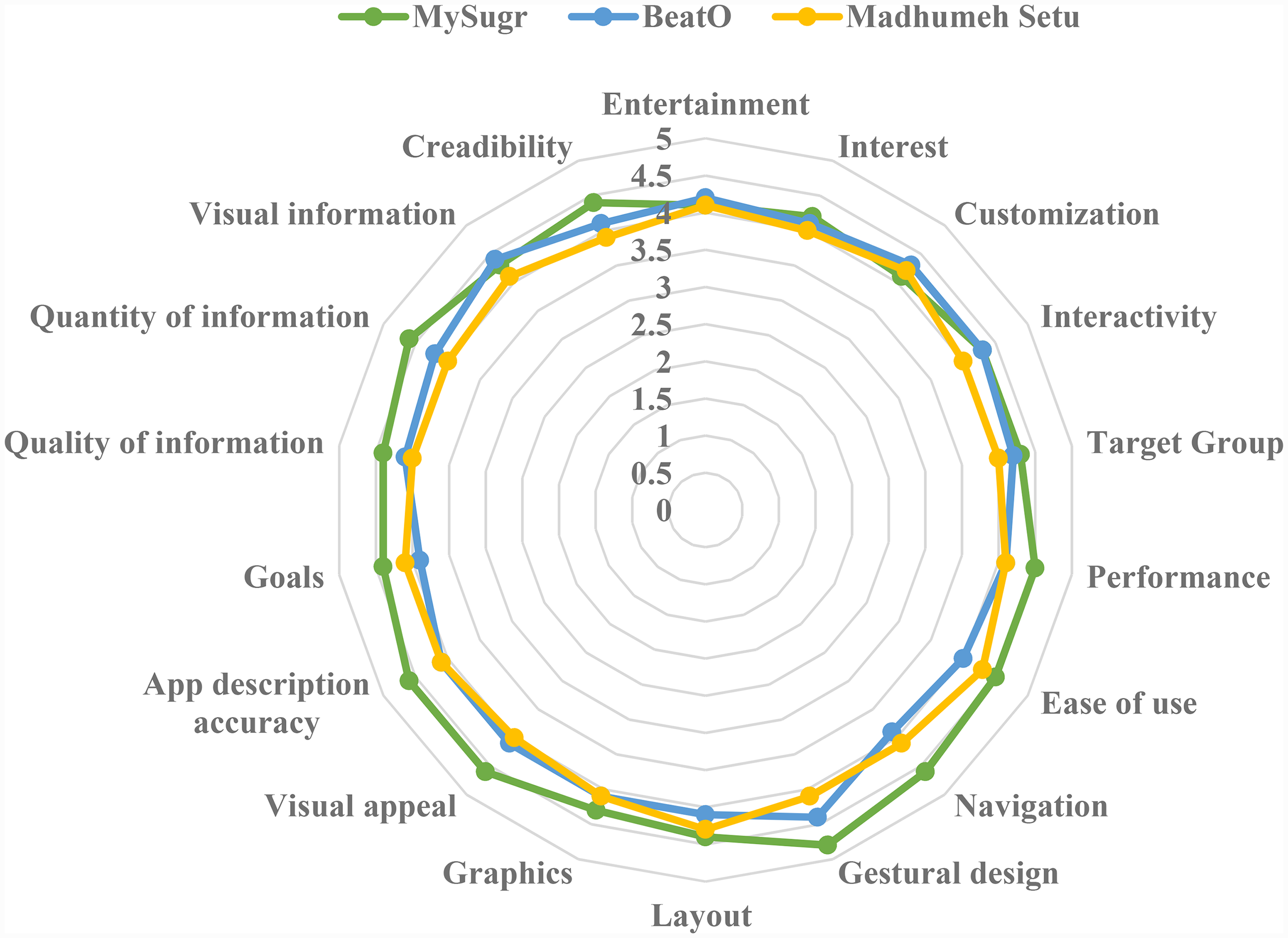
MARS criteria-wise average scores provided to selected apps by diabetes patients.
User testimonials gathered through this study, reported that MySugr provides better engagement features such as; gamification and motivational prompts, the app consistently received the highest patient scores, owing to its playful and visually rich interface, provided more comprehensive, internationally standardized educational material but was considered less region specific. BeatO also perceived as moderately engaging but was critiqued for limited personalization, offered moderate-quality educational content, largely focusing on device integration and monitoring without sufficient depth in lifestyle education. Madhumeh Setu demonstrated moderate to high-level engagement due to its personalized goal setting, regional food options, and vernacular language support. Patients appreciated the intuitive design, minimal technical glitches, and efficient loading times though a minority of users suggested it could benefit from more modern, polished graphics, and educational support.
Discussion
To the best of our knowledge, this is the first study to qualitatively assess diabetes applications using the MARS instrument, incorporating perspectives from both healthcare providers and patients. The integration of the app rating scale proposed by Rajani et al. 22 with the AADE-7-criteria 17 strengthens the rigor and comprehensiveness of the search strategy for diabetes mobile applications. This approach ensures the inclusion of apps that foster habits of continuous monitoring, adherence, and effective self-management.36,37 All the 11 apps which were selected through our search strategy, were also carrying above 4 -star-rating on the Google Play Store. Glooko and BD Diabetes care apps offered features that provide actionable insights from patient data, while BeatO, Glucoe Buddy, and Oxyjon offered personalized plans to manage diabetes. Previous studies identified these features as beneficial for enhancing self-care behaviors in patients.36,38,39 In the qualitative MARS assessment conducted by secondary reviewers (healthcare professionals), the MySugr app (4.40 ± 0.14) and BeatO app (4.12 ± 0.04) emerged as the highest-rated applications, while the Madhumeh Setu app achieved an overall mean score of 4.05 ± 0.05. Among the four MARS subscales, the majority of apps received higher ratings for functionality and aesthetic attributes, whereas information-related components were rated comparatively lower by the secondary reviewers. This consistent pattern aligns with prior research indicating superior app performance in functionality and aesthetics, yet showing deficiencies in engagement and information dissemination.35,40
To incorporate end-user perspectives, a comparative evaluation was undertaken wherein type 2 diabetes mellitus (T2DM) patients assessed the Madhumeh Setu app alongside the two highest-rated applications identified by secondary reviewers, using the Mobile App Rating Scale (MARS). MySugr and BeatO were selected for this analysis based on their superior ratings, widespread user acceptance, frequent citation in published literature, and positive clinical appraisals, providing a robust framework for qualitative comparison. On the MARS scale, diabetes patients rated the MySugr app as superior to Madhumeh Setu in terms of gestural design, visual appeal, app navigation, and the quantity of information provided. However, features related to entertainment, user engagement, customization, and credibility received comparable ratings across all three applications. Notably, MARS sum scores as well as the subscale functionality were correlated significantly with the ratings provided by diabetes patients. However, this was conversely reported during previous studies; hence, it is an encouraging finding in the context of mobile apps that support diabetes self-management.35,39,41 Madhumeh Setu scored comparably to both the other apps in terms of user engagement and customization, largely because it offers diet plans and calorie information tailored to the diverse dietary habits and regional standards found across Asia.29,35,38 However, there remains room for growth, particularly in the areas of information quality and interactivity. While Madhumeh Setu successfully includes essential features such as blood glucose tracking, diet monitoring, and medication reminders, it fell behind MySugr and BeatO in delivering in-depth, evidence-based educational content and opportunities for user interaction. This gap may be due to the fact that Madhumeh Setu is still in an early phase of development, and much of the user feedback for this study was gathered after the app's initial release.30,35,40 Given the complexity of managing type 2 diabetes, future updates of Madhumeh Setu will focus on enhancing the depth and reliability of its educational material, possibly by incorporating expert-reviewed content and creating more dynamic, interactive learning tools for users.
Strengths and limitations
The methodology employed in this study to compare our internally developed application with leading commercially available apps is likely novel and innovative. It combines user-based rating criteria with the principles of the persuasive system design model to seamlessly incorporate diabetes self-management features, aligning with the AADE-7 guidelines. Certain limitations should be acknowledged in our study. Firstly, our search focused solely on mHealth apps available in the Google Play Store in English, thus restricting the generalizability of our findings to apps in other languages and app stores. Secondly, given the rapid pace of technological advancement, some mHealth apps may undergo changes or become unavailable for varying durations.24,40,42 Additionally, our evaluation of privacy and security features was conducted at a descriptive level; however, a more comprehensive assessment of these aspects is warranted, especially considering the reported limited information in current privacy policies for mHealth apps targeting smoking cessation, depression, and psychological disorders.41,43,44
Conclusion
With the increasing advancement of technology, mobile applications represent a promising tool for enhancing diabetes self-management. Qualitative assessments using the Mobile App Rating Scale (MARS) reaffirmed the efficacy and user satisfaction of the selected diabetes mobile apps, with Madhumeh Setu receiving ratings comparable to well-established apps such as MySugr and BeatO. Incorporating both patient and healthcare provider perspectives, the study highlighted Madhumeh Setu's strong alignment with the cultural and educational needs of Indian type 2 diabetes patients. Notably, while MySugr outperformed other applications in terms of overall engagement and aesthetic appeal which are the attributes recognized for driving long-term user adherence, Madhumeh Setu performed equivalently to BeatO, particularly excelling in regional contextualization, personalized goal-setting, and vernacular language support. Its ease of navigation and minimal technical barriers further enhance patient empowerment. However, improvements in graphic design and interactive features are needed for broader appeal. As mobile technology continues to evolve, apps like Madhumeh Setu are expected to play an increasingly significant role in diabetes management. Future research should focus on longitudinal, randomized controlled trials to evaluate its impact on clinical outcomes, including glycemic control, medication adherence, and quality of life. Moreover, refinements based on user feedback could further enhance the app's scalability and integration into broader public health strategies targeting diabetes self-management in low-and-middle-income settings.
Supplemental Material
sj-xlsx-1-dhj-10.1177_20552076251343700 - Supplemental material for Quality, functionality, and features of a newly developed smartphone app for diabetes: A comparative analysis using Mobile app rating scale
Supplemental material, sj-xlsx-1-dhj-10.1177_20552076251343700 for Quality, functionality, and features of a newly developed smartphone app for diabetes: A comparative analysis using Mobile app rating scale by Tarani Prakash Shrivastava, Swati Wagdhare, Banshi Saboo and Ramesh K Goyal in DIGITAL HEALTH
Supplemental Material
sj-docx-2-dhj-10.1177_20552076251343700 - Supplemental material for Quality, functionality, and features of a newly developed smartphone app for diabetes: A comparative analysis using Mobile app rating scale
Supplemental material, sj-docx-2-dhj-10.1177_20552076251343700 for Quality, functionality, and features of a newly developed smartphone app for diabetes: A comparative analysis using Mobile app rating scale by Tarani Prakash Shrivastava, Swati Wagdhare, Banshi Saboo and Ramesh K Goyal in DIGITAL HEALTH
Footnotes
Acknowledgements
Authors are thankful to the department of Endocrinology, Max Super-specialty Hospital, Saket, New Delhi, for providing technical, research, and analytical support.

Ethical considerations
This study was reviewed and approved by local ethics committee at Delhi Pharmaceutical Sciences and Research University (DPSRU-BREC/2023/A/018).
Author contributions
TPS contributed to conceptualization, data curation, investigation, formal analysis, and drafting the manuscript. SW contributed to conceptualization, methodology, investigation, formal analysis, validation, supervision, as well as drafting and revising the manuscript. BS contributed to conceptualization, supervision, validation, and revising the manuscript. RKG contributed to validate formal analysis, reviewed the manuscript, and approval of final draft. All authors reviewed and approved the final manuscript for publication.
Funding
The authors received no financial support for the research, authorship, and/or publication of this article.
Declaration of conflicting interests
The authors declared no potential conflicts of interest with respect to the research, authorship, and/or publication of this article.
Supplemental material
Supplemental material for this article is available online.
Appendix
Initial rating/scoring scale based on available information in the google play store—adapted from Ranjani et al. 2021. AADE-7 criteria-based minimum features required for diabetes mobile apps-adapted from Salari et al. 2019.
Initial Rating Scale
Overall app rating in the play store
Score out of 4
≤3.4
1
3.5–3.9
2
4–4.4
3
4.5–5
4
No. of downloads
10,000–49,999
1
50,000–99,999
2
100,000–999,999
3
≥1,000,000
4
Size of the app
>75 MB
1
51–75 MB
2
26–50 MB
3
≤25 MB
4
User reviews (Shows Popularity)
≤1000
1
1001–4999
2
5000–13,999
3
≥14,000
4

AADE-7 Criteria
App features
Healthy eating
1. Diet tracking
2. Meal time tagging
3. Target range setting
4. Food database
Being active
5. Weight and BMI tracking
6. Physical activity tracking
7. Trend chart view
Monitoring
8. Blood sugar tracking
9. Blood pressure tracking
Taking medication
10. Insulin and medication tracking
11. Reminders
12. Alerts
Problem-solving
13. Color coding
14. Customizable theme
15. Preset note
16. Numerical indicator
17. Problem solving (Q&A by chats/consultation)
Healthy coping
18. Messaging
19. Healthy coping tips
20. Educational material
21. Log book views
22. Share records
Reducing risks
23. Tips and knowledge on reducing risks
References
Supplementary Material
Please find the following supplemental material available below.
For Open Access articles published under a Creative Commons License, all supplemental material carries the same license as the article it is associated with.
For non-Open Access articles published, all supplemental material carries a non-exclusive license, and permission requests for re-use of supplemental material or any part of supplemental material shall be sent directly to the copyright owner as specified in the copyright notice associated with the article.
