



Abstract
Aims and Objectives
Young adulthood is a life stage comprised of many turning points. For young adults with type 1 diabetes (T1DM), diabetes self-management support is crucial during this period. There is a lack of diabetes education programs and services tailored to this population. This paper presents the findings, according to the STROBE guidelines, on the usability and acceptability of a patient-informed mHealth support program (Diabetes YES) that was developed for young adults with T1DM.
Methods
A total of 34 young adults aged 18–35 years with T1DM participated in the Diabetes YES program over 12 weeks. Google analytics was used to tracked website use, while a website usability survey measured ease of use. Facebook analytics was used to measure peer support engagement. Evaluation of the program was completed using Likert scales and open-ended questions.
Results
Conclusions
Introduction
Young adults with diabetes face a host of physical and emotional barriers that dissuade access to ongoing diabetes education and support services.1–3 An Australian survey of 86 young adults with type 1 diabetes (T1DM) aged 18–30 years reported the top three obstacles that prevented access to adult clinic attendance as the inconvenient times of their diabetes clinic appointment (74.4%), cost (66.3%) and distance required to travel (54.7%). 3 Young adults are also less likely to attend an adult clinic regularly, or at all, if diabetes healthcare teams fail to show support or awareness of their emotional and educational needs. 2 These findings highlight the need for diabetes education or support services that are flexible, cost-effective and provide a supportive environment with age-appropriate information and care for young adults. Such transitional needs were also reflected in an Australian study where 13 young adults with T1DM were interviewed on their experiences as they transitioned through various turning points where participants commonly described the desire for support that was more responsive to their life circumstances as young adults. 4
Although young adults often consider themselves to be time poor, they may not view online browsing as a large investment of time. 5 Online and mHealth platforms provide flexibility for individuals to access information at a time and place that suits them, are low in cost and allow self-moderation of anonymity.6,7 These factors combined enable young adults to build a safe and comfortable environment online and develop the confidence to express personal problems compared with traditional modes of communication within the clinical environment.7,8 An example of online platforms that can be used for mHealth is social media. In Australia, Facebook is the preferred social media platform of choice, with 79% of the population reportedly using it. 9 Furthermore, Facebook and Facebook messenger had the highest monthly active users in 2018 compared with other social media platforms. 9 With the use of online services and social media becoming engrained in culture and daily life worldwide, these platforms serve as a promising avenue for health promotion and education.10,11
Currently, there is a dearth of evidence-based, person-centred online programs for people living with chronic conditions, including diabetes. 12 Specifically in Australia, there is a lack of diabetes support services for young adults with T1DM as they navigate through various turning points or transitional events in life. To address this, a mHealth program called the Diabetes Youth Empowerment and Support (Diabetes YES) program was developed. Diabetes YES was informed by findings from an earlier study that investigated the transitional needs of Australian young adults with T1DM. 4 The purpose of the Diabetes YES program was to support young adults with T1DM through the provision of appropriate diabetes education and opportunities for peer support. The current paper focuses on the usability and acceptability of findings from the evaluation of the Diabetes YES program.
Research design and methods
Study design
The Diabetes YES program consisted of a mobile-optimised website (www.diabetes-yes.com) and a closed online peer support group hosted on Facebook, a commonly used social media platform. The website was developed from information located on existing credible websites such as national and state diabetes organisations, government supported websites and sites underpinned by professional bodies. Information on the website was grouped into categories that included ‘Diabetes Technology’, ‘Exercise and Diet’, ‘Emotional Wellbeing’ and ‘Life and Diabetes’. These categories were informed by semi-structured interviews with 13 Australian young adults with T1DM that further investigated the transitional needs of this population. 4 Nationally recognised clinical experts within the field of diabetes education reviewed relevant sections from the website to ensure that information was evidence-based and up to date. The Diabetes YES website was regularly updated throughout the data collection period with the latest diabetes-related news and research. The Diabetes YES Facebook peer support group was moderated by the researcher (A.N.) who is female, within the same age group as the target audience and has lived experience with diabetes management. A.N. also has had previous experiences moderating peer support groups within the diabetes community. As such, she was able to relate to participants, develop and engage in discussion prompts relevant to the target audience. The Diabetes YES program was trialled for a period of 12 weeks and evaluated by Australian young adults with T1DM. Results were reported according to the Strengthening the Reporting of Observational studies in Epidemiology (STROBE) checklist (see supplemental file 1). 13
Ethics approval was obtained from the Human Research Ethics Committee and all participants provided written informed consent.
Setting and participants
The 12-week study was conducted online and ongoing recruitment was open to young adults with T1DM residing in Australia aged between 18 and 35 years from the June 2016 to January 2017. A sample size target of 30 participants was used based on the timeframe feasibility and use of snowball sampling for this target group. As the primary purpose of this study was to assess the program’s usability and acceptability, the sample size was not powered to measure its impact. Participants were recruited online through social media platforms such as Facebook and Twitter. Eligible participants were required to have Internet access either through a smart phone, tablet, laptop or desktop computer in order to complete the online surveys and participate in the intervention. Participants who previously volunteered in the preceding qualitative arm of the study were excluded to reduce bias. 4 An incentive to win one of two AUD 50 gift cards upon completion of the study was offered.
Study measures
Once eligible participants provided consent, they were given instructions to create an account to access the website and were invited to join a closed Facebook group. Usability and acceptability of the Diabetes YES program were measured by Google analytics, an 8-item website usability survey, Facebook analytics and an overall evaluation survey that included a 5-point Likert scale question with open-ended responses.
Participants were required to complete three online surveys over the 12 week intervention period. The mid-point online survey administered during week 6 of the intervention period included a website usability questionnaire. Questions related to the overall evaluation of the Diabetes YES program were included in the final survey in week 12 of the intervention period, which will be the focus of this paper.
Website usability and acceptability
Usability and acceptability of the Diabetes YES website was determined by which Diabetes YES web pages were visited the most often and how much time participants spent on each web page on average over the study period as tracked by Google Analytics. A validated 8-item, 5-point Likert scale, website usability survey was adapted from Utah State University to further evaluate the Diabetes YES website. 14 An additional question was also included to determine which device participants used most frequently to access the Diabetes YES website.
Facebook peer support group usability and acceptability
To evaluate the usability and acceptability of the Facebook peer support group, engagement within the Facebook group was tracked by the number of shares, posts, comments or likes that have been made by participants. Administrators of the Facebook group were also given access to track whether participants have viewed or read a post via the ‘seen’ feature. With this feature, participants needed to have accessed and viewed the group post to be marked as ‘seen, which allows researchers to track passive engagement in discussion forums or ‘lurkers’. Participants were asked to rate the helpfulness of the Facebook peer support group on a 5-point Likert scale.
Overall diabetes YES evaluation
As part of the overall Diabetes YES evaluation, participants were asked a question on how likely it was, on a 5-point Likert scale, that they would recommend the Diabetes YES website and the Facebook peer support group to others.
Quantitative analysis
Quantitative data was summarized and presented as descriptive statistics to demonstrate the program’s usability and acceptability.
Qualitative Analysis
Opportunities for open-ended feedback as part of the overall Diabetes YES evaluation were also provided to participants for additional comments, suggestions and topics they would like to see on the Diabetes YES website in the future. Open-ended responses options also allowed participants to expand on how the Facebook peer support group helped them with their diabetes management. Responses underwent line-by-line coding with similar themes grouped into categories.
Results
Participant characteristics
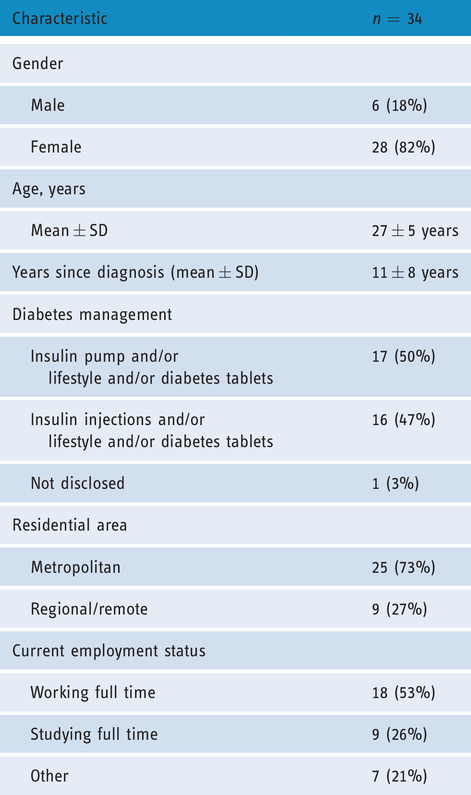
A total of 43 young adults living with T1DM aged between 18 to 35 years old consented to the study; of these, two failed to complete the baseline survey and five did not complete mid-point online surveys, with one participant reported to be overseas without the Internet for majority of the data collection period. From the remaining participants, 2 did not complete the final online survey, which left 34 participants who completed all online surveys across the 12-week trial period at 79% retention rate (21% attrition). Characteristics for the 34 participants who finished the 12-week trial are presented in Table 1.
Participant characteristics
Diabetes YES – the website
Over the 7-month data collection period, the Diabetes YES landing page saw 457 total unique users, or individuals who opened the website, which may have included those who found the website by chance. However, 220 unique page views were recorded from the Diabetes YES home page, which was accessible only to participants through a login page. Figure 1 shows the number of page views logged by participants over the intervention period. As evident in Figure 1, web page visits were frequent during active participant recruitment followed by a sharp decline.

Weekly breakdown of Diabetes YES home page views throughout the intervention period between June 2016 and January 2017.
Figure 2 shows a breakdown of the Diabetes YES website page view by individual pages. The most frequently visited page on the website was the ‘Eating Well’ page, while the least visited pages were the ‘Continuous Glucose Monitoring (CGM)’ and ‘Emotional Wellbeing’ pages.

Individual page view breakdown of Diabetes YES over intervention period throughout June 2016 and January 2017.
A total of 24 participants (67%) predominantly accessed the website through a desktop computer or a laptop, while 7 (19%) used their mobile device and five (14%) mostly used their tablet device. As seen in Table 2, the Diabetes YES website was overall well received by participants.
Reported usability scores of the Diabetes YES Website among participants (Range of scores: 1=strongly disagree to 5=strongly agree)

Consistent with the website usability survey scores, participants provided open-ended feedback that further highlighted the acceptability and usability of the Diabetes YES website. One participant appreciated the organisation of the website, which made it easy to navigate the website and search for content they required. Two other participants agreed that the information on the website was easy to understand, concise and valued the provision of additional resources. “Great website – very concise and simple, which is perfect as there’s nothing worse than having to read through a whole heap of information to get what you’re after.” – Female, 24 years old “Some [sections] are too long and I just don't want to spend that much time reading … maybe some quick stops of information would be good.” – Female, 26 years old “I tend to see the Facebook group more as I check Facebook a couple of times a day.” – Female, 31 years old
Diabetes YES – the Facebook peer support group
The Facebook peer support group consisted of 41 members, which included three moderators from the research team and 38 participants, as not all participants who consented to the study accepted the invitation to join the group. Over the data collection period, a total of 76 posts were made within the peer support group and on average, each post was seen by 33 members.
A moderator (A.N.) made the majority of the posts (61%) and the posts were either weekly discussion topics, links to diabetes-related information or research updates. The remainder of the posts (39%) were generated by participants, and included discussions around diabetes technologies, suggestions for travelling with diabetes and tips to maintain healthy eating and exercise habits.
Weekly discussion topics encouraged participants to share their experiences and insights into various aspects of diabetes management. Topics ranged from social chats to managing day-to-day aspects of living with diabetes, such as stress, balancing multiple priorities and problem solving tips and tricks.
As reported on the 5-point Likert scale, participants found the Facebook peer support group helpful to their diabetes management (3.76 ± 1.37; mean ± SD). Through optional open-ended responses, participants shared further insight into how the Facebook peer support groups supported them in their diabetes management.
Twelve participants valued the ability to learn about different strategies related to diabetes management through exchanged diabetes-related experiences with other members of the group. “It was so helpful to be able to ask questions and see the questions asked by others to learn from their experiences and gain knowledge of how others manage their diabetes.” – Female 23 years old “It was nice to be able to ask a couple of Australian-specific questions as the other [online forums] I am on tend to be very American focused.” – Female, 31 years old “I feel less isolated and alone with my disease and not sure [who] to talk to. Having a group there discussing [diabetes] makes you feel less alone, and also the notifications coming through the page keeps me more engaged with discussion and news” – Male, 31 years old “I got to see other people’s experiences and know that the things I go through are normal for a person with diabetes.” – Female, 23 years old “I wanted to participate in this [online peer support group] but the main barrier to using this service was lack of time. I have found myself so busy in the past year with university, work and many other things going on in my life that I did not find time to access it.” – Female, 24 years old
Diabetes YES – the overall evaluation
Helpful aspects of Diabetes YES
On average, the Facebook peer support group and the Diabetes YES website were equally likely to be recommended by participants as per responses on the 5-point Likert scale (4.15 ± 1.00 vs. 4.00 ± 0.87; mean ± SD for the Facebook peer support group and Diabetes YES website respectively).
Optional open-ended responses to describe what participants felt were the most and least useful aspects of the Diabetes YES program were also recorded. Overwhelmingly, 25 participants described the most useful aspect of the Diabetes YES program was the support received from the Facebook peer support group. Participants were connected through their diabetes and were open to diabetes-related discussions, which fostered a sense of community and comfort by validating their experiences with each other.
In turn, participants felt comfortable sharing their experiences with their peers, which either helped to validate the emotions or experiences of other participants or provided additional information to help them overcome their own difficulties. “Seeing that other people with diabetes sometimes feel the same as me, as they struggle to manage their diabetes. I believe there should be more things like this, especially for people of the same age as it’s more relatable for me.” – Female, 23 years old “The information helped me to feel supported about my life transition and that my feelings and reactions to it were normal.” – Female, 27 years old “[The most helpful part of Diabetes YES is] being able to ask questions and get information on the spot rather than waiting for a doctor’s appointment. Also being able to talk to other [people with type 1 diabetes] who have experience living with the daily management of type 1 rather than the textbook understanding.” – Female, 31 years old “[The most helpful part about Diabetes YES was] the information available to me through the website and seeing how other people manage their health to see what could work better for me.” – Female, 18 years old
Pain points in Diabetes YES
In contrast, 14 participants reported various aspects of the Diabetes YES website as being the least useful of the overall online program. The aspect most commonly reported as least useful (by six participants) was the basic and general nature of the information or a lack of specific topics on the Diabetes YES website. One participant would have preferred more links to relevant original peer-reviewed journal articles. There was a general consensus that the information provided was basic and was more appropriate as a refresher or for someone who was newly diagnosed. “I wish I had these resources as a [newly diagnosed person with type 1 diabetes]! At this stage in my life though, it was a lot of information I am already aware of.” – Female, 31 years old “[The] website needs to be updated regularly to encourage repeat visits. Once I had navigated through it, I didn’t need a reason to return. [The Facebook peer support group] was less static and gave reasons to visit and engage,” – Male, 31 years old
Discussion
Overall, the mHealth support program for young adults with T1DM was well received by participants. The Diabetes YES program is an example of an mHealth tool as it incorporates a website that has been mobile optimised, or designed for a smartphone and tablet screens, as well as the use of a closed Facebook group as a peer support opportunity for participants. The majority of positive feedback that surrounded the Diabetes YES Facebook peer support group related to having emotional support and the ability to chat with peers who understood the day-to-day challenges of diabetes management. Participants appreciated that information on the Diabetes YES website was evidence-based and presented in a visually appealing way and in language that was simple to understand, yet comprehensive and concise.
Previous studies with social media interventions have often found it difficult to measure social media engagement, especially with participants who ‘lurk’, which means reading comments but choosing not to interact by liking or commenting, which leads to the underestimation of engagement. 15 To overcome this limitation, the current study also tracked the number of participants who had ‘seen’ posts made within the group within the Facebook peer support group. On average, each post within the Facebook peer support group was seen by 87% of participants that includes users who viewed the post and chose not to like or comment on the post. The regular engagement of participants may be due to the weekly discussion topics, which were posted within the group to encourage member interaction. Additionally, having a moderator who could be considered a peer and understood the lived experiences of diabetes management could have contributed to the regular engagement within the group. Future studies could consider the use of peer facilitators utilising a ‘train the trainer’ model could assist with sustainability and scalability of the Diabetes YES program.
With a report in 2019 confirming that majority of Australian social media users are aged between 18 and 34 years, it can be assumed that the targeted population are familiar with the Facebook platform. 9 By using a social media platform that was already familiar to and regularly used by young adults, participants found it convenient, easy to use and fit into their lifestyle compared with the Diabetes YES website. While the Diabetes YES webpage visits dropped over time, participant engagement remained consistent within the Facebook peer support group throughout the 6-month data collection period. The use of weekly discussion topics helped to maintain participant engagement throughout the study period and resulted in consistent conversation within the Facebook peer support group in comparison to a significant drop in website visits at the conclusion of the recruitment period. A key reason for the sharp drop in webpage visits over time was the use of a separate login feature for the website in order to accurately track page views from participants only. Some participants reported having issues with the login while others found it bothersome. It was also speculated the user interface design did not showcase new articles hosted on the web pages easily, which led participants to believe that there were no updates on the website. Future iterations could also consider the use of the Diabetes YES webpage as a landing page for content and notifying members in the Facebook group of new content to increase webpage visits.
Participants valued the ability to learn more about various strategies related to diabetes management through the lived experiences from other members in the Facebook peer support group. Such findings were also highlighted in an American study with 15 young adults aged 18–30 years who participated in a professionally led support group. 16 Markowitz and Laffel found that peer support draws from experiential information shared by members of the group, which then translates into practical and realistic diabetes-related management strategies for young adults living with diabetes. 16 Additionally, a qualitative study that explored the perceptions and experiences of engaging with online health information found that young adults aged 18–30 years described using peer support groups on social media to corroborate health-related information from websites and other anecdotes. 17
Importantly, participants in the current study reported that the most useful aspect of the Diabetes YES program was the opportunity to interact and connect with other peers living with T1DM through the Facebook peer support group. Unsurprisingly, peer support has been associated with numerous benefits for people with diabetes; particularly towards their self-management and emotional wellbeing.18,19 Often the experiences shared between peers with diabetes allow individuals to validate their feelings, instigate problem-solving strategies and increase self-efficacy and motivation towards positive diabetes self-management behaviours.18,19 Some young adults have reported actively using online platforms to seek out users with similar experiences, which in turn also validated their experiences and reduced their sense of isolation as they received emotional support. 17
Similarly, several participants credited the Facebook peer support group for an improvement in their emotional wellbeing. Participants stated in survey comments that they felt less isolated as a result from engagement with discussions from the Facebook peer support group and learning from the experiences of their peers. Connecting through their shared experiences fostered a sense of community and inclusion for members within the Facebook peer support group. The support participants received proved to be important to their diabetes self-management and emotional wellbeing. These findings are aligned with those from an Australian national survey which showed that the most frequent benefit reported by young adults with T1DM from peer support was not feeling alone. 20 Additionally, the current study confirms the importance of an mHealth resource such as Diabetes YES for this target group.
Strengths and limitations
The main strength and novel aspect of the study was the integration of a popular mainstream social media platform, Facebook, as part of the mHealth intervention. Additionally, the study used a mix of qualitative and quantitative measures as well as objectively assessed analytics to monitor participant engagement, usability and acceptability of the program. A limitation to consider was that as recruitment was advertised online, participants may be representative of individuals who are mostly well adjusted to their diabetes management with adequate knowledge and support to make informed health-related decisions. Interestingly, while there are generally more male young adults with T1DM in Australia, 21 the large skew in female to male participants in this study may reflect the traditional gender differences within healthcare seeking behaviours. 22 Therefore, the evaluation of the mHealth program may be biased towards those who are already familiar with navigating diabetes-related information online, willing to engage in healthcare seeking behaviours and may not be generalisable to the broader population of young adults with T1DM.
Conclusion
Evaluation of a novel mHealth platform confirmed the need for an online resource that adds value to existing health services through its ability to bridge the gap between clinical diabetes care and real-time diabetes management. While participants appreciated information from the Diabetes YES website, they gained the most from the connections formed as part of the Facebook peer support group. As a result of the Diabetes YES program, young adults reported a reduction in a sense of isolation, increased motivation in diabetes self-management and potentially improved emotional wellbeing. These findings highlight that social and psychological factors may be key influences on the experience of going through transitions or turning points. The preference for peer support also suggests that while young adults know about diabetes management, they need practical and emotional support to put these into practice. It is important for health professionals to integrate mHealth programs like Diabetes YES or encourage use of existing diabetes online peer support groups into their practice to better serve young adults with diabetes as they transition through turning points or to prepare themselves for anticipated significant life events such as starting a family. Future trials of mHealth programs such as the Diabetes YES program should also include a cost-benefit analysis, particularly due to additional ongoing cost and resources required to maintain the currency of online information and peer support group moderation.
Supplemental Material
DHJ882179 Supplemental Material - Supplemental material for A mHealth Support Program for Australian Young Adults with Type 1 Diabetes: A Mixed Methods Study
Supplemental material, DHJ882179 Supplemental Material for A mHealth Support Program for Australian Young Adults with Type 1 Diabetes: A Mixed Methods Study by Ashley H Ng, Timothy C Crowe, Kylie Ball and Bodil Rasmussen in Digital Health
Footnotes
Acknowledgements
The authors would also like to acknowledge and thank participants for their time and sharing their experiences and insight.
Contributorship
All authors participated in the study concept and design. All authors participated in analysis and interpretation of data. AHN drafted the manuscript; BR, TCC and KB critically revised the manuscript for intellectual content. All authors read and approved the final manuscript.
Conflict of interest
The author(s) declared no potential conflicts of interest with respect to the research, authorship, and/or publication of this article.
Ethical approval
Ethics approval was obtained from the Deakin University Human Research Ethics Committee (DU-HREC number: 2016-081).
Funding
The author(s) disclosed receipt of the following financial support for the research, authorship, and/or publication of this article: This study was supported by Deakin University through a Deakin University Postgraduate Research Scholarship. KB was supported through an NHMRC Principal Research Fellowship (ID 1042442). The contents of this manuscript are the responsibility of the authors and do not reflect the views of the NHMRC.
Guarantor
AHN
Peer review
This manuscript was reviewed by reviewers who has chosen to remain anonymous.
Supplement Material
Supplemental material for this article is available online.
References
Supplementary Material
Please find the following supplemental material available below.
For Open Access articles published under a Creative Commons License, all supplemental material carries the same license as the article it is associated with.
For non-Open Access articles published, all supplemental material carries a non-exclusive license, and permission requests for re-use of supplemental material or any part of supplemental material shall be sent directly to the copyright owner as specified in the copyright notice associated with the article.
