




Abstract
Background
Telemedicine uses videoconferencing technology to enable real-time audio and visual communication, linking on-site healthcare providers with specialists at remote locations. Over the past decade, telemedicine has grown significantly within the field of neonatology. This study seeks to deepen the understanding of telemedicine applications for newborns and neonatal intensive care units (NICUs) through a detailed bibliometric analysis.
Methods
Publications on telemedicine in newborns and NICUs from January 1, 2004, to October 22, 2024, were retrieved from the Web of Science Core Collection. Using Microsoft Excel, CiteSpace, the R package “bibliometrix,” and VOSviewer, we analyzed the data to examine the number of publications, contributing countries/regions, institutions, authors, journals, references, and keywords.
Results
Since 2004, 1177 publications have been included, reflecting a rapid increase in research on telemedicine in newborns and NICUs over the past decade. These studies originated from 55 countries/regions and 139 institutions. The United States, the United Kingdom, and India were the primary contributors in terms of publication volume. Among the 405 authors analyzed, Jennifer L. Fang had the highest number of publications, while James P. Marcin received the most co-citations. BMC Pregnancy and Childbirth published the most articles, and Pediatrics had the highest citation count. The most frequently used keywords included “accuracy,” “depression,” “digital health,” “mobile health,” and “parents,” highlighting key research areas. Emerging research frontiers such as “palliative care,” “low-income populations,” “artificial intelligence,” and “parents with high-risk infants” indicate rapidly advancing topics in this field.
Conclusions
This study is the first to perform a comprehensive bibliometric analysis of publications on telemedicine in newborns and NICUs. In the previous 20 years, global interest in teleneonatology research has significantly increased. Our bibliometric findings offer valuable insights for researchers, helping them understand essential information, recognize current research hotspots, identify potential collaborators, and explore future research frontiers in this field.
Introduction
Telemedicine, also known as telehealth, involves the distant delivery of medical information and clinical services to patients through Information Communication Technologies (ICT) like video conferencing, phone, and messaging. 1 In recent years, telemedicine has gained prominence as a cost-effective approach to healthcare delivery, significantly improving access to care, reducing healthcare costs, and enhancing patient satisfaction. 2 Its implementation has been particularly impactful in addressing healthcare disparities among underserved populations by increasing the availability of medical services and information. 3 Consequently, telemedicine is increasingly recognized as a transformative innovation in medical technology, with the potential to revolutionize global healthcare systems.
Telemedicine in neonatology was first introduced in 1977 by Grundy, who used synchronous telemedicine to facilitate newborn nursery rounds in a US forest hospital with the support of university hospital specialists. 4 In the last decade of the 20th century, virtual assessments, such as pediatrician-performed echocardiography reviewed by cardiologists, demonstrated positive results in the early diagnosis of newborns with possible congenital heart disease, helping to avoid unnecessary transfers when cardiac issues were ruled out. 5 In the previous 20 years, advancements in device sophistication, software, and connectivity have transformed teleneonatology from an innovative concept to a routinely used tool in neonatal care. 6
Telemedicine has emerged as a vital tool in neonatology, offering significant benefits in a range of clinical applications, including neonatal resuscitation, Neonatal Resuscitation Program (NRP) training, neonatal transport, tele-rounding, family support, and subspecialty consultations.7,8 Encrypted video messaging has proven successful in reducing family separation during an infant's NICU stay; while also strengthening relationships between parents and staff. 9 Additionally, Telemedicine is reliable for conducting neurological assessments among NICU patients, and some tertiary neonatal units have adopted remote video consultations for urgent newborn assessments.10–12 The COVID-19 pandemic further accelerated the integration of telemedicine into neonatal care, with UK hospitals quickly incorporating remote consultations for ward rounds by off-site clinicians. 13
Despite the broad applications of telemedicine in neonatology, there is a significant gap in understanding its global scope and the evolution of research in this field. This gap aligns with calls for standardized methodologies in digital health evaluation. Existing reviews highlight the need for a more comprehensive approach to analyzing the growth of telemedicine in neonatal care.6,14 While traditional reviews provide valuable insights, they often lack the structured, data-driven analysis needed to reveal emerging trends and patterns, making bibliometric analysis essential.
Bibliometrics is a field that employs mathematical and statistical techniques to conduct both qualitative and quantitative analyses of literature systems and their characteristics. 15 Through the visual examination of countries, institutions, journals, authors, and other relevant factors, bibliometrics provides a global view of a field's development. It can also help in identifying foundational research and predict emerging trends by analyzing co-occurrence and patterns in references and keywords. 16 VOSviewer and CiteSpace are two widely adopted tools for conducting bibliometric analysis. The value of bibliometric analysis rests in its capacity to deliver an in-depth survey of research undertakings, spotlight impactful studies and emerging research areas, and guide policy decisions and the distribution of funding. Through bibliometric analysis, researchers can quickly gain an understanding of the development status of various disciplines and utilize these insights to determine future research directions. 17 This study used visual analysis to clarify the research landscape and trends of telemedicine in newborns and NICUs over the past two decades, providing fresh perspectives for advancing telemedicine in neonatology.
Materials and methods
Study design and data acquisition
This study adopts a bibliometric analysis coupled with a systematic literature mapping approach to investigate the application of telemedicine in neonates or NICU settings. The design integrates quantitative citation network analysis with thematic synthesis to identify research trends and knowledge gaps. For this study, we chose the Web of Science (WoS) Core Collection as our only database because of its premium indexing and extensive inclusion of prominent, peer-reviewed journals. WoS is renowned due to its reliable citation tracking and common application in bibliometric studies. Although other databases, such as Scopus and Lens, extend the scope, we aimed to encompass the most consequential studies, focusing on top-tier research findings. Publications dating from January 1, 2004, to October 22, 2024, were considered in the literature search. Our information retrieval approach targeted studies examining the role of telemedicine in newborn care or NICU. The specific search terms used were: (TS = (Telemedicine) OR TS = (Telehealth) OR TS = (Remote consultation) OR TS = (Mobile health) OR TS = (mHealth) OR TS = (eHealth) OR TS = (Telemonitoring) OR TS = (Remote patient monitoring) OR TS = (Virtual care) OR TS = (Digital health)) AND (TS = (neonates) OR TS = (newborns) OR TS = (Neonatal intensive care) OR TS = (NICU)).
Literature screening and data extraction
The screening process consisted of two stages: preliminary screening and full-text screening. The full-text screening was conducted using the inclusion and exclusion criteria after preliminary screening according to the title and abstract. The analysis was restricted to peer-reviewed original research articles and reviews published in English, specifically examining telemedicine applications in neonates or NICU settings. After duplicate removal, we excluded non-English publications, studies irrelevant to neonates/NICUs or telemedicine interventions, and non-research materials including letters, news, editorial materials, proceeding papers, short reports and conference abstracts. Following standardized training on eligibility criteria, two researchers independently screened titles and abstracts under the supervision of the first corresponding author. Full-text articles were retrieved when initial assessments indicated potential relevance. Any inter-rater discrepancies were resolved through consensus discussions, with unresolved cases escalated to the first corresponding author for final arbitration. These entries contained basic attributes such as authors, journals, keywords, countries/regions, and references referenced and were exported in text-text format. The overview of the comprehensive search strategy and inclusion criteria used in this study are summarized in Figure 1 and Table S1 in the Supplementary material.

(A) Flowchart illustrating the literature search and screening process used in this study. (B) Global publication trend on telemedicine research in newborns and NICUs.
Data analysis and visualization
This study conducted a visual analysis using VOSviewer (version 1.6.19), the R package “bibliometrix” (version 4.3.1), and CiteSpace (version 6.2.R4). VOSviewer was employed to develop and represent bibliometric networks visually, generating maps based on co-authorship, co-citation, and keyword co-occurrence. This tool enabled a detailed exploration of the associations and structural relationships within the scholarly landscape, facilitating the identification of key clusters. The “bibliometrix” R package provided statistical and graphical tools for evaluating and visualizing scientific literature, including citation and trend assessment and identification of highly productive authors, institutions, and countries. Its comprehensive approach allowed us to quantify research productivity and assess temporal trends in the field covering the period from 2004 to 2024. CiteSpace was used to visualize and analyze trends and patterns in scientific literature, aiding in the detection of innovative research areas, identification of pivotal moments, and visualization of the field's temporal evolution through co-citation and cluster analyses. By detecting critical junctures and visualizing evolving research trajectories, CiteSpace contributed to understanding the broader development of the field. These tools were selected for their complementary strengths, each contributing distinctly to the transparency, rigor, and depth of our methodology.
Results
Publication outputs and trends
Figure 1A presents a diagram of the bibliometric analysis process, outlining the procedure followed to select relevant publications from the Web of Science Core Collection. Initially, 1370 publications were identified. After limiting the timeframe to January 2004 through October 2024, 48 publications were excluded. Further refinement to include only English-language articles and reviews resulted in a total of 1177 publications for bibliometric analysis. Figure 1B illustrates the annual publication trends in telemedicine research related to newborns and NICUs. This timeline is divided into three stages, with 2010 and 2016 marking distinct shifts. The first stage, termed the “infant stage” (2004–2009), saw relatively few publications, as research on telemedicine in newborn and NICU settings was in its early stages. The second stage, the “development stage” (2010–2015), showed a growth in publications, though with some fluctuations. The third stage, labeled the “outbreak stage” (2016–2024), demonstrated a marked increase in publications, indicating a rising interest in the potential of telemedicine for newborns and NICUs, especially over the past five years.
Worldwide research cooperation and productivity
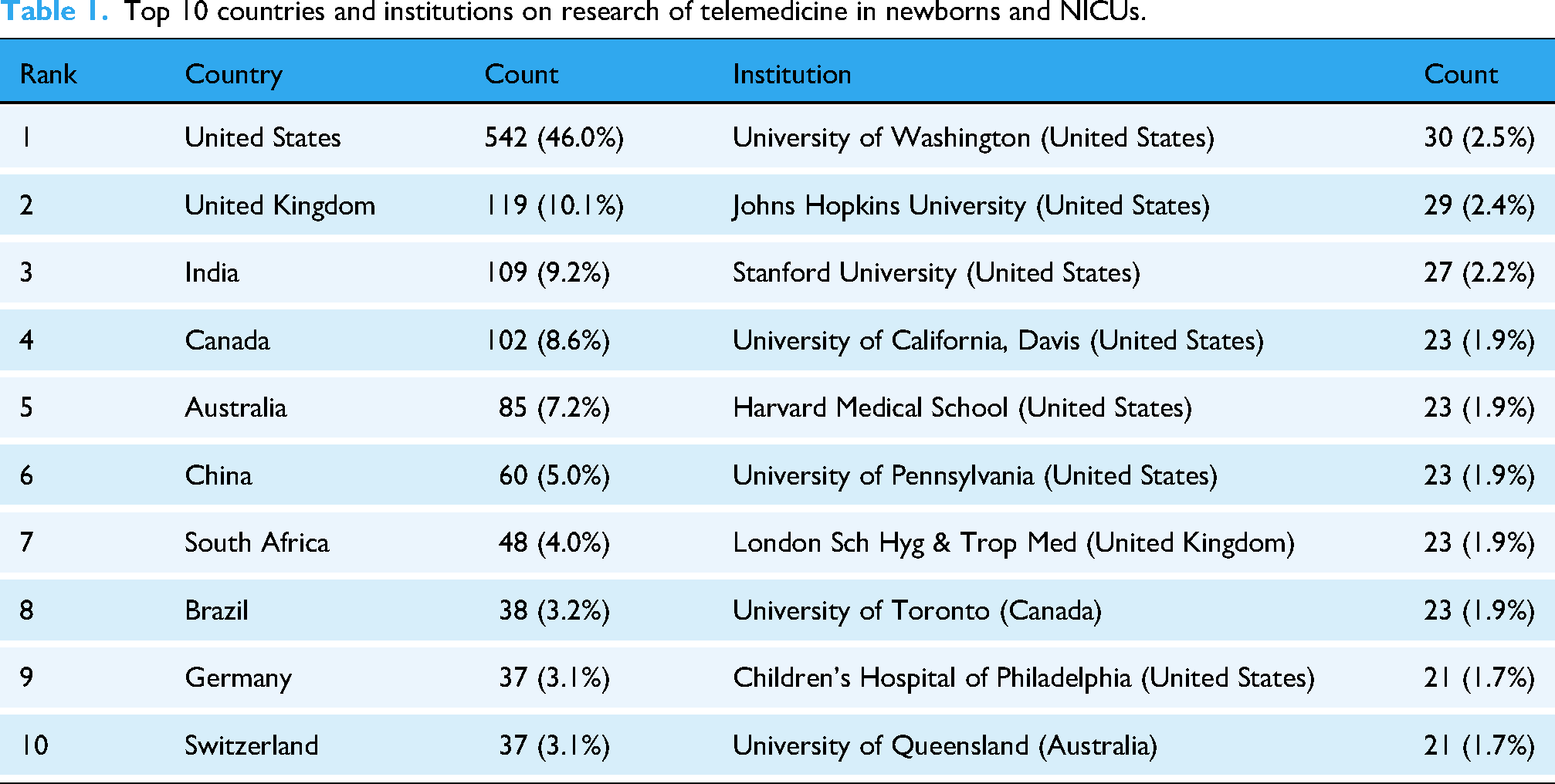
Publications were distributed across 55 countries/regions, with extensive collaboration observed among highly productive countries. Figure 2A represents the global network of cooperative efforts in telemedicine research focused on newborns and NICUs. The thickness of the lines represents the strength of collaboration between countries, highlighting prominent connections between the United States, the United Kingdom, India, Canada, and Australia. These robust connections suggest regular co-authorship and collaborative research activities, underscoring the international scope of studies in this area. Figure 2B shows the top 10 countries contributing to telemedicine research in neonatal settings. The United States ranks first in publication count, followed by the United Kingdom in second place, and India, Canada, and Australia in subsequent positions. Further noteworthy contributors are China, South Africa, Brazil, Germany, and Switzerland. This ranking highlights significant research contributions from these countries and their pivotal roles in progressing the field. The United States has seen a significant rise in publication volumes over recent years, highlighting increased research focus and investment, positioning the United States as a leading country in this research area. Figure 2C demonstrates the co-occurrence relationships between countries involved in neonatal telemedicine research, with the United States at the core node, showing the greatest co-occurrence frequency with other countries, which emphasizes its crucial role in international research partnerships. India, the United Kingdom, and Canada also exhibit robust co-occurrence connections, indicating their important collaborative efforts. Figure 2D presents the institutional co-occurrence network, illustrating the relationships and collaboration patterns among various research institutions. The bibliometric analysis suggests that these institutions with the widest collaborative connections include the University of California, the University of London, and Harvard University. Additional leading institutions include Johns Hopkins University, the University of Toronto, and the University of Washington, with most of these institutions based in the United States. Table 1 summarizes the top 10 prolific countries and institutions in telemedicine research on newborns and NICUs. These institutions are pivotal in the research network, fostering substantial collaborative work and contributing to advancements in the field.

Collaboration networks in neonatal telemedicine research. (A) Global collaboration network map. (B) Publication trends for the top 10 countries by publication count. (C) Country/region collaboration network. (D) Institutional collaboration network.
Top 10 countries and institutions on research of telemedicine in newborns and NICUs.
Analysis of the influential authors
Since the first publication on telemedicine in neonatology in 2004, 405 authors have contributed studies related to telemedicine in newborns and NICUs. Co-authorship analysis reveals a network of key contributors who have shaped the field (Figure 3A). Prominent authors such as Jennifer L. Fang, Marsha Campbell-Yeo, Michelle Heys, and Justine Dol are central to this network, reflecting the collaborative nature of the research. Figure 3B visualizes the co-citation network of authors analyzed with CiteSpace. Co-cited authors are those cited concurrently in at least one publication, signifying a similar research focus. The World Health Organization (WHO) emerges as a highly co-cited entity, underscoring its sustained influence in the field. Authors such as S. Lund, J.E. Lawn, and S. Agarwal are also identified as key contributors, demonstrating their broad impact. Figure 3C displays the top 15 authors featuring the most significant citation bursts, highlighting those who have garnered notable attention over the past few years. Sondaal S.F.V. (2016) exhibits the largest citation burst, with a burst strength of 10.43 from 2018 to 2021, signaling a growing influence. Other notable authors with substantial citation bursts include Quinn G.E. (2014) and Free C.(2013), reflecting their impact on recent trends. Table 2 lists the top 10 authors and co-cited authors in telemedicine research focused on newborns and NICUs. A close co-occurrence relationship exists between them, with more prolific contributors frequently co-cited. These patterns emphasize their significant influence on current research and future directions.

Visualization of authorship and co-citation in neonatal telemedicine research. (A) Visual representation of contributing authors in telemedicine research focused on newborns and NICUs. (B) Visualization of co-cited authors in this research area. (C) Top 15 cited authors with the strongest citation bursts.
Top 10 authors and co-cited authors on research of telemedicine in newborns and NICUs.

Journal co-citation and layered analysis
Figure 4A displays the journal co-citation network, emphasizing the main journals that contribute to the field. The figure shows a tightly knit network of co-cited journals, reflecting a robustly interconnected literature base. Leading journals like Pediatrics, The Lancet, and PLOS ONE frequently appear, demonstrating their substantial influence within this research domain. Other journals, including BMC Pregnancy and Childbirth and Journal of Perinatology, also hold considerable influence. This network of connections reflects a robust interconnected network of researchers and emphasizes the essential role these journals play in disseminating findings on telemedicine in neonatal settings. The dual-map overlay in CiteSpace reflects the development of research across disciplines. As depicted in Figure 4B, citing articles appear on the left and cited articles on the right, with colored paths in between indicating citation relationships. The green citation paths reveal that research published in fields such as medicine, clinical journals, ophthalmology, neurology, and dentistry is frequently cited by journals in health, nursing, dermatology, surgery, and other medical disciplines. This overlay map further indicates that research on telemedicine for newborns and NICUs spans various disciplines, such as medicine, ecology, and nursing. The bulk of citing journals are concentrated in the fields of medicine, mathematics, and economics, while cited journals cover broader areas such as molecular biology, psychology, and toxicology. Table 3 summarizes the top 10 journals and co-cited journals on telemedicine research in newborns and NICUs. This distribution highlights the diverse nature of the field, demonstrating the cross-disciplinary collaborative studies conducted in this area.

Visualization of journal co-citations in neonatal telemedicine research. (A) Co-citation network among journals in telemedicine research focused on newborns and NICUs. (B) Dual-map overlay of journals involved in neonatal telemedicine research.
Top 10 journals and co-cited journals on research of telemedicine in newborns and NICUs.

Analysis of highly cited references
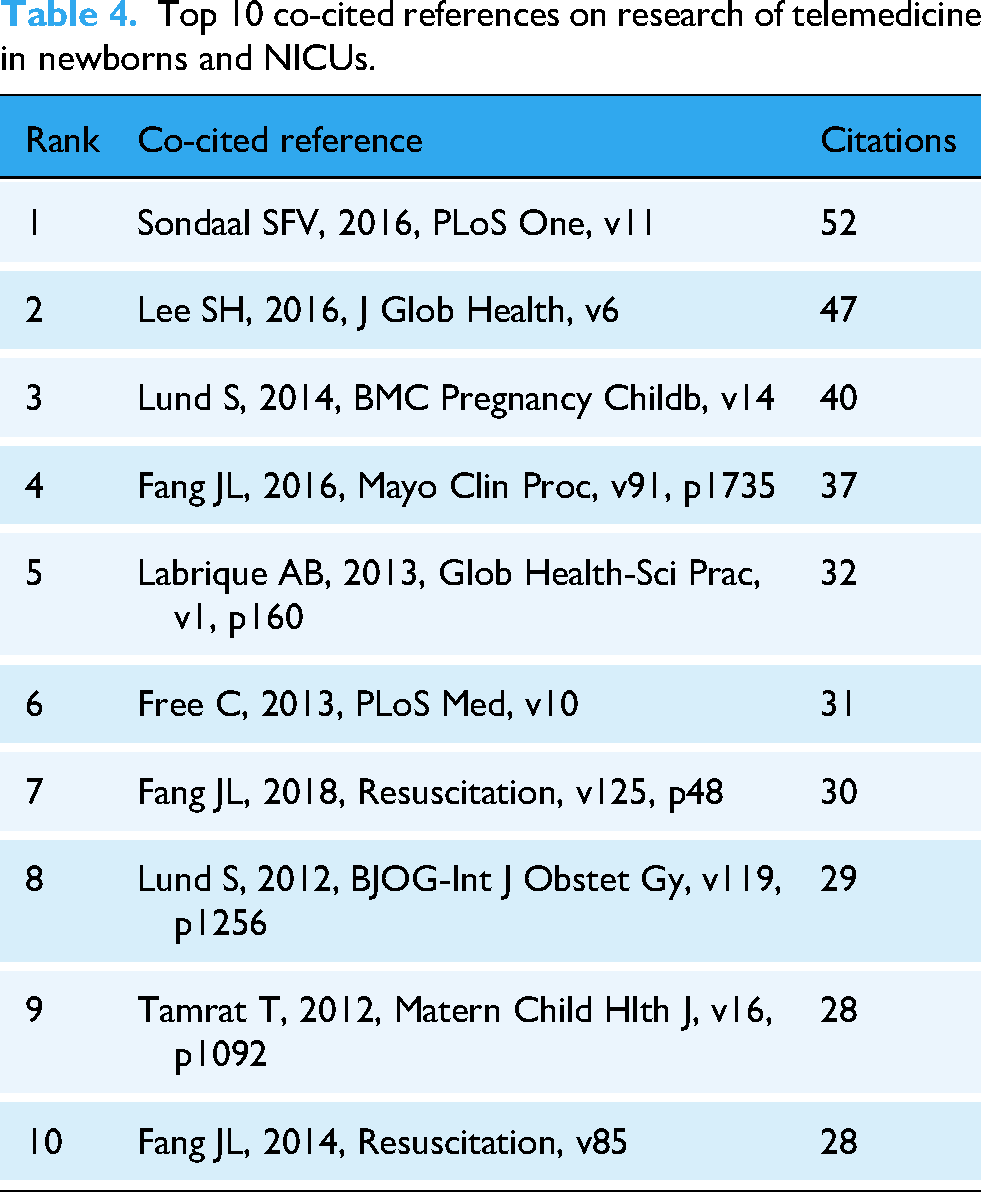
Reference co-citation analysis is one of the most valuable features of CiteSpace, often used to identify research focuses within a field. Co-cited references indicate the magnitude of the relationship between sources. Figure 5A illustrates the co-citation network, emphasizing major articles commonly cited in tandem. Noteworthy studies by authors like Sondaal S.F.V. (2016) and Lee S.H. (2016) appear prominently, emphasizing their significant contributions to the field. The network displays robust co-citation clusters, reflecting the interrelation among these foundational studies. Figure 5B illustrates the network map of co-cited reference clusters, pinpointing six primary clusters that highlight key references commonly cited together, underscoring their essential role within the field. The cluster number corresponds to the level of concern for the subject within the field, with smaller values indicating higher attention. These prominent clusters include labels such as “#0 information technology,” “#1 partograph,” “#2 knowledge,” “#3 parent,” “#4 outcomes,” and “#5 mHealth.” Table 4 summarizes the top 10 co-cited references in telemedicine research related to newborns and NICUs.

Visualization of co-cited references in neonatal telemedicine research. (A) Co-cited references network in telemedicine research focused on newborns and NICUs. (B) Cluster network map of co-cited references in this research area.
Top 10 co-cited references on research of telemedicine in newborns and NICUs.
Analysis of the concerned keywords
A keyword co-occurrence network is instrumental in uncovering research hotspots and trends within a particular discipline. Figure 6A presents this network structure for the telemedicine field focused on newborns and NICUs, highlighting terms frequently paired together. Key terms such as “telemedicine,” “care,” “management,” “impact,” “newborn,” “health,” “mortality,” and “infants” denote primary research themes. These keywords signify areas of focus, including neonatal care via telemedicine, telemedicine's effects on infant health, telemedicine management, and efforts to reduce neonatal mortality. Connections among terms reveal the interdisciplinary nature of this research, illustrating its multifaceted integration. Figure 6B maps out nine major keyword clusters, each representing a unique research topic. The largest cluster, labeled “#0 critical CHD,” relates to studies examining telemedicine's role in managing critical congenital heart disease (CHD). Clusters such as “#1 low-income population” and “#5 parents of high-risk infants” address telemedicine applications for specific groups. Other important clusters include “#2 metabolomics” and “#6 glycosylated [analysis],” underscoring telemedicine's impact, while clusters like “#3 reproductive” and “#4 palliative care” emphasize its role in women's reproductive health and neonatal palliative care. Additional clusters like “#7 wearable device” and “#8 telemedicine” highlight the integration of smart wearable devices in telemedicine. Figure 6C provides a visual landscape of keywords, showing the evolving focus within this research domain. For example, earlier research clusters often concentrated on telemedicine applications for critical CHD and palliative care, while recent clusters highlight advanced wearable devices tailored for specific populations, such as low-income groups and parents of high-risk infants. This temporal view enriches our understanding of the progression and evolution of key research themes in this area.

Keyword analysis in neonatal telemedicine research. (A) Co-occurrence network map of keywords. (B) Keyword cluster network map. (C) Keyword landscape.
The timeline view of the keyword cluster network illustrates the chronological development of research topics related to telemedicine in newborns and NICUs (Figure 7A). Key clusters, such as “critical CHD,” “low-income population,” “metabolomics,” “reproductive,” and “palliative care,” mark significant research areas. Over time, the focus has transitioned from broad themes like “infants” and “disorders” to more specialized topics such as “premature infants,” “dried blood spots,” and “mental health,” indicating an increasing depth and diversification within research themes. The timezone chart (Figure 7B) further maps the emergence and growth of multiple keywords throughout the timeline. Initial studies centered around foundational topics like “telemedicine,” “infants,” and “management,” while recent research emphasizes clinical and applied topics such as “mental health,” “mobile health,” “artificial intelligence,” and “newborn resuscitation.” This progression points to a growing interest in exploring specific clinical applications and implications of telemedicine in neonatal care. Figure 8 highlights the top 15 keywords with the most significant citation bursts in telemedicine research related to newborns and NICUs. Blue bars represent periods of lower citation frequency, while red bars indicate times of heightened interest. Keywords like “depression,” “digital health,” and “parents” exhibit strong bursts, reflecting their increasing prominence in recent research and suggesting potential areas for future exploration.

Keyword analysis over time in neonatal telemedicine research. (A) Cluster timeline view of keywords related to telemedicine in newborns and NICUs. (B) Timezone chart of keywords in this research area.

Top 15 keywords with the strongest citation bursts. Blue bars indicate periods of low citation frequency, while red bars represent periods of frequent citation.
Discussion
General information
This study presents a bibliometric analysis of 1177 papers on neonatal telemedicine published in 57 journals by 139 institutions across 55 countries/regions, drawing data from the Web of Science Core Collection. Through keyword clustering analysis, we identify dynamic research hotspots and emerging trends. The findings reveal a significant upward trajectory in research output. Before 2010, research in this area was limited; however, interest in neonatal telemedicine has grown substantially since 2016. This acceleration is attributed to advancements in telemedicine technology and heightened global healthcare demands, further amplified by the COVID-19 pandemic. 18
Leading countries and institutions
The United States, the United Kingdom, and India are the leading countries in neonatal telemedicine research, with the US contributing the highest volume of publications over the past 20 years. This prominence can be attributed to successful neonatal telemedicine programs, such as those at the Mayo Clinic, along with supportive policies, a robust healthcare system, and advancements in technology within the US. 19 In contrast, many Asian and African countries remain in the early stages of adoption, highlighting the global disparity in neonatal telemedicine development. To address this, increased investment in research, talent development, and international collaboration is essential. For example, while China began its telemedicine efforts in the late 1990s, recent government support has driven significant expansion, particularly in remote areas. 20 Despite these advances, the relatively low citation counts for the top 10 contributing countries suggest a need for more high-quality publications. Institutional patterns mirror country distributions, with the US hosting most of the leading institutions, followed by Canada and Australia. While international collaborations are strong, inter-institutional cooperation remains limited, underscoring the need for greater institutional partnerships to advance the field.
Active authors and journals
The 10 most active authors (each publishing ≥8 articles) were exclusively affiliated with institutions in North America (8/10: 6 US, 2 Canada) and the UK (2/10), indicating concentrated research leadership in developed economies. Co-citation analysis identified 10 pivotal contributors with ≥158 citations each, reflecting their foundational impact on neonatal telemedicine scholarship. Leading this list is James P. Marcin, with 372 citations, followed by Graham E. Quinn with 336 citations, and Stine Lund with 320 citations. James P. Marcin has contributed to pioneering work in telemedicine, focusing on advancements that enhance patient outcomes and healthcare delivery.11,21 Graham E. Quinn, affiliated with the University of Pennsylvania, specializes in ophthalmology and pediatrics, with research focusing on telemedicine applications for acute-phase ROP assessment (e-ROP).22,23 Stine Lund has concentrated on neonatal emergency care through telemedicine, contributing to studies on newborn and NICU telemedicine.24,25
The top 10 journals published 239 articles, accounting for 20.3% of the total in the field. Leading journals include BMC Pregnancy and Childbirth, JMIR mHealth and uHealth, and BMJ Open, highlighting a strong focus on neonatal telemedicine. This insight can guide researchers in choosing suitable journals for submission. Additionally, analysis of authors and co-cited references revealed that Jennifer L. Fang appeared across all three indicators, marking her as a key contributor and a potential collaborator for other researchers.
High-impact publications
Co-citation analysis reveals key publications that have shaped neonatal telemedicine research. These highly cited works include five clinical studies and five review articles, primarily from leading journals. The clinical studies trace the development of neonatal telemedicine, with the Mayo Clinic playing a pivotal role. In 2013, the Mayo Clinic began offering teleneonatology services to six community hospitals, significantly improving care delivery and neonatal outcomes, particularly in resource-limited settings. 26 That same year, Jennifer L. Fang and colleagues demonstrated that video-assisted resuscitation (VAR) during simulated neonatal resuscitation reduced the time to effective ventilation and improved adherence to NRP guidelines, thereby enhancing neonatal safety. 27 A study by Stine Lund explored the impact of mobile phone interventions in island settings, showing their potential to increase skilled birth attendance—a critical intervention for maternal and neonatal health in low-resource settings.28,29
The review articles emphasize the growing potential of telemedicine for maternal and neonatal health. mHealth interventions, for example, have been shown to enhance prenatal and neonatal education and promote antenatal care. 30 However, Siew Hwa Lee and colleagues noted that many studies conducted in low- and middle-income countries (LMICs) suffer from methodological weaknesses, limiting their ability to assess patient outcomes effectively. They suggest that more transparent reporting is necessary to improve research quality. 31 Nonetheless, studies like Caroline Free et al.'s show that mobile interventions, such as text messaging, can improve adherence to antiretroviral medication in low-income settings. 32 Stephanie Sondaal and colleagues also suggest that mHealth could enhance maternal and neonatal service use, recommending further research to evaluate its impact. The growing trend towards robust experimental designs and government involvement in mHealth integration is promising for developing best practices. 33
In summary, these 10 co-cited references highlight the progress and challenges of neonatal telemedicine. Co-citation analysis provides key insights into the field's evolution and informs future research directions.
Hotspots and frontiers
Keyword frequency analysis revealed that “accuracy” is a major research focus in neonatal telemedicine, particularly regarding its use in diagnosing retinopathy of prematurity (ROP). Studies by Cheng et al. 23 and Biten et al. 34 showed telemedicine's accuracy to be comparable to ophthalmoscopy for detecting clinically significant ROP. Other frequently mentioned terms, such as “depression,” “digital health,” and “mobile health,” represent emerging research trends in health management and mental health within neonatal intensive care and telemedicine, driven by advancements in technology. As emphasized by the WHO, digital health technologies are pivotal for building sustainable health systems. In mental health, interventions like online cognitive behavioral therapy have demonstrated efficacy in reducing depression symptoms,35–38 while research by van den Heuvel et al. suggests that home-based care can improve patient satisfaction and efficiency in pregnancy care. 39
A cluster analysis of the literature on neonatal telemedicine highlighted nine major research themes: critical congenital heart disease (CHD), low-income populations, metabolomics, reproductive health, palliative care, parents of high-risk infants, glycosylation analysis, wearable devices, and telemedicine. Clusters 1 and 5 highlight application scenarios, such as tele-echocardiography for CHD screening and remote nutritional management for post-surgery neonates, which enhance patient outcomes and reduce healthcare costs.40–43 Clusters 3 and 7 underscore telemedicine's impact, with cloud computing advancing data management in fields like genomics and metabolomics, improving healthcare access, and driving better outcomes.44–46 Clusters 2 and 6 focus on underserved populations, showing how telemedicine improves access to specialist care and parental education and reduces emergency visits. 47 However, challenges persist in low-income settings, including education barriers and limited healthcare access.48,49 Despite these obstacles, initiatives like Zanzibar's mobile health interventions and Arkansas’ ANGELS program highlight the potential of telemedicine to improve maternal and neonatal care in resource-limited environments.28,29,50
Continued high-quality investigation into the impacts of telehealth on patient outcomes and healthcare systems is critical for the ongoing development of neonatal telemedicine best practices. Future studies should assess the economic impact of telemedicine in low-income regions and focus on expanding telemedicine programs with an emphasis on improving both accuracy and safety.
Limitations
This study is the first to systematically analyze neonatal telemedicine publications and trends in an intuitive, objective, and precise way, providing a comprehensive resource for clinicians and researchers in this field. Several bibliometric tools were used to examine important research topics from multiple viewpoints. However, certain limitations should be noted: (1) Our retrieval was completed on October 22, 2024, so some recently published studies with important findings may have been excluded, potentially affecting the completeness of the research trends and overlooking recent developments (2) We restricted our search to articles and reviews in WoSCC to maintain high literature quality, which means that other types of publications, such as books, case reports, clinical trials, and meta-analyses with relevant findings, were not included. These excluded types of literature may contain valuable insights that could have further enriched our analysis. (3) Our search was limited to WoSCC-indexed journals, excluding data from other key databases such as PubMed, Embase, and Ovid, so studies indexed only in these databases were omitted. This restriction may have impacted the breadth of our findings by omitting relevant studies from these databases. (4) Only English-language studies were retrieved from WoSCC, meaning that significant research published in other languages may not have been captured in our analysis, potentially affecting the global generalizability of our findings.
Conclusions
Neonatal telemedicine, as a product of the integration of modern medicine and information technology, has garnered widespread attention globally in recent years. The upward trend in annual publications indicates that neonatal telemedicine has garnered substantial interest from researchers globally, especially over the past five years. This study aimed to analyze research hotspots and trends in neonatal and NICU telemedicine, with the USA, the United Kingdom, and India as the primary contributors. Differences in publication volume among countries may be influenced by factors such as policy support, technological advancement, and healthcare infrastructure. According to the analysis of keywords with the strongest burst strength, areas such as accuracy, depression, digital health, mobile health, parents, and program are prominent research hotspots. It is recommended to focus further attention on key topics like critical CHD, low-income populations, metabolomics, reproductive health, palliative care, and parents of high-risk infants, among others.
Supplemental Material
sj-docx-1-dhj-10.1177_20552076251336283 - Supplemental material for Worldwide research performance on telemedicine for newborns and neonatal intensive care units: A bibliometric and visualization study
Supplemental material, sj-docx-1-dhj-10.1177_20552076251336283 for Worldwide research performance on telemedicine for newborns and neonatal intensive care units: A bibliometric and visualization study by Liyan Luo, Yaochen Lou, Chuyan Wu, Jiahui He and Feng Jiang in DIGITAL HEALTH
Footnotes
Contributorship
Liyan Luo contributed to the study design, data collection, and initial drafting of the manuscript. Yaochen Lou performed data analysis and interpretation and contributed to manuscript revisions. Jiahui He supervised the study, provided critical feedback, and ensured the accuracy of data analysis. Feng Jiang was involved in the conceptualization of the study, coordinated research activities, and provided essential revisions to the final manuscript. All authors read and approved the final version of the manuscript.
Availability of data and materials
The data for this study were obtained from the Web of Science Core Collection, a publicly accessible database. This bibliometric analysis focused on publications from January 1, 2004, to October 22, 2024, related to telemedicine in newborns and NICU. The datasets generated and analyzed during the study are available from the corresponding author upon reasonable request. Additional information or data supporting the study's findings can also be requested from the corresponding author.
Consent for publication
Not applicable.
Declaration of conflicting interests
The authors declared no potential conflicts of interest with respect to the research, authorship, and/or publication of this article.
Ethics approval and consent to participate
This study did not involve collecting new data from human or animal subjects. All data used in this bibliometric analysis were sourced from the Web of Science Core Collection, so ethics approval and consent to participate were not required. The research adheres to all relevant ethical guidelines and regulations for studies utilizing publicly available data. Future research that builds on these findings should obtain appropriate ethical approvals if it involves direct interactions with human or animal subjects.
Funding
The authors disclosed receipt of the following financial support for the research, authorship, and/or publication of this article: This work was supported by the Dali Prefecture Science and Technology Plan Project (grant number 20232901A020010).

Supplemental material
Supplemental material for this article is available online.
References
Supplementary Material
Please find the following supplemental material available below.
For Open Access articles published under a Creative Commons License, all supplemental material carries the same license as the article it is associated with.
For non-Open Access articles published, all supplemental material carries a non-exclusive license, and permission requests for re-use of supplemental material or any part of supplemental material shall be sent directly to the copyright owner as specified in the copyright notice associated with the article.
