




Abstract
Background
In recent years, with the advancement of technological innovation and the widespread application of semiconductor materials, wearable technology has emerged as a significant branch in healthcare, demonstrating considerable potential for further development. This analysis aims to explore the global scientific trends on wearable technology applications in healthcare.
Methods
Scientific publications on wearable technology applications in healthcare from 1 January 2003 to 31 December 2022 were retrieved from the Web of Science Core Collection. A total of 19,426 publications were included in the bibliometric analysis. VOSviewer and CiteSpace were used to conduct bibliometric and visualized analysis. Key metrics such as country, institution, author co-authorships, cited references, journal citations, and keyword co-occurrences were selected for analytical emphasis.
Results
The United States of America and China emerged as the top two contributing countries, with significantly higher publication compared to other countries/regions. Chinese Acad Sci and Sensors are the institution and journal with the largest number of publications, respectively. Najafi, Bijan is the most active author. Research hotspots of wearable technology were divided into four clusters based on the co-occurrence analysis of keywords: (1) Wearable Technology for Detecting and Monitoring Human Physiological Parameters; (2) Wearable Technology for Human Chronic Disease Detection and Management; (3) Wearable Technology Exercise Health and Sports Rehabilitation Therapy under Intervention; and (4) The Technical Realization of Accuracy Enhancement in Wearable Technology.
Conclusions
The number of annual publications on wearable technology applications in healthcare has increased over the past 20 years. This analysis identified the status, trends, hot topics, and frontiers of wearable technology applications in healthcare. These findings will help researchers quickly identify emerging themes and offer new insights into the future development of wearable technology in healthcare.
Introduction
In the context of rapidly advancing technological innovations, wearable technology has emerged as a significant sector within modern healthcare, garnering substantial interest over the past years. 1 Additionally, assertions have been made regarding the potential of wearable technology to enhance health outcomes and quality of life. 2 Based on the future potential of wearable technology, researchers have conducted a large number of scenario studies and case studies.3–5 Furthermore, research indicates that while centralized health services, such as hospitals, remain the primary choice for disease diagnosis, they pose logistical and temporal challenges for the majority of individuals. 3 In this scenario, wearable devices have their own audience and a wide range of applications. 4 Wearable biosensors, in particular, are exemplary for real-time, continuous health monitoring, characterized by their self-sufficiency in power, lightweight design, cost-effectiveness, high flexibility, user-friendly interface, and comfortable integration with the body. 2 These devices are capable of not only tracking physiological parameters but also offering insights for health management. 5 By converting physiological signals into quantifiable electrical metrics such as current, capacitance, and resistance, wearable biosensors provide users with immediate, accurate feedback on their health status.5,6
However, despite notable advancements in recent years, research on wearable technology remains in its nascent stage. 1 Previous studies have not integrated bibliometric analysis to comprehensively summarize regional research depth, current research hotspots, and predict future trends. This study addresses this gap by employing a bibliometric perspective to analyze the application of wearable technology in the healthcare domain.
Bibliometric is defined as the quantitative analysis of published material, employing statistical methods to visually analyze a vast array of publications. 7 It plays a pivotal role not only in informing governmental policy-making and macroeconomic regulation but also in guiding the direction of funding allocations.8,9 Most importantly, bibliometric is instrumental in defining and understanding research fields by identifying relevant articles, journals, authors, and themes. It enables the tracking of developmental trends within a field and facilitates the understanding of research depth variations across different countries or regions. 10 In our study, bibliometric analysis extends to measuring the impact or influence of articles, providing a feasible approach for evaluating their significance within the field or predicting future research trends. 11 In this study, we utilized bibliometric analysis to ascertain global trends in publications, countries, journals, institutions, authors, and keywords related to the application of wearable technology in healthcare. Additionally, we offer a visualization of this information to assist in identifying hotpots and emerging trends.
Data and methods
Figure 1 illustrates the search process and steps for retrieving publications on wearable technology in healthcare. We conducted a comprehensive search on the Web of Science Core Collection (WOSCC) using the search query TS = "wearable*” and TS = (“health*” or “medic*” or “disease*” or “hospital” or “hospitalized” or “clinic*” or “patient*” or “outpatient*” or “inpatient*” or “doctor*” or “nurse*” or “treatment*” or “therap*” or “illness*”). The document type was limited to articles between 2003 and 2022, and the publication language was limited to English. In total, 16,426 scientific publications from 1 January 2003 to 31 December 2022 were retrieved from WOSCC. Full records and referenced bibliographic data in TXT format were downloaded and imported into the bibliometric software VOSviewer for analysis. Key metrics such as country, institutional affiliations, author co-authorships, cited references, journal citations, and keyword co-occurrences were selected for analytical emphasis. Additionally, these data were imported into the bibliometric software CiteSpace for supplementary analysis using reference burst graphs. It is important to note that the search and data download were completed within a single day to minimize the impact of daily updates. Furthermore, this dataset, being publicly available on a common data source, does not implicate any ethical concerns.
Results
Number of global publications
The volume of publications over time reflects the popularity and developmental trends in a field. After conducting a search and subsequent selection from WOSCC, a total of 16,426 studies were included in our analysis. Figure 2 illustrates the trend of increasing publication volume over the past 20 years on wearable technology applications in healthcare. There has been a steady rise in the number of publications, from 16 in 2003 to 3625 in 2022. The publication growth rate was 225.56 from 2003 to 2022. This growth can be divided into two phases: a gradual increase during the first phase (2003–2014) and a rapid surge in the second phase (2015–2022).

The search process and steps for retrieving publications on wearable technology in healthcare.

The annual number of publications on wearable technology in healthcare from 2003 to 2022.
Contributions of countries/regions
Figure 3(a) categorizes the top 50 countries/regions in publication volume in this field into five distinct color groups, with each group comprising ten countries/regions and denoted by a specific color: red, yellow, blue, green, and pink. Among them, there are 23 European countries/regions, 18 Asian countries/regions, three North American countries/regions, and two Oceania, South American and African countries/regions. This visualization reveals that countries with higher publication volumes are primarily located in Asia, North America, and Australia. According to Table 1, countries/regions with over a thousand publications, besides the United States of America and China, include the United Kingdom, South Korea, and Italy. It can be seen that different countries/regions have different research depths for this research, generally showing a more in-depth law of developed countries and China.

(a) Distribution of the top 50 countries/regions published on the world map. (b) The countries/regions co-authorship network map generated by using VOSviewer. (c) Growth in the number of publications in the top 10 countries/regions over the past 20 years.
The top 10 productive countries/regions on wearable technology applications in healthcare.

Figure 3(b) displays a network co-authorship map of country/region collaborations, generated using VOSviewer software. A minimum publication threshold of 30 publications was set for each country/region, resulting in a network map of 50 countries/regions meeting this criterion. The three countries with the highest Total Link Strength (TLS) are the United States of America (TLS = 2786), China (TLS = 1901), and the United Kingdom (TLS = 1783), indicating their high frequency of collaboration with other countries/regions. The top three pairs of countries in terms of depth of cooperation are, in order, the United States of America and China, the United States of America and the United Kingdom, and the United States of America and South Korea, which shows that these countries have established deep cooperative relations with each other. In addition, a network of cooperation with the United States of America as the core has been formed.
A total of 125 countries/regions have contributed on wearable technology applications in healthcare. Figure 3(c) presents a bar stack graph illustrating the publication volume of the top ten contributing countries/regions over the past 20 years (2003–2022). It can be seen that from 2003 to 2014, the number of publications in each countries/regions was not large. Since 2015, the number of publications published by various countries/regions has increased significantly, showing a cliff trend of United States of America and China leading other countries/regions in the number of publications. In 2020, China published roughly the same number of articles as United States of America, then surpassed it in 2021. At the same time, we can also find that since 2020, except for United States of America and China, the annual publication of other countries/regions has tended to be stable.
Table 1 lists the ten most productive countries/regions in this field. It is noteworthy that the United States of America and China have published 4621 and 4209 publications, respectively, with total citation counts of 158,118 for the United States of America and 131,330 for China. These figures, both in terms of publication volume and total citations, significantly surpass those of other countries/regions, indicating a deeper level of research engagement by the United States of America and China in this area of study.
Contributions of journals
To date, this research area has been featured in 2352 academic journals. According to Table 2, the number of publications published by Sensors Major is 1267, which is significantly more than other journals. Following SENSORS are ACS APPLIED MATERIALS & INTERFACE and IEEE SENSORS JOURNAL, with publication volumes of 417 and 391, respectively. Notably, SENSORS and ACS APPLIED MATERIALS & INTERFACE also lead in total citation counts, with 20,111 and 19,019 citations, respectively. As shown in Figure 4, these two journals are also the focal points of their respective clusters in Journals co-authorship network map. According to the 2022 Journal Citation Reports, the top 10 publishing journals in this field are predominantly ranked in Q1/Q2 quartiles, with NANO EBERGY having the highest impact factor (IF = 17.6). Interestingly, while NANO EBERGY and IEEE TRANSACTIONS ON BIOMEDCIAL ENGINEERING do not rank among the top in terms of publication volume in this field, they exhibit higher average citations per publication, at 51 and 57 citations, respectively. In terms of TLS, SENSORS and ACS APPLIED MATERIALS & INTERFACE significantly surpass other journals, with TLS values of 4254 and 3207, respectively.

The journals co-authorship network map generated by using VOSviewer.
The top 10 productive journals on wearable technology applications in healthcare.

Contributions of institutions
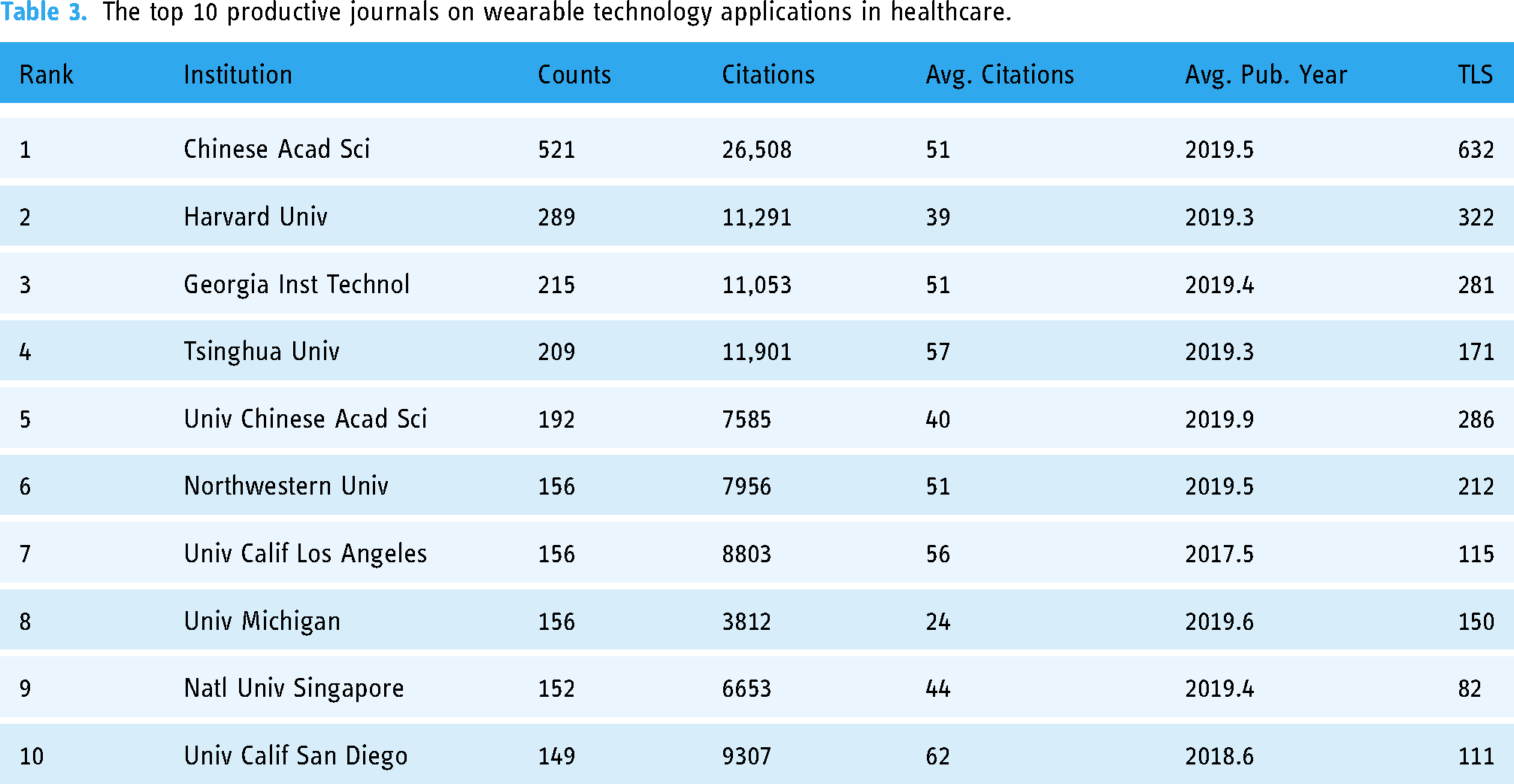
A total of 11,471 institutions have conducted research on the application of wearable technology in health and medical care. Figure 5(a) presents a polar bar chart depicting the publication volume, average citations, and TLS of the top ten institutions. It is evident that among the top ten publishing institutions, three are based in China, six in the United States of America, and one in Singapore. This distribution indicates that both China and the United States of America have a profound depth of research in this field. Additionally, from a global perspective, North America and Asia emerge as leading regions in terms of research contributions to this domain.

(a) The polar bar chart of counts, total link strength (TLS), total citations of the top productive 10 institutions. (b) The co-authorship network map of leading research institutions on wearable technology applications in healthcare.
Figure 5(b), generated using VOSviewer software, illustrates the network of institutional collaborations. A minimum publication threshold of 50 was set for each institution, resulting in the depicted network. The network is primarily divided into four clusters, indicating extensive collaboration among various institutions. It is worth noting that Harvard University and the Chinese Academy of Sciences not only lead other institutions in the number of publications. Moreover, the co-authorship map of institutions shows that they are divided into clusters of their own, forming a network map of cooperative relationships with them as the core, indicating that they have close communication with other institutions.
According to Table 3, Chinese Academy of Sciences leads globally in the number of publications in this field, with a total of 521 published works. Harvard University ranks as the second most prolific institution, contributing 289 publications. Following closely are Georgia Institute of Technology and Tsinghua University, with 215 and 209 publications, respectively.
The top 10 productive journals on wearable technology applications in healthcare.
Analysis of the active authors and co-cited authors
A total of 65,141 authors have contributed to the publication of publications on wearable technology applications in healthcare. Table 4 summarizes the top ten most prolific authors and the top ten most co-cited authors in this domain. Bijan Najafi leads in publication volume with 61 publications, followed by ZhongLin Wang and Wei Wang with 54 and 46 publications, respectively. Notably, John A. Rogers, the fourth most prolific author, holds the record for the highest total citation count at 6374. Additionally, Joseph Wang, while not among the top in publication volume, has the highest average citation count per publication at 136.
The 10 most productive authors and top 10 co-cited authors on wearable technology applications in healthcare.

Among the top ten most co-cited authors, the highest total number of citations belongs to Kim, J (n = 1487), indicating his substantial contribution to the field and the widespread acceptance and application of his theories or viewpoints. Following Kim, J, the authors with the second and third highest citation counts are Wang, Y. (n = 995) and Kim, D.H. (n = 826), respectively.
Figure 6, created using VOSviewer software, presents a visualization of the author co-authorship analysis in the field. Key authors who act as bridges connecting multiple research clusters include Aminian, Kamiar; Zhang, Wei; Wang, Zhong Lin; Wang, Wei; and Dai, Kun. It is observable that, although there are numerous author collaboration clusters in this field, the interconnectivity between these clusters is relatively limited, indicating a need for enhanced international cooperation among researchers.

The co-authorship network map of leading authors on wearable technology applications in healthcare.
Highly cited publications
In this study, a total of 16,426 research articles were included, among which 832 publications have been cited over 100 times. Table 5 lists the top ten most-cited articles, with the highest-cited publication being authored by Gao, Wei, published in NATURE in 2016, accumulating a total of 2807 citations. Following this, publication by
The top 10 most cited publications on wearable technology applications in healthcare.

The 25 most significant citation bursts in the literature are depicted in the following Figure 7. The onset of citation bursts in this study began in 2010, marked by a publication published by Pantelopoulos A. Additionally, the publication by Gong S, published in 2014, exhibits the highest burst strength. Most of the publications showing citation bursts were highlighted between 2013 and 2018, suggesting rapid development on wearable technology applications in healthcare during this period. The most recent publication that continues to be frequently cited is by Kim J, published in 2019.

Visualization map of top 25 references with the strongest citation bursts on wearable technology applications in healthcare.
Co-occurrence analysis of keywords
Keywords in an article encapsulate knowledge, ideas, and scientific concepts, making keyword co-occurrence analysis an important metric in bibliometric analysis. Keyword co-occurrence analysis can provide a more specific version of the main ideas covered in the publications. 22 The more frequently keywords co-occurrence, the closer the research directions of different publications are. 23 Keyword co-occurrence networks facilitate the identification of important keywords used in publications within a knowledge domain, providing insights into the primary research themes. 24 Approximately 65141 keywords were identified in the 16426 articles.
Following data cleansing and keyword co-occurrence analysis, four distinct keyword clusters are identified from Figure 8.

The co-occurrence network map of keywords on wearable technology applications in healthcare.
The first cluster, represented in red, focuses on basic physiological parameters such as blood pressure and skin condition, along with wearable sensors. This cluster's theme is anticipated to be the detection of physiological parameters, indicating that wearable technology is capable of monitoring heart rate, blood pressure, skin condition, and other fundamental parameters.
The second cluster, in green, centers around chronic diseases such as diabetes and hypertension, suggesting a theme of chronic disease monitoring and management. This implies that wearable technology can be used for detecting chronic conditions.
The third cluster, in blue, relates to movement, walking, and the correlation between physical activity, health, and chronic disease recovery. The predicted theme here is the application of wearable technology in exercise health and rehabilitation therapy, exploring their role in guiding recovery treatments for patients.
Finally, the yellow cluster focuses on signals, algorithms, and accuracy, pointing to a theme of precision enhancement in wearable technology. This cluster explores the refinement of wearable technology for more precise applications in health and medical fields.
As shown in Figure 9, the evolution of the keywords in the research of wearable technology in the field of health care is demonstrated. From the very beginning of the exploration phase, wearable technology can be used to detect and monitor what diseases, and now the use of various technologies to improve accuracy. It is obvious that the depth of research in this field is increasing, and it also reflects the changing trend of the focus of attention in this field over time.

The overlay visualization map of keywords on wearable technology applications in healthcare.
Discussion
Basic knowledge
The number of scientific publications in a field can be indicative of its research progress and depth. Our study reveals that from 2003 to 2022, there has been a continual increase in the volume of research publications focusing on the application of wearable technology in healthcare. Particularly since 2015, the research output has grown exponentially, largely attributed to the widespread adoption of semiconductor materials. This surge in publications reflects the expanding scope and increasing significance of wearable technology applications in healthcare. As a result, wearable technology has emerged as a critical area of research in clinical practice, promising extensive future applications.
Geographical analysis can show the differences in the research concerns that different countries/regions focus on. We organized the list of the top 20 keywords in the top five countries (United States of Americas, China, United Kingdom, South Korea, and Italy) in order to show the differences in research trends or themes among different countries/regions (as shown in Supplementary Table 1).
It can be seen from Supplementary Table 1 that the research hotspots of the top five countries in terms of the number of publications are generally different. Although the keyword “sensor” is the key concern of each country, the attention degree and priority order of the other keywords are different. By analyzing the keywords of different countries, it can be seen that they have different focuses on the application of wearable technology in healthcare, showing geographical differences.
The keywords with high frequency in the United States of America are “sensor,” “validation,” “system,” and so on. It shows that United States of America is mainly concerned with the verification of sensor systems to ensure their accuracy and reliability.25–27 The keywords with high frequency in China are “sensor,” “film,” “composite,” and so on. It shows that China is mainly concerned the research of sensor materials, especially thin films and composites.28–31 The keywords that appear more frequently in the United kingdom are “sensor,” “system,” “validation,” and so on, indicating that United kingdom focus on research directions similar to those in the United States of Americas.32–34 The keywords with high frequency in South Korea are “sensor,” “system,” “performance,” and so on, indicating that South Korea pays attention to the performance optimization of sensor systems to ensure their good performance in various application scenarios.35–37 The keywords with high frequency in Italy are “sensor,” “system,” “walking,” and so on, indicating that Italy focuses on gait analysis and detection and develops sensor systems for gait monitoring.38–40
In terms of international collaboration, the United States of America stands out as a central hub, engaging closely with China, the United Kingdom, and South Korea. However, most collaborations are primarily confined to a few countries in North America, Europe, and Asia. Consequently, the importance of cross-border cooperation, especially with developing countries/regions, becomes increasingly evident. Such global collaborations are crucial for driving scientific advancements and ensuring a more inclusive representation of diverse perspectives in research.
In the author co-authorship analysis, among the top ten most active authors, five are from China, collectively contributing to 200 publications. The most prolific author, Bijan Najafi from the United States of America, has published 61 publications, followed by ZhongLin Wang and Wei Wang from China, with 54 and 46 publications, respectively. Notably, aside from ZhongLin Wang who ranks second in publication volume, other authors such as John A. Rogers and Joseph Wang from the United States of America, and Chuntai Liu from China, do not rank as high in total publication count. However, they have a significant number of citations, each exceeding 3000, indicating their prominent status in the field. Moreover, the author co-authorship network reveals a diverse range of color groups, suggesting that international collaboration in this research area is not as robust as it could be. The interactions among different groups appear to be limited, indicating a need for enhanced international cooperation to further advance the field.
Citation analysis and co-citation analysis are pivotal methodologies in bibliometric research, instrumental in identifying influential literature within a field. 41 These publications are crucial for evaluating the advancement and current landscape of research.42,43 They also play a key role in forecasting future research trends and identifying emerging hot topics. Highly cited works typically signify major breakthroughs or offer new insights within their fields. 11
Our study lists the top ten most-cited research publications in the application of wearable technology in healthcare, each cited over 800 times, indicating their substantial impact in this domain. Notably, the most cited publication in this field is Wei Gao's 2016 publication in Nature, titled Fully integrated wearable sensor arrays for multiplexed in situ perspiration analysis. This publications with a total citation count of 2807 introduce the concept of using wearable technology to monitor basic physiological parameters such as in situ sweat analysis or body surface temperature, thereby enabling real-time tracking of human physiological indicators. At the same time, we found that not only did Gao, Wei have one of the top ten cited articles, but he was also one of the top 10 co-cited authors. To a certain extent, it can indicate that the research or theory proposed by authors with a large number of publications or co-citations may drive the development of the field, lead the hot topics in the field, and be used for reference by scholars. The substantial impact of publications like Gao, Wei's demonstrates how influential research can drive innovation. This underscores the importance of citation analysis in understanding the evolution and future directions of research within the field of wearable technology.
Burst detection algorithms are specifically designed to identify significant surges in citations or keyword popularity over a certain period. 44 This approach is an effective means for pinpointing key research directions and seminal references within a field. According to our analysis, the field of wearable technology applications in health and medical care began garnering significant research attention starting from 2010. This trend has continued through to 2022, indicating ongoing interest and development in this area. A notable publication marking the beginning of this surge is A. Pantelopoulos's 2010 publication, A Survey on Wearable Sensor-Based Systems for Health Monitoring and Prognosis. This publication, through a systematic review, summarized the current allocation of resources and functional implementations of wearable technology in healthcare, thereby providing a reasoned extrapolation of future research trends.
Additionally, we observed a significant surge in the number of references starting from 2015, indicating heightened attention and rapid development in the field during this period, which aligns with the data shown in the publication volume bar graph, which demonstrates a rapid increase in total publications from 2015 onward. It is noteworthy that, according to our co-citation analysis, authors Kim J, Wang Y, and Kim D.H rank as the top three in terms of total citations in this field. Moreover, many of the 25 key publications identified in the burst detection analysis are authored by these researchers.
Hot topics of wearable technology in healthcare
Keyword co-occurrence analysis is a prevalent method in bibliometric for identifying trending research topics. It accurately reflects the hotspots in research subjects and predicts future research interests. 44 In our study, following the data cleansing process to remove irrelevant nouns, we conducted a keyword co-occurrence analysis. This analysis, through categorical sorting, yielded four main themes related to the application of wearable technology in the healthcare.
Red cluster: Wearable technology for detecting and monitoring human physiological parameters
Because wearable devices are characterized by their ease of use, timely data display, portability, and cost-effectiveness. 1 In both healthy populations and hospitalized patients, it is common practice to conduct multiple physiological measurements daily using wearable devices. 34 Research indicates that wearable devices have been extensively applied for monitoring a wide range of human physiological parameters. These include the detection of pulse beats,45,46 the analysis of metabolites in body fluids,12,47 monitoring of temperature changes, 48 assessment of cardiac activities, and evaluation of fall risks, 49 among others. We also found a lot of human physiological parameters or secretions words in the keyword co-occurrence map, such as “blood,” “chitosan,” “lactate,” “ph,” and “sweat.” Wearable devices can directly or indirectly analyze whether the trace element indicators in these secretions are within the normal range to provide health advice. The above all reflect that wearable technology can be used to detect and monitor a variety of physiological parameters of the human body, has universal applicability.
Concurrently, the type of physiological parameters monitored varies with different wearable device types. For instance, compact and cost-effective wrist-worn devices, such as fitness trackers, are predominantly used for monitoring easily accessible biometrics such as sleep quality and heart rate. These devices utilize surface-level measurements to provide insights into vital signs that can be reliably captured through non-invasive methods.50–52 Complex physiological parameters, such as blood oxygen saturation, are typically measured using wearable devices equipped with infrared spectroscopy technology. Additionally, certain wearable devices are designed to monitor biobehavioral patterns or personal habits. For example, devices equipped with triaxial accelerometers, typically worn on the chest, can track daily postures and walking patterns. 53 On the other hand, some wearable devices, such as visi mobile, integrate multiple sensors to measure a wide array of physiological parameters. This particular device is capable of monitoring blood pressure, heart rate, respiratory rate, blood oxygen saturation, skin temperature, and providing a 5-lead electrocardiogram, showcasing the multifunctionality of advanced wearable technology. 54
Green cluster: Wearable technology for human chronic disease detection and management
Chronic diseases have a high incidence and require continuous surveillance, personalized health management, early warning, and prevention. People with chronic diseases are becoming more common in the population, accounting for 71% of all deaths worldwide. About 41 million people die each year from chronic diseases. 55 Meanwhile, wearable devices possess the capability for synchronous real-time monitoring of physiological indicators, enabling wearers to receive assessments of their health status along with immediate feedback and beneficial health guidance. This interactive process facilitates effective self-management of health.56,57 The above indicates that wearable technology has great significance in the research hotspot of the health care field to study chronic diseases alone. Numerous reports have already demonstrated the potential of wearable devices in assisting with the management of chronic diseases and in facilitating the prediction of clinical outcomes.58–62
Since most chronic disease patients receive home-based care, continuous, stable, and real-time monitoring of their physical condition, coupled with effective management of their chronic illnesses, is essential. Given these considerations, the application of wearable technology in the management of chronic diseases in humans is not only beneficial but increasingly necessary. Recent studies indicate a growing demand for wearable devices in home healthcare and remote monitoring. This trend is reflected in market projections, which anticipate an annual growth rate of 27.9% from 2020 to 2027. Additionally, the global market for wearable technology is expected to reach approximately 70 billion USD by 2025. 58
In the keyword co-occurrence map, we found a large number of keywords related to the application of wearable technology to chronic disease. At the same time, we organize the names of chronic diseases for which wearable technology can be applied through the co-occurrence network map of keywords (as shown in Supplementary Table 2). The top five chronic diseases with the high frequency are “Depression,” “Obesity,” “Dementia,” “Anxiety,” and “Epilepsy.” The emergence of these keywords indicates that there are already a large number of studies illustrating that wearable technology can be applied to chronic disease management.
Blue cluster: Wearable technology exercise health and sports rehabilitation therapy under intervention
Traditional rehabilitation therapies are typically guided by physical therapists. However, this approach can be both time-consuming and labor-intensive. A significant limitation is that patients may quickly forget the key aspects of the exercises in the absence of proper documentation or recorded guidance. 59 Wearable devices, recognized for their real-time monitoring capabilities and potential to guide rehabilitation exercises, are increasingly being utilized in postoperative recovery and in the rehabilitation of non-surgical conditions. Patients often refer to these devices multiple times daily to conduct corrective training exercises, tailored to their physiological status and rehabilitation needs. 63 Wearable devices provide users with accurate and reliable feedback in posture monitoring and correction techniques. This feedback plays a proactive role in disease management through rehabilitation exercises. The effectiveness of these devices is often substantial, potentially reducing the frequency of use or even eliminating the need for continued use. 60 In the keyword co-occurrence map, we also found a number of sports rehabilitation disorders or symptoms that wearable technology can intervene with, such as “cerebral palsy,” “disability,” “low back pain,” “musculoskeletal disorders,” and “spinal cord injury.” We also found some parts of the body where wearable technology can intervene, such as “ankles,” “arms,” “hands,” “head,” and “hips.” This shows that wearable technology has been widely used and has strong universality in the field of sports health and sports rehabilitation treatment.
Yellow cluster: The technical realization of accuracy enhancement in wearable technology
Through the overlay visualization map of keywords (Figure 9), we can see that yellow clustering initially started around 2017, and the number of keywords exploded in 2018, indicating that the research on wearable technology in healthcare has increased significantly. In conclusion, research on the technical accuracy of wearable technology shows a more rapid growth trend. This rate of change reflects the increasing demand for accuracy in the field as well as technological advances that are increasing accuracy. We find many related words in the keyword co-occurrence map, such as “algorithm,” “optimization,” “feature selection,” “fusion,” and “real-time.” These keywords are very relevant to improving the measurement accuracy of wearable technology in healthcare.
Despite significant advancements in wearable technology in recent years, it is important to note that wearable biosensors are still in their nascent stages of development. 1 The sensitivity of wearable technology remains an undeniable practical challenge, primarily due to individual differences and the subtle variations in the concentration of human metabolic substances. For example, in sweat analysis, the concentration of most metabolites, such as uric acid, lactic acid, and ions, is as low as the micromolar (μM) level.3,61,62 Consequently, the monitoring or detection of these individual-specific physiological indicators and low-concentration metabolites undeniably necessitates the use of more precise sensors. Currently, a variety of methods have been implemented to enhance the sensitivity of sensors, thereby improving the precision of wearable technology. These include the use of high-affinity nanomaterials,64,65 the application of enzymatic reactions, 66 and the fabrication of micro-patterns.45,67,68
Limitation
This study acknowledges certain limitations. Firstly, the scope of publications included was restricted to article within WOSCC that are specifically related to the designated research themes. Secondly, the reliance on a single database, WOSCC, for data collection means that relevant studies in other databases were not considered.
Conclusion
In this study, we conducted an extensive analysis of scientific publications over the past two decades, utilizing both VOSviewer and CiteSpace for quantitative and visual analysis of the progression and future trends in the application of wearable technology within the healthcare sector. We identified the countries/regions, journals, and authors with the most in-depth research over the past 20 years and predicted significant articles in the field for various years based on article highlights. Additionally, we analyzed co-authorship networks among authors and countries/regions, as well as clusters of keywords. The results indicate a growing trend in the total number of publications on wearable technology in healthcare over the last 20 years. In addition, research focuses suggested by keyword co-occurrence clusters, the use of wearable technology to monitor physiological parameters, manage chronic disease, assist prognostic rehabilitation, and improve accuracy, reflect the frontier hotspots in this field. We hope these findings will help researchers and policymakers provide the scientific basis for policies and regulations that support the development of wearable technology in healthcare.
Supplemental Material
sj-docx-1-dhj-10.1177_20552076241281210 - Supplemental material for Global research on wearable technology applications in healthcare: A data-driven bibliometric analysis
Supplemental material, sj-docx-1-dhj-10.1177_20552076241281210 for Global research on wearable technology applications in healthcare: A data-driven bibliometric analysis by Fanyu Meng, Zhiying Cui, Haoxin Guo, Ye Zhang, Zhengmin Gu and Zhongqing Wang in DIGITAL HEALTH
Supplemental Material
sj-docx-2-dhj-10.1177_20552076241281210 - Supplemental material for Global research on wearable technology applications in healthcare: A data-driven bibliometric analysis
Supplemental material, sj-docx-2-dhj-10.1177_20552076241281210 for Global research on wearable technology applications in healthcare: A data-driven bibliometric analysis by Fanyu Meng, Zhiying Cui, Haoxin Guo, Ye Zhang, Zhengmin Gu and Zhongqing Wang in DIGITAL HEALTH
Footnotes
Acknowledgements
Thanks to WOSCC for providing the original data for this experiment; Thanks to Liaoning Province Education Administration under Grant No. LJKR0273 for providing economic support for this experiment.
Contributorship
FM: Methodology, Writing – original draft; YZ: Investigation, Data curation; HG: Software; ZC: Visualization; ZW: Conceptualization, Writing – review & editing, Supervision; ZG: Conceptualization, Writing – review & editing, Supervision. All authors read and approved the final manuscript.
Consent Statement
All contributing authors of this manuscript have given the submission consent. In addition, this manuscript does not require patient consent because it is a bibliometric study and does not involve patients.
Declaration of Conflicting Interests
The author(s) declared the following potential conflicts of interest with respect to the research, authorship, and/or publication of this article: Zhongqing Wang reports financial support was provided by Scientific Research Project of the Education Department of Liaoning Province. If there are other authors, they declare that they have no known competing financial interests or personal relationships that could have appeared to influence the work reported in this paper.
Ethical approval
Not applicable, because this article does not contain any studies with human or animal subjects. In addition, this dataset, being publicly available on a common data source, does not implicate any ethical concerns.
Funding
The author(s) declared the following potential conflicts of interest with respect to the research, authorship, and/or publication of this article: This work was supported by the Foundation of Liaoning Province Education Administration under Grant No. LJKR0273.
Guarantor
All authors involved in the study warrant that this article is independent and original and does not raise ethical issues.

Supplemental Material
Supplemental material for this article is available online.
References
Supplementary Material
Please find the following supplemental material available below.
For Open Access articles published under a Creative Commons License, all supplemental material carries the same license as the article it is associated with.
For non-Open Access articles published, all supplemental material carries a non-exclusive license, and permission requests for re-use of supplemental material or any part of supplemental material shall be sent directly to the copyright owner as specified in the copyright notice associated with the article.
