



Abstract
Aims
This study aimed to evaluate the related research on artificial intelligence (AI) in inflammatory bowel disease (IBD) through bibliometrics analysis and identified the research basis, current hotspots, and future development.
Methods
The related literature was acquired from the Web of Science Core Collection (WoSCC) on 31 December 2024. Co-occurrence and cooperation relationship analysis of (cited) authors, institutions, countries, cited journals, references, and keywords in the literature were carried out through CiteSpace 6.1.R6 software and the Online Analysis platform of Literature Metrology. Meanwhile, relevant knowledge maps were drawn, and keywords clustering analysis was performed.
Results
According to WoSCC, 1919 authors, 790 research institutions, 184 journals, and 49 countries/regions published 176 AI-related papers in IBD during 1999–2024. The number of papers published has increased significantly since 2019, reaching a maximum by 2023. The United States had the highest number of publications and the closest collaboration with other countries. The clustering analysis showed that the earliest studies focused on “psychometric value” and then moved to “deep learning model,” “intestinal ultrasound,” and “new diagnostic strategies.”
Conclusion
This study is the first bibliometric analysis to summarize the current status and to visually reveal the development trends and future research hotspots of the application of AI in IBD. The application of AI in IBD is still in its infancy, and the focus of this field will shift to improving the efficiency of diagnosis and treatment through deep learning techniques, big data-based treatment, and prognosis prediction.
Introduction
Inflammatory bowel disease (IBD), comprised of ulcerative colitis (UC) and Crohn's disease (CD), is a chronic inflammatory gastrointestinal disorder related to a complex interaction between environmental, microbial, and immune-mediated factors in a genetically susceptible host. 1 It has emerged as a global disease with considerable morbidity and significant healthcare utilization. However, the diagnosis of IBD remains a subjective determination based on laboratory tests and medical images. 2 In addition, although treatment algorithms based on clinical trials and experience have been developed to guide the clinical management of IBD, significant heterogeneity exists among IBD patients in both the presentation and prognosis.3,4 Besides, the objective of IBD treatment has shifted from conventional clinical remission to a more precise, integrated, and comprehensive deep remission or mucosal healing. 5 Therefore, higher diagnostic accuracy and precise treatment are significant to IBD patients.
To improve diagnostic accuracy and treatment response prediction, “big data” from large clinical trials, electronic health records, medical imaging, biobanks, and multi-omics (genomic, transcriptomic, metabolomic, and proteomic) databases have been extensively utilized in recent years. 6 How to properly organize, integrate, comprehend, and analyze these big data to assist medical practitioners is a current scientific challenge, which the emergence of artificial intelligence (AI) addressed. AI is a vast and multidisciplinary field incorporating computer science, engineering, philosophy, and linguistics to comprehend and develop systems that exhibit or replicate human intelligence. 7 With cheaper and more accessible computing power, AI has become increasingly prevalent in various medical and health-related fields, such as disease diagnostics, drug research, functional genomics, biomarker recognition, and medical imaging diagnostics, thereby fostering the development of precision medicine. 8 In recent years, AI has created novel diagnostic and therapeutic opportunities for a variety of diseases, including IBD. It is increasingly being applied in the field of IBD to enhance diagnosis, treatment, and patient care. AI techniques, such as predictive modeling using electronic health records, are being used to identify patients at risk of acute exacerbations, facilitating early intervention. 9 In endoscopic image analysis, deep learning algorithms assist in detecting intestinal inflammation, improving diagnostic accuracy, and reducing the risk of misdiagnosis. 10 AI is also advancing precision medicine by analyzing genomic data to identify genetic markers associated with disease susceptibility, paving the way for personalized treatment strategies. 11 Additionally, AI is utilized in monitoring disease activity, integrating clinical, laboratory, and imaging data to predict disease progression and guide treatment adjustments. 12 These applications demonstrate the growing role of AI in improving the management of IBD through better prediction, diagnosis, and treatment personalization.
The application of AI in IBD is progressing rapidly, and a significant number of related papers have been published. Therefore, it has become challenging for researchers to identify the newest advancements and research hotspots in this field. Numerous summary studies are also included in the published related studies, demonstrating that many researchers pay close attention to the development and direction of AI research in IBD.7,13 However, there is a general subjective bias in traditional literature retrieval and review research since it focuses on the content and selects representative studies from the available literature. 14
Bibliometrics is an interdisciplinary subject that uses information visualization techniques to perform quantitative analyses and summaries of the indicators of authors, journals, nations, institutions, references, and keywords in the global literature of a specific field. 15 Bibliometrics based on big data and statistical analysis mitigates to some extent the frequent subjective bias in traditional literature retrieval and review forms, and the results given via digitization and visualization are more objective and reliable. Bibliometric analysis has been widely applied in many fields,including medicine. 16 However, no research on bibliometric analysis to synthesize the literature in the field of AI applications in IBD has been conducted. Through bibliometric analysis, this study systematically, objectively, and comprehensively summarized the research on the application of AI in IBD, which enables us to appreciate the research's current situation and development more thoroughly. The quantitative data indicators may serve as a guide for the research and application of worldwide academics.
Material and methods
Data source
The Web of Science Core Collection (WoSCC) of Clarivate Analytics (https://clarivate.com/) was used as the data source. The WoSCC is the most popular and reliable scientific or bibliometric database, with a consistent and uniform record for multidisciplinary literature research. 17 All data were retrieved from WoSCC on 31 December 2024 to prevent bias that may result from continuously updating the WoSCC database. To guarantee that the internalized literature was representative, the document type was restricted to “article” or “review,” and the language was restricted to English. The publication timeframe was not limited. In the WoSCC database, the subject area was not restricted when using the subject term search method. The search strategy used the following keywords: (“inflammatory bowel disease” or “Crohn” or “Crohns-disease” or “ulcerative colitis” or “IBD”) AND “artificial intelligence”. The search results were filtered to eliminate irrelevant papers by title and abstract. Two independent reviewers collected relevant data from screened papers. When required, complete texts were retrieved from PubMed or other databases. To ensure the accuracy of data and the repeatability of the study, the two reviewers compared their results, and disagreements were resolved by discussion with a third reviewer.
Data establishment and processing
Data creation and conversion
The document data were imported into Note Express software in “RefWorks” format, and duplicated items such as conference papers and errata were electronically removed. A total of 352 publications were finally extracted. The two researchers retrieved pertinent information from the screened publications, including titles, authors, citation numbers, keywords, publication years, institutions, countries, and references. The journal names and impact factors (IF) were also recorded using the 2023 Journal Citation Reports (JCR) edition. The data in plain text file format were imported into CiteSpace 6.1.R6 and the Online Analysis platform of Literature Metrology (OALM) (http://bibliometric.com/) to discuss this study's dynamic evolution and trend research.
Data processing
Excel software was applied to analyze and export the files of top-cited or productive authors, institutions, countries/regions, publications, and journals. CiteSpace is a well-known data visualization tool in the field of knowledge graphs that explores the dynamic mechanism of disciplinary development by temporal mapping from research frontiers to knowledge bases, shows the development trend of a discipline or knowledge area over a certain period in an intuitive visual form, and analyzes the evolution of research frontiers areas. 18 It is mostly based on co-citation analysis and pathfinder network scaling to analyze the literature on a certain field so that users may discover the significant advances and knowledge turning points in the history of the field's history. Using CiteSpace 6.1.R6, the co-occurrence visualization maps of (cited) authors, institutions, countries, and cited journals were constructed, as well as a keyword cluster analysis. Numerous nodes populated the co-occurrence chart. The nodes indicated various components, including author, country, keywords, etc. The nodes’ size reflected the frequency or significance of components. The linkages between the nodes showed collaboration, co-occurrence, or co-citation. The color of the connection indicated the node's appearance time, with cold colors arriving earlier and warm colors coming later. The parameters in CiteSpace were set as follows: (1) Time slicing: 1999–2024; time zone selection (year per slice): 1 year; node type: (cited) author, institution, country, cited journals, references, keywords. (2) The threshold (top N per slice): 10%, meaning that the top 10% but fewer than 100 high-frequency keywords in each time zone were chosen. To prevent the co-citation network from becoming overly complicated, the Pathfinder algorithm was utilized in this study. This algorithm could simplify the network by deleting edges that violate the triangle inequality and properly extracting the network's core structure. Visualization was performed using the default system. In addition, OALM was utilized to examine the number of common national articles and keywords by year, partnerships (including authors, institutions, and countries), and article citation linkages.
Literature measure indicators
Frequency
Frequency is one of the metrics of bibliometric analysis, referring to the number of occurrences of distinct node types in the investigated data of a particular field. Counting the high or low frequency of a given node type can be used to monitor and analyze the current progress of research in the specific field.
Centrality
Centrality is one of the primary metrics used in network analysis and is a measurement of the status of individuals within a network. It is a central measure of the degree of control of resources by network nodes in a network graph and primarily gauges the function of each node in a specific network graph. Suppose the centrality of a node is higher in a co-occurrence network. In that case, it indicates that the more frequently the node appears on the shortest path in the network graph, the greater the likelihood of other nodes establishing co-occurrence relationships with it and the greater the influence and importance of the node in the network graph. A node whose centrality is greater than 0.1 is known as a critical node.
Degree
Degree is another standard measure of node importance and the most direct measure of network centrality. The higher a node's degree, the greater its importance in the network.
Results
Research trends
Based on WoSCC, the literature retrieval revealed that 352 papers were published between 1999 and 2024, and the trend was identified (Figure 1A). The number of papers regarding the application of AI in IBD has been modest until 2019, indicating relatively new interest in this field. Since 2019, there has been a substantial increase, and by 2023, the number of papers published had reached a maximum of 84. This development parallels the rising availability of computational resources and the popularity of AI solutions in the medical domains. Among all the retrieved literature, the main type was the review, accounting for 54.5% (Figure 1B). In actuality, the proportion of reviews is not small, demonstrating that it is crucial to summarize the current research hotspots and examine the future development trend in time. Moreover, based on OALM, we have conducted a statistical analysis of the cumulative publication volume of relevant literature. (Figure 1C).
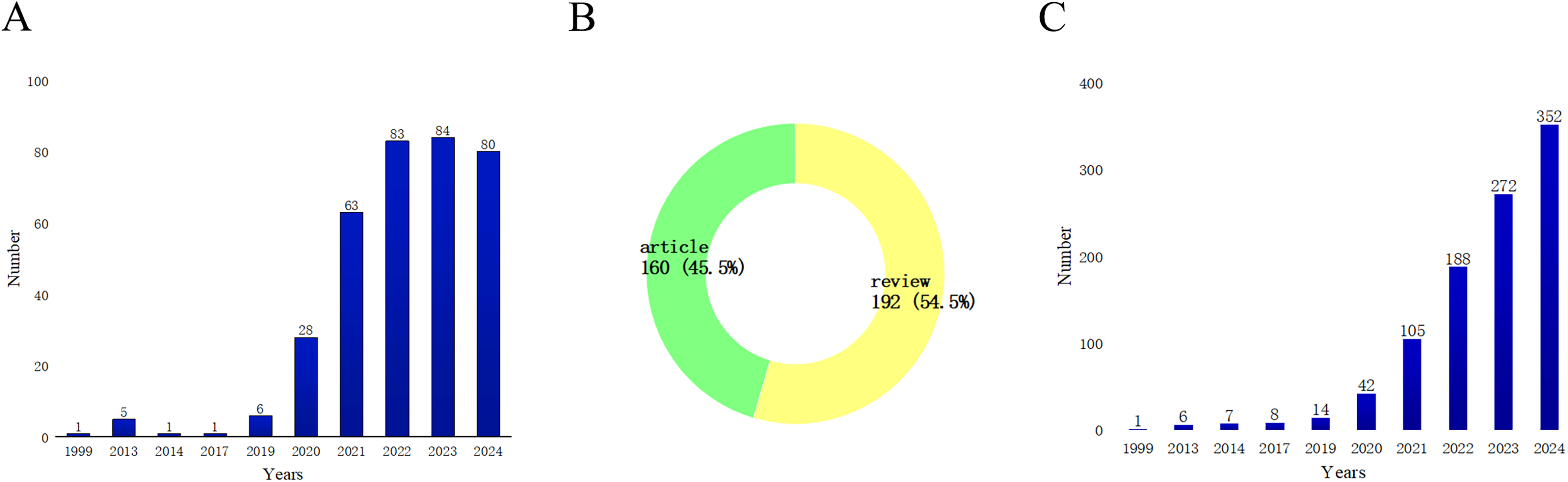
Annual number of publications (A), the type of literature (B), and the cumulative number of publications per year (C) of relevant literature.
Author and co-author analysis
Analyzing the distribution of core authors permits a more thorough evaluation of academic exchanges, cooperation, and research advancement. According to WoSCC, 1919 authors conducted AI-IBD related research, with Iacucci Marietta of Cork Univ Hosp publishing the most papers. The H-index, which combines the number of papers an author has authored with the number of citations, is a crucial metric that is objective and used to measure the scholar's influence. 19 The H-index in Table 1 evaluates the author's influence in the field of IBD and AI. Iacucci Marietta from Cork Univ Hosp is the author with the highest H-index at 9. According to CiteSpace, the research includes 237 authors and 468 cited authors. Table 1 listed the top 10 authors on CiteSpace based on frequency. The median citation percentile is another significant indicator to measure the influence of authors. Based on the median citation percentile, Maeda Yasuharu was the most influential author, with a Median citation percentile of 78th, indicating that his publications are more significant and well-known than other authors in this field.
Top 10 authors of relevant literature based on CiteSpace.

Through CiteSpace, the cooperative network of authors and cited authors was analyzed (Figure 2). Figure 2A shows the co-authorship network, illustrating the collaborative relationships between authors, highlighting key research groups and collaboration trends. Figure 2B displays the co-citation network of authors, emphasizing the influential researchers and their citation patterns, which reveal the central figures and most impactful studies in this area. Ohtsuka Kazuo from Japan Gastroenterol Endoscopy Soc was the author with the most extensive collaboration based on the cooperative network. As shown in Figure 2C, highly productive authors and a solid research team had established a cooperative relationship. However, the collaboration between about three-quarters of the research teams was weak and needs to be strengthened in the future.

The co-occurrence of authors (A) and cited authors (B) and the cooperation relationship between authors (C) of relevant literature. (C: Each small blue dot represents an author, the link represents collaboration, and the larger the blue dot, the more collaboration. The dark blue dots are the authors who collaborated the most, and the red dots are the authors who collaborated with that author.)
Institution and countries analysis
Based on WoSCC, 790 institutions and 49 countries/regions participated in AI application research in IBD from 1999 to 2024, and the top 15 were outlined (Supplementary Table 1). The Chaim Sheba Medical Center, Tel Aviv University, University College Cork, and the University of Birmingham all published the most studies, reaching 16, followed by the Humanitas University, Universidade do Porto, Sao Joao Hospital, and the University of California System. Among the countries/regions, the United States (USA) had the most publications, reaching 99, followed by Italy, England, Japan, and China. In addition, the USA has published far more papers than any other country, indicating its academic standing in this field and its considerable influence on the research direction.
CiteSpace was used to portray the cooperation network of the institutions and countries and co-occurrence visualization maps were generated to better appreciate the cooperation links between diverse institutions and countries in this field. According to CiteSpace, between 1999 and 2024, 216 institutions and 48 countries/regions were involved in related research. The Tel Aviv University published 10 publications, followed by the Univ Coll Cork, Humanitas University and Univ Porto and Univ Birmingham, each with more than 10 articles (Figure 3A). The USA ranked first with 89 articles, followed by Italy, England, China, Japan, and Portugal, all of which had more than 20 articles (Figure 3B). Figure 3C, based on OALM, stressed the close and intricate cooperative interaction between different institutions, with each small black dot representing an institution and the line representing mutual collaboration. However, many institutions were dispersed and needed more coordination, and universities comprised the majority of research institutions. The central location of Katholieke University Leuven indicated that it had conducted more research in this area. Countries maintained steady cooperation relations, and the USA has collaborated with other countries most closely (Figure 3D).

The co-occurrence of institutions (A) and countries (B), and the cooperation relationship between institutions (C) and countries (D) of relevant literature. (C: Each small blue dot represents an institution, the link represents collaboration, and the larger the blue dot, the more collaboration. The dark blue dot is the institution that cooperates the most, and the red dots are the institutions that cooperate with that institution.)
(Cited) Journals and cited articles analysis
In every study field, referential relationships between academic publications frequently represent information sharing, and citation research is both the foundation and the frontiers of knowledge. In addition, citation research is an essential bibliometric indicator and frequently cited studies always have a typical and significant impact on their respective fields.
Based on WoSCC, relevant studies were published in 184 journals during the past 25 years, with at least 5 articles in 13 journals (Figure 4A). Diagnostics (20, 5.682%), Journal of Crohn's Colitis (11,3.125%), World Journal of Gastroenterology (11, 3.125%), Inflammatory Bowel Disease (9, 2.557%), and Therapeutic Advances In Gastroenterology (9, 2.557%) were the top five journals with the most articles. Among them, the Gut had the highest IF (31.79). Most published journals are Q1 and Q2 medical journals with high IFs and academic influence, indicating that relevant research in this field is of high quality and welcomed by high-quality journals.
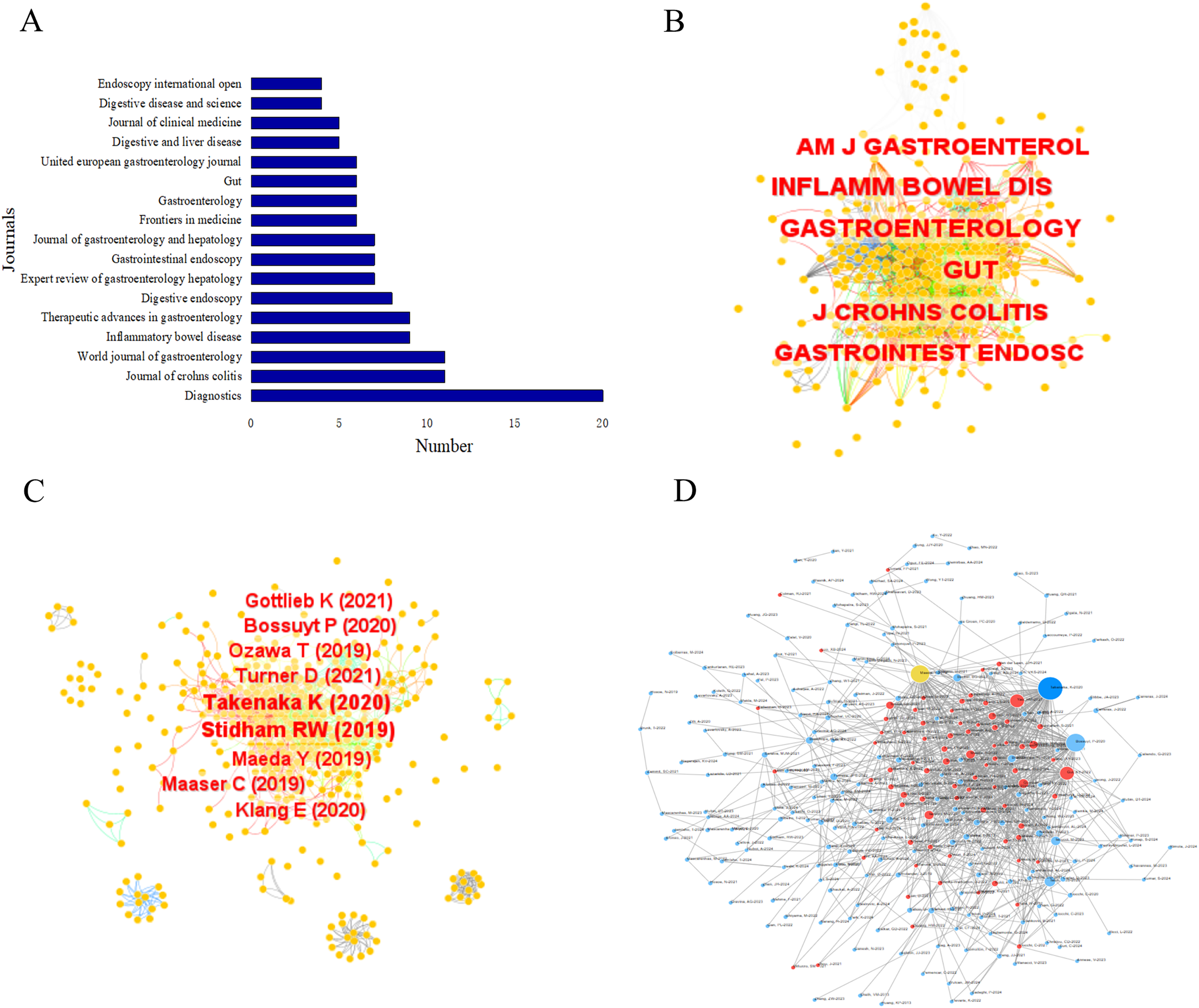
The number of articles published by journals (A), the article citation relationship network (D), and the co-occurrence of cited journals (B) and references (C) of relevant literature. (C: Each small blue dot represents an article, the links represent citations, and the larger the blue dot, the more citations. The dark blue dot is the most cited article, and the red dots are the articles that cite that article.)
CiteSpace was used to analyze the cooperation network of cited journals and references, and the visual maps of co-occurrence were generated. According to CiteSpace, 449 journals have been cited in the previous 25 years. As Figure 4B shows, the top journals for publishing research on this topic were Gastroenterology (254 citations), Gut (220 citations), Inflammatory Bowel Disease (199 citations), Journal of Crohn's Colitis (190 citations), and American Journal of Gastroenterology (181 citations). The collaborative relationship between these journals is relatively balanced. This indicates that mainstream medical and endoscopic journals are interested in this field. The papers had been cited up to 437 times, with 7 papers cited more than 40 times. The study by Takenaka et al., 20 which focused on accurately evaluating endoscopic images of patients with UC, had the highest total citation frequency of 66 times (Figure 4C). It indicates that AI research in IBD applications focuses on image evaluation, especially endoscopic images.
Figure 4D visually presents the OALM-based article citation relationship network, with each tiny blue dot representing an article and lines representing mutual citations. The greater the size of the blue dot, the greater the number of citations. The dark blue dot represented the most-cited articles, while the red dots represented the articles that cited them. The mutual references were relatively close, particularly in the last 3 years, suggesting that the application of AI in IBD will continue to be a research hotspot in the next few years. Like the analysis based on CiteSpace, Takenaka K had the second most citations (Supplementary Table 2), further confirming this author's high impact in the field.
Keywords analysis
Word frequency analysis
Keywords often reflect the core and main content of an article. Keyword frequency analysis can clarify the research patterns and explore the hotspots in the research field. The keywords extracted from AI-IBD-related research were analyzed and processed. The top 15 keywords are shown in Table 2. The most frequent keyword is “artificial intelligence” (178 times), followed by “inflammatory bowel disease” (135 times) and “Crohn's disease” (116 times).
Top 15 keywords of relevant literature.

CiteSpace was practiced for visual graphic analysis. By analyzing the studies between 1999 and 2024, a total of 328 keywords were obtained, of which 3 had a frequency greater than 100 times. Figure 5A and B shows the evolution of common keywords and keywords from year to year, and we can find that the temporal hotspot trend has shifted. Deep learning, machine learning (ML), and neural network are emerging keywords aggressively, indicating that they will be the research hotspots in the future. In addition, the application of AI in UC has become more widespread in recent years. In the past, the application of AI in IBD tended to focus on CD.

Annual number of common keywords (A) and keywords plus (B), the co-occurrence (C), and clustering timeline view (D) of keywords of relevant literature.
The purpose of keywords co-occurrence analysis is to explore the links between keywords, reveal hot topics, and help scholars better grasp the current research hotspots. The keywords co-occurrence map was also generated by CiteSpace (Figure 5C). The nodes were modified based on keyword co-occurrence. The size of nodes represents the frequency of the keywords, and the larger the node, the greater the weight of the keywords. Concatenation between nodes represents the co-occurrence of keywords. Node centrality is an important indicator to measure its importance in the network and how closely it is connected with other nodes. The higher the centrality of a keyword, the easier it is to become a key node in the network, indicating that this keyword has a more significant influence in this field. As shown in Table 2, the most influential keywords were “Crohn's disease” (0.25), “prediction” (0.15), “computer aided diagnosis” (0.12), “inflammatory bowel disease” (0.12), and “artificial intelligence” (0.11).
Cluster analysis
Cluster analysis can clearly show specific research areas’ hot spots and cutting-edge content. This study used CiteSpace to perform cluster analysis of title words and keywords separately, as well as a combined cluster analysis of title words, keywords, and abstracts. The log-likelihood ratio (LLR) method was used to label the clusters and obtain the clustering timeline view. The larger the LLR of a word, the more representative the word is for the cluster. There are two essential evaluation metrics for the effectiveness of cluster mapping, namely Modularity Q (Q, value interval [0,1]) and Weighted Mean Silhouette S (S, value interval [−1,1]). The Q value is used to evaluate the clustering impact of the network. A higher value indicates better performance of the clustered network. The S value is used to quantify the homogeneity of the cluster members, and a higher value indicates better consistency among class members. Q > 0.3 and S > 0.5 indicate that the obtained clustering network structures are plausible, and the clustering outcomes are rational, respectively. Figure 5D depicted a timeline view of the clustering of keywords in the relevant literature, visualizing the period of each cluster and the association between different clusters, clearly demonstrating the evolution of the study. The Q value of 0.5363 (>0.5) and the S value of 0.8058 (>0.8) indicated an excellent clustering effect and reliable network homogeneity. The largest cluster was “artificial intelligence” (#0). The earliest studies focused on “correlation” (#7), and then moved to “10-year retrospective study” (#8), “clinical process” (#2), and “natural language processing” (#4). The latest research hotspots were “intestinal ultrasound” (#6), “gastrointestinal tuberculosis” (#9), and “macrophage processes” (#11).
In addition, 11 meaningful clusters were formed based on title words, keywords and a combination of title words, keywords and abstracts, respectively, and visualized by clustering maps (Table 3 and Figure 6). From #0 to #10, the smaller the number, the more keywords were included in the cluster. The presence of multiple overlapping clusters in the clustering diagram indicated that they were strongly correlated. Cluster analysis revealed that the latest hotspots in this field were “artificial intelligence” and “gastrointestinal endoscopy”. Most of the clusters “capsule endoscopy” (#0), “comorbid condition” (#1), “endoscopic subscore” (#3), “risk factor” (#4) were related to the practical clinical applications of AI in the field of IBD. Meanwhile, the results indicate that the applications of AI in the field of IBD have evolved from the initial focus on scoring and scale assessments [“AAS score”(#7), “Amsterdam Alexithymia scale”(#7)] to clinical data analysis[“risk factor”(#4)], endoscopic[“endoscopic subscore”(#3)] and pathological image processing[“luminal pathologies”(#0)], with increasing attention being directed toward the use of capsule endoscopy [“small bowel capsule”(#5), “video capsule”(#5)] in recent years.
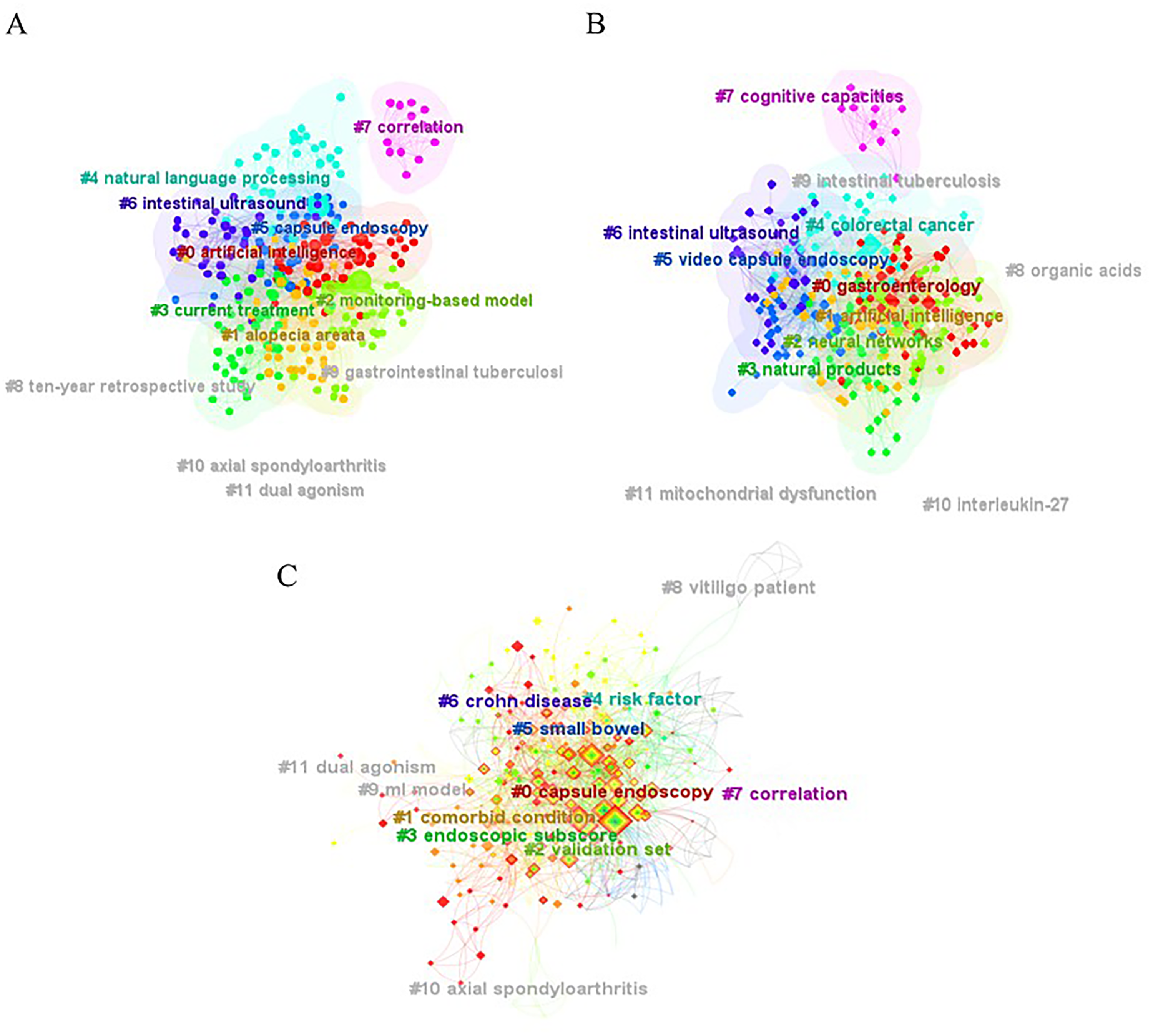
The clustering maps based on title words (A), keywords (B), and combination of title words, keywords, and abstract (C).
Keywords co-occurrence network clustering table.

Discussion
IBD has become a global disease with increasing incidence and prevalence worldwide, resulting in serious implications for overall well-being, social functioning, and utilization of healthcare resources.21–23 Large datasets from electronic health records, high-definition multi-omics (including genomics, proteomics, transcriptomics, and metagenomics), and imaging approaches (endoscopy and endomicroscopy) have emerged to help unravel the mechanisms of IBD as well as address unmet clinical needs. 7 The advent and development of AI have greatly improved the ability of clinicians and researchers to process, analyze and interpret large datasets. As a result, the application of AI in IBD has received increasing attention in recent years. As this study shows, the number of papers on the application of AI in IBD has risen significantly in the last 5 years, more than the previous 10 years combined. In the face of the vast amount of literature, it is essential to get an overview of the research field and to predict research trends. Unlike systematic reviews or meta-analyses, the bibliometric analysis uses visualization software such as VOSviewer and CiteSpace to synthesize the existing literature, thus visualizing the research trends and predicting future research hotspots. 24
Although many articles related to bibliometric analysis have been published in recent years,16,25, 26 this study is the first bibliometric analysis to summarize the current status and to visually reveal the development trends and future research hotspots of the application of AI in IBD through two widely used bibliometric software tools. According to WoSCC, 1919 authors, 790 research institutions, 184 journals, and 49 countries or regions have published 352 papers during 1999–2024. Since 2019, the number of papers published has trended upward year by year as AI technology continues to mature, suggesting an increasing number of papers in the field in the future. Obviously, the most productive, influential and highly cited authors are all from developed regions such as the USA and Europe. However, the cooperative network (Figure 2) suggests that most researchers have little collaboration. This may because the annotation and calibration of the underlying data require significant human and financial resources, making data collection complex and valuable. The results show a clear contrast between the individual network and country networks. Key individuals like Ohtsuka Kazuo have strong collaborations, but many research teams remain fragmented. On the country level, the USA leads in output and international cooperation, while countries like Italy and Japan also contribute significantly. Strengthening both individual and national networks is crucial for fostering more global collaboration in IBD research. It is recommended that researchers from Asian countries such as China should strengthen their collaboration with researchers from developed countries. This will promote more meaningful research innovations and breakthroughs through joint efforts and guide research to keep up with international research frontiers and hotspots. Furthermore, we found that the most productive author is not the most influential, suggesting that the number and quality of articles are not necessarily related or that truly influential author have yet to emerged.
From this study, it can be found that only 49 countries or regions have participated in this field, and nearly half of them have published less than 5 papers, suggesting that the application of AI in IBD is still an emerging field for many countries/regions. After all, research related to the application of AI in IBD first appeared in 1999, nearly half a century later than in 1956, when AI was first proposed. 27 This has also led to a wide variation in the development of the field in different countries/regions. In terms of the number of papers, except for China, the top 10 countries/regions are all developed countries, indicating that research on the application of AI in IBD in developing countries/regions is significantly behind that of developed countries/regions. This may be attributed to the developed countries/regions’ strong science and technology base and prosperous economies. Many low-income countries/regions have been unable to implement AI technologies widely in the healthcare industry due to insufficient healthcare resources, 28 causing them to lag relatively behind in the field. However, we found that in recent years, the number of papers published in China, Japan, and India has increased rapidly compared to the USA and Italy, where the number of papers has increased steadily, indicating that researchers in various countries/regions are more interested in the application of AI in IBD. It is foreseeable that more countries and researchers will be involved in this field in the future. Although China ranks fourth in the world in terms of the number of papers published in this field based on WoSCC, there is still a lack of high-quality articles, probably due to the following reasons: (1) AI research in IBD in China started late and has a low academic influence internationally; (2) Lake of innovation in AI core algorithms and little cooperation with advanced international researchers; and (3) Some language barriers may exist. In addition, there are many high-quality journals with a high volume of research related to the application of AI in IBD, such as Gut, Gastrointestinal Endoscopy and IBDs. It is foreseeable that more publications in this field will also be published in the journals mentioned above as a priority in the future. And Diagnostics, World Journal of Gastroenterology and Frontiers in Medicine are also highly productive journals. They have the potential to publish more high-quality papers and improve their academic status and IF. While this study focuses on journals due to their key role in disseminating high-impact research, we recognize that editing companies also influence the publication process. However, academic journals remain the primary platform for scholarly communication in IBD research. Future studies could explore the role of editing companies in shaping research visibility and impact.
As evidenced by our study, the application of AI in IBD research has historically been predominantly directed toward CD. This emphasis is likely due to the systemic nature of CD, which can involve the entire gastrointestinal tract, cause transmural inflammation, and is widely regarded as a progressive, disabling, and destructive disease associated with significant societal costs and a substantial quality-of-life burden. In contrast, UC, characterized by superficial inflammation confined to the colon, has often been perceived as less severe or progressive. 29 However, our findings reveal a growing trend in the application of AI to UC in recent years, reflecting increasing recognition of its potential in addressing the clinical challenges associated with this condition. The diagnosis and assessment of the activity of IBD is a common clinical challenge that requires a combination of different factors, including clinical data, biochemical indicators, imaging, endoscopy and histology. 30 Among these, endoscopy is the cornerstone of the diagnosis and follow-up of IBD. 31 With the development of pattern recognition AI technology, capsule endoscopy is expected to be one of the most beneficial of the many endoscopic examinations, 32 consistent with our keyword analysis results. Reading capsule endoscopy images is a very tedious task, and the process is error-prone as it requires a long time and solid expertise. With the development of deep learning techniques, research in this field is very active and will most likely be applied to actual clinical practice in the future. In keyword analysis, many terms are associated with AI, including ML (e.g. random forests and boosting) and deep learning (e.g. recurrent neural networks and convolutional neural networks)—all of which refer to the way algorithms can learn to recognize patterns to solve complex problems, mimicking human decision. 33 Unlike traditional statistical techniques, ML inferred patterns from data to perform a specific task, usually classification or regression and applied models to unseen cases. 34 Its advantage over traditional prediction tools is the potential ability of computational algorithms to automatically discover and learn complex, hidden relationships between predictive markers and outcomes. 35 This is particularly true for deep learning or artificial neural network approaches. 36 ML can potentially improve patient care at every stage of the disease course for IBD through predictive modeling: from rapid diagnosis of subtypes to determine appropriate treatment options, to assessing disease activity and identifying patients at higher risk for complications. 34 The cluster analysis for this study likewise showed that AI-related algorithms were the most important keywords, and it was evident that researchers were most interested in diagnosis and treatment. Meanwhile, the clustering map showed the evolution of the relevant hotspots over time. We can find that the current application of AI in IBD focuses on improving the diagnostic and therapeutic efficiency of endoscopy, and AI research in the field of endoscopy will remain a hotspot in the future. Furthermore, through cluster analysis, we have found that the key core technological architectures for the application of AI in the field of IBD have gradually shifted from artificial neural network and deep learning to natural language processing. This has promoted the application of large language models in the IBD field, primarily the application of ChatGPT in IBD.37–41
This study still has some limitations. First, it relied exclusively on the WoSCC database, potentially excluding relevant studies indexed in other databases such as PubMed, Scopus, or IEEE Xplore, which may limit the comprehensiveness of the findings. However, WoSCC is widely recognized as a leading resource for bibliometric studies.42,43 Second, the inclusion of only English-language publications introduces the possibility of language bias, although English remains the predominant language in academic research. Third, the analysis is based on publications up to 31 December 2024, and therefore does not account for research published thereafter, which could influence the study's relevance in the rapidly evolving field of AI. Additionally, citation counts and collaboration networks, commonly used to assess research impact, can be influenced by factors such as self-citations and regional funding, which may not accurately reflect the true impact of the research. The keyword clustering methodology, while informative, may oversimplify complex research topics and miss important nuances. Moreover, the study's reliance on specific software tools (CiteSpace and the Online Analysis platform) means that the results are subject to the limitations and biases inherent in the algorithms and parameters of these tools. Lastly, the study's projections regarding emerging trends are based on past and current data, which may not fully capture the rapid advancements and shifting dynamics in AI research.
Conclusions
We generated a comprehensive, systematic, and objective bibliometric analysis of the number of published papers, authors and their collaborative networks, countries, major research institutions, published journals, and keywords in applying of AI in IBD through visualization software and data mining. These analyses identified the research basis, current hotspots and future development trend in this field. The application of AI in IBD is still in its infancy, and the focus of this field will shift to improving the efficiency of diagnosis and treatment through deep learning techniques, big data-based treatment and prognosis prediction.
Supplemental Material
sj-docx-1-dhj-10.1177_20552076251326217 - Supplemental material for The global research of artificial intelligence on inflammatory bowel disease: A bibliometric analysis
Supplemental material, sj-docx-1-dhj-10.1177_20552076251326217 for The global research of artificial intelligence on inflammatory bowel disease: A bibliometric analysis by Suqi Zeng, Chenyu Dong, Chuan Liu, Junhai Zhen, Yu Pu, Jiaming Hu and Weiguo Dong in DIGITAL HEALTH
Supplemental Material
sj-docx-2-dhj-10.1177_20552076251326217 - Supplemental material for The global research of artificial intelligence on inflammatory bowel disease: A bibliometric analysis
Supplemental material, sj-docx-2-dhj-10.1177_20552076251326217 for The global research of artificial intelligence on inflammatory bowel disease: A bibliometric analysis by Suqi Zeng, Chenyu Dong, Chuan Liu, Junhai Zhen, Yu Pu, Jiaming Hu and Weiguo Dong in DIGITAL HEALTH
Footnotes
Acknowledgments
The authors would like to thank editors and the anonymous reviewers for their valuable comments and suggestions to improve the quality of the article.
Contributorship
Conception and design were done by SZ, CD, CL. Administrative support was provided by WD. Provision of study materials or patients was done by SZ, CD, CL, JZ, YP. Collection and assembly of data were done by SZ, CD, CL, JZ. Data analysis and interpretation were done by SZ, CD, CL, JH. All authors did manuscript writing and final approval of manuscript.
Data availability

Declaration of conflicting interests
The authors declared no potential conflicts of interest with respect to the research, authorship, and/or publication of this article.
Ethical approval
There is no need for approval of ethics committee or institutional review board, because this study is a bibliometrics study which do not involve any clinical trials and patient consent.
Funding
The authors disclosed receipt of the following financial support for the research, authorship, and/or publication of this article: This work was supported by the National Natural Science Foundation of China (grant number 82170549).
Supplemental material
Supplemental material for this article is available online.
References
Supplementary Material
Please find the following supplemental material available below.
For Open Access articles published under a Creative Commons License, all supplemental material carries the same license as the article it is associated with.
For non-Open Access articles published, all supplemental material carries a non-exclusive license, and permission requests for re-use of supplemental material or any part of supplemental material shall be sent directly to the copyright owner as specified in the copyright notice associated with the article.
