



Abstract
Objective
This study aimed to evaluate the current research progress and future research directions of artificial intelligence in spinal diseases through a bibliometric analysis.
Methods
Publications regarding spinal diseases and artificial intelligence published from 2006 to 2025 were extracted from the Web of Science Core Collection (WOSCC). Subsequently, a bibliometric analysis of these publications was conducted using CiteSpace, VOSviewer, and Bibliometrix Online Analysis Platform.
Results
A total of 734 papers were included in the study. The annual publication numbers are on the rise. The USA (267 papers) and Beijing Jishuitan Hospital (24 papers) were identified as the most productive country and institution, respectively. Tian, Wei (25 papers) is the most productive author. “Spine” (49 publications) is the most productive journal. “Machine Learning” was the most cited keyword, with high-frequency keywords such as “Artificial Intelligence,” “Robotic Surgery,” “Deep learning,” “Virtual Reality,” and “predictive modeling” signaling hot topics in this field.
Conclusions
There are increasingly many papers on artificial intelligence in spinal diseases. However, cooperation between institutions in various countries needs to be strengthened. In addition, this study summarized the research focus of artificial intelligence in spinal disorders as accurate diagnosis, robot-assisted surgery, and prognosis prediction, providing researchers with future research directions.
Introduction
Spinal disorders refer to a spectrum of diseases affecting the structure or function of the spine, including degenerative changes, trauma, infections, tumors, and deformities in the cervical, thoracic, lumbar, and sacral regions. Globally, spinal disorders are among the leading causes of pain and disability, imposing a substantial public health and economic burden.1,2 With the aging population and lifestyle changes, spinal diseases have become a common and significant condition affecting the quality of life of middle-aged and elderly individuals. Patients often require long-term treatment (physical therapy, medication, or surgery), leading to high medical costs that impact their financial status. Meanwhile, the increasing outpatient visits and surgical procedures related to spinal diseases have placed tremendous pressure on the healthcare system. Traditional diagnostic and treatment approaches for spinal diseases rely heavily on the experience and clinical judgment of radiologists and surgeons. However, these methods exhibit certain limitations in terms of accuracy, consistency, and efficiency. 3 Due to their dependence on manual interpretation, traditional diagnostic approaches are highly subjective and susceptible to variability in physician expertise, potentially resulting in misdiagnosis or missed diagnoses. 4 The high prevalence and complexity of spinal disorders pose significant challenges to the current healthcare system. 5 Additionally, with the rapid growth of medical imaging data, physicians face an escalating workload, necessitating the adoption of more efficient and precise technological solutions to assist in diagnosis and treatment. Furthermore, conventional surgical interventions heavily depend on the experience and technical skill of the surgeon. Manual intraoperative procedures, such as pedicle screw placement or decompression, are prone to human error, increasing the risk of nerve damage or screw mispositioning.
In recent years, with the rapid advancement of artificial intelligence (AI) technology, particularly the application of deep learning, the potential value of medical image analysis and intelligent diagnostic systems in spinal diseases has become increasingly prominent. 6 Furthermore, deep learning plays a crucial role in real-time navigation and monitoring during spinal surgery, providing surgeons with more precise and dynamic intraoperative support. 7 Artificial intelligence is a broad concept that can be understood as a collective term for a variety of technologies, including machine learning, deep learning, natural language processing (NLP), etc. 8 It enables computer systems to perform human-like tasks, such as reasoning and decision-making. 9 Over the past few years, artificial intelligence has played a significant role in medical diagnosis, treatment, and predictive analysis, thanks to its complex computational algorithms and machine learning capabilities.10,11 Data-driven artificial intelligence technology represents an innovative breakthrough in the field of medicine and has been widely applied in the healthcare industry, particularly in the field of spinal disorders, where it has demonstrated significant potential in computer-assisted diagnosis and computer-assisted surgery.12,13
Bibliometrics is a quantitative approach, a discipline that uses statistical and mathematical tools to analyze characteristics such as the quantity, quality, structure, trends, and impact of publications.14,15 It facilitates the evaluation of academic achievements, journals, authors, institutions, and the development of fields. By analyzing a large number of publications, it reveals the trends of specific disciplines, which can provide researchers with an overview of the evolution of specific research topics. We can effectively describe the literature through bibliometric analysis, enabling researchers to grasp research hotspots and frontier issues quickly.16,17 Bibliometrics has been employed to reveal the hotspots and frontiers in the medical field, such as cancer-related fatigue, 18 rehabilitation robotics, 19 patient delay, 20 etc. At present, although some reviews have been conducted on the applications of artificial intelligence in the field of spinal diseases, there is a lack of comprehensive insights into the entire domain, as well as a unified understanding of key research directions, hotspots, and trends. Therefore, it is imperative to utilize specialized tools to conduct a comprehensive analysis of the literature in this domain, thereby furnishing researchers with multifaceted information and insights. To identify the research hotspots and trends in this field and to provide potential directions and informational support for future studies, we performed a bibliometric analysis of the applications of artificial intelligence in spinal diseases. We performed a bibliometric analysis of publications with AI in spinal diseases by VOSviewer, CiteSpace software, and Bibliometrix Online Analysis Platform from 2006 to 2025.
Methods
Search strategy
Publications were systematically extracted from the Web of Science Core Collection (WOSCC) within the defined temporal scope spanning from 1 May 2006 to 1 May 2025. The search scope was limited to publications indexed in the Science Citation Index Expanded (SCI-EXPANDED) and the Social Sciences Citation Index (SSCI). The following search strategy was employed to retrieve the database: TS = (“artificial intelligence” OR “computational intelligence” OR “deep learning” OR “machine learning” OR “neural network” OR “3D printing” OR robot OR “virtual reality” OR “augmented reality” OR AI OR VR OR AR) AND TS = (“spinal diseases” OR “spinal disorders” OR spine OR spin*). Search was limited only for article and Review published in English. This study strictly followed the established exclusion criteria, which include: (1) studies unrelated to AI applications; (2) studies unrelated to spinal diseases. A total of 734 valid articles were ultimately selected. After the first search, all papers were screened and checked separately by 2 researchers to ensure that all the papers used were relevant to the study topic. In the case of a dispute, we consulted a third investigator. The literature screening process is illustrated in Figure 1. Relevant bibliographic data were extracted from eligible articles, including title, author, country, institution, publication year, journal, keywords, abstract, and cited references, among other details.
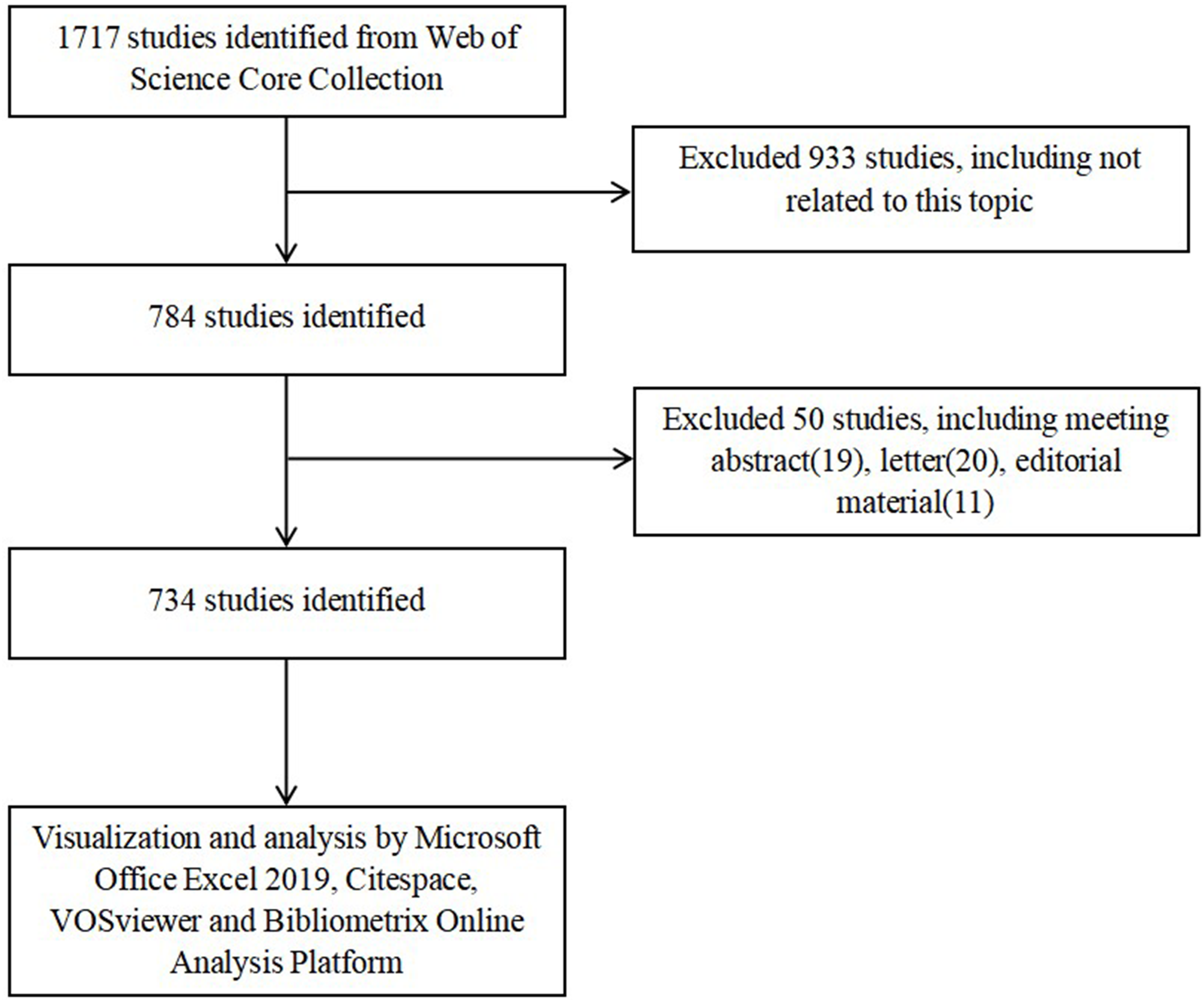
The literature screening process.
Data analysis
In this study, bibliometric analysis was performed utilizing VOSviewer (v1.6.20), CiteSpace (v.6.3.R2), and Bibliometrix Online Analysis Platform, ensuring a comprehensive exploration of the relevant literature. CiteSpace is an information visualization analysis software developed by Professor Chen Chaomei based on the Java language. 21 CiteSpace provides a variety of visualization functions by revealing the connections between basic characteristics of literature, including term relationships, term clustering, co-occurring keyword identification, and dynamic representations of bibliometric and citation networks, helping researchers decipher the knowledge structure and evolutionary trajectory of the field. 22 The parameters of CiteSpace were as follows: time span (2006–2025), year of slice (1), selection criteria (g-index k = 10), link retaining factor (LRF=2.5), look back years (LBY=5), e for top N (e = 1), pruning (Pathfinder). VOSviewer is a free Java software developed by the Center for Science and Technology Studies at Leiden University in the Netherlands for document mapping. VOSviewer excels at visualizing relationships within scientific fields, offering a variety of visualization features that help researchers identify the cutting edge of their research field. 23
In terms of analysis, this study used WOS visualization tools to summarize the number of publications and total citations. At the same time, we explored multiple dimensions, including contributing countries, institutions, authors, journals, references, keywords, and international cooperation.
Results
Annual publications
A total of 734 papers were ultimately included in this study. The annual publications increased from 6 papers in 2006 to 177 papers in 2024 (Figure 2). From 2006 to 2021, the annual publications remained below 100 papers. In 2022, the publications exceeded 100 articles. Generally, the annual number of publications exhibited a sustained upward trend throughout the period from 2006 to 2025. This rapid growth trend may reflect the accelerated application and widespread promotion of artificial intelligence in the field of spinal diseases.

Annual publication counts.
Distribution of countries/regions
A total of 234 countries and regions participated in this study. As shown in Table 1, the USA and China led in terms of publication volume, contributing 267 and 191 papers, respectively. Germany ranked third with 58 papers. The top 10 countries and regions accounted for more than 70.00% of the total publication volume, indicating significant imbalances in research development in this field across different countries and regions.
Top 10 most productive countries.

Cooperation between international institutions in different countries reflects the level of academic exchange in this field. 24 Generally, the more frequent the exchanges between countries, the greater the number of outputs generated. Figure 3 illustrates the cooperation status among countries/regions, where the larger the area occupied by a region, the greater the number of papers it has published. Meanwhile, the closer the cooperation between countries, the more connection lines there are between them. It can be seen that the USA and China have the most connection lines and the largest area, indicating that they cooperate most closely with other countries. However, overall, international cooperation remains limited, with most partnerships established between domestic institutions.

Visualization map of cooperation among countriesregions.
Distribution of research institutions
Institutions were analyzed through VOSviewer, and 1154 institutions were identified (Figure 4). Leading publishing institutions are divided into 8 clusters. The red cluster includes China Med Univ, Chinese Acad Sci, Nankai Univ, etc. The green cluster is made up of Columbia Univ, Hanyang Univ, Korea Univ, etc. The blue cluster includes Harvard Univ, Johns Hopkins Univ, Natl Taiwan Univ Hosp, etc. The yellow cluster is mainly Brown Univ, Duke Univ, Hosp Special Surg, etc. The purple cluster is mainly Beihang Univ, Beijing Jishuitan Hosp, Beijing Key Lab Robot Orthopaed, etc. The light blue cluster is mainly Capital Med Univ, Chinese Acad Med Sci & Peking Union Med Coll, Guangxi Med Univ, etc. The orange cluster is mainly Mayo Clinic, Rush Univ, and other institutions. The brown cluster is made up of Univ Michigan, Univ Tennessee, and other institutions.

Visualization of research networks of institutions.
Table 2 illustrates the top 10 most productive institutions, with Beijing Jishuitan Hospital (n = 24, 3.27%) and Harvard Medical School (n = 24, 3.27%) being the most prolific institutions, followed by Mayo Clinic (n = 16, 2.18%) and Stanford University (n = 16, 2.18%). In addition, seven of the top 10 institutions are located in the USA.
Top 10 most productive research institutions.

Distribution of research authors
The most prolific author is Tian, Wei (Beijing Jishuitan Hospital), with 25 publications (3.41%) (Table 3). Authors were analyzed through VOSviewer (Figure 5). Leading publishing authors are divided into 3 clusters. The red cluster includes Hu Lei, Hu Ying, Li Weishi, etc. The green cluster is mainly Han Xiaoguang, He Da, Liu Bo, etc. The blue cluster includes Fan Mingxing, Liu Yanjun, Zhao Jingwei, etc.

Visualization of research networks of authors.
Top 10 most productive authors.

Journal distribution
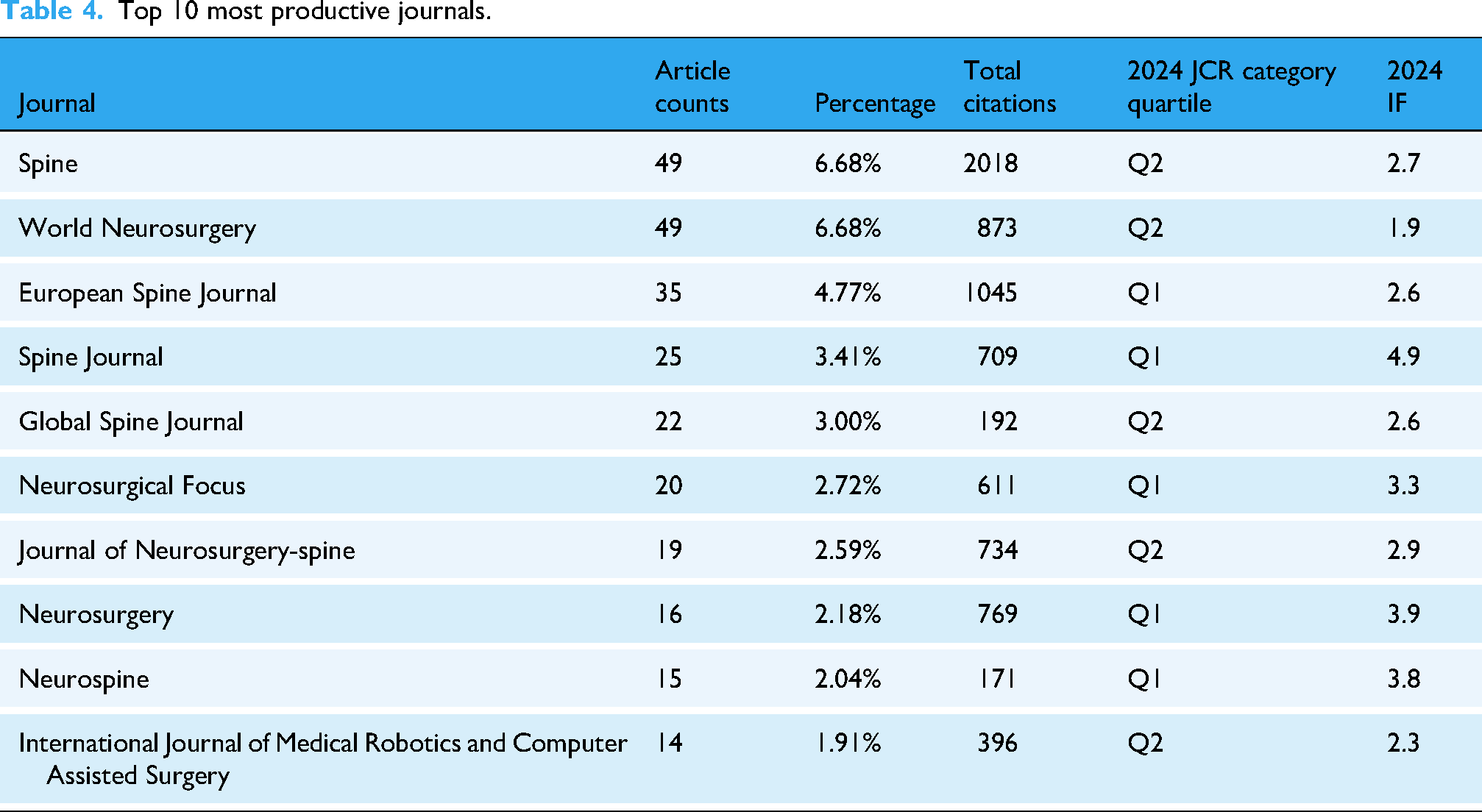
Table 4 illustrates the top 10 most productive journals, with “Spine” and “World Neurosurgery” ranked first with 49 papers, closely followed by “European Spine Journal” with 35 papers. The top 10 journal publications accounted for 29.56% (217/734) of the total number of publications. Figure 6 shows the co-citation bibliometric map. The top 5 journals with the highest citations are Spine, European Spine Journal, Spine Journal, World Neurosurgery, and Journal of Neurosurgery-spine.
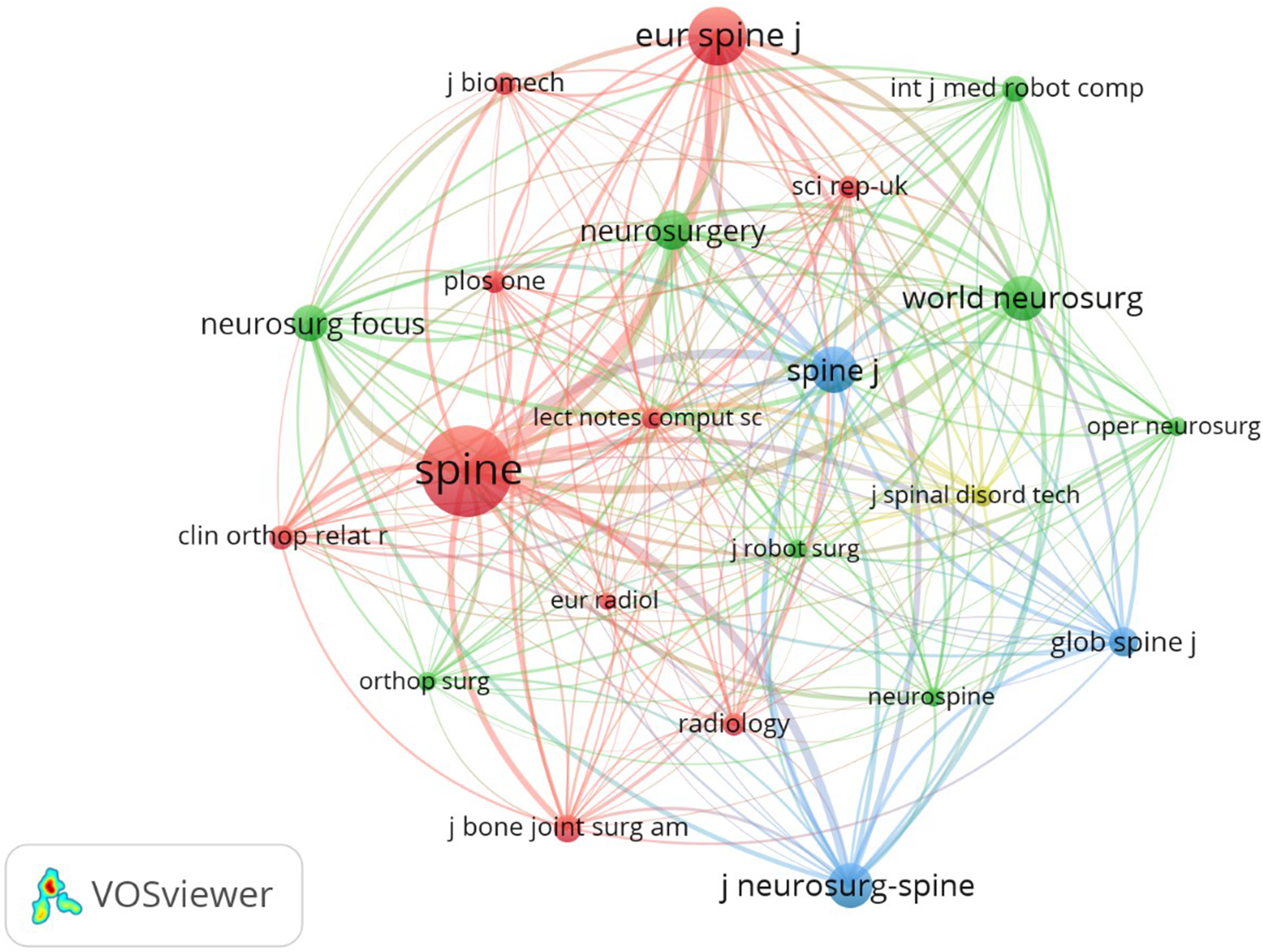
Visualization of research networks of journals.
Top 10 most productive journals.
Analysis of co-cited references
We analyzed 16,837 co-cited references over the past 20 years, of which 37 were cited 22 times or more. Figure 7 shows the results of a co-citation network analysis based on the 37 documents. Notable references such as “Gertzbein SD, 1990, Spine,” “Ringel F, 2012, Spine,” and “Kantelhardt S, 2011, Eur Spine J” exhibit strong co-citation relationships. Additionally, the top 10 co-cited references are listed in Table 5. The most co-cited article is “Accuracy of pedicular screw placement in vivo” (96 citations), followed by “Accuracy of robot-assisted placement of lumbar and sacral pedicle screws: a prospective randomized comparison to conventional freehand screw implantation” (76 citations). The third most co-cited article is “Perioperative course and accuracy of screw positioning in conventional, open robotic-guided and percutaneous robotic-guided, pedicle screw placement” (66 citations).

Visualization of co-cited references.
Top 10 most co-cited references.

Keyword analysis
Figure 8 shows a visualization of the keyword research network, reflecting the frequency with which different keywords appear together. It is divided into four different clusters. The red cluster is mainly “Accuracy,” “Complications,” “Learning Curve,” “Lumbar,” “Minimally Invasive,” “Minimally Invasive Surgery,” “Navigation,” “Pedicle Screw,” “Pedicle Screw Placem,” “Robot,” and “Robot-assisted Spine Surgery”. The green cluster predominantly includes keywords like “Artificial Intelligence,” “Computed tomography,” “Convolutional Neural Network,” “Deep Learning,” “Lumbar Spine,” “Machine Learning,” and “Magnetic Resonance Imaging.” The blue cluster includes “Augmented Reality,” “Cervical Spine,” “Neurosurgery,” and “Virtual Reality.” The yellow cluster includes “Scoliosis,” “Spine,” and “Surgery.”
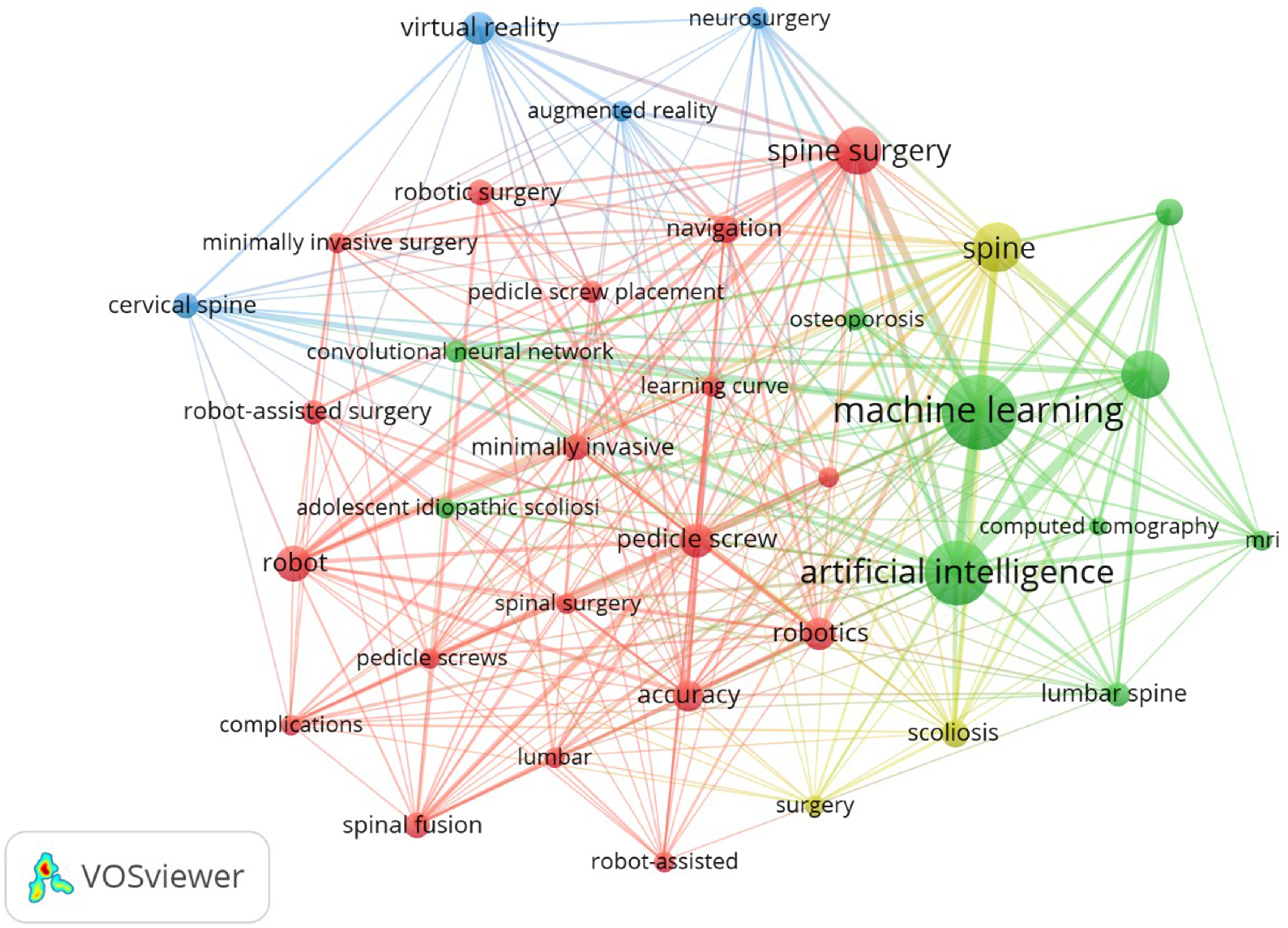
Keyword co-occurrence network.
Figure 9 illustrates the top 22 burst keywords in the field. “Placement” ranked first with the highest burst strength (7.05), closely followed by “System” (5.94), “Guidance” (5.62), “Insertion” (4.56), “Minimally Invasive” (4.55), “Outcome” (4.35), and “Navigation” (4.32). “Insertion,” “Robotic Surgery,” “System,” “Guidance,” “Motion,” “Cancer,” “Computer-assisted Surgery,” and “Navigation” drew attention over two decades ago. Instead, “Minimally Invasive Surgery,” “Scoliosis,” and “Magnetic Resonance Imaging” represent recent frontiers in the field.
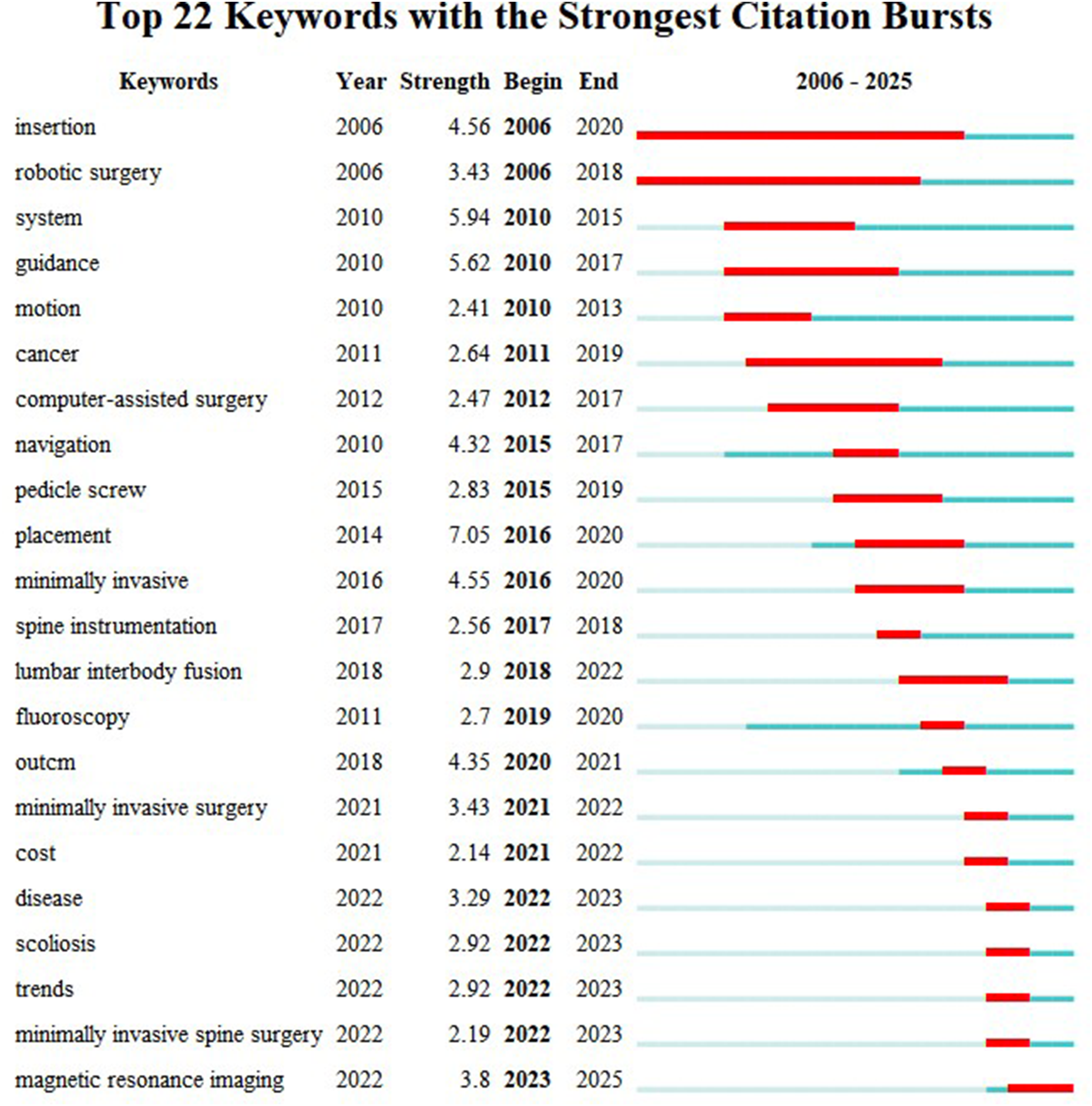
Top 22 keywords with strong citation bursts.
Figure 10 shows the timeline viewer in the field. The keywords prevalent in earlier years revolved around “Machine Learning,” “Artificial Intelligence,” “Robotic Surgery,” “Adolescent Idiopathic Scoliosis,” “Neck Pain,” “Image guidance,” “Deep learning,” “Virtual Reality,” and “predictive modeling”. In the years 2020–2025, emerging keywords include “Robot-assisted Pedicle Screw Fixation,” “Survival,” “Robotic Testing,” “Degenerative Spine Disease,” “Vertebral Body Cement Augmentation,” and “Spinal Deformity.”

A timeline graph from CiteSpace depicting the top 15 keyword clusters.
Discussion
With the rapid development of artificial intelligence technology and its widespread application in the medical field, its application in spinal disease research has become an emerging field. The annual publication counts show that 77.00% were published in the past five years. The number of research papers on the application of artificial intelligence in spinal diseases has increased significantly. This trend underscores the growing scientific interest, increased research investment, and expanding pool of investigators in this domain.
At the national level, the United States and China have emerged as leaders in AI-related spinal disorder research publications. These two nations account for 36.38% and 26.02% of total publications in this field, respectively, significantly outpacing Germany's contribution of 7.90%. Publications from the first three countries account for 70.00% of all publications, underscoring their dominant role in shaping the research landscape. Substantial disparities exist in research progress across countries/regions, which may be attributed to varying levels of economic development. The United States emerges as the most productive nation and maintains the most extensive international collaborations. Countries with higher levels of economic development have advantages in terms of research funding and infrastructure, enabling them to effectively integrate domestic and international scientific resources for scientific research. In addition, most of the top 10 institutions are located in the United States, which may explain why a predominant share of research output originates there. 20 China ranks second in international cooperation, reflecting its relatively strong research teams and scientific research resources. However, most high publication volumes and intensive collaborations remain concentrated in high-income countries. Despite the upward trend in research on artificial intelligence in spinal diseases, international cooperation remains crucial. Strengthening cooperative networks and knowledge exchange among nations will facilitate resource integration and shared research advancements. Strengthening cooperative networks and knowledge exchange among nations will facilitate resource integration and shared research advancements, especially in promoting the cross-border application of technologies such as federated learning that address data privacy issues.
At the institutional level, seven of the top 10 ranked institutions are located in the United States, reflecting the nation's absolute leadership to research in this field, which benefits from its elite experts, comprehensive research facilities, and scientific research support. This observation aligns with international collaboration trends. Notably, China's Beijing Jishuitan Hospital has also taken a leading position in artificial intelligence research related to spinal disorders in China. In addition to the Beijing Jishuitan Hospital, Capital Medical University has also made significant contributions. However, analysis of institutional collaboration networks reveals limited international cooperation, with most collaborations occurring domestically. To address key challenges in AI research for spinal disorders, future work must strengthen collaboration between international institutions.
The historical evolution of artificial intelligence in spinal disorder research can be traced back to 2001, when Wolf A. first employed computed tomography (CT) to quantitatively assess the morphological characteristics of the human lumbar spine for operation-workspace specifications. 25 Following this pioneering work, progress remained relatively limited until recent breakthroughs in AI technologies, particularly machine learning, which have driven remarkable expansion in this research field. Since 2019, there has been a substantial increase in research activity, with prominent investigators such as Tian Wei and He Da emerging as leading contributors through their extensive publication records and highly cited works. Schwab has similarly made significant scholarly contributions to the advancement of this discipline. Furthermore, the bibliometric network analysis has identified Tian Wei, He Da, Liu Bo, and Zhang Qi as pivotal nodes in academic collaboration networks, demonstrating their critical role in facilitating cross-institutional knowledge dissemination and scientific exchange within the research community.
Co-citation analysis showed the most cited journals in this field. “Spine” emerged as the most frequently cited publication, followed by “World Neurosurgery” and “European Spine Journal”, suggesting their status as core journals in the domain. To some extent, the prominence of these influential periodicals reflects current research trends in the field. Furthermore, “Spine Journal”, “Global Spine Journal”, and “Neurosurgical Focus” have demonstrated significant impact. Due to the multidisciplinary nature of artificial intelligence technology, relevant research also appears in artificial intelligence and robotics-related journals such as “International Journal of Medical Robotics and Computer Assisted Surgery”.
References serve as a critical component and pivotal demonstration of a high-quality dissertation, not only furnishing a robust argumentative foundation but also expanding the information chain. 26 The co-cited references represent a statistically significant metric for evaluating the scientific merit of a paper. 21 The two most cited papers in the literature are “Accuracy of Pedicular Screw Placement in Vivo” and “Accuracy of Robot-Assisted Placement of Lumbar and Sacral Pedicle Screws: A Prospective Randomized Comparison to Conventional Freehand Screw Implantation”.27,28 These studies focus on how artificial intelligence can improve the accuracy of lumbosacral pedicle screw placement. In recent years, robotic technology has advanced rapidly and has been increasingly applied to assist in clinical spinal surgical procedures. Study have demonstrated that robot-assisted pedicle screw placement in spinal fixation procedures offers several advantages over conventional freehand techniques, including reduced intraoperative blood loss, fewer intraoperative fluoroscopies, shorter operative time per screw, and lower incidence of postoperative neurological dysfunction. 29
In summary, the continuous advancement of artificial intelligence and its integration with spinal disorder research hold promising potential for enhancing diagnostic accuracy and optimizing therapeutic strategies. Future investigations should focus on translating these technological developments into clinically actionable applications to ultimately improve patient outcomes. Building upon our prior analyses, we have explored multiple research hotspots in artificial intelligence applications for spinal disorders, demonstrating the diversity and depth of this evolving field.
Firstly, the prominence of “artificial intelligence,” “machine learning,” “convolutional neural network,” “virtual reality,” and “augmented reality” indicates the hot topics in the application of artificial intelligence in the field of spinal diseases. Notably, “computed tomography” has emerged as a key focus. Artificial intelligence is crucial for achieving accurate diagnosis. Traditionally, the diagnosis of spinal disorders has heavily relied on medical imaging combined with physicians’ expertise and observational skills. However, this conventional approach is inherently limited by its subjective nature and diagnostic inefficiency. In contrast, deep learning algorithms, through their self-learning mechanisms, can autonomously construct more accurate classification and diagnostic models by processing large volumes of annotated data, thereby significantly reducing human error. Among various neural network architectures, convolutional neural networks have emerged as one of the most widely implemented models for lumbar spine image recognition and analysis. 30 Their exceptional capability in feature extraction from medical images assists clinicians in pathological identification and localization. Notably, Huang et al. 6 successfully developed a model named Spine Explorer based on the U-Net architecture. This model has demonstrated outstanding performance in segmenting vertebral bodies and intervertebral discs in standard lumbar magnetic resonance imaging scans of healthy individuals. Liawrungrueang et al. 31 developed a novel CNN-based model utilizing YOLO-v5 for automated detection of lumbar intervertebral disc degeneration, with severity classification into five grades according to the Pfirrmann grading system. Although deep learning has demonstrated preliminary success in diagnostic applications for spinal disorders, most existing models are task-specific, designed for particular datasets or clinical settings. These models typically exhibit excellent performance when applied to single-institution data or specific pathological conditions, yet often fail to maintain consistent accuracy when generalized to datasets from other hospitals or diverse pathological presentations. Consequently, no universal deep learning model has emerged that can be broadly applied across global patient populations and varied healthcare environments. This represents a critical interdisciplinary challenge requiring urgent resolution in the intersection of medicine and engineering.
Furthermore, keywords “robot-assisted surgery,” “pedicle screw placement,” “pedicle screw,” “robot-assisted,” “robotics,” “navigation,” “accuracy,” and “learning curve” show the application of robot-assisted pedicle screw placement in spinal surgical procedures. Compared to other assistive technologies, robotic systems are characterized by intelligent planning capabilities. Operators can import preoperative and intraoperative CT scan data into the system, real-time visualize the surgical site on the screen, select appropriately sized screws using workstation software, and automatically plan optimal screw trajectories, followed by robotic arm-guided screw placement. With continuous iterative advancements in robotic technology and accumulating clinical research, robot-assisted screw placement has gained recognition as a feasible approach for spinal disorders, and its indications are progressively expanding.32–34 Gao et al. 35 reported a case of atlantoaxial fracture-dislocation with subaxial cervical fusion deformity treated with Mazor X-assisted surgical planning and pedicle screw placement. Postoperative imaging at one week demonstrated satisfactory vertebral alignment, with no screw-related complications observed during the 3-month follow-up period. Robot-assisted pedicle screw placement offers superior repeatability and fatigue resistance, minimizing risks of neural or vascular injuries while enhancing the accuracy and safety of spinal instrumentation. 36 Additionally, for novice surgeons, robot-assisted pedicle screw placement can significantly shorten the learning curve for surgical techniques. Trainees also demonstrate greater willingness to adopt this method as an educational tool for mastering procedural skills.37,38 However, the current high costs associated with the procurement and maintenance of spinal robotic systems significantly limit their widespread clinical adoption. 39
While robotic technology has demonstrated clear advantages in improving surgical accuracy, the over-concentration on this single direction has led to insufficient attention to other critical modern AI trends. Large vision models (LVMs) and foundation models (FMs) represent the most transformative trends in current AI development. Foundation models, trained on massive unlabeled datasets, possess strong general feature extraction and cross-task transfer capabilities, which can be fine-tuned for specific spinal disease tasks with minimal labeled data. For example, medical-specific foundation models such as Med-PaLM and BioBERT have shown promising results in medical image analysis and clinical text processing. In spinal disease research, pre-trained foundation models based on CT, MRI, and other medical images can be rapidly adapted to tasks such as vertebral body segmentation, intervertebral disc degeneration grading, and spinal deformity detection, significantly reducing the cost of model training in small-sample scenarios. Large vision models, with their exceptional ability to process high-resolution images and capture subtle anatomical features, can further enhance the accuracy of early diagnosis of spinal diseases. However, current research in this field is still dominated by task-specific models, and the application of foundation models and large vision models remains relatively scarce, representing a key frontier for future research. Future research on robotic surgery should not only focus on improving mechanical accuracy but also integrate emerging AI technologies. For example, combining foundation models to optimize surgical path planning, integrating multimodal fusion to enhance intraoperative perception, and applying federated learning to accumulate large-scale surgical data for robot model optimization. This integration will promote the transformation of robotic surgery from “assisted operation” to “intelligent decision-making assistance.”
In addition, keywords “predictive modeling,” “complications,” and “survival” demonstrate the capability of artificial intelligence to predict postoperative outcomes. Deep learning has been widely employed to predict complication risks and postoperative rehabilitation outcomes. A study developed predictive models for surgical site infections (SSIs) and unplanned readmissions following spinal fusion surgery, identifying advanced age as a significant risk factor for complications and prolonged anesthesia duration as a contributor to increased SSI rates. 40 In a multicenter study, Ito et al. 41 developed and validated a deep learning model with discriminative and predictive capabilities for forecasting complications and pain outcomes 12 months after cervical disc herniation surgery. The use of multicenter data enhanced the generalizability of the model, making the findings more representative than single-center studies. Another study utilized machine learning models to predict pain relief and functional recovery following lumbar discectomy. 42 By integrating preoperative and postoperative data, the research demonstrated the efficacy of the model in postoperative rehabilitation prediction. Furthermore, deep learning models can leverage multimodal data (preoperative, intraoperative, and postoperative) to forecast patient recovery trajectories. Through large-scale patient data analysis, these models can predict recovery timelines and potential complications. 43 These findings underscore the substantial potential of deep learning in predicting complication risks and rehabilitation outcomes, offering valuable decision-support tools for clinical practice.
Analysis of research focus reveals “spinal surgery” as the central theme, with high-frequency keywords including “machine learning,” “artificial intelligence,” “virtual reality,” “augmented reality,” “diagnosis,” “prediction,” and “robotic surgery.” This indicates that diagnostic applications, therapeutic interventions, and outcome prediction currently represent the most prominent research domains in AI-driven spinal disorder studies. Despite demonstrating significant potential in spinal disorder diagnosis, intraoperative planning, and postoperative prediction, deep learning still faces several challenges. Current research on deep learning applications in spinal disorder management predominantly consists of single-center retrospective studies. While these studies have shown promising results in localized practice, the generalizability of their findings may be limited. Furthermore, the substantial costs associated with the acquisition and maintenance of robotic systems have restricted their widespread clinical adoption. Future research on robotic surgery should not only focus on improving mechanical accuracy but also integrate emerging AI technologies. The future of surgical intervention is evolving toward precision medicine, minimally invasive techniques, and enhanced recovery protocols. With the accumulation of more comprehensive spinal disorder datasets and improvements in model self-learning capabilities, deep learning is poised to play an increasingly pivotal role in personalized medicine, intelligent diagnostics, and treatment planning. Concurrent advances in robotic technology are expected to yield more comprehensive, intelligent, and reliable technical support for spinal surgeries. Collectively, these developments suggest that artificial intelligence will realize even greater potential in spinal disorder applications.
Limitations
The limitations of this study should not be overlooked. First, the data source is limited to WOSCC, which may not include all relevant publications. Second, the quality of the included literature varies significantly, which may lead to bias and affect the reliability of the analysis results. Furthermore, due to the time lag inherent in citation dynamics, citation counts may exhibit potential biases. Therefore, future research should consider integrating multiple databases and standardized tools to achieve a more comprehensive understanding of research on the application of artificial intelligence in spinal diseases.
Conclusion
This study introduces a comprehensive bibliometric analysis focusing on artificial intelligence applications in spinal diseases, providing in-depth insights into the current research advancements, future research trajectories, and emerging frontiers within this domain. Using the results of the bibliometric analysis, this study explores the research focus of AI in spinal disorders on accurate diagnosis, robot-assisted surgery, and prognosis prediction. While artificial intelligence demonstrates broad potential applications spanning diagnostic support, treatment, and outcome prediction, significant challenges remain. In addition, although the United States and China currently lead in research productivity, other nations are intensifying efforts to narrow this gap. To advance AI technology for spinal disorders, it is crucial to promote interdisciplinary and international collaboration. We anticipate that continued technological and research advances will result in increasingly effective AI-driven solutions for diagnosing and managing spinal pathology.
Footnotes

Ethical approval
There is no need for approval of ethics committee or institutional review board, because this study is a bibliometrics study which does not involve any clinical trials and patient consent.
Contributorship
Conception and design were done by FL, CL, YL. Administrative support was provided by YL. Provision of study materials or patients was done by FL, CL, YL. Collection and assembly of data were done by FL, CL, YL. Data analysis and interpretation were done by FL, CL. All authors did manuscript writing and final approval of manuscript.
Funding
The authors disclosed receipt of the following financial support for the research, authorship, and/or publication of this article: This work was supported by the Hunan Province Natural Science Foundation of China, (grant number 2022JJ30412).
Declaration of conflicting interests
The authors declare that they have no known competing financial interests or personal relationships that could have appeared to influence the work reported in this paper.
Availability of data and materials
The original data associated with this study has not been deposited into any publicly available repository, as the data used to support the results of this study are provided by the Web of Science Core Collection with permission. Additional data will be made available on request to the corresponding authors.