



Abstract
Background
Mental health issues like insomnia, anxiety, and depression have increased significantly. Artificial intelligence (AI) has shown promise in diagnosing and providing personalized treatment.
Objective
This study aims to systematically review the application of AI in addressing insomnia, anxiety, and depression, identifying key research hotspots, and forecasting future trends through bibliometric analysis.
Methods
We analyzed a total of 875 articles from the Web of Science Core Collection (2000–2024) using bibliometric tools such as VOSviewer and CiteSpace. These tools were used to map research trends, highlight international collaboration, and examine the contributions of leading countries, institutions, and authors in the field.
Results
The United States and China lead the field in terms of research output and collaborations. Key research areas include “neural networks,” “machine learning,” “deep learning,” and “human-robot interaction,” particularly in relation to personalized treatment approaches. However, challenges around data privacy, ethical concerns, and the interpretability of AI models need to be addressed.
Conclusions
This study highlights the growing role of AI in mental health research and identifies future priorities, such as improving data quality, addressing ethical challenges, and integrating AI more seamlessly into clinical practice. These advancements will be crucial in addressing the global mental health crisis.
Introduction
As global mental health issues worsen, the demand for research and treatment of conditions such as insomnia, anxiety, and depression has dramatically increased. These mental health challenges not only significantly reduce patients' quality of life but also place a considerable burden on society and the economy.1,2 Insomnia, anxiety, and depression are intricately interconnected, with evidence supporting this relationship on both psychological and physiological levels. Insomnia is recognized as a significant risk factor for both anxiety and depression, and it is also a common symptom of these conditions. 3 Research suggests that insomnia affects the hypothalamic-pituitary-adrenal axis, leading to abnormal secretion of stress hormones like cortisol, which can exacerbate or trigger symptoms of anxiety and depression.4,5 Moreover, insomnia is linked to neurotransmitter imbalances, such as reduced serotonin and dopamine levels, which are strongly associated with the onset of depression.6,7 Likewise, anxiety and depression can disrupt sleep patterns, worsening insomnia and creating a vicious cycle.8,9 This interplay between insomnia, anxiety, and depression complicates treatment, emphasizing the need for multidimensional diagnostics and personalized therapeutic strategies.
Artificial intelligence (AI), with its capabilities in data processing, pattern recognition, and predictive analytics, has emerged as a critical tool in mental health interventions.10–12 Research highlights its vast potential in personalized treatment, real-time monitoring, and risk prediction. For example, AI utilizes multisource data to develop innovative tools for the accurate identification, dynamic prediction, and optimization of mental health interventions, particularly demonstrating significant value in assessing and supporting university students' mental health. 13 Machine learning algorithms can analyze physiological signals and behavioral patterns to effectively detect mental health risks, such as insomnia. 14 Additionally, the use of social media data offers fresh perspectives for population-level mental health interventions. 15 Bone et al.'s dynamic prediction model, which integrates symptom data to forecast treatment outcomes, provides essential support for refining personalized intervention strategies. 16 By analyzing large-scale, complex clinical datasets, AI can uncover patterns that traditional methods often miss, offering robust scientific support for the early diagnosis and precise intervention of mental health disorders.
However, the application of AI in mental health still faces numerous challenges. First, the performance of AI models relies heavily on high-quality, large-scale annotated datasets, which are difficult to acquire in mental health due to strict privacy and ethical concerns.17,18 Additionally, the “black box” nature of many AI models makes their decision-making processes hard to interpret, leading to skepticism from both clinicians and patients and limiting AI's clinical utility.19,20 To address these issues, researchers are exploring explainable AI technologies that aim to enhance the transparency and trustworthiness of these models. Furthermore, there is a growing emphasis on multidisciplinary collaboration to ensure the safe and effective integration of AI in mental health care.
This study applies bibliometric analysis methods21,22 to systematically review and analyze research on AI's application in insomnia, anxiety, and depression. By analyzing relevant articles published over the past 24 years from the Web of Science database, this study aims to uncover key research trends, development trajectories, and challenges in this area. Specifically, it examines research institutions, countries, authors, keywords, and co-cited references to identify the core research themes and current frontiers in the field. The findings provide valuable insights for advancing AI's application in mental health and outline future directions for research and clinical practice.
Methods
Data sources and search strategy
We conducted a comprehensive search for relevant articles in the Web of Science Core Collection (WoSCC) database. To ensure the accuracy and reliability of the results, two independent researchers were responsible for screening and reviewing the literature. Any disagreements between the two researchers were resolved through discussion, or if necessary, by consulting a third researcher to reach a consensus. The criteria for article retrieval were as follows: (1) Search strategy: The search terms were determined by the TS (“subject”, including title, abstract, author keywords, and keywords Plus). Specific content is TL = (“insomnia” OR “agrypnia” OR “sleeplessness” OR “aypnia” OR “hyposomnia” OR “anxiety” OR “anxiety disorder” OR “anxiety neurosis” OR “depression” OR “depressive disorder”) AND TL = ("deep learning” OR “machine learning” OR “neural network” OR “support vector machine” OR “decision tree” OR “k-nearest neighbor” OR “data mining” OR “feature extraction” OR “graph mining” OR “reinforcement learning” OR “supervised learning” OR “unsupervised clustering” OR “multimodal learning” OR “large language model” OR “knowledge graph” OR “graphical model” OR “Bayesian network” OR “robotics” OR “image segmentation” OR “expert system” OR “computational intelligence” OR “artificial intelligence”); (2) The publication types were limited to “article” or “review”; (3) The publication dates ranged from 2000 to 2024; (4) The publication language was restricted to English; (5) The collected information included publication details, authors, countries, institutions, journals, keywords, and other relevant data. The data collection and retrieval strategy are shown in Figure 1.
Research ethics
The data for this study were obtained from the publicly available WoSCC database. All data were acquired through legitimate channels and in accordance with the database's terms of use. As the data are anonymized and publicly accessible, they do not involve personal privacy and do not require ethical approval or informed consent.
Statistical analysis
This study employed bibliometric methods and integrated three tools—VOSviewer (v1.6.20), CiteSpace (v6.3.R1), and Scimago Graphica (v1.0.42)—to systematically analyze and visualize collaboration networks, research hotspots, and knowledge evolution in the field. 23 VOSviewer was used to reveal collaboration patterns and key nodes among countries, institutions, and authors. 24 CiteSpace focused on keyword co-occurrence analysis, citation bursts, and timeline visualizations to track research hotspots and frontier dynamics. Scimago Graphica enhanced the visual presentation by optimizing chart designs and improving interpretability. 25
Annual growth and academic collaboration
The growth trends of the research field were analyzed based on annual publication output. Collaboration networks, constructed using VOSviewer, provided insights into the intensity of international collaborations, the central roles of key institutions, and the academic contributions of influential authors.
Keyword analysis
CiteSpace was employed to conduct keyword co-occurrence and citation burst analyses, identifying emerging research directions within the field. Through timeline mapping, it uncovered the evolutionary patterns and shifting trajectories of research hotspots, providing a comprehensive view of the phased development of key themes.
Reference analysis
CiteSpace was employed to perform citation burst detection and timeline view analysis, identifying highly cited references and key academic breakthroughs while tracing the evolutionary trajectory of the knowledge structure.
Results
Trends in annual publications
Based on the search strategy, we retrieved a total of 875 articles from the WoS database, covering a span of 24 years. The trend of annual publications is shown in Figure 2. During the first decade (2000–2010), the number of publications per year in this field remained below 25. In the subsequent eight years (2011–2018), the annual publication count exhibited a fluctuating but overall increasing trend.

The data collection and retrieval strategy. The flowchart illustrates the search process, exclusion criteria, and subsequent bibliometric analysis conducted on the selected publications.

Global publication trends in artificial intelligence (AI)-based research on insomnia, anxiety, and depression. The blue line represents the actual number of publications, while the red line denotes the exponential fitting trend, illustrating the growth trajectory.
Distribution of countries and institutions
A total of 74 countries and 1643 institutions have published works on this topic (Table 1). An analysis of collaboration networks among countries indicates that international cooperation in this field is relatively active, with the United States and China occupying leading positions in global partnerships and maintaining close and stable collaborations with other countries (Figure 3).

Distribution and co-authorship network of countries/regions. The size of each node represents the research output and impact of a country or region, while the lines indicate collaborative relationships. The thickness of the lines reflects the strength of these collaborations, and different colors distinguish various collaboration clusters.
Top 10 countries by total number of publications.

Note: China ranks first with 274 publications, followed by the United States (214) and the United Kingdom (71). The United States leads in total citations (5004) and total link strength (132), highlighting its academic influence in this field.
To explore the core institutions and their collaborative relationships in this field, we established a co-authorship network of institutions. As shown in Table 2, the University of Toronto has published the highest number of papers (n = 22), followed by the University of Pittsburgh (n = 17). These institutions have received 622 and 552 citations, respectively, underscoring their strong influence in this research area. Using VOSviewer, we constructed a co-authorship network among institutions (Figure 4). The analysis indicates that the University of Toronto, the Chinese Academy of Sciences, and McMaster University are central to the collaboration network, actively collaborating with other institutions.

The co-authorship network of institutions. Node size represents the number of publications, line thickness indicates the strength of collaboration, and colors differentiate the research groups.
Top 10 institutions by number of publications.

Analysis of authors and co-authorship networks
A total of 4156 authors have contributed to research in this field. Citation count is a key metric for assessing academic influence, and Table 3 lists the top ten authors ranked by citation count. Uddhav Rajendra Acharya holds the highest number of citations (413), followed by Reza Rostami (374) and Paolo Brambilla (330). Among these, Paolo Brambilla has the highest number of published papers (n = 7). The co-authorship network among authors was analyzed (Figure 5(a)), revealing that both Paolo Brambilla and Reza Rostami have a substantial number of collaborators and maintain close cooperation with other authors(Figure 5(b) and (c)). However, overall, the scale of collaboration among authors is relatively small, indicating that the overall connectivity among researchers in this field could be strengthened.
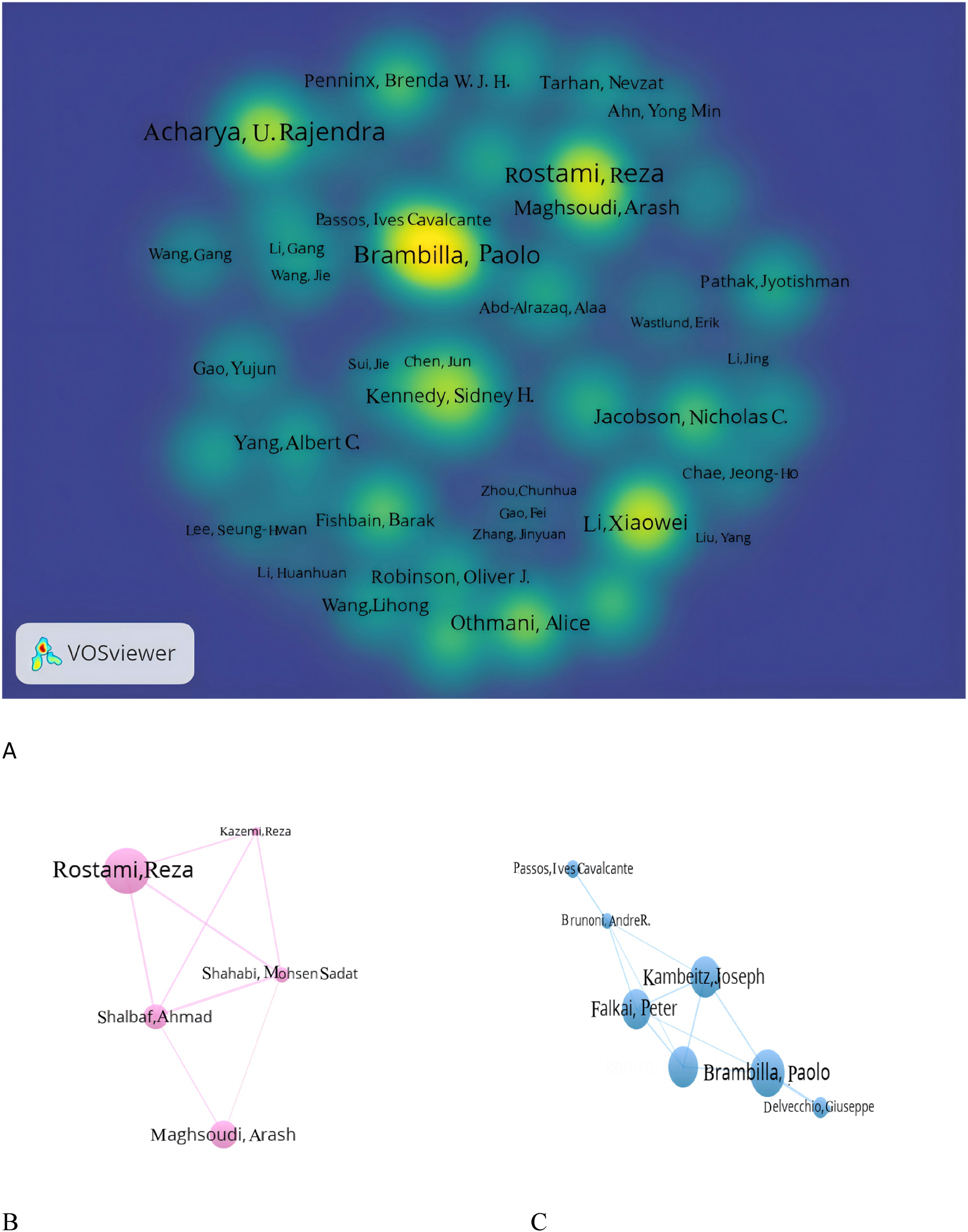
(a) the co-authorship network of authors. (b) Enlarged View of Reza Rostami's Network (Pink Group). (c) Enlarged View of Paolo Brambilla's Network (Blue Group). Lines represent collaboration between authors, while different colors indicate distinct collaboration groups.
Top 10 authors by number of citations.

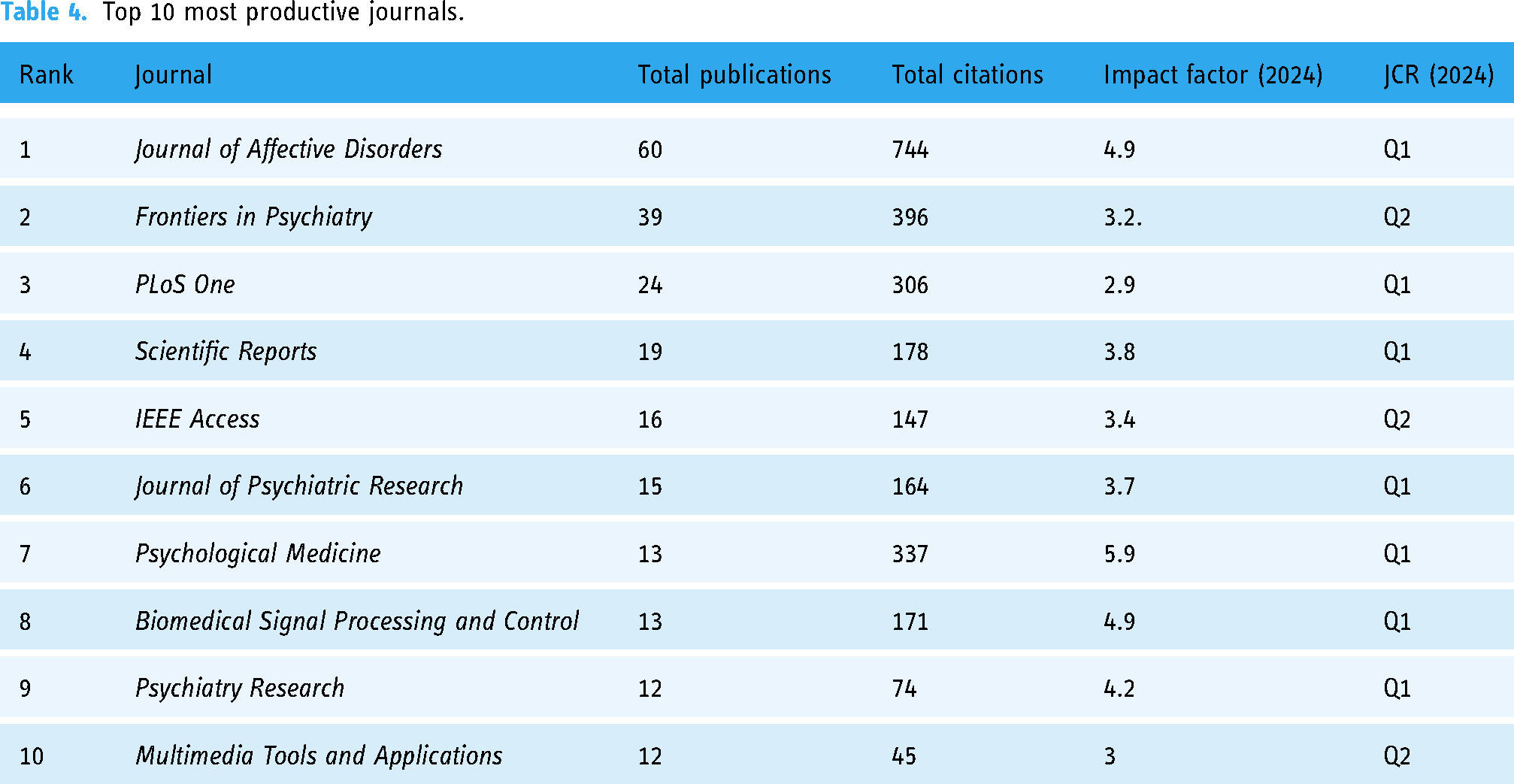
A total of 365 journals have published articles on the application of AI in insomnia, anxiety, and depression. In terms of publication volume (Table 4), the top three journals are the Journal of Affective Disorders (60 publications), Frontiers in Psychiatry (39 publications), and PLoS One (24 publications). Among the top 10 journals with the most publications, Psychological Medicine (Impact Factor—IF = 5.9) has the highest IF. Citations are a key indicator of a journal's academic influence. The most highly cited journal is the Journal of Affective Disorders (744 citations), followed by Frontiers in Psychiatry (396 citations) and Psychological Medicine (337 citations).
Top 10 most productive journals.
Analysis of references
The number of citations a publication receives reflects its significance within the field. Appendix A lists the top 7 most-cited articles. The most cited article is by Kroenke, K., published in 2001, which validated the Patient Health Questionnaire-9 (PHQ-9) as a brief and effective scale for assessing depression severity. 26 The second most cited article is by Acharya, U. R., published in 2018, which employed deep convolutional neural networks (CNNs) for automated depression screening using electroencephalogram (EEG) data. 27
Figure 6 highlights the top 20 references with the strongest citation bursts, with the most significant being a 2016 study by Chekroud AM. 28 This study utilized machine learning to predict the effectiveness of depression treatments, optimizing personalized treatment strategies. The timeline view of co-cited references illustrates the evolution of research hotspots (Figure 7), with the latest topics including “Convolutional Neural Networks” (#0), “Depression Detection” (#1), “Machine Learning” (#2), and “Deep Learning” (#3). This highlights the increasing application of AI technologies in the diagnosis and treatment of depression and other mental health disorders.

Top 22 references with the strongest citation bursts. Burst strength indicates a significant increase in citation frequency for a publication during a specific time period. The timeline shows citation bursts from 2000 to 2024.

Co-cited references timeline view. The size of each node represents the annual frequency of a keyword, with larger nodes indicating higher frequency. Dense areas represent keyword clusters, reflecting major research directions. The numbers and labels on the right indicate cluster IDs and themes.
Analysis of keyword
Keyword analysis is instrumental in identifying important topics and research hotspots within a field. Keyword co-occurrence refers to the occurrence of two or more keywords appearing together in the same or related publications. Figure 8(a) presents the keyword co-occurrence network, showing that “machine learning,” “depression,” and “anxiety” have the strongest overall connection strengths, indicating their central role as key focal points in this area of research.
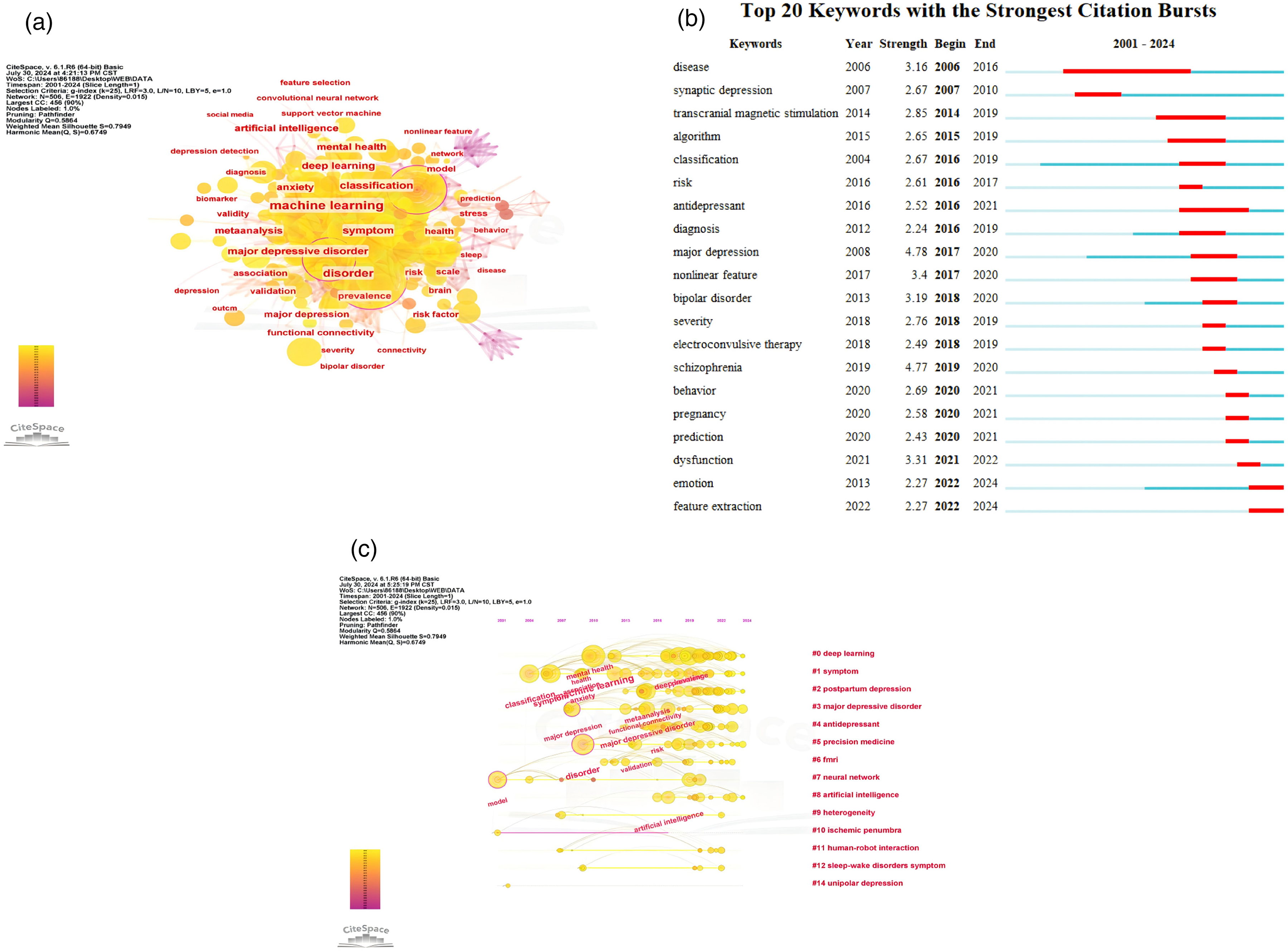
(a) the network map of keyword co-occurrence. The size of each node represents the frequency of a keyword, while dense regions indicate keyword clusters, revealing major research directions. (b) The top 22 keywords with the strongest citation bursts. The timeline on the right displays burst periods from 2000 to 2024, with red bars indicating periods of keyword bursts. (c) The timeline map of keyword co-occurrence. Dense regions indicate keyword clusters, highlighting the primary research directions.
CiteSpace was used to analyze citation bursts for keywords. Figure 8(b) displays the top 20 keywords with the highest burst strength, serving as key indicators of emerging research hotspots in this field. Among them, “feature extraction” is currently experiencing a burst, underscoring its significance in recent studies. The keyword timeline view illustrates the trends in research hotspots over time. In the timeline view (Figure 8(c)), all keywords are grouped into 14 clusters. The clusters “deep learning” (#0), “symptom” (#1), “postpartum depression” (#2), and “major depressive disorder” (#3) span almost the entire timeline, indicating their consistent importance within the field. In contrast, keywords like “artificial intelligence” (#8), “human–robot interaction” (#11), and “neural network” (#7) have gained prominence in recent years, highlighting current research trends.
Discussion
Global trends and Status of publications
This study provides a comprehensive review of articles published over the past 24 years using the WoSCC database, highlighting significant advancements in the application of AI in insomnia, anxiety, and depression. Notably, the past 5 years have seen a rapid increase in publications within this field. The study analyzed a total of 876 articles, authored by 4156 researchers from 1643 institutions across 74 countries/regions, published in 365 journals, and citing 35,713 co-cited references.
China (274 articles) and the United States (214 articles) lead in the number of publications, positioning them as the primary contributors to research on AI in insomnia, anxiety, and depression. Both countries are at the forefront of international collaboration, maintaining strong connections with other nations. The United States holds the highest total citation count (5004), underscoring its significant influence in the medical community. The University of Toronto stands out as the most productive and most cited institution. Furthermore, both the University of Toronto and the Chinese Academy of Sciences occupy central positions in the institutional co-authorship network, underscoring their pivotal roles in advancing this field.
Analysis of the co-authorship network revealed that Uddhav Rajendra Acharya's articles have the highest citation count (413), while Paolo Brambilla has published the most articles (7), reflecting their significant academic influence in this field. However, overall collaboration among researchers remains relatively limited, and future efforts should focus on fostering academic cooperation to expand the depth and breadth of research. Journal analysis indicates that the Journal of Affective Disorders has the highest number of publications (60) and citations (744), while Psychological Medicine has the highest IF (IF = 5.9), underscoring the academic significance and reference value of these two journals in the field.
Research hotspots
The analysis of cited references and keywords further highlights the evolution of research hotspots and emerging trends. Key terms such as “neural networks,” “machine learning,” “deep learning,” “feature extraction,” “depression detection,” “artificial intelligence,” and “human-robot interaction” occupy prominent positions in the timeline view, reflecting their widespread application in mental health research and the considerable attention they have garnered from researchers. The current research hotspots in this field primarily concentrate on the following areas.
Machine learning and personalized treatment
In recent years, machine learning has been extensively applied to the classification and prediction of mental health data, emerging as one of the core technologies in this field.29–31 The co-citation analysis of keywords in this study reveals that terms such as “machine learning,” “feature extraction,” “depression,” and “anxiety” frequently appear in the literature and are strongly interconnected, underscoring their importance as key research directions. Feature extraction is a critical step in machine learning. Machine learning techniques, including support vector machines, decision trees, and random forests, are frequently used to identify clinical features in patients with anxiety or depression. By utilizing these technologies, researchers can extract the most diagnostically valuable features from complex biomedical data, thereby enhancing the predictive accuracy of models.32,33 Personalized treatment represents a key application of machine learning in the mental health field.34,35 Through the development of machine learning models, researchers can classify patients based on the severity of clinical symptoms and predict disease progression.36,37 Xu et al. 38 investigated the neuroimaging characteristics of the negative emotion network in patients with chronic insomnia and applied machine learning to predict the severity of anxiety symptoms. The results revealed that neural activity in the negative emotion network is closely related to anxiety, offering new insights into the relationship between anxiety and insomnia. Furthermore, machine learning models can predict patients' responses to different treatment options by analyzing data, thus reducing the trial-and-error process and optimizing treatment strategies. Chekroud et al. 28 utilized a machine learning model to predict treatment outcomes for depression patients across multiple clinical trials. The study demonstrated that the model effectively predicted treatment responses in diverse clinical settings, highlighting its potential for personalized treatment in depression.
Deep learning and intelligent diagnosis
Deep learning, particularly CNNs, has become a core technology for processing complex medical data, such as EEG and imaging data.39–41 These techniques have demonstrated excellent performance in the automated diagnosis and prediction of mental health issues, particularly in the early detection and monitoring of depression and anxiety, showcasing significant potential in these areas.42–45 Among the key studies, Acharya et al. 27 published a highly cited article in 2018 titled “Automated EEG-based screening of depression using deep convolutional neural network.” This research developed an automated depression screening system using CNNs to analyze EEG data for detecting depression. The results showed that CNNs significantly improved the accuracy and reliability of depression screening. Additionally, Wang et al. 46 developed a deep learning framework based on diffusion models for diagnosing major depressive disorder using EEG data. This model effectively extracted key features of the disorder and demonstrated strong classification performance, providing a new tool for the early detection of major depression.
These studies highlight the application value of deep learning in the automated diagnosis of mental health conditions. Multimodal fusion is another important application of deep learning, integrating medical data from different sources into a single model to provide more comprehensive diagnostic information. This approach captures and analyzes complex patterns and relationships that cannot be revealed by a single data source, thus enhancing diagnostic accuracy and improving prediction reliability.47,48. Liu et al. 49 developed a system using CNNs to assess depression severity based on facial expressions and body movements. The results demonstrated that the model exhibited high accuracy in predicting depression severity, underscoring the potential of deep learning technology in analyzing nonverbal behavioral features for depression assessment.
Human-Computer interaction and AI-assisted therapy
The emergence and advancement of human–computer interaction (HCI) technologies, particularly in combination with AI-powered smart devices and robots, have shown unprecedented potential in medical research.50,51 These technologies not only aid in treatment but also enable real-time monitoring and adjustment of treatment plans through patient interaction, offering a more personalized treatment experience. The application of HCI technology in addressing common mental health issues such as insomnia, anxiety, and depression has been steadily increasing, suggesting that it may become a crucial component of mental health treatment in the future.52,53
In recent years, AI and HCI-based smart devices, such as intelligent sleep monitors, have proven to be effective tools in assisting with the treatment of insomnia. Roberts et al. 54 conducted a comparative analysis of multisensor consumer wearable devices for sleep detection. The study found that these devices performed well in detecting total sleep time, providing valuable reference data for sleep monitoring in everyday environments. Additionally, HCI-based virtual reality therapy has gained widespread use in the treatment of anxiety disorders, emerging as an effective and innovative psychological therapy tool.55,56 AI-enhanced virtual reality therapy simulates realistic scenarios, allowing patients to gradually acclimate to anxiety-inducing factors, reduce sensitivity to anxiety triggers, and effectively alleviate anxiety symptoms. 57
AI-driven chatbots have also introduced new therapeutic approaches for patients with anxiety and depression.58,59 Fitzpatrick et al. 60 evaluated the effectiveness of an automated chatbot, Woebot, in delivering cognitive behavioral therapy to university students. The results showed that participants using Woebot experienced a significant reduction in depression and anxiety symptoms within two weeks. As a convenient and user-friendly tool, Woebot provides effective support for managing anxiety and depression symptoms.
Future development trends
With the rapid advancement of machine learning and deep learning technologies, personalized treatment in mental health is expected to see broader and more precise applications.19,61,62 Future research should prioritize improving the accuracy and robustness of models, particularly through the integration and analysis of multimodal data. By combining data from diverse sources—such as facial expressions, body movements, voice characteristics, EEG, and other physiological signals—researchers can develop more comprehensive and detailed personalized treatment models. 63 These models not only enhance the capabilities of automated diagnosis and prediction but also provide more precise and customized treatment plans.
The application prospects for personalized models in treating anxiety and depression are especially promising. By analyzing multidimensional patient data, clinicians can more accurately predict responses to various treatment methods, including medication, psychotherapy, or behavioral therapy. This reduces the trial-and-error process and significantly optimizes treatment outcomes. Furthermore, integrating multiple data sources allows these models to detect early symptoms or risk factors that may be overlooked in traditional screenings, enabling earlier and more effective interventions, and thus improving long-term patient outcomes.
Comprehensive application of human-computer interaction technology in mental health
The maturation of HCI technology has expanded the application of AI-based smart devices and virtual reality therapy in mental health treatment.64–66 These advancements not only provide patients with a more interactive therapeutic experience but also make the treatment process more convenient and personalized.67–69 In the future, optimizing the interaction between HCI technology and patients will be crucial to enhancing treatment outcomes. AI-driven autonomous therapeutic tools, such as chatbots and virtual advisors, are increasingly becoming essential support tools in the mental health field. These tools can utilize technologies like natural language processing and sentiment analysis to more accurately assess patients' psychological states and deliver personalized interventions.70,71
In resource-limited or remote areas, these technologies can be integrated into conventional treatment processes, offering continuous support and guidance to patients and helping address the shortage of mental health resources. Future research should focus on optimizing the interaction design and algorithms of these AI tools to improve their ability to recognize complex emotions and psychological states, thereby providing more accurate psychological interventions and emotional support. Overall, the continuous advancement of HCI technology will further broaden the scope of mental health treatment, making it more accessible, efficient, and personalized, ultimately improving patients' quality of life.
Focus on ethics and privacy
As AI technology becomes more widely applied in the mental health fields of insomnia, anxiety, and depression, concerns around data privacy and ethics have increasingly come to the forefront.72,73 Balancing the protection of patient privacy with the effective utilization of big data and AI for personalized treatment remains a key challenge for future research. Potential measures include anonymizing data, implementing data encryption technologies, and strengthening access control mechanisms.17,74,75.
Moreover, the application of AI technology raises ethical risks related to algorithmic bias and automated decision-making. Future research must ensure algorithm transparency and fairness, with regular reviews and updates to algorithms to prevent harm to patient rights and ensure that these technologies contribute meaningfully to improving mental health. Striking a balance between technological innovation and ethical safeguards will be crucial for the sustainable development of the mental health field, particularly in addressing insomnia, anxiety, and depression.
Limitations of this study
This study provides a comprehensive review of the application of AI in insomnia, anxiety, and depression through bibliometric analysis, but several limitations should be noted. First, the study only included English-language literature, potentially leading to language bias by excluding relevant studies published in other languages. Secondly, our analysis relied primarily on the WoSCC database. Although this database contains a large collection of high-quality international literature, exclusive reliance on it may result in the omission of influential studies from other databases. Additionally, the bibliometric methods employed in this study are based on indicators such as citation counts, which may not fully capture the academic value and broader impact of the research. Despite these limitations, this study offers valuable insights and guidance through a comprehensive and systematic analysis of AI applications in the fields of insomnia, anxiety, and depression.
Conclusion
In summary, this study is the first to comprehensively review publications related to the application of AI in insomnia, anxiety, and depression over the past 24 years using bibliometric analysis. The findings indicate that AI's role in addressing mental health issues is rapidly expanding, with significant potential in personalized treatment and intelligent diagnosis for these conditions. Machine learning and deep learning technologies are prominent research hotspots, widely employed to extract key features from complex data, optimize treatment plans, and enhance diagnostic accuracy. Multimodal data fusion offers more comprehensive support for the diagnosis and treatment of mental health disorders.
Looking ahead, the continued development of personalized treatment and HCI technology will be central research directions. However, as AI technology becomes more pervasive, concerns surrounding data privacy and ethics are increasingly pressing. Future efforts should focus on mitigating algorithmic bias and reducing the risks associated with automated decision-making, ensuring the robust and sustainable development of AI in the field of mental health.
Supplemental Material
sj-docx-1-dhj-10.1177_20552076251324456 - Supplemental material for The application of artificial intelligence in insomnia, anxiety, and depression: A bibliometric analysis
Supplemental material, sj-docx-1-dhj-10.1177_20552076251324456 for The application of artificial intelligence in insomnia, anxiety, and depression: A bibliometric analysis by Enshi Lu, Di Zhang, Mingguang Han, Shihua Wang and Liyun He in DIGITAL HEALTH
Footnotes
Availability of data and materials
The original data from the current study are available from the corresponding author upon reasonable request.
Contributorship
ESL conceived and designed the study, analyzed and interpreted the data, and wrote the manuscript. LYH responsible for the study design and instructions. DZ performed the data acquisition and analysis, and contributed to writing the manuscript. MGH participated in the data analysis and discussion of the results. SHW analyzed the results of the study and revised the manuscript.
Declaration of conflicting interests
The authors declared no potential conflicts of interest with respect to the research, authorship, and/or publication of this article.
Ethical approval
No patients were involved in this research, so the ethical approval is not required. The data sets analyzed during this study are available in the Web of Science core collections.
Funding
The authors disclosed receipt of the following financial support for the research, authorship, and/or publication of this article: This work was supported by the Capital Health Development Research Special Project (grant number: 2022-1-4301).
Guarantor
ESL and LYH

Supplemental material
Supplemental material for this article is available online.
References
Supplementary Material
Please find the following supplemental material available below.
For Open Access articles published under a Creative Commons License, all supplemental material carries the same license as the article it is associated with.
For non-Open Access articles published, all supplemental material carries a non-exclusive license, and permission requests for re-use of supplemental material or any part of supplemental material shall be sent directly to the copyright owner as specified in the copyright notice associated with the article.
