




Abstract
Background
Currently, artificial intelligence (AI) has been widely used for the prediction, diagnosis, evaluation and rehabilitation of stroke. However, the quantitative and qualitative description of this field is still lacking.
Objective
This study aimed to summarize and elucidate the research status and changes in hotspots on the application of AI in stroke over the past 20 years through bibliometric analysis.
Materials and Methods
Publications on the application of AI in stroke in the past two decades were retrieved from the Web of Science Core Collection. Microsoft Excel was used to analyze the annual publication volume. The cooperation network map among countries/regions was generated on an online platform (https://bibliometric.com/). CiteSpace was used to visualize the co-occurrence of institutions and analyze the timeline view of references and burst keywords. The network visualization map of keywords co-occurrence was generated by VOSviewer.
Results
A total of 4437 publications were included. The annual number of published documents shows an upwards trend. The USA published the most documents and has the top 3 most productive institutions. Journal of Neuroengineering and Rehabilitation and Stroke are the journals with the most publications and citations, respectively. The keywords co-occurrence network classified the keywords into four themes, that is "rehabilitation," "machine learning," "recovery" and "upper limb function." The top 3 keywords with the strongest burst strength were "arm," "upper limb" and "therapy." The most recent keywords that burst after 2020 and last until 2023 included "scores," "machine learning," "natural language processing" and "atrial fibrillation."
Conclusion
The USA shows a leading position in this field. At present and in the next few years, research in this field may focus on the prediction/rapid diagnosis of potential stroke patients by using machine learning, deep learning and natural language processing.
Introduction
Stroke is an acute cerebrovascular disease that causes brain tissue damage due to the sudden vascular obstruction or the rupture of blood vessels. It characterized by high morbidity and mortality, and can be categorized as ischemic and hemorrhagic stroke.1,2 Both types of stroke can cause neurological deficits, such as hemiplegia, semisensation loss, aphasia and visual disorders, due to damage to nerve tissue. 3 Stroke has become the second leading cause of death and the second leading cause of disability-adjusted life-years lost worldwide. 4 The corresponding burden has increased significantly globally in the past three decades. 5 Research has shown that predicting and preventing stroke before stroke onset can reduce its incidence. 6 Early diagnosis, assessment and rehabilitation may improve the quality of life of stroke patients, thereby reducing the related social burden.7,8
Artificial intelligence (AI) refers to simulate and extend human intelligence through artificial machines. It encompasses a wide range of technologies, such as machine learning (ML), natural language processing (NLP), robotics and deep learning (DL). 9 AI has developed rapidly in the past few decades and is increasingly used in medicine. 10 For stroke, DL can measure the bleeding volume of hemorrhagic stroke and automatically assess the Alberta Stroke Program Early computed tomography (CT) score for ischemic stroke from CT images.11,12 ML enables comprehensive analysis of a wide range of datasets to help identify the subtypes and risk stratifications of stroke. 13 Rehabilitation robots can assist in gait training for hemiplegic patients. 14
There have been many studies on the application of AI in stroke, and many scholars have provided excellent reviews of the current state of this field.15,16 They focus on depicting the latest research advancements and the present scenario but do not analyze countries, institutions, or journals, let alone hotspot changes. Bibliometrics is a technique for the quantitative analysis of countries, institutions, authors, journals, keywords and references and is therefore capable of summarizing changes in research focus and hotspots in a specific field. 17 This study aimed to use bibliometric methods to analyze publications related to the application of AI in stroke research to summarize the achievements, explore changes in research hotspots over time and provide a reliable reference for future studies.
Materials and methods
Data collection and retrieval strategy
Publications related to AI in stroke published between 2004 and 2023 were retrieved from the Web of Science Core Collection (WoSCC) database, which is considered a paramount data source for bibliometric analysis, 18 on October 26, 2024. The search formula was as follows: TS = (("stroke" OR "ischemic stroke" OR "hemorrhagic stroke" OR "cerebral infarction" OR "transient ischemic attack") AND ("artificial intelligence" OR "machine intelligence" OR "robot*" OR "robot technology" OR "assistant robot" OR "robot-assisted" OR "computational intelligence" OR "computer reasoning" OR "Computer aided system" OR "Computer aided diagnosis" OR "deep learning" OR "computer vision system" OR "sentiment analysis" OR "machine learning" OR "radiomics" OR "data learning" OR "expert* system*"OR "natural language processing" OR "support vector machine*" OR "decision tree*" OR "deep learning" OR "Bayesian network*" OR "intelligent learning" OR "feature*learning" OR "feature* extraction" OR "feature*selection" OR "image* segmentation" OR "supervised learning" OR "semantic segmentation")) AND FPY = (2004–2023). The first section of the formula comprises stroke and its multiple subtypes, the second section contains AI and related technologies, and the third section is the time frame of the publications.
The inclusion criteria were as follows. (a) Relevant articles published and collected by WoSCC. (b) Publication types were article. (c) Publication years between 2004 and 2023. The exclusion criteria were as follows. (a) The language of the publications was not English. (b) The research areas of the publications were not related to the application of AI in stroke. All the inclusion and exclusion steps were based on the screening function of the WOS website.
A total of 11,997 publications were retrieved from the WoSCC database. 7160 articles met the inclusion criteria. After excluding the publications with languages other than English (n = 42), and mismatch research areas (n = 2681) (Figure 1). A total of 4437 publications were ultimately included. The ‘full records and cited reference' of the publications were downloaded in plain text format from the database. Patients and the public were not (or will not) be involved in this study. No medical institutions or patients were included, and thus ethical approval or informed consent was not applicable.

Flow chart of the study.
Analysis and visualization tools
Bibliometric analysis and data visualization in this study were performed using Microsoft Excel 2021, CiteSpace (Version 6.4.R1), VOSviewer (version 1.6.20), an online platform (https://bibliometric.com/) and R-package "Bibliometrix". Excel 2021 was used to analyze the annual and cumulative publications. The Lotka's law and Bradford's law were used to analyze the productivity of the authors and journals via "Bibliometrix" package. A map of the collaboration networks among countries/regions was constructed on the online platform. 19 CiteSpace was used to construct an institutional co-occurrence map, a timeline view of references and burst keywords.20,21 The network visualization map of keywords co-occurrence was generated by VOSviewer. Before conducting the keyword analysis, keywords with similar meanings were unified as a keyword. For example, "acute-ischemic stroke" and "acute ischemic stroke" were unified as "acute ischemic stroke," "algorithm" and "algorithms" unified as "algorithm."
Results
Annual publication analysis
A total of 4437 related publications were ultimately included. The cumulative number of publications increased from 16 to 4437 over the past 20 years (Figure 2). The annual publications show an overall upward trend, and there is a sharp growth trend after 2020.

Trend of annual publications on the application of artificial intelligence in stroke.
Country, institution and author analysis
A total of 5269 institutions from 84 countries/regions participated in this field. Table 1 shows the top 10 countries/regions, institutions and authors by publication count. The United States of America (USA) had the most publications (n = 1378) and citations (n =
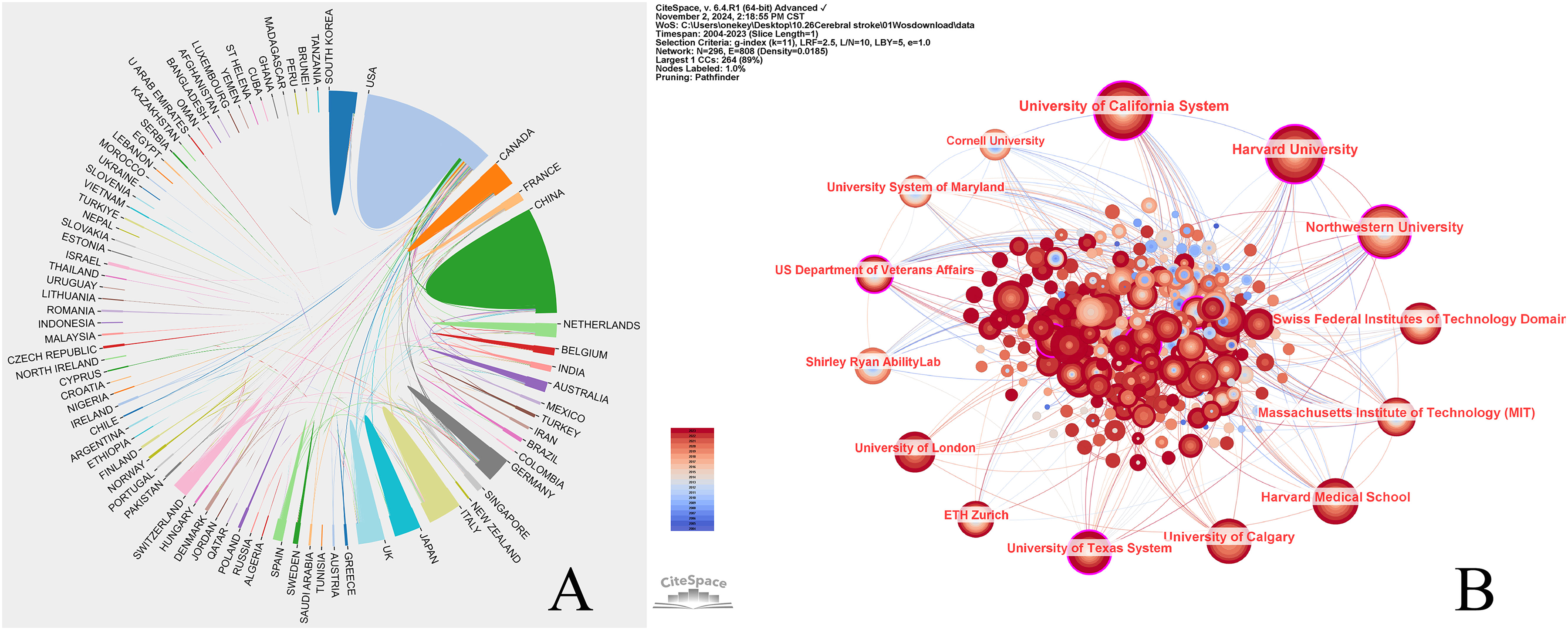
Cooperative map. (a) Co-occurrence of countries/regions, (b) Co-occurrence of institutions.
Top 10 productive countries, institutions and authors.

A total of 21,498 authors participated in the included articles, of which 386 authors had published no fewer than 6 articles. The top 3 authors in terms of publications were Krebs Hermano Igo from the USA (n = 66), Dukelow Sean P (n = 53) and Scott Stephen H from Canada (n = 42). Krebs Hermano Igo also has the highest H-index among them. Table 2 displays the stratification of authors based on the productivity index grouping based on Lotka's law. Authors who have published only one paper make up the largest group. Large producers, defined as those who have published over 10 publications, represent just 1.08% of the group.
Author dispersion according to productivity level calculated by Lotka's law.

PI, participation index.
Funding analysis
The funding information comes from the WOS database. A total of 200 funding agencies have supported the publications in this field. The top 10 funding agencies are as follows, United States Department of Health Human Services (491), National Institutes of Health (USA) (474), National Natural Science Foundation of China (402), European Union (123), Ministry of Education Culture Sports Science and Technology Japan Mext (92), Canadian Institutes of Health Research (90), Japan Society for The Promotion of Science (89), National Science Foundation (USA) (89), National Institute of Neurological Disorders Stroke (USA) (86) and UK Research Innovation (85).
Journal analysis
A total of 726 journals have published articles on the application of AI in stroke. The study evaluated the algebraic representation of Bradford's law in 726 journals grouped into three zones. Table 3 presents data on the distribution of journals, along with the corresponding number of publications and Bradford's multipliers in three zones. The journals in the three zones published approximately 1/3 of the articles, respectively. The core journals in Zone 1 and the top journals by citation are listed in Table 4. The Journal of Neuroengineering and Rehabilitation published the most publications (n = 280), followed by IEEE Transactions on Neural Systems and Rehabilitation Engineering (n = 232) and Frontiers in Neurology (n = 185). The most cited journal was Stroke (n = 10,312).
Distribution of journals in Bradford's zones.

The core journals and the most cited journals.

Keyword analysis
The frequency and burst analysis of keywords can help researchers identify research hotspots and emerging trends in a certain knowledge field. 22 A total of 12,120 keywords were found in this study, and the top 20 keywords in terms of occurrence frequency are shown in Table 5. Except for “stroke,” the most frequent keywords were "rehabilitation" (n = 1021), "recovery" (n = 684), "robot" (n = 629), "machine learning" (n = 578) and "upper limb" (n = 502). The network visualization map of keywords co-occurrence (Figure 4) can be summarized into four categories, each representing a research theme. The research themes, in order of frequency, are "rehabilitation," "machine learning," "recovery" and "upper limb function." Figure 5 shows the top keywords with the strongest citation bursts. The top 3 keywords with the strongest burst strength were "arm," "upper limb" and "therapy." The most recent keyword bursts, including "scores," "machine learning," "NLP" and "atrial fibrillation (AF)," occurred in 2020/2021 and had last until 2023.

Keywords co-occurrence network.

Top 25 keywords with strongest citation bursts between 2004 and 2023. The keywords burst periods are marked with red lines.
Top 20 keywords in terms of the frequency of occurrence.

Reference analysis
Figure 6 shows the timeline view of the reference citation clusters. The timeline view of reference and keyword burst analysis can effectively describe the transition of research hotspots and emerging trends in a specific field within a given timeframe. 23 It can be seen from the timeline view that the most cited themes of the application of AI in stroke mainly include controlled trial (#0), deep learning (#1), active participation (#2), acute ischemic stroke (#3), robotic therapy (#4), chronic stroke (#5), sub-acute stroke patient (#6), multi-joint arm exoskeletons (#7), poststroke hemiparesis (#8) and using pre-trained CNN model (#9).

Reference timeline visualization map for the application of artificial intelligence in stroke. The cluster labels are generated through cluster analysis, the references in the cluster are chronologically sorted by the year of publication, and the node size represents the total number of citations of the references.
According to Figures 5 and 6, research on the application of AI in stroke research can be roughly divided into three periods. The first period was from 2004 to 2011, and the core keywords included "hemiparesis," "motor control," "upper limb," "induced movement therapy," "robotic therapy," "body weight support." The second period was from 2012 to 2019, and the core keywords included "gait," "walking," "brain computer interface (BCI)," "stimulation" and "exoskeleton." The third period was from 2020 to 2023, and the keywords included "score," "machine learning," "deep learning," "natural language processing" and "AF."
Discussion
Wang et al. systematically analyzed 50 representing publications on AI-assisted acute stroke prevention and diagnosis over the past 25 years, and summarized the algorithms applied to stroke segmentation, classification, risk prediction. 24 Our study investigated the application of AI in whole clinical procedure of stroke based on the documents published between 2004 and 2023. This study focuses on various application scenarios of different AI technology in stroke over different time periods. The results suggested that the number of annual publications had increased significantly in recent years, which showed that this field was receiving increasing attention. The USA is the leading country in this field with the most publications and the most productive institutions. The network visualization map of keywords co-occurrence classified the keywords into four themes, that is "rehabilitation," "machine learning," "recovery" and "upper limb function." Moreover, research in this field can be divided into three periods. The first period (2004–2011) focused on the exploration of primary AI technologies such as robotic therapy for assisting in the rehabilitation of patients with impaired motor function (mainly upper limbs) after stroke. In the second period (2012–2019), in addition to continuing the in-depth research on the contents of the first period, the researchers began to explore the use of exoskeleton and BCI to assist stroke patients to recover motor functions (especially lower extremity). The third period (2020–2023) focused on exploring the feasibility of AI technology, such as DL, ML and NLP in assisting in deep evaluation such as medical imaging diagnosis, scoring and outcome prediction of stroke.
Except for China, all the countries in the top 10 are developed countries. Even though China ranks second in terms of the number of publications, it ranks only fifth in terms of citations. Seven of the top 10 productive institutions come from the USA, with the other three from Switzerland, Canada and the United Kingdom. Among the top 10 authors, three were from the USA, three were from China, and two were from Canada. Developed countries were in a leading position in this field, and this phenomenon may be caused by the following reasons. On the one hand, developed countries, especially the USA, which has a great advantage in medicine and AI-related technologies, have a higher level of technology and medical care. On the other hand, for economic reasons, scholars from developing countries receive less research funding than those from developed countries do. Funding agencies of USA, represented by United States Department of Health Human Services, supported more than 1000 publications, maintaining its' leading position. The National Natural Science Foundation of China funded 402 publications, contributing to the second-highest number of publications. This may be the reason why China is the only developing country in the top 10 productive countries. The European Union ranks fourth in the amount of research funded, and this, combined with funding from national funding agencies, results in a generally high national influence.
The identification of trends in research priorities, so called hotspots, in given field, thus enabling scientists to identify subsequent promising directions is a crucial element of bibliometrics. The network visualization map of keywords co-occurrence classified the keywords into four research themes. The most prolific theme is the research on the rehabilitation of stroke patients based on robot-assisted gait training and exoskeleton. The second theme includes the risk prediction of stroke in the context of AF and other cardiovascular diseases based on ML and DL, as well as stroke detection, diagnosis and prognosis prediction. The third theme is the use of AI combined BCI to realize the communication between machine and human brain, and replace the function of damaged nerves to some extent. The fourth theme is to restore the shoulder and upper limb motor function to improve the quality of life. And the research in this filed can be classified into three periods through keyword bursts and reference analyses.
Period I (2004–2011)
The keywords in the first period included "hemiparesis," "motor control," "upper limb," "induced movement therapy," "robotic therapy," "body weight support." The most common and widely recognized deficits caused by stroke are motor impairments, including hemiplegia, muscle weakness, intensified reflexes, reflexes and loss of coordination or apraxia. 25 Restoring motor function, such as upper limb motor function, is an important part of poststroke recovery, which can greatly improve the quality of life and reduce the economic burden of patients. Two widely practiced treatments for improving upper limb motor function are constraint-induced movement therapy and motor relearning programs. 26 However, these high-intensity and task-specific stroke recovery therapies generally rely on a therapist's intensive care over a long period of time. Rehabilitation robots combined with AI technology have greatly improved the situation. In the initial stage, AI-related technologies have not been fully developed, the robot can only receive mechanical assistance instructions to help the affected limb carry out repeated fixed movements and make simple records, and the adaptability and safety are not guaranteed. 27 With the development of AI, AI-based rehabilitation robotics can also accurately detect and record the movement progress of patients, and provide feedback to patients in the target movement, and both adaptability and safety have been improved. 28 Currently, robot-assisted therapy enables physical therapists to reduce the workload and provide patients with more repetitive and intensive rehabilitation training. 29
Period II (2012–2019)
In the second period, the rehabilitation of AI in stroke patients is still the focus. Notably, the first period focused mainly on the rehabilitation of upper limb motor ability, and with the progress of technology and the pursuit of a better standard of living, lower limb motor rehabilitation for patients with sequelae of stroke has gradually attracted increasing attention. AI-based robot-assisted devices can optimize treadmill training in guiding patients to return to a normal physiological gait and prevent incoordination among multiple therapists. 30 The Lokomat proposed by Colombo et al., which combines a robotic gait orthosis and a body weight-supported treadmill, can guide patients’ legs to perform automated gait training according to a preprogrammed gait pattern. 31 To promote the recovery of lower limb function, exoskeleton technology products have also made progress. For example, advanced AI technology is embedded in the exoskeleton, which predicts the patient's motion intention through ML algorithms, provides corresponding dynamic support, and promotes natural movement patterns. 21 By recording the patient's exercise, an adaptive and individualized rehabilitation program was developed. 33
BCI aims to build a direct connection pathway between the human brain and external devices to enable the exchange of information between the brain and an external device. The principle of operation is that after the brain signals acquisition, typically ECG signals, AI-driven the signal processing and decoding, and translates the decoded neural signals into commands for the external device. 34 Convolutional neural networks and recurrent neural networks have been widely used in signal processing and coding, and showed good performance. 35 The combination of BCI and AI makes it possible for patients with movement disorders such as sequelae after stroke to live independently, and promotes the revolution of traditional rehabilitation techniques.
Period III (2020–2023)
Different from the previous two periods, which mainly focus on the treatment of stroke, studies in this period pay more attention to the prevention, early diagnosis and in-depth evaluation of stroke. ML, DL and NLP technologies that can automatically analyze data and images were frequently mentioned. 13 For stroke risk assessment, clinical factors, genetic factors, serum markers and imaging can be used as raw data for AI to predict the occurrence and possible prognosis of stroke. Jung et al. constructed a prediction model using an attention-based deep neural network based on demographics, health examination, and medical history information, and obtained better performance for the prediction of ischemic stroke in AF patients than traditional CHA2DS2-VASc scores. 36 Gregory et al. established an ML model based on vascular ultrasound that provides greater accuracy in stroke risk prediction than traditional methods. 37 Based on the imaging data, DL and ML can evaluate stroke based on automatic or manual segmentation. One study developed an automatic DL-based segmentation method to detect the infarct volume in patients with acute ischemic stroke from CT scans. 38 Cao et al. proposed deep asymmetry network to automatically obtain the Alberta Stroke Program Early CT Score from CT imaging, and verified that the resulting score was highly correlated with patient prognosis. 39 Some studies have demonstrated that ML models based on clinical and radiological factors can predict the short-term functional outcome of hemorrhagic stroke patients and the long-term prognosis of ischemic stroke patients.40,41 In short, CNN-based DL algorithms, ML including logistic regression, random forests and other algorithms can accelerate the prediction and assessment of stroke and provide more objective quantitative indicators.
NLP is another major AI processing technology based on the ML/DL algorithm. It can extract information from unstructured data (such as routine medical records and imaging report text) to form structured data in a unified format. 42 Such structured data list each important aspect of the disease in a separate entry (such as the presence/absence of lymph node metastasis in lung cancer), provide clearer information for the disease management. The commonly used algorithms in NLP include ML algorithms such as the bag of words, term frequency-inverse document frequency, hidden Markov model, as well as DL algorithms such as recurrent neural network and long short-term memory network. Studies have suggested that NLP can be used to determine the acuity and location of ischemic stroke from radiologists’ reports. 43 Sung et al. used NLP to extract medical concepts from the eligibility criteria for intravenous thrombolysis to assist in determining the feasibility of intravenous thrombolytic therapy in acute ischemic stroke patients. 44 Some researchers have also explored the feasibility of using DL-NLP to predict transient ischemic attack and stroke events.45,46 In general, structured data extracted through NLP can shorten the time to clinical decision making due to its professional and clear presentation.
Our study has several limitations. First, the publications were retrieved from the WoSCC. Although it contains comprehensive literature data, there are still some excellent publications not included in it. Second, only the articles in English were included, and publications in other languages and types were not analyzed. Third, keywords or references are required to be frequently cited so that their related topics can be identified during the analysis. As a result, bibliometric analyses may have difficulty identifying topics that are have few articles but are emerging directions.
Conclusion
In this bibliometric analysis study, we delineated the trajectory of research on AI in stroke in the past 20 years. From 2004 to 2011, the research mainly focused on AI-driven robotic rehabilitation therapy, especially the rehabilitation of upper limb motor function. From 2012 to 2019, robot-assisted functional rehabilitation of lower limbs in stroke patients has gradually attracted attention, and the combination of AI and BCI has become a hot topic. Since 2020, the focus of researches has gradually shifted to the prediction, diagnosis and prognosis assessment of stroke, hoping to promote health through intervention of high-risk patients.
To sum up, the application of AI-based robot-assisted rehabilitation and automatic diagnosis/scoring of stroke has been mature, but the following problems need to be further solved. (a) Although BCI combined with AI has obtained considerable results in scientific research, the algorithmic framework constructed on the basics of the research group may be unavailable in applying to the remaining individuals, feedback mechanisms and adaptive learning algorithms, such as closed-loop neurofeedback systems are needed to be improved. (b) Previous studies have suggested the feasibility of AI in stroke risk prediction, but automated platforms predict individuals' risk of acute stroke based on clinical metrics, such as imaging, arterial plaque, and hypertension, to guide clinical interventions, have yet to be seen. Tools that can be accurately applied to clinical settings need to be further investigated and promoted.
Footnotes
Abbreviations
Data availability
The datasets generated and analyzed during this study are available from the corresponding author upon reasonable request.
Declaration of conflicting interests
The authors declared no potential conflicts of interest with respect to the research, authorship, and/or publication of this article.
Funding
The authors disclosed receipt of the following financial support for the research, authorship, and/or publication of this article: This work was supported by the Jiangxi Provincial Science and Technology Department (grant number 20212B A B206053).
