



Abstract
Objective
In the digital era, artificial intelligence (AI) is increasingly used in clinical medicine. To investigate this trend, this study uses bibliometric methods to systematically review the literature on AI applications in clinical medicine from 2010 to 2025, aiming to reveal the global landscape of development.
Methods
This study employs bibliometric analysis methods based on the Web of Science Core Collection database, utilizing software such as Microsoft Office Excel 2023, Origin, VOSviewer, CiteSpace, and Bibliometrix to analyze the selected literature and identify research trends and hotspots in the application of AI within clinical medicine.
Results
A total of 2,872 literature articles on AI applications in clinical medicine were included in the analysis. Since 2017, publication volume has increased significantly. Researchers from 114 countries contributed to this field. The United States produced the highest number of articles and led in international collaborations. In total, 1,000 institutions were engaged in AI clinical medicine research, with Harvard Medical School having the highest output (n = 85). 19,537 researchers contributed to the publication of the research report. Arman Rahmim from the University of British Columbia was the most prolific (n = 12), maintaining high productivity between 2020 and 2022. The fields of medicine, general medicine, and internal medicine dominated participation in AI clinical applications. Biomedical sciences showed the highest level of involvement (n = 798). Currently, AI, classification, and prediction studies are at the forefront of AI clinical applications. In 2023, the emergence of ChatGPT, a large language model, brought this technology to the forefront.
Conclusion
AI fosters rapid growth in global research within clinical medicine. This expansion is driven by technological innovation and spreads across all areas of healthcare. Large language models, such as ChatGPT, have initiated a new growth phase in this field. Their integration with clinical scenarios is accelerating intelligent and convergent advancements.
Introduction
Background
Artificial intelligence (AI) is driving a global transformation of clinical medicine systems. As a key technology in the new wave of the technological revolution, AI leverages advanced methods such as machine learning, deep learning, and natural language processing to deliver significant advantages in improving the precision and efficiency of disease diagnosis, treatment decision-making, and health management. 1 Globally, AI-assisted diagnostic technology excels in medical imaging analysis, pathological detection, and emergency triage, and its diagnostic accuracy is comparable to or even exceeds that of humans in several randomized controlled trials. 2 Concurrently, the deep integration of AI into drug discovery, 3 surgical planning, 4 and chronic disease management 5 offers novel solutions to address global healthcare resource disparities and improve access to medical care services. 6
However, the application of artificial intelligence in clinical medicine still faces many challenges. Issues such as insufficient model interpretability, 7 data privacy and security concerns, 8 algorithmic bias, 9 and the lack of clinical acceptance criteria 10 have become key bottlenecks that constrain its large-scale clinical implementation. 11 Although existing studies have analyzed AI applications in specific disease domains using systematic review methodologies, most reviews remain confined to single diseases or technological approaches, lacking a macro-level understanding of the overall research landscape, international collaboration networks, and developmental trends. As a scientific method that integrates quantitative and qualitative analysis, bibliometrics can reveal research hotspots, developmental trajectories, and academic influence within specific fields by mining large-scale literature. However, comprehensive bibliometric studies of AI applications in clinical medicine remain scarce.
Against this backdrop, this study employs bibliometric methods to systematically analyze research progress on the application of artificial intelligence in clinical medicine from 2010 to 2025. It will provide a deep exploration of the national cooperation network, leading research institutions, core authors, cutting-edge journals, and the evolution of themes in this field. The aim is to construct a comprehensive research landscape of AI applications in clinical medicine, providing empirical evidence and theoretical references to inform the selection of subsequent research directions, policy formulation, and clinical practice.
This study focuses on AI research driven by clinical problems, aiming to improve patient health outcomes or enhance the efficiency of the healthcare system. This definition explicitly excludes literature on purely theoretical algorithmic research and engineering implementations in non-clinical settings, thereby establishing a unified conceptual framework for the full-text analysis.
Methods
Overview
The core objective of this study is to map the core knowledge structure and evolutionary trajectory of AI clinical applications that have entered the mainstream biomedical academic communication system. Therefore, in selecting a database, we prioritized platforms that could provide high-quality, standardized citation data. After comparing preliminary search results from multiple databases, we ultimately selected WoSCC (https://www.webofscience.com/wos/woscc/basic-search) as the sole data source. This database is renowned for its rigorous journal selection mechanism (covering core indexes such as SCI, SSCI, and A&HCI) and its authoritative, comprehensive citation records, 12 which provide the most reliable foundation for subsequent co-citation analysis, journal impact assessment, and diachronic trend studies.
To ensure the quality, consistency, and reproducibility of our data analysis, we established a clear methodological strategy. In the WoSCC database, we conducted searches using the search terms TS = (“artificial intelligence”) and TS = (“clinical medicine”), yielding 256,343 and 208,426 relevant records, respectively. To precisely define the core scope of this study (i.e., literature on both “artificial intelligence” and “clinical medicine”), we identified the intersection of these two search results, yielding a preliminary dataset of 6,140 records. All data were uniformly exported and frozen on September 1, 2025, to exclude the impact of subsequent database updates. To focus on the period of rapid development of AI technology in the clinical field, we restricted the publication dates of the literature to January 1, 2010, through August 31, 2025; To ensure the analysis is based on substantive, original academic contributions, we excluded 2,972 records that were not original research or did not conform to standard academic formats (including Review Articles, Early Access publications, Editorial Material, Proceedings Papers, Letters, Meeting Abstracts, Book Chapters, and Retracted Publications); To maintain consistency in terminology and context, and to ensure broad international accessibility, we excluded 128 non-English language publications, ultimately including 2,872 core publications for analysis. The detailed inclusion and exclusion criteria for the bibliometric analysis are shown in Figure 1. Publications screening flowchart.
Data analysis
In the bibliometric analysis section, to ensure the accuracy of the multidimensional analysis, this study adopted a multi-tool collaborative analysis strategy. Software, including Origin (Origin 2021; OriginLab Corporation), CiteSpace (version 6.2. R6 Advanced; Drexel University), 13 VOSviewer (version 1.6.19; Leiden University), 14 and Bibliometrix (R package), 15 was used for synergistic analysis. Specifically, data and trend visualization were performed using Origin. In the annual publication trend chart, only complete data from 2010 to 2023 were used for model fitting to avoid misleading interpretations of recent incomplete data. CiteSpace was primarily used for keyword emergence analysis to identify recent research hotspots and emerging trends. The parameters were set as follows: a 1-year time slice, a node selection criterion based on the g-index (k = 25), and the software’s default emergence detection settings. VOSviewer was used for author- and institutional-collaboration network analysis and journal-article coupling analysis. Key parameters included: a minimum keyword occurrence threshold of 5, standardization using the association strength method, the default modular-based clustering algorithm, and a LinLog/modular layout for visualization. For institutional analysis, institutions with two or more publications were included to provide a comprehensive view of collaboration within the field. Node size represented publication volume, and link thickness indicated collaboration intensity; nodes of the same color belonged to the same cluster. Institutional types were categorized into universities, hospitals, enterprises, research institutes, and government departments. Outputs are quantified separately by type, and an inter-type collaboration matrix is constructed. Bibliometrix is used for advanced topic evolution analysis. All analyses are conducted based on the explicit parameters described above, ensuring transparency in methodological decisions and the reproducibility of results.
Ethical considerations
This study is a retrospective bibliometric analysis based on publicly available literature and does not involve human participants or animal experimental data. Therefore, it does not require ethics committee approval.
Results
The annual trends of publications
Between 2010 and 2025, 2,872 articles were included in this study, yielding an average annual publication rate of 191.47. To illustrate publication trends, we used Origin (Origin 2021; OriginLab Corporation), with the red dashed line representing the fitted trend. The search cutoff date was set to August 30, 2025, so not all relevant 2025 studies were included. Since the data for 2025 is incomplete, the values presented (Figure 2(a)) and the recent trend derived from the breakpoint regression (Slope 3 = -114.00, Figure 2(b)) cannot accurately reflect the real-time output in this field. Distribution of AI applications in clinical medicine research output. (a) Annual output distribution and trend graph. (b) Change point year analysis graph.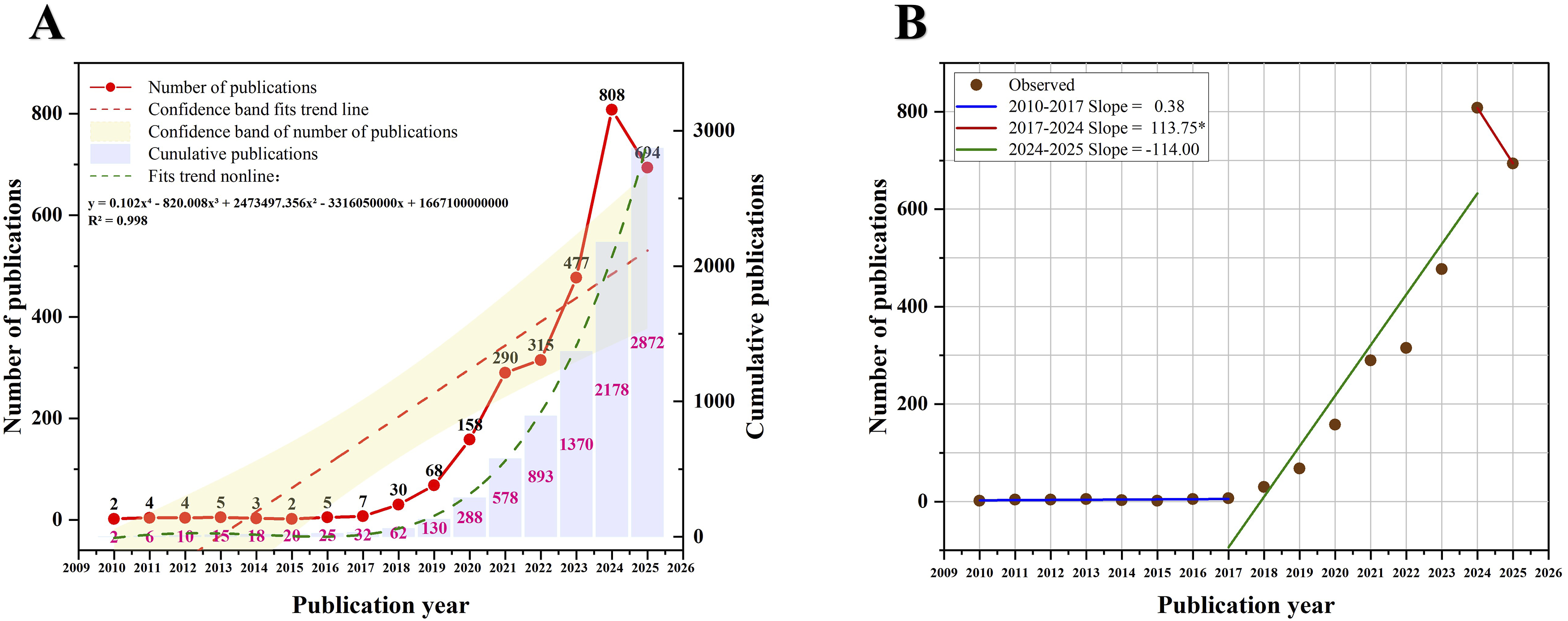
However, within the observation period for which data is complete (2010–2023), the number of publications in this field shows a clear upward trend. The data show that during the full observation period from 2010 to 2023, particularly since 2017, the number of publications has exhibited highly regular and robust exponential growth; the overall trendline shows an upward trajectory (R2 = 0.998), indicating a well-fitted model that accurately reflects the growth trend in publications, as shown in Figure 2(a). Using breakpoint regression analysis, we identified 2017 as a potential inflection point. The average annual growth rate between 2010 and 2017 was relatively low (Slope 1 = 0.38), whereas the rate increased significantly between 2017 and 2023 (Slope 2 = 113.75), indicating that research output entered an accelerated growth phase after 2017.
Country analysis
When constructing the network of international collaborations, we recorded each author’s country of affiliation for each publication. Consequently, a single multi-national co-authored publication generates multiple entries, resulting in a total count exceeding the overall number of 2,872 publications; however, this approach provides a more intuitive reflection of the breadth of international collaboration.
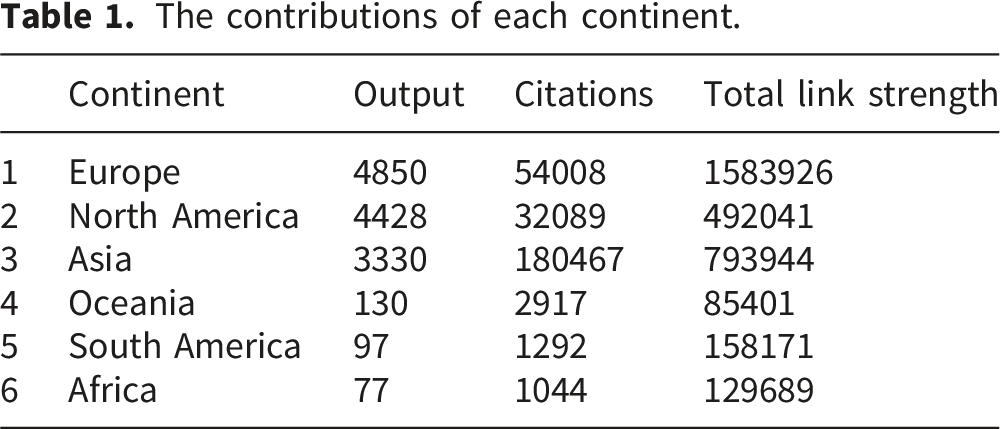
The contributions of each continent.
Top 10 countries for AI applications in clinical medicine.

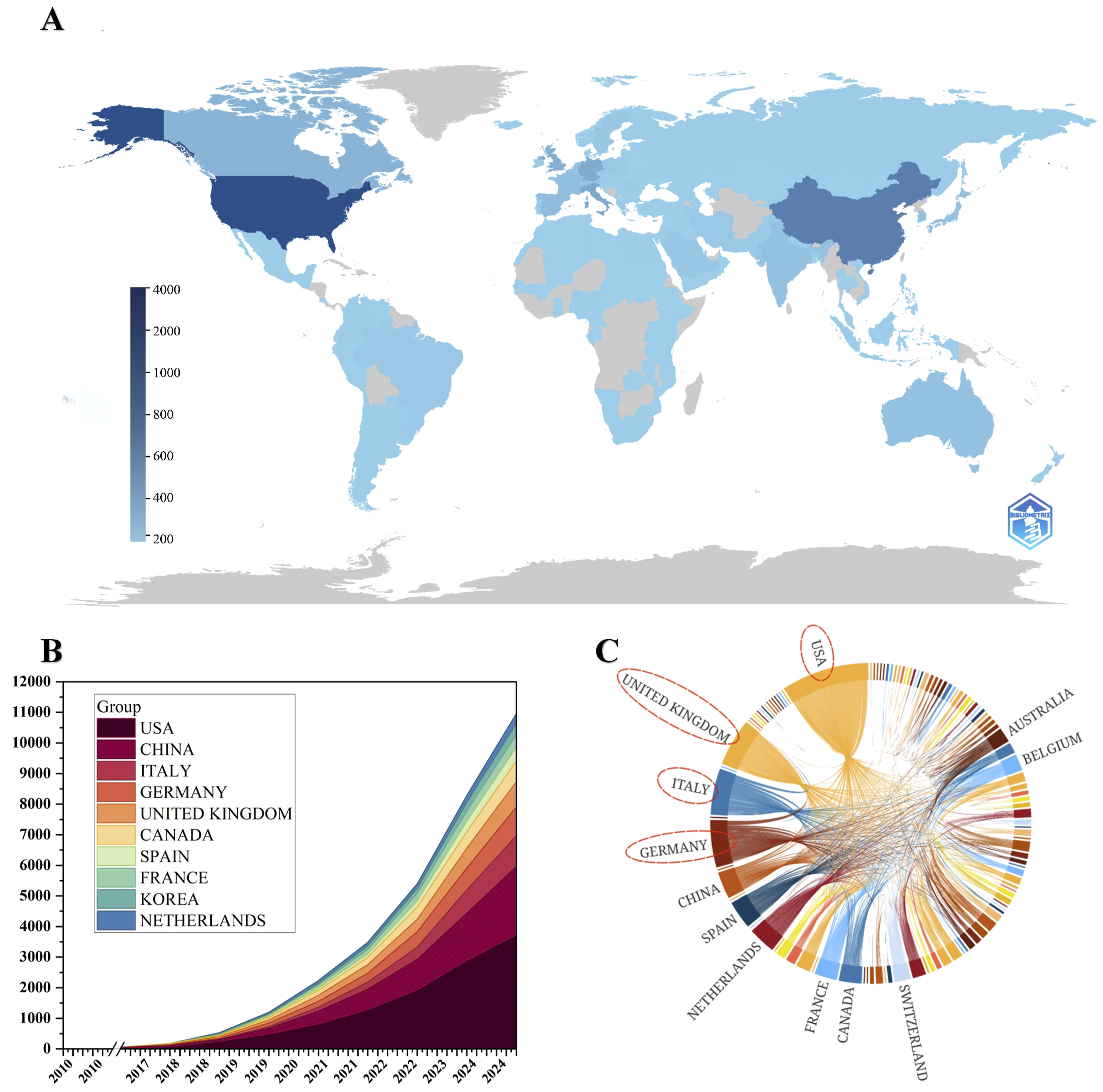
Country analysis. (a) Global distribution map of AI applications in clinical medicine research output by country. (b) Annual output distribution trends of high-producing countries. (c) International collaboration chord diagram of AI applications in clinical medicine research by country.
Institutional analysis
When calculating institutional contributions, the total number of institutional records often exceeds the total number of included publications because multiple institutions frequently co-author a single publication; this precisely reflects the prevalence of inter-institutional collaboration.
Annual publication volume of the top 10 countries for AI applications in clinical medicine.

We employ a co-occurrence matrix to visualize the strength of collaboration among different types of institutions, normalizing co-occurrence values to facilitate comparative analysis of relative differences in cooperation across institutional categories, as shown in Figure 4(a). Overall, collaboration among universities, research institutes, and government agencies is most frequent, with the highest normalized co-occurrence value (2.90) and shown in dark purple, indicating that these two types of institutions form the core linkages within the scientific research collaboration network. Collaboration intensity between companies and other institution types is relatively weak, with normalized co-occurrence values of 1.07 across the board, represented by the lightest color. Overall, in the current field of AI applications in clinical medicine, universities play a pivotal hub role, while hospitals and companies still have significant room to expand within the collaborative network. Overview of institution analysis. (a) Institutional collaboration network map. (b) Heatmap of the collaboration intensity matrix between different types of institutions.
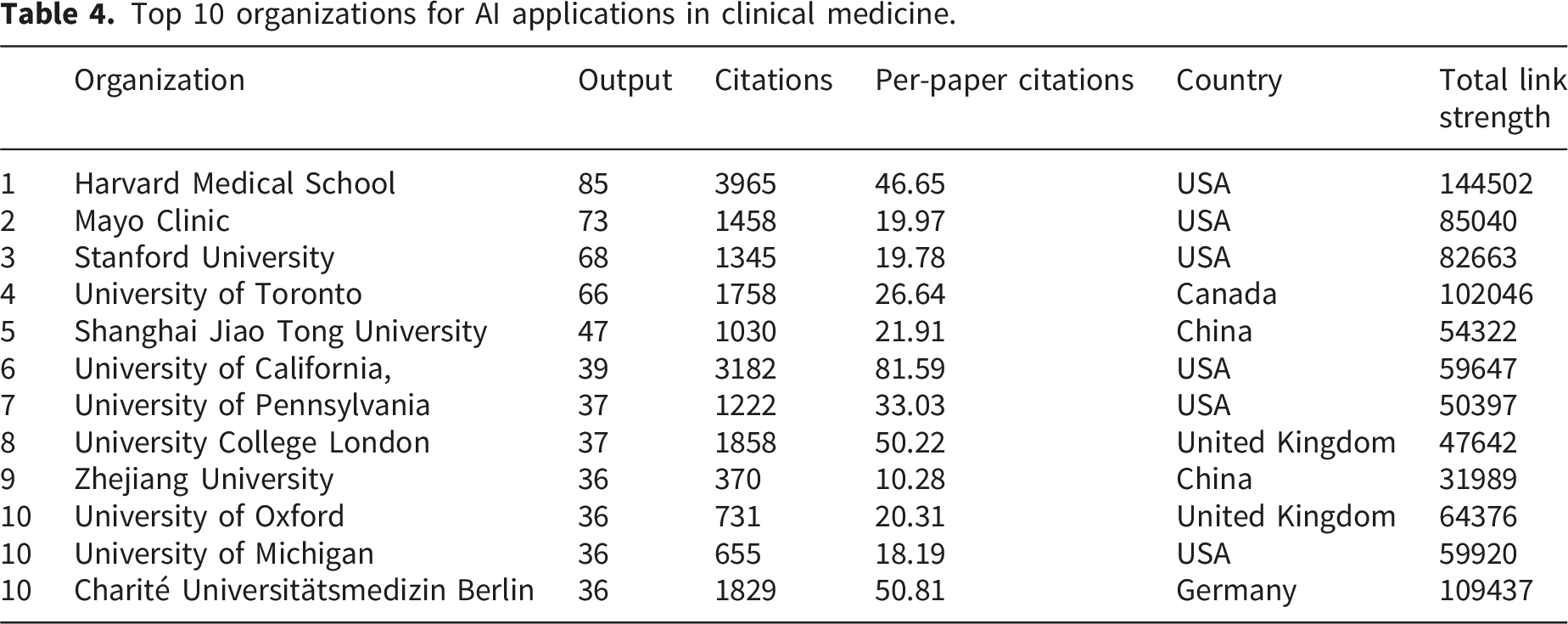
Top 10 organizations for AI applications in clinical medicine.
Author analysis
When counting authors, the total number of author entries often exceeds the total number of 2,872 included studies because multiple authors frequently co-author a single study; this precisely reflects the prevalence of team collaboration.
A total of 19,537 researchers contributed to the publication of 21,659 studies. As shown in Figure 5(a), 18,038 researchers (92.33%) published only one study, accounting for 83.28% (18,038/21,659) of total publications. Additionally, 1,127 researchers (5.77%) published two studies, accounting for 10.41% of total output (2,254/21,659). According to Price’s analysis,
16
the minimum threshold for core authorship is three papers. A total of 372 researchers (1.90%) met this threshold, contributing 1,367 articles (6.31%). However, this still falls short of the legally defined core author output threshold (>50%) established by Price. Author analysis overview. (a) Author publication distribution. (b) Core author collaboration network map. (c) Top 25 authors with the strongest citation bursts.
Authors with over 7 publications on AI applications in clinical medicine.

For core authors, we constructed a collaboration network diagram. As shown in Figure 5(b), three scholars from Japan’s Dokkyo Medical University—Andrea Padoan, Yukinori Harada, and Takanobu Hirosawa—belong to the same cluster, underscoring the institution’s active and highly productive collaborative ecosystem. Meanwhile, nodes for Rahmim Arman (link strength 142) and Lekadir Karim (link strength 133) radiate numerous connections into this cluster and extend into other colored clusters as well. This explains their exceptionally high link strength values and underscores their pivotal role in integrating field collaborations. As shown in Figure 5(c), through cross-analysis of authors’ publication volume and citation burst intensity, this study found that high-output researchers, Rahmim Arman (n = 12) and Cabitza Federico (n = 8), ranked among the top 25 authors by citation burst intensity. Further timeline analysis indicates that both researchers experienced bursts of influence between 2020 and 2022, with peak emergence intensity in 2020: Rahmim Arman at 7.94 and Cabitza Federico at 6.56. Between 2020 and 2022, both scholars efficiently produced a large volume of high-quality, cutting-edge research at the intersection of medicine and AI.
Cross-disciplinary collaboration analysis
Top 10 disciplines involved in research on the application of artificial intelligence in clinical medicine.


Cross-disciplinary collaboration analysis. (a) Top 10 disciplines. (b) Researchers from different disciplinary backgrounds.
Researchers from diverse disciplines have been engaged in the application of AI in clinical medicine, We compiled statistics on the academic backgrounds of the authors who contributed to the published literature. Figure 6(b)) shows the distribution of researchers across disciplinary backgrounds. Regarding disciplinary distribution, technology-related disciplines are the most prevalent. Researchers in informatics (2,684) and computer engineering (2,257) far outnumber those in medical disciplines, and their combined share exceeds 100% among researchers with documented disciplinary backgrounds (due to overlap). This underscores the role of technology disciplines as the core driving force in this field, highlighting its pronounced interdisciplinary nature. Regarding participation in medical disciplines: biomedical research involves 798 individuals, neurology 658 researchers, psychiatry 247, geriatrics 131, and psychology 88. Collectively, these medical disciplines account for 1,922 researchers, representing only 39.13% of the total researchers with disciplinary backgrounds.
Journal and highly cited literature analysis
Top 10 journals for AI applications in clinical medicine.


Journal and highly cited literature analysis. (a) High-output journal distribution map. (b) Co-cited journal clustering map. (c) Highly cited literature distribution map.
Top 10 cited journals on AI applications in clinical medicine.

Top 10 cited literature on AI applications in clinical medicine.

Keyword theme and keyword progress analysis
Keyword theme trend analysis (Figure 8(a)) clearly outlines the landscape of AI research topics in clinical medicine. Topics in the “Motor Themes” quadrant—such as artificial intelligence, classification, and prediction—exhibit high relevance and strong development density, indicating that they represent mature and central research directions in this field. Topics in the “Emerging or Declining Themes” quadrant—such as technology, ChatGPT, education, and radiomics—show lower levels of both relevance and development density, suggesting they may be in the early stages of development or experiencing declining interest. Topics in the “Basic Themes” quadrant—such as risk management validation, medicine health care, health services, and nursing—constitute the indispensable foundational pillars of the entire research field. Research on prostate cancer and convolutional neural networks, located in the “Niche Themes” quadrant, though less directly relevant to the broader field, has evolved into highly mature specialized domains within specific professional contexts. Keyword analysis. (a) Keyword theme trend analysis. (b) Keyword burst distribution.
The keyword emergence map (Figure 8(b)) illustrates the evolution of research hotspots. From 2010 to 2016, research focused on traditional machine learning methods such as classification and random forests. Subsequently, the focus shifted to technologies such as deep learning and convolutional neural networks, which were widely applied to the diagnosis of specific diseases such as cancer and COVID-19, and were also supported by big data and clinical decision support systems. Notably, since 2022, ChatGPT and large language models (associated with the emerging theme of ChatGPT education) have experienced explosive growth, becoming today’s most cutting-edge research hotspots.
The keyword progress analysis (Figure 9) illustrates a path of technological iteration rather than simple replacement. The themes at the bottom of the diagram—classification, intelligence, sensitivity, and support—have persisted since 2017, indicating that research into AI’s foundational capabilities, model performance, and auxiliary functions forms a stable and enduring cornerstone of the field. Building on this foundation, a series of themes closely tied to specific clinical scenarios—including blood-pressure, radiotherapy, images, and cancer—emerged around 2019 and have persisted to the present, reflecting the increasingly deep integration of AI technology into core medical scenarios such as chronic disease management and cancer treatment. The most significant shift occurs at the top of the figure: ChatGPT emerged as an independent theme in 2023, and its frequency of appearance (as indicated by the size of the dots) is now on par with core themes such as cancer and images, indicating that large language models and generative AI have become the most cutting-edge and highly focused directions in this field. Keyword progress analysis.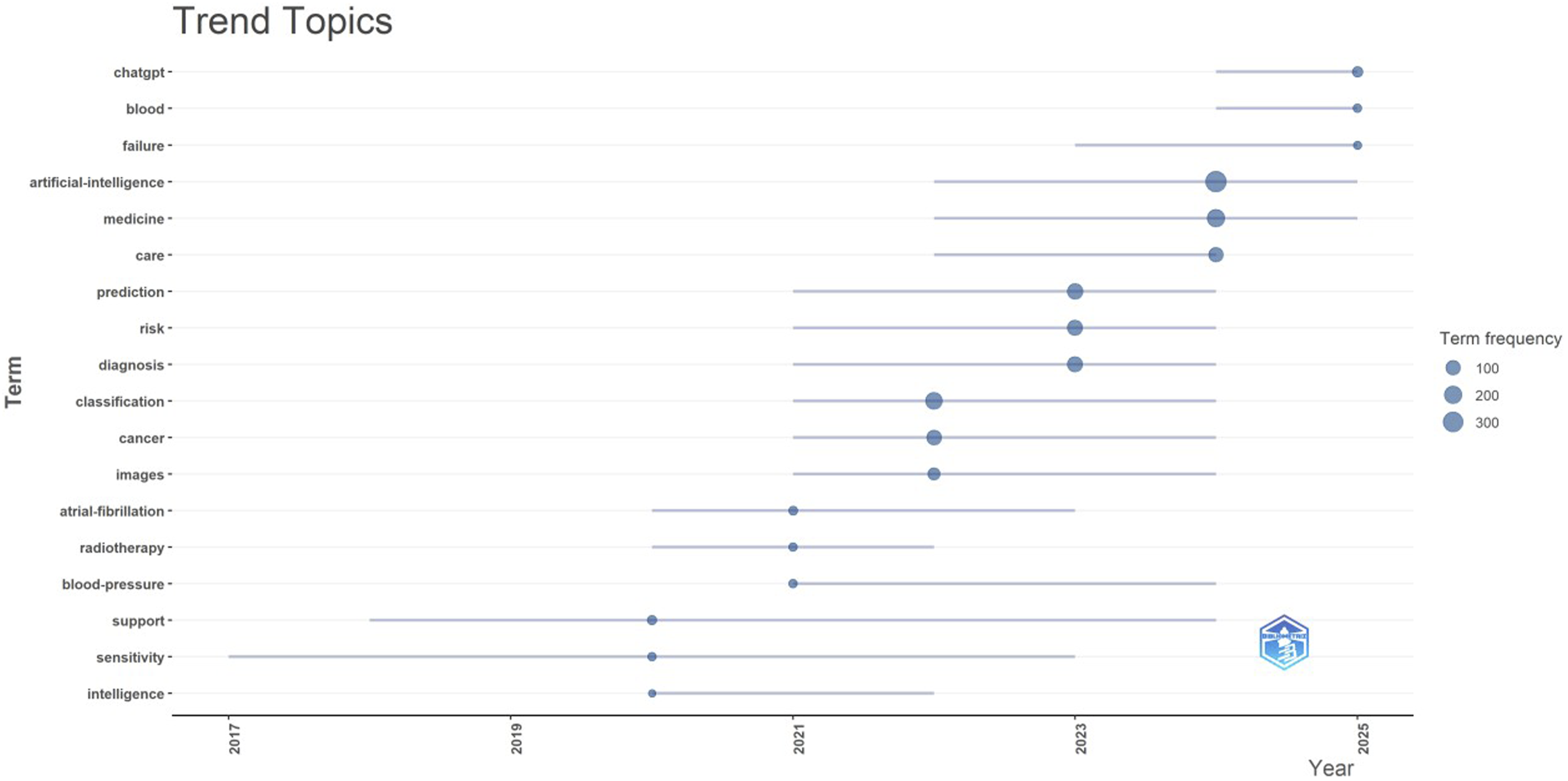
Discussion
Notes on the interpretation of bibliometric indicators
Before presenting the main findings of this study, it is necessary to clarify the nature and scope of the indicators used. The bibliometric indicators analyzed in this study—such as the number of publications, citation frequency, and collaboration networks—primarily reflect the scale of academic research output in this field, the dissemination of research findings, and the patterns of collaboration among researchers. These indicators help reveal overall trends in the field’s development, the evolution of its knowledge structure, and the organizational forms of research activities. However, it is important to note that the values of these metrics, which are based on academic publications, do not equate to the effectiveness, safety, or successful clinical translation of the corresponding research findings. A study may receive a high number of citations due to the innovativeness of its methods or the universality of the issues it addresses, but this does not directly indicate that it is more advantageous in improving patient outcomes or integrating into clinical workflows. Therefore, the subsequent discussion in this section will focus on interpreting these bibliometric characteristics from an academic development perspective, rather than making direct inferences about their clinical value.
The annual trends of publications
Although the 2025 data is incomplete, this does not affect the conclusions drawn from the complete historical data. Based on complete data from 2010 to 2023, this study’s analysis clearly outlines the field’s growth trajectory. Overall, research on the application of AI in clinical medicine has shown sustained and rapid growth, forming a field with intrinsic momentum and a continuously expanding scale.
Notably, a significant surge in growth occurred around 2017, indicating that this time point marked a critical turning point in acceleration. This finding aligns closely with the technological backdrop of the field’s development. Around 2017, deep learning technologies—represented by convolutional neural networks (CNNs)—achieved major breakthroughs in image recognition. 19 Research, clinical trials, and practical applications of AI in medical imaging began to develop rapidly, becoming one of the earliest sectors across industries to achieve large-scale implementation of AI technology. Therefore, the growth inflection point in 2017 is not only statistically significant but also substantively reflects breakthroughs in underlying technologies as the core driving force propelling research output in this field into a phase of scaled, rapid growth. This analysis, from a data perspective, confirms that technological evolution is a key factor in the development of AI in clinical medicine. 21
Country analysis
The global landscape of AI in clinical medical research exhibits distinct structural characteristics, with a concentrated distribution centered on the United States and China as the leading group. This reflects the strategic investments and systematic research capabilities of these two countries in this field. Meanwhile, although European countries lag slightly in total output, they play the most prominent central role in international collaboration networks, indicating that Europe serves as a hub in facilitating global knowledge exchange and collaborative innovation.
Asia (with China as the primary contributor) ranks first among continents in total citations, significantly surpassing its ranking in publication volume. This phenomenon aligns chronologically with breakthrough advancements in key technologies, such as deep learning, in the region in recent years, as well as the significant increase in research activity in clinical settings (such as medical image analysis). 22 Furthermore, the dense international collaboration network centered on the United States clearly delineates the primary pathways and intensity of current global knowledge flow. Together, these findings indicate that regional development of technological capabilities and the existing structure of global research networks are the drivers shaping the international research landscape for AI applications in clinical medicine.
Institutional analysis
Analysis at the institutional level reveals that universities and research institutions are central to the field’s development, with their basic research functions complementing their role as network hubs. In contrast, while hospitals possess critical clinical data and application scenarios, their link strength within core collaborative networks is relatively limited, suggesting certain barriers to translating clinical needs into cutting-edge algorithmic research. Although companies exhibit high average output, they have the lowest participation rates and the weakest network connections, indicating that corporate involvement remains insufficient. Currently, they focus more on developing specific products or solutions than on broad, in-depth collaboration in cutting-edge science.
The institutional collaboration network exhibits distinct geographical and academic clustering, with North America, Europe, and Asia each forming internally cohesive yet globally interconnected academic communities. The strong influence of the North American cluster is closely linked to its world-class research universities, medical institutions, and robust venture capital ecosystem. The close collaboration within the European cluster benefits from the long-term transnational research programs and funding frameworks promoted at the EU level. 23 The rise of the Asian cluster, centered on Chinese institutions, corresponds to the region’s substantial investments in artificial intelligence over the past few years and the rapid improvement in the quality of its research. 24 These clusters do not exist in isolation; the close interactions among them—particularly between North America and Europe—form the main arteries of global knowledge flow.
Author analysis
Analysis at the author level indicates that while researcher participation in this field is widespread, it lacks continuity; the vast majority of researchers (92.33%) have published only one paper, and the output share of the core author group (those with ≥3 publications)—at 6.31%—is significantly lower than the standard for the “core” stage in bibliometrics (>50%). This reflects that the field remains in its early stages of development, with research efforts dispersed and a stable academic core yet to be established.
The structure of the collaboration network indicates that multiple highly productive international collaboration teams drive the core author group and are tightly interconnected through a few central hub scholars, forming an organic whole that integrates division of labor with collaboration.
Cross-disciplinary collaboration analysis
Research on the application of artificial intelligence in clinical medicine is characterized by a framework centered on clinical needs. Data show that clinical disciplines, led by “General Practice and Internal Medicine” (8.15%), have the highest participation in collaborative networks, indicating that practical clinical problems and real-world scenarios primarily drive the research agenda in this field. Although the participation of core disciplines such as computer science—which serve as the technological engine—is relatively low, research remains closely focused on addressing clinical challenges, reflecting a strong emphasis on practical application.
In terms of the disciplinary backgrounds of research participants, the field exhibits a personnel structure dominated by technical expertise, with a relatively limited clinical presence. Among authors with clearly documented disciplinary backgrounds, the number of technical experts from informatics and computer engineering far exceeds that of researchers with medical backgrounds. This personnel composition—characterized by “technical leadership and clinical collaboration”—is a structural reason why many current AI clinical studies are technically advanced but face challenges in clinical integration and translational validation. This also highlights the need to strengthen the cultivation of interdisciplinary talent who possess both clinical insight and technical capabilities to bridge the gap between technology and clinical practice.
It is worth noting that statistics on participation in disciplinary directions show a trend opposite to researchers’ disciplinary backgrounds. This may be because the field of clinical medicine publishes a large volume of papers, yet a significant portion of these are contributed to or co-authored by technical researchers. Second, a substantial number of researchers come from interdisciplinary or emerging fields that are not fully captured by traditional disciplinary classifications, leading to underestimation or double-counting of their backgrounds in statistical analyses. Additionally, technical personnel are more involved in foundational algorithm and system development, while clinical personnel predominantly participate in validation and application, resulting in differing visibility of outputs across stages. AI applications in clinical medicine are inherently interdisciplinary, and their advancement relies on both clinical demand and technological advances. 25 Current data indicate that technical talent is the primary driver in this field. However, to enhance transformation and clinical implementation, it is essential to further promote the transformation of clinical medical personnel from demand proposers into co-designers and deep collaborators, thereby achieving effective interdisciplinary integration.
Journal and highly cited literature analysis
Currently, clinical medicine research in artificial intelligence has evolved into a vibrant knowledge-production ecosystem centered on open access and community-driven collaboration. A group of journals, led by Journal of Medical Internet Research and its subsidiary publications, dominates the field, reflecting the strong demand for rapid publication and immediate knowledge sharing. At the same time, general-interest open-access journals such as Scientific Reports and BMJ Open are also highly active, collectively forming the foundational platform for the rapid dissemination and extensive discussion of research findings in this field.
A comprehensive analysis of highly cited journals and publications reveals a three-tiered structure of knowledge influence in this field. The top tier consists of leading clinical journals such as Nature Medicine and JAMA, which provide authoritative validation of major clinical breakthroughs. The middle tier is anchored by multidisciplinary journals such as Nature and Scientific Reports, which deeply integrate AI methods across various clinical specialties, driving the validation and adoption of these technologies in real-world settings. The bottom layer centers on the preprint platform arXiv, which aggregates methodological research from computer science and engineering and serves as the forefront for the rapid publication and dissemination of original algorithms. The high concentration of highly cited papers on arXiv directly confirms that original methodological innovation is the core driving force behind the field’s development and reflects the research community’s relentless pursuit of rapid knowledge dissemination. Meanwhile, highly cited papers in journals such as Scientific Reports represent a substantial body of robust scenario-based validation work, providing a broad foundation for applications across the entire field. While this structure accelerates innovation, it also underscores the need for more systematic evaluations of the robustness, reproducibility, and clinical translation risks of research findings.
Keyword theme and keyword progress analysis
This study identifies four core application levels in AI-driven clinical medical research and outlines their evolutionary trajectories. Diagnosis and image analysis constitute the core layer that runs throughout the entire period, with a particular emphasis during the early phase (2010–2015); treatment and decision support have grown significantly since 2017, emerging as a research direction of equal importance; Patient management and interaction have seen rapidly rising attention since 2020, with large language models and ChatGPT experiencing explosive growth since 2022, becoming the most cutting-edge hotspots; drug discovery and genomics, meanwhile, continue to develop as relatively independent specialized directions. Overall, research hotspots in this field exhibit a clear path of technological iteration, progressing from traditional machine learning to deep learning and then to generative AI.
The current research landscape exhibits a multi-layered, stable structure. Core methodological research—represented by classification and prediction—along with applied research focused on specific clinical scenarios such as medical imaging and cancer, together form the backbone of the field, ensuring the practicality and clinical relevance of the research. At the same time, the explosive growth of generative AI signifies that the field’s frontier is shifting from solving specific, closed-domain tasks toward developing systems capable of handling complex, open-ended medical scenarios. While this shift demonstrates immense potential to address complex scenarios, it also creates significant tension between the inherent opacity of these models and the stringent safety and interpretability requirements of medical practice. Therefore, the key path forward lies in actively promoting the deep integration of transformative technologies—represented by generative AI—with actual clinical needs, while simultaneously establishing rigorous evaluation systems, validation standards, and ethical frameworks to ensure that technological innovation, while dynamic, is always built upon a solid and reliable foundation.
Hot topics and frontiers
AI technology not only enhances the accuracy of disease diagnosis26–28 and the personalization of treatment29,30 but also drives the precision31,32 and intelligent development of clinical medicine 33 by optimizing clinical decision-making processes.
We found that the Chat Generative Pre-trained Transformer (ChatGPT) has emerged as a prominent trend in the application of artificial intelligence within the field of clinical medicine. ChatGPT, released in late November 2022, is an AI-powered natural language processing tool that can generate responses and interact contextually within conversations, mimicking human dialogue patterns.34,35 Its emergence represents a milestone in AI development; its clinical applications primarily focus on three domains: medical consultation, patient education, and clinical decision support. In medical consultations,36–38 it can generate preliminary diagnostic suggestions from symptom descriptions, providing accessible entry points for resource-constrained regions—though final verification by healthcare professionals remains essential. For patient education,39–42 it delivers personalized health information and self-management guidance, enhancing health literacy through interactive learning. For clinical decision support,43–45 ChatGPT demonstrates the ability to integrate clinical guidelines and analyze patient data, thereby supporting the generation of differential diagnoses and the optimization of medical documentation. In specific scenarios, it exhibits accuracy comparable to experts, serving as a supplementary reference for physicians.46,47
However, the clinical application of ChatGPT still faces significant challenges on multiple fronts. The most critical issue is the instability of its output accuracy and reliability, which may generate inaccurate or misleading information, posing potential risks to patient safety. 48 Data privacy and information security are other primary concerns. 49 Handling sensitive medical and health data must comply with stringent regulatory requirements. Furthermore, its application has sparked profound discussions about ethics and accountability, including concerns about the erosion of doctor-patient trust, the exacerbation of healthcare disparities, and the difficulty of assigning responsibility when errors occur. 50 These factors collectively limit its direct deployment in critical clinical settings at present.
The future advancement of ChatGPT in clinical medicine hinges on continuous technological refinement, the establishment of robust standards, and the optimization of collaboration models. Technologically, enhancing model accuracy and reliability requires fine-tuning with specialized medical datasets and integrating multimodal information. Application-wise, robust validation mechanisms, ethical guidelines, and regulatory frameworks must be established to ensure the safe, compliant, and equitable use of these applications. Ultimately, its ideal role should be as an auxiliary tool that augments physicians’ expertise, fostering a collaborative model where “doctors lead, and AI assists.” This approach will elevate healthcare accessibility and efficiency while safeguarding the core values of medical quality and patient safety.
Limitations
This study employs bibliometric methods to conduct a systematic analysis of research on artificial intelligence in clinical medicine, revealing the field’s development characteristics from 2010 to 2025. This study primarily uses the Web of Science Core Collection as its data source, focusing on mainstream peer-reviewed academic literature. While this approach has advantages in analyzing academic influence and collaboration networks, it may systematically underestimate relevant research published in engineering databases (such as IEEE Xplore) or certain specialized medical databases (such as PubMed). Regarding the search strategy, this study used “artificial intelligence” and “clinical medicine” as core search terms. This approach was designed to effectively define the core interdisciplinary field and strike a balance between search breadth and thematic focus. We recognize that this strategy may have limited coverage of highly specialized subfields that use more specific technical terms or disease names. However, through a rigorous subsequent manual screening process, we ensured that the final set of included literature was highly relevant to the research topic, thereby guaranteeing the consistency and clarity of the macro-level analysis.
Methodologically, the study developed a thematic analysis framework through keyword clustering, which aids in identifying macro-level research structures and development trends; however, this framework’s classification accuracy has certain limitations when applied to complex systems characterized by high technological convergence. Furthermore, the study’s dedicated quantitative analysis of social dimensions—such as ethics, equity, and governance—remains insufficient; future research could conduct systematic reviews and discussions of this topic within the academic literature.
Due to the study’s timeframe, there is a time lag in incorporating the latest findings and non-English literature after August 31, 2025. Future research could conduct a more comprehensive tracking of this field by expanding data sources and optimizing analytical methods. Overall, this study provides a foundational analytical framework for understanding the research landscape of artificial intelligence in clinical medicine.
Conclusions
This study analyzes 2,872 publications from 2010 to 2025 to reveal the macro-level landscape of artificial intelligence in clinical medicine and its core characteristics. The analysis indicates that the field experienced sustained exponential growth throughout the full observation period (2010–2023), with a significant acceleration around 2017. The average annual publication growth rate surged from 0.38 to 113.75, providing quantitative evidence of the core role that breakthroughs in underlying technologies, such as deep learning, play in driving growth. Since 2022, generative AI, represented by large language models, has emerged as the most cutting-edge growth area.
From a global perspective, research output is highly concentrated, with the United States (3,732 papers) and China (2,225 papers) forming the leading tier, together contributing nearly half of the world’s publications. Asia leads in total citations (180,467), demonstrating significant academic influence, while the United States occupies an absolute central position in the global collaboration network, having established co-authorship relationships with 104 countries. At the same time, the field still exhibits characteristics of an early development stage: as many as 92.33% of researchers have published only one paper, core authors account for a relatively low proportion (6.31%), and the research ecosystem features a technology-led, clinically coordinated collaboration structure. Researchers with a technical background account for over 100% of those with a clearly defined disciplinary background (due to interdisciplinary overlap), while those with a clinical background constitute only 39.13%.
In summary, this study is the first to systematically quantify the evolutionary trajectory, global collaboration structure, and knowledge production patterns of AI clinical medical research through bibliometric analysis. The findings reveal that the field’s development follows a dual-core logic of technology-driven and clinically-guided approaches, and is evolving from addressing specific tasks toward developing systemic capabilities to handle open-ended, complex scenarios. Moving forward, the key to advancing this field toward maturity lies in fostering substantive integration between clinical practice and technology, establishing evaluation systems tailored to new AI models, and addressing the uneven distribution of global research resources. This study provides data-driven, empirical insights for understanding the field’s development trends and optimizing research strategies.
Footnotes
Acknowledgements
We acknowledge the participants who contributed to this study. During the preparation of this work, the authors used Deepseek and other AI-assisted tools for language polishing, grammar checking, and translating some text from Chinese to English. The authors also used these tools to draft responses to reviewer comments. All AI-generated or AI-assisted content was thoroughly reviewed, edited, and validated by the authors. The authors take full responsibility for the content of the publication, including the research design, data collection, bibliometric analysis, interpretation of results, scientific conclusions, and the creation of all figures and tables.

Ethical considerations
This study is a retrospective bibliometric analysis based on publicly available literature and does not involve human participants or animal experimental data. Therefore, it does not require approval from an ethics committee.
Author contributions
Min Li*: Conceptualization, Methodology, Writing - original draft. Suyu Chen*: Data curation, Formal analysis, Visualization. Sihan Liu*: Investigation, Validation, Writing - review & editing. Jinting Yang: Resources, Supervision. Yumin Qin: Project administration. Yiping Chen: Software, Validation. Xiantao Tai: Corresponding author, Funding acquisition, Supervision, Writing - review & editing. The authors would like to express their sincere gratitude to Associate Professor Xiong Guangyi of Yunnan University of Chinese Medicine for his expert review and constructive suggestions regarding the statistical and bibliometric analyses in this manuscript.
Funding
The authors disclosed receipt of the following financial support for the research, authorship, and/or publication of this article: This study was supported by Yunnan Province Innovation Team of Prevention and Treatment for Brain Diseases with Acupuncture and Tuina (Grant No. 202405AS350007), Yunnan Provincial Acupuncture and Tuina, Doctoral Supervisor Team for Cerebrovascular Disease with Prevention and Treatment (Grant No. 10170101868).
Declaration of conflicting interests
The authors declared no potential conflicts of interest with respect to the research, authorship, and/or publication of this article.
Guarantor
Xiantao Tai.