




Abstract
Background
Artificial intelligence (AI) has promising applications in arthroplasty. In response to the knowledge explosion resulting from the rapid growth of publications, we applied bibliometric analysis to explore the research profile and topical trends in this field.
Methods
The articles and reviews related to AI in arthroplasty were retrieved from 2000 to 2021. The Java-based Citespace, VOSviewer, R software-based Bibiometrix, and an online platform systematically evaluated publications by countries, institutions, authors, journals, references, and keywords.
Results
A total of 867 publications were included. Over the past 22 years, the number of AI-related publications in the field of arthroplasty has grown exponentially. The United States was the most productive and academically influential country. The Cleveland Clinic was the most prolific institution. Most publications were published in high academic impact journals. However, collaborative networks revealed a lack and imbalance of inter-regional, inter-institutional, and inter-author cooperation. Two emerging research areas represented the development trends: major AI subfields such as machine learning and deep learning, and the other is research related to clinical outcomes.
Conclusion
AI in arthroplasty is evolving rapidly. Collaboration between different regions and institutions should be strengthened to deepen our understanding further and exert critical implications for decision-making. Predicting clinical outcomes of arthroplasty using novel AI strategies may be a promising application in this field.
Introduction
Knee and hip arthroplasty are the leading treatment options for end-stage joint disease and have proven effective and reliable. It is projected that by 2030, more than four million patients will receive primary joint arthroplasty in the United States each year. 1 To further improve the entire surgical process of joint arthroplasty, artificial intelligence (AI) is expected in disease diagnosis, screening, preoperative planning, surgical robotics, and predicting outcomes. 2
AI, introduced by John McCarthy, is a branch of computer science. Its modern definition is that machines, supported by various algorithms, solve problems that traditionally require human intelligence. 3 Although it was once considered science fiction, the combination of AI technology and healthcare is moving at an incredible pace and gradually demonstrates a considerable impact.4,5 Despite lagging behind disciplines such as dermatology 6 and ophthalmology, 7 AI in orthopedics is also in a state of accelerated development. There are numerous subfields in AI. As one of the essential subfields, machine learning can learn and draw experience from large-scale data to achieve certain specific tasks. 8 Recently, studies have assessed its potential for natural language processing, 9 clinical outcome prediction,10,11 imaging recognition,12,13 and telemedicine.14,15 Advances in robot-assisted surgery have also received increasing attention in recent years. 16 It allows for the personalized designation of preoperative planning and enhances the ability to perceive complex in vivo anatomy with the help of AI to assist surgeons in clinical decision-making.2,17,18
As scholarly interest in AI has grown exponentially, several reviews of AI in arthroplasty have been reported, but they mainly focus on a particular subfield and lack quantitative analysis.19–22 Additionally, we usually have difficulty getting our heads around exponential growth. 23 The rapid growth in the number of publications makes it increasingly tricky to gain insight into developments in particular fields and to keep track of the latest research hotspots. As a solution, bibliometrics is a cross-cutting discipline applied in many cutting-edge medical areas.24–26 It can systematically and quantitatively process large-scale literature information, presenting the development history and scientific status. 27
This study aims to provide the comprehensive bibliometric analysis of the AI in arthroplasty from 2000 to 2021, providing a scientific performance of countries, institutions, authors, journals, and references, presenting collaborative networks and research trends from a global perspective.
Materials and methods
Data source
Science Citation Index Expanded (SCI-Expanded) of Web of Science Core Collection (WoSCC) was selected as the data source. SCIE primarily included the most influential and essential journals in natural science and engineering technology and was one of the internationally recognized search tools for scientific statistics or bibliometric research.
Searching strategy
The search strategy was as follows: Topic = (“artificial intelligence” OR “deep learn*” OR “neural network*” OR “machine intelligence” OR “robotic*” OR “data mining” OR “graph mining” OR “Bayes* network” OR “expert* system*” OR “intelligent learning” OR “feature* extraction” OR “feature* mining” OR “thinking computer system” OR “machine learning” OR “feature* selection” OR “supervised learning” OR “semantic segmentation” OR “deep network*” OR “neural learning” OR “neural nets model” OR “artificial neural network*” OR “data clustering” OR “big data” OR “knowledge graph” OR “robot*” OR “natural language process*” OR “evolutionary computation” OR “fuzzy expert system*” OR “unsupervised clustering” OR “image* segmentation” OR “feature* learning” OR “hybrid intelligent system*”) AND topic = (hip OR knee OR shoulder OR joint OR unicompartmental OR unicondylar) NEAR/1 (arthroplasty* OR replacement* OR revision* OR hemiarthroplasty *) AND language =(English) AND publication year = (2000–2021). Two authors independently conducted the literature search and downloaded data in plain text or UTF-8 format. In addition, we excluded specific types of publications and included only original articles and reviews. The literature search and data retrieval were completed on 28 March 2022, to avoid bias caused by database updates.
Data analysis and visualization
We summarized the bibliometric indicators of publications, including authors, affiliations, countries, number of articles, journals, keywords, references, and collaborations. The citations, H-index and G-index were used to assess the academic impact of authors or journals. In addition, the citations can be categorized into total citations and local citations. The former includes all citations, while the latter contains only citations received from our downloaded publication collections. Journal categories (Q1, Q2, Q3, and Q4) and impact factors (IF) were extracted from Journal Citation Reports (JCR) 2020.
We conducted a comprehensive analysis using four bibliometric analysis tools, including the Java-based Citespace (version 5.8.R3), the Java program VOS viewer (version 1.6.18), the R software-based Bibiometrix (version 3.0), and an integrated online analytics platform (https://bibliometric.com/). Co-citation analysis, co-occurrence analysis, co-authorship analysis, citation burst detection, collaborative networks, and a dual-map overlap of journals were used to assess the knowledge networks of AI in arthroplasty.
Results
General information and publication trends
Table 1 depicts the basic information of our bibliometric analysis. In the past 22 years, 867 publications on AI in arthroplasty have been published in 251 journals. These publications were written by 3227 authors and consisted of 759 original papers and 108 reviews, citing 20,883 references. The average citations per doc per year was 2.5, with a peak of 6.1 for publications published in 2019. It indicated that new publications might have a high impact. As shown in Figure 1A, the exponential growth in the number of publications in recent years boded well for the potential development of the field. The last three years alone accounted for 60.3% (523/867) of the publications.
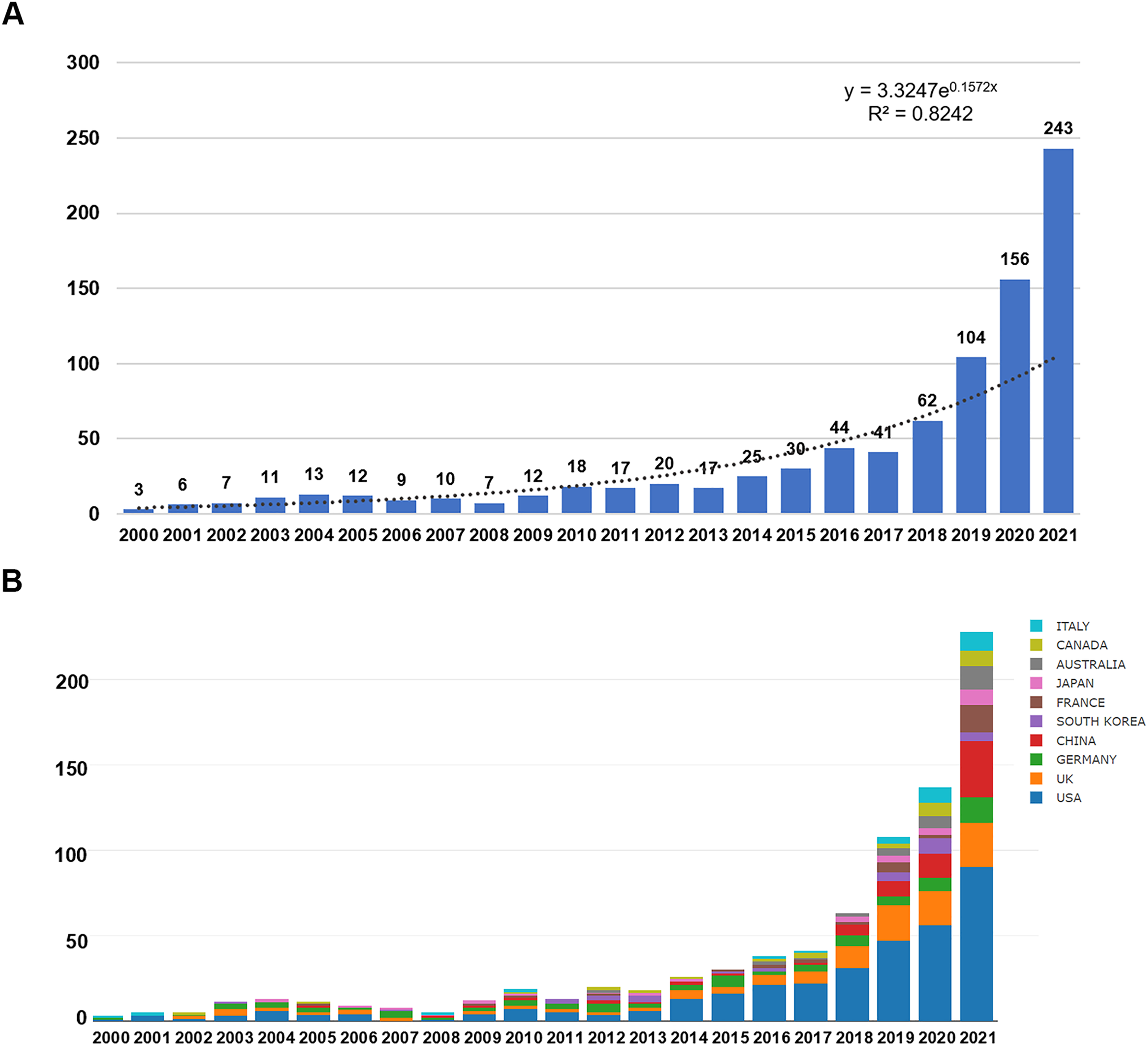
Annual publication trends in the world (A) and in the top ten most productive countries (B).
Main information about bibliometric analysis.

Publication performances: countries
We assessed the countries’ performance in the publications based on the nationality of the corresponding authors. Forty-two countries published literature on the subject. As shown in Table 2, the United States was the most productive country (n = 335, 38.7%), followed by the United Kingdom (n = 100, 11.5%) and China (n = 73, 8.4%). The top ten most productive countries included two from North America, four from Europe, three from Asia, and one from Oceania. These countries have shown explosive growth in the number of publications, with China emerging as a performer in the last three years (Figure 1B). The United States had the highest number of citations (n = 5857 average article citation (AAC) = 17.48), followed by United Kingdom (n = 2,230, AAC = 22.30) and Germany (n = 1,052, AAC = 15.47). Greece had the highest AAC with 86.00.
Top 20 productive countries and citations per country.

NP: number of publications; MCP: multiple countries publications (inter-country collaboration); SCP: single country publications (intra-country collaboration).
We constructed a global collaboration network for AI in arthroplasty. Figure 2A demonstrated that although collaboration existed among many countries, the number of collaborative publications was still relatively low. We mapped the collaboration onto a global map and found that the collaboration was primarily focused on United States-Europe and United States-East Asia (Figure 2B).

The country distribution (A) and international collaboration (B) of publications in the field of AI in arthroplasty. The thicker the line, the higher the frequency of cooperation.
Publication performances: institutions
Hospital for Special Surgery was the most productive institution, with 48 publications, almost twice as many as the second place. The second through fifth places were the Cleveland Clinic (n = 25), Harvard Medical School (n = 23), Lenox Hill Hospital (n = 22), and Imperial College London (n = 21). Six of the top 10 institutions were from the United States and four from the United Kingdom, demonstrating the significant influence of both countries in this field (Figure 3A).

Publication performance of the institution: the top ten most productive institutions (A); coauthorship analysis of institutions (B); and inter-institutional collaboration network (C).
We conducted a co-authorship analysis of institutions with at least five publications (Figure 3B). The Cleveland Clinic had the highest total link strength (TLS) of 44, followed by the Hospital for Special Surgery (33) and University College London Hospital (25). The University of Modena and Reggio Emilia was the latest institution to emerge. The collaborative network further revealed the Hospital for Special Surgery and the Cleveland Clinic as the cores in the cluster, respectively (Figure 3C). However, we identified only six small clusters, indicating that inter-institutional cooperation is not close.
Publication performances: authors
The top ten most-cited authors were shown in Appendix A. Mont MA was the most productive (n = 37) and the most academically influential author (H-index = 18, total citations = 781). Haddad FS was ranked second in productivity (n = 23) and academic impact (H-index = 13, total citations = 635). As depicted in Figure 4A, collaborative network analysis revealed eight author clusters, with Mont MA and Haddad FS at the center of their respective clusters. Krebs VE was at the center of another cluster containing seven authors. Five of the top ten authors were from the United States. We also analyzed the top authors’ production over time (Figure 4B). Eight of the 20 authors have been deeply involved in the field for more than ten years. Notably, most authors experienced an academic explosion after 2017. 2019 was probably the most critical year, with phenomenal publications and citations.

Publication performance of the authors: the inter-author collaboration network (A); and top authors’ production over time (B).
Highly contributive journals
The most productive journal published on AI in arthroplasty is the Journal of Arthroplasty (JOA). It published 99 relevant publications and received a remarkable 2230 citations. Knee Surgery Sports Traumatology Arthroscopy (KSSTA, n = 48, citations = 777) and Journal of Knee Surgery (n = 41, citations = 527) came in second and third place. Five of the top ten most productive journals belonged to JCR Q1, and four belonged to JCR Q2 (Table 3). It indicated that most journals publishing on this topic had a high academic impact. When the minimum number of citations was set at 50, three major clusters were identified in the co-citation network (Figure 5A). JOA had the highest TLS at 106,001, occupying the central position of cluster one. The centers of the other two clusters were Clinical of Orthopaedics and Related Research (CORR, 87,583) and Journal of Biomechanics (12,907), respectively. A dual-map overlap of the research journals can reveal the relationship between citing and cited journals (Figure 5B). The citing papers were primarily focused on two areas: (1) Medicine, Medical, Clinical; (2) Neurology, Sports, Ophthalmology. While the cited papers were mainly concentrated on: (1) Sports, Rehabilitation, Sport; (2) Health, Nursing, Medicine.

Publication performance of the journals: co-citation network (A); and a dual-map overlap of the research journals (B).
The top ten most productive journals.
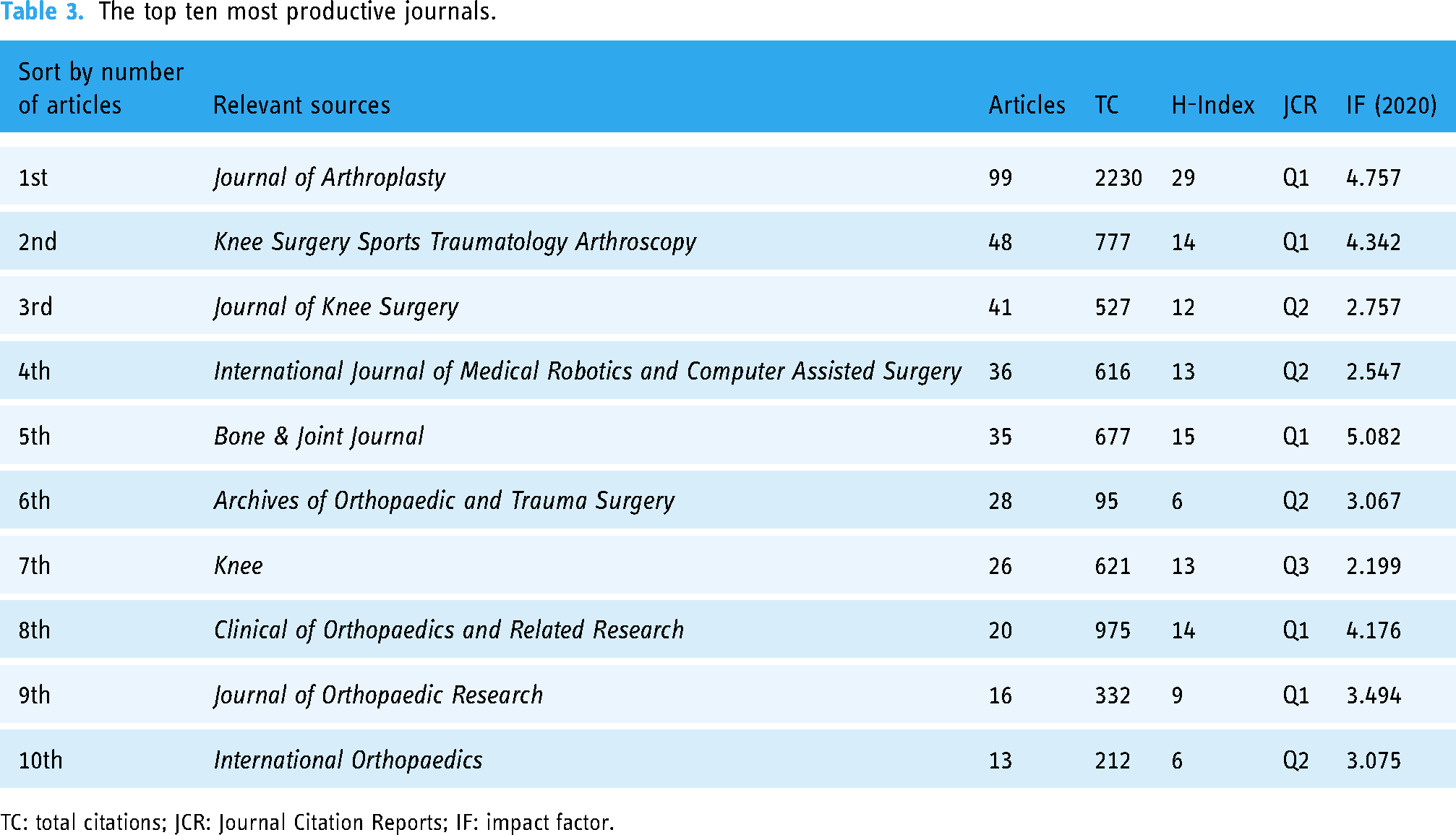
TC: total citations; JCR: Journal Citation Reports; IF: impact factor.
Highly contributive papers
Appendix B lists the top ten most cited articles. These highly cited studies were published between 2002 and 2016, with six published after 2010. The most cited paper, written by Cobb J and published in 2006, is a study of a prospective, randomized controlled trial of the Acrobot system for unicondylar knee replacement. 28 We constructed a co-citation network of references (Figure 6A). It consisted of four clusters with the highest TLS publications authored by Cobb J et al. 28 (1040), Song EK et al. 29 (1113), Liow MHL et al. 30 (830), and Jacofsky DJ et al. 16 (806). Figure 6B shows the top 20 references with the strongest citation bursts. The journal with the most considerable contribution was CORR with six publications, followed by JOA with five publications. The citation burst occurred mainly after 2011 and experienced a quick turnover. In 2021, only two publications, published in 2015 and 2016, remain high impact.
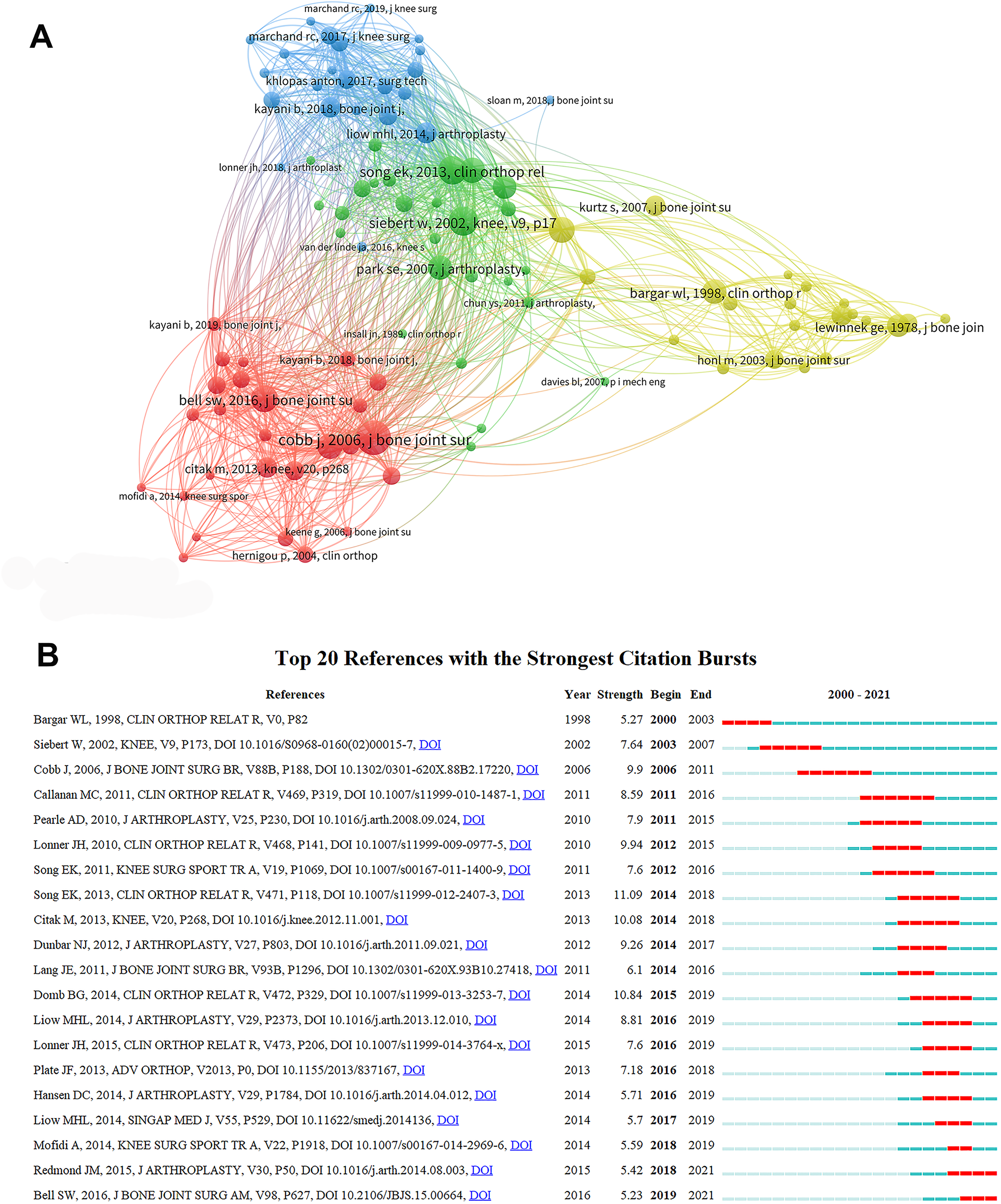
Highly contributive papers: a co-citation network of references (A); and the top 20 references with the strongest citation bursts (B).
Keyword co-occurrence
Keyword co-occurrence analysis allows us to identify clusters and trends in research topics, thus providing a better overview of the field. As depicted in Figure 7A, the keywords were classified into five clusters. The red clusters focused on total hip arthroplasty, outcome, and machine learning-related keywords. The blue and green clusters corresponded to the terms related to total knee arthroplasty and unicompartmental knee arthroplasty, respectively. Robotics-related research was primarily centered on purple clusters. The temporal evolution of the keywords is presented in Figure 7B. The more yellow color indicates that the keyword is more emerging. Emerging topics focused on two main areas: AI subfields such as machine learning and deep learning, and the other was clinical outcome-related research such as outcomes, satisfaction, and survival.

Cluster analysis (A), temporal evolution (B), and burst detection (C) of the keywords.
The keyword burst detection further confirmed the keywords’ popularity trend (Figure 7C). Many emerging keywords appeared after 2018 and concentrated on new AI tools such as machine learning and clinical outcome studies such as clinical outcomes and survival.
Discussion
Unlike systematic reviews, bibliometrics is another effective tool for assessing the current state of research in a given knowledge area.31,32 In our study, the global research profile and macro patterns of publications within the field of AI in arthroplasty were systematically presented by elucidating the publication output, countries, institutions, scholars, journals, and keywords. The report can serve as a reference and guide for more in-depth research in the future.
Our results revealed the publication output on this topic had experienced a substantial increase over the past 22 years. Although the use of AI in arthroplasty is not a piece of fresh news, we have been facing a dramatic explosion of literature in the last three years (60.3% of the publications were published in this period). It is foreseeable that there will be a further rapid accumulation of publications in this field, and scholars should be prepared for this.
The United States was the most productive country with 335 publications, more than three times as many as the United Kingdom. More than half of the top ten most productive institutions and authors were from the United States, four each from the United Kingdom. Notably, publication output in China was snowballing, and it was the only developing country among the top ten most productive countries. It is easy to understand, as the development of high technology is closely related to economic power.
The international collaboration network indicated a lack and imbalance of inter-regional cooperation. Besides, we constructed six and eight sub-networks in the collaborative network of institutions and authors, respectively. Cleveland Clinic and Mont MA are the centers of the two largest subnetworks, but their networks only contain six and seven nodes. It further demonstrated that most institutions and authors were fragmented. In arthroplasty, sufficient specific data is a prerequisite to taking full advantage of the power of AI. However, clinical research in AI is currently based primarily on a single institution; future broad collaborations to develop and validate new algorithms are urgently needed.19,33,34 In addition, the labeling and calibration of data require a lot of human resources. Another option is to realize automatic identification through unsupervised learning. 35
Most of the documents were published in journals with significant academic impact. These well-regarded journals attract high-quality papers on new technologies, and their publication can consequently increase the academic impact of these journals. Similar to some previous bibliometric studies in arthroplasty,16,36–38 the performance of JOA was impressive, riding high on metrics such as publication output, total citations, and H-index.
We explored the evolution of research concepts and hotspots in the field through keyword co-occurrence analysis and burst detection. In the cluster analysis, keywords were primarily clustered by type of surgery and related terms. It is understandable, and it provides several essential concepts in the current study, such as alignment, accuracy, motion, and classification. More significantly, the keyword evolution identified two emerging areas: major AI subfields such as machine learning and deep learning, and another for clinical outcomes-related research such as outcomes, satisfaction, and survival. The two emerging areas were also supported by keyword burst detection.
Briefly, machine learning is a subset of AI, and deep learning is a subset of machine learning. The number of machine learning studies published in orthopedics has increased tenfold in the last ten years. 39 Additionally, arthroplasty is a suitable scenario for the application of machine learning because it has good data sources available for machine learning modeling: registry systems at institutions or national registries. Besides, the application of new technologies such as robotic surgery allows imaging data to be made accessible in digital form. The latest literature reported good capabilities of machine learning in predicting postoperative complications, pain, and patient-reported outcomes after arthroplasty. 40 However, we must also be aware of the new concerns it brings with its rapid development: the high heterogeneity of current research and the standard method for implementing machine learning algorithms have not yet been defined or established. 19 Is machine learning hype or practical? A growing body of research will address this confusion in the future.
The present study revealed that clinical outcome prediction was the most important and cutting-edge application of AI in arthroplasty, and it was foreseeable that a greater number of investigations would focus on this area in the future. Previous studies using large-scale data from the American Joint Replacement Registry have constructed TJA risk prediction models by traditional algorithms, but they have been shown to be less accurate by external validation research. 41 Recent evidence suggested that clinical outcome prediction based on novel AI strategies such as machine learning could give us a better opportunity to risk-stratify patients and thus improve their prognosis. Harris et al. 42 developed a model to predict mortality and major complications following TJA via Lasso regression and demonstrated good accuracy in an external cohort of 70,000 cases. Meanwhile, a clinical prediction model using machine learning algorithms can also assess patient-reported outcome measures (PROMs) up to two years postoperatively. 43 Kunze et al. 44 developed machine learning algorithms for predicting dissatisfaction after TKA, which showed good discriminatory ability. Furthermore, the AI algorithm could provide informative guidance even in the early postoperative outcome assessment. Data collected by Bini et al. 15 from patient-worn devices could accurately predict PROMs six weeks after TJA. Additionally, Hyer et al. 45 identified several significant variables associated with the utilization of medical resources after TJA, such as congestive heart failure and chronic kidney disease, in a one-million-patient dataset through the Logistic Forest algorithm. As one of the most catastrophic complications following TJA, the surgical outcome of periprosthetic joint infection is usually considered to be rather unpredictable. However, the recent model based on a random forest algorithm has shown promising predictive ability. 46 Even in robot-assisted arthroplasty, further exploration to determine whether it objectively improves clinical outcomes is urgent.16,47 Although almost all explorations are preliminary, several online calculators for assessing specific risks after TJA have become available, 22 meaning that we have a considerable opportunity to improve current clinical practice and improve the accuracy of the models in larger datasets.
AI can be used in several other directions in the field of arthroplasty. For example, it is well suited for the diagnosis and progression assessment of osteoarticular disease, either based on X-ray images 48 or MRI. 49 Pedoia et al. 50 constructed a multimodal model for predicting the progression of osteoarthritis using clinical, biomechanical and MRI data, with a sensitivity and specificity of 91.1% and 86.8%, respectively. Such tools could be useful in the future for early diagnosis of joint disease and screening potential candidates for arthroplasty. Automatic implant identification systems are urgently needed in clinical practice to avoid unnecessary component removal or delays in care. Recent studies have developed image identification programs based on AI algorithms to identify the type of hip and knee implants.51,52 Moving forward, these tools are also expected to provide technical implant information, like taper size and placement angle, to aid surgeons in preoperative planning and supplement relevant data in large arthroplasty registry databases. Lastly, mobile devices are developing to aid in the post-operative rehabilitation of arthroplasty. 22 These devices allow remote monitoring of patient's physical activity and provide personalized medical support, thus further improving the prognosis of patients.
It should be noted that our study still has some limitations. First, although the WoSCC is the most commonly used data source for bibliometric analysis, ignoring publications from other databases may lead to selection bias. Second, it takes a specific time frame for an article to reach high academic impact from publication. Thus, the metrics such as the total citations might be underestimated. Besides, the bibliometric analysis was usually performed on an annual basis, and some recent publications were not included in the assessment. Given the rapid development of the field, additional findings are potentially available in future updated studies. Finally, due to the limitation of the number of publications, we did not conduct an independent assessment of machine learning. It may be interesting to further explore the research profile and hot trends in this subfield in the future.
Conclusion
We provided an insight into the global knowledge landscape and trends in AI in arthroplasty through four bibliometric tools. It has undergone significant advances over the past 22 years and can be expected to continue to evolve rapidly. The United States is a leader in this field. Although AI technology has received extensive attention from the academic community, enhanced international collaboration may yield further insights. Predicting clinical outcomes of arthroplasty using novel AI techniques was a significant topic and could be the development direction for some time to come. This report can serve as a reference and guide for more in-depth research in the future.
Supplemental Material
sj-docx-1-dhj-10.1177_20552076231184048 - Supplemental material for Global research landscape on artificial intelligence in arthroplasty: A bibliometric analysis
Supplemental material, sj-docx-1-dhj-10.1177_20552076231184048 for Global research landscape on artificial intelligence in arthroplasty: A bibliometric analysis by Zhuo Li, Zulipikaer Maimaiti, Jun Fu, Ji-Ying Chen and Chi Xu in DIGITAL HEALTH
Footnotes
Contributorship
LZ and MZ conceived the study, performed the bibliometric and visualized analysis and wrote the manuscript. FJ, XC, and CJ conducted the literature search and screening. All authors participated in the revision and finalization of the manuscript, and read and agreed to the published version of the manuscript.
Consent statement
Patient consent was not required for the present manuscript, as it was a bibliometric study with data obtained from the Web of Science Core Collection.
Declaration of conflicting interests
The author(s) declared no potential conflicts of interest with respect to the research, authorship, and/or publication of this article.
Ethical approval
Not applicable, because this article does not contain any studies with human or animal subjects.
Funding
The author(s) disclosed receipt of the following financial support for the research, authorship, and/or publication of this article: This work was supported by the National Key Research and Development Program of China (No. 2020YFC2004900), the National Natural Science Foundation of China (No.82002323, 82102585), and the Military Medical Science and Technology Youth Training Project (No.21QNPY110).
Guarantor
XC.

Supplemental material
Supplemental material for this article is available online.
References
Supplementary Material
Please find the following supplemental material available below.
For Open Access articles published under a Creative Commons License, all supplemental material carries the same license as the article it is associated with.
For non-Open Access articles published, all supplemental material carries a non-exclusive license, and permission requests for re-use of supplemental material or any part of supplemental material shall be sent directly to the copyright owner as specified in the copyright notice associated with the article.
