




Abstract
Objective
Depression among older adults is increasingly becoming a global public health issue. Along with the rapid development of digital information technology, the Internet has profoundly changed the lifestyle of older adults. However, few studies have focused on the mental health of rural middle-aged and older adult populations, and this study aims to explore the impact of Internet use on depressive symptoms among rural middle-aged and older adults.
Methods
Our study is based on 10,946 Chinese rural participants aged 45 and above in the 2018 China Health and Retirement Longitudinal Study (CHARLS). Depression is measured by a 10-item Centre for Epidemiologic Studies (CES-D10), and multiple linear regression and the propensity score matching (PSM) method are used to examine the effect of Internet use on depression in Chinese rural middle-aged and older adults.
Results
Internet use significantly reduced depression in rural middle-aged and older adults. The mechanism was that Internet use improved mental health by improving social interaction and enhancing social support. Furthermore, desk computer, laptop computer, and cellphone use were all significantly associated with lower depression scores compared to non-Internet users. And the more the content of Internet use, the significantly lower the level of depression in rural middle-aged and older adults. Heterogeneity analysis showed that Internet use reduced depression more pronounced in the groups of males, those in elementary and secondary education, low-medium income, and aged under 75.
Conclusion
The paper confirms that Internet use significantly reduces depression, with social interaction and social support playing a mediating role. The results of the study show that strengthening rural Internet infrastructure can promote healthy aging in rural areas.
Introduction
China is experiencing rapid rural population aging. In 2021, the proportion of the rural population aged 60 and above in China reached 20.04%. 1 With the acceleration of rural population aging, the mental health problems of rural older adults in China are becoming increasingly prominent. Depression is one of the most common mental health problems among middle-aged and older adults, which is not only closely related to cardiovascular and cerebrovascular diseases, chronic diseases, and dementia but also has an important impact on their subjective well-being, daily life ability, and suicide. 2 Due to the urban–rural gap in China, there is a significant difference between rural middle-aged and older adults and urban middle-aged and older adults in terms of economic status, medical resources, education level, and cognitive status, 3 resulting in a much higher incidence of depression symptoms in rural middle-aged and older adults than their urban counterparts. 4 Therefore, it is necessary to find accessible ways to address the high prevalence of depression among rural middle-aged and older adults in China, to ensure the smooth implementation of healthy aging.
With the rapid development of digital information technology, the Internet has profoundly changed people's lifestyles and social interactions. Particularly, in terms of mental health performance, the current research on the relationship between the Internet and depressive symptoms is inconsistent. One view holds that Internet use is beneficial to the mental health of the elderly.5–9 Internet use helps the elderly establish social ties with society and communicate with their children, thereby reducing loneliness and depression. 10 For example, Cotten et al. 11 used correlation analysis to explore the relationship between Internet use and depression among retired older adults aged 50 and above in the United States and found that Internet use reduced the likelihood of depression among retired older adults by approximately 20–28%. Cotten et al. 12 and Heo et al. 13 also reached more consistent conclusions based on the same data and research methodology. Furthermore, in studies related to the elderly population in China. Jing et al. 14 found a significant negative association between Internet use and depressive symptoms based on 9642 participants (aged 60 and above) from the China Longitudinal Aging Social Surveys. Chai et al. 15 examined a sample of 6722 Chinese older adults aged 60 years and above by using descriptive statistics and correlation analyses and found that Internet use significantly reduced depression among older adults, especially among those who lacked intergenerational emotional support and those with chronic illnesses. 16 Similarly, Wang et al., 17 Wang et al., 2 Jiang and Luo, 18 and Li et al. 19 have all focused on the relationship between Internet use and mental health related to the overall older population or urban older adults at the macro level and have found the evidence that the Internet use promotes mental health. However, these studies did not focus specifically on rural older adults and ignored possible self-selection of samples for Internet use and health.
Another view is that Internet use undermines older adults’ mental health.20–22 Kraut et al.,
23
based on 169 participants in 73 families in the USA, found that Internet use made them communicate less with family members and narrowed their social circles, all of which were associated with increased depression and loneliness. Erickson and Johnson
24
found no significant relationship between recreational use of the Internet and psychological outcomes in a survey of participants aged 60 and above living in a Canadian community. Zhou et al.
25
found a significant negative association between Internet use and older adults’ mental health based on health needs theory and a fixed effects model and instrumental variables approach. Overall, the impact of Internet use on depression among rural middle-aged and older adults was ignored. In rural China, digital technology has become an important tool to improve residents’ happiness and narrow the gap between urban and rural areas. Therefore, the popularity of the Internet in rural areas may significantly improve the mental health of residents. Based on the above considerations, we propose
In terms of potential mechanisms, scholars have elaborated on the specific channels through which the Internet affects health, mainly through information search and health behaviors.
26
The Internet provides a wealth of information on telemedicine services and knowledge, which helps older people manage their health.
18
Medlock et al.
27
found that older adults who used the Internet to search and enquire about health information had certain health management concepts, which improved their physical and mental health. In terms of health behaviors, Cui et al.
26
found that Internet use significantly enhanced healthy lifestyles such as sleep, healthy eating, and physical activity among older adults and that health behaviors, in turn, could have a significant impact on an individual's mental health. However, the above studies ignored the typical differences between urban and rural societies in China. These studies lacked mechanisms to explore the perspectives of social interaction and social support. First, social interaction. The ecological theory of aging suggests that individual behavior is influenced by the environment and social systems in which they live.
28
The Internet breaks the limitations of time and geospatial space, allows middle-aged and older adults to maintain communication and contact with family and friends, expands social interaction, and helps to establish social connections,
12
which provides a favorable environment for the improvement of mental health. Based on these considerations, we propose
In summary, the above studies provide the research basis for this paper, but the following gaps remain: First, population groups, the current research mainly discussed the relationship between Internet use and mental health of the urban, retired, or general elderly population, and few studies have focused on rural elderly groups. These studies ignored the “digital divide” between urban and rural areas in China and the health inequality in rural areas, and the Internet development suggestions from the overall level masked the particularity of digital development in rural areas. Second, research method, existing studies mainly relied on descriptive statistics, small sample or correlation analysis methods, and the conclusions drawn are only correlative, not causal. Even though some studies used instrumental variables to deal with endogeneity, their instrumental variables were usually the Internet use ratio at the city or community level, and difficult to effectively meet the exogeneity and exclusiveness. As a result, the credibility of those research results needs to be further improved. Finally, regarding mechanism analysis, the current research mainly discussed the two mechanisms of health information acquisition and health behavior but ignored the typical characteristics of rural acquaintance society in China, and lacked the analysis of the mediating effect of social interaction and social support between Internet use and rural middle-aged and older adults’ depression.
To address the above knowledge gap, our study aims to explore the effect and mechanism of Internet use on depression among middle-aged and older adults in rural China. Specifically, the contributions of this study are mainly in the following three aspects: First, study population group, we focused on the relationship between Internet use and mental health in China's rural elderly population, deepening our understanding of the impact of Internet use on the mental health of rural middle-aged and older adults. Second, in research methodology, we used the internationally representative CHARLS data and adopted the propensity scores matching method to overcome the endogeneity problem, and accurately identify the causal effect of Internet use on depression among rural middle-aged and older adults. Third, in research content, we innovatively examined the mediating mechanism between Internet use and depression among rural middle-aged and older adults from the dimensions of social interaction and social support. In addition, this paper further analyzed the heterogeneity of the impact of Internet use on depression among rural middle-aged and older adults.
Methods
Data
The data used in our study is from the 2018 China Health and Retirement Longitudinal Study (CHARLS) which was jointly hosted by Peking University and the National Development Research Institute. We use a multistage probability-proportional-to-size (PPS) sampling technique. To ensure the representativeness of the sample, the CHARLS baseline survey randomly selected 150 districts and counties from the 30 provincial administrative units across the country, and then three villages or communities from each of the 150 districts and counties, resulting in a final sample of 450 villages/communities. The total community sample contained 17,708 individuals in 10,257 households. The 2018 CHARLS was completed in July–August 2015. All data were collected using face-to-face interviews, and the survey was conducted with rigorous quality control training for the interviewers, which overcame sample selection bias caused by participants’ inability to navigate the digital questionnaire. There is rich information in the 2018 CHARLS, such as individual basic characteristics, health status and function, socioeconomic status, production, and lifestyle, and the data is well representative and timely.
We apply the following selection criteria to this dataset: (1) We exclude samples where the individual's place of residence was a town (n = 5355). (2) We exclude samples aged under 45 (n = 126) at the time of the survey and with missing age (n = 259). (3) We further delete the samples that answered “don't know” or “refuse to answer” on the depression scale. In this way, our final analyses included 10,946 samples of rural middle-aged and older adults aged 45 and above, including 5411 males and 5535 females.
The CHARLS study was approved by the ethics committee of Peking University Health Science Center, Beijing, China (IRB00001052-11015). The requirement for informed consent was waived since the collected data were already anonymous. Because the present study was conducted based on the de-identified, publicly available CHARLS data, it does not constitute human subject research. Its institutional review board review was waived because there was no interaction with any individual or use of identifiable private information.
Variable
Explained variable
Depression was assessed with the 10-item short-form Center for Epidemiological Studies Depression (CES-D10) Scale. The scale covers a total of 10 questions on respondents’ mood, loneliness, sleep, and attitude toward life, including eight negative depression mood entries and two positive mood entries. Each entry has four options, where 0 = rarely or none of the time, 1 = some or a little of the time, 2 = Occasionally or a moderate amount of the time, and 3 = most or all the time, with the two positive mood entries scored inversely, and the depression index of 0–30 is obtained by summing the question options, referring to an existing study. 33
Explanatory variables
The explanatory variable is Internet use, and the question DA056 in the 2018 CHARLS questionnaire asks “Have you used the Internet in the past month?”; we assign a value of 1 to Internet use and 0 to nonuse.
For individuals who use the Internet, the questionnaire continues to ask about the form and content of Internet use. The questionnaire on forms of Internet use asks “Which types of devices do you use to access the Internet?”; there are four types of options: desktop computer, laptop computer, tablet computer (such as iPad), and cellphone. Since tablets and cellphones are both mobile Internet devices, and the proportion of tablet use is only 0.19% of the total sample, these two categories are combined and finally re-generated into three dummy variables. Using a desktop computer is assigned to 1, and not using one is assigned to 0. Using a laptop is assigned to 1, and not using one is assigned to 0. Using a cellphone to access the Internet is assigned to 1, not using one is assigned to 0.
Regarding the content of Internet use, the questionnaire asks “What do you usually do on the Internet?,” with options 1, 2, 3, 4, and 5 indicating online chatting, watching the news, watching videos, playing games, and financial management respectively. We reassign these 5 types of activities in turn, with the value of 1 for those who do the content and 0 for those who do not, adding up the five types of content to get a numeric variable from 0 to 5. The value of 0 is assigned to those who do not use the Internet, 1 is assigned to those who perform one of the activities, 2 is assigned to those who perform two of the activities, and 3 is assigned to those who perform three or more of the activities
Control variables
Based on current research, 34 the control variables in this article include both individual characteristics and household characteristics. Individual characteristics include gender, age, education, marital status, individual income, social security, and the number of chronic diseases. Household characteristics variables include the household income, living arrangement, and financial support provided by children.
Mediating variables
The mediating variables selected in this article include both social interaction and social support. The social interaction is measured by the questionnaire “Whether you visited your neighbor's house or socialized with friends in the past month.” Social support is measured by the questionnaire “whether you have offered help to your relatives, friends or neighbors in the past month.”
The descriptive statistics of the relevant variables are shown in Table 1.
Variable definition and description.

OLS model
To examine the effect of Internet use on depression among rural middle-aged and older adults, we use the OLS model to perform a baseline regression. The model is set as follows:
Results
Internet use and depression among rural middle-aged and older adults
Table 2 presents the regression results of the impact of Internet use on the depression of rural middle-aged and older adults. Model 1 to Model 3 were the OLS estimation results of the impact of Internet use on depression, respectively. As shown in Model 1, where no control variables were included, Internet use reduced depression levels among rural middle-aged and older adults (β = −2.352, P < .01). With the further addition of individual characteristics as control variables in Model 2, the coefficient decreased slightly but still reduced the depression of rural middle-aged and older adults at the 1% significance level (β= −1.109, P < .01). In Model 3, household-level control variables were further added based on Model 2, and the results showed that there was a significant negative correlation between Internet use and lower depression scores (β= −1.101, P < .01). However, the above research results were only a preliminary examination of the correlation between Internet use and depression. Later, we would use the propensity score matching method to identify the causal relationship between Internet use and depression.
Internet use and depression in rural middle-aged and older adults.
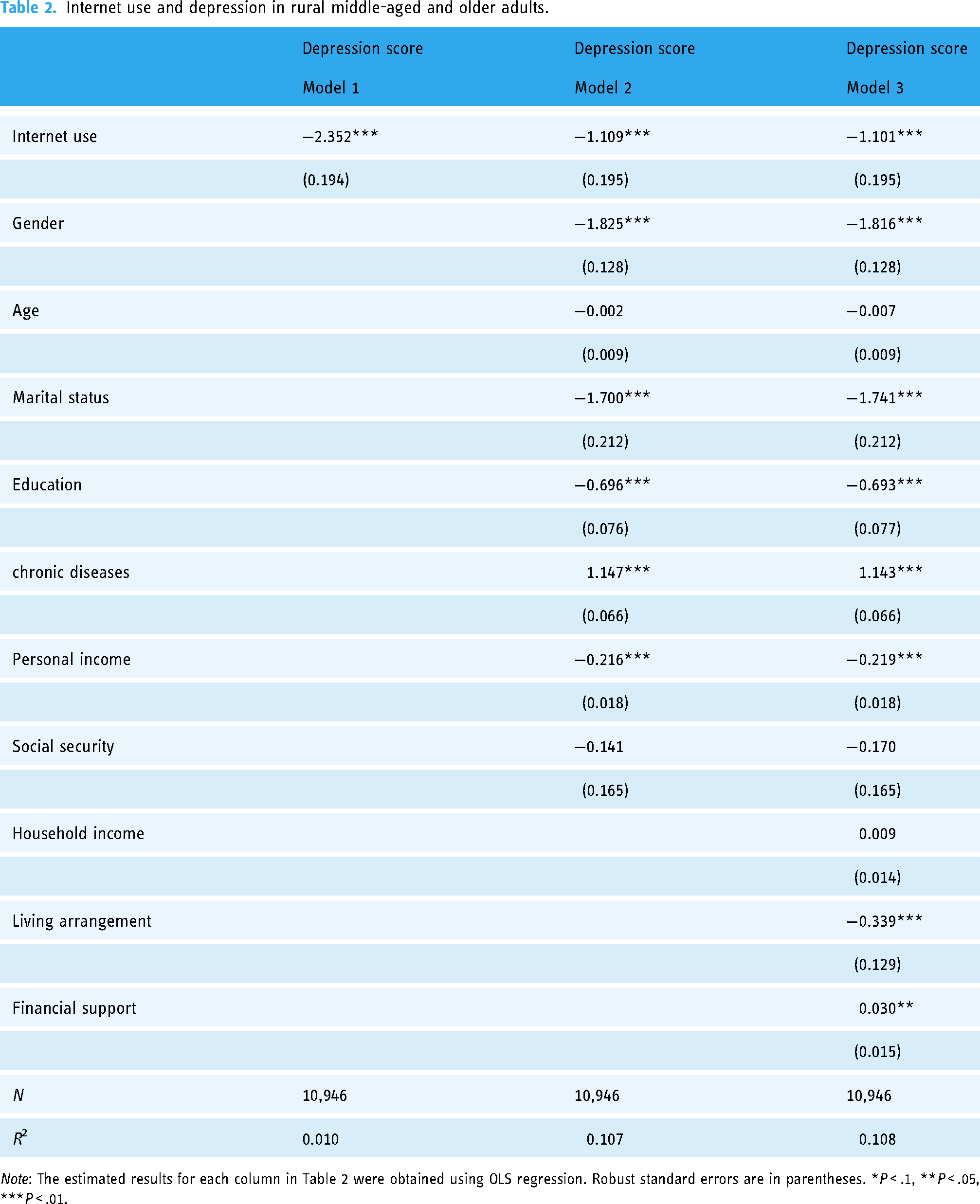
Note: The estimated results for each column in Table 2 were obtained using OLS regression. Robust standard errors are in parentheses. *P < .1, **P < .05, ***P < .01.
The effect of Internet use on depression: propensity score matching method
The results of the previous baseline regression analysis showed that Internet use could significantly reduce the depression of middle-aged and older adults in rural areas. However, it is worth mentioning that whether rural middle-aged and older adults use the Internet is not a random choice. Those rural middle-aged and older adults who can use the Internet and have a high preference for it, are more willing to access online information. The above results may lead to biased estimation results. This paper further used the PSM method to estimate the average treatment effect of participants. The group using the Internet was considered the treatment group, and the group not using the Internet was treated as the control group. To measure the balance between the treatment group and the control group, we conducted a balance test on the PSM results. Table 3 showed that the standardized deviations of all matching variables were less than 10% after matching, and the t-test results indicated that there was no systematic difference between the treatment group and the control group after matching.
Propensity score matching sample balance test.

In this study, four matching methods were used: K-nearest neighbor matching, radius matching, kernel matching, and locally linear matching. The results in Table 4 showed that in K-nearest neighbor matching, the depression index was reduced by about 1.076 in the treatment group as compared to the control group, and the result was significant at the level of 1%. We further used radius matching, kernel matching, and local linear matching to verify the accuracy of the results. The depression index of the treatment group was about 0.950, which was consistent with the previous simple regression results. Overall, we could conclude that Internet use had a significant inhibitory effect on the depression of rural middle-aged and older adults.
The effect of Internet use on depression score: PSM estimation.

Note: AAT indicates average treatment effect .***P < .01.
Mediation effect analysis
Table 5 demonstrates the results of the mediation effects analysis of the effect of Internet use on depression. The first step of mediation effect analysis was to test whether the total effect of Internet use on depression was significant. This result had already been presented in Model 3 of Table 2 of the benchmark regression analysis and would not be presented here. The second step was to test the impact of Internet use on mediating variables. Model 1 of Table 5 showed that Internet use had a significantly positive effect on the mediating variable, which indicated that Internet use significantly increased the frequency of social interactions among rural middle-aged and older adults (β = 0.735, P < .01). In the third step, Model 2 included Internet use along with social interactions in the regression model, and the results showed that the regression coefficients of Internet use (β = −1.070, P < .01) and social interactions (β = –0.176, P < .05) on depression were both significantly negative. This suggested that social interaction played a significant mediating role between Internet use and depression.
Mechanism analysis.

Note: Robust standard errors are in parentheses; *P < .1,** P < .05,***P < .01.
Similarly, Model 3, which estimated a regression on the mediating variable of Internet use, showed that Internet use significantly increased the level of social support among rural middle-aged and older adults (β = 0.536, P < .01). Furthermore, the coefficients on the regression estimates for Internet use (β = –1.078, P < .01) and social support (β = –0.249, P < .1) for Model 4 were significantly negative, suggesting that social support mediated the relationship between Internet use and depression to a large extent.
Further analysis
Heterogeneity analysis
It has been noted that the inhibitory effect of Internet use on depression might be influenced by factors such as education level, gender, and age. 34 Table 6 reported the results of the heterogeneity analysis of the effect of Internet use on mental health based on gender, education, income, and age subgroups. The results of Models 1 and 2 indicated that Internet use had a more pronounced depressive inhibitory effect on the male group compared to the female group. Furthermore, Models 3–6 reported the effect of the Internet on depression at different levels of education and showed that Internet use significantly reduced depression in the primary and secondary school groups. However, it did not significantly reduce depression in the illiterate and university and above groups. In regression analyses of subgroups based on income level, the results of Models 7–9 showed that Internet use had a significant negative impact on depression in the low-, middle- and high-income groups, but more so in the low- and middle-income groups. Finally, the results of subgroups in Models 10–12 indicated that Internet use significantly improved the mental health of the group aged under 75, but did not have a significant impact on the mental health of the group aged 75 and over. Finally, the results of the subgroups in Models 10–12 indicated that Internet use significantly improved the mental health of the group aged under 75, but did not have a significant impact on the mental health of the group aged 75 and over.
Heterogeneity analysis of the effect of Internet use on depression.
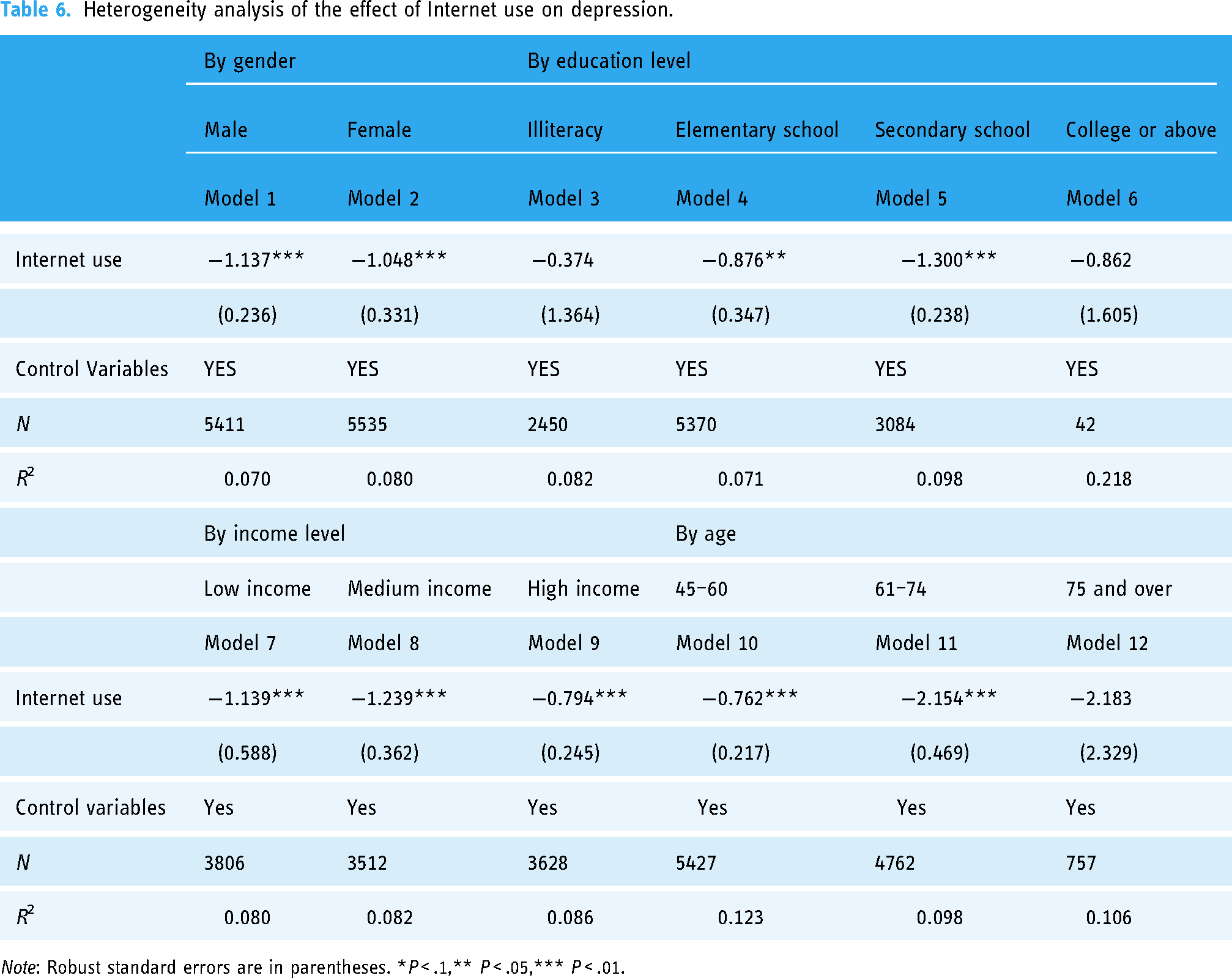
Note: Robust standard errors are in parentheses. *P < .1,** P < .05,*** P < .01.
The form and content of Internet use and depression
Table 7 reports the effects of form and content of Internet use on depression among rural middle-aged and older adults in Table 7. In terms of form of Internet use, Model 1, Model 2, and Model 3 analyzed the impact of desktop computers, laptop computers, and cell phones on depression, respectively. The results showed that compared with not using the Internet, the use of desktop computers, laptops, and cell phones significantly reduced depression, and the use of laptops had a more obvious relieving effect on depression, which meant that enhancing public services and infrastructural construction in rural areas and enriching the patterns of Internet use would help to improve the mental health of rural middle-aged and older adults.
Effects of form and content of Internet use on depression.

Notes: Robust standard errors are in parentheses;*P < .1,**P < .05,***P < .01.
In terms of Internet use content, Model 4, Model 5, and Model 6 were the analysis of the impact of using one content, two contents, and above three contents on depression, respectively. The results showed that compared with the group that did not use the Internet, the level of depression of rural middle-aged and older adults with more contents of Internet use was significantly lower.
Discussion
Using data from the 2018 China Health and Retirement Longitudinal Study and multiple linear regression and propensity score matching method, this study explored the impact of Internet use on depression and its mechanisms among rural middle-aged and older adults, revealed heterogeneity in the impact of Internet use on depression, specifically the impact of the form and content of Internet use on depression. To the best of our knowledge, this is the first article that uses a propensity score matching method to explore the causal relationship between Internet use and depression among rural middle-aged and older adults.
Internet use significantly reduces depression among rural middle-aged and older adults
We found that Internet use had a significant inhibitory effect on depression in rural middle-aged and older adults. Moreover, the more frequently the Internet is used and the richer the content, the more significant its effect on reducing depression among rural middle-aged and older adults. Under the rapid development of urbanization in China, many young rural laborers have flowed into the cities, while most middle-aged and older adults are staying in the countryside and becoming empty-nesters. The Internet has broken the time and space barriers of emotional communication and relationship maintenance and has become an important way for them to keep in touch with their family, friends, and the outside world. 11 It meets the needs of rural middle-aged and older adults to maintain family relationships and participate in society, 12 and reduces their sense of isolation and loneliness, thereby reducing the risk of depression. 9 Our findings are consistent with existing research findings,2,11,15,35,36 and the findings further enrich the literature on the Internet and mental health.
Social interaction and social support significantly mediate the relationship between Internet use and depression
We found that social interaction and social support played a significant mediating role between Internet use and depression. Internet use has enriched the channels for middle-aged and older adults to establish social networks and has enhanced individual subjective well-being. 37 In addition, the Internet use has also reduced depression by improving social support for middle-aged and older adults in rural areas. It has facilitated online engagement activities for older adults in the form of online communities and forums, and these online relationships can easily develop into offline relationships, 38 which can improve their happiness in rural areas and reduce the risk of depression. 39
The reduction effect of Internet use on depression has significant heterogeneity
First, Internet use was more likely to improve depression in the male group than in the female group. This is because middle-aged and older women have more social relations and social activities than men, and they tend to be more involved in offline social activities, such as square dancing, community volunteering, and other activities.40,41 As a result, they can increase their well-being and life satisfaction without using the Internet. A study found that participating in square dancing could significantly reduce depression, especially for people with mild cognitive impairment. 42 As for the group of older men, the possibility and the frequency of social participation were both significantly reduced. Research pointed out that older men did not socialize with friends and neighbors or dance for fitness as often as older women. 43 Within one year, men's social participation frequency is 16 times less than that of women. In the case of older men who have a single type of social participation, Internet use can better fulfill their needs for social participation and entertainment, thereby reducing depression.
Second, for rural middle-aged and older adults in the illiterate group, the Internet did not significantly improve their depressive symptoms. The reason is that their ability to acquire information and accept new knowledge was low, and their skills in using the Internet were insufficient, thus they showed anxiety and loneliness in the face of new technological applications of the Internet. Those middle-aged and older adults in rural areas with a higher education level might be less dependent on the Internet due to their rich and diversified social relationships and ability to distinguish the authenticity of online information. Therefore, the number of Internet users was not large, and the improvement of their depressive symptoms through Internet use was not obvious. Those rural middle-aged and older adults with primary and secondary education levels relied on the Internet more strongly and used it more frequently. Through online chatting with children or friends, and watching the news and other content, they have obtained emotional comfort and social support, so using the Internet could significantly reduce their depressive symptoms.
Third, in the income groups, we divided the individual income into three equal groups, namely low, medium, and high-income groups. Table 6 shows that Internet use had a more significant improvement in the depression of middle-income and low-income groups. The possible explanation is that high-income people were rich in social resources and had more experience and time to expand their social networks and maintain social relations, 44 and thus they got more happiness and a sense of achievement from the real world. Therefore, the effect of online Internet use on their depression was not obvious. As for the low-income group, due to the limitation of the economic foundation, there were fewer social entertainment activities. The Internet provides people with a variety of lifestyles and consumption methods. They could learn knowledge and engage in entertainment activities without leaving home. Therefore, the Internet has brought more changes in the lifestyle and production methods of low-income people.
Limitations
Like other studies, this one has some limitations. First, due to data limitations, the “digital divide” is not measured in this paper. With the rapid development of digital technology in China, there may be a significant digital divide between urban and rural areas and within groups of rural middle-aged and older adults due to differences in knowledge and information access. In rural areas, we found evidence that the use of digital technology improved the mental health of rural middle-aged and older adults. However, whether the digital divide exacerbates health inequalities among middle-aged and older adults needs to be further examined, which is crucial for health promotion among the rural poor and disadvantaged elderly. In the future, researchers can further analyze the impact of Internet use on the mental health inequality of urban and rural elderly using the concentration index and the re-centered influence function regression decomposition method. Second, there may be a potentially nonlinear relationship between Internet use and depression. That is, there may be a threshold effect. Does the health effect diminish as Internet use time increases? We were unable to explore the nonlinear relationship between Internet use time and depression because there were no specific indicators of Internet use time in the data. In future studies, we will further refine the indicators of Internet use as data become available or through field surveys to provide empirical evidence for Internet development policies in rural China and other developing countries. Finally, because this study is a cross-sectional study, it is not possible to observe the dynamic effects of Internet use on individuals’ depression. As Internet technology continues to spread in rural areas, the use of smart devices such as mobile phones for chatting and watching short videos among rural older adults has been gradually increasing, which may lead to further health effect enhancement. In the future, researchers can further test the causal relationship between Internet use and depression by using difference-in-differences (DID) and event study methods, and observe whether the health effects of Internet use are persistent.
Conclusions
Internet use significantly reduces the depression of middle-aged and older adults in rural areas, and the more frequently the Internet is used, the more diverse the forms of Internet use, and the richer the content used, the greater the effect of improving depression. To reduce the endogenous bias caused by sample self-selection, the above conclusion is still valid after using the propensity score matching method for robustness testing. Heterogeneity analysis shows that Internet use is more effective in reducing depression among middle-aged and older adults in the groups of men, aged under 75, with primary and secondary education levels, and low-medium income. Mediation effect analysis shows that social interaction and social support significantly mediate the relationship between Internet use and depression in rural middle-aged and older adults.
The above study provides a wealth of policy implications: (1) Public policymakers should continue to promote rural digital infrastructure development, enhance the coverage and speed of household broadband Internet access, and improve supporting service projects, such as smart elderly care services and smart medical platforms. (2) They should strengthen the construction of rural sports facilities, recreational service facilities, and social organizations for older adults, to increase their breadth and opportunities for social interaction and participation, and improve their sense of well-being and accessibility. (3) Public policymakers should improve the digital literacy of the elderly, especially rural middle-aged and older adults from low-income families, illiterate or with low socio-economic status, and help them to cross the “digital divide” and integrate into the digital society.
Footnotes
Acknowledgments
I thank the CHARLS team for their contributions to data collection and management.
Contributorship
JQM conceptualized this research. JQM gathered resources, curated all the data, wrote/prepared the original draft, and was responsible for project administration.
Declaration of conflicting interests
The author(s) declared no potential conflicts of interest with respect to the research, authorship, and/or publication of this article.
Availability of data and materials

Ethics approval
The CHARLS study was approved by the ethics committee of Peking University Health Science Center, Beijing, China (IRB00001052-11015). The requirement for informed consent was waived since the collected data were already anonymous. Because the present study was conducted based on the de-identified, publicly available CHARLS data, it does not constitute human subject research. Its institutional review board review was waived because there was no interaction with any individual, and no identifiable private information was used.
Funding
This work was supported by the Chongqing Municipal Education Science Planning Project General Subjects"Research on Mechanisms and Paths of Modernizing Rural Education Governance in Chongqing Empowered by Digitalization” (K23YG2080367).And the 2023 Chongqing Municipal Education Commission Humanities and Social Sciences Research General Project “Research on the Effectiveness and Strategies of International Communication of Chongqing Traditional Culture under the New Media Environment” (23SKGH165).