




Abstract
Objective
In the aging world, the depression of older adults has aroused great concern. It brings detrimental side effects to old adults and the sustainability of society. The information and communication technologies have reshaped how people live among which the Internet has gained much popularity in the senior community. This study aims to explore the association between Internet use and depression in older adults.
Methods
This study applied a representative national dataset (China Longitudinal Aging Social Survey, CLASS 2018) to examine by conducting regression analysis. Inspired by the social capital theory, we further examined the mediating role of general social networks (as a general concept) and specific networks (family and friend networks) in reducing depression. All calculations and analyses were conducted by STATA.
Results
(a) Internet use significantly reduces depressive symptoms among Chinese older adults; (b) internet use enhances social network support for Chinese older adults; and (c) social networks in general and family networks and friend networks in specific all play a mediating role between internet use and depression symptoms.
Conclusion
This work proved that internet use could reduce depression levels in older adults in China, and social networks, including family networks and friend networks, have a mediation role in the relationship between internet use and depression in older adults in China. Combined with the Chinese social context, we explained that the existence of an empty-nest elderly community in Chinese society and the emphasis on kinship in Chinese tradition may be the reasons. Based on the main findings, tailor-made suggestions for addressing depression issues among older adults were discussed.
Introduction
Depression is a common chronic mental illness, with 5.7% of older adults over 60 years old suffering from depression throughout the world according to the World Health Organization. 1 As critical as it is, depression causes symptoms and patterns such as an extremely depressed mood, pessimistic attitude, lack of passion and energy, poor sleep quality, and life quality. 2 In extreme circumstances, people suffering from depression could even commit suicide, and 700,000 people ended their life each year all around the world. 1 Older adults are also major victims of depression due to bereavement, physical illness, and independence, which has aroused worldwide attention. 3
Depression among older adults in China has become a pressing crux that nearly 40% of older adults self-reported having depressive symptoms. 4 China is representative enough as the research sample of depression in the old community considering the manifold social and cognitive reasons. From a macro perspective, China is in a period of incessantly aging, making it one of the most pressing social issues. Data released by the National Health Commission of China (NHC) show that there are 267.36 million people aged 60 and above in China by the end of 2021, accounting for 18.9% of the total population. 5 The well-being of this great amount of community should be paid great attention. However, the medical resources in China are insufficient and unevenly distributed in different regions. Moreover, China, as the country with the most population in the world, also has the largest population of older adults. 6 Taking China as the research object could offer a more useful and thought-provoking reference for other countries at risk of aging issues in the world. From a micro perspective, the public's stereotypes and stigma toward depression still exist in China. 7 Older adults’ mental health is rather underestimated since they may often attribute their depressive mood to physical ailments or feel reluctant to acknowledge the mental disorder due to shame or stigma. 8 Therefore, it's necessary to find accessible ways to address the high prevalence of depression in older adults in China to secure well-being as the resolution of facing the aging society.
The cause of depression in older communities could result in insufficient family support and social contact, poor physical health, social isolation or invisibility, etc.4,9 The popularization of information and communication technologies (ICTs), such as the internet, smartphones, and computers, enables people, including old people, an accessible way to interact, communicate, and engage with others no matter the time or place. In this way, the use of the internet could be regarded as an essential method to gain social connections, especially for older people to counteract depression. To be specific, the internet offers access for the elderly to seek information more effectively and promptly, for example, by providing healthcare service when seeking medical assistance, 10 enriching their lives by facilitating better interpersonal relationships on the internet so to prevent loneliness and secure the living quality. 11
The relationship between internet use and depression in older adults has attracted much attention, and most studies reported that internet use can reduce depressive symptoms or lower the probability of developing depression in older adults.9,12,13 And yet, some studies pointed to another direction and proved that excessive internet use will also cause higher levels of depressive symptoms due to less social engagement in real life. 14 Internet users above 60 have reached 119 million and became an important source of growth in the netizen population in China, 15 which offers a novel scope and practical value in discovering the relationship between internet use and depression in older adults.
Considering the representativeness of China in terms of social and cognitive aspects, we’re concerned about to what extent internet use is associated with depression in older adults and try to uncover the underlying mechanism in the Chinese context.
Theoretical framework and research questions
The relationship between internet use and depression and the positive impact of internet use on health
Research regarding the relationship between internet use and depression in older adults is abundant concerning the severity of the issue. The extant literature could be concluded as two opposing sides. Some hold the optimistic opinion that the internet is favorable in decreasing depressive symptoms. The most used framework for explaining the mechanism is the social causation theory. Social causation theory is a well-studied theory that explains that social environmental factors, such as socioeconomic status (SES), education level, and technology availability, could result in changes in health conditions, including mental health. 16 Social causation theory explains that lack of social support could lead to psychological distress. 17 Through the internet, old people who are considered departed from the center of social activity could activate social contact with family and friends, extend their social reach, and strive for more social support from individuals or communities online,17,18 to relieve anxiety and improve well-being. 19 Moreover, the internet could benefit old people's information-seeking to have a better understanding of health and develop healthy behavior, so as to overcome misconception and deconstruct the stigma of depression. 20 The internet also offers a wide range of entertainment, which slows down their cognitive deterioration and improves their mental health. 21
On the other dimension, internet use is not always positively connected to mental well-being, and it could lead to adverse impacts. Research shows that internet use was significantly negatively associated with the life satisfaction of old people in China, demonstrating the negative effects that internet use may cause for the old community. 22 The time spent on the internet would crowd out other activities, which reduces social engagement and interpersonal communication, and even damage family relationships. For example, a recent German-based study found that internet use reduced contact with family and friends among older adults, leading to the increased feeling of loneliness, reduced life satisfaction, and worsened depression symptoms. 23
Furthermore, internet use is also acknowledged to have negative effects on health outcomes. Despite providing people with a wider channel to seek information, the internet also increases the probability of exposure to misinformation. 24 The adverse impacts of misinformation are far-reaching and long-standing. 25 The rapid changes in technology and media ecology require a higher standard of information literacy and media literacy for the audience to discern the information's veracity. However, this poses a significant obstacle for elderly individuals since research has found that older adults are often targeted for misinformation scams and phishing because of the insufficiency of media literacy. 26 Although it may be tempting to believe that acquiring new knowledge through internet use can exercise older people's cognitive functionality, a study by Slegers et al. proved that computer and internet learning does not benefit healthy, community-dwelling older adults concerning many domains of cognitive functions. 27
Based on the aforementioned research, it is evident that the relationship between internet use and depression has been a topic of widespread discussion.
27
However, scholars are still inconsistent regarding the effect of internet use on depression among the elderly. Hage et al. (2016) had a similar doubt and identified that the online communication type influences social connectivity in older adults, which also leads to two opposite causal directions of relationship. Even though Hage et al.'s study is about the relationship between types of online communication and types of social connectivity, which differs in the focus of our study, it could also offer us the inspiration to examine the conflicting results. To clear up the doubt, we raise the first research questions:
RQ1: What is the relationship between internet use and depression in older adults, and can it reduce the level of depression in older adults?
Mediation effect of social networks between internet use and depressive symptoms among older adults
When it comes to mental illness, causal attributions are the deductions made about what might have caused it. As previously mentioned, extensive evidence has suggested a correlation between internet use and depressive symptoms in older adults. Also, potential underlying mechanisms exist in the relationship between internet use and depressive symptoms, through which the causal effects may operate.
Extant knowledge mostly agrees that a reduction in social capital is linked to increased depressive symptoms. 28 Besides, social capital also plays a mediator role in predicting depressive symptoms in older adults. For instance, Han et al. suggested the mediating role of cognitive social capital in the association between SES and depressive symptoms, as well as the moderating effect of SES on the relationship between social capital and depressive symptoms. 29 Social capital is defined as the resources that individuals can access through social connections, 30 encompassing associations between individuals or communities (e.g. social networks, norms of reciprocity). To study the relationship between social capital and health, researchers concluded two mechanisms, psychosocial/cognitive dimensions and network/structural dimensions. 31 Psychosocial social capital includes measures of trust, reciprocity, and group norms and perceptions of social environments, while the network social capital includes the resources that possess through the social network,31,32 which could be measured through social participation and information socializing. 33 The internet itself is a “‘net’ work,” in which users can process information, contact other people, and build social networks online. Therefore, people with access to internet use could have more social capital.
Social networks provide people with positive experiences and socially rewarding roles within their communities, which contribute to cohesion and mental health well-being. 34 That's why we put the spotlight on the factors that influence social networks. Among all the literature about the relationship between social networks and depression, family networks and friend networks are the two important aspects. 33
However, previous research also pointed out a negative correlation between the intensity of the social network and depressive symptoms: those at the center of social networks are less likely to be depressed than those at the periphery, 35 while weaker social networks lead to stronger depressive symptoms. 36 Normally speaking, old adults would gain more depression due to the shrinking social network as their physical condition gradually deteriorates. Internet use, however, offers old adults to widen their social networks. Due to special historical, policy, and economic reasons, there is a large number of empty-nest elderly in China, referring to the old adults whose children are away from home and living with their spouses or alone. 37 Empty-nesters have a bigger probability of getting depressed due to the poor family network and social support, and the use of digital technology is proven to be effective in decreasing depressive symptoms. 38 In China, there's a novel and interesting phenomenon of “old influencers.” 39 More older adults become opinion leaders in internet support groups (ISGs) by actively using the internet, which increases the centrality of their social networks and reduces their potential depression. 40
However, the results of relationships between depression and social networks vary in different studies, and it could contribute to the quality of design factors.
41
For example, Hage et al. (2016) had a similar doubt and identified that the online communication type influences social connectivity in older adults, which also leads to two opposite causal directions of relationship. Even though Hage et al.'s study is about the relationship between types of online communication and types of social connectivity of older adults in the Netherlands, which differs in the focus of our study, it could also offer us the inspiration to examine the different types of social networks’ effects on depression levels. Extant studies mostly regard social networks as a general concept. However, people have different types of social networks, and the modes of these social networks may vary in interaction, information processing, and so forth. In this way, we’re in doubt as to whether they may lead to different impacts on depression in older adults. As the two main aspects of social networks, the different effect of family network and friend network on depression is very significant but remain underexplored. Hence, we propose the following research questions and hypothesis:
RQ2: What are the effects of internet use and the social networks of old adults (including family networks and friend networks)? H1: Social networks mediate the relationship between internet use and depressive symptoms in older adults. RQ3: Is there any difference in the mediation effect of family networks and friend networks between internet use and depressive symptoms in older adults?
Methods
Data
This study conducted empirical research using panel data from the China Longitudinal Aging Social Survey 2018 (CLASS 2018), which is a publicly available dataset led by the Renmin University of China (RUC). CLASS 2018 is a nationwide survey conducted in mainland China, which selected the most presentative sample that suits the geographic characteristics of China through a field survey. Moreover, this dataset is designed with rich variables covering many aspects related to the living quality of the elderly population and therefore offers many possible perspectives for studying the elderly population in the Chinese context. The quality, representativeness, and credibility of the dataset have been acknowledged by academia, and many scholars applied this dataset as a scope to explore the well-being of the elderly in the Chinese society. This study involving human participants was conducted in accordance with the Declaration of Helsinki and reviewed and approved by the Ethics Committee of the RUC, and written informed consent was obtained from all participants.
Since the CLASS 2018 contains many questions that are consistent with the target variables in our study, such as depression level, internet use, social interaction approach, and many geographic characteristics of older adults, it's highly advisable for us to apply this dataset to properly answer our research questions with high reliability. A stratified multistage probability sampling method was used to select elderly people aged 60 years and above, with a total of 13,246 individuals as survey respondents.
The survey includes internet use, social networks, depressive symptoms, and demographic characteristics, such as gender, age, income, and social security status. Respondents who refused to answer or answered “I don’t know” were regarded as missing samples. After removing the missing sample and missing values of key variables, we have 8392 final samples in total, including 4246 males and 4146 females; 7929 belonging to the Han ethnic group and 463 to ethnic minorities; 3188 residing in Eastern China, 2079 in Central China, 1272 in Northeastern China, and 1853 in Western China; 7871 people with no religious belief and 521 people with religious belief; 4236 residing in urban areas and 4156 people living in rural areas; and 2747 using the internet regularly and 5645 reporting no or infrequent internet use.
Variables and measurement
Dependent variables: depressive symptoms, health-motivating effects of internet use
Depressive symptoms in the CLASS 2018 were measured according to the Center for Epidemiological Survey, Depression Scale (CES-D). The CES-D scale contains 12 items, including nine negative emotions and somatic syndromes (loneliness, sadness, worthlessness, boredom, loss of appetite, and sleep disorder) and three positive emotions (happiness, enjoyment of life, and joyfulness). Participants were asked to rate the frequency of experiencing these symptoms in the past week using a 5-point Likert scale (0 = never, 1 = sometimes, and 2 = often). In this study, positive emotions were reverse scored, and then, the item scores were summed to obtain the total score of depressive symptoms, ranging from 0 to 24, with higher scores indicating higher levels of depression.
Independent variable: internet use
The survey of CLASS 2018 also documented internet use among Chinese older adults. Recipients need to rate the frequency of internet use on a 5-point Likert scale (1 = never use the internet, 2 = use the internet several times a year, 3 = use the internet at least once a month, 4 = use the internet at least once a week, and 5 = use the internet every day). Consistent with prior research,9,10,12 a binary coding approach was employed to code “never use the internet,” “use the internet several times a year,” and “use the internet at least once a month” as “0,” indicating no internet use, while responses of “use the internet at least once a week” and “use the internet every day” were coded as “1,” indicating internet usage.
Mediating variable
As for the social network and social support assessment, CLASS 2018 utilized the Lubben Social Network Scale (LSNS-6) to obtain the results among older adults. 42 The assessment of family networks included three items: (a) “How many family members/relatives do you see or contact at least once a month?”; (b) “How many family members/relatives can you talk to freely about your personal matters without any scruples?”; (c) “How many family members/relatives are available to you when you need help?” According to the options, responses were coded as “0” to “5,” representing “none,” “one,” “two,” “three to four,” “five to eight,” and “nine or more,” respectively. The scores of all items were summed to obtain the family network score, with higher scores indicating the greater intensity of family network support (Cronbach's α = 0.818).
The friend network assessment includes three items: (a) “How many friends do you see or contact at least once a month?”; (b) “How many friends can you talk to freely about your personal matters without any scruples?”; (c) “How many friends are available to you when you need help?” The scoring of the response is the same as the family network. The scores of all items were summed to obtain a friend network score, with higher scores indicating the greater intensity of friend network support (Cronbach's α = 0.824).
Control variables
The control variable is vital for establishing robust research to ensure that it minimizes the influence of confounding factors and enhances the internal validity of findings. By controlling for these variables, researchers can increase the validity and reliability of their findings and draw more accurate conclusions about the relationship between the independent and dependent variables. In this study, from the perspective of demographic characteristics, we chose gender (0 = male, 1 = female), education level (0 = illiterate, 1 = literate), income (log scale of the income), economic regions (Eastern China, Central China, Western China, and Northeast China), geographic residence (urban, rural), ethnicity (Han ethnic group, ethnic minorities), religion (have a religious belief, have no religious belief), marital status (married, unmarried, bereaved, and divorced), and homeownership as control variables in this study. Among them, gender, economic regions, religion, and marital status were treated as dummy variables.
Moreover, previous studies have shown that self-rated health, basic mobility, cognitive ability, chronic diseases, social security, and preferential treatment for the elderly have an impact on depressive symptoms,10,22,43,44 so these variables were also included as control variables in this study. In the CLASS 2018 survey, “self-rated health” was assessed as a 5-point Likert scale, which a higher score indicating better self-rated health.
“Basic mobility” was assessed using 11 questions that evaluate whether the elderly can complete basic activities independently such as making phone calls, self-cleaning, dressing, bathing, eating, taking medication, and using the toilet (1 = can’t do it at all, 2 = needs some help, and 3 = doesn’t need any help). The score of basic mobility was measured on the sum of the scores of each question item. “Cognitive level” was measured by the respondents’ knowledge of 16 questions in eight categories, such as “What is the date of the month today?”. Each incorrect answer was coded as “0” while the correct answer was coded as “1”. The scores of the 16 questions were summed, with higher scores indicating higher cognitive levels of the elderly.
“Chronic diseases” was assessed based on the question “Which chronic diseases do you have?”, which includes 23 types of chronic diseases. If the2 respondent had any of these, it would be calculated as one score. So, the final score of chronic diseases in our study varies from 0 to 23.
“Social security” was calculated from the responses to eight questions such as “Do you have basic pension funds” (0 = No, 1 = Yes), and the scores of the eight questions were summed. The higher the score, the higher the social security benefits enjoyed by the elderly.
“Preferential treatment” was evaluated by the question, “Have you ever enjoyed preferential treatment for the elderly as a resident, such as free bus rides, free park visits, etc.” (0 = No, 1 = Yes).
Results
This study applied IBM SPSS Statistics (Version 27.0) and STATA 17.0 software to validate the questions and hypotheses in the previous sections.
Differences in internet use with social networks and depressive symptoms among the older adults
Table 1 shows the results of the t-test of internet use and social networks and depression among older adults, which represented the differences. It demonstrated that older adults who used the internet received significantly higher levels of the family network, friend network, and social network than those who do not use the internet, and the depressive symptoms of older adults who use the internet were also significantly lower than those who did not use the internet.
Differences in internet use and social networks and depression among older adults.

Effects of internet use and social networks on depressive symptoms of older adults
To explain the correlation between internet use and the depression symptoms of old adults, we chose depression symptoms as the dependent variable and internet use as the independent variable to conduct the regression. Besides, social networks, family networks, and friend networks were included as independent variables for multiple linear regression analysis, and the results are shown in Table 2. In model 1, model 2, model 3, and model 4, the key explanatory variables are social networks, family networks, and friend networks, respectively.
Multiple linear regression results of the effects of internet use and social networks on depressive symptoms of older adults.

Reference variables: ethnicity: Han ethnic group; gender: male; marital status: married; geographical residence: urban areas; economic regions: Northeastern China.
***p < 0.001, **p < 0.01, *p < 0.05.
As seen in Table 2, internet use has a significant negative impact on depressive symptoms among older adults (B = −1.663, p < 0.001). In the baseline model, with other variables not included, older adults who use the internet at least once a week or more have a 0.1% lower risk of depression compared to those who do not use the internet. In other words, while having other variables controlled, older adults who use the internet at least once a week and above have a decrease of 1.663 units in their depression scores compared to older adults who do not use the internet, which answered RQ1.
The possible reason why internet use significantly reduces the level of depression in older adults is that the use of social media in older adults could promote their online social capital to reduce their sense of loneliness, so the depression symptom is accordingly reduced. Regarding the individual characteristics of older adults, basic mobility, cognitive ability, self-rated health, personal income, education, home ownership, and social security all showed a negative correlation with depressive symptoms. Compared to older adults who were married, depressive symptoms were significantly higher among older adults who answered: “no” in the item of “marital status” (B = 1.823, p < 0.001), which also reflects the positive effect of family network support on promoting the mental health of older adults.
Model 2 introduces the social network as an independent variable based on the baseline model, and the results show an improvement in the model's performance. It can be found that internet use and social network support both have significant negative effects on depressive symptoms among older adults. After controlling all the other variables, older adults who use the internet at least once a week or more have significantly lower depressive symptoms compared to those who do not use the internet (B = −0.088, p < 0.001).
Further investigation was conducted to explore the separate effects of the family network and the friend network on depressive symptoms among older adults. Model 3 and model 4 included the variables of family network and friend network in the regression, respectively. The results revealed that both the family network (B = −1.559, p < 0.001) and friend network (B = −1.588, p < 0.001) played a significant negative effect on the depression symptoms of the old adults, and the negative effect of the former on depression symptoms was greater than the latter. This may be related to the tradition and culture of valuing the harmony of family in China. 45
In summary, the results of multiple linear regression analysis indicate that internet use significantly reduces the depression symptoms of older adults, answering RQ1. The social network, family network, and friend network all represent a significantly negative association with depressive symptoms in older adults, which suggests that the social network may mediate the relationship between internet use and depressive symptoms among older adults, and the mediating role of family network and friend network may be different, which requires subsequent testing of the mediation effect.
Effect of internet use on the social network of older adults
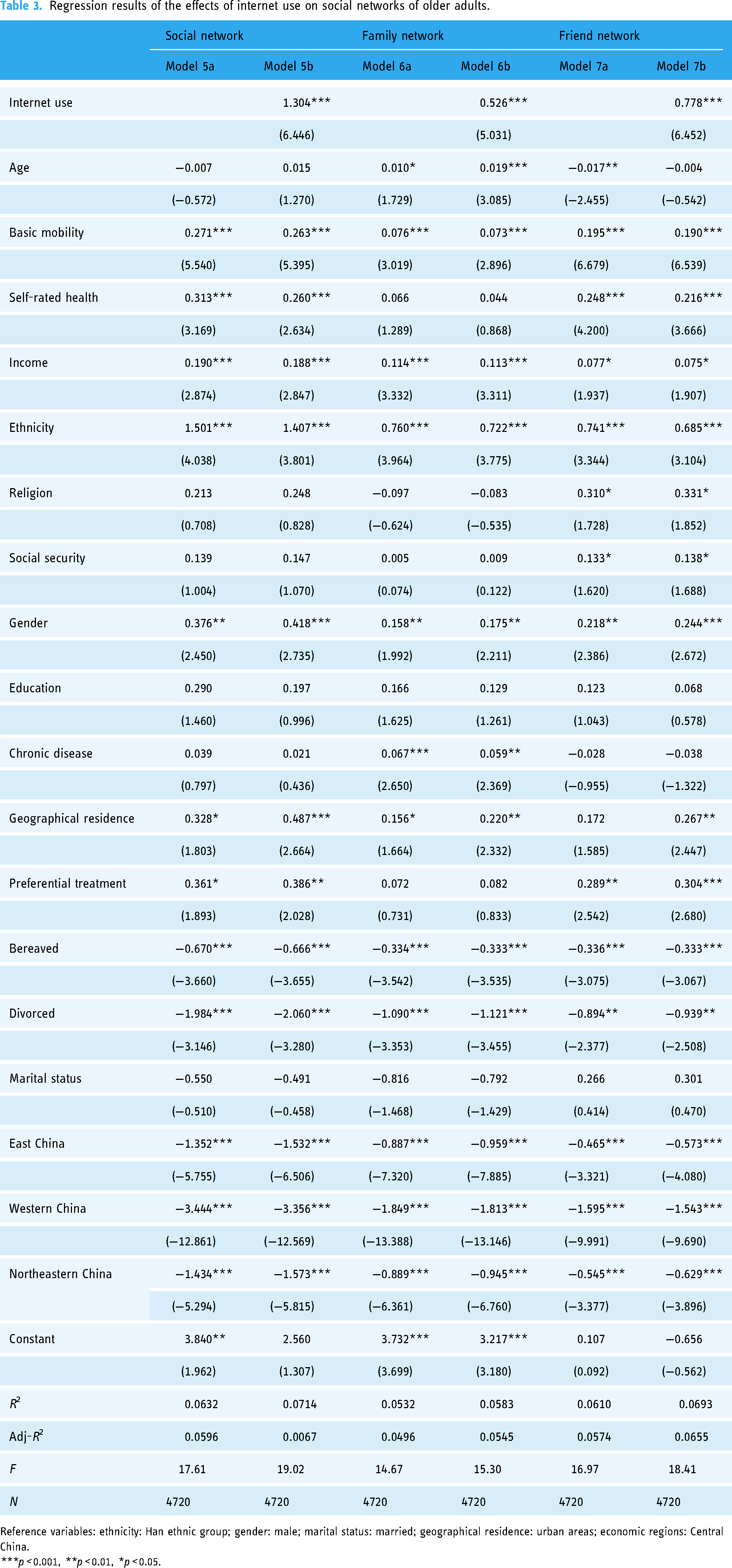
This study chose social networks, family networks, and friend networks as dependent variables and internet use as the independent variables to conduct the linear regression analysis, respectively, as shown in model 5, model 6, and model 7 accordingly (see Table 3). Among them, model “a” did not include internet use of the independent variable, while model “b” represents the inclusion of internet use. The results of linear regression analysis indicated that internet use significantly and positively predicted the social network, family network, and friend network of the elderly.
Regression results of the effects of internet use on social networks of older adults.
Reference variables: ethnicity: Han ethnic group; gender: male; marital status: married; geographical residence: urban areas; economic regions: Central China.
***p < 0.001, **p < 0.01, *p < 0.05.
As shown in Table 3, in model 5, model 6, and model 7, the explanatory power of the models was improved to some extent after including the variable of internet use in the model. In model 5, after controlling for variables such as gender, age, and income, internet use has a significant positive effect on older adults’ social networks (B = 1.304, p < 0.001). From model 6b, internet use increases the family network of older adults by 0.526 units. Similarly, in Model 7b, internet use increases the friend network of older adults by 0.778 units.
Based on the results of Table 3, we can observe that internet use has a significant positive effect on older adults’ social networks as well as family and friend networks, which answered RQ2. Moreover, it's more evident and stronger on the positive effect of internet use on expanding and maintaining older adults’ friend networks. On the one hand, internet use does have positive effects on social relationships of older adults, such as reducing their social isolation and compensating for the lack of family care; on the other hand, this study found that internet use has a positive contribution to both family network and friend network of older adults, and the contribution to the friend network is higher than the contribution to the family network for the old community.
From the perspective of the closeness of relationships, we found new potential relationships are created in the process of using the internet. Most Chinese older adults live in families, and their family networks have constructed and stayed a table situation most of the time. By means of the internet, older adults could have contact with family members online, which reinforces the family network. However, compared with the family network, which is established by genes and long-time contact, the friend network obtained through the internet is considered weak. But the “weak relation” constructed by the internet is easy to be established, maintained, and even expanded. In addition, compared with limited access to support from the family network, older adults could have more diversified channels to expand their friend network, such as phone calls, in-person visits, or living together.
Compared with model 5, model 6 included internet use as an independent variable, and the regression results showed that age and chronic illness gained significance in affecting the family network of the old adults. From another perspective, compared with model 6, variables such as religion and social security become significantly correlated to friend networks in model 7. Thus, we can observe that older adults’ access to family network support is mainly related to demographic factors such as age, income, marital status, and health status, while older adults’ access to friend networks is related to cultural and social factors of religious beliefs and social security. Meanwhile, from the perspective of geographic residence, older adults living in rural areas had significantly higher social networks, family networks, and friend network support than those living in urban areas. Older adults living in central China had significantly higher social networks, family networks, and friend network support than those living in Eastern China, Western China, and Northeastern China.
Robustness analysis
As we mentioned above, the studies about the relationship between internet use and depression in older adults are abundant, and we have already identified the association between the two variables. However, there's a necessity of considering the possibility of reverse causality in the data. Reverse causality means the reverse direction in the cause and effect; for instance, if a study is supposed to examine that X causes changes in Y, then the reverse causality is Y causes changes in X, which definitely leads to biased results. 46 Common approaches to address the endogeneity problem include instrumental variable (IV), fixed effects model (FE), propensity score matching (PSM), experiments, and quasi-experiments. 47 In the counterfactual causal analysis framework, experimental or quasi-experimental methods fit the ideal situation better. However, in social sciences research, the use of experimental or quasi-experimental methods lacks feasibility.48,49 Other approaches also have their limitations, such as FE can only eliminate time-fixed confounding terms 50 and PSM that rely exclusively on the hypothesis that “observables are ignored.”51,52 Thereafter, IV analysis is more suitable when it comes to quantitative survey data.47,52,53
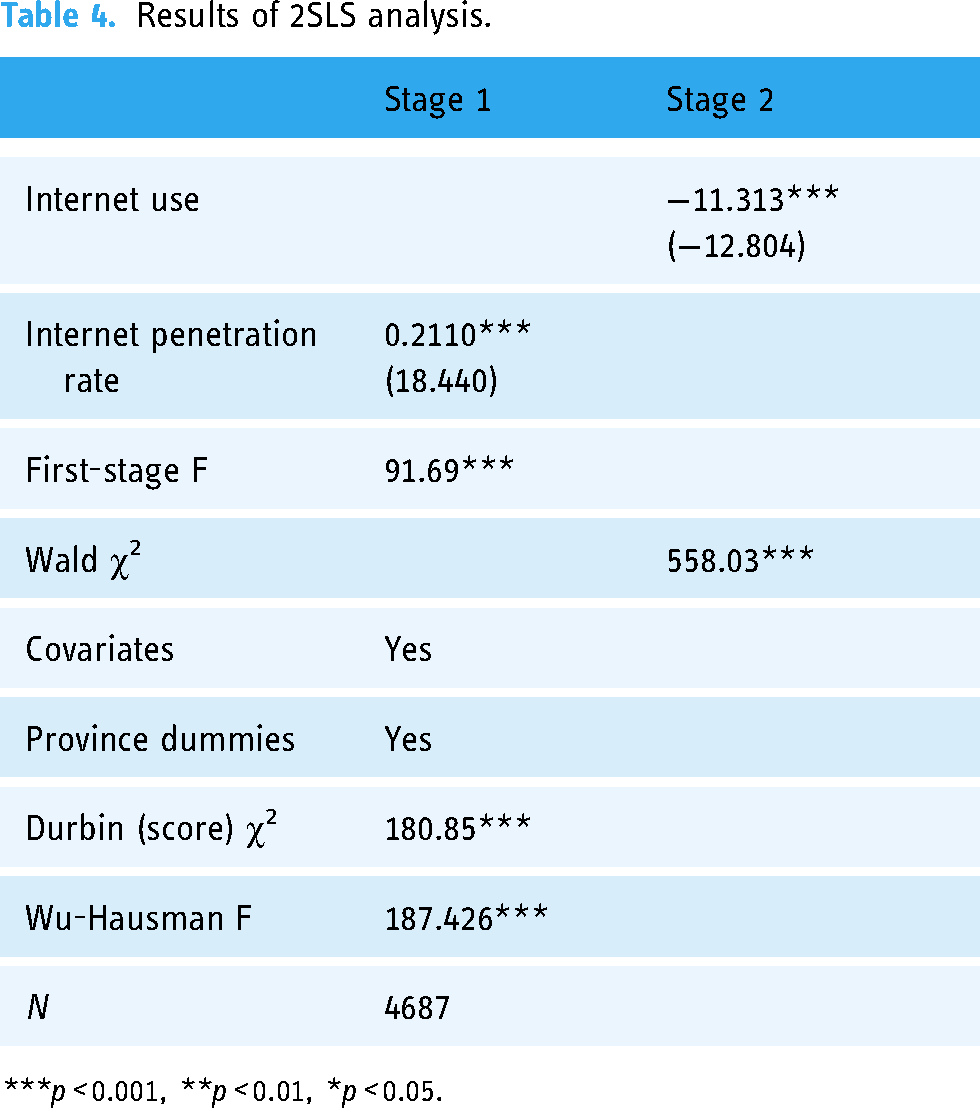
Based on previous studies,54,55 we use the internet penetration rate among Chinese provinces as an IV, and the data were derived from the statistical report published by the China Internet Network Information Center (CNNIC). 56 The internet penetration rate is suitable in our study as the instrument variable for two main reasons. On the one hand, the network infrastructure and internet penetration rate have evitable regional characteristics in China according to local development. The internet penetration rate can indirectly reflect the status of the internet infrastructure. In this way, for people who live in a specific region, individual internet use is also associated with the region, which is in line with the assumption of the relevance of instrumental variables. On the other hand, internet penetration is largely influenced by the economic level of the region. Thus, internet penetration is independent of the level of depression of the population, in line with the homogeneity assumption of the IV.54,57 Hence, we used the 2SLS in a two-stage process. First, we estimated the effect of provincial internet penetration on internet use. Second, we estimated the effect of internet use on depression among older adults through regression. 48
As shown in Table 4, in the first-stage regression of the 2SLS model, internet penetration was significantly and positively associated with internet use among the elderly, which was consistent with the assumption of correlation of instrumental variables. The Estat first-stage test results proved that internet penetration is not a weak instrument variable (WIV) in this study (Partial R2 = 0.0678, F = 339.868). 58 The second-stage regression results of the SLS model showed that, after correcting for possible endogenous bias (bias), internet use still has a significant negative effect on depression among older adults and is consistent with the direction and significance of the regression analysis results above, which suggests the robustness of the statistical analyses.
Results of 2SLS analysis.
***p < 0.001, **p < 0.01, *p < 0.05.
Finally, we used the Durbin–Wu-Hausman (DWH) test to verify the endogeneity of the model, and the results showed that the p-values corresponding to both Durbin (score) and Wu-Hausman F were less than 0.001, which implies that the use of internet penetration rate by the province as an IV for regression analysis is appropriate; the endogeneity issue does not cause statistically significant estimation bias in our analysis.
In addition, drawing on previous studies,52,59,60 we further conducted a sensitivity analysis to verify the robustness of the regression analysis results in different sample groups. We divided the sample into the 60–69-year-old group, 70–79-year-old group, and 80-year-old-and-above group and compared the regression test results of each group with the overall sample. As shown in Table 5, the hypothesis test results were highly consistent across the age groups, with a significant negative correlation between internet use and depression in older adults in all cases and social network, family network, and friend network also showing a significant negative correlation. Accordingly, we can draw the conclusion that the hypothesis test results were robust.
Results of robustness analysis in different sample groups.

***p < 0.001, **p < 0.01, *p < 0.05.
Mediation analysis of social networks between internet use and depressive symptoms in older adults
Based on Bellocco and Grotta's methodology of mediation analysis in STATA, 61 we applied depression as the dependent variable, internet use as the independent variable, and social network as the mediator and performed the mediation effect analysis by bootstrapping for 5000 times. The results are displayed in Table 6 and Figure 1. In the model examining the effect of internet use on depressive symptoms in older adults, the indirect/mediation effect of social networks was −0.188, with a 95% bootstrap confidence interval (BootCI) of [–0.237, –0.140], which does not contain zero. It indicated that social network plays a mediating role between internet use and depression symptoms in older adults. The direct effect coefficient of internet use and depression symptoms was −2.986 (p < 0.01). The direct effect of internet use involving internet use as the predictor is still statistically significant after including the social network as a mediating variable; this may indicate that there's a mediation of the social network between internet use and the depression symptoms of old adults, which means H1 is supported.
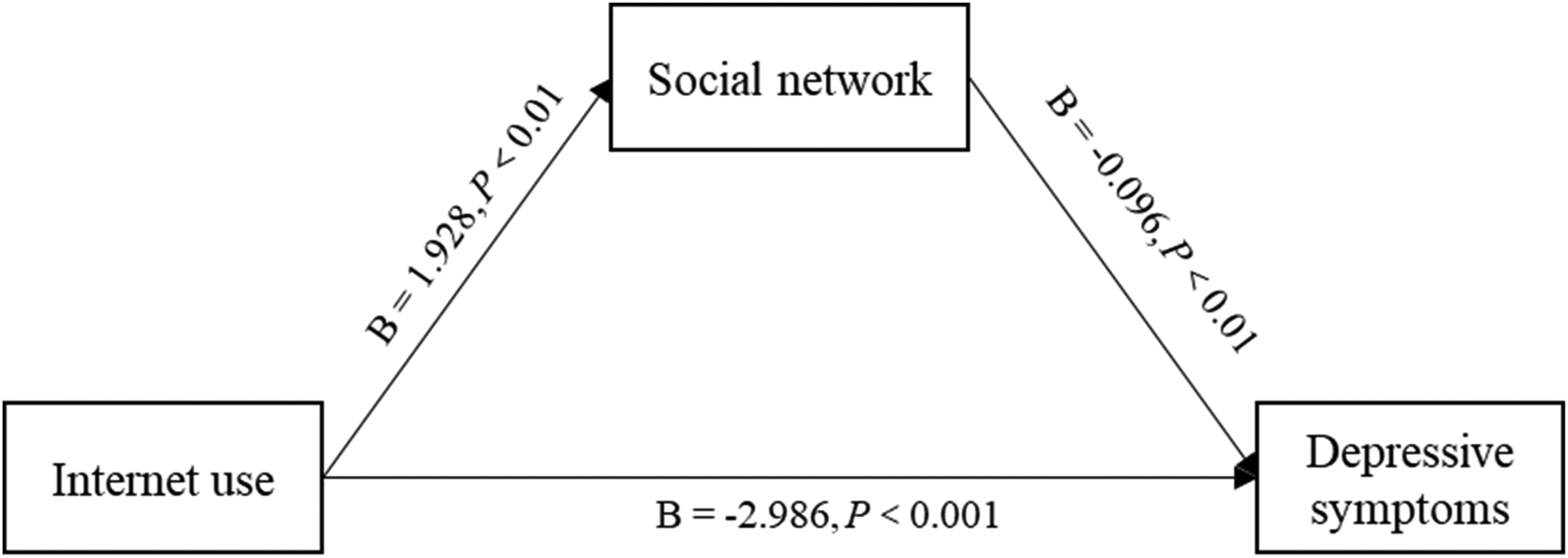
The mediating effect of social network between internet use and depressive symptoms.
Mediation effect of social networks between internet use and depressive symptoms in older adults.

***p < 0.001, **p < 0.01, *p < 0.05.
According to the mediating effect test bootstrap method proposed by Preacher and Hayes, 62 we used internet use as the independent variable, family networks and friend networks as the mediating variables, and depression as the dependent variable. As shown in Table 7, we verified the mediating effect of family networks and friend networks between internet use and depression; the mediating effect of family networks between internet use and depression was found to be significant (path a: B = −0.810, p < 0.001), and the path between the family network and depression symptoms was also significant (path b: B = −0.104, p < 0.001). The indirect effect of internet use affecting depressive symptoms through family networks is also negatively significant at the 0.1% level. Therefore, we can say that family networks play a mediating role between internet use and depression.
Results of mediation effects of family network and friend network on internet use and depressive symptoms among older adults.

(P): percentile; (BC): bias-corrected; (BCa): bias-corrected and accelerated.
***p < 0.001, **p < 0.01, *p < 0.05.
Additionally, the mediating effect of friend networks between internet use and depression was found to be significant (path a: B = −1.161, p < 0.001), and the path between the friend network and depression was also significant (path b: B = −0.086, p < 0.001), and the indirect effect of internet use and depression through friend networks was also negatively significant at the 0.1% level. This shows that friend networks also play a mediating role between internet use and depression. In all, the mediating role of both the family networks and friend networks exists, but the mediating role of friend networks is relatively a bit stronger, and this result partially answers RQ3. In addition, the indirect effect of internet use affecting depression through family networks and friend networks is significant at the 0.1% level (coef = –0.185) (Figure 2).

The mediating effect of family networks and friend networks between internet use and depressive symptoms.
Heterogeneity analysis
For older adults with different levels of education, their ability to use the internet may differ. To have a better understanding of the heterogeneity among the rural older adults with different levels of education, this study classified the rural older adults into illiterate (illiterate in general or only received “sishu,” old-time home school in China) or “literacy class” (class set for the illiterate with the goal of providing fundamental literacy skill) and literate groups (elementary school and above in education).
Table 8 represents the results of the heterogeneity analysis among older adults with different education levels. Internet use had a significant negative effect on depressive symptoms among illiterate older adults, while for illiterate older adults, there was no significant relationship between internet use and depressive symptoms. This may be due to the limitations in the basic literacy of illiterate older adults that unenabled them to learn how to use the internet and social media applications, as well as reduced receptiveness to new things. However, literate older adults have stronger learning abilities and are more receptive to new things, so they are more able and willing to use the internet, leading to more pronounced effects of internet use on reducing depression symptoms.
Results of the heterogeneity analysis.

Reference variables: ethnicity: Han ethnic group; gender: male; marital status: married; geographical residence: urban areas; economic regions: Eastern China.
***p < 0.001, **p < 0.01, *p < 0.05.
Discussion
Based on the representative panel data, CLASS 2018, this study investigated the relationship between internet use and depression among older adults and examined the mediating role of social networks generally and family networks and friend networks, respectively, in the special social context in China. The results revealed that internet use significantly reduced depressive symptoms and increases the social network support of older adults. Besides, social networks in general and family networks and friend networks in particular all play a significant mediating role in the relationship between internet use and depression in older adults. Based on the findings, the main contribution of our study is to have a better understanding of the relationship between internet use, social networks, and depression in China, calling for extra attention to the types of social networks as the approach to combat depression. More interestingly, the main findings and the social–contextual explanations are discussed in detail as follows.
First, this study indicates that internet use can reduce depression among older adults, and social networks (including the family network and friend network) mediate the relationship between internet use and depressive symptoms in older adults. For traditional Chinese older adults, support from family networks has a positive impact on relieving depression. Influenced by deep-rooted Confucianism, East Asia (including China) countries place great importance on the nature of kinship; the concept of family is rather the most vital social network. 63 However, because of the One-Child Only policy, the family size in China has shrunk. Moreover, the young generation tends to strive for more job opportunities outside of their home during the booming urbanization in China. 37 This will lead to more empty-nest elderly who are living alone. Empty-nesters are elderly people living alone or elderly couples without children to take care of them. Without the company of offspring, the family ties that traditional Chinese older adults possess would be greatly weakened, and so would their mental condition. Using the internet means offering viable access to contact family members, which may have a greater impact on the mental health status of older adults. In this way, older adults can improve their mental health levels by using the internet to keep in touch with their offspring who are living away from home. 64
Second, internet use could promote social networks among older adults. Frequent internet use increases opportunities for social interactions and expands the social network of older adults, which also offers extra support. Older adults who use the internet at least once a week or more have significantly more social networks compared to those who do not frequently use the internet. As we mentioned in the literature review, more social network means more social capital, and social capital is closely associated with people's mental health. Internet usage helps older adults strengthen their connections with family and friends and increases the social support they receive.
Apart from the family network, as we stated above, it is worth noting that under the environment of growing empty-nesters and growing urbanization in China, the support from family networks is insufficient for older adults, and friend networks also matter. According to China's Ministry of Civil Affairs, there will be more than 130 million empty-nesters by the end of 2021, which means that more than half of China's elderly people are empty-nesters, and the proportion of empty-nesters is more than 70% in some big cities and rural areas. 65 In this way, it's far from enough for the empty-nesters to gain social support only from family networks. These empty-nesters are more fragile to mental issues, especially depression because they have difficulty obtaining support from family.66,67 One study showed that the overall prevalence of depression among Chinese empty-nesters was 43% in the 5337 samples. 66 Our study found that internet use significantly enhances the friend networks of Chinese older adults, and the mediating effect of friend networks is greater than that of family networks. This finding, however, offers us an innovative perspective on combating depression in older adults in China. Previous research has proved that the core relationship in the social network of older adults is the family network, with strong ties and high network interaction density, 44 and they normally focused more on the positive significance of family networks or family support in reducing depressive symptoms among Chinese older adults.68–71 Our study enriches new perspectives on friend networks. As the internet is increasingly integrated into daily life, developing hobbies and making friends have gradually become one of the motivations for elderly people to use the internet. 12 The internet provides older adults with abundant knowledge and information as well as a bridge for making friends who share the same interests. Expanding the friend network could be seen as an approach for older adults to gain more social support, especially in the absence of intimate kinship.
Above all, we can see the effectiveness of internet use in improving mental wellness in the old community. Hence, we should not oversee the existence of older adults’ need for the internet in the rapid-developing society. Scholars have pointed out “digital divide” is expanding, alienating people from enjoying the benefits of modern technology, in which the elderly is one of the representative communities.72,73 The digital divide does not only eliminate the digital right of old people to be informed and engaged in civic activities, which may bring negative effects on their well-being and also lead to exacerbating social inequality that widens the gap for older adults.72,74 To promote old people's mental health and for a sustainable society, we propose the following suggestions based on our findings.
First, it is advisable for older adults who suffer from depression to adopt the internet as a method to actively communicate with their family and friends. The assistance of family members is essential. For example, children should play the role of the teacher in internet use to help their parents be equipped with knowledge and skills of using the internet properly and how to communicate with others. And children away from home can also use the ICTs to contact their parents more frequently to ease the loneliness of older adults. Apart from communication with family, older adults could also gain extra social support from their friends through the internet. What needs to be mentioned is that friend networks are not only limited to friends in real life. Hence, older adults are suggested to communicate with their friends more often and make more new friends with shared hobbies through the internet to expand people's friend circle.
Second, for society, it's fundamental to accelerate the construction of equitable internet infrastructure to alleviate the “digital divide” of the elderly communities, as well as the elderly in different geological residences. For example, the local government and other related organizations could reduce the old people's barriers to the internet through measures such as cutting internet fees and improving internet infrastructure in underdeveloped areas. Moreover, it is necessary to strengthen the age-appropriateness of the internet and optimize the elderly-friendly internet environment to eliminate technology fears and improve internet use.
Third, for the community, it's advisable to have regular internet training for older adults, which suits their practical demands. For conservative older adults, even though they want to use the internet properly, they don’t have access to learn, and they’re afraid of burdening and troubling their children. Training resources targeted at old people could improve their digital literacy and media literacy while using the internet. For the convenience of the elderly, the way of training could be more old-friendly, such as internet-based training, home visits by volunteers, and guidance from family members. The content for internet training should be more tailor-made for the old people's needs, such as instant message, video chat, and search engines, to meet the demand for communication, engagement, and entertainment.
Conclusion
Society nowadays is facing the emergence of aging and intelligent technology. In such a social context, it is of great significance to enable older adults to enjoy the benefits of technological development. As a revolutionary innovation in human history, the internet plays a positive role in promoting the living quality of older adults. This study concluded the previous research and used microdata from the CLASS 2018 to empirically examine the impact of internet use on depressive symptoms among older adults. The findings of this study reveal that internet use has a significant negative impact on depressive symptoms among older adults, indicating that internet use is associated with lower levels of depression among older adults. Social networks, including family networks and friend networks, also have significant negative effects on depressive symptoms among older adults, indicating that support from family and interaction with friends both benefit the old community to gain more social capital in keeping mental well-being. Considering the special social and cognitive factors in China, this study also explained the potential reasons, especially the deep-rooted kinship in Chinese tradition, the growing number of empty-nesters in the process of urbanization, and the conflict between them. By doing so, this study enriches the extant research and offers an innovative scope on the relationship between internet use and depression in older adults in China, providing a practical and adaptable implication for healthy and sustainable development of humanity as well as society.
Footnotes
Acknowledgments
The authors would like to sincerely thank the China Longitudinal Aging Social Survey 2018 Team at the China Survey and Data Center of Renmin University of China.
Declaration of conflicting interests
The authors declared no potential conflicts of interest with respect to the research, authorship, and/or publication of this article.
Funding
The authors disclosed receipt of the following financial support for the research, authorship, and/or publication of this article: This work was supported by the China Association for Science and Technology, National Natural Science Foundation of China (grant number KXYJS2022023, KXYJS2022070, 71573241).
