




Abstract
Background
As artificial intelligence (AI) continues to permeate various sectors including healthcare, understanding its impact on nursing students’ attitudes and intentions to use is crucial. To examine the association of AI ethical awareness, attitudes, anxiety, and intention-to-use AI technology among Jordanian nursing students.
Method
A descriptive, cross-sectional design was used. The study was conducted in three private universities in Jordan, utilizing a convenience sampling technique; data were collected from a sample of 140 nursing students between January and March 2024.
Results
Results showed moderate levels of AI ethical awareness, attitudes toward AI technology, anxiety to use AI, and intention-to-use AI technology among Jordanian nursing students. There are no significant differences found in the levels of AI ethical awareness, attitudes toward AI technology, anxiety to use AI, and intention-to-use AI based on gender and study year (p < 0.01). Intention-to-use AI had a significant positive relationship with AI ethical awareness (r = 0.521, p < 0.001), students’ attitudes toward AI (0.558, p < 0.001), and anxiety to use AI (r = 0.407, p < 0.001).
Conclusion
The need to keep pace with technological developments is urgent and crucial, especially in nursing educational institutions. The findings shed important light on the levels of behavioral intention toward AI, as well as on variables such as ethical awareness, attitudes, and anxiety about AI, and the effect of demographics on participants’ attitudes, anxiety, and intentions to use AI technology.
Introduction
Artificial intelligence (AI) has been defined as technology that enables a computer system or computer-controlled robot to “learn, reason, perceive, infer, communicate, and make decisions similar to or better than humans”. 1 The integration of AI has grown to be very popular in today's world and has a primary concern in healthcare, scientific research, and education. 2 According to Pailaha, AI has many beneficial aspects that have a significant impact on improving patient care, developing and supporting professionals, among them nursing students, who are the future of the nursing profession. 3 They are being prepared to interact with AI technologies on a regular basis.
Artificial intelligence technology has recently seen rapid advancement, with an expanding role and scope in nursing education and healthcare. 4 According to Tang et al., AI can be used in education for analysis, prediction, guiding, assessment, and adaptive learning. 5 Artificial intelligence has become a hot topic in a number of domains and has become a cutting-edge instrument in a number of industries, including healthcare. Application fields include but are not restricted to pedagogical assistance and profiling, assessment and evaluation in e-learning environments, and routine institutional decision-making.5–7
Developing leadership in the area and educating students for the workforce of the future are the goals of governments’ investments in AI education and research. 8 With an emphasis on enhancing educational equity via the application of AI-augmented learning for adult learners, the National Science Foundation in the United States is also funding AI education and research. 9 Also, AI in nursing education has recently found application in the form of ChatGPT, a tool that creates a range of simulated situations, including job interviews and patient interviews, saving teacher's time and offering interactive learning opportunities. In order to free up nursing faculty time to concentrate on other facets of education, AI may also automate assessment and grading. 10
The frequency of ethical occurrences has increased quickly in parallel with the development of AI. 11 Tenório et al. investigate the need for interventions to improve awareness of the ethical challenges raised by AI. 12 Preparing nursing students and nurses for clinical practice necessitates a careful mix of training for present needs and predicting future expectations.13,14 According to the findings of a global study of over 450 schools and institutions conducted by UNESCO in (2023), less than 10% of them have created institutional guidelines and/or formal recommendations on the usage of generative AI applications. 15 According to the findings of the study, education institutions must set their own regulations and evaluate and approve new and complex AI applications for formal usage in schools. 16
A few studies in nursing have shown that student nurses’ attitudes regarding AI play an important role in defining their motivation to employ AI technologies in healthcare. According to Lambargue et al., 17 student nurses exhibited a modest readiness to incorporate AI into their courses and a reasonably positive impression of AI application in nursing practice. Gado et al., 18 who concentrated on the Knowledge, Attitude, and Practice model, students might learn about AI provided they had a sense of autonomy and competence and the ability to apply AI.
Artificial intelligence anxiety should have an impact on both inner and extrinsic learning motives. The previous studies found negative correlations between AI anxiety and perceived usefulness 19 and ease to use. 20 The perceived utility of AI applications can have a significant impact on an individual's willingness and interest in embracing AI-based technologies. 21 Artificial intelligence anxiety should have an impact on both inner and extrinsic learning motives.
This study offers insights and perspectives on the issue of ethical awareness, attitudes, anxiety, and intentions regarding the use of AI technology among nursing students. The aim of this study is to examine the correlating of AI ethical awareness, attitudes, anxiety, and intention-to-use AI technology among Jordanian nursing students.
Methods
Design
A descriptive, cross-sectional design was adopted to examine the association of AI ethical awareness, attitudes, anxiety, and intention-to-use AI technology among nursing students.
Settings
This study was conducted in three private Jordanian universities in which all of them provide a bachelor degree in nursing program which is accredited by the Jordanian Accreditation and Quality Assurance Commission for Higher Education Institutions.
Sample and sampling
A convenience sampling technique was used to recruit participants for this study. All of the participants were over the age of 18 years. Eligible participants were any nursing student presently enrolled in the selected universities in the nursing program at the Bachelor's level.
Sample size
The required sample size was calculated via a power analysis using program of G*Power 3.1. The type of power analysis was a priori power analysis revealed that for one-way analysis of variance (ANOVA) and based on moderate effect size 0.15, power estimate of 80%, and alpha of 0.05, a total of (123) nursing students would need to be approached. An additional 10% of participants were added to overcome incomplete questionnaires. Therefore, the sample size was (140).
Instruments
Participants completed a self-administered five-part questionnaire, covering (1) Sociodemographic data, (2) AI Ethical Awareness, (3) Attitudes Toward AI, (4) AI Anxiety, and (5) Intention-to-Use AI Technology. Sociodemographic data included age, gender, and year of study, use AI in educational stages, and previous knowledge of AI in Education. The Test for AI Ethical Awareness (TAIEA), a tool created by Kim and Shin, 22 was used to gauge AI ethics awareness. It comprises of 24 components divided into eight categories: responsibility (three items) Cronbach's 0.665, stability and reliability (three items) Cronbach's 0.81, no discrimination (three items) Cronbach's 0.723, explanability and transparency (three items) Cronbach's 0.808, people-centered service (three items) Cronbach's 0.715, employment (three items) Cronbach's 0.789, permit and limit (three items) Cronbach's 0.616, and robot rights (three items) Cronbach's 0.797, total Cronbach's 0.812 to all items in TAIEA. 22 A 5-point Likert scale is used to rate each subject, with 1-point denoting “strongly disagree” and 5 points denoting “strongly agree.” The higher the score, the more morally aware the individual is. The tool coded as 20 items favorable and 4 unfavorable opinions about AI. The tool's Cronbach's alpha at the time of creation was 0.81. The Scale Measuring Student Attitudes toward AI (SATAI) was developed by Suh and Ahn, 23 to measure SATAI used. The scale consisted of 26 items, it is divided into three subscales with attention to students cognitive, affective, and behavior attitudes; the Cognitive Components consisting of four questions, the Affective Components consisting of 10 questions, and the Behavioral Components are consisting of 12 questions, and each question scored using a 5-point Likert scales ranging from 1 point for “strongly disagree” to 5 points for “strongly agree.” The total of these scores (range from 26 to 130) represents a student's attitude toward AI: A higher score suggests a positive attitude toward AI and a student's chance of being an active participant in AI education. A lower score suggests a negative attitude toward AI. Cronbach's alpha of all factors indicated excellent reliability as a total 0.87 during its development. 23 The Unified Theory of Acceptance and Use of Technology (UTAUT) model consists of six dimensions’ and 24 as total items. The researcher utilized in this study four items to measure AI Anxiety after request the permission from the original author to use subscale in this study, each of the four questions in the tool regarding participants’ concerns about the use of AI technology graded on a 5-point Likert scale, with 1-point denoting “strongly disagree” and 5 points denoting “strongly agree.” Higher scores correspond to greater Anxiety to use AI technologies. For these four items were used, Cronbach's α was higher than 0.70 in earlier research. 4 The UTAUT scale is used to measure the intention-to-use AI technology, after gaining the permission to use this subscale, this tool consisting of three items. A 5-point Likert scale was used to grade the participants on three questions (1 point for “strongly disagree” to 5 points for “strongly agree”). Higher scores correspond to a greater behavioral desire to adopt AI-based technologies. Reliability for the three items that are used in the study, calculated using internal consistency with a Cronbach alpha value of 0.89. 4
Data collection procedure
A pilot study was conducted recruiting (n = 15) nursing students to evaluate the readability and level of comprehension of the items in the questionnaires. Participants were encouraged to comment on any item they found unclear or difficult, which allowed the questionnaire's general clarity to be improved by doing the needed revisions. It is worth mentioning that the 15 participants who participated in the pilot study were excluded from the final sample to prevent any potential bias or influence on the results.
The deans of the nursing faculties and heads of departments were contacted to provide them with comprehensive information about the study after granting the necessary approvals to collect data. More collaboration was sought from the departments’ heads to identify eligible participants for inclusion in the study. Once participants agreed to take part, the survey package was sent to them. The period of data collecting began on January 1, 2024, and ended on March 1, 2024.
Data analysis
Data analysis was performed using SPSS version 26. Data coding was completed taking into account the variables’ level of measurement. After completing the data entry, data screening was done to check for any outliers. For all statistical tests that were used, the level of significance was p < 0.05. Descriptive statistics were used to describe the characteristics of the study's sociodemographic characteristics such as mean and standard deviation. As well as inferential statistics were used to answer the rest of research questions.
Results
Sociodemographic characteristics
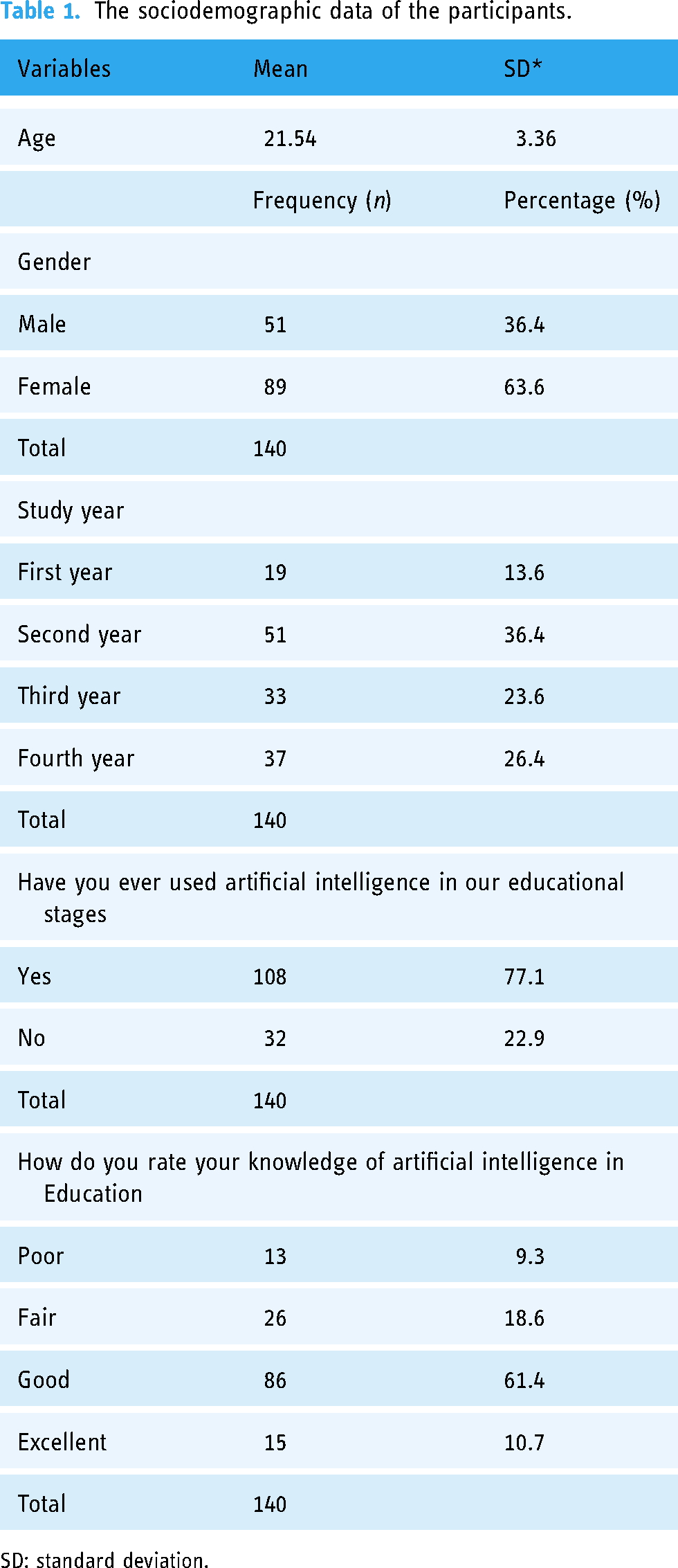
A total of 140 nursing students participated in the study. The mean age was (M = 21.54, SD = 3.36), Min = 18 years and Max = 36 years. The majority of the participants were females (n = 89, 63.6%). The majority of participant are at the second year (n = 51, 36.4%), while the first year (n = 19, 13.6%), third year (n = 33, 23.6%), and fourth year (n = 37, 26.4%).
The majority of the students have used AI in their education stage 108 (77.1%). Thirteen students rated themselves as poor knowledgeable of AI in education which combines 9.3% of total sample size, 26 student rate themselves as fair knowledgeable of AI in education which combines 18.6% of total sample size, 86 student rated themselves as good knowledge of AI in education which combines 61.4% of total sample size, 15 student rate themselves as excellent knowledgeable of AI in education which combine 10.7% of total sample size (Table 1).
The sociodemographic data of the participants.
SD: standard deviation.
Level of AI ethical awareness (TAIEA)
Table 2 shows that the overall mean score of TAIEA was (M = 2.445, SD =0.763), indicating a low level of Ethical Awareness. The highest mean score for the subscales of TAIEA namely responsibility (M = 2.559, SD =1.136), stability and reliability (M = 2.321, SD =1.036), no discrimination (M = 2.154, SD = 0.952), transparency and explanability (M = 2.466, SD = 1.037), people-centric service (M = 2.345, SD = 1.056), employment (M = 2.464, SD = 1.125), permit and limit (M = 2.421, SD = 1.036), and robot rights (M = 2.881, SD = 0.802).
Perceptions of the study variables among the participants.

SATAI: Student Attitudes toward AI; SD: standard deviation.
Level of SATAI
Table 2 shows that the mean score of SATAI was (M = 2.208, SD = 0.962), indicating a negative level of SATAI. The highest negative attitude subscales of SATAI were behavioral component (M = 2.244, SD = 1.013), affective component (M = 2.152, SD = 1.014), and cognitive component (M = 2.239, SD = 1.237).
Level of AI anxiety
Table 2 shows that the mean score of AI anxiety was (M = 2.364, SD = 0.993), indicating a low level of anxiety.
Level of intention-to-use AI technology
Table 2 shows that the mean score of the intention-to-use AI technology was (M = 2.369; SD = 1.228), indicating a low level of intention-to-use AI technology among nursing students.
The differences in AI ethical awareness, attitudes, anxiety, and intention-to-use AI based on sociodemographic characteristics
The independent t-test and one-way ANOVA test were used to detect potential differences based on the sociodemographic, as presented in Table 3. The independent t-test exhibits that there no statistically significant difference in gender with AI ethical awareness (t(138) = 1.438, p = 0.153), and its subscales: responsibility (t(138) = 0.751, p = 0.455), stability and reliability (t(138) = 0.384, p = 0.702), no discrimination(t(138) = 0.572, p = 0.569), transparency(t(138) = 1.680, p = 0.095), people-centric service (t(138) = 0.407, p = 0.685), employment (t(138) = 1.196, p = 0.234), and robot right (t(138) = 1.480, p = 0.141), but there are significant differences among age and permit and limitation (t(138) = 2.020, p = 0.046) which shows that males are higher than female (M = 2.66 SD = 1.164) while female (M = 2.28, SD = 0.938).
The differences between TAIEA, SATAI, AI anxiety, and intention-to-use AI based on demographical data.

SATAI: Student Attitudes toward AI.
Also, there are no significant differences in gender with students attitude toward AI (t(138) = −0.185, p = .0853), behavioral component (t(138) = 0.349, p = 0.727), affective component (t(138) = −0.621, p = 0.535), and cognitive component (t(138) = −0.524, p = 0.601).
Furthermore, there are no significant differences among gender and Anxiety (t(138) = 1.585, p = 0.115) and Intention-to-use AI (t(138) = 0.691, p = 0.491). One-way ANOVA exhibits no statistically significant difference in study year differences in AI ethical awareness, attitudes, anxiety, and intention-to-use AI.
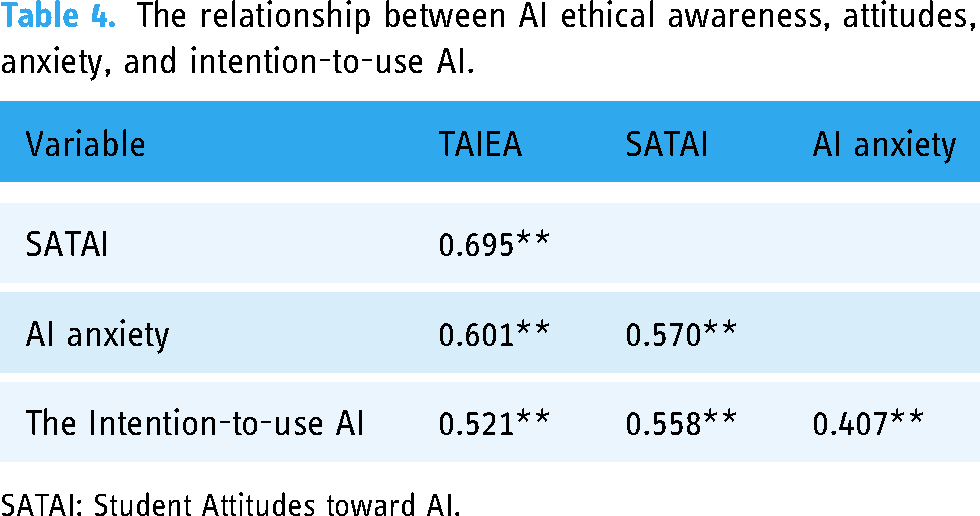
Table 4 presents that Pearson's r was used to determine whether any significant relationships existed among AI ethical awareness, attitude, anxiety, and intention-to-use AI. Artificial intelligence ethical awareness had a significantly strong positive relationship with its subscales responsibility (r = 0.753, p < 0.001), no discrimination (r = 0.767, p < 0.001), transparency (r = 0.837, p < 0.001), people-centric service (r = 0.755, p < 0.001), employment (r = 0.741, p < 0.001), and permit and limit (r = 0.772, p < 0.001) which meant that nurses with high levels of AI awareness had high scores of responsibility, no discrimination, transparency, people-centric service employment, permit and limit, and vice versa. Similarly, AI ethical awareness had a significantly moderate positive relationship with SATAI (r = 0.695, p < 0.001), and the subscale of SATAI cognitive component (r = 0.507, p < 0.001), affective component (r = 0.695, p < 0.001), and behavioral component (r = 0.673, p < 0.001) meaning that nurses with high levels of AI ethical awareness had high scores of SATAI and vice versa. Also, a significantly moderate positive relationship with AI anxiety (r = 0.601, p < 0.001) and intention-to-use AI in his / her study (r = 0.521, p < 0.001) that indicates high score of AI ethical awareness has a high score of AI anxiety and high score to intention-to-use AI.
The relationship between AI ethical awareness, attitudes, anxiety, and intention-to-use AI.
SATAI: Student Attitudes toward AI.
Student attitudes toward AI had a significantly strong positive relationship with his subscales cognitive component (r = 0.815, p < 0.001), affective component (r = 0.939, p < 0.001), affective component (r = 0.942, p < 0.001), also, it had a significantly moderate positive relationship with anxiety (r = 0.570, p < 0.001) and intention-to-use AI (r = 0.558, p < 0.001), which that mean nurses with high levels of attitudes toward AI had high scores of cognitive component, affective components, behavioral component, anxiety, and intention-to-use AI and vice versa.
Anxiety had a significantly moderate positive relationship with intention-to-use AI (r = 0.407, p < 0.001) which that mean nurses with high levels of anxiety had high level of intention-to-use AI and vice versa.
Discussion
The current study's findings show that nursing students have a negative level of ethical awareness about AI, which suggests that the optimal approach to integrating training with AI-related techniques should be the subject of future study. Comparing these findings with a recent study of nursing students in Gyeonggi-do, Korea, which included 189 students from Chung-Ang University, there were mostly similar levels of AI ethical awareness, attitudes, and anxiety, though with minor differences. 4 In a previous study, nursing students scored an average of 3.27 for AI ethical awareness, suggesting a somewhat higher level than in the current study. On the other hand, another study discovered the concerns and awareness of AI practitioners, by Pant et al., conducted another study in Australia with a sample of 100 participants, based on the results, most participants believe that privacy protection and security are important ideas and are aware of the ethics of AI. 24 It was found that different AI practitioners had different opinions about AI ethics. They recommend AI educators include the idea of “AI ethics” in the curriculum to ensure that students are aware of and informed about ethical issues surrounding the development of AI.
In terms of AI ethical awareness among nursing students, the current findings on TAIEA subscales reveal that the highest negative mean score was related to “Robot Rights” (M = 2.881, SD = 0.802), while the lowest mean score was observed in the “No Discrimination” subscale (M = 2.154, SD = 0.952). These results suggest that nursing students are increasingly familiar with AI technologies in educational settings, classrooms, and even at home. This familiarity underscores the importance of incorporating ethics courses or modules into the curriculum to foster greater awareness and critical thinking about the ethical implications of human and AI interactions. This study suggests that a higher level of ethical awareness is emerging among nursing students, ensuring that AI technologies are developed to be fair and unbiased. These findings align with previous studies emphasizing that AI should support human development by enhancing creativity and fostering a collaborative culture. Additionally, the study advocates for the development and deployment of AI systems in ways that benefit all of humanity. 25
According to Stahl and colleagues, investigating organizational responses to the ethical issues of AI, the result showed that organizations are highly aware of the AI ethics debate and keen to engage with ethical issues proactively. 26 These insights are highly relevant for organizations implementing or utilizing AI, contribute meaningfully to the academic discourse on AI ethics, and may be especially valuable for policymakers engaged in shaping effective policies to address the ethical challenges posed by AI.
The study results indicate that nursing students generally hold a moderate attitude toward AI technology. This finding aligns with a previous study that also reported a moderate level of negative attitudes but contrasts with findings that revealed a high level of positive attitudes toward AI technology. 4 Also, another study revealed moderate level of student's attitudes a mean score was 3.24. 27 Also, Sheela's study, which assessed the attitudes of 189 nursing students in Bengaluru, India, about AI, found that 37% of students had positive attitudes and 63% had negative ones that indicate a low level of attitudes toward AI technology. 28
In this study, the SATAI instrument was used to test and quantify the attitudes of students concerning AI. In contrast to the general attitudes toward AI measure, which was employed in earlier research,4,29 this measure is distinct. As demonstrated by the developers Suh and Ahn, 23 none of them were verified especially for AI education, which made them unsuitable for the current study's assessment of students’ attitudes regarding AI. The three components of attitudes the affective, behavioral, and cognitive components were examined specifically for the purpose of selection. 23 Contrary to the current findings, which indicate that the affective component has the lowest represents students’ attitudes toward AI. In comparison with the study, Suh and Ahn 23 performed a survey of 305 primary, middle, and high school students in Seoul, Korea. The average of these students’ attitude toward AI considering the affective component was the highest average.
This study is significant as it specifically examines attitudes toward AI education among nursing students in Jordan. Additionally, it holds potential to advance future nursing research in this area. In contrast to other studies assessed attitudes toward STEM education30–32 as well as various forms of technology-enhanced learning.33,34 Previous studies have shown that the elements explaining attitudes toward AI might differ depending on the type of attitude under investigation. Thus, this study is interest in AI adoption, usability, and student attitudes. The results underscore the essential role of experiential learning techniques in cultivating positive attitudes and perceptions about AI among students, offering valuable insights that can inform the design of AI education curricula.
The current study indicated that nursing students experienced a low level of anxiety related to AI, and the AI anxiety average was (M = 2.364, SD = 0.993). Kwak and colleagues’ 4 earlier research results were contrasted with these findings, a mean anxiety score was 3.28, which was similar to another study conducted to identify the dual mediating effects of anxiety to use and acceptance attitude toward AI on the relationship between perception of and intentions to use AI among nursing students in South Korea. 35 The result showed a low level of AI anxiety (M = 3.27) that's align with the result of current study. In contrast, Kim study, that sought to identify the factors affecting university students’ intentions and attitudes toward AI technology in healthcare using the UTAUT model. The average anxiety factor was found to be 3.36 for the 278 participants, who were healthcare students from different colleges, 27 which mean inconsistent with the current study.
The average score for AI intention was (M = 2.369, SD = 1.228), suggesting a moderate degree of students’ intention, the findings result congruent with the study of which was 3.23 for intention to use as a moderate level on average. 27 Following a comparison of these findings with those of a prior study conducted by Kwak and Colleagues, 4 it was found that the mean of intention-to-use AI score in the prior study was 3.79, that indicates a high level of intention-to-use AI, which is incomparable to the present study.
According to Labrague et al.'s study, 36 the attitudes and intentions of 202 nursing students toward the adoption of AI technology were examined. The study results indicate that student nurses indicated strong intention-to-use AI technology, had good attitudes toward AI, and had favorable evaluations of AI's application in nursing practice. Also, another study showed a high level of intention-to-use AI technology was (M = 3.59) that not align with the result of current study. 35 Another study conducted 289 nursing students in three Korean nursing schools to determine whether factors influence nursing students’ intention-to-use chatbots and if they are aware of their use. 37 The average awareness of chatbot use was 3.49, which indicates a high level of students’ awareness among the nursing students and high level of intention-to-use AI technology such as chatbot.
There are significant gender differences in permission and limitation (t(138) = 2.020, p = 0.046), with males scoring higher than females (M = 2.66 SD = 1.164) and females rating lower (M = 2.28, SD = 0.938). Comparably, research looked into how gender differed in AI-based technologies, which are now essential for teaching and learning in higher education. 38 The study contended that gender is noteworthy in determining students’ utilization of AI-based educational technologies, drawing from data from 128 higher education students in Ghana. The study's findings indicated that women are less likely than men to think favorably of AI-based learning resources in the classroom. In several studies, males have indicated higher positive attitudes toward AI.38,39
The results indicated that participants in the third year 23.6% of sample (n = 33) nursing students (M = 2.56, SD = 0.830), and fourth year 26.4% (n = 37) exhibited the highest level of AI ethical awareness compared to other years, which is supported by with the work of Kwak and colleagues, who found the third- and fourth-year students had shown significantly higher AI ethics awareness. 4 And similar to study by Tubaishat 40 who investigated the nursing students’ attitudes toward technology, found that since they had more opportunities to engage in technology instruction, fourth-year nursing students had the highest positive attitudes toward technology. According to Kim, investigated that accumulating expertise and exposure to AI technologies fosters a positive attitude of the technology's apparent utility. 27 Moreover, it may enhance students’ motivation to use AI. This aligns with recent research, as students in their final years apply their knowledge, increasing their awareness of AI's role in learning nursing skills and encouraging them to incorporate this technology.
The findings of the current study showed that most students (61.4%, n = 86) rated their knowledge of AI in education as good, which is consistent with the findings of Ampofo and colleagues, who conducted a study among imaging students in Ghana, where a majority (72.9%, 132/181) of the students expressed that they have a general knowledge of AI, 41 and another study by Gong and et al., 42 where 78.9% of the 322 Canadian medical students’ respondents Also, a study conducted in India showed that 53% of the nursing students had previous knowledge about AI and 47% had no knowledge about AI among nursing students. 28 According to Kwak and colleagues found about 81% of the participants in previous study responded that they had no experience in AI education. 4 This result is in contrast to the results of the current study, where the majority of the students (77.1%, n = 108) had prior knowledge or had used AI in education. Additionally, this result is in keeping with earlier research which suggests that views toward and interest in using AI technology were positively influenced by knowledge and awareness of AI. 43
The study reveals a significant positive correlation between behavioral intention to adopt AI technology and AI ethical awareness. Consistent with study emphasized the importance of preserving flexible ethics in the context of AI's significant societal impact. 44 The study suggested that a careful and iterative approach to analyzing the environment and perceptions, which corresponds with the current study's focus on ethical awareness and nursing students’ willingness to use AI technology. Also, Study have shown that awareness significantly influences people's intention-to-use technology, highlighting the significant relationship between behavior intention and awareness. 45 The study is also in line with research that highlights how raising knowledge of AI ethics might encourage the use of AI and boost nursing students’ intentions to utilize it. Moreover, research conducted with Tajikistani journalism students revealed that training on the ethical, technical, and practical aspects of applying AI in journalism, together with exposure to the tool ChatGPT-3, increased the students’ writing and critical thinking skills. This study implies that, depending on students’ desire to interact with AI tools, it may be possible to improve critical thinking with the help of AI. The interactive nature of the tool offers suggestions and improvements that encourage deeper thought and cooperation. 46
The results revealed a substantially moderate positive link between ethical awareness and anxiety connected AI (r = 0.601). In contrast, A study found a weak negative correlation between ethical awareness and anxiety related to AI (r = −0.13). 4 This pattern supports the idea that lowering anxiety levels and being aware of AI's potential benefits for healthcare might help. 27
Interesting results were found in the current study, which examined the association between attitudes toward AI technology and behavioral intention-to-use AI. The result indicated a moderate positive correlation between them this result aligns with Kwak et al.'s study 4 result showed a moderate positive relationship between the positive attitudes toward AI and the intention-to-use AI technology. A study also found that favorable attitudes toward AI had an impact on workers’ behavioral intentions to use AI in a variety of contexts, including computer use, sports, and education. 47 A positive attitude toward AI is associated with a larger intention-to-use AI technology, especially in less AI-engaged healthcare practices. 48 And according to Tubaishat, reported students who have a favorable attitude toward information technology (IT) may be more inclined to study it and generate a variety of IT-related ideas. Therefore, as IT usage grows, so will IT-related anxiety, leading to the development of a positive attitude. 40
Moreover, the result reveals a moderate relationship between AI anxiety and student's intention-to-use AI technology (r = 0.407). When comparing the current result with Kwak and colleagues 4 which found a weak negative association between AI anxiety and student's intention-to-use AI technology that's inconsistent with the current results. The current result connects AI anxiety with intention-to-use AI technology suggesting that students who feel anxious about using AI, it can actually make them more intention-to-use AI technology because students want to overcome their anxiety and prove to themselves that they can handle it.
Regarding the relationship between AI anxiety and attitudes toward AI, the study found a moderate positive correlation (r = 0.570). This contrasts with a study conducted in Korea on a sample of 180 nursing students, which found that lower anxiety levels were associated with more positive attitudes toward AI. Anxiety and acceptance serve as dual mediators in the link between nursing students’ perceptions and their intent to use AI, with partial correlation analysis showing that the desire to use AI is influenced by several factors, including perception, anxiety, and acceptance of the technology. The current findings suggest that anxiety may act as a motivator, encouraging students to understand and engage with AI more deeply, which could foster more positive attitudes toward AI technology.
Implications and recommendations
This study provides valuable insights for nursing students and educators, emphasizing the importance of addressing AI ethical awareness, attitudes, and anxiety. By understanding these factors, students can make informed decisions about the use of AI technology and integrate it effectively into their learning. Identifying the components associated with AI ethical awareness, attitudes, and anxiety—and examining how they influence students’ intentions—allows nursing students and educators to recognize the significance of supportive learning environments.49,50 This knowledge empowers students to make well-informed choices about their educational pathways, prioritize well-being, and enhance learning satisfaction. Furthermore, integrating AI into nursing education can improve students’ academic performance and competencies, preparing them for clinical practice.
The study underscores the importance of raising ethical awareness when adopting AI in nursing education to maximize its benefits across learning levels. Integrating comprehensive ethical training programs into the nursing curriculum helps students develop critical thinking, moral reasoning, and self-awareness of personal values and biases, encouraging more responsible and accountable AI use. These programs can also alleviate anxiety and boost students’ confidence in applying their knowledge to clinical settings.
Policymakers are encouraged to develop strategies that improve educational conditions, implement supportive practices, and allocate resources effectively. Policies should highlight ethical AI usage, patient safety, and privacy protection while promoting positive attitudes toward AI's potential healthcare benefits. Such informed policies can help nursing students embrace AI ethically, contributing to a well-prepared technological nursing profession.
Strengths and limitations
While this study provides valuable insights into the use of AI in nursing education, its conclusions should be considered with caution due to several limitations. First, the cross-sectional methodology limits the ability to establish causation between AI ethical awareness, attitudes, anxiety, and behavioral intentions. As data were collected at a single point in time, determining the directionality of these relationships is challenging. Future research could employ longitudinal or experimental designs to strengthen causal inferences.
Second, the study's generalizability is limited, as it focuses on a specific sample of nursing students from private universities in Jordan. Therefore, results should be extrapolated cautiously to other populations or educational settings. Additionally, the use of convenience sampling may introduce selection bias, as it depends on participants’ availability and willingness, potentially affecting sample representativeness.
Another limitation lies in the use of self-reported measures, such as questionnaires, which are subject to biases such as social desirability or response bias. These factors may influence the accuracy of students’ reported attitudes and behaviors. To address this, confidentiality and anonymity were emphasized, and clear instructions were provided to encourage honest responses. Future studies could incorporate objective measures or observational data to enhance accuracy.
Conclusions
This study aims to examine the factors influencing nursing students’ intention of adopting AI. The findings shed important light on the levels of behavioral intention toward AI, as well as on variables such as ethical awareness, attitudes, and anxiety about AI, and the effect of demographics on participants’ attitudes, anxiety, and intentions to use AI technology.
While limitations exist, the study has important implications for the nursing profession, policymakers, healthcare organizations, and the Ministry of Higher Education in understanding and addressing the influence of ethical awareness, attitudes, and anxiety on the intention-to-use AI technology among nursing students in Jordan.
Footnotes
Acknowledgment
The authors extend their appreciation to Princess Nourah bint Abdulrahman University Researchers Supporting Project number (PNURSP2024R444), Princess Nourah bint Abdulrahman University, Riyadh, Saudi Arabia.
Author contributions
M.M., M.O., and I.O. performed the literature search, collected and interpreted the data. K.A. and I.O. drafted the work and contributed to the writing of this manuscript. M.M., I.O., M.O., K.A., S.A., and A.A. edited and drafted the final version of this manuscript. I.O. and K.A. reviewed the final version to be published.
Data availability statement
All data that were analyzed during this study are included in this article, and further inquiries can be directed to the corresponding author.
Declaration of conflicting interests
The authors declared no potential conflicts of interest with respect to the research, authorship, and/or publication of this article.
Ethics approval and patient consent
The ethical approval from Zarqa University was obtained with the number of 6/2023. Besides, the ethical approval statements from the selected universities were granted. All participants were assured that their participation was voluntary. Written informed consent was obtained from all participants. All methods were carried out in accordance with relevant guidelines and regulations—Declaration of Helsinki. Respondents were assured that their answers would not be connected with them in any way, and they were not obliged to disclose their names to maintain their anonymity and confidentiality. All information was kept safely on a personal computer with a password.
Funding
The authors disclosed receipt of the following financial support for the research, authorship, and/or publication of this article: The research was funded by Princess Nourah bint Abdulrahman University Researchers Supporting Project number (PNURSP2024R444), Princess Nourah bint Abdulrahman University, Riyadh, Saudi Arabia.
