




Abstract
Access to timely oral healthcare services is paramount for any oral healthcare system, as good oral health contributes to overall quality of life and wellbeing. Despite several initiatives’ efforts, there are still persistent deficiencies in accessing oral healthcare. As a result, teledentistry is recognized as a promising and cost-effective intervention to reduce oral health inequalities, enhance patients’ outcomes and experiences, improve oral healthcare providers’ wellbeing, reduce costs, and contribute to environmental sustainability in dentistry. However, there is confusion in its terminology with many interchangeably used terms referring to this concept. Therefore, based on our research on systematic reviews on teledentistry, we define teledentistry as the use of technology for remote oral healthcare delivery between patients and oral healthcare providers or between healthcare providers. Its goals are to facilitate access to care, reduce oral health inequalities, mitigate the economic impact of oral diseases and treatment, and foster interprofessional collaboration.
Background
Teledentistry stands out as one of the most important innovations in oral healthcare, not only from a technological perspective but also from a cultural and social point of view. Originating from the concept of dental informatics during the 1990s, it was defined as “the practice of using telecommunication technology to make a diagnosis and subsequently provide advice on treatment over a distance.” 1 Teledentistry includes two forms of modalities such as the “real-time consultation” and the “store and forwarding” method. 2 Its applications can overcome the sociodemographic and economic challenges such as the ageing population, mobility of citizens, people with special needs, and living in rural, remote, and urban areas by improving access to care, reducing costs, hereby achieving equity and environmental sustainability.3–6
In the initial years following the introduction of teledentistry, its implementation was slow and mainly perceived for individuals living in remote and rural regions. However, the COVID-19 pandemic catalyzed the interest and transition toward digital healthcare, where teledentistry was suggested as a necessity to improve the continuity of healthcare anywhere. 7 Since then, publications on teledentistry have risen at an exponential rate. 8 However, this concept remains inconsistently used in the literature with ambiguity regarding its definition, resulting in confusion and challenges to its understanding and communication between various stakeholders.
This inconsistency has been driven by the different purposes (all legitimate) that various stakeholders within care systems attribute to this term. For example, it can be driven by differing points of view (e.g. clinical vs. managerial; professional vs. patient; general vs. specialist; public health, clinician). Teledentistry has been defined in different ways, with a recent study highlighting the critical role that the distance plays between the stakeholders involved. 9 Thus, the purpose of this study is to bring clarity to the meaning of teledentistry using the definitions introduced by various authors of systematic reviews on teledentistry. It aims to provide a comprehensive definition of teledentistry to foster effective communication among interested stakeholders and facilitate its implementation for improved access to oral healthcare. A better understanding of the meaning and perspectives of teledentistry could impact its use in research, policy, and practice.
Methods
This short communication is part of a comprehensive overview of systematic reviews on the access to, and the quality of care with teledentistry.10,11 The search strategy was developed with the support of a librarian and was conducted from the inception of the databases until March 2024. It has been conducted in eight electronic databases such as MEDLINE (Ovid), Embase, CINAHL (EBSCO), Web of Science, The Cochrane Library, Epistemonikos, Academic Search Premier (EBSCO), and Proquest Dissertations & Theses. Teledentistry was considered as encompassing both modalities, along with mHealth, as its subset. 12 There were no restrictions on language or publication date. However, we excluded systematic reviews (SRs) which did not perform formal methodological quality or risk of bias assessment, or those that did not conduct the search strategy in at least two databases.13–15 Two independent reviewers performed study selection, data extraction, and data synthesis. Any discrepancy throughout the process was resolved by discussion or consultation with a third reviewer.
Results
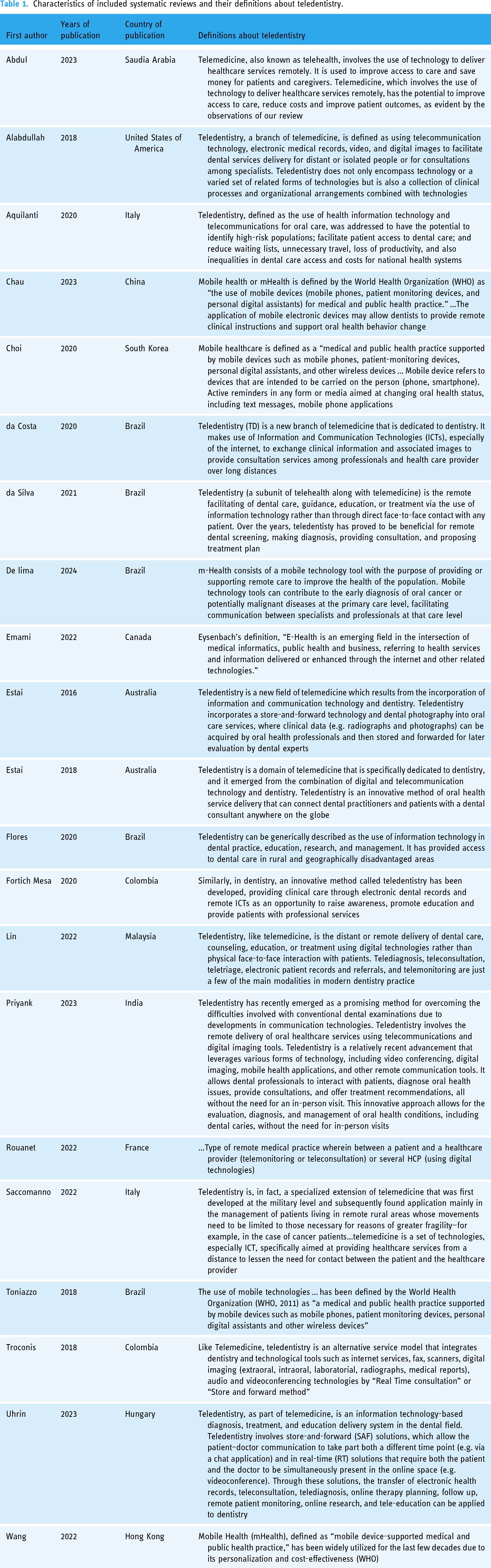
The overview included 30 systematic reviews that met the eligibility criteria (Table 1).3,4,16–43 Among them, only 21 SRs (70%),3,16–26,28,30,31,34,37,41–44 provided definitions of teledentistry, whereas 6 SRs,4,27,35,36,39,40 emphasized the goals of teledentistry and 3 SRs did not define teledentistry.32,33,38 Overall, teledentistry was used as an umbrella term for the delivery of oral healthcare using digital technologies. The terms referring to teledentistry included remote oral healthcare, mHealth, e-oral healthcare, telehealth, or telemedicine in dentistry, and just as telemedicine. Among the 21 SRs, 9 SRs (43%),16,17,19,21,22,25,29,34,41 referred to teledentistry like telemedicine or a subset or extension of telemedicine. Five SRs (24%) defined mHealth,18,20,27,42,43 among which four SRs,18,20,27,43 cited the World Health Organization's definitions of mHealth. One SR 45 referenced Eysenbach's definition of eHealth. 3 Other SRs described teledentistry as an integration of communication technology (ICT) and dentistry,16,25,27,30,44 or a combination of clinical processes, organizational arrangements, and digital technologies. 16 Several SRs referred to teledentistry using the words “remote/distance/at the globe/without in-person/online space.”17,19,21–23,28,31,34,37,43,44 Among these, the concept of “remote” was commonly cited.19,22,23,28,31,34,37 The term “technology” was explicitly mentioned by various authors in their definitions of teledentistry.3,16,17,21–25,27,28,30,31,34,37,41,42,44
Some digital devices were reported such as information and communication technologies,16,25,27,30,44 digital technology, electronic dental records, 16 store-and-forward technology, 25 dental photography, 25 and audio and videoconferencing technologies. 37 In addition, the authors indicated the tools used such as fax, scanners, 41 and digital imaging tools.16,37 Some definitions highlighted the process of care and the outcomes. The applications of teledentistry included oral healthcare delivery, specialist consultations, education, management, treatment planning, and diagnosis.16,19,21,23,24 The relationships between people involved in these clinical interactions were addressed in a few SRs, which mentioned the interactions between patients and healthcare providers, 22 only between healthcare providers 17 or including both.28,29 The reported goals of teledentistry were to facilitate access to dental care and reduce time, travel, loss of productivity, costs and inequalities in dental care access.23,30,31,44 Reflecting on the variations among the definitions and perspectives, it is evident that teledentistry can be used in different contexts and has many purposes for oral healthcare (clinical and public health). As a result, teledentistry should not be solely regarded as a means to managing oral health diseases since its principles extend to the wider definition of promoting health and wellbeing. 17
Discussion
The purpose of this study was to provide a comprehensive definition of teledentistry to foster effective communication between interested stakeholders to improve its use in research, policy, and practice. Our research provides a thorough and timeless analysis of the definitions of teledentistry to capture the full range of meanings and interpretations. As the understanding of teledentistry continues to evolve and be debated, these compilations of definitions serve to broaden the researchers’ perspectives. Drawing on the definitions included in our overview of SRs, 7 we define teledentistry as “the use of technology and various devices (e.g. video, audio, secure message) for remote oral healthcare delivery between patients and oral healthcare providers or between healthcare providers, aiming to facilitate access to care, reduce oral health inequalities, mitigate the economic impact of oral diseases and treatment, and foster interprofessional collaboration.” This definition presents teledentistry as a comprehensive approach to oral healthcare delivery, encompassing four fundamental components: (i) separated location between stakeholders engaged in the patients’ oral healthcare, (ii) use of information technology as a substitute for in-person interactions, (iii) staffing to carry out required functions (including dentist, dental hygienist, and other healthcare providers), (iv) the goals of these interactions. Therefore, teledentistry represents a complex and social innovation where both human and technological factors play a necessary role. A review of the definitions of teledentistry is essential to ensure clarity, consistency, and a comprehensive understanding, which will contribute to rigorous research, effective practice, and informed decision making in dentistry.
Overviews of systematic reviews offer a powerful means for synthesizing evidence from a broad area of research in an efficient and readily accessible way. Thus, from this context, reviewing various definitions of teledentistry will help to reduce the inconsistencies in how the concept is defined, allowing for better comparison and replication of studies informed by previous studies. This compilation and the proposed definition can also improve the communication and collaboration between various stakeholders for translating research into practice and advancing digital technologies in dentistry. A comprehensive definition can assist researchers and policymakers in developing and implementing effective strategies to successfully increase the uptake of teledentistry, as well as in evaluating its sustainability and widespread application. Researchers across various disciplines and settings can benefit from the standardization of teledentistry-related interventions and their applications, allowing them to effectively communicate their findings.
This review of teledentistry definitions can also provide oral healthcare providers (OHCPs) greater insights into teledentistry and the related interventions for diagnosis, treatment planning, and preventive care. The OHCPs and their patients can greatly benefit from a clear definition, which can improve their understanding of the concept, inform decision making and enhance the quality of care. The results of this study underscore the critical need to clarify teledentistry for stakeholders, as this clarity is essential for delivering patient-centred oral healthcare. The diversity of opinions and limited perspectives in some studies highlighted the importance of this compilation on teledentistry to ensure its effective implementation and minimize adoption failures.
Limitations
Although this short communication is relevant, it only includes the definitions from the SRs that conducted the search strategy in at least two databases and performed quality assessments.
Consequently, definitions of teledentistry from authors’ knowledge synthesis that did not meet our inclusion criteria or from other primary studies have been excluded. However, teledentistry definitions in SRs are often derived from primary studies, potentially encompassing aspects reported from multiple studies. It is still important to note that the proposed definition is comprehensive, underscoring the tools, involved stakeholders, various mechanisms, modalities, and desired goals, and can be useful for research, policy, and practice.
Characteristics of included systematic reviews and their definitions about teledentistry.
Conclusion
The results of this research reported the different meanings and interpretations of teledentistry, highlighting knowledge gaps about this concept. This compilation is a contribution to the advancement of research to ensure a common understanding and a shared foundation of teledentistry. Through our results, effective communication between interested stakeholders on teledentistry would be facilitated. It is particularly valuable to stimulate discussion and further research, highlighting the importance of teledentistry in research, policy, and practice. However, the successful implementation of teledentistry necessitates the adoption of an inclusive and multifaceted approach to policy and design to ensure that no one will be left behind, as its benefits contribute meaningfully to oral healthcare.
Footnotes
Contributorship
PKT was involved in conceptualization, methodology, formal analysis, writing, and original draft. AR was involved in data collection, data analysis, and writing. Both the authors have read and approved the last version of the article.
Declaration of conflicting interests
The authors declared no potential conflicts of interest with respect to the research, authorship, and/or publication of this article.
Funding
The authors disclosed receipt of the following financial support for the research, authorship, and/or publication of this article: The principal investigator has received a start-up from McGill University's Faculty of Dental Medicine and Oral Health Sciences; Funding Grant Number: 130422.
Guarantor
PKT
