




Abstract
Objective
This study aimed to investigate postgraduate pediatric dental students’ knowledge, practice, and attitudes toward teledentistry and identify potential applications of this technology in pediatric dentistry.
Methods
An online questionnaire was sent to all students through Google Forms. The questionnaire included questions about socio-demographic information, knowledge, practice, and attitudes regarding teledentistry and the use of teledentistry during coronavirus disease 2019.
Results
Before the coronavirus disease 2019 pandemic, only 8.2% of students knew teledentistry. However, this increased to 45% after the pandemic, with differences depending on the student's clinical experience. Teledentistry was reported as useful for medicine taking, follow-up consultations, and diagnosing soft tissue problems.
Conclusions
Integrating teledentistry topics into the dental curriculum can increase awareness and adoption of this technology in pediatric dentistry. Dental students need to be aware of its potential applications.
Introduction
Teledentistry combines dentistry with virtual communication technologies such as computers, cameras, and the Internet. This approach offers consultation, diagnosis, treatment planning, and dental care for patients not physically present at a dental office. 1 There are two modalities of teledentistry: Synchronous (real-time consultation) and asynchronous (store-and-forward method), which enable interactions between dental professionals and patients by forwarding clinical information, radiographs, photographs, and laboratory tests to specialists for consultation. 2 Other teledentistry applications include remote monitoring of treatment progress, providing preventive care and dental education programs, and delivering oral healthcare services.3,4
Teledentistry has proven effective in almost all dental fields, including orthodontics, oral surgery, dental traumatology, and pediatric dentistry. Previous studies have evaluated the utilization and efficacy of teledentistry in different fields, reporting that this tool could enhance oral healthcare delivery.5–9 For instance, a recent study indicated that using teledentistry for orthodontic treatment follow-up reduced the number of appointments and shortened the treatment time by improving appliance tracking. 10 Another study compared the diagnostic accuracy of teledentistry and clinical dental examination in pediatric dentistry, finding no significant difference between the two assessment methods. 11
During the coronavirus disease 2019 (COVID-19) pandemic, dental professionals have increasingly adopted teledentistry to provide remote consultations, triage services, drug prescriptions, and specialist referrals.12–14 This approach has effectively reduced the transmission risk of COVID-19 to patients and staff by minimizing face-to-face interactions and waiting times.15,16 Studies evaluating patients’ opinions on the use of teledentistry during COVID-19 have reported that patients have had a mostly positive experience with this system, and it will continue to be helpful after the pandemic.17,18 Another study investigated the attitudes of dentists and patients towards teledentistry, revealing that the majority of survey participants expressed positive views toward this approach. 19
Although teledentistry has many advantages, there are also some notable limitations. Most patients need procedural activity such as fillings, extractions, and examination, which can be performed only in the clinic.
1
Teledentistry should be viewed as a supplementary tool to augment accessibility to primary dental services rather than a substitute for comprehensive dental care. The limitation of the teledentistry of delivering dental care is that one can perform limited activities
Although most studies have demonstrated the benefits of teledentistry, many dentists and dental students may need to be aware of its potential applications. Therefore, it is critical to comprehensively assess clinicians’ actual attitudes and perspectives regarding this approach to determine its routine applicability. In consideration of the increasing significance of teledentistry and its potential to improve dental care delivery, the present study aimed to explore the knowledge, practice, and attitudes of postgraduate students in pediatric dentistry toward this technology and to identify the potential procedure where teledentistry may be helpful in the clinical practice of pediatric dentistry.
Materials and methods
Study design and participants
A cross-sectional study investigated the knowledge, practices, and attitudes of postgraduate pediatric dentistry students in pediatric dentistry specialty/doctorate program
The online questionnaire was distributed to 127 postgraduate pediatric dentistry students in Ankara via the Turkish Pediatric Dentistry Association listserv between April 2021 and July 2021. A social media application (WhatsAppTM Messenger, Mountain View, CA) was used to share the questionnaire link. The survey was open for 3 months, and the data were collected using Google Forms. A reminder message was sent to all postgraduate pediatric dental students on the list at regular intervals (once a month) to increase the participation rate.
Before participation, the participants were provided with a brief introduction, which included an invitation to participate, a summary of the study, an informed consent form, and a confirmation that all information collected would remain confidential. Participation was voluntary. The inclusion criteria considered all postgraduate dental students in the Department of Pediatric Dentistry who were willing to participate.
Questionnaire
The questionnaire consisted of 21 questions, adapted from similar studies,20–22 and included closed-ended and single-select (Yes/No) questions. Only the last two questions were created so that more than one answer could be given. A pilot study was conducted with a group of 15 postgraduate pediatric dental students, and the survey was administered twice with a 1-week interval between each administration. The questionnaire was modified based on the pilot study results.
The questionnaire included three parts. The first part collected socio-demographic information, including gender, age, the year of postgraduate education, and daily internet usage time. The second part started with two questions: “Have you ever heard of teledentistry?” and “Do you know what teledentistry is?” The participants were then asked a question regarding the definition of teledentistry, followed by 13 questions to evaluate their attitudes and practice regarding previous experience, benefits of teledentistry, dental practice improvement through teledentistry, the use of pediatric dentistry, the use of teledentistry in dental education, and willingness to use teledentistry in the future. The third section comprised three questions regarding the use of teledentistry during the COVID-19 pandemic. Finally, two questions were asked about which procedures teledentistry can be used in pediatric dentistry and the barriers to using teledentistry.
Statistical analyses
The data were analyzed using IBM SPSS Statistics V23 (IBM Corp., Armonk, NY, USA). Descriptive statistics included frequency distributions. Fisher's Exact and Pearson Chi-Square test
Results
One hundred twenty-seven questionnaires were distributed to postgraduate pediatric dental students, and 110 replies were received from Google Forms, indicating a response rate of 86.6%. The participants had a mean age of 28.8 ± 5.8 years (range: 21–35 years), and the majority were female (90.9%). Demographic information on the study participants is provided in Table 1. Table 2 displays the responses of participants’ knowledge, attitude, and practice regarding teledentistry, as well as its association with the year of postgraduate education.
Frequency distributions and descriptive statistics of the participants’ characteristics.

Responses of participants’ knowledge, practice, attitude to use teledentistry, and the use of teledentistry during the coronavirus disease 2019 (COVID-19) pandemic and its association with the year of postgraduation education.
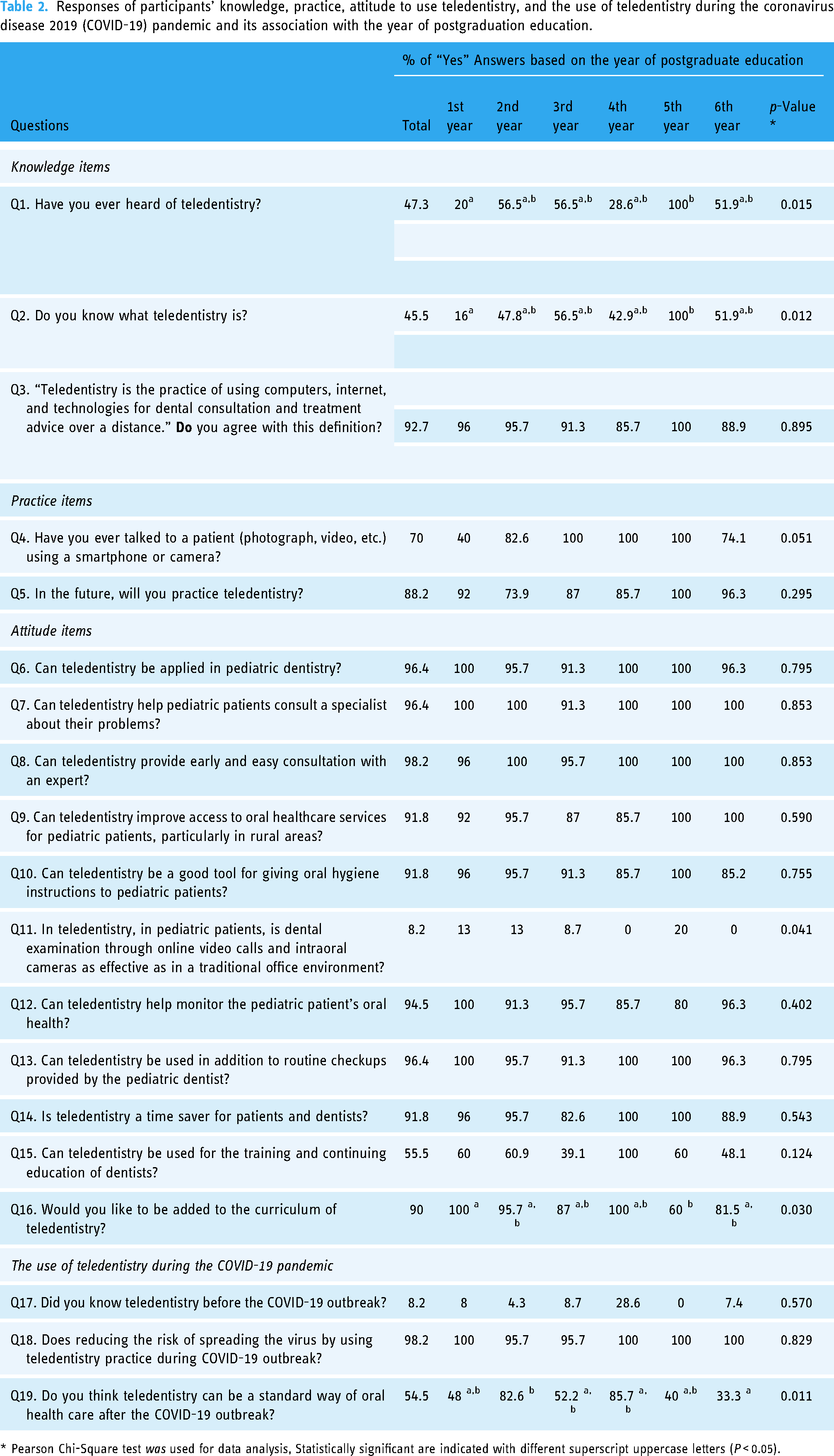
* Pearson Chi-Square test was used for data analysis, Statistically significant are indicated with different superscript uppercase letters (P < 0.05).
The participants’ knowledge of teledentistry was revealed; only 47.3% had heard about it, and 45.5% knew what it was. Significant differences were found depending on dental students’ years of clinical experience (p < 0.05). The knowledge of first-year postgraduate students about teledentistry was the lowest, while fifth-year postgraduate students had significantly higher knowledge about teledentistry than first-year postgraduate students (p = 0.012).
Regarding the practice of teledentistry, 70% of the subjects reported talking to a patient (photograph, video, etc.) using a smartphone or camera, with no significant differences based on years of experience (p < 0.05). When asked about their intention to use teledentistry in the future, 88.2% expressed interest in practicing it, with no significant differences based on the year of education (p > 0.05).
Most participants (96.4%) agreed that teledentistry could be applied in pediatric dentistry and help pediatric patients consult a specialist about their problems. Almost 91.8% of participants believed teledentistry could improve access to oral healthcare services for pediatric patients, particularly in rural areas, and help provide oral hygiene instructions to pediatric patients. While most participants (96.4%) believed that teledentistry could be used in addition to routine checkups provided by the pediatric dentist, only 8.2% of the participants agreed that dental examination using teledentistry is as effective as traditional examination in the office environment. The year of education was significantly associated with the inclusion of teledentistry in the curriculum (p < 0.05).
Before the COVID-19 outbreak, only 8.2% of participants knew teledentistry. However, 98.2% of participants believed that using teledentistry during the COVID-19 outbreak could reduce the risk of spreading the virus. 54.5% of participants stated that teledentistry could be a standard way of oral healthcare after the COVID-19 outbreak, with significant differences depending on participants’ years of education (p < 0.05). A statistically significant difference was observed between the answers of the participants in their second year of education and those in their sixth year.
Table 3 presents only questions with statistically significant correlation among the participants’ knowledge, attitudes, and practice results regarding tele-dentistry
Responses of participants’ knowledge, practice, attitude to use teledentistry, and the use of teledentistry during the coronavirus disease 2019 (COVID-19) pandemic and its association with gender and daily internet usage time.

*Fisher's exact test, **Pearson Chi-Square test were used for data analysis, statistically significant are indicated with different superscript uppercase letters (P < 0.05).
Responses of the participants about the barriers faced in teledentistry (Q20).

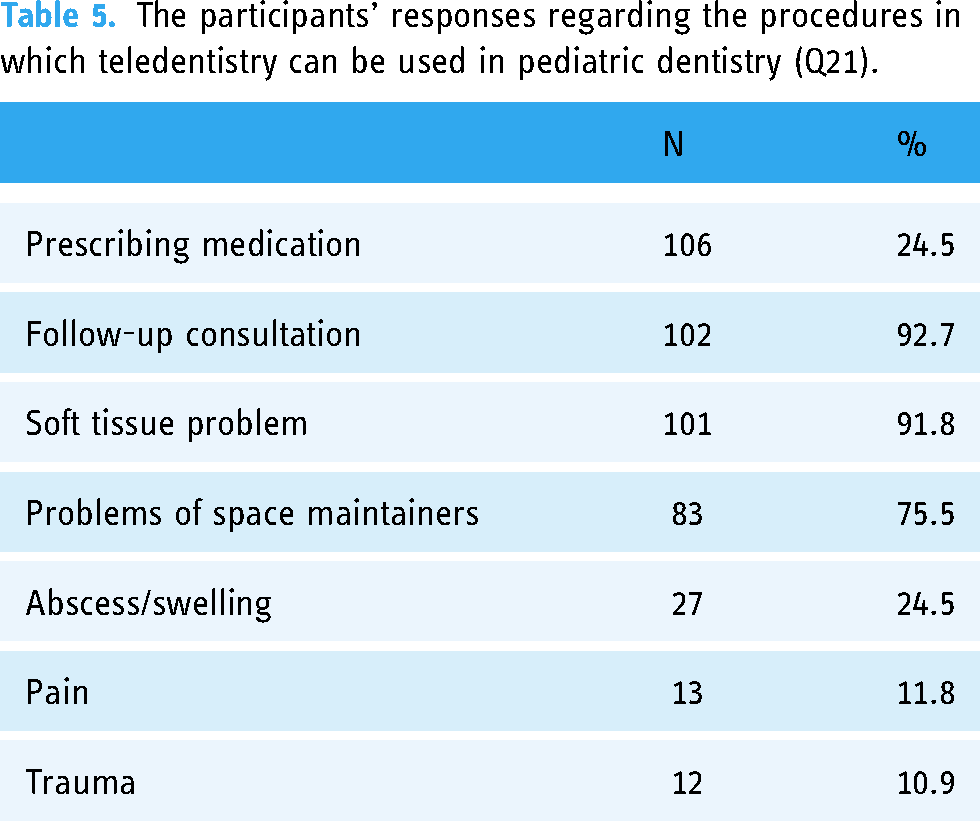
Table 5 illustrates the potential procedures for which teledentistry might be useful in pediatric dentistry practice. Most participants rated prescribing medication (96.4%), follow-up consultations (92.7%), and soft tissue problems (91.8%) as essential uses for teledentistry in clinical practice. Other procedures that were rated highly included space maintainer issues (75.5%), abscesses/swelling (24.5%), pain (11.8%), and trauma (10.9%).
The participants’ responses regarding the procedures in which teledentistry can be used in pediatric dentistry (Q21).
Discussion
The twenty-first century has brought significant changes to the healthcare industry, including the adoption of digital health solutions that have the potential to improve the efficiency, accessibility, and quality of healthcare services. Healthcare providers must adapt to this technological shift, and these solutions must be effectively integrated into existing healthcare systems. 23 In recent years, the dental profession has witnessed a significant surge in the adoption of communication systems and information-based technologies, which have introduced novel paradigms for promoting and preventing oral health. 24 Teledentistry is a technological advancement that can improve access to dental care services and enhance time management for dental practitioners and patients. 25 Although teledentistry is not a new discipline, the emergence of the COVID-19 pandemic has raised attention to its crucial role as a tool for delivering dental services without the risk of infection.26,27
To the best of our knowledge, the first teledentistry system in Turkey was established in the Department of Pedodontics at the Faculty of Dentistry of Necmettin Erbakan University. Abaklı İnci et al. 17 to investigate the satisfaction of parents who received teledentistry service in a pediatric dentistry clinic during the COVID-19 pandemic reported that parents benefited greatly from this technology and would be open to using it after the pandemic. They also reported that teledentistry systems, which offer significant benefits to patients and dentists in pediatric dentistry, are expected to become commonplace soon. Therefore, evaluating the knowledge, practice, and attitudes of postgraduate pediatric dental students who will use this technology is essential.
There are two postgraduate education programs in dentistry faculties in Turkey (1) Specialization (2) PhD The PhD program takes a minimum of 4 years, but an extension of up to 8 years can be taken. However, the specialization program lasts for 4 years, and it can be extended for 1–2 years depending on the student's academic performance
In the present study, nearly half (47.3%) of the postgraduate pediatric dental students had some knowledge of teledentistry. However, one study 21 found that only 17.2% of dental students were aware of this technology. Similarly, the other study 28 revealed that 57.1% of private dentists had never heard of teledentistry. Before the COVID-19 pandemic, the knowledge of teledentistry was relatively low (8.2%); however, the current study observed an increase in awareness, with 45% of participants indicating some understanding of this technology. This finding is consistent with previous studies that have reported an increase in knowledge of teledentistry during the COVID-19 pandemic despite low levels of awareness before the pandemic.1,29 Nonetheless, it is worth noting that almost half of the current study participants needed more teledentistry knowledge. Recent research20,21,30 has demonstrated that this is a common trend among dental students, likely due to a lack of training in the dental curriculum. Therefore, integrating teledentistry into the curriculum could help to bridge the knowledge gap.
Moreover, the present study found significant differences in the level of knowledge of teledentistry among postgraduate dental students, depending on their year of education (p > 0.01). Specifically, as the education year of the students increased, their knowledge of teledentistry also increased. Students in their fifth year of education had significantly higher levels of knowledge than those in their first year. This finding is consistent with a recent study that reported a significant association between years of clinical experience and better knowledge (p > 0.01), with specialists demonstrating significantly better knowledge than dentists and students. 26
Despite the potential benefits of teledentistry, its adoption by dental practitioners has been limited.26,31 It is worth noting that most participants (70%) in the current study reported conducting dental consultations via video/photograph calls with patients using a smartphone or camera. This trend was likely due to the COVID-19 lockdown, which limited in-person consultations. Additionally, many dentists relied on telephone communication to stay connected with their patients, answer emergency calls, and send prescriptions as needed. 28 Before the COVID-19 pandemic, the practice of teledentistry among dentists in Canada was low, but it increased during the pandemic, as reported in one study. 1
Most of the participants in this study exhibited positive attitudes toward the benefits of teledentistry. They acknowledged that teledentistry provides easy and early consultation to pediatric dentists, facilitates access to oral health services for pediatric patients living in rural areas, is a valuable tool for giving oral hygiene practices, helps monitor the pediatric patient's oral health, and saves time for dentists and patients. These findings are consistent with a previous study investigating the knowledge, attitude, and awareness of dentists and dentistry students towards teledentistry. 22 The perceived need for teledentistry among dental students during the COVID-19 pandemic may have contributed to these positive attitudes.
However, the study participants also expressed challenges in using teledentistry. Only 8.2% of the participants reported that dental examination using teledentistry in pediatric patients could be as effective as in a traditional office environment. However, a systematic review has reported that teledentistry has an acceptable diagnostic performance in detecting dental caries. 32 In a recent study on the remote management of emergencies with intraoral photographs in the pediatric dentistry department during the COVID-19 lockdown, 93% of cases were accurately diagnosed using teledentistry alone. 32 A recent study 33 evaluated the reliability of teledentistry in the diagnosis and treatment planning of dental caries in children in mixed dentition. They reported that the reliability of teledentistry is higher in primary teeth than in permanent teeth, and it offers acceptable reliability for the initial diagnosis of caries in children.
Teledentistry has been reported to be a valuable tool in pediatric dentistry for consultation, patient triaging, treatment planning, and follow-up purposes.33–35 In this study, most participants (96.4%) agreed that teledentistry should be applied in pediatric dentistry. When asked which procedures teledentistry can be used for in pediatric dentistry, participants reported that it could be chiefly used in prescribing medication, follow-up consultation, and soft tissue problems. One study 35 evaluated the implementation of teledentistry in pediatric practice during the COVID-19 pandemic and reported that the highest utilization of teledentistry was for eruption concerns and other issues such as ankyloglossia and aphthous ulcers. Teledentistry has uses and implications beyond the triage of acute dental emergencies.
In this study, 55% of participants reported that teledentistry could be helpful for dentists’ training and continuing education. Additionally, teledentistry was found to be a valuable educational resource among postgraduate pediatric dental students, supplementing traditional teaching methods. Its applications extend beyond education, providing a secure and confidential platform for case discussions, which allows multiple users to interpret clinical cases related to diagnosis and treatment.36,37 Recent literature has demonstrated that real-time teledentistry consultations can effectively improve learning for dental students and healthcare professionals. Integrating teledentistry into dental education can enhance student learning, perception, and motivation. 38
While many countries have adopted teledentistry in the face of a surge in cases of COVID-19, the overall adoption of teledentistry has been slow and inconsistent worldwide. While developed countries continue to benefit and expand this technology
This study has several limitations. The low response rate of students in the fourth and fifth years of postgraduate pediatric dentistry education is a limitation. While the doctoral program was suspended during the pandemic period in our faculty, the specialization program was continued. The decrease in the number of students because the training period of the specialization program is more limited in this period may have caused this situation. Therefore, we are cautious in assuming the generalizability of the study findings. In addition, while investigating the potential applications of this technology in pediatric dentistry in the study, more positive results were reflected by focusing on non-invasive applications that can be diagnosed/resolved using teledentistry. It is important to emphasize that dental care opportunities are limited with teledentistry, emergencies (abscess, pulpal inflammation, etc.)
Teledentistry is an effective tool for oral health planning and patient management. Incorporating teledentistry into the curriculum and exposing postgraduate pediatric dental students to its use during their training may increase the likelihood of dentists using this technology in their practice. With the increasing use of teledentistry during the COVID-19 pandemic, providing more information about its application areas and use is vital, leading to greater adoption by specialists. This study provides a basis for further research and development and can inform future efforts to promote teledentistry in pediatric dental practice.
Conclusion
In conclusion, the study results demonstrate a lack of knowledge of teledentistry among postgraduate pediatric dental students. Therefore, there is a need for greater awareness and education about teledentistry among these students. However, most postgraduate pediatric dental students exhibit positive attitudes towards teledentistry. To prepare teledentistry for pediatric dentists to use in their practice and facilitate patient care, the practice of teledentistry should be integrated and emphasized in the dentistry curriculum.
Footnotes
Contributorship
N.A. researched literature and conceived the study. N.A., Z.H.P., and N.A. were involved in protocol development, going ethical approval, patient recruitment, and data analysis. N.A. wrote the first draft of the manuscript. All authors reviewed and edited the manuscript and approved the final version of the manuscript.
Declaration of conflicting interests
The authors declared no potential conflicts of interest with respect to the research, authorship, and/or publication of this article.
Ethical approval
The study was conducted by the Declaration of Helsinki and approved by the Institutional Review Board of the Faculty of Dentistry of Gazi University (approval number: E-21071282-0.50.99-60062; date 25.03.2021).
Funding
The authors received no financial support for the research, authorship, and/or publication of this article.
Guarantor
N.A.
Informed consent statement
Written informed consent was obtained from all subjects involved in the study.
