




Abstract
Objective
The number of citations can be used as an impact marker of research work. This study aimed to determine and characterize the worldwide research productivity on robotic and computer-assisted arthroplasty.
Methods
All accessible publications from 1992 to 2023 on robotic and computer-assisted arthroplasty from Web of Science Core Collection (WOSCC) database were recorded in August 2024. The following aspects were retrieved: cited times, name of author, keywords, institution, country, year of publication, journal, title, topic, impact factor, and H-index. VOSviewer software and Microsoft Excel were conducted to make the bibliometric research visual. The nature of our study is a systematic study and was conducted in China.
Results
1061 articles were included in our study. The total cited times were 27,461 with the average number of 26. The most productive year was 2022, with a total of 158 publications. The United States contributed the highest number of articles (n = 389, 36.66%) and the Hospital for Special Surgery (n = 53, 5.00%) held the leading institution. “Orthopedics” became the dominant topic (n = 894, 84.26%) and the latest keywords “clinical outcomes”, “acetabular cup placement”, and “satisfaction” have mainly appeared since 2020.
Conclusions
Our analysis gives a comprehensive review of related articles on robotic and computer-assisted arthroplasty from past to future. The United States dominated studies of robotic and computer-assisted arthroplasty and a journal about arthroplasty was the most productive one. “Clinical outcomes”, “Acetabular cup placement”, and “Satisfaction” may become the future research hotspots.
Introduction
The earliest recorded attempt at joint arthroplasty was made by Themistocles Glück using the ivory to replace femoral heads of patients whose hip joints had been destroyed by tuberculosis in Germany in 1891. 1 Joint arthroplasty is a proven solution for treating end-stage joint degenerative disease and rebuilding joint functions, which is widely studied in orthopaedics.2,3 Although the progress of surgical management and prosthesis design of joint arthroplasty is obvious, insufficient precision still influences the long-term outcome negatively.4,5 Robotic and computer-assisted arthroplasty have emerged as tools that aim to operate with greater precision and consistency, with the goal to improve clinical outcomes in joint arthroplasty. 6
Bibliometric analysis, based on the characteristics of articles has recently become a popular tool to evaluate scientific work and grab the spotlight of research.7,8 VOSviewer makes networks of articles visible via the Java environment. It presents the current research hotspots and tendency of a special area from different views novelly through density-based clustering and superposition. 9 Nowadays, bibliometrics have been extensively applied in different research fields10–12. Recently, many studies have paid attention to robotic and computer-assisted arthroplasty. However, as far as we can tell, only few bibliometric studies were conducted on the limited publications on robotic arthroplasty.13,14 Moreover, they did not address the global research trend, worldwide productivity of the study, limiting its’ usefulness to the field. Therefore, we aimed to use VOSviewer as the core tool for analyzing all accessible publications regarding robotic and computer-assisted arthroplasty for getting a comprehensive understanding of current research status and future hot topics in this area.
Materials and methods
Data source and searching strategy
All accessible peer-reviewed publications on robotic and computer-assisted arthroplasty were searched from the WOSCC database. The retrieval duration was between 1945 and 2023, and the final searching execution time was in August 2024. In this study, we took the searching strategy of “article title” to get related findings rather than “article topic”.15,16 The searching terms were “robotic arthroplasty”, “robotic replacement”, “computer assisted arthroplasty”, “computer assisted replacement”, “robot replacement”, “robot arthroplasty”, “robotic arm-assisted arthroplasty”, “robotic arm-assisted replacement”, “computer navigation arthroplasty”, “computer navigated arthroplasty”, “computer navigation replacement”, “computer navigated replacement”, “3D printing arthroplasty”, “3D printing replacement”, “3D planning arthroplasty”, “3D planning replacement”, “Three-dimensional printing arthroplasty”, “Three-dimensional printing replacement”, “Three-dimensional planning arthroplasty”, “Three-dimensional planning replacement”, “Image-derived instrumentation arthroplasty”, and “Image-derived instrumentation replacement” with the use of the “OR” operator.
Publication selection criteria
Two individual authors read the abstracts or full contents of articles regarding robotic and computer-assisted arthroplasty. If necessary, another author was involved to solve their disagreements. The publication type was refined as article or review. Meeting abstracts, letters, corrections, notes, or editorial materials were excluded. References of selected publications were screened for extra related manuscripts. Detailed selection criteria and inclusion procedure of this study were shown in Figure 1.
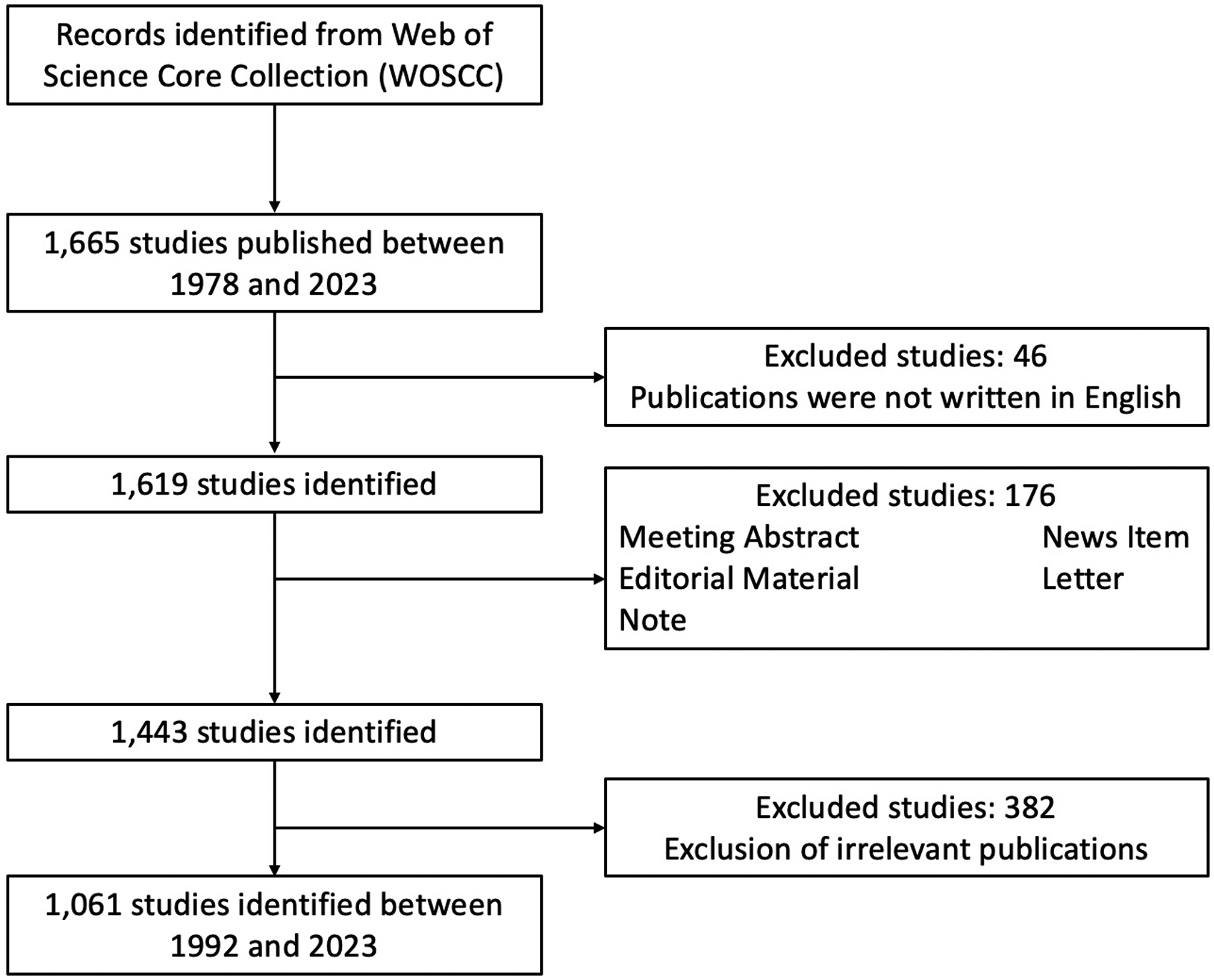
Flow diagram of screening process concerning robotic and computer-assisted arthroplasty research.
Data extraction
Several characteristics of selected articles extracted from the WOSCC database comprised: cited times, name of author, keywords, institution, country, year of publication, journal, title, topic, impact factor (IF), and H-index. The H-index is considered as a standard approach for assessing scholarly performance, which attempts to measure both the productivity and impact of a researcher's work with a balanced principle. The higher H-index number, the stronger influence of researcher's scientific work. 17
Statistical analysis
Microsoft Excel and GraphPad Prism v. 7.0 (GraphPad, La Jolla, CA, USA) were used to analyze the bibliometric characteristics. VOSviewer 1.6.16 was conducted to visualize the authors’ co-citation, references, the co-occurrence of keywords and topics. Here, thickness of the line among colored nodes represented the total link strength, while the scale of colored nodes indicated the quantity of articles on bibliographic coupling. Different colors stood for different clusters in the network maps.
Results
Publication output
The number of 1061 articles from WOSCC were included based on our inclusion criteria. The total cited times were 27,461 (19,556 without self-citations) with the average number of 26. The H-index of all selected articles concerning robotic and computer-assisted arthroplasty was 78. The literature with the highest number of citations was released in the year of 2004 by Bathis. H. 18
Year of publication
The distribution of publication year was from 1992 to 2023 with the amount of articles and annually average citations both generally increasing (Figure 2). The most productive years were 2022 (n = 158), followed by 2023 (n = 152) and 2021 (n = 151).

Publication and citation trends on robotic and computer-assisted arthroplasty between 1992 and 2023.
Topics of publications
In all included publications, “Orthopedics” was the dominant topic (n = 894, 84.26%), followed by “Surgery” (n = 510, 48.07%) and “Sport Sciences” (n = 144, 13.57%) (Figure 3).
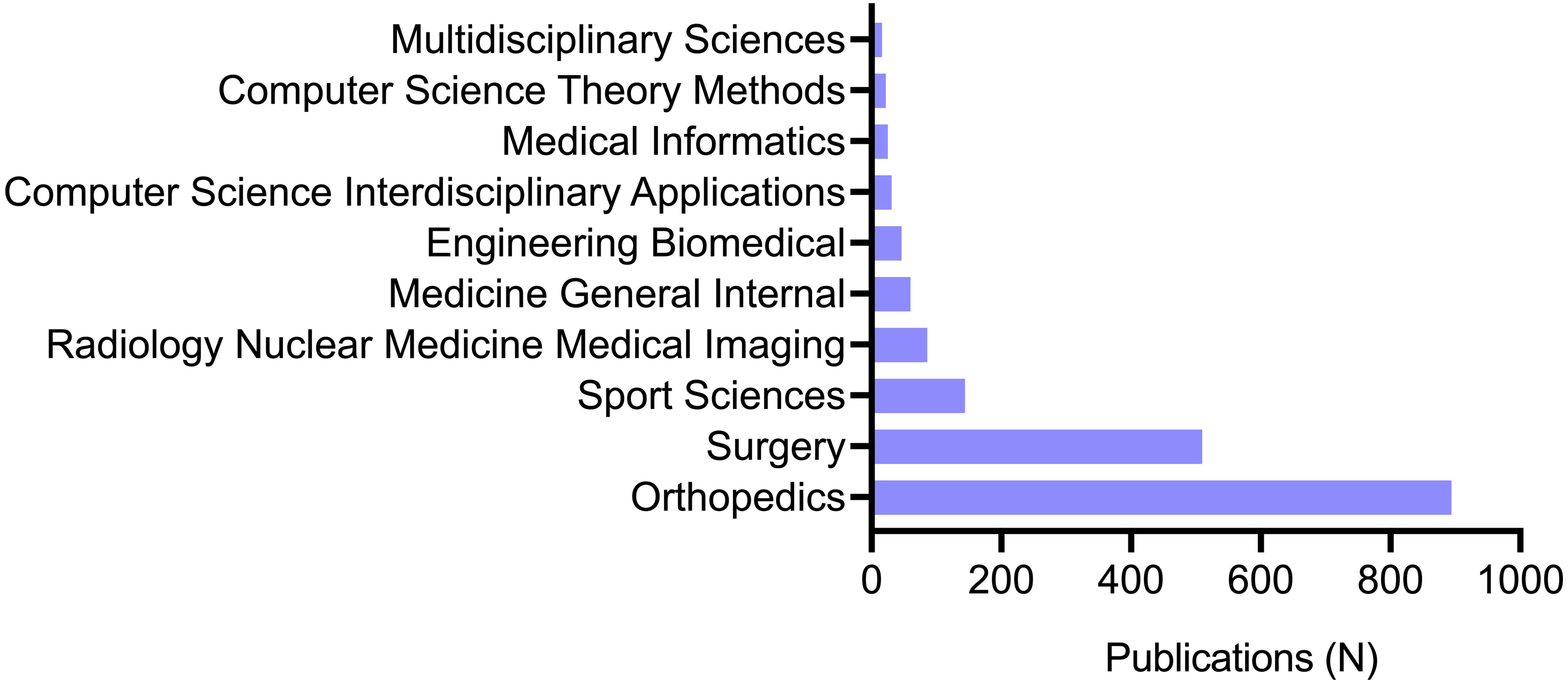
The most prominent research topics in the field.
Publication journals
All included manuscripts were found in 110 different journals. One journal related to joint arthroplasty specifically contributed the most publications (IF = 3.4, n = 156, 14.70%), then the one focused on knee surgery (IF = 3.3, n = 78, 7.35%) and another comprehensive journal of orthopedics (IF = 2.0, n = 68, 6.41%) (Table 1).
Top 10 productive journals of publications on robotic and computer-assisted arthroplasty.

Countries and institutions
The United States held the leading position (n = 389, 36.66%). The United Kingdom ranked the second in the number of articles (n = 106, 9.99%), followed by Australia (n = 91, 8.58%) (Table 2). The top three productive institutions were Hospital for Special Surgery (n = 53, 5.00%), Cleveland Clinic Foundation (n = 41, 3.86%) and Northwell Health (n = 38, 3.58%) (Table 3).
Top 10 contributing countries of publications.

Top 10 productive organizations for the research.

Bibliometric analysis of co-citations
Co-citation analysis of references was based on deducing the similarity among different references through co-cited times, which was one of the most important aspects of bibliometric analysis. Twenty was set for the minimum standard of a cited paper of the whole 12,348 references, 216 satisfied the standard and then they were analyzed (Figure 4). We used VOSviewer to analyze and visualize the total link strength among cited papers. The reference that studied coronal alignment after the total knee arthroplasty with the strongest citation links was published in 1991 by Jeffery RS, which was mostly cited of 148 times and held the greatest total link strength of 2032. 19 A quantity of 8054 authors made contributions to robotic and computer-assisted arthroplasty. Twenty was set for the minimum standard of an author's cited times and 308 matched the threshold. Kayani B owned the top cited times of 546 and led the position in total link strength of 10,664 (Figure 5).


Bibliometric analysis of co-occurrence
Co-occurrence analyzing networks were presented via VOSviewer, which contained 300 terms with a minimum of five occurrences from total 2184 keywords and was divided into seven clusters (Figure 6(a)). Individual cluster was indicated by a specialized color. The occurrence incidence of keywords was positively correlated to the size of circle. Keywords with the highest occurrence rate were “replacement”, “alignment” and “navigation”, with 461, 299 and 234 occurrences, respectively. The new research trends on robotic and computer-assisted arthroplasty were associated with “Clinical outcomes”, “Acetabular cup placement”, and “Satisfaction” (Figure 6(b)).

Discussion
Since the technique of robotic and computer - assisted hip arthroplasty and image-free system for total knee replacement were firstly utilized in 1992 and 1997 respectively, arthroplasty operations applied with assistance are increasing yearly4,20–22. This indicates orthopedic surgeons pay more attention and interests on robotic and computer - assisted arthroplasty. In addition, research productivity is an important perspective to evaluate academic achievements of researchers. Consequently, a higher H-index score stands for an upper scholarly rank. 23
Herein, bibliometrics were applied to obtain the research status and tendency on robotic and computer - assisted arthroplasty from 1992 to 2023. Based on keyword co-occurrence analysis, we concluded characteristics of hot topics and predicted the future research trends. Our study might provide scholars with valuable insights and suggestions for further research.
In the last 30 years, articles pertaining to robotic and computer-assisted arthroplasty have increased apparently, with a high rise from 2018 to 2022. This is consistent with publication trends on different sub-specialization fields like revision arthroplasty and femoroacetabular impingement, which can be illustrated by the elevated expectations to share medical research outcomes with scientific communities.11,24,25 There were 110 journals contributing to 1061 publications in total. The top three journals are forerunners of orthopedic research, containing different sub-specializations like arthroplasty, knee surgery, and so on. Notwithstanding the IF of one journal corresponding to arthroplasty specially is not the highest, owning to it is one of the few journals that concentrate on hip and knee arthroplasty uniquely, it contributed the most articles. Researchers focusing on robotic and computer - assisted arthroplasty may pay more attention to these journals. The United States had the dominant position in the number of total articles, citations, and H-index. Meanwhile, the top three productive institutions including Hospital for Special Surgery, Cleveland Clinic Foundation, and Northwell Health were all from the United States. This suggested that the United States dominates research on robotic and computer - assisted arthroplasty, the reason might be due to sufficient health insurance coverage as well as the economic founding from academic institutions.26,27
Information on the influential publications is a beneficial index for bibliometric study, which is widely used in other research fields.11,28 The most cited article was released in 2004 by Bathis. H, comparing the alignment in total knee arthroplasty (TKA) between computer-assisted and conventional operation, which showed an improved alignment correction and position of components in computer-assisted procedure. 18 However, long-term clinical conclusion and functional rehabilitation remain controversial and need deeper study.29,30 The reference with the strongest citation links studied coronal alignment after the total knee arthroplasty, which was published in 1991 by Jeffery RS. 19 Both these two influential publications were focused on the alignment in TKA. Traditionally, the purpose was to reach a neutral mechanical alignment to maximize implant longevity in TKA, which was considered as the gold standard. 31 However, this concept has become controversial with the recent spike in personalized alignment techniques. 31 For restoring natural knee kinematics and improving functional restoration after operation, implant positioning with assistance to enhance individualized alignment accuracy and soft tissue envelope is of critical importance.
Based on the co-occurrence visualization map, we found that “replacement”, “alignment”, and “navigation” were the most frequent mentioned keywords in this research field. Total knee and hip replacement with assisted navigation have several benefits containing dynamic perioperative evaluation, improved correction of malformation, kinematics and mechanical axis, higher alignment precision of components, longer utilization time of prostheses and an enhanced function recovery.32,33 Although the advantages are well documented, the uptake rates of assisted navigation arthroplasty vary from country to country, which might be explained that the cost of navigation systems is higher than that of conventional systems and the charge of robotic-assisted surgical operation is still worth to be furtherly investigated according to present publications.32,34 Furthermore, the new research trends were “Clinical outcomes”, “Acetabular cup placement”, and “Satisfaction”. The specific purpose of assisted arthroplasty is to improve operation process for more reliable prognosis and better clinical outcomes, which can improve patients’ satisfaction.35,36 Accurate personalized acetabular cup placement is essential for clinical prognosis after total hip arthroplasty (THA) and malposition is considered as a risk parameter for causing postoperative complications. 37 However, the adoption of robotic-assisted operation is still at the outset in contrast to knee replacement. 38 We have reasons to believe THA with assistance attempts to solve issues by providing improved technical accuracy, thus, enhancing clinical outcomes and the ability of risk analysis.37,39,40
Comparing to conventional joint arthroplasty, as a relatively new technique, different aspects need to be considered when conducting assisted arthroplasty. Firstly, the number of operations ought to be large enough so that surgeons can complete the learning curve fast. Secondly, the assistance itself needs to be unequivocal and not over surgical abilities. Thirdly, the establishment of a novel approach relies on technical improvement, experience, and personal learning curve too. Learning curves exist in assisted THA and TKA, previous research about learning curve has informed a substantial reduction in surgery time and perioperative complications with operators’ increasing skills.4, 41 Perioperative complications, recurrences, and conversion rates which are necessary for completing a surgeon's learning curve differ in different types of arthroplasties.41,42
This study has several limitations. At first, only specified publications (English writing, article or review) were contained in our analysis, which might ignore some high-quality studies written in different languages and cause biased results. Second, we sought to find only relevant publications on robotic and computer-assisted arthroplasty, thereby the searching scheme of “article title” rather than “article topic” was applied. Perhaps this could exclude few, but probably a negligible amount of relevant publications. Third, although the WOSCC database is commonly utilized in the world, it might not consist of specific publications which are recorded in Google Scholar or PubMed. Finally, H-index and number of citations only represent present conditions of related studies when we made the analysis, which is unable to eliminate the influence of time to new literature and citations.
Conclusions
The current understanding of robotic and computer-assisted arthroplasty has improved considerably during the past thirty years in diverse approaches. In conclusion, this bibliometric study provides a comprehensive review of related publications in this research area from past to future. The United States dominated studies of robotic and computer-assisted arthroplasty and a journal related to arthroplasty specially was the most productive one. “Clinical outcomes”, “Acetabular cup placement”, and “Satisfaction” probably become the future research hotspots. This study may be used as a feasible solution for assisted arthroplasty research, which will benefit patients and specialists in practice.
Footnotes
Abbreviations
Acknowledgements
Not applicable.
Contributorship
BS designed the conception and wrote the original manuscript. LH, SS and XO revised the manuscript. All authors agreed to submit the manuscript.
Consent statement
All contributing authors have given the submission consent. In addition, patient consent is not required for this manuscript as it is a bibliometric study with data obtained from the Web of Science Core Collection.
Declaration of conflicting interests
The authors declared no potential conflicts of interest with respect to the research, authorship, and/or publication of this article.
Ethical approval
Not applicable, because this study does not include any human or animal subjects.
Funding
The authors received no financial support for the research, authorship, and/or publication of this article.
Guarantor
Leiming Hu
