




Abstract
Objective
The types and number of day surgeries have significantly increased, but the construction of the whole process nursing service system (WPNSS) for preoperative education, intraoperative cooperation, postoperative knowledge, and follow-up for day surgery patients is still in the exploratory stage. The aim of this study is to establish the WPNSS for day surgery patients using the Kano model and to preliminarily assess its efficacy.
Methods
WPNSS for day surgery was devised leveraging Internet hospital information systems and patient mobile terminals (WeChat), guided by the World Health Organization's conceptual framework for scaling-up strategies. The system was methodically developed, progressing from defining the overall framework to delineating modular functions and developing specific educational materials and tools. A pilot test was conducted in a hospital in China.
Results
WPNSS, a patient-centric remote education and monitoring system, seamlessly amalgamates health education, online consultations, and follow-up functionalities; offering semi-automated surgical consultations, inquiry services, and postoperative follow-ups, as well as autonomously disseminating perioperative health education content. Comprising both client and server components, patients utilizing the system are inclined to recommend day surgery at the hospital to others
Conclusions
WPNSS delivers personalized and precise health education, consultation, and postoperative follow-up services for day surgery patients. Current results suggest that the WPNSS may improve patients’ experience.
Trial Registration
Chinese Clinical Trial Register (ChiCTR2200066782).
Keywords
Background
Worldwide, with the rapid development of anesthesia and surgery, the frequency and variety of day surgeries are increasing.1,2 In China, particularly in the capital city of Beijing, medical resources have long been strained, leading to the pressing issue of difficulty in accessing medical care and securing hospital stays. Day surgery offers an ideal solution to reduce average hospital stays and expedite bed turnover, garnering strong support from the government and resulting in a significant rise in the number of hospitals offering day surgery services.3,4
Given that day surgery patients typically stay in the hospital for 4–24 h, with a maximum of 48 h, 5 they often lack sufficient understanding of their conditions and postoperative care requirements. Meanwhile, nurses face a heavy workload, struggling to meet the demands for services such as health education, online consultations, and follow-ups for day surgery patients.6,7 In recent years, researchers have explored various methods to address the knowledge and follow-up needs of these patients, including pre-admission group education sessions, 8 video and telephone interventions, monitoring and follow-up, 9 use of paper-based health education materials alongside telephone follow-ups, 10 yielding promising results. However, current electronic nursing platforms for day surgery patients typically focus on individual health education or follow-up systems,11,12 or cater to specific disease types, 13 making it challenging to provide comprehensive nursing services across the entire patient journey. The process and content relevant to preoperative education, postoperative continuity care, and follow-up are currently fragmented, resulting in poor connections. Patients often lack clarity about their surgical schedule, leading to common issues such as preoperative anxiety. The emergence of M-health provides a direction to solve the above problems.
By identifying the diverse needs of day surgery patients, tailored medical services can be provided more effectively. 14 The Kano model, 15 a tool for qualitatively assessing customer satisfaction, has seen widespread adoption in the medical industry to clarify patient needs and enhance the quality of medical services.16,17 Therefore, this study utilized the Kano model as a theoretical framework, building upon previous research that identified the nursing needs of day surgery patients. 18 This study aimed to create a whole-process nursing service system (WPNSS) for day surgery patients, offering comprehensive nursing care from preoperative consultations to postoperative follow-ups. Such a system holds significant practical implications for hospitals striving for high-quality development and for improving patients’ access to medical care.
Methods
This study constitutes a two-arm implementation study. The development and updating of WPNSS occur in four steps: (1) establishing the overall framework; (2) configuring modules and functions; (3) developing educational materials and online systems; and (4) conducting a pilot study. The developmental process adheres to a four-stage implementation model encompassing preparation, pilot, scale-up, and maintenance. 19 During the preparation stage, the Kano model questionnaire was utilized to assess the holistic nursing service needs of day surgery patients. 18 Subsequently, the WPNSS was constructed and piloted for patients undergoing day anorectal surgery, later expanding the framework to encompass 24 common types and diseases of daytime surgery, such as cataract, macular edema, and hysteroscopy. In the maintenance stage, the contents of WPNSS for day surgery patients with different diseases undergo constant updates. These updates are made in accordance with evidence-based developments.
Step 1: Build the overall framework of the WPNSS based on the Kano model
Establish a research team
In December 2021, a multidisciplinary team of experts was assembled, including the director of nursing, nursing clinical director, surgical nurse, senior clinical nurse, specialist nurse, nursing graduate student, and information center engineer. Responsibilities were divided among team members as follows: the director of nursing and nursing clinical director oversaw design and quality control; surgical nurses and nursing graduate students were responsible for evidence retrieval and system maintenance; senior clinical nurses and specialist nurses supplemented the health education knowledge base and promoted the system; and information center engineers built the system interfaces.
Analyze the Kano attribute of nursing service demand in the whole process
The Kano model 15 categorizes system or product functionality into five distinct attributes: Must-be (M) qualities are fundamental, determining whether a product or service is deemed complete; One-dimensional (O) qualities adhere to the conventional wisdom that customer satisfaction is linear; it increases proportionately with improvements in product/service quality and vice versa; Attractive (A) qualities are unexpected and elevate customer satisfaction disproportionately; Indifferent (I) qualities are those whose fulfillment level does not impact customer satisfaction; Reverse (R) qualities are those that, paradoxically, dissatisfy the consumer when present.
Concurrently, based on the Kano attribute analysis, satisfaction and importance can be quantified, leading to the construction of an important-satisfaction matrix. This matrix comprises four quadrants: The first quadrant: Advantage area, where a failure to meet satisfaction results in a significant decrease in satisfaction; The second quadrant (Area to be Improved): Characterized by low patient satisfaction, indicating a key area for improvement; The third quadrant (Secondary Improvement Area): Non-critical evaluation indicators with low patient importance and satisfaction, serving primarily as observation items; The fourth quadrant: Reserved attributes, where patient importance is low, yet satisfaction ratings are high.
Based on a previous Kano attribute survey involving 210 day-surgery patients, most items pertaining to disease-related information, surgical information, postoperative extended care, and whole-process management platform needs were deemed expected or essential attributes. These are crucial for patient satisfaction and are routinely integrated into the construction of whole-process care delivery systems for day surgery patients. Postoperative follow-up, adverse drug reactions, online counseling, and psychological intervention were identified as reserved attributes, with online counseling considered an attractive feature. Accordingly, the construction of the whole-process nursing service system for day surgery patients was conducted in a manner that optimally allocates hospital resources, actively incorporating online consultation and postoperative follow-up initiatives. Detailed methods and results have been reported previously. 18
Establish the overall framework of WPNSS for day surgery patients
Collaboration with the information center to interactively integrate the information and functionalities of the hospital's HIS system, Yuanzhuo system, and WeChat App to establish a comprehensive nursing service platform framework for day surgery patients. This framework comprises two main components: the patient mobile terminal framework (client) and the nurse PC management framework (server). The client-side framework consists of three parts, while the server-side framework comprises six parts. These components complement each other, forming a closed-loop nursing model for the entire process of day surgery patients, as illustrated in Figure 1.
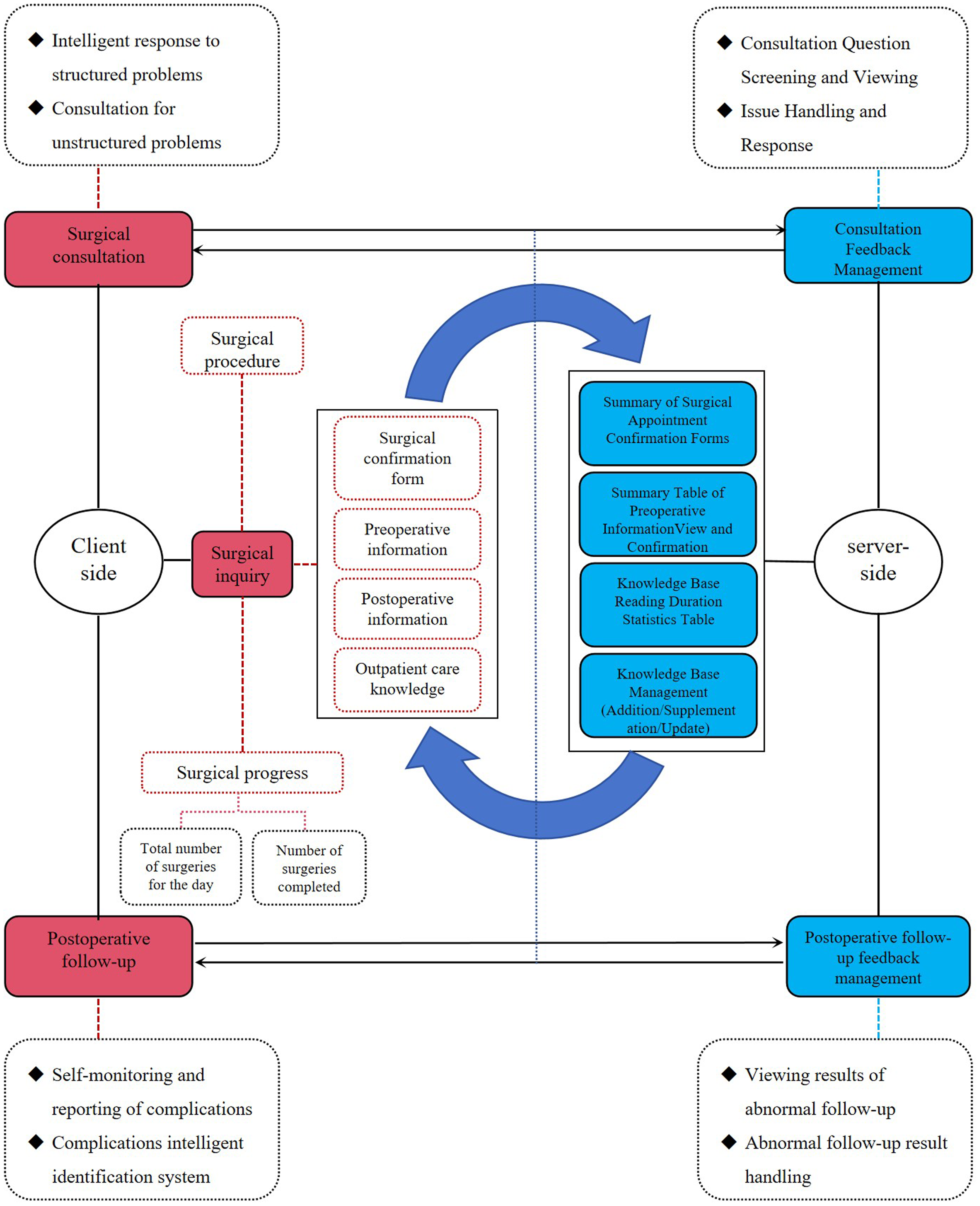
Frame diagram of the whole-process nursing service system.
Step 2: Determine the modular functions of the WPNSS, and develop educational materials and online systems
Patient mobile terminal interface and function development
Building upon prior research experience and insights from the Kano model's demand attributes, this study defines intervention components and activities for the patient mobile terminal aimed at enhancing the knowledge, skills, and behaviors of patients undergoing day surgery.
Surgical inquiry
The platform facilitates various functions for day surgery patients, including surgical confirmation, surgical process inquiry, access to preoperative and postoperative health knowledge databases, and querying the number of surgical patients.
The surgical confirmation module enables the automatic delivery of surgical confirmation forms to patients at 10 AM on the day preceding surgery and on the surgery day itself. Patients are empowered to indicate reasons if unable to proceed with surgery, with options including 13 predefined reasons and an open-choice alternative (allowing manual input), as depicted in Fig. 3 in Annex 1.
The structure and content of the health education knowledge base were determined through literature review and group meetings. The functionality enabling the retrieval of preoperative health knowledge and both horizontal and vertical postoperative health knowledge for day surgery patients is achieved by referencing the patient's ICD disease diagnosis code and disease name in the knowledge base. Each ICD diagnosis code corresponds to a specific disease name in the knowledge base, facilitating personalized and precise health education. This includes preoperative preparation knowledge, disease guidance, dietary advice, exercise recommendations, medication instructions, and reminders for follow-up visits.
The surgical patient query module provides data on the total number of patients undergoing a particular type of day surgery as well as the number of patients who completed surgery on a given day. The data for this system is sourced from and integrated between the comprehensive information platform of the HIS system and our hospital's Yuanzhuo system. Patient numbers are derived from the appointment system of day surgery patients in the HIS system and the workflow in the Yuanzhuo system, where nurses scan patient identification wristbands at various stages: upon admission, discharge, entry into the operating room, and return to the day ward. These scan times are automatically transmitted to the Yuanzhuo system to update the count of completed operations. Upon patient return to the day ward, the number of patients who completed surgery is incremented by 1.
Surgical consultation
The platform enables structured and unstructured communication between patients and healthcare professionals. Common queries from day surgery patients have been identified and addressed through group meetings that involve both researchers and patients. For unstructured inquiries, a database stores patient consultation questions and associated information. Professionals provide responses within 24 h via the nurse's PC server. Patients can access the response content through the mobile terminal. Unstructured consultations support various modes, including text, voice, pictures, videos, and more, as demonstrated in Fig. 4 in Annex 1.
Postoperative follow-up
The postoperative follow-up module incorporates functionalities such as the push of postoperative complications forms, processing of abnormal results, and self-symptom monitoring (Fig. 5 in Annex 1). Initially, the contents of the follow-up form for day surgery patients were determined through literature review and group meetings. The follow-up form is integrated into the WeChat Public Number Service System, where it is pushed to the patient's WeChat terminal on the first day post-discharge. Patients can also access the postoperative follow-up module at any time to report symptoms. The form consists of nine fixed options for common complications: bleeding (wet outer medical dressing), fever (body temperature ≥38.5°C), nausea/vomiting, pain > 4 points (pain affecting sleep), urinary retention, constipation, infection, edema, and posterior tenesia (manifested as anal distention, frequent bowel movements but poor bowel movements) and one open option (symptoms can be filled in). If any of the specified complications are reported, the system automatically identifies the result as abnormal and notifies the nurse PC server for professional feedback and patient management. At the same time, the system will automatically reply to the patient's emergency treatment of the complication.
Nurse pc terminal interface and function development
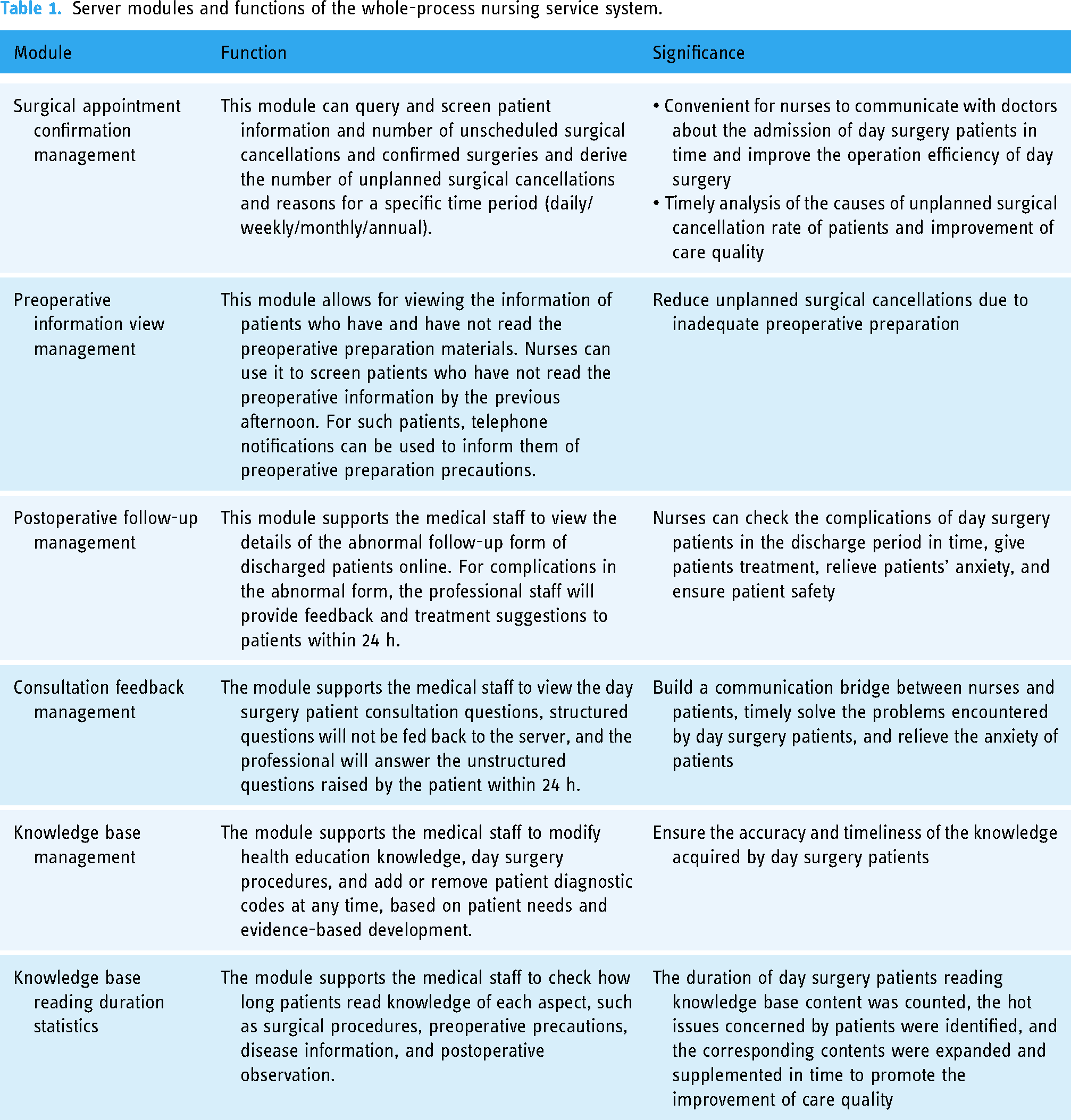
In accordance with the specifications of the patient mobile terminal, corresponding server-side modules and functions have been developed, which are detailed in Table 1.
Server modules and functions of the whole-process nursing service system.
Step 3: preliminary experiment
Design
This study was conducted as a cluster randomized controlled trial.
Participants
Patients in the day ward of a tertiary hospital in China between April 2023 and June 2023 were chosen as the study participants. Inclusion criteria were as follows: (1) Patients undergoing day surgery for the first time; (2) Patients who are conscious and can communicate normally; (3) Patients understood the purpose of the study and agreed to participate in and cooperate with the study. Exclusion criteria were as follows: (1) Patients cancel the surgery or change the date after booking the day surgery; (2) Patients or family members cannot use smart phones; (3) Patients with mental illness, cognitive impairment and inability to communicate.
This study included 32 subjects, comprising 17 in the intervention group and 15 in the control group. The age of patients in the intervention group was 56.11 (19.16) years, while in the control group, it was 50.20 (21.08) years. There were no statistically significant differences in age, sex, marital status, or type of medical insurance between the two groups, indicating comparable baseline data.
Randomization
A simple randomization method was adopted in this study. A week, from Monday to Sunday, was considered as a cluster. A random sequence of 0 or 1 was generated using SPSS 26.0, where 0 represented the control group and 1 represented the experimental group. At this medical institution, the timing of day surgery is determined and notified to patients 1–2 weeks in advance. Patients were grouped based on their operation dates. The random sequence generated in this study is shown in Table 2. All eligible patients consenting within the same week were assigned to the respective groups. For example, if a patient's surgery date is scheduled for April 11, 2023, the patient will be included in the control group. If the patient's surgery date is scheduled for April 25, 2023, the patient will be included in the experimental group. Surgeries were conducted in the day ward from Monday to Friday, with no operations scheduled for Saturday and Sunday. Therefore, this arrangement will not cause contamination issues among patients in adjacent two weeks. The random sequence was generated by the first author, while the other authors were responsible for enrolling and assigning participants.
Random sequence, surgery date and group assignment.

Intervention method
Patients in the control group received standard management, which included paper health education materials and oral instructions upon admission to the day ward. Nurses were available to address any concerns they might have.
The experimental group received the WPNSS intervention, which commenced after patients received a day ward admission certificate from the specialist. Initially, a trained researcher explained the study's purpose, introduced the main functions, usage methods, and precautions of the nursing service platform. After obtaining informed consent, patients were allowed to begin using the platform.
Outcome and measurements
The primary outcome measure of this study was patient satisfaction. The secondary outcome measure was the extent to which patient needs were met. To enable patients to fully experience the WPNSS, data were collected by telephone on the 7th day after discharge. This data collection was conducted by researchers who had received standardized training. Using the ‘Questionnaire Star’ software to set up an electronic survey questionnaire, each question in the questionnaire is set with logic verification to ensure the accuracy and comprehensiveness of the questionnaire responses.
Measuring tool
Patient satisfaction. Based on the contents of the inpatient satisfaction questionnaire of the National Health Commission, this study developed a patient satisfaction questionnaire. The questionnaire comprises 10 items, covering nine aspects such as medication guidance, hospitalization/discharge process, health education, continuity of care, overall evaluation, and whether the hospital would be recommended to others. The questionnaire has a total score of 50 points, with higher scores indicating greater satisfaction.
Meeting patient needs. A 20-item demand satisfaction questionnaire was developed for day surgery patients. The questionnaire was based on the study's objectives and the results of the Kano model demand attribute analysis. It covers various aspects including online consultation, treatment process, surgical procedures, admission and discharge process, surgery appointment, preoperative preparation, cooperation during operation, guidance on pathogenic factors, disease prevention measures, wound care, pain management, temperature regulation, nausea and vomiting management, daily activity guidance, dietary advice, excretion guidance, post-operation follow-up, review procedures, wound dressing and removal, care for indwelling pipelines, and medication usage. The Cronbach's α coefficient of this questionnaire is 0.97, and the content validity index (I-CVI) for each item in the questionnaire ranges from 0.857 to 1.000, all of which are greater than 0.780. This demonstrates that the questionnaire has good reliability and validity. 18
Statistical analysis
SPSS 26.0 software was used for statistical description and statistical inference. The statistical method is determined based on the type of data. In order to correct for some potential confounders, we still have tried to expand on the statistical analysis by integrating more robust statistical methods. Data of patient satisfaction were described using mean (SD). The difference in patient satisfaction between the two groups was compared using the t-test and linear regression. The number of cases (percentage) was described using count data, and the difference in demand satisfaction and whether we would recommend the day ward of the hospital to others between the two groups was compared using the Chi-square test or Fisher exact probability method and binary Logistic regression.
Ethics statement
This study was approved by the Beijing Tiantan Hospital, Capital Medical University Ethics Committee (approval number: KY2022–055–04). The main study was registered in the Chinese Clinical Trial Register (ChiCTR2200066782). Written informed consent was obtained from all participants prior to their involvement in the program. Participants had the right to withdraw from the program at any time without providing an explanation. De-identified data were used solely for statistical analysis and reporting purposes.
Results
After 13 group meetings and extensive systematic literature searches, we developed an intelligent and personalized whole-process service system for day surgery patients. This system comprises two main components: a WeChat mini-program (client) and an online website (server). Patients can easily access the service by searching for “Beijing Tiantan Hospital, Capital Medical University” within the WeChat mini-program and providing their identity information. Meanwhile, managers can log in through a PC account and password to maintain and update the platform.
The WPNSS offers semi-automatic surgical consultation, surgical inquiries, and postoperative follow-up services for day surgery patients. Additionally, it automatically provides perioperative health education knowledge. Leveraging China's popular social networking platform, WeChat, the WPNSS is compatible with almost all smartphone brands, versions, and operating systems. Patients can easily use it by scanning a specific QR code or searching for “Beijing Tiantan Hospital, Capital Medical University” within the WeChat mini-program, eliminating compatibility issues often encountered with traditional smartphone applications.
Patient mobile terminal operation manual
Day surgery patients can access the mini-program of “Beijing Tiantan Hospital, Capital Medical University” on WeChat, where they can register, login, and find day surgery services within the day ward module. From there, patients can navigate through surgical inquiry, consultation, and postoperative follow-up interfaces based on their needs. The system provides comprehensive information regarding the daytime operation process, preoperative preparations, disease-related knowledge, and other relevant information to fulfill the informational needs of patients throughout the nursing service process. Furthermore, patients can access details such as admission and discharge procedures and day ward location, reducing the need to visit various hospital departments for consultation. For postoperative care and consultation, patients can self-report symptoms within the postoperative follow-up module. The system automatically assesses the reported symptoms and provides feedback and treatment measures within 24 h if abnormalities are detected. Patients can also access structured answers to common postoperative questions or leave online messages within the surgical consultation module. Additionally, the system sends surgical confirmation and preoperative preparation reminders through WeChat and provides health education content at specific intervals (days 1, 3, and 7) after discharge (Fig. 6 in Annex 1).
Nurse data management background
Nurses can access the management interface through computer web pages or iPad, utilizing tagging technology to accomplish various functions: monitoring patient operation confirmations, preoperative preparations, postoperative complications, addressing patient queries, and updating the health education knowledge base for day surgery patients. Each function covers relevant content allowing for collecting formatted data, querying, filtering, and exporting.
Current use of the system
Currently, we have developed health education paths for 24 common day surgeries and have addressed 55 consultation questions from patients. The total reading time for all types of knowledge materials for day surgery patients exceed 200 h.
Preliminary results
Patient satisfaction
Regarding patient satisfaction scores, there was no statistically significant difference between the intervention group [48.35 (3.39) points] and the control group [47.13 (6.2) points] (P = 0.602). The single factor analysis and linear regression had the same results. The Chi-square test results showed a statistically significant difference was observed between the two groups regarding whether they would recommend the hospital to others (P = 0.038). Binary Logistic results showed that the intervention group was more likely to recommend the hospital to others, but did not reach statistical significance (P = 0.083).
Extent to which patient needs are met
No significant difference was observed between the two groups in meeting patient needs such as online consultation, treatment process, procedures for surgery, admission and discharge, preoperative preparation and so on, see table 3 for details.
Extent to which patient needs are met.

Discussion
Main findings
Adequate health education and a comprehensive follow-up system can mitigate patients’ anxiety 5 and reduce delayed discharge rates for day surgery patients,20,21 thereby enhancing patient satisfaction. The WPNSS is an innovative and comprehensive remote health education, consultation, and follow-up system. It provides preoperative knowledge, intraoperative information, and postoperative precautions for day surgery patients through modules such as surgical consultation, inquiries, and postoperative follow-ups, catering to the diverse health education needs of such patients. According to the outreach strategy and theoretical framework developed by the World Health Organization, the system will be continuously enhanced based on pilot usage, outreach results, as well as evidence development and updates. 22 Preliminary results suggest that the WPNSS may enhance patients’ experience, with patients inclined to recommend day surgery at this hospital to others.
Compared with other day surgery health education platforms including apps, websites, or videotapes,11,12,23 the WPNSS is more compatible, scientifically grounded, and supportive for patients. (1) Developed on the WeChat platform, 24 the WPNSS leverages the widespread popularity of WeChat, addressing issues such as compatibility with mobile health tools, frequent app downloads, and updates. 25 (2) All surgical procedures and health education materials are evidence-based and expert-reviewed, with ongoing updates based on evolving evidence. (3) The WPNSS includes a nurse-patient communication platform, enabling patients to have unstructured consultations before surgery or after discharge, ensuring timely resolution of any issues arising during short day surgeries. In addition, Yuan Zhong's research carried out health education, follow-up and consultation for patients undergoing day surgery in the department of beauty through an online platform based on hospital information. 26 The effects are ideal in improving patients’ psychological and emotional state, compliance, and quality of life. But the online platform simply groups patients of the same kind. Patient consultation and health education are on two different platforms, which cannot provide personalized services to patients and is not convenient. The WPNSS provides personalized perioperative knowledge for patients by matching perioperative knowledge and patient consultation to the globally recognized ICD disease diagnosis code. This has laid a certain technical foundation for the promotion of WPNSS in other similar medical institutions in the world.
Patient satisfaction is a multifaceted concept, evident across various aspects. Previous studies have shown that providing adequate perioperative health education to day surgery patients significantly impacts patient satisfaction. 27 Therefore, building on prior research results, 28 this study delivered comprehensive health education to patients undergoing day surgery, covering disease-related knowledge, treatment options, disease triggers, high-risk factors, protective measures, preoperative precautions, surgical procedures, preoperative preparations, intraoperative coordination, postoperative observation periods, and key postoperative horizontal information (medication, complication/symptom management, exercise, diet, and excretion) and postoperative longitudinal information (postoperative days 1, 3, and 7, and matters needing attention during recovery). Additionally, patients receive online follow-ups, enabling them to access nursing consultations and services conveniently from home. The more accessible and user-friendly the service, the higher the patient's motivation to utilize it. Patients express satisfaction with this approach to health education and are inclined to recommend day surgery at this hospital to others. Similarly, Peiting Fan et al. ‘s study compared the effect of QR code and telephone on the follow-up of patients after discharge. 29 The results showed that patients in the QR code group had higher follow-up attendance and significantly reduced the number of follow-up reminders. Jaensson's research also supports the same perspective. 27 In different health care settings, almost all types of day surgery include preoperative preparation knowledge, hospitalization procedures, surgical coordination methods, discharge procedures, postoperative follow-up, and continuity of care. Therefore, the WPNSS framework is suitable for almost all medical facilities that perform day surgery. To clarify, the Chi-square test and binary Logistic regression showed different results. Therefore, the findings of this study can only indicate a trend among the experimental group patients to recommend this hospital's day surgery to others and cannot confirm that these patients are more likely to do so compared to the control group patients. However, in theory, Logistic regression requires a larger sample size, and the negative results may be attributed to the small sample size. Robust results will require a larger sample to verify.
Regarding nursing care, the health education provided by the WPNSS proves to be comprehensive. Preliminary findings suggest similarities with the traditional nursing service model. No statistically significant difference was observed in patient satisfaction and meeting the needs between the two methods, both of which effectively meet the needs of day surgery patients. This is similar to the research findings of Chiang V et al., 30 who also found that interactive mobile technology did not significantly improve patient satisfaction with their needs. However, it differs from the research results of Tahsin F et al. 31 and Richards R et al., 32 who suggested that mobile devices are better able to meet patients’ information needs. This may be due to differences in the population studied. However, the WPNSS may reduce time spent on repetitive patient education attributed to variations in memory and educational levels. In addition, the platform automatically pushes the follow-up form to patients based on patients’ needs, which also reduces the workload of nurses to make follow-up calls, thus reducing the work burden of clinical nurses. At the same time, standardized health education paths also improve the level of nursing homogenization and broader service accessibility, further enhancing the patient experience, which is similar to the research results of Wongkietkachorn et al. 14
Limitation
Several limitations merit attention. First, day surgery patients, particularly those undergoing eye surgery, may not register on the day surgery reservation platform if they require a second operation. This could lead to inaccuracies in intraoperative surgery inquiries, with a potential error margin of ± 3 persons. Second, The survey tools in this study have not been tested for reliability and validity, which may lead to unstable pilot results. Finally,the study's small sample size may result in false positives or false negatives. Large-scale randomized controlled trials are essential for further validating the platform's effectiveness.
Conclusion
The WPNSS is an expanded, innovative and internet-based health education system, tailored for patients undergoing various surgical procedures. It integrates surgical consultation, inquiries, and postoperative follow-up, meeting the diverse informational needs of day surgery patients. Current research progress indicates that patients tend to recommend the hospital’ s day surgery services to others.
Supplemental Material
sj-docx-1-dhj-10.1177_20552076241286799 - Supplemental material for Construction of the whole-process nursing service system for day surgery patient based on the Kano model: A pilot cluster randomized controlled trial
Supplemental material, sj-docx-1-dhj-10.1177_20552076241286799 for Construction of the whole-process nursing service system for day surgery patient based on the Kano model: A pilot cluster randomized controlled trial by Weige Sun, Fei Wu, Yue Du, Jie Luo, Xin Wang, Aman Li, Ran Zhang and Weixin Cai in DIGITAL HEALTH
Supplemental Material
sj-doc-2-dhj-10.1177_20552076241286799 - Supplemental material for Construction of the whole-process nursing service system for day surgery patient based on the Kano model: A pilot cluster randomized controlled trial
Supplemental material, sj-doc-2-dhj-10.1177_20552076241286799 for Construction of the whole-process nursing service system for day surgery patient based on the Kano model: A pilot cluster randomized controlled trial by Weige Sun, Fei Wu, Yue Du, Jie Luo, Xin Wang, Aman Li, Ran Zhang and Weixin Cai in DIGITAL HEALTH
Supplemental Material
sj-docx-3-dhj-10.1177_20552076241286799 - Supplemental material for Construction of the whole-process nursing service system for day surgery patient based on the Kano model: A pilot cluster randomized controlled trial
Supplemental material, sj-docx-3-dhj-10.1177_20552076241286799 for Construction of the whole-process nursing service system for day surgery patient based on the Kano model: A pilot cluster randomized controlled trial by Weige Sun, Fei Wu, Yue Du, Jie Luo, Xin Wang, Aman Li, Ran Zhang and Weixin Cai in DIGITAL HEALTH
Footnotes
Acknowledgements
We would like to thank the patients for their cooperation, as well as Neusoft's technical support.
Author contributorship
Weige Sun: Writing–review & editing, data analysis. Fei Wu: Writing–original draft. Yue Du : Data curation. Jie Luo: Methodology. Xin Wang: Data curation. Aman Li: Investigation. Ran Zhang: Methodology and data curation. Weixin Cai: Project administration–validation.
Declaration of conflicting interests
The authors declared no potential conflicts of interest with respect to the research, authorship, and/or publication of this article.
Funding
The authors disclosed receipt of the following financial support for the research, authorship, and/or publication of this article: This research was supported by the Capital's Funds for Health Improvement and Research “Construction and operation of whole-process nursing model for day surgery patients based on Internet hospital platform.” (grant number: CFH 2022–2–2046).

Supplemental material
Supplemental material for this article is available online.
References
Supplementary Material
Please find the following supplemental material available below.
For Open Access articles published under a Creative Commons License, all supplemental material carries the same license as the article it is associated with.
For non-Open Access articles published, all supplemental material carries a non-exclusive license, and permission requests for re-use of supplemental material or any part of supplemental material shall be sent directly to the copyright owner as specified in the copyright notice associated with the article.
