




Abstract
Objectives
As an important extension of mental health services, online mental health communities (OMHC) have become vital to access psychological support, share experiences and seek professional help. To enhance OMHC user satisfaction and promote the sustainable development of the industry, this study investigated the key elements of service quality within OMHCs and develops optimization strategies to inform practice.
Methods
This study collected user comments from the “One Psychology” online community. Based on this data, Latent Dirichlet Allocation (LDA) topic modeling was conducted to establish a framework of service quality elements. Furthermore, the Kano- Importance Performance Analysis (Kano-IPA) model is employed for the classification and priority evaluation of these elements.
Results
This research proposes a framework for service quality in OMHCs by identifying its core elements. The findings reveal that users place high expectations on attractive quality elements such as content diversity and personalization, while emphasizing one-dimensional quality elements including privacy security and interactivity. Additionally, professionalism, effectiveness and system stability are identified as must-be quality elements. The priority sequence for service quality optimization is effectiveness, responsiveness, peer support, interactivity, stability, professionalism and simplicity.
Conclusion
To optimize the service quality of OMHCs, it is essential to respond to users’ demands in a hierarchical manner: prioritize ensuring the stability and reliability of must-be elements, strive to enhance the performance of one-dimensional quality elements, and explore potential attractive elements in a timely manner to create pleasant surprises for users. Meanwhile, efforts should be made to strengthen technology empowerment, resource integration, responsive support and emotional mutual assistance. This study enriches the research related to the service quality of OMHCs and provides theoretical foundations and practical guidelines for service quality optimization.
Keywords
Introduction
In recent years, Online Health Communities (OHCs) have emerged as a vital platform for health information exchange and support. 1 These virtual communities enable users to share knowledge, consult with experts, and interact with peers regarding health-related issues or treatment options. 2 With increasing public awareness of mental health, OMHCs have become a crucial avenue for accessing psychological support, sharing experiences, and seeking professional assistance. 3 As a specialized type of OHCs, OMHCs focus primarily on mental health and emotional well-being, encompassing online counselling platforms, virtual therapy centres, and mental health apps that utilize remote technologies such as telephones, video conferencing, and text-based communication to deliver services. 4
Compared to traditional face-to-face interventions, OMHCs offer unique advantages including accessibility, convenience, reduced stigma, and personalized user experiences. 5 Research indicates that online counselling interventions are nearly as effective as in-person counselling interventions, 6 while also effectively addressing the persistent limitations of time, space, and stigma inherent in traditional models. By providing an accessible, anonymous, and user controlled environment, this transformation expands support for traditionally underserved populations, thereby strengthening the overall coverage and system resilience of public mental health services. 7 However, as the online mental health service market continues to expand, OMHCs are gradually revealing shortcomings in areas such as service content, user experience, and technical support, making it difficult to meet users’ evolving needs. 8 Furthermore, the neglect of critical individual factors such as privacy concerns and empathy can negatively impact service quality, ultimately affecting user retention and platform sustainability. 9 This raises pressing questions: What factors influence the service quality of OMHCs, and how can these platforms enhance their offerings? Addressing these issues is essential for advancing OMHC development.
Existing studies on OMHCs service quality have largely focused on analyzing discrete dimensions such as interaction, content, usability, cost, privacy and technical features,10–14 rather than incorporating them into a unified hierarchical framework. This fragmented approach hinders the identification of which basic services users perceive as essential, which key improvements could substantially enhance satisfaction, and which value-added features might deliver exceptional user experience. Furthermore, it limits the ability to systematically prioritize service optimization strategies based on the relative importance and actual performance of each dimension. Consequently, investigating the determinants of service quality in OMHC and implementing targeted optimizations are essential for enhancing user satisfaction and ensuring the sustainable growth of this emerging field.
With the popularization of big data and text mining technology, extracting service quality elements and optimizing services by analysing users’ online comments has become a research hotspot. 15 Comment-based analysis can enhance research efficiency while providing actionable recommendations for platform improvement. 16 This study investigates “One Psychology”, a well-known OMHC in China. By employing the Kano-IPA model, we establish a framework of service quality elements and propose targeted recommendations. Our findings aim to enhance OMHC service quality, offering theoretical insights and practical guidance for platform development.
Literature review
In recent years, with the increasing attention of the society to mental health problems and the wide application of OMHCs, a growing number of scholars have begun to conduct research in this field and have made considerable progress. Existing studies mainly focus on OMHC user characteristics, information behaviorand participation model, community service management, the key role played by communities in providing peer-based social support, especially in depression and anxiety disorders.17–22 The research methods mainly include questionnaire, text analysis and machine learning technology.
In terms of community service management, the current research mainly discusses the influence of isolated factors such as personalized content, peer interaction, system stability on service satisfaction.11,12,23–26 For example, Rickwood et al. (2019) emphasized the importance of consultation duration and user interaction on the eheadspace platform. 23 Hogsdal et al. (2023) pointed out that factors such as the quality of mental health information, text complexity and system stability are the key to adolescent satisfaction using the system availability scale. 24 Melcher et al. (2023) showed that cost and privacy transparency are basic and non-negotiable factors in application selection. 25 Users’ expectations also include the need for credibility, customizability and instant response support to meet urgent needs. Opie et al. (2024) found that peer interaction, application-based service provision, asynchronous support and personalized content help to improve service satisfaction. 26
Research within the Chinese context reflects similar priorities while highlighting culturally and structurally distinct concerns. For instance, studies note the critical role of anonymity in facilitating self-disclosure within stigma-laden environments, 27 and emphasize hybrid moderation models where peers and facilitators jointly guide support exchanges. 28 Culturally attuned interaction styles, such as the use of metaphor is also noted as salient in text-based mental health support. 21 Nevertheless, like the international literature, Chinese scholarship remains fragmented, examining attributes such as trust, interface accessibility, or peer interaction11,29,30 in isolation rather than as interrelated components of an integrated service system.
Beyond identifying isolated factors, scholars have proposed service quality improvements at the macro level or technical level. For example, Research on mobile applications for immigrant populations shows that OMHC applications are positively associated with immigrants’ level of social integration, overall health, and mental health, with AI-assisted applications showing even better outcomes. 31 Similarly, in China, scholars such as Jin et al. (2022) advocated systematic improvements in regulation, employee training and remote application technology, 4 and Zhou et al. (2025) developed a recommendation framework using knowledge mapping and large-scale language model to optimize the accuracy and professionalism of information transmission. 32
In summary, existing research on OMHC service quality—both globally and in China—has predominantly examined discrete dimensions such as interaction, content, usability, cost, privacy, and technical features10–14 without integrating them into a coherent, hierarchical framework. This fragmentation makes it difficult for us to identify which basic services users consider essential, which are the key improvement points that can significantly improve satisfaction, and which are value-added functions that may bring surprises. Moreover, it is impossible to systematically determine the strategic priority of service optimization according to the importance and actual performance of each element. In addition, the current research relies more on subjective survey data and ignores the rich and active feedback contained in user generated content (such as online comments). This often limits the depth and objectivity of opinions.
Therefore, we go beyond subjective investigation and use LDA topic modeling technology to objectively extract key service elements from large-scale online user reviews and establish a service quality framework. On this basis, we classify and optimize these elements based on Kano-IPA model. This approach enables us to: (1) systematically classify quality elements, (2) diagnose their current performance level, and (3) provide data-driven strategic suggestions for service improvement. By doing so, the focus of this study has shifted from listing factors to establishing an operable overall OHMCs quality management framework.
Research design
By collecting and analyzing user comments from the platform “One Psychology”, which is one of the most prominent OMHCs in China, we construct a service quality element framework based on LDA top model analysis. Then, the Kano-IPA model was used to classify the service quality elements, evaluate the importance and satisfaction of each quality element, locate the key points of service optimization, and put forward suggestions for the optimization of service quality of OMHC, thus painting roadmap as Figure 1. Analytical framework for optimizing service quality of OMHC. Note. 
LDA topic model
LDA topic model (Latent Dirichlet Allocation) is a model that can mine potential topic information from massive texts. Its concept was first proposed by Blei et al. in 2003. 33 Its basic idea is to define a document as a collection of multiple hidden topics and repeatedly simulate the generation process of the document, so as to identify the potential topic information in the text data. 34 LDA topic model can effectively extract implicit topics from large-scale unstructured text data and realize feature dimensionality reduction and information extraction. 35
Compared to other topic models, LDA model offers greater flexibility and higher accuracy in identifying latent topics, making it particularly effective for precisely categorizing themes within complex textual structures. 32 As an unsupervised learning algorithm, LDA does not require annotated training datasets. Instead, it only requires the specification of the optimal number of topic clusters. 36
The data for this study consist of authentic, unsolicited user comments from OMHCs. The unsupervised nature of LDA allows for the inductive derivation of themes directly from this user-generated content, minimizing preconceived structural biases. 37 This provides a complementary perspective to traditional survey-based approaches, which are inherently shaped by a priori researcher-defined constructs and scales while valuable for testing specific hypotheses. 38 Consequently, LDA is particularly well-suited to uncover the nuanced, emergent, and user-driven factors that constitute service quality in this context. 39 This paper aims to employ LDA topic model to mine and analyze the comments in OMHCs with the goal of identifying key factors for improving the quality of OMHC services.
Kano model
Inspired by Herzberg’s two-factor theory, Noriaki Kano, a Japanese quality management expert, proposed the Kano model in 1984. 40 Through a specifically designed questionnaire survey method—using paired functional and dysfunctional questions—the model collects user perception data. According to the nonlinear relationship between perceived importance of product/service characteristics and customer satisfaction, Kano model then divides the quality elements into five categories based on the collected questionnaire responses: (1) attractive quality element (A): the element that will significantly increase customer satisfaction with the increase of service level but will not significantly decrease due to insufficient service; (2) one-dimensional quality element (O): the element that high service level will lead to customer satisfaction and low service level will lead to customer dissatisfaction; (3) must-be quality element(M): the element that user satisfaction will not significantly improve with the improvement of service level, but will decline significantly due to the decline of service level; (4) indifferent quality element (I): the element that customer satisfaction will not change regardless of changes in service levels; (5) Reverse quality element(R): the elements that user satisfaction will gradually decrease as service levels improve. However, Kano model is a qualitative analysis method. The classification criteria for the elements are relatively subjective, which limits its potential for decision-making support in relevant fields. 41
To gain a more precise understanding of user needs and behavioral patterns, researchers have drawn inspiration from the concept of analytical CRM and proposed the Analytical Kano model. 42 It begins with the traditional paired questionnaire and the five-category Kano evaluation table. By systematically calculating the Better coefficient and Worse coefficient for each requirement item, it ultimately forms an analytical decision-making system that comprehensively reflects requirement attributes, quantifies satisfaction impact, and supports priority ranking. 43 This shifts demand classification from qualitative judgment based on statistical frequency to using quantitative coefficients, thereby enabling more precise decision-making in prioritizing requirements across the two dimensions of “enhancing satisfaction” and “preventing dissatisfaction”. Its effectiveness has been widely confirmed in studies. By this method, Meng et al. constructed a synchronous multi-service planning model based on the classification and reorganization of customer service demand. 44 Lizarelli et al. proposed support improvement decisions in an entrepreneurial education service. 45 In this paper, we will use this quantitative Kano model to classify the service quality elements and then determine the priority of quality elements.
IPA model
In 1977, Martilla and James proposed the importance-performance analysis model (IPA model) in marketing research. 46 The model divides product/service attributes into four regional quadrants with satisfaction as the abscissa and importance as the ordinate. Quadrant I is the performance maintenance area, where the importance of attributes and satisfaction performance are both high, and enterprises should continue to maintain positive advantages. Quadrant II is the key improvement area, with higher attribute importance but lower satisfaction, which is the main disadvantage of the product and should be improved. Quadrant III is low value area, with lower importance and lower satisfaction performance, which belongs to the secondary disadvantage attribute and can be considered to develop when resources are sufficient. Quadrant IV represents the over performance area, with lower importance but higher satisfaction, which is considered as the secondary focus area requiring only the maintenance of the current status and no further action.
As a commonly used tool for identifying critical quality problems, IPA model can be effectively combined with Kano model to formulate targeted strategies for enhancing customer service quality. For example, Zhai et al. adopted the analytical Kano model combined with the improved IPA to realize the priority analysis of user demands. Finally, the optimal path for product improvement can be obtained. 43 Chen et al. applied the Kano model and Importance-Performance Analysis (IPA) to clarify the categories of quality elements and the priority order of improvement for the online training of intellectual property information services provided by subject librarians in university libraries. 47 This paper will employ the model to classify the service quality elements of OMHCs and develop targeted improvement strategies.
Construction of service quality element system based on topic identification
Data collection and processing
The data for this study were collected from publicly accessible user comment sections of the “One Psychology” platform (website and mobile applications—Tencent My App and the Apple App) using the Octoparse web crawler, in compliance with the platform’s published terms of service. The dataset consists solely of textual comments and was anonymized prior to analysis, with all personally identifiable information removed. No private user data were accessed, and no interaction with users occurred during the research. “One Psychology” community (https://www.xinli001.com/) is one of the largest and most advanced online psychological theme communities in China. 48 This platform positioned to provide professional psychological support, with almost 53 million registered users worldwide, adopting an operation mode integrating professional content popularization, psychological assessment, counseling services, and a community interaction ecosystem that connects users and qualified counsellors. This paper selects “One Psychology” as the research object, which has a high reputation in the field of OMHC in China and covers the main fields of OMHC services, thereby demonstrating strong representativeness.
The collection of comments spanned from the time “One Psychology” enters the application store to December 15, 2024. A total of 6,270 user reviews were collected. Then the data were cleaned through the following operations. Firstly, invalid comments primarily fell into two categories: the first category consists of extremely brief comments, such as “good”, “positive review”, “thank you”, etc., which often lack substance and cannot reflect the theme well. The second category of comments comprises lengthy comments that exhibit characteristics of review spamming. These comments contain a significant amount of invalid information. In order to ensure the validity of the subsequent analysis, this study removed comments with lengths exceeding 150 words and those that appeared repeatedly. Secondly, the redundant and noisy data were cleaned, including removing emoticons, web links, and useless characters from the text data. After the above steps, a total of 4,127 valid comments were obtained as the original corpus set for LDA topic modelling.
Topic modelling and analysis based on user comments
LDA model is an unsupervised topic recognition method, and its parameter settings will directly influence the effectiveness of comment text clustering. In LDA topic model, there are three parameters that need to be set, which are the number of topics K, the prior parameters of topic distribution α and the prior parameters of word distribution β.
33
Existing studies predominantly employ the index of perplexity to determine the optimal number of topics.
49
A lower perplexity value indicates stronger predictive performance of the model.
50
Here α was set to 0.05, β was set to 0.01 and the number of topics was set to 1-19. Based on the number of topics, the perplexity was calculated and the corresponding perplexity curve was plotted, as shown in Figure 2. By testing the perplexity and coherence of topic distributions under different parameter settings, LDA can accurately identify topic structures with practical business implications. These data-driven topics provide a direct and comprehensive source for the specific attribute items used in the subsequent Kano questionnaire, ensuring that the established attribute system is both grounded in authentic user feedback and systematically measurable. Thereby, it supports the logical coherence of the entire research process, from text mining to quantitative analysis.
51
Perplexity curve and clustering effect. Note. The number of topics depends on the minimum of perplexity, and the number of bubbles denotes the number of clusters.
LDA topic distribution of user comments.
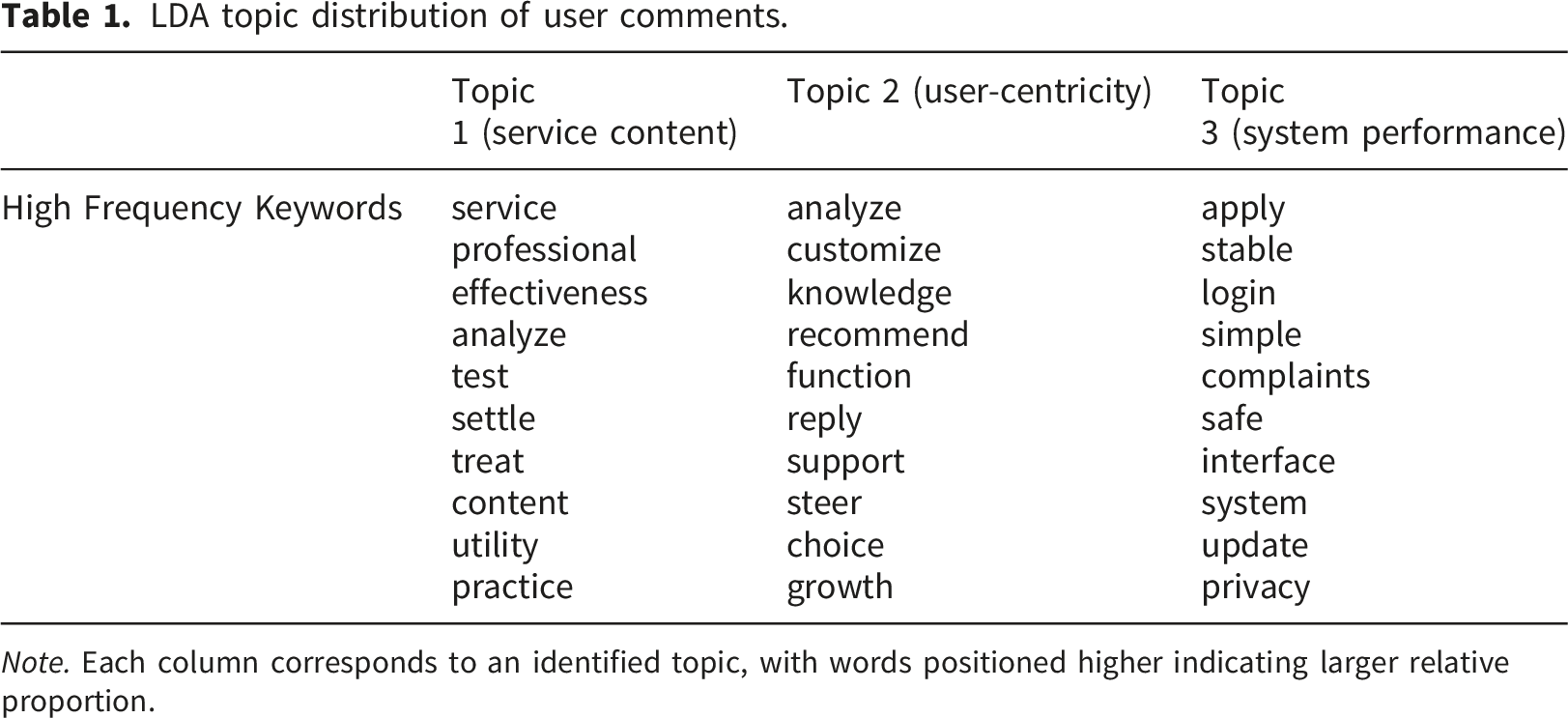
Note. Each column corresponds to an identified topic, with words positioned higher indicating larger relative proportion.
As can be seen from Table 1, in topic 1, users put forward more detailed requirements for the characteristics of service content. For example, the original text “You are such a dedicated teacher, who has a sharp insight into problems and always hits the nail on the head. You have been able to provide relatively effective solutions under the existing conditions. It is so relaxing. Thank you so much!” reflects users’ demands for professional, effective and friendly service. The original text “The reading column of One Psychology offers abundant and high-quality content. Its Q&A area is vibrant, with a diverse array of questions relating to psychology, emotions, relationships, work and study, each drawing active and excellent answers.” reflects users’ demand for diverse content. Through comprehensive analysis, the core needs and expectations of users are extracted and topic 1 is named as “service content”.
Topic 2 indicates that users hold much expectations for the user-centric design of OMHC. For example, the original text “One Psychology is a heaven for psychological healing and spiritual purification. Whenever I am stressed and need to manage my emotions, I will turn to One Psychology. That’s because this platform provides tailored guidance and help alleviate mental distress, and they formulate one suitable mental health service plan after another for you.” reflects the platform providing personalized, on-demand guidance that aligns with individual emotional needs is very important. The original text “One Psychology feels like a soothing comfort and a godsend: it lets you ask questions and get personalized service suggestions that fit your situation.” indicates that users expect to obtain personalized service experiences. After comprehensive analysis, these are closely related to the functions of the community. Therefore, the core needs and expectations of users are extracted and topic 2 is named as “User centricity”.
In topic 3, the original text “The interface of this app is so visually appealing! This free online counseling website is fully-featured—it works like a space for relieving stress. No need to worry about heavy work pressure anymore. Thumbs up!” reveals the necessity of friendly interface from the perspective of users. The original text “An amazing app! The long-awaited update brings multiple favorite features, enhanced stability and better user experience, making this great emotional counseling platform highly impressive.” indicates that users have high expectations for the platform’s stability and smoothness and continuous optimization, which are highly related to the improvement of system performance. Therefore, the core needs and expectations of users are extracted and topic 3 is named as “system performance”.
Construction of service quality element system
Elements of OMHC service quality based on LDA topic analysis.
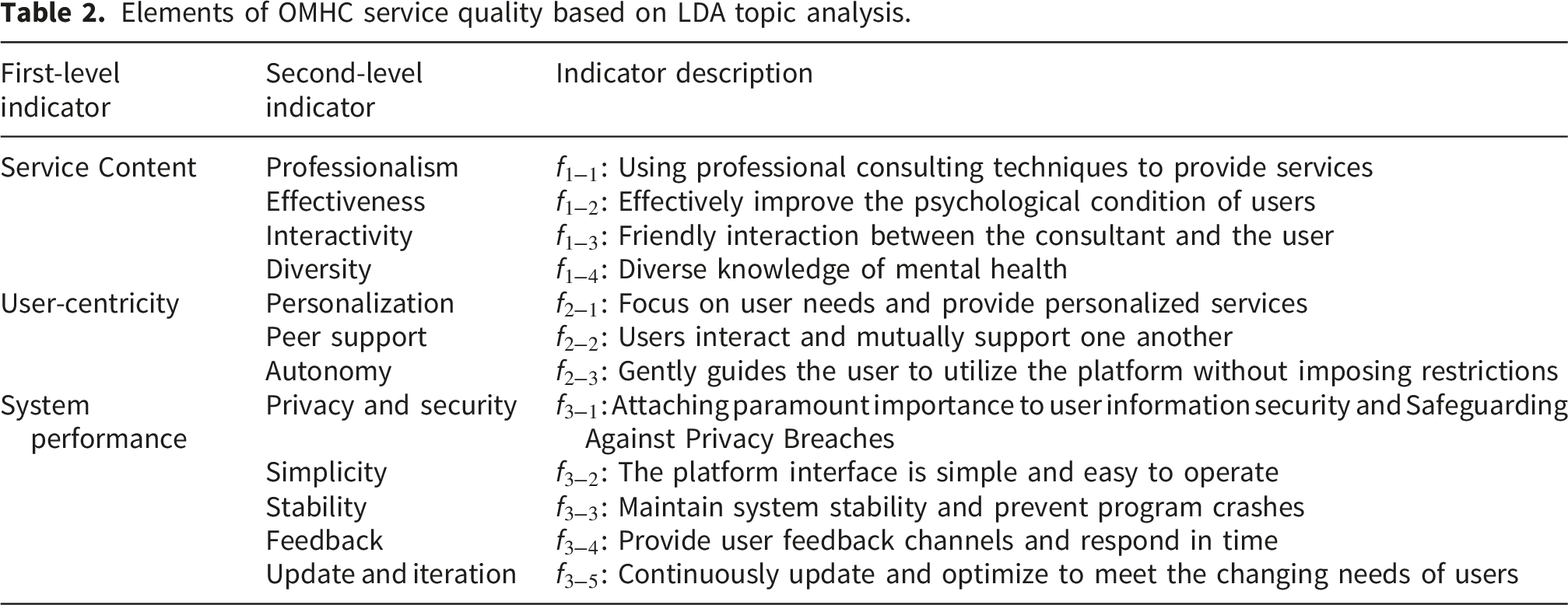
The second-level indicators are derived from the mapping of high-frequency words associated with relevant topics and are further supplemented based on existing research.27,52 Different from the conclusion of traditional research,25,26 autonomy, update and iteration are the new factors found in the text mining of user comments. Autonomy emphasizes the gentle guidance of the community and the autonomous participation of users, which can enhance users’ sense of belonging and long-term willingness to participate. When users feel a sense of control over their own rehabilitation process, their psychological compliance and treatment cooperation will be significantly improved, so as to improve the actual effect of service quality. Update and iteration reflect the key value of community dynamic evolution ability for service sustainability. Mental health needs are dynamic. The continuous optimization of community content, rules and functions can adapt to the changing needs of users, reflecting the key role of “dynamic evolution” for service sustainability.
Analysis of service quality elements of OMHC based on Kano-IPA model
Questionnaire design and data collection
In order to formulate elaborate strategies for improving service quality, the questionnaire was designed according to the service quality element system constructed before. Firstly, the design of Kano model indicators is conducted.
Satisfaction scale for positive and negative questions.

Note. This scale is used to calculate
Importance scale.

Note. This scale is used to calculate w in formula (4.2).
The product or service quality element is expressed as F = { 
In formula (4.1),
For each product or service attribute 
The values of (

The distance of the vector
Due to the limited granularity of the traditional Kano model in classifying different attributes, certain elements may exhibit identical priority levels. Therefore, we will combine IPA and priority index 
Demographic characteristics of survey participants.

Note. n=512.
The reliability and validity of the questionnaire was tested through SPSS 25.0. The Cronbach’s α coefficient was 0.873 and the KMO value obtained by Bartlett spherical test was 0.754, which are all above 0.7, indicating that the questionnaire had good reliability and validity and met the requirements for further analysis.
Classification of OMHC service quality elements based on Kano model
Referring to the study of Xu,
42
the importance indicator of Kano
Summary of relevant data of quality elements.

Note. The values of

Distribution of service quality elements in OMHC. Note. Classification rule: if
As can be seen from Figure 3 and Table 6, content diversity (
Peer support (
Professionalism (
Simplicity (
Optimization strategy of OMHC service quality based on IPA model
In order to further clarify the improvement strategy of OMHC service quality, we constructed an IPA matrix to conduct in-depth analysis of the elements, in which the horizontal axis represents satisfaction IPA matrix of service quality elements in OMHC. Note. IPA area types: Key improvement area; Performance maintenance area; Low value area; Over performance area.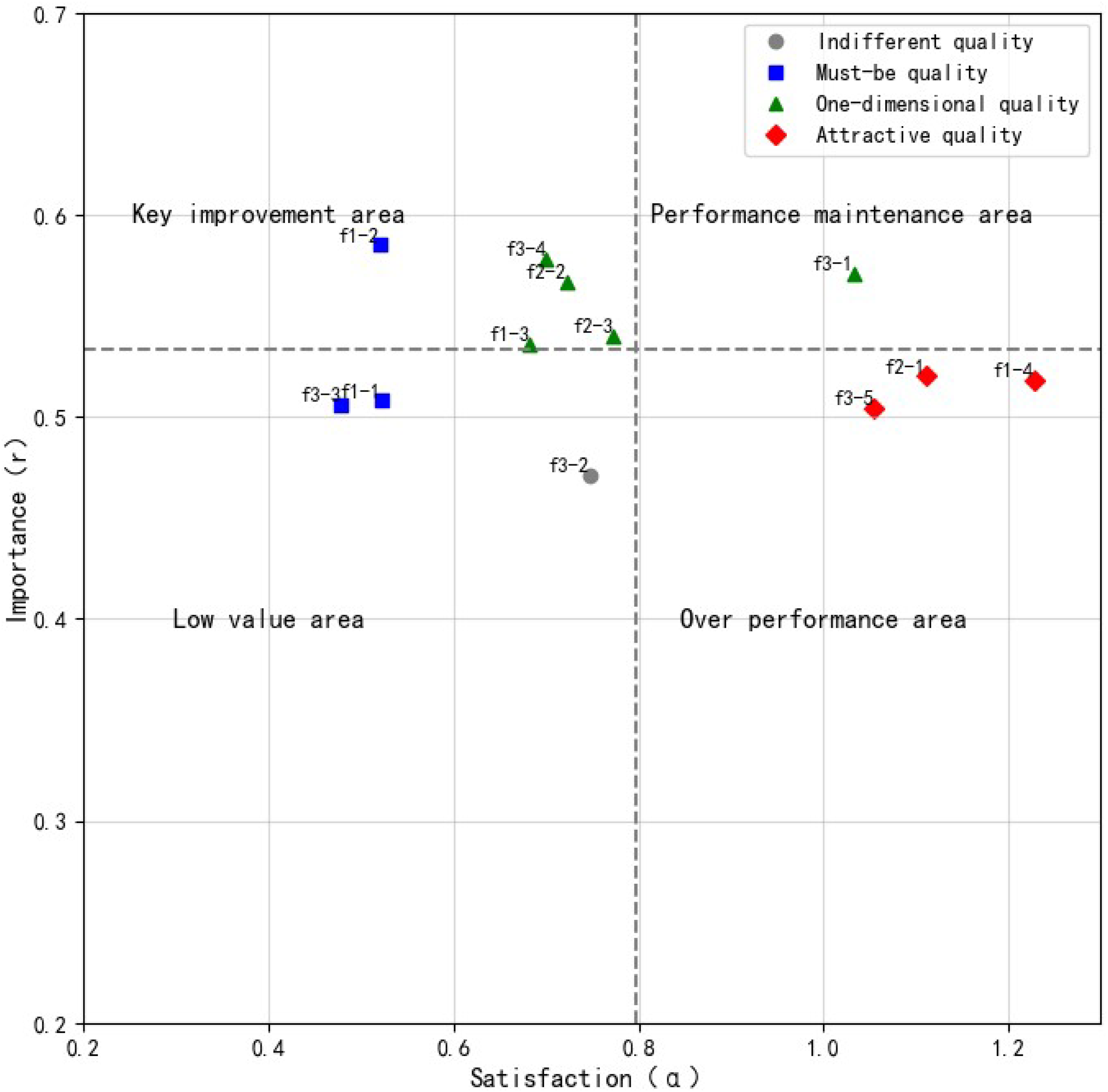
It can be seen that the elements are distributed across all four quadrant regions. The level of user satisfaction in performance maintenance area (Quadrant I) and over performance area (Quadrant IV) is relatively high, so maintenance strategies could be implemented to maintain high user satisfaction. The level of user satisfaction in key improvement area (Quadrant II) and low value area (Quadrant III) is low, hence it is necessary to implement improvement strategies for the quality elements of these two areas. Based on the above analysis, combined with the classification of quality elements by the Kano model, the decision rules can be obtained as follows:
Prioritization of improvement strategies
Peer support (
Professionalism (
Based on the above analysis, the prioritization of improvement strategies for individual elements is: effectiveness (
Prioritization of maintenance strategies
Autonomy (
Content diversity (
Based on the above analysis, the prioritization of maintenance strategies for individual elements is: autonomy (
According to the Importance-Performance Analysis, all attractive quality elements fall within over performance area. Most one-dimensional quality elements and must-be quality elements fall within the key improvement area, and the indifferent quality elements are in the low value area, which are in line with the psychological characteristics of OMHC users. Consequently, the maintenance strategy should be implemented for the attractive quality elements and certain one-dimensional quality elements, while the improvement strategy should be implemented for the must-be quality elements, other one-dimensional quality elements and indifferent quality elements.
Suggestions for optimizing service quality of OMHC
Based on the research conclusions above, we put forward suggestions for optimizing service quality of OMHC as follows.
Enhancing technological empowerment to improve community service efficacy
Given the digital characteristics of OMHC, it is imperative for community operators to utilize advanced technologies such as big data, cloud computing and artificial intelligence to analyse user behaviours, build accurate user portraits and provide users with personalized psychological resources recommendations, intervention programs and counselling services. 59 Furthermore, community operators could explore the development of AI-driven psychological counselling assistant and provide instant mood analysis and initial psychological support to help users alleviate emotional problems such as anxiety and depression, and at the same time provide auxiliary decision-making support for professional counsellors. 60
Community operators could adopt modern system architecture such as federated learning and differential privacy to improve system performance. For example, Kumari and Kaur integrated ensemble federated learning (EFL) and transfer learning (TL), combined with differential privacy (DP) to design a robust and privacy-preserving framework for detecting abusive language on social media, which enables collaborative training across platforms without exposing user data, while improving both generalization and detection accuracy. 61 OMHC operators can improve the service quality of the core function modules of the system by promoting user centered improvement. For example, regularly publish mental health science articles, videos or podcasts to help users understand mental health knowledge and eliminate misunderstandings about psychological problems. Integrate online booking, interactive feedback, case query and other functions to make services more accessible and more timely. 62 Operators can continuously optimize the system through iterative development based on user data and behaviour analysis, so as to bridge the gap between technical design and practical application.
Additionally, community operators can provide multi-terminal support. In addition to mobile and web, WeChat mini programs could also be developed to allow users to access community services anytime and anywhere, enhancing the convenience and accessibility of services. 63 For example, based on ReproSchema and cross platform framework, operators can use visualization tools to independently configure content and interaction processes, and rapidly deploy them. 64 While reducing the technical threshold, they can realize the agile iteration and scenario adaptation of service modules, so as to transform the usability design into the improvement of actual user experience.
Optimizing professional resource integration to improve the effect of user service
Community regulators should strictly review the qualifications of online psychological counselors to ensure that they have legal practice certificates and relevant qualifications. 4 At the same time, experience assessment and skill test of counselors could be carried out to examine their core professional competencies such as communication skills, problem solving and crisis intervention, ensuring that the counsellors are able to provide users with high-quality psychological support services. 65
In order to provide comprehensive mental health services, community operators could establish a multidisciplinary professional team by integrating expertise from psychiatrists, clinical psychologists and social workers. This approach can be implemented by combining professional expertise with structured intervention programs. For instance, following the model developed by Przybylko et al., a structured online program centered on “lifestyle medicine and positive psychology” can be designed to promote behavioral activation through theoretical guidance, practical tasks, and interactive community features. The effectiveness of such programs in improving mental health, enhancing vitality, and alleviating symptoms of depression and anxiety has been validated through multidimensional assessments. 66 In practice, operators can develop standardized service modules based on similar frameworks, supported by expert supervision and digital tools, thereby establishing a closed-loop service process that spans from interdisciplinary collaboration to outcome tracking.
Moreover, professional scientific content on mental health and accessible knowledge should be provided by professional counsellors, enabling users to better understand mental health issues, identify problems in a timely manner and seek professional assistance. Typical psychological cases should be organized and provided to users with reference and learning resources. To assist users in self-assessment and adjustment, community developers should develop more practical mental health tools such as psychological assessment tools, emotion monitoring tools and integrate self-help intervention tools, therefore further enhancing the practicability and convenience of services.
Establishing user feedback mechanisms and optimizing community response support
The development of OMHCs is fundamentally supported by user engagement. It is essential for community operators to establish a user feedback and response mechanism to promptly identify user needs and service pain points, thereby fostering user trust and enhancing user stickiness. Simultaneously, strengthening data privacy protection measures is crucial. Community operators should adhere to relevant laws and regulations to foster a safer and more reliable environment for mental health communication. 67
In order to improve the service quality, the OMHC platform should support multiple feedback channels such as surveys, open comment sections and anonymous messaging. 68 At the same time, a dedicated feedback processing team or an intelligent system should be established to ensure that users’ questions and suggestions receive prompt responses, and the processing progress is updated openly and transparently. For example, the intelligent feedback processing framework developed by Huang et al. may be adopted, which leverages GPT-4o to enable systematic and empathetic user interactions through role definition, structured processes, and ethical safeguards. 69
Community operators could establish a “User Suggestion Adoption List” and put the excellent suggestions contributed by users into practice and provide rewards. To address urgent mental health-related feedback (e.g. self-harm, suicidal ideation), it is recommended to develop an intelligent crisis early warning system, which would utilize keyword recognition and real-time response mechanisms, integrating with professional rescue resources to provide timely and effective interventions for users. 70
In order to ensure service continuity, the community operators also needs to establish user profiles, conduct regular follow-ups and track the service effect to adjust service plans promptly, thereby providing users with sustained support. 71
Fostering emotional communication and mutual support for a positive community atmosphere
OMHCs offer emotional support to users, with their core function centered on alleviating psychological stress and fostering resilience through shared experiences, peer support and empathetic engagement. Community operators can facilitate peer-to-peer communication among individuals facing similar challenges by implementing grouping mechanisms that categorize users based on shared interests, specific conditions, or therapeutic goals. For example, Akar summarized 12 common themes such as suicidal tendencies, depression and anxiety, and interpersonal relationships, 72 which can be used as a realistic basis for grouping. In specific implementation, the operator can dynamically classify users based on the above topic tags and establish corresponding topic groups or support communities. At the same time, continue to optimize the grouping strategy in combination with user behaviour data, such as pushing mindfulness training content for high anxiety groups, and building peer communication boards for parenting pressure users. In order to improve the pertinence of support, and make the service continuously adjust with the change of user needs, so as to systematically implement the service goal of “personalized support”.
Community operators can also design incentives to encourage users to share mental health stories and coping experiences, and enhance the community atmosphere through interactive features such as likes, comments or badge rewards, thereby reinforcing community cohesion and participation. 73 Simultaneously, to ensure the quality and safety of communication, experienced users can be trained to serve as “community facilitators” or “peer mentors”, guiding discussions and promoting positive interactions within the group. 74 To avoid the spread of misinformation, professional counsellors can regularly review and give feedback on the content shared by users in OMHC and provide scientific supplementary suggestions. Thus, the community will not only provide emotional support but also serve as a platform for mutual empowerment, thereby further enhancing its functionality and social value.
Conclusions
The service quality of OMHCs plays a crucial role in enhancing user satisfaction and promoting the sustainable development of the industry. This study focuses on “One Psychology” community as a case, collecting user comments and conducting LDA topic analysis to establish a framework of service quality elements for OMHCs.
Different from the conclusion of traditional research, this study found that autonomy is an important factor influencing the service quality of online mental health community, users prefer to make counselling plans independently rather than accept fixed routine. In addition, this study discovered that update and iteration become notable merits, with most studies just focusing on effectiveness, personalization, react, privacy and so on.10,12–14 This discovery provides a new perspective for optimizing the quality of community service, emphasizing the key value of community gentle guidance, user autonomous participation, and community dynamic evolution ability for service sustainability.
Using the Kano model, the service quality elements are systematically categorized, in which content diversity, personalization, update and iteration are attractive quality elements; peer support, autonomy, interactivity, privacy and security and feedback are one-dimensional quality elements; professionalism, effectiveness and system stability are must-be quality elements; and simplicity is an indifferent quality element. On this basis, utilizing the IPA matrix analysis, the prioritization of improvement strategies for individual elements is proposed and practical recommendations are provided from the perspectives of technological empowerment, resource integration, responsive support and emotional mutual assistance. This study enriches the research on service quality of OMHCs, providing a theoretical foundation and practical guidance for optimizing service quality. It contributes to enhancing the service level of OMHCs, thereby improving user experience and promoting the sustainable development of online mental health industry.
Footnotes
Acknowledgments
The authors like to acknowledge and thank all those who participated in the interviews and questionnaire surveys.

Ethical considerations
This study utilized publicly available social media data and voluntary user surveys, involving no patients, clinical data, or identifiable personal information. The research adhered to platform terms and relevant ethical guidelines for internet-based research. All data were anonymized; no personally identifiable information (PII) was retained.
Consent to participate
Survey participation was voluntary and based on informed consent. Analysis uses aggregated data only, ensuring participant anonymity and adherence to ethical research standards.
Author contributions
Conceptualization: Yang Hua and Li Wanting; Methodology: Yang Hua and Li Wanting; statistical analysis: Li Wanting; Data collection: Li Wanting; writing – Li Wanting; writing – review and editing, Yang Hua. All authors have read and agreed to the published version of the manuscript.
Funding
The authors disclosed receipt of the following financial support for the research, authorship, and/or publication of this article: This work was supported by the Research project the Humanity and Social Science Youth Foundation of Ministry of Education of China under Grant Number 23YJC630214.
Declaration of conflicting interests
The authors declared no potential conflicts of interest with respect to the research, authorship, and/or publication of this article.
Data Availability Statement
The data that support the findings of this study are available on request from the corresponding author. The data are not publicly available due to ethical restrictions.