




Abstract
Introduction
The need for privacy is a high-order psychological need of human, which is closely related to human mental health problems in the digital age. The Need for Privacy Scale (NFP-S) is a reliable measure of need for privacy. This study tested its psychometric characteristics among Chinese populations.
Methods
Firstly, we modified and translated the NFP-S into Chinese version (NFP-SC). Subsequently, we invited 15 participants to complete pre testing of the NFP-SC and determined the final version. Next, we collected questionnaire data from 1130 participants for confirmatory factor analysis to confirm factor structure and validate convergent validity.
Results
The results showed that the bifactor Exploratory Structural Equation Modeling (bifactor-ESEM) could better reflect the potential structure of NFP-SC, which included one general factor of need for privacy and three specific factors which were the informational need for privacy, the psychological need for privacy, and the physical need for privacy. Based on the bifactor-ESEM model, the measurement invariance of NFP-SC was demonstrated across gender groups. The general factor and specific factor of NFP-SC showed good reliability with high McDonald's coefficient omega. Convergent validity was tested by verifying the relationship between NFP-SC and four covariates.
Conclusions
Our study results showed that NFP-SC exhibited satisfactory psychometric properties in the Chinese context, meaning that it could be applied for future studies on investigating need for privacy in Chinese populations. Future research could build panel data by gathering data from different periods, and supplement the test-retest reliability of NFP-S to improve its application effect.
Introduction
Like water, food, and shelter, privacy is also a kind of human need. 1 However, water, food, and shelter are seen as fundamental needs, while privacy is seen as a high-order need. 1 According to Maslow's 2 hierarchy of needs theory, satisfaction of these high-level needs contributes to individuals’ self-actualization. Westin 3 assumed that human's privacy need, combined with other needs, can help them emotionally adapt to their daily life with others. On this basis, Margulis 4 also proposed that privacy is “a means for achieving the overall end of self-realization,” by promoting the development of creativity and intelligence. Thus, it can be seen that, the need for privacy is of great importance to human. However, failure to satisfy the need for privacy can trigger various adverse effects for individuals on mental health, such as privacy helplessness, social anxiety, and social media fatigue.5–7 Therefore, the need for privacy has consistently been a topic of significant concern in academic research.8–13
In the digital age, the continuous popularity of the Internet and the continuous development of big data have led to more privacy-related issues in people's lives,14,15 such as excessive disclosure of personal privacy in social media and unreasonable collection and use of private information by businesses. However, different individuals may have varying needs for privacy. Accurately capturing the level of individuals’ need for privacy can help us understand their willingness to accept certain digital technologies, attitudes toward algorithms, or privacy related decisions. A validated measurement of need for privacy is necessary for identifying groups with a higher need for privacy and can effectively avoid infringement of need for privacy. On this basis, we could develop corresponding privacy protection measures for groups with different types of need for privacy, thereby avoiding various mental health problems caused by unmet privacy needs. Researchers can also benefit from focusing on the measurement of need for privacy, such as conducting in-depth tests on the association between individual privacy needs and various psychological disorders, or exploring how patient privacy needs can be met in a digital healthcare environment. In this study, we will investigate the construct of need for privacy and perform a thorough psychometric validation of the Need for Privacy Scale in Chinese (NFP-SC).
Development of the measurement of need for privacy
Currently, four scales have been developed to measure the need for privacy. The earliest one was the 46-item Privacy Preference Scale (PPS) developed by Marshall. 16 Marshall 16 characterized privacy preference as a subjective attitude towards privacy that was greatly impacted by individual and situational factors. Based on the factor analysis, Marshall 16 found that the PPS contained six dimensions: intimacy, not-neighboring, seclusion, solitude, anonymity, and reserve. After Marshall, 16 Pedersen 17 developed a 30-item Privacy Questionnaire (PQ-30), which determined privacy preferences on five dimensions: reserve, isolation, solitude, intimacy, and anonymity. Three dimensions of Pedersen's PQ coincided with Marshall's PPS (i.e., intimacy, anonymity, solitude/isolation). Another commonly used measurement of need for privacy was the 19-item Privacy Questionnaire (PQ-19) developed by Buss. 18 The PQ-19 included three privacy protection factors: self-disclosure, concealment, and personal space. Recently, based on the conceptual framework of need for privacy proposed by Burgoon, 18 Frener et al. 1 developed the Need for Privacy Scale (NFP-S) to measure need for privacy. The NFP-S was determined as a two-order model with three first-order factors: the informational need for privacy (INP), the psychological need for privacy (PSNP), and the physical need for privacy (PHNP). 1
In comparison with the other three scales, the NFP-S designed by Frener et al. 1 has the following advantages. First, the NFP-S was developed based on Burgoon's 19 conceptual framework of need for privacy, which clearly defined the dimension of privacy needs and comprehensively covered all aspects of privacy needs. Supported by Burgoon's 19 theory, the NFP-S could accurately define and comprehensively divide the dimensions of need for privacy. Second, the NFP-S measured trait differences in individuals’ need for privacy rather than situational differences in individuals’ need for privacy. Specifically, consistent with Burgoon's 19 theory, Frener et al. 1 emphasized that the need for privacy is cross-situational, not limited to specific situations, but a general personal trait across various situations. Therefore, the NFP-S based on this theory is not limited by the situation and could be applied to a variety of applications and environments. Third, the NFP-S is suitable for measuring in both offline and online environments, especially focusing on applications in online media, as the most common case at present. Finally, the NFP-S is relatively concise, which reduces the participants’ cognitive load and facilitates its use in large surveys.
The current study
Despite the numerous advantages of the NFP-S over traditional scales for measuring the need for privacy, it has only been used in a German sample. We still lack a comprehensive understanding of the psychometric properties of NFP-S in Chinese. As a country with highly developed big data technology, China currently has serious privacy problems. 20 For example, China is constantly expanding its camera monitoring network, with cameras scattered in various public spaces for real-time data collection. 21 Face recognition has been widely used in both public and private areas in China; the elegant institutions can easily access the biometric data of the public. 22 The application of these digital monitoring technologies is likely to lead to the phenomenon of privacy violation, which has aroused public concern about privacy issues. 23 In this context, more and more scholars begin to pay close attention to the privacy needs of Chinese.24,25 Especially during the coronavirus (COVID-19) pandemic, the disease prevention and control institutions in China widely used digital tracking technology and monitoring resources to reduce the impact of the virus, which may have led to the invasion of need for privacy of Chinese citizens, thus has caused widespread controversy in academia.26,27
Currently, there is still a lack of measurement tools for the need for privacy of Chinese individuals. The existing scales widely used in China to measure individual privacy were mainly limited to the field of privacy concern and privacy literacy. 28 Apart from adapting the mature privacy scales from other countries, Chinese scholars have developed two scales to measure Chinese individual privacy. The first is the Internet Privacy Concerns Scale (IPU) developed by Hong et al., 29 which reflected users’ perceptions of privacy disclosure on the internet. Based on the multidimensional developmental theory, Hong et al. 29 constructed the IPU with six dimensions: collection, secondary usage, errors, improper access, control, and awareness. The second is the Social Media Users’ Privacy Literacy Scale (SMUPL) developed by Wang et al., 30 consisting of five dimensions: privacy awareness, privacy knowledge, privacy boundary management, privacy risk management, and privacy morality and law. The SMUPL focused on measuring an individual's ability to control the external environments’ access to personal privacy information. 30 Although these two scales can reflect the privacy concepts and related abilities of Chinese users from certain aspects, they cannot measure the deep-seated needs for privacy. Moreover, the dimensions of these two scales are not comprehensive enough, focusing mainly on information privacy and lacking measurement indicators for physical privacy and psychological privacy. In addition, the IPU and the SMUPL are limited by situations and can only be applicable to online environments. Compared to the IPU and the SMUPL, the NFP-S has a comprehensive privacy dimension framework and is applicable to all kinds of application scenarios, which could make up for the shortcomings of the existing privacy scale in China.
Above all, testing the psychometric properties of the Chinese version of NFP-S (NFP-SC) can provide a reliable measurement tool for Chinese scholars to explore the factors influencing Chinese people's need for privacy and how the need for privacy affects Chinese people's behaviors. Specifically, our initial focus was on evaluating the construct validity of the NFP-SC. The validation of any psychometric instrument relies on its ability to effectively and impartially compare individuals with diverse characteristics in a reliable and unbiased manner. 31 Therefore, it is significant to assess the measurement invariance (MI) of the NFP-SC. In this study, we evaluated the MI of the optimal model across gender groups. At last, we evaluated the convergent validity of the NFP-SC by examining its correlation with four theoretically relevant constructs. Specifically, previous studies have established the theoretical basic of need for privacy and loneliness, 32 openness, 33 social media self-disclosure (SMSD), 34 and privacy concerns. 35 Therefore, we expected NFP-SC to be correlated with loneliness and privacy concerns positively, but correlated with SMSD and openness negatively.
Method
Participants
The initial sample size of this study was 1130 Chinese participants and all spoke Mandarin Chinese. One hundred and ten participants were excluded because they failed the attention test. Finally, we obtained a sample size of 1020 (63.24% female). The average age of the participants was 26.75 (SD = 0.35, range: 18–71). The participants completed a questionnaire, including the NFP-SC and theoretically related constructs (i.e., openness, loneliness, privacy concern, and social media self-disclosure). Descriptive statistics of the sociodemographic characteristics of the sample are shown in Table 1.
Composition of the sample (N = 1020).

Procedure
The procedure of the present study was granted by the Ethics Committee of the University of the corresponding author. The NFP-S was adapted to Chinese according to the forward-backward procedure proposed by Beaton et al. 36 Specifically, the team comprised five bilingual members proficient in both Chinese and English. The team included a university lecturer with extensive experience in psychometrics, a bilingual researcher who has lived in Australia for 7 years and has obtained bachelor's and master's degrees from the University of Sydney (PhD in Progress), a member who has obtained a master's degree from the Business School in Britain (PhD in Progress), and two doctoral students who have rich experience in English Writing (Majoring in media economy and management).
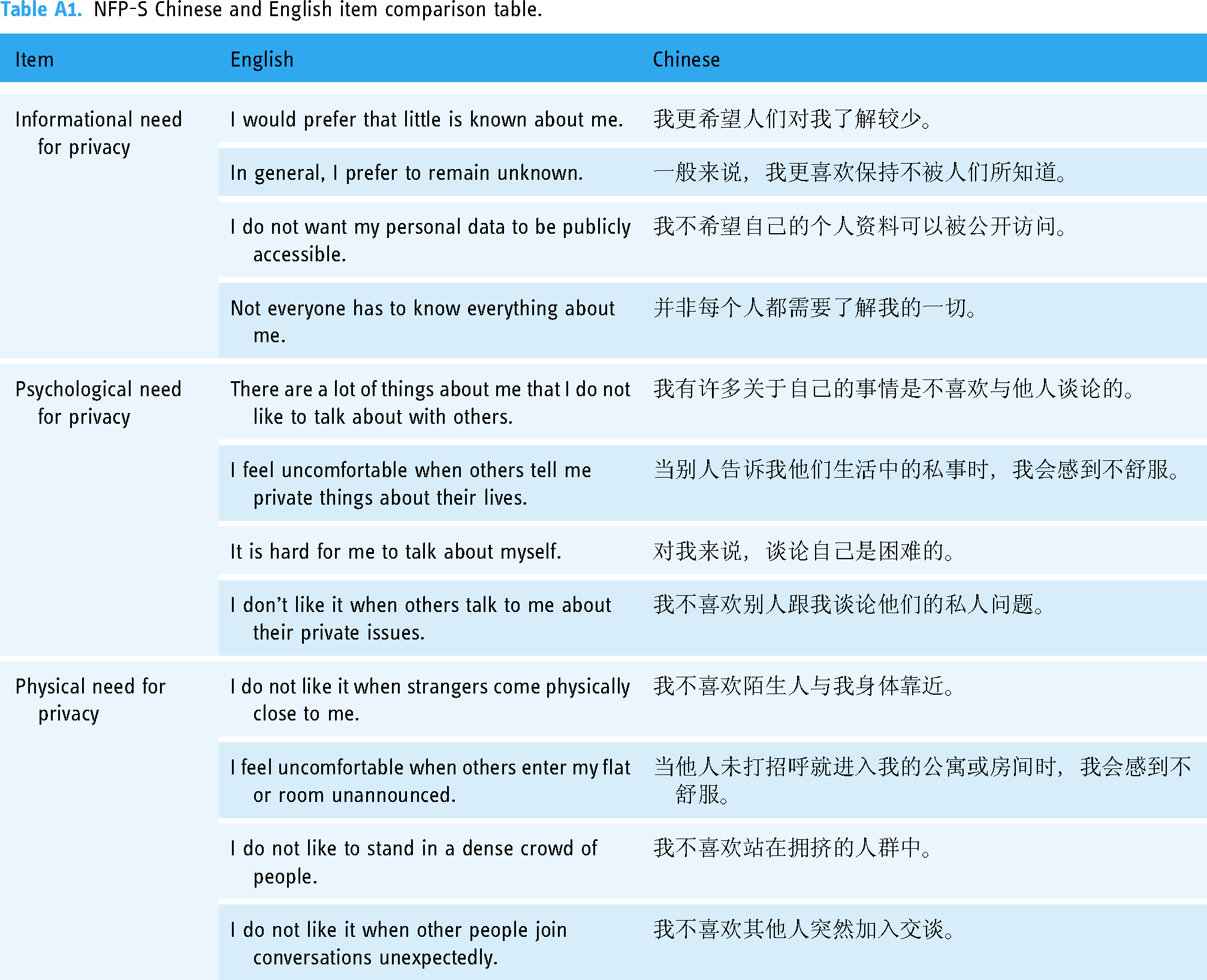
Firstly, the two doctoral students translated the scale from English to Chinese independently and discussed the translation results together, ultimately obtaining a consistent Chinese version. All the discrepancies in wording were solved through consensus. Secondly, the other two doctoral students conducted reverse translation. Subsequently, the university lecturer compared the back-translation version of the NFP-S with the original scale, finding them to be nearly identical. Finally, we invited 15 participants to complete the pretest, and according to the relevant feedback and suggestions obtained from them, we slightly modified the NFP-SC and then entered the data collection stage. The final version of NFP-SC is shown in Table A1. The dissemination of the online survey link was transpired through the Credamo online questionnaire platform. The original questionnaire used in this study is provided in the Supplemental Material. An attention check item was set in the online questionnaire, designed to filter out the answers with insufficient attention, and excluded 110 participants who failed to pass the check. All the participants were required to fill in all the questions in the questionnaire before submitting the results to the network. Therefore, there were no missing values. Data were collected in November 2023. Before submitting the questionnaire results, participants need to click on the “Agree to participate this survey” option to provide informed written consent. In the survey, participants were reminded that the information they submitted will be strictly confidential and only allowed to be used in legitimate academic researches. Participants were rewarded with 2 RMB.
Measures
NFP-SC. Frener et al. 1 developed the 12-item NFP-S to measure the need for privacy. The NFP-S included three dimensions: INP, PSNP, and PHNP. The items of NFP-S were measured on a 5-point Likert-type scale (1 = “I do not agree at all” to 5 = “I entirely agree”). INP was defined as the desire to disclose or shield personal information and data to others. PSNP was defined as the individual preference level of cognitive inputs and outputs. PHNP was defined as the desire to avoid physical violation and to establish a personal space that could regulate others’ entry. We adapted the NFP-S to Chinese (i.e., NFP-SC).
Loneliness. We applied the 3-item Loneliness Scale (LS-3) to measure the feelings of loneliness. 37 The items of loneliness were measured on a 5-point Likert-type scale (1 = “never” to 5 = “always”). A prior research demonstrated that the LS-3 exhibited satisfactory psychometric characteristics when used in Chinese participants. 38 The LS-3 revealed good internal consistency in this study (ω = 0.823).
Openness. We applied the 8-item Openness subscale (OS-8) of the Chinese Big Five Personality Inventory brief version to evaluate the openness trait. 39 The OS-8 has been extensively utilized and demonstrated good psychometric characteristics in Chinese populations. 39 Responses were given based on a 5-point Likert-type scale (1 = “did not apply to me at all” to 5 = “applied to me very much”). In the present study, the OS-8 had an omega coefficient of .910.
SMSD. SMSD was assessed by a five-item scale (SMSD-5) developed by Posey et al. 40 In previous research, the SMSD-5 exhibited good psychometric properties in Chinese samples.41,42 Responses were given based on a 5-point Likert-type scale (1 = “did not apply to me at all” to 5 = “applied to me very much”). In the present study, the SMSD-5 had an omega coefficient of .867.
Privacy concerns. The Internet Users’ Information Privacy Concerns (IUIPC) was adopted to evaluate individual privacy concerns. 43 The original version of IUIPC included 10 items. Lin and Feng 44 utilized Chinese data to develop a concise version of IUIPC with 4 items (IUIPC-4), demonstrating strong psychometric properties in the Chinese population. Therefore, we used the IUIPC-4. Responses were given based on a 5-point Likert-type scale (1 = “did not apply to me at all” to 5 = “applied to me very much”). In our study, the IUIPC-4 exhibited excellent internal consistency (ω = 0.881).
Statistical analysis
First, we examined the construct validity of the NFP-SC. Frener et al. 1 previously utilized Confirmatory Factor Analysis (CFA) to examine the second-order model of the NFP-SC. While this approach allowed for the exploration of the general need for privacy factor (G-factor) within the NFP-SC, it has faced criticism due to its strict proportionality constraints, as extensively discussed in the literature.45,46 In response to these criticisms, the bifactor-CFA model has emerged as a more versatile alternative, enabling the separate exploration of the G-factor and the specific factors (S-factors; i.e., INP, PSNP, and PHNP). However, Morin et al. 47 pointed out that the bifactor-CFA model, like other CFA models, fails to consider the cross-loadings of the indicators. This issue is important in multidimensional scales where indicators may have meaningful connections with more than one S-factor, a characteristic that can be captured through cross-loadings in Exploratory Factor Analysis but is constrained to be zero in CFA. To address both the cross-loading and hierarchical features of the multidimensional scale, the bifactor Exploratory Structural Equation Modeling (bifactor-ESEM) was introduced. 47 Therefore, we developed three models to assess the factor structure of the NFP-SC: the second-order-CFA model, the bifactor-CFA model, and the bifactor-ESEM model.
In the second-order CFA model, the 12 items were loaded on the three S-factors they were designed to measure and the three S-factors were loaded onto a G-factor. In the bifactor-CFA model, the 12 items were simultaneously loaded on a G-factor and S-factors that they were designed to measure. The bifactor-ESEM model permitted each item to cross-load on other S-factors, distinguishing it from the bifactor-CFA model. Following the precedent set by bifactor model studies, we specified that all factors in the bifactor-CFA model and bifactor-ESEM model undergo orthogonal rotation.47– 49 The orthogonal rotation aids in a clearer interpretation of the relationship between S-factors and observed items both above and beyond the G-factor.50,51 The graphics representations of these three models are shown in Figure 1. After conducting a comparative evaluation of three alternative models, we identified the optimal factor model for NFP-SC. Next step, we proceeded to analyze the gender-based measurement invariance (MI) of NFP-SC. Following previous research,52,53 three levels of equivalence from the weakest to the strongest across gender groups were examined. Initially, we performed a test of configural invariance to establish the equivalence of the factor structure between male and female groups. No constraints were imposed on any parameters during this test, which served as the baseline for subsequent MI analyses. Subsequently, we evaluated metric invariance by equalizing factor loadings across groups. Lastly, scalar invariance was examined by further equalizing intercepts across different groups. All models were estimated using the robust maximum likelihood (ML) estimator in Mplus 8.0. 54

Simplified conceptual representations of the estimated models.
To evaluate the fit of the three alternative models, several indices were utilized. The Comparative Fit Index (CFI) was employed, considering that values equal to or greater than 0.90 indicated an acceptable fit, and those equal to or greater than 0.95 suggested a good fit. Additionally, the Tucker–Lewis Index (TLI) was also taken into account, with values of 0.90 or higher indicating an acceptable fit, and 0.95 or higher suggesting a good fit. Furthermore, the Root Mean Square Error of Approximation (RMSEA) was scrutinized, and values equal to or less than 0.06 were considered to indicate a good fit. Alterations in these fit indices were analyzed to facilitate model comparison. Specifically, an increase in RMSEA of no more than 0.015 and a decrease in CFI of no more than 0.010 were considered significant in establishing more stringent levels of invariance. Furthermore, in order to compare the models, the alteration in the Sample-Size Adjusted Bayesian Information Criteria (ΔABIC) was utilized as a criterion. When the ΔABIC value surpasses 10, it demonstrates that the model with the lower ABIC exhibits a superior fit to the data. 55 In order to ensure comprehensive reporting, the chi-square test of model fit was included; however, it is crucial to acknowledge that sole reliance on the chi-square test was avoided because of its susceptibility to variations in the size of simples. 56
McDonald's omega (ω) values were calculated to evaluate the internal consistency reliability, of both the NFP-SC and its subscales. So as to examine the convergent validity of NFP-SC, Pearson correlations between NFPS-C and four theoretically related constructs (i.e., loneliness, openness, SMSD, and privacy concerns) were calculated. A correlation coefficient (r) is deemed weak when the absolute value of r is less than .30, moderated when r ranges from .30 to .50, and strong when r exceeds .50. 57 These computations were carried out using SPSS 26.0 software, 58 while the determination of ω value was based on formulas derived from Dueber's 59 Excel spreadsheet.
Results
Structural validity
Second-order CFA model. The second-order model exhibited poor model fit (see Table 2). Specifically, the values of CFI (0.864), TLI (0.824), and RMSEA (0.145) fell below the acceptable thresholds.
Goodness-of-fit statistics and information of the estimated models on the Chinese version of the need for privacy scale.

Note. CFA: confirmatory factor analysis; ESEM: exploratory structural equation modeling; CFI: comparative fit index; TLI: Tucker–Lewis index; RMSEA: root mean square error of approximation; 90% CI: 90% confidence interval of the RMSEA; AIC: Akaike information criteria; ABIC: adjusted Bayesian information criteria; ΔCFI: change in the CFI value; ΔTLI: change in the TLI value; ΔRMSEA: change in the RMSEA value.
Bifactor-CFA model. In the bifactor-CFA model, the twelve items of NFP-SC were loaded onto three S-factors (i.e., INP, PSNP, and PHNP), while also being loaded onto the G-factor simultaneously. The bifactor-CFA model showed acceptable values of CFI (0.949) and TLI (0.920). However, the RMSEA (0.097) did not meet the desired threshold. Compared to the second-order model, the bifactor-CFA model showed a notable enhancement in fit (ΔCFI = 0.085, ΔTLI = 0.096, ΔRMSEA = −0.048, with all changes significantly surpassing the predefined threshold levels).
Bifactor-ESEM model. The bifactor-ESEM model concurrently addresses the dual sources of construct-relevant psychometric multidimensionality. In our study, this model displayed favorable fit indices (CFI = 0.995, TLI = 0.987, RMSEA = 0.039) and showed significant superiority compared to the bifactor-CFA model (ΔCFI = 0.046, ΔTLI = 0.067, ΔRMSEA = −0.058).
To summarize, among the three alternative models, we found that the second-order CFA model had the least satisfactory fit. On the other hand, the bifactor-CFA model had a relatively weak fit, whereas the bifactor-ESEM model displayed a strong fit. Table 3 presents the standardized factor loadings for the bifactor-ESEM model. When comparing the bifactor-CFA and bifactor-ESEM models directly, the results indicated that there was a significant difference in their ABIC values, with |ΔABIC| = 319.664 (>10). This suggested that the bifactor-ESEM model, with its lower ABIC value, offered a superior fit for the data. Consequently, these findings strongly suggested that the bifactor-ESEM model was the optimal choice to represent the factor structure of NFP-SC.
Standardized factor loadings for the bifactor exploratory structural equation modeling.

Note. Target loadings are in bold. GF: general need for privacy; INP: informational need for privacy; PSNP: psychological need for privacy; PHNP: physical need for privacy.
Measurement invariance
Before testing the MI, we first conducted separate assessments of the fit metrics for the bifactor-ESEM model in both male and female populations, which revealed good fit indices (see Table 4). Next, we evaluated three levels of MI, varying from the least restrictive (configural invariance) to the more restrictive (metric and scalar invariance). Notably, no significant changes were detected in CFI (|ΔCFI| ≤ 0.005), TLI (|ΔTLI| ≤ 0.002), or RMSEA (|ΔRMSEA| = 0.002) among the three models. Therefore, the bifactor-ESEM model demonstrated upheld MI within its framework.
Measurement invariance of the bifactor ESEM across gender groups.
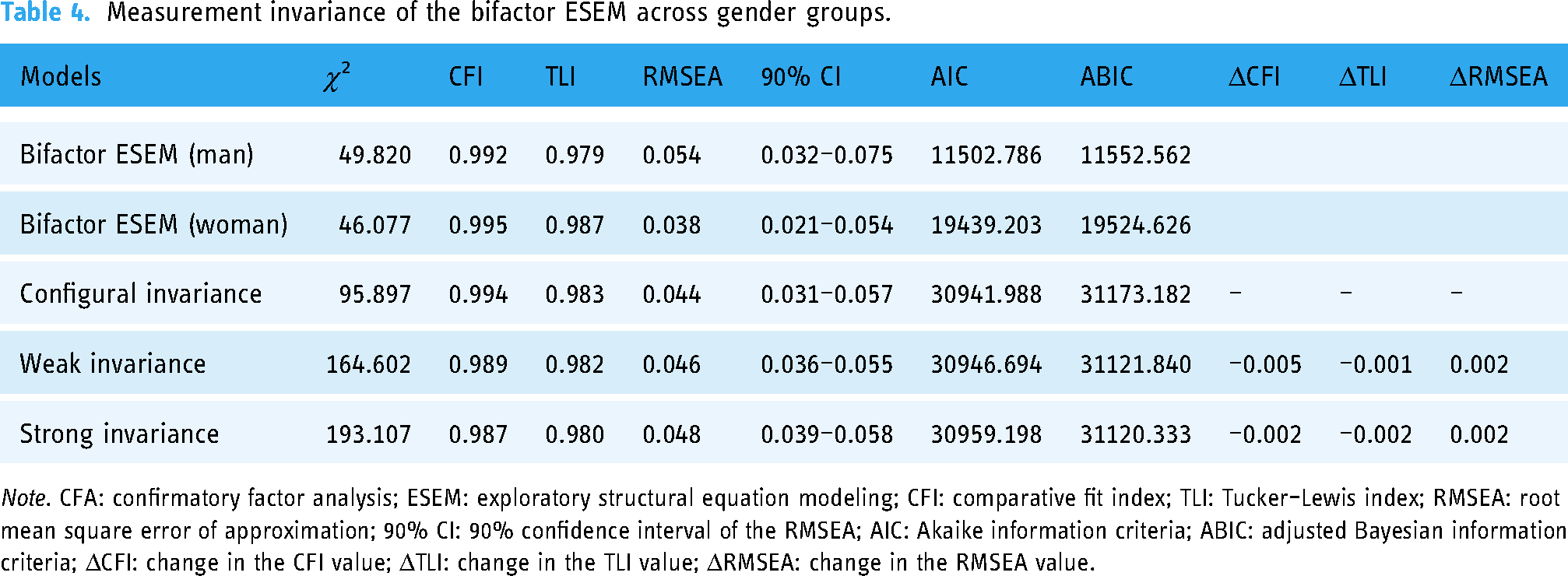
Note. CFA: confirmatory factor analysis; ESEM: exploratory structural equation modeling; CFI: comparative fit index; TLI: Tucker–Lewis index; RMSEA: root mean square error of approximation; 90% CI: 90% confidence interval of the RMSEA; AIC: Akaike information criteria; ABIC: adjusted Bayesian information criteria; ΔCFI: change in the CFI value; ΔTLI: change in the TLI value; ΔRMSEA: change in the RMSEA value.
Reliability indices
To evaluate the reliability, the study utilized model-based ω coefficients. The G-factor, INP, PSNP, and PHNP had respective ω values of 0.949, 0.892, 0.860, and 0.866. These findings highlight the strong internal consistency reliability of both the G-factor and S-factors.
The calculation of ω hierarchical (ωH) was performed to determine the proportion of total score variance that can be attributed to the G-factor. In addition, we determined the ω hierarchical for each S-factor (ωHS) to indicate the proportion of systematic variance in the subscale score that could be explained by the S-factors after eliminating the variance associated with the G-factor. Furthermore, we computed the Explained Common Variance of the G-factor (ECVGF) and S-factors (ECVSF). We integrated ωS, ωHS, and ECVSS to substantiate the interpretability of the S-factors. The results are shown in Table 5.
Bifactor indices and descriptive statistics of the need for privacy scale.

Note. ω: omega index; ωH: omega hierarchical for general factor; ωHS: omega hierarchical for specific factors; ECV: explained common variance.
The ωH value (= 0.91) showed that the G-factor accounted for a significant 91% of the variability in the total scores. The ωHS for the S-factors were low, with INP being 0.06, PSNP being 0.19, and PHNP being 0.08. The smaller values of ωHS for the S-factors suggested that the S-factors elucidated only minimal variance subsequent to the consideration of the G-factor. Based on the findings of previous research, 60 if ωS hovers around 0.90, a ωHS surpassing 0.10 or an ECVSF exceeding 0.15 is deemed adequate for the subscores to contribute additional value; if ωS hovers around 0.86, a ωHS surpassing 0.16 or an ECVSF exceeding 0.20 is deemed adequate for the subscores to contribute additional value. Nevertheless, we found that none of the indices met the cutoff criteria except for the ωHS of PSNP, suggesting that the interpretation of the subscores yielded less meaningful information.
Convergent validity
We assessed convergent validity by analyzing the connections between NFP-SC factors and four constructs that are theoretically linked (see Table 6). Bivariate correlation analyses revealed that NFP-SC was significantly and positively associated with loneliness (r = .322, p < .001) and privacy concern (r = .754, p < .001). Additionally, NFP-SC was significantly and negatively linked with openness (r = −.320, p < .001) and SMSD (r = −.713, p < .001). These outcomes, aligning well with our anticipated direction, supported the convergent validity of the NFP-SC.
Correlation matrix of the study variables.

Note. NFPS: need for privacy scale; PC: privacy concern; SMSD: social media self-disclosure.
*p < .001
Discussion
Analyzing the psychometric properties of the NFP-SC was the main objective of this research. At first, we evaluated three alternative models in order to identify the factor structure of NFP-SC. Frener et al. 1 compared three models to validate the factor structure of NFP-S: the multi-dimensional first-order model, the second-order model, and the bifactor model. The goodness of fit index showed that these models all could fit the data well. Since the high intercorrelations were consistent with their theoretical assumptions of a G-factor, Frener et al. 1 finally selected the second-order model to express the NFP-S. However, according to our study, the second-order model exhibited inadequate model fit. Then by using the bifactor-CFA model, the fitting index has been greatly improved. However, while the bifactor-CFA model could better solve the hierarchical nature of NFP-SC, it ignored the fallible nature of these indicators. It is noteworthy that the items of NFP-SC were designed to measure separate dimensions, but they were not pure indicators of these dimensions, which meant that the structural model equation of NFP-SC should also consider the cross-loadings. Accordingly, we chose to further use the bifactor-ESEM model to test the factor structure of NFP-SC. The results showed that the fitting index of the bifactor-ESEM model was better than the other two models. Overall, our study results supported that the bifactor-ESEM model had advantages in revealing the potential dimensions of NFP-SC. In addition, considering the estimated values of ωH, ωS, ωHS, and ECVSS, it can be deduced that the NFP-SC should be interpreted unidimensionally with a total score, as the subscores offer minimal additional value beyond a total score interpretation. Regarding reliability, the general need for privacy and its three components indicated good internal consistency reliability, as evidenced by the ω values.
Next, based on the bifactor-ESEM model, we proceeded to examine the MI of NFP-SC between males and females. Our study results evaluated three levels of MI across different gender groups, indicating that the construct of the need for privacy measured by NFP-SC was similar in both male and female samples. Thus, we can infer that individuals of different genders had very similar ways of understanding the items of NFP-SC. Therefore, the significant differences in mean scores of NFP-SC between individuals of different genders could be by reason of the actual differences in the level of personal need for privacy.
As an additional supplement, we tested the convergent validity of the NFP-SC. The results proved that there were significant correlations between NFPS-C and four selected covariates, which were consistent with the direction expected in our hypothesis. Specifically, there was a moderately positive correlation between NFP-SC with loneliness, which agreed with the inference of Frener et al. 1 that satisfying the need for privacy may require a higher level of loneliness as a cost. It is very important to socialize with others on social media to alleviate people's loneliness, but users with high need for privacy will reduce the use of social media to protect privacy to a certain extent, which may increase their loneliness. 32 Meanwhile, NFP-SC was highly positively correlated with privacy concerns. Since individuals with a higher need for privacy are more sensitive and concerned about the lack of privacy, 61 they will exhibit more privacy concerns. The need for privacy was highly negative correlated with SMSD, which was also in line with the inference of Frener et al. 1 that people with high privacy need may satisfy their privacy level by adjusting the amount of information they share with others, 62 such as reducing self-disclosure on social media. Especially, according to the protection motivation theory, when they feel their privacy has been violated, they will consciously withdraw from self-disclosure behavior on social media to reduce the risk of privacy information being leaked. 63 Openness and need for privacy were moderately negative correlated, further confirming that individuals with high openness usually pay less attention to privacy. 33 The openness to new experiences makes individuals tend to try and experience new things, leading to reduced concerns about potential risks, including privacy risks. 64 As a result, people with high openness usually have lower privacy needs, manifested in not caring about their information being collected, information errors, or being accessed improperly. 65
Limitations and future research
According to our current research, there are still some deficiencies which should be acknowledge. First, the samples of our study were mainly Chinese adults and lacked a sample of adolescents. Therefore, future studies should include more categories of participants in experimental samples to further examine the psychometric characteristics of NFP-SC, especially adolescents, while they have different models of privacy from adults. 66 Second, our study used cross-sectional data, which led to certain limitations in testing the NFP-SC and inferring its causal relationship with the convergent variables. Therefore, future research could build panel data by gathering data from different periods for further testing. Finally, our study did not conduct test-retest reliability, which could reflect the stability of NFP-SC over time. Test-retest reliability is crucial for determining whether self-reported outcomes have changed over time and intervention effectiveness, thus future researches ought to supplement the test-retest reliability 67 of NFP-S to improve its application effect in the design of longitudinal and intervention studies. 68
Conclusion
Our findings showed that the bifactor-ESEM model is more effective in reflecting the potential structure of NFP-SC. The results of MI suggested that males and females have the same understanding of need for privacy as measured by the NFP-SC. The correlations between NFP-SC and covariates supported the convergence validity of NFP-SC. Overall, our study results showed that NFP-SC exhibited satisfactory psychometric properties in the Chinese context, meaning that it could be applied for future studies on investigating need for privacy in Chinese populations.
Supplemental Material
sj-docx-1-dhj-10.1177_20552076241284685 - Supplemental material for Psychometric properties of the Chinese version of the Need for Privacy Scale
Supplemental material, sj-docx-1-dhj-10.1177_20552076241284685 for Psychometric properties of the Chinese version of the Need for Privacy Scale by Hao Wang, Ming Cheng and Wenlan Zhu in DIGITAL HEALTH
Supplemental Material
sj-doc-3-dhj-10.1177_20552076241284685 - Supplemental material for Psychometric properties of the Chinese version of the Need for Privacy Scale
Supplemental material, sj-doc-3-dhj-10.1177_20552076241284685 for Psychometric properties of the Chinese version of the Need for Privacy Scale by Hao Wang, Ming Cheng and Wenlan Zhu in DIGITAL HEALTH
Footnotes
Acknowledgments
There are no other contributors to be acknowledged in this study.
Contributorship
HW contributed to conceptualization, methodology, writing–original draft, data curation, writing–review and editing, and supervision. MC contributed to formal analysis, writing–review and editing, data curation, and visualization. WZ contributed to conceptualization, writing–original draft, and data curation.
Declaration of conflicting interests
The authors declared no potential conflicts of interest with respect to the research, authorship, and/or publication of this article.
Ethical approval
The ethics committee of the School of Journalism and Communication, Wuhan University, China approved this study. The ethics committee of the Institutional Review Board, Wuhan University, China approved this study.
Funding
The authors received no financial support for the research, authorship, and/or publication of this article.
Informed consent
This study conducted questionnaire distribution on the legitimate online survey platform “Credamo” in China. All participants voluntarily chose to participate in the survey and received the corresponding compensation. We provided a thorough explanation of anonymity and privacy to the participants at the beginning of the questionnaire, and provided written notice regarding the use of their data collection for academic research. And we informed the participants that if they are unwilling to provide data, they can choose to withdraw from the questionnaire without any impact. Therefore, when participants click the “Agree to participate in the survey” button to continue answering the questionnaire, it can be considered that we have obtained their implicit consent.

Supplemental material
Supplemental material for this article is available online.
Appendix
NFP-S Chinese and English item comparison table.
| Item | English | Chinese |
|---|---|---|
| Informational need for privacy | I would prefer that little is known about me. | 我更希望人们对我了解较少。 |
| In general, I prefer to remain unknown. | 一般来说,我更喜欢保持不被人们所知道。 | |
| I do not want my personal data to be publicly accessible. | 我不希望自己的个人资料可以被公开访问。 | |
| Not everyone has to know everything about me. | 并非每个人都需要了解我的一切。 | |
| Psychological need for privacy | There are a lot of things about me that I do not like to talk about with others. | 我有许多关于自己的事情是不喜欢与他人谈论的。 |
| I feel uncomfortable when others tell me private things about their lives. | 当别人告诉我他们生活中的私事时,我会感到不舒服。 | |
| It is hard for me to talk about myself. | 对我来说,谈论自己是困难的。 | |
| I don’t like it when others talk to me about their private issues. | 我不喜欢别人跟我谈论他们的私人问题。 | |
| Physical need for privacy | I do not like it when strangers come physically close to me. | 我不喜欢陌生人与我身体靠近。 |
| I feel uncomfortable when others enter my flat or room unannounced. | 当他人未打招呼就进入我的公寓或房间时,我会感到不舒服。 | |
| I do not like to stand in a dense crowd of people. | 我不喜欢站在拥挤的人群中。 | |
| I do not like it when other people join conversations unexpectedly. | 我不喜欢其他人突然加入交谈。 |
References
Supplementary Material
Please find the following supplemental material available below.
For Open Access articles published under a Creative Commons License, all supplemental material carries the same license as the article it is associated with.
For non-Open Access articles published, all supplemental material carries a non-exclusive license, and permission requests for re-use of supplemental material or any part of supplemental material shall be sent directly to the copyright owner as specified in the copyright notice associated with the article.
