



Abstract
Objective
When hyper-infectious diseases sweep over the world, pro-community participation has been found to effectively curb the spread of viruses. This study explores the associations among media-related perceptions and media users’ pro-community participation during the peak of the 2022 COVID-19 outbreaks in China.
Methods
A cross-sectional survey was conducted among 976 Chinese media users in April 2022 to collect data on their pro-community participation and perceptions of pandemic news influence, information relevance, and credibility of traditional media and social media. Hierarchical regression analyses were run to analyze the associations between these perceptual variables and pro-community participation.
Results
The findings revealed that information relevance was positively associated with perceived news influence on oneself and pro-community participation. Perceived credibility of traditional media was positively associated with perceived news influence on both oneself and others. Perceived credibility of social media was positively associated with perceived news influence on others. Additionally, perceived credibility of traditional media positively moderated the association between information relevance and perceived news influence on others.
Conclusions
Information relevance and perceived media credibility play significant roles in shaping media user’ perceptions of news influence and their subsequent pro-community behaviors. Higher perceived media credibility can produce a broader impact on perceived news influence on both media users themselves and others, highlighting its importance in public health communication strategies. These insights can inform media practices and public health policies to enhance community participation during public health crises.
Introduction
When hyper-infectious diseases sweep over the world, pro-community participation, as constructive collaboration and collective action, has been proven to effectively curb the spread of viruses.1,2 In response to challenging situations, such as unprecedented pressure on healthcare systems that causes the neglect of high-risk social groups during the outbreaks of COVID-19, people in many countries demonstrated high levels of pro-community participation by assisting seniors or engaging in interactions with public administration.3,4 While several studies have examined the effects of media use on pro-community participation in public health crises,2,5 little attention has been paid to exploring the mechanisms of pro-community participation. Crises are sudden and widespread events that seriously disrupt system routines and require urgent action to address the disruption. 6 Public health crises, in particular, refer to emergent situations where the consequences have the potential to exceed a community's usual capacity to tackle them. 7 The unique circumstances of public health crises raise important questions regarding public participation: What prompts people to participate in collective pro-community behaviors? When media serve as the main channels to keep people informed, how do people's subjective evaluations of the “mediated” disease presented by the media affect their downstream participation? Research on these matters will promote a sophisticated understanding of potential factors and their combined influence on pro-community participation and, particularly, the understudied area of health-related participation. 8
This study addresses these unanswered questions by examining Chinese media users’ pro-community participation during a large-scale pandemic outbreak. Informed by the third-person and the first-person effect on public health issues,9–12 the current study examines the antecedents and moderators of perceived news influence and first-person perception by testing the associations among information relevance, media credibility, perceived news influence, and pro-community participation. The analyses explicate the mechanism by which the potential contributing variables may suppress or elevate individuals’ subjective perceptions of the influence of public health news and subsequent behavioral participation. Considering the global impact of emerging contagious diseases and public health crises, we expect the findings to enlighten public health and community development research and provide public administrators and media practitioners with pragmatic implications for soliciting the public to take collective action.
Media, public health crises, and pro-community participation
In public health crises, such as MERS, avian flu, and COVID-19, the media serve as indispensable sources to inform the public. People usually do not have first-hand experience with the disease or infected cases, so media such as television, newspapers, and social networking sites are major information sources, shaping public perceptions of and reactions to the crisis.13,14 The public may perceive crisis news as both negative and positive. The rapid spread of a contagion among the masses and the symptoms indicated by infected cases trigger public perceptions of risks and threats to health. 13 Health crisis news also communicates prosocial information. The mainstream media, particularly in collectivist cultures, provide necessary information on desired civic activities and tend to frame public health crises as situations in which people shall act collectively to fight the virus and promote social cohesion.5,15
Along with media consumption, the public also takes opportunities for pro-community participation.16,17 It refers to public engagement in voluntary activities for public interest within the community. 18 Numerous studies have emphasized the impact of motivational or personality factors on helping behaviors,19,20 but pro-community participation during a pandemic involves more complex factors, going beyond motives and personalities. 21 The underlying mechanisms by which perceptual media influence could encourage pro-community participation during public health crises remain insufficiently researched.
Third-person or first-person effect in public health crises
The third-person hypothesis suggests that people tend to overestimate media influence on others, underestimate its influence on themselves (i.e. the perceptual component), and react to their perceptions of media influence (i.e. the behavioral component).22,23 The self-serving and self-enhancement tendencies suggest that people have a motivation to maintain a superior self-image. 24 Being influenced threatens one's ego due to a common belief that only those gullible persons are easily influenced. People therefore tend to overestimate their immunity to unfavorable media influence while perceiving others as susceptible. In addition, being influenced implies being controlled or manipulated. Admitting that one is influenced by media suggests a loss of autonomy and susceptibility to manipulation, which conflicts with individuals’ belief in individual agency and free will. 25
Previous literature further suggests that when media influence is perceived as socially desirable or normatively positive, a reversed third-person perception, namely first-person perception, occurs. 26 The motivation for self-enhancement prompts people to believe that they are smarter than others in identifying the positive values of media messages, admit high receptivity to positive messages, and attribute more positive influence to themselves. 27 People thus underestimate others’ reception to media messages with positive values while judging themselves as being more affected. When examining the PSAs’ influence involving altruistic values, scholars found that the PSAs implying high social desirability contributed to a greater perceived media influence on oneself than on others. 28
Pandemic-related media publicity in China often recognizes the importance of grassroots efforts in combating COVID-19 and mobilizes people to participate in pro-community service by depicting volunteers as role models and highlighting their exceptional sacrifices to contain the pandemic. 29 A content analysis of COVID-19 news in China Daily, one of the state's leading news outlets, examined key social actors participating in the pandemic containment, indicating that “people,” primarily “Chinese people,” was the single actor group with the highest word frequency. The official media adopted the generic frame of responsibility to highlight the role of Chinese people's togetherness in battling the pandemic. 30 Discourse analyses of People's Daily articles indicated frequent acknowledgment and respect for the sacrifices and efforts of Chinese people in maintaining the public health system and infrastructure.31,32 A similar pattern was also dominant in People's Daily's social media posts. 33 Although social media enable Chinese people to obtain information on public issues from other sources besides governmental outlets, the platforms are not allowed to produce information that deviates too far from the information from official media due to the country's sophisticated control system. 34 As a result, prosocial content and positive social values conveyed by pandemic news may render Chinese media users to perceive pro-community participation in containing the virus as socially desirable and believe that they are more affected by media through their engagement in positive, prosocial, and altruistic behaviors, or pro-community participation behavior, than others.
The influence that people expect the media to have on others may lead them to take action.35,36 Those who assume media influence on others tend to believe that others represent the general public. They will accommodate their behaviors to align with such assumptions and adjust their behaviors to conform to the majority.37,38 We therefore propose that Chinese media users’ perceptions of the pandemic news influence on others can encourage their own pro-community participation. Having perceived a significant effect on others of media-disseminated role models regarding how one should act during the pandemic, they could form the assumption that the public actions depicted by the news represent the mainstream. This belief compels media users to conform to the behaviors of the majority in the community, leading to pro-community participation.
Prior studies support the positive association between the perceived effect of media coverage on oneself and behavioral intention to take protective action when facing health threats. Wei et al. 39 found a stronger association between the perceived news influence of tainted food recalls on oneself and the intention to avoid tainted food or select food cautiously than between the perceived influence on others and behavioral intention. In a study of news about the imported US beef controversy, the perceived effect of news coverage on oneself was a strong predictor of one's intention to support government trade policy and boycott US beef. 10
The process in which people's perceptions of media influence on themselves encourage subsequent pro-community participation needs further exploration. People learn what is socially desirable from media coverage. Those who perceive media influence on themselves will consider that they are expected to engage in the behaviors promoted by the media.38,40 Such expectations may motivate people to perform the behaviors. 41 The more Chinese media users perceive pandemic news to affect their behaviors, the more likely they will demonstrate actual pro-community behaviors.
People may react to the self-other perceptual discrepancy of media effects by adjusting their behaviors. When examining prosocial behaviors in a public crisis, Kim 15 found that third-person perception hindered people's intentions to donate to the recovery from Hurricane Katrina. A stronger perceived news influence on others while a weaker influence on oneself might lead people to believe that “they will help, so I don’t need to” and lessen their engagement in social issues. 15 (p93) The current study proposes a stronger perceived media influence on self than on others and hypothesizes that first-person perception is positively associated with pro-community participation. A weaker perceived influence of pandemic news on others may lead people to believe that they are duty-bound to enact pro-community behaviors and engage in pro-community activities for the common good because others are less affected or mobilized to help the community.
Information relevance, media credibility, and perceived news influence
Existing studies have identified several predictors of people's evaluation of media influence, one of which is information relevance.10,39 It refers to people's subjective evaluations of their connection to an issue covered by media. 42 The elaboration likelihood model (ELM) explains the process in which audiences use a central or peripheral route of information processing. 43 When media messages are personally relevant, the central route is activated. People are motivated to appraise the message implications and systematically scrutinize media influence on themselves.17,42 When media messages have low relevance, people will use the peripheral route for information processing with less motivation.
Information relevance may increase perceived media influence on oneself. 44 Lo et al. 10 found that issue importance, a proxy for information relevance, predicted perceived media influence on oneself and others and was positively related to first-person perception. When media messages are perceived as personally relevant, audiences are likely to accept the messages that promote socially desirable views and acknowledge that the messages have affected them. 37 People may demonstrate increasing perceived influence of pandemic news on themselves as information relevance arises, while considering media influence on others to be relatively stable. We thus propose that information relevance is likely to inspire a stronger presumed influence of pandemic news on themselves than on others.
Defined as the extent to which people judge information sources in terms of their accuracy, trustworthiness, fairness, free of bias, and truthfulness, 45 media credibility has also been identified as a critical predictor of people's evaluation of news influence.39,46 When they view the source as less credible, self-serving bias may activate a belief in their ability to evaluate incoming messages and process the information properly. They believe that they can distinguish quality news from fake news while believing others cannot. 47
The burgeoning popularity of social media as information sources raises new questions about media credibility and perceived media effects. Extant studies have mentioned the varying levels of media credibility that people perceive in traditional media and social media. The latter are often criticized for producing and disseminating unverified news. Due to the increasing layers of users and the absence of professional gatekeepers, people are less trustful of news on social media than from traditional outlets. 48 In the Chinese context, the traditional media play an irreplaceable role in disseminating critical health information and are considered reliable for COVID-19 information. 49 People also get information from social media which have more freedom in delivering a variety of information and analyses. As a battlefield where commercial news media, self-media, and multiple players compete for audience traffic and advertising revenue, social media are tied with disinformation and fake news that degrades their credibility. 50 In providing COVID-19 information, social media are viewed as less trustworthy compared with traditional media. 49
Given the potential perception difference between the two types of media, we anticipate that perceived credibility of traditional media and social media would produce variation in people's perceptions of media influence on themselves and others. When people evaluate media influence on themselves, the influence from credible sources is more likely to be identified than that from less credible ones. 46 When assessing media influence on others, people tend to believe that others are more affected by less credible sources. 51 When pandemic news is received from more credible sources such as traditional media and the presumed influence is considered socially desirable, people tend to report a higher level of perceived media influence on themselves than on others. By contrast, the relatively low perceived credibility associated with social media may render people reluctant to acknowledge the social media influence on themselves but overestimate the influence on others.
As the ELM suggests, when encountering highly personally relevant messages, people engage in the central route and focus closely on the messages. 43 When people see media messages as personally irrelevant, they use the peripheral route and rely on other cues, such as media credibility, to process information. 42 Given that information relevance may lead people to switch between central and peripheral routes, information relevance and media credibility could interact to produce variant effects on people's perceptions of media effects. We thus explore whether the association between information relevance and perceived media influence varies by perceived media credibility.
Specifically, when media credibility is high, people tend to process and accept incoming information without much thought. 52 People rely heavily on information relevance to evaluate the media influence on themselves and others. Information relevance may produce a greater perceived news influence on oneself and a relatively smaller perceived influence on others, resulting in a positive association between information relevance and first-person perception. As perceived traditional media credibility increases, the positive association between information relevance and perceived news influence will become stronger on oneself than on others, and information relevance will be positively associated with first-person perception as well.
By contrast, when media credibility is perceived as low, people may evaluate media influence on themselves and others in a relatively thorough way. 52 The scrutiny of media influence may lead people to discount the impact of information relevance and be reluctant to acknowledge the media influence on themselves. 46 Information relevance may thus predict a smaller perceived news influence on oneself but a larger perceived influence on others, resulting in a negative association between information relevance and first-person perception. This could be the case when evaluating social media credibility. The association between information relevance and perceived influence on oneself becomes weaker whereas that between information relevance and perceived influence on others becomes stronger, predicting a smaller first-person perception. To better understand the associations between information relevance and perceived news influence moderated by media credibility, this study explores whether the associations between information relevance and perceived news influence on oneself and others and the related first-person perception vary as a function of perceived credibility of traditional media and social media.
Methods
To test the hypotheses, we conducted a cross-sectional survey and selected Mainland China as a locale. The survey was administered with the assistance of an online survey company with a pool of more than 6.2 million respondents in 33 provinces and autonomous regions in China. The target population consists of general media users in China above the age of 18. Given that the response rate of online surveys is usually around 10%, 53 a sample was randomly drawn from the pool of the company. The survey was conducted between April 13 and April 17, 2022. The COVID-19 situation in China at that time was unprecedentedly severe. Compared with the outbreak in early 2020, residents nationwide were subject to tougher containment measures. Key variables, including perceived pandemic news influence on oneself and on others, first-person perception, information relevance, perceived credibility of traditional and social media, and pro-community participation were measured or calculated. Hierarchical regression analyses were conducted to test the associations among the key variables.
Sample
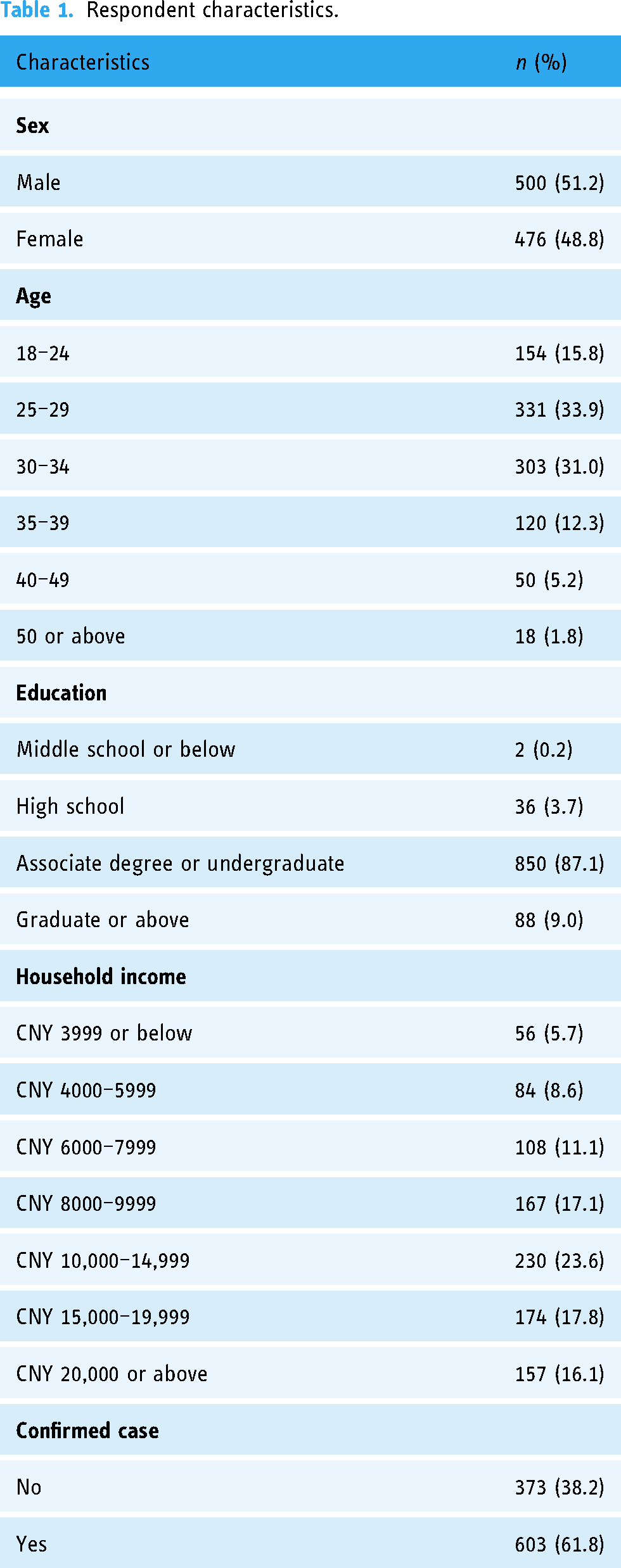
Institutional ethical approval was obtained before data collection. After each respondent clicked to agree to an online written consent form, they continued to participate in the survey. Written consent was obtained from all respondents. Responses with missing data were excluded. The survey was completed by 976 respondents, with 500 (51.2%) men and 476 (48.8%) women. Their ages ranged from 18 to 78 (M = 30.24, SD = 6.69). The majority (87.1%) had an associate degree or above. More than half of the respondents (57.48%) reported a household monthly income above CNY 10,000 (USD 1445), followed by 36.79% earning CNY 4000–9999 (USD 578–1444) and 5.73% earning below CNY 3999 (USD 577). Table 1 indicates the respondent characteristics.
Respondent characteristics.
Measures
The key variables in this study included perceived influence of pandemic news on oneself, on others, and first-person perception as the independent variables, pro-community participation as the dependent variable, and information relevance as the antecedent. Perceived traditional and social media credibilities were included as two antecedents and moderators. The measures used in this study were adapted from previous studies to fit the Chinese context and the items were validated.5,17,39 Permission to use all applicable questionnaires has been confirmed. Table 2 summarizes the correlations among the key variables.
Correlation matrix for key variables.

** p < .01.
Perceived influence of pandemic news on oneself and others
Respondents were first asked to report the extent to which they thought the pandemic news had affected them in terms of their pro-community behaviors to contain the virus on a five-point scale (1 = not at all, 5 = considerable). The “self” item was revised into “other residents in your city” to measure the perceived influence of pandemic news on others (Mself = 4.19, SD = .81; Mothers = 4.08, SD = .81).
First-person perception
Given a greater perceived influence on oneself than others, this study measured first-person perception by subtracting the perceived influence of pandemic news on others from the perceived influence on oneself (Mself−others = .11, SD = .91).
Information relevance
Three items were used to measure information relevance, including (a) “the information I obtained from pandemic news is relevant to others rather than me,” (b) “news coverage of the pandemic has little to do with me,” and (c) “the pandemic news is useful for a small number of people.” Respondents were asked to report their agreement on a five-point scale (1 = strongly disagree; 5 = strongly agree). The results were reverse-coded and averaged to create a composite measure for information relevance (M = 3.74, SD = .99, α = .83).
Perceived media credibility
Perceived media credibility was measured for traditional media and social media. 54 For traditional and social media credibility, respondents were shown seven adjectives and asked to indicate the extent to which they agreed that the pandemic news they consumed from traditional media or social media was “serious,” “accurate,” “scientific,” “true,” “biased (reversed),” “exaggerated (reversed),” or “manipulated (reversed).” A five-point scale was used (1 = strongly disagree; 5 = strongly agree). Ratings were averaged to create a score of traditional media credibility (M = 4.06, SD = .58, α = .78) and of social media credibility (M = 3.64, SD = .71, α = .84). A paired t-test indicated a significant difference between perceived traditional and social media credibility, t(1, 975) = 20.07, p < .001.
Pro-community participation
Respondents were asked to report how well each of the following statements reflected their pro-community participation in pandemic containment. The four items are “I have taken responsibility for pandemic control for the whole community,” “I have taken every chance to do something for pandemic control within my community,” “I have spent time and efforts to participate in pandemic containment for the whole community,” and “I have dedicated myself to the pandemic control measures.” A five-point scale (1 = reflects very poorly; 5 = reflects very well) was employed. 17 The results were averaged to create a score of pro-community participation (M = 4.23, SD = .56, α = .68).
Control variables
Based on the time of data collection and confirmed cases released by the local government of each respondent's city, we created a categorical variable of confirmed case (1 = no cases, n = 373; 2 = cases confirmed in the city, n = 603). Demographic variables (i.e. age, sex, education, and household monthly income) and confirmed case were all controlled.
Previous literature suggests that media consumption is positively associated with perceived media influence. 5 We controlled respondents’ traditional media and online media exposure to pandemic news as well. Respondents were asked to report the frequency of accessing COVID-19 pandemic news from traditional media such as newspapers, television, and radio, and online media such as social networking sites and online portals. Responses were rated on a five-point scale from 1 = never to 5 = always (Mtraditional = 3.15, SD = .77; Monline = 4.34, SD = .54; t(1, 975) = -42.37, p < .001).
Results
Preliminary analyses
To understand how individuals’ perceptual factors shaped their pro-community participation during a public health crisis, we employed hierarchical regression analysis. This method helped us test the associations among perceived influence of pandemic news on oneself and others, first-person perception, information relevance, perceived credibility of traditional and social media, and pro-community participation. We controlled for demographics (age, sex, education, and household monthly income), confirmed case, and traditional and online media exposure to pandemic news. Results are presented in Tables 3 and 4.
Standardized linear regression coefficients predicting pro-community participation.

Notes. N = 976.
a 1 = male, 2 = female.
1 = no confirmed cases, 2 = confirmed cases.
Information relevance * Perceived traditional media credibility.
Information relevance * Perceived social media credibility.
***p < .001.
**p < .01.
*p < .05.
Standardized linear regression coefficients predicting perceived news influence and first-person perception.

Notes. N = 976.
1 = male, 2 = female.
1 = no confirmed cases, 2 = confirmed cases.
Information relevance * Perceived traditional media credibility.
Information relevance * Perceived social media credibility.
***p < .001.
**p < .01.
*p < .05.
Our analyses first revealed that respondents’ traditional media news exposure was positively associated with their pro-community participation (β = .14, p < .001; see Table 3). In addition, respondents with less education (β = −.08, p = .006), higher income (β = .09, p = .004), no confirmed cases in their cities (β = −.08, p = .007), and higher exposure to both traditional (β = .11, p = .001) and online media (β = .11, p < .001) to pandemic news tended to estimate a greater influence of news on others. Respondents with no confirmed cases in their cities (β = −.07, p = .036) and higher exposure to online media news (β = .15, p < .001) were more likely to perceive greater news influence on themselves (see Table 4).
Perceived news influence and pro-community participation
H1 predicted that perceived influence of pandemic news on oneself would be greater than perceived influence on others. Media users would estimate that pandemic news affected themselves more than it did other users. We conducted a paired t-test and found that respondents believed that pandemic news indeed produced a stronger influence on themselves than on others. The results supported the first-person perception, t (1, 975) = 3.67, p < .001, and confirmed H1.
To delve deep into how these perceptions of news influence affected actual behavior, we continued to explore how respondents’ perceptions of pandemic news influence on themselves and others would each be positively associated with their actual participation in pro-community activities, as H2 and H3 proposed. To test these hypotheses, we performed two hierarchical regression analyses by entering multiple variables into the regression model in blocks. A hierarchical regression analysis in SPSS involves a set of linear regressions that can be separated into Blocks. Each block represents one model or one step in which predictors, usually decided by researchers, are entered into the regression model. 55 We thus entered demographics and confirmed case in Block 1, media exposure to pandemic news in Block 2, information relevance, perceived media credibility, along with the interaction terms in Block 3, and perceptions of news influence or first-person perception in Block 4. The predictors entered in prior Blocks were also included in the subsequent Blocks. In so doing, we could clearly observe how predictors in each Block contributed to the dependent variable.
Given the high correlations between perceived news influence on oneself and first-person perception (r = .57, p < .001) and between perceived news influence on others and first-person perception (r = −.56, p < .001; see Table 2), we entered perceived news influence on oneself and on others (see Table 3, the first column under pro-community participation) and first-person perception (see Table 3, the second column under pro-community participation) separately and then regressed pro-community participation on the above variables twice, following the procedures of prior studies.5,12
We found significant associations between perceived news influence on oneself and pro-community participation (β = .24, p < .001), as well as between perceived news influence on others and pro-community participation (β = .17, p < .001), confirming H2 and H3. However, H4, which proposed a positive association between first-person perception and pro-community participation, was not supported (β = .04, p = .14).
Information relevance, perceived media credibility, and perceived news influence
Next, we explored the role of information relevance in shaping perceptions of news influence. H5 predicted a stronger association between information relevance and perceived news influence on oneself than between information relevance and perceived influence on others. Two hierarchical regression analyses were performed with perceived influence on oneself and on others as dependent variables (see Table 4). Our analyses supported the hypothesis, showing that when respondents found pandemic news personally relevant, they perceived it as having a greater influence on themselves (β = .12, p = .001), but not on others (β = .03, p = .34).
We further explored the role of perceived credibility of traditional and social media. H6 predicted that perceived traditional media credibility would be more positively associated with perceived news influence on oneself than on others, whereas H7 proposed that perceived social media credibility would be more positively associated with perceived influence on others than on oneself. Perceived traditional media credibility was positively associated with perceived news influence on both oneself (β = .15, p < .001) and others (β = .16, p < .001). However, Fischer's z-score transformation was used to compare the difference between two regression coefficients. The results showed that the two coefficients did not vary significantly (z = .12, p = .90), leading to the rejection of H6. On the other hand, perceived social media credibility was positively associated with perceived news influence on others (β = .10, p = .005), but not on oneself (β = .06, p = .12), thus supporting H7.
Perceived media credibility as moderator
Further analyses were performed to examine how media credibility moderated these relationships. For H8, we looked at how perceived traditional media credibility might moderate the associations between information relevance and (a) perceived news influence on oneself, (b) others, and (c) first-person perception. Our findings indicated that information relevance * perceived credibility of traditional media was significantly associated with neither perceived news influence on oneself (β = .03, p = .40), nor first-person perception (β = −.07, p = .08; see Table 4). However, the interaction was positively associated with perceived news influence on others (β = .12, p = .003). A moderation analysis through PROCESS macro was further performed. 56 The Johnson–Neyman output indicated that the moderating effect of perceived traditional media credibility was significant only when it was one SD above the mean, namely 4.65, b = .78, SE = .04, p = .048, 95%CI [.001, .152]. As respondents found traditional media more credible, they also thought it influenced others more strongly when the information was relevant to them (see Figure 1). Thus, H8b was supported, but H8a and H8c were not.

Interaction between information relevance and perceived credibility of traditional media on perceived news influence on others.
Lastly, we tested the moderating role of perceived social media credibility. H9 proposed that perceived social media credibility would positively moderate the association between information relevance and (a) perceived news influence on others, but negatively moderate the associations between information relevance and (b) perceived influence on oneself and (c) first-person perception. Contrary to our expectations, it did not significantly moderate the associations between information relevance and perceived news influence on oneself (β = .01, p = .96), others (β = −.06, p = .11), or first-person perception (β = .06, p = .16). The findings did not support the hypotheses.
Discussion
This study examined the predictors of pro-community participation and delineated how people's subjective perceptions of pandemic news influence affected pro-community participation. This study also investigated the role of information relevance and perceived media credibility in predicting perceptions of pandemic news influence and, ultimately, pro-community participation in pandemic containment. The findings confirmed a first-person perception. Chinese media users appeared to underestimate the influence of pandemic news on others while overestimating that on themselves when such presumed influence was related to behaviors with social desirability. The findings resonate with existing evidence that, when the topic under examination is normatively positive or socially desirable, people tend to acknowledge media influence on themselves.
Perceived news influence and pro-community participation
First, we found that the perceived influence of pandemic news both on oneself and on others could spur people to enact pro-community behaviors actively for the purpose of pandemic containment. People's presumptions of news influence on the general public can turn into a real influence on their behavioral participation in civil society. Their appraisals of the social environment and socially desirable behaviors that are thought to be accepted by the majority predict their offline civic participation. 37 Because pro-community participation was highly advocated by official media, people adjusted their behaviors to fit the current social norms. However, the study found no association between first-person perception and pro-community participation and supported the general presumed-influence model, which argues that subsequent behaviors do not necessarily rely on the perceptual distinction between oneself and others, especially when media messages are perceived as much less negative. 35 The perceived media influence examined in this study, that is presumed media influence regarding pro-community participation, seems to be more socially desirable than the perceived media influence examined in previous studies that emphasized the role of media in arousing public concerns or negative emotions.12,23 The level of social desirability of overt behaviors matters in producing first-person perception regarding the media influence of the corresponding prosocial behaviors.
Recent studies of the third-person effect have found inconsistent predictors of prosocial behaviors, either perceived media influence on oneself or perceived media influence on others, or even the perceptual discrepancy between the two.12,15,17 This study confirms the effects of perceived media influence both on oneself and on others. The findings align with the results of a meta-analysis of the third-person effect research, which suggested treating perceived media influence on oneself and that on others as separate variables while avoiding the perceptual discrepancy. 57 The current study further demonstrates that perceived media influence on oneself appears to be a stronger predictor of respondents’ pro-community participation than perceived media influence on others. This finding expands on what Jin et al. revealed concerning Korean residents’ seafood consumption during the Fukushima Daiichi nuclear accident. 58 Despite the different contexts, both this study and Jin et al. involve media coverage of public health threats, where people tend to take both their own and others’ situations seriously. As a result, perceived media influence on oneself and that on others serve as two crucial antecedents to behavioral change. By examining pro-community participation in a health crisis, this study also address Jin et al.'s call to test their findings in contexts where media messages about risks convey socially desirable information. 58
Information relevance, perceived media credibility, and the interaction
Information relevance and media credibility are two crucial perceptual predictors in determining people's perceived influence of pandemic news and pro-community participation. The positive associations among information relevance, perceived media influence on oneself, and pro-community participation show that the more the pandemic news was perceived as personally relevant, the greater were the perceived effects of such news on oneself and the higher were the levels of participation in community-based pandemic control. However, Chinese media users appeared not to infer the news influence on others using the cues of information relevance. This finding suggests that people may adopt different construal levels to represent the same health crisis. The evaluation of personal relevance might be related to more concrete thoughts, while the estimation of news influence on others involves more abstract thoughts. 59
We also explored the associations between perceived media credibility and perceived news influence and found that information sources per se could make a difference. Interestingly, perceived news influence on oneself and others increased as perceived traditional media credibility increased while only perceived influence on others increased as social media credibility increased. Respondents perceiving information to be from less credible sources were unlikely to acknowledge media influence on themselves but viewed others as unintelligent enough to be affected. These findings altogether suggest the importance of enhancing the credibility of information sources. When people consider the sources as credible, they tend to internalize the information and acknowledge its positive influence on themselves, subsequently affecting their prosocial behaviors promoted by these sources.
Moreover, the interaction effect of information relevance and perceived traditional media credibility on perceived news influence on others whereas no interaction effect on perceived influence on oneself suggest that people may adopt different modes of cognitive reasoning when evaluating media influence on themselves and others. The estimation of media influence on others requires more accessible cues and is affected by multiple factors, including both information and its sources. The moderating effect of traditional media credibility on the association between information relevance and perceived news influence on others was significant only among respondents who reported high levels of perceived credibility. Perceived credibility of social media, as less reliable sources, was not a moderator of the association between information relevance and perceived news influence. These findings altogether suggest that high media credibility serves as an essential condition under which people link self-message relevance to the perceptions of media influence on others. Future examination of the relationships between information relevance, media credibility, and perceived media influence will contribute new knowledge for specifying a clear boundary of medium effects on various behavioral outcomes. For example, under what conditions people are willing to acknowledge that they are smart enough to identify the desirable values of incoming messages and that others are as smart as they are. 15
Theoretical and managerial implications
This study focused on the media influence of a public health crisis and examined how the subjective reality constructed in people's minds affected their actual contribution to the community. The findings may enlighten democratic engagement beyond online settings and facilitate initiatives of collective action at the local community level, which are urgently needed during public health crises.
Theoretically, this study examined media users’ pro-community participation and the findings provide evidence for a broader framework of the predictors of perceived media influence with the interaction of information relevance and perceived media credibility. The current study focused on people's perceived influence of media coverage of prosocial behaviors, which goes beyond how previous studies examined third-person perceptions of risks and threats in public health crises, focusing almost exclusively on negative messages. Variations in behaviors and situations generate diverse findings on how perceptions of media influence and the associated perceptual disparity affect subsequent health behaviors. 12
The other theoretical contribution of this study lies in its exploration of perceived media credibility as a predictor of public engagement during crises. Prior research has established that highly credible sources can lead to significant behavioral and attitudinal changes.60,61 Besides confirming those findings, this study further identifies the moderating role of perceived media credibility in the relationship between information relevance and perceived media influence. Perceived media credibility does not merely enhance the persuasiveness of messages but also shapes how people assess the impact of information on the broader public. The findings offer new insight into the interplay between media credibility, information relevance, and public participation in times of public health crises.
Managerial implications are also evident. This study showcases the possibility of bottom-up actions to curb the virus and illustrates how media can empower grassroots to collaborate with collective issues within their community. The findings are relevant to community managers who enthusiastically seek ways to keep people engaged in local issues or solicit volunteer efforts through media influence in times of health and social emergency. Messages designed to enhance personal relevance of social issues, highlight collective identity, and show how exemplary role models take action when confronted with adversity may merit dissemination through reliable media outlets. People can be inspired to participate in pro-community services provided they believe that the news about an emerging crisis is highly relevant to themselves, the information sources are trustworthy, and the news produces an influence on themselves and others.
More importantly, given the crucial role of collective pro-community participation in fighting infectious diseases, care needs to be exercised when making generalizations. It is essential for the media to disseminate accurate and evidence-based information to guide the public in making informed decisions during public health crises. Health organizations and public service administrators also need to closely monitor whether the practices recommended by health experts are followed properly to combat the disease. This approach is imperative for mobilizing effective community participation, ultimately saving lives. Otherwise, misinformation or incorrect measures conveyed by trusted sources can lead to harmful actions and worsen the crisis. The Spanish Flu exemplifies how patients were misled by incorrect instructions to stay indoors and deprived of sunlight and fresh air, leading to a significantly higher infection fatality rate. 62
Limitations and future research
Beyond the insights, several limitations must be addressed. First, although the study delineates the associations among key variables predicting the behavioral outcomes of perceived influence of pandemic news, other individual or cultural factors (e.g. altruism, collectivism, and cultural values) 20 should be included in future studies to examine the relationship between third-person/first-person perception and pro-community participation. Second, this study assumed that Chinese respondents’ perceptions of media influence on other residents in their region did not vary significantly with certain attributes of others due to Chinese people as a collective entity emphasized by official media. 31 A self-categorization explanation suggests that individuals’ judgment of self-other distinction, for example, geographic or social distance, affects their estimation of perceived news influence. 27 Third, although the measures used in this study have been validated in prior research, their reliability could be improved through further testing. For example, identifying the multiple dimensions of pro-community participation may enhance the reliability.2,17 Likewise, pro-community participation can be explored in a more nuanced way. The measures of participation can be categorized into various dimensions (e.g. volunteering and advancing community members’ interests), as Waeterloos et al. 2 suggested. Last but not least, this study was conducted in a country where the government requires the media to promote collective interests and group harmony. Readers shall be cautious when generalizing the findings to individualist societies or media landscapes with greater freedom.
Conclusion
This study examined the impact of media users’ perceptual factors (i.e. perceptions of pandemic news influence, information relevance, and traditional and social media credibility) on pro-community participation during the 2022 COVID-19 outbreaks in China. The findings confirmed that users underestimated the pandemic news influence on others while overestimating it on themselves as a result of social desirability. Information relevance and perceived media credibility were key factors in shaping these perceptions. Perceived influence of pandemic news on both oneself and others increased as perceived traditional media credibility increased, while only perceived influence on others increased as perceived social media credibility increased. In addition, perceived traditional media credibility positively moderated the association between information relevance and perceived news influence on others. These insights highlight the importance of perceived media credibility in fostering civic engagement and the need to enhance the credibility of social media in disseminating health information during public health crises.
Contributorship
TC and LX researched literature and conceived the study. LX was involved in protocol development, gaining ethical approval, and respondent recruitment. TC analyzed the data and wrote the manuscript. All authors reviewed and edited the manuscript and approved the final version of the manuscript.
Data availability
The dataset for this study is available upon request.
Supplemental Material
sj-docx-1-dhj-10.1177_20552076241281215 - Supplemental material for Bottom-up actions: Examining perceived influence of pandemic news, information relevance, perceived media credibility, and pro-community participation
Supplemental material, sj-docx-1-dhj-10.1177_20552076241281215 for Bottom-up actions: Examining perceived influence of pandemic news, information relevance, perceived media credibility, and pro-community participation by Caixie Tu and Xigen Li in DIGITAL HEALTH
Supplemental Material
sj-docx-2-dhj-10.1177_20552076241281215 - Supplemental material for Bottom-up actions: Examining perceived influence of pandemic news, information relevance, perceived media credibility, and pro-community participation
Supplemental material, sj-docx-2-dhj-10.1177_20552076241281215 for Bottom-up actions: Examining perceived influence of pandemic news, information relevance, perceived media credibility, and pro-community participation by Caixie Tu and Xigen Li in DIGITAL HEALTH
Footnotes
Declaration of conflicting interests
The authors declared no potential conflicts of interest with respect to the research, authorship, and/or publication of this article.
Ethical approval
This study was approved by the Ethics Committee of Shanghai University (ECSHU 2020-049).
Funding
The authors disclosed receipt of the following financial support for the research, authorship, and/or publication of this article: This study was funded by General Research Fund, University Grants Committee, Hong Kong (Grant No: 11405914).
Guarantor
LX.

Supplemental material
Supplemental material for this article is available online.
References
Supplementary Material
Please find the following supplemental material available below.
For Open Access articles published under a Creative Commons License, all supplemental material carries the same license as the article it is associated with.
For non-Open Access articles published, all supplemental material carries a non-exclusive license, and permission requests for re-use of supplemental material or any part of supplemental material shall be sent directly to the copyright owner as specified in the copyright notice associated with the article.
