




Abstract
Objective
This study explores how trustworthiness, expertise, and attractiveness of fitness influencers affect Chinese users’ attitudes, subjective norms, perceived behavioral control, and intentions to engage in fitness activities on social media. By integrating the Theory of Planned Behavior with source credibility theory, this research examines the effectiveness of digital health communication in China, offering a novel approach.
Methods
Data were collected through a cross-sectional survey using convenience sampling, targeting 339 active fitness video viewers on DouYin, China's premier short video platform. The survey was administered via the professional online platform Sojump.com. Participants, active followers of various fitness influencers, engaged with diverse types and durations of fitness videos. Confirmatory factor analysis and structural equation modeling validated the measurement and structural models, rigorously examining the hypothesized relationships within the study.
Results
Trustworthiness and expertise of influencers significantly influenced users’ attitudes and perceived behavioral control, crucially affecting their intentions to engage in fitness activities. Unlike trustworthiness and expertise, attractiveness had no significant impact on subjective norms. Gender did not moderate these effects, indicating a consistent influencer impact across male and female users.
Conclusions
This research underscores the critical role of credible fitness influencers in enhancing engagement with health-promotive behaviors on social media. It emphasizes that authenticity and reliability are more influential than attractiveness in promoting health behaviors. This study advances our understanding of effective health communication on social media and offers practical insights for leveraging influencer credibility in public health campaigns.
Keywords
Introduction
Fitness has gained prominence on platforms such as YouTube and TikTok, capturing users’ keen interest. 1 China's social media fitness market has grown significantly in 2022, accounting for 48.0% of the total fitness market share. It is projected to reach 60.6% by 2026. 2 As a complement to offline sports, social media fitness offers flexible venues, lower entry barriers, and diverse activities, meeting the demand for fragmented-time workouts. The National Sports Administration 3 reported over 13.96 million participants in the 2022 nationwide online sports event. Live streaming and short videos have emerged as innovative tools, satisfying the Chinese public's growing interest in physical activities.
Advocating for regular physical activity (PA) is crucial for public health, given its role in mitigating various diseases.4–6 However, global concerns arise with 31.1% of adults not engaging in sufficient PA. 7 Examining regional situations, General Administration of Sport of China reported that only 37.2% of adults engaged in moderate-intensity exercise at least three times per week, with each session lasting at least 30 min, in 2022. 8 This statistic is set against the backdrop of the World Health Organization's global action plan on PA, which recognizes the potential of social media to influence large audiences to engage more in PA. 9 Influencers, ranging from those with massive to modest followings, play a pivotal role in leveraging social media's dynamic capability to promote healthy lifestyles.
While existing research has extensively explored the impact of social media influencers on exercise intentions in Western contexts,10,11 the exploration within the Chinese cultural milieu remains limited. This study seeks to explore this critical area by focusing on DouYin, the Chinese version of TikTok. Specifically designed for the Chinese market, Douyin has become a major platform for health communication. Every day, the platform adds 21,000 new health education content items, reaching 200 million users who rely on Douyin for their daily dose of health information. 12
The integration of source credibility theory with the Theory of Planned Behavior (TPB) has proven effective in examining users’ intentions on social media platforms, particularly focusing on how credibility influences attitudes.13,14 Theory of Planned Behavior has also been applied to explore the factors that lead to exercise as a behavioral outcome, utilizing persuasive messaging aligned with public health guidelines to effectively influence health-related actions. 15 However, the impact of credibility factors on other TPB components, such as subjective norms and perceived behavioral control, has been less explored, especially within the context of Chinese social media fitness platforms. This study aims to fill this gap by integrating both theories, which will provide deeper insights into the comprehensive role that influencers play in shaping health-related behaviors.
By concentrating on the unique cultural setting of China and utilizing DouYin as a case study, this research contributes to a broader understanding of social media's role in promoting healthy lifestyles. It explores the success of social media fitness influencers from the perspective of users in China, thereby enhancing our understanding of how social media can be harnessed to promote healthier lifestyles across the Asian region.
Literature review
Social media influencers
Social media fitness influencers are individuals who have garnered a substantial following on social media platforms by sharing their fitness journeys, exercise routines, and healthy lifestyles. 16 These influencers inspire and guide others to engage in physical activities by leveraging their personal experiences and expertise. 17 They typically showcase their daily workouts, dietary habits, and fitness results, aiming to motivate their followers to pursue healthier lifestyles. 13 By utilizing their influence, social media fitness influencers can shape their followers’ behaviors and attitudes, particularly in promoting healthy lifestyles and PA intentions. 10
Social media fitness influencers motivate individuals to participate in physical activities by showcasing their fitness achievements and sharing workout tips on social platforms. 11 They exhibit their daily routines and fitness outcomes, encouraging followers to adopt healthier lifestyles. 16 The credibility of these influencers is crucial when assessing their impact on users’ intentions to engage in PA. Interaction between influencers and followers goes beyond simple information sharing, involving the creation of supportive communities and enhancing the accessibility of fitness behaviors socially. 11 This trust-based relationship fosters positive motivation and strengthens the drive to exercise, continuously boosting participation in physical activities. 13 Thus, the credibility of social media fitness influencers is key to effectively promoting healthy behaviors and intentions for PA, underscoring their significant role in enhancing public health awareness.
Source credibility theory
Credibility, as defined by Ohanian, 18 encompasses the perceived reliability and persuasiveness of information conveyed by a communicator to the message recipient. It acts as a tool for recipients to assess information sources, aiding in the understanding of what makes a source influential. 19 This concept spans various contexts, including information, advertising, and social media. 20 Users often evaluate the credibility of social media platforms before engaging in activities. 21 Higher credibility leads to increased audience trust and the persuasiveness of provided information. 20 In fitness literature, reliable information has been found to enhance university students’ exercise motivation and influence their exercise intentions and behaviors. 22
As a multidimensional concept, credibility incorporates dynamism, attractiveness, authority, and character. While dimensions such as dynamism and authority may be debated, there's consensus around trustworthiness and expertise.23,24 Ohanian 18 proposed a model integrating expertise, trustworthiness, and attractiveness, combining Hovland and Weiss's 25 credibility model with McGuire's 26 source attractiveness model. Within the realm of online video marketing, credibility is commonly associated with trustworthiness, expertise, and attractiveness, as identified by Todd and Melancon. 27 Extensive empirical research on celebrity and athlete endorsements affirms the significance of these three factors for successful influencers.28–30 In this study, we conceptualize credibility as a three-dimensional structure with expertise, trustworthiness, and attractiveness as its dimensions.
Trustworthiness
Trustworthiness, a pivotal aspect of source credibility, is defined as the quality where a source demonstrates reliability, sincerity, and a trustworthy character. It reflects the extent to which information receivers view endorsers’ messages as dependable. This construct embodies a perceived expectation for effective statements from an information source. 31 Consumers’ perception of trustworthiness is rooted in their assessment of the communication source; sources perceived as trustworthy are generally deemed reliable channels of communication. As Filieri 32 posited, digital communication is particularly effective when consumers, without skepticism, perceive the source as trustworthy. In the realm of fitness coaching, instructors earn trust when their customers confidently believe in their professionalism rather than seeing them as opportunists. 33
Expertise
Expertise, a critical facet of source credibility, is defined by consumers’ perception of a source's knowledge or skill in a specific domain. 18 The perceived level of expertise directly influences compliance with a source's recommendations and the strength of the advice provided. Highly specialized sources significantly impact the perception of product information. For instance, Crano and Wuliam 34 demonstrated that expert resources led participants to agree more with the advocated position than those exposed to less knowledgeable sources. As Heesacker et al. 35 noted, perceiving a source as an expert motivates receivers to process its information more thoroughly.
In transitioning from theoretical understanding to practical application, expertise in the fitness domain indicates that a coach can provide safe and effective training grounded in exercise science. 36 Fitness trainers must effectively translate their knowledge into practice, encompassing exercise techniques, tailored programs to individual client needs effective communication, and creating a motivational environment. This emphasizes the trainer's role as an educator and mentor, rather than just an instructor. 37 Furthermore, Evans et al. 38 highlighted that students favored coaches who not only have exercise skills and leadership abilities but also hold certified credentials.
Attractiveness
Attractiveness, a distinct dimension of source credibility, is defined by researchers as the appeal of physical attributes or features of the endorser.18,39,40 While some define attractiveness in terms of fashion, sexiness, or likability,41,42 in the fitness industry, the allure of a fitness coach extends beyond physical appearance to encompass a lean and fit physique. The coach's healthy body symbolizes their physical credibility. Research emphasizes the societal value placed on physical beauty, influencing the selection and hiring of personal trainers and motivating engagement in physical exercise.37,43 Customers prioritize a trainer's appearance in their decision-making processes when enrolling in fitness programs. 44
Theory of planned behavior
The theory referred to as TPB is an influential theory that extends Ajzen and Fishbein’s 45 theory of reasoned action. Among the earliest theories to use personal beliefs in predicting human behavior, TPB comprises four principal constructs: attitudes, subjective norms, perceived behavioral control, and behavioral intentions. 46 Attitudes refer to an individual's overall evaluation of a specific behavior. This evaluation is typically based on the individual's beliefs about the outcomes of the behavior and the perceived value (positive or negative) of these outcomes. 47 Subjective norms refer to the perceived social pressure an individual feels regarding whether or not to engage in a particular behavior. 48 Perceived behavioral control refers to an individual's belief in their ability to perform a behavior, considering available resources and potential obstacles. 45 Intention refers to an individual's readiness or decision to perform a particular behavior. 49 It is the most immediate determinant of behavior, indicating how hard a person is willing to try and how much effort they plan to exert to engage in the behavior. The stronger the intention to perform the behavior, the more likely it is that the behavior will be performed. 49 A systematic review by Hagger et al. 50 underscored TPB's prevalence, with over 200 studies applying it to predict and explain PA, consistently yielding coherent results.
Research hypotheses
Drawing upon extensive previous research, investigations into influencers’ impacts on social media have utilized credibility structures.51–53 Credible sources enhance consumers’ acceptance, persuasiveness, and influence on attitude changes.54,55 When a source is perceived as trustworthy, consumers are more likely to accept recommendations and maintain positive attitudes toward presented products or information.56–59 Elevated levels of source expertise generally lead to improved attitudes toward the source.28,60,61 Research has explored the relationship between attractiveness and attitude in the realms of social media and fitness.29,54,62 In the fitness domain, positively perceived information from credible sources fosters better attitudes toward exercise.16,22 Hence, it is plausible to assume that: Hypothesis 1a: The higher the perceived trustworthiness of social media fitness influencers, the more favorable the attitudes toward social media fitness among users. Hypothesis 1b: The higher the perceived expertise of social media fitness influencers, the more favorable the attitudes toward social media fitness among users. Hypothesis 1c: The higher the perceived attractiveness of social media fitness influencers, the more favorable the attitudes toward social media fitness among users.
Research has also demonstrated the impact of source credibility on subjective norms, further supporting its importance in shaping behavioral intentions. Judith and Alejandro
14
affirmed the positive influence of green influencers’ credibility on consumers’ subjective norms and perceived behavioral control in purchasing environmentally friendly products. Wong et al.
61
showcased the significant effects of source expertise and trustworthiness on subjective norms. Tsai et al.
63
argued that consumers’ trust in a store positively affected their attitudes and subjective norms toward purchasing nutritional supplements. However, Chang's
64
research indicated that trust's significant impact was context-specific, specifically influencing users’ subjective norms in certain contexts. Therefore, we postulate that: Hypothesis 2a: The higher the perceived trustworthiness of social media fitness influencers, the more positive the users’ subjective norms perception of social media fitness. Hypothesis 2b: The higher the perceived expertise of social media fitness influencers, the more positive the users’ subjective norms perception of social media fitness. Hypothesis 2c: The higher the perceived attractiveness of social media fitness influencers, the more positive the users’ subjective norms perception of social media fitness.
While the association between source credibility and attitudes has been extensively explored, the connection between source credibility and perceived behavioral control has received comparatively less attention. Existing literature, however, suggests a positive impact of credibility on perceived behavioral control, as demonstrated in psychological and social research.55,57 For instance, in Becker et al.,
55
the study found that when consumers perceive the communication as credible, with high levels of expertise and trustworthiness, their perceived behavioral control is significantly enhanced. A credible source not only increases the persuasiveness of the information but also boosts the audience's confidence in their ability to effectively carry out the suggested actions. Similarly, in Dong et al.,
57
it was found that high source credibility not only increased consumers’ trust in the recommendation information but also enhanced their perceived behavioral control. Hypothesis 3a: The higher the perceived trustworthiness of social media fitness influencers, the stronger the perceived behavioral control toward social media fitness by users. Hypothesis 3b: The higher the perceived expertise of social media fitness influencers, the stronger the perceived behavioral control toward social media fitness by users. Hypothesis 3c: The higher the perceived attractiveness of social media fitness influencers, the stronger the perceived behavioral control toward social media fitness by users.
Theory of Planned Behavior posits that attitudes, subjective norms, and perceived behavioral control shape intentions.
65
In the realm of social media, TPB has demonstrated its utility in understanding and predicting health behaviors. Research by Durau et al.
13
focuses on how the credibility, expertise, and attractiveness of social media fitness influencers shape users’ attitudes and intentions toward exercising. This study reveals that influencers with high credibility and expertise can significantly alter user attitudes, thereby increasing their intentions to engage in physical activities. Additionally, Eng's
66
research employs TPB to examine how “fitspiration” content on social media impacts users’ exercise-related attitudes, intentions, and behaviors. Cavallo et al.
67
found that although social support, acting as a variant of subjective norms, directly influences the intention to engage in PA, traditional components of the TPB—attitude and perceived behavioral control—also play significant roles in the formation of intentions. This highlights the potential of social media content in molding health behaviors, showcasing how TPB can be applied to analyze and predict changes in health behaviors facilitated through social media platforms. Therefore, this study posits hypotheses in the domain of social media fitness: Hypothesis 4: The more positive the users’ attitudes toward social media fitness, the stronger their intentions to engage in fitness activities. Hypothesis 5: The higher the perception of subjective norms toward social media fitness by users, the stronger their intentions to engage in fitness activities. Hypothesis 6: The stronger the perceived behavioral control of users toward social media fitness, the stronger their intentions to engage in fitness activities.
Social media fitness influencers demonstrate distinct gender impacts on male and female users. Research shows that female users are particularly influenced by physically attractive influencers and often feel inspired by their social interactions, leading to increased participation in fitness activities.16,66 Conversely, male users value the professionalism of fitness influencers more highly. 13 Content from female fitness influencers frequently emphasizes gender-specific, idealized physical forms. 68 Females are more likely than males to be motivated to engage in physical activities by fitness influencers’ content. 11 These differences underscore the influence of gender on the credibility of fitness influencers and its effect on shaping users’ PA intentions. Consequently, we explore the following research question:
Based on the above research hypotheses, we propose the basic theoretical framework illustrated in Figure 1.

Conceptual framework.
Method
Pretest
The study was conducted in China, where the scales had not been validated for the national population. Beginning with the original items in English, two independent, bilingual experts were engaged to ensure accuracy and wording. Initially, a Chinese-speaking researcher translated the original questionnaire into Chinese. Then, another researcher translated it back into English. Finally, the two researchers compared their results, discussed the Chinese version, and made necessary modifications.
Considering the purpose of the pretest and its relevance to the target group, we selected university students who frequently use DouYin for fitness activities as participants for the pretest. These students not only use the platform frequently but also actively participate in fitness content, enabling them to provide effective feedback on the questionnaire. The pretest results demonstrated high reliability and sound validity. All factor loadings were above 0.7, indicating robust links between the items and their respective constructs. Cronbach's alpha values, ranging from 0.716 to 0.860, highlighted strong internal consistency. Composite Reliability, varying from 0.785 to 0.863, further confirmed the reliability of our measures. Additionally, average variance extracted values between 0.544 and 0.655 affirmed good convergent validity. These findings establish the questionnaire as an effective and reliable tool, well-suited for further scientific investigations (For detailed data, see Appendix A).
Sample
This study employed convenience sampling and collected data through the professional online survey platform found at https://www.sojump.com, a platform that has been widely used in previous research.69–71 Before participation, respondents accessed a unique URL to ensure each completed only one questionnaire. Participants also read and signed an electronic informed consent form, which detailed the study's objectives, procedures, risks, and benefits, adhering to the Helsinki Declaration's ethical standards. Sojump offered participants rewards upon survey completion.
Participants were selected based on their activity on DouYin, China's largest and most popular short video platform, known for its numerous fitness video bloggers. 72 This platform was chosen because respondents familiar with it could readily understand the study's purpose. These participants had engaged in fitness activities on DouYin according to their preferences and independently chose fitness influencers to follow. This approach enabled a direct assessment of how social media influences user behavior in real-life scenarios, through active users engaging with DouYin fitness routines. Between April 5, 2023, and April 13, 2023, we distributed 360 questionnaires to active DouYin users using convenience sampling. After excluding responses failing two attention checks and removing incomplete cases and outliers, 21 cases were excluded. The dataset thus included 339 valid responses, resulting in a 94.17% response rate.
The categorical data from 339 valid questionnaires included gender, age, exercise content, and duration (Table 1). The majority of respondents were male, comprising 54.57%. About 89.67% of respondents were aged 18–39, while 10.32% were 40–60 years old. Participants chose diverse exercise content, most commonly fitness aerobics and leg workouts. Most participants spent 31–60 min per session, accounting for 80.82% of the total. Weekly exercise frequency indicated that 279 participants primarily exercised 2–4 times a week, making up 82.3% of the sample.
Sample characteristics.

Instruments
Foddy 73 suggested that the 7-point scale has good validity and reliability, so all measurement items were assessed using a 7-point Likert scale with anchors ranging from strongly disagree (1) to strongly agree (7). The items, derived from existing multi-item scales, were modified based on the context of social media fitness and exercise. These adaptations primarily involved rephrasing the items to ensure they accurately reflect the context of social media fitness. In some cases, we simplified the original scales based on our research objectives, removing items that were not applicable or adding new items to enhance the relevance and applicability of the scales.
Based on Jang et al. 74 and Kim et al., 75 the attitudes scale used four measurement items. The subjective norms construct was adapted from similar four-item measurements by Jang et al., 70 Kim et al., 75 and Courneya et al. 76 Perceived behavioral control was modified from four-item scales used by Jang et al., 74 Ellis et al., 77 and Bagozzi and Kimmel. 78 The intentions construct was adapted from Jang et al. 74 and Ellis et al. 77 Trustworthiness was modified based on the work of Durau et al. 13 and Ohanian, 18 while expertise was adapted from Ahearne et al. 79 and Ohanian. 18 The attractiveness construct used three items based on measurements developed by Ahearne et al. 79 and Gadberry. 43 We have made every effort to contact the original authors and, where applicable, the publishers to obtain permission to use and modify these scales. Although some authors and publishers did not respond and we did not find any explicit copyright restrictions regarding the use of these questionnaires, we have ensured that all original sources are appropriately cited and have clearly indicated that our research is noncommercial in nature (see Appendix B for scale details). Data analysis encompasses the utilization of descriptive statistics through SPSS and the application of structural equation modeling using Mplus.
Results
Convergent validity
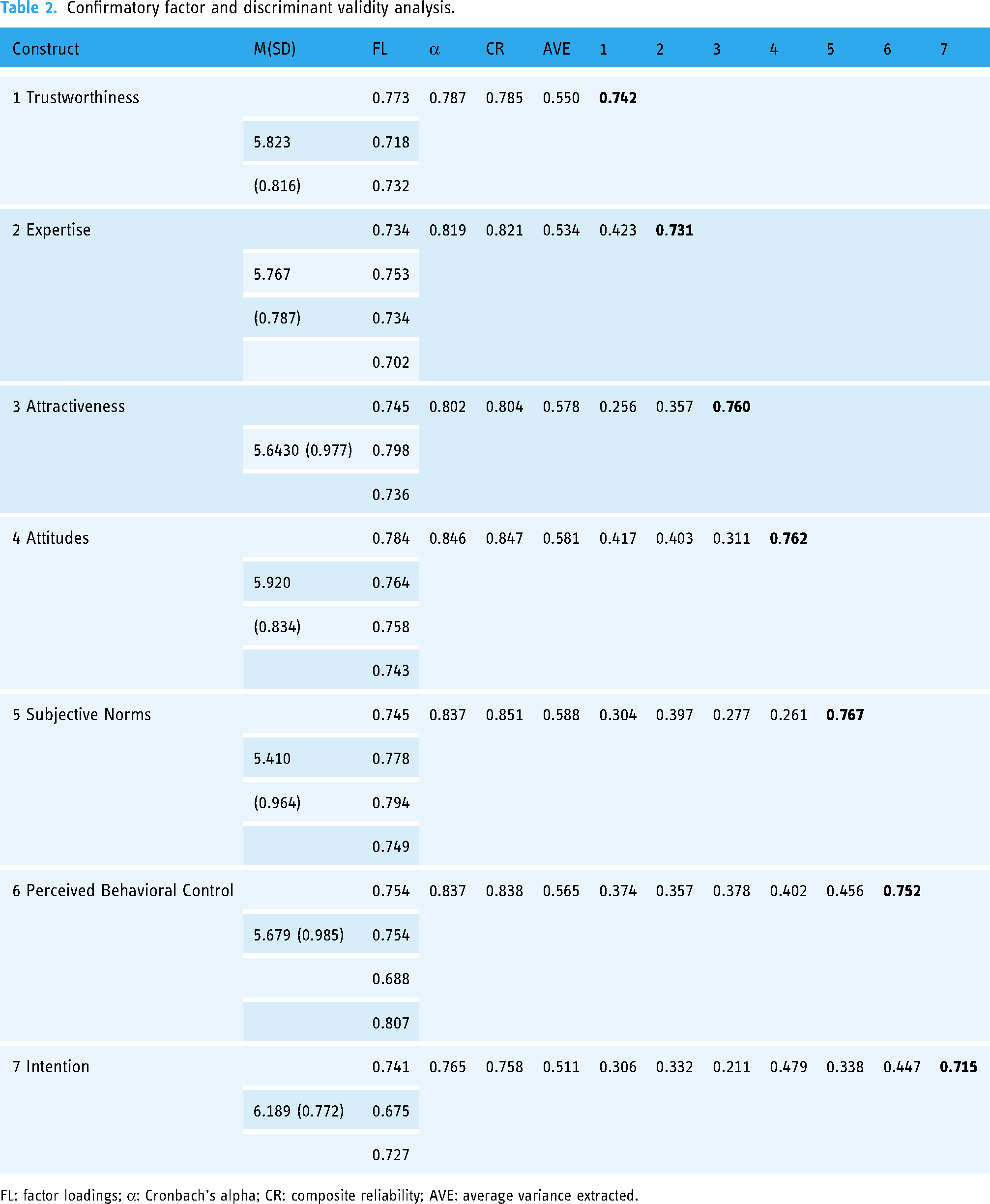
A full-structural equation model should be carried out in a two-step process: the initial step involves the validation of the measurement model, followed by the subsequent step focusing on the analysis of the structural model. 80 Confirmatory factor analysis (CFA) is employed to assess the measurement quality for all latent constructs and their items. Standardized factor loadings should be greater than 0.6 and if a loading value is less than 0.45, the item should be considered for deletion.81,82 Table 2 presents the results of the CFA which we conducted during this study. All standardized factor loadings ranged between 0.675 and 0.807, exceeding the threshold of 0.6 and significantly different from zero (significance threshold: 0.1%) to indicate that all items possessed acceptable reliability.
Confirmatory factor and discriminant validity analysis.
FL: factor loadings; α: Cronbach's alpha; CR: composite reliability; AVE: average variance extracted.
Cronbach's alpha (α) was used to test the reliability of the constructs. As shown in Table 2, α values ranged from 0.765 to 0.846. The average Cronbach's alpha coefficients, exceeding the threshold of 0.7, supported the constructs’ reliability. 83 The recommended threshold for CR is 0.6, and the AVE should be greater than 0.5. 84 All CR values for this study fell between 0.758 and 0.851, exceeding the suggested cutoff of 0.70 to indicate that all constructs showed acceptable reliability. Last, all AVE values ranged from 0.511 to 0.588, surpassing the threshold of 0.5, indicating that all constructs had acceptable convergent validity.
Discriminant validity
In this study, extracted average variance was used as the criterion to test the research constructs’ discriminant validity. According to Fornell and Larcker, 84 the square root of the AVE should be greater than the correlations between constructs. Table 2 presents the test of discriminant validity for the model used in our measurement. The values below the diagonal represent the Pearson correlation coefficients between the constructs, all smaller than the square roots (shown in bold numbers) of the extracted average variance values above the diagonal. Therefore, the research constructs’ discriminant validity was acceptable.
All constructs demonstrated CR and discriminant validity, suggesting that the parameter estimates and diagnostics of the measurement model would provide strong evidence of reliability and validity in the structural measurements.
Structural model analysis
Randall et al. 85 have pointed out that large-sample analyses can result in p-values below 0.05, thus affecting model fit and yielding poor results. Therefore, quantitative researchers should employ multiple methods to test the fit of the models they design. In this study, the fit of the model was validated using the eight common model fit assessment methods proposed by Jackson et al. 86 According to these methods, if the sample size is large (greater than 200), the chi-squared value can produce poor results. The bootstrap method provides an alternative approach that helps researchers to obtain better results. 87 Ideally, the result should yield a chi-squared value which, when divided by df, is less than three.
As shown in Table 3, further criteria provided more stringent standards for model fit assessment. Overall fit indices displayed acceptable levels. 88 For instance, the chi-squared/df ratio was 1.532 (χ2 = 398.213; df = 260; p ≤ 0.001), which is less than 3. The RMSEA was 0.040, less than 0.08. CFI was 0.962 and TLI was 0.956, all exceeding 0.9. All tested model fit criteria aligned with the recommended standards. 85
Model fit verification.

DF: degree of freedom; RMSEA: root mean square error of approximation; CFI: Comparative Fit Index; TLI: Tucker–Lewis Index; SRMR: standardized root mean square residual.
Path analysis
Table 4 displays the results from the path coefficient analysis, validating the causal relationships among the variables. The analysis confirmed that all proposed relationships were significant, except for H2c. Hypothesis 1a posits that higher perceived trustworthiness of social media fitness influencers leads to more favorable attitudes toward social media fitness among users. The path coefficient for this relationship was 0.340, significant at p = 0.000, supporting H1a. Supported by a path coefficient of 0.239 (p = 0.000), Hypothesis 1b examines the impact of expertise on attitude. Hypothesis 1c, which suggests attractiveness influences attitude, is strongly supported by a β value of 0.179 (p = 0.000).
Path analysis.

DV: dependent variable; IV: independent variable; Std.: standardized regression coefficients; S.E.: standard error; R2: explainable variations; Hypo: hypothesis.
Trustworthiness (β = 0.243, p < 0.001) and expertise (β = 0.272, p < 0.001) positively correlated with subjective norms, supporting Hypotheses 2a and 2b. Conversely, the relationship between attractiveness and subjective norms was not statistically significant, not supporting Hypothesis 2c. Further analysis showed positive correlations between perceived behavioral control and trustworthiness (β = 0.260, p < 0.01), expertise (β = 0.297, p < 0.01), and attractiveness (β = 0.255, p < 0.01). Consequently, Hypotheses 3a–3c were confirmed.
Within the TPB framework, our analysis indicated that attitude (β = 0.386, p < 0.01), subjective norms (β = 0.216, p < 0.01), and perceived behavioral control (β = 0.284, p < 0.01) significantly influenced intentions to engage in social media fitness, thereby confirming Hypotheses 4–6. The findings supported the hypotheses associated with this model. Trustworthiness, expertise, and attractiveness accounted for 36.5%, 27.1%, and 41% of the variations in attitude, subjective norms, and perceived behavioral control toward social media fitness, respectively. Attitudes toward online fitness, subjective norms, and perceived behavioral control explained 46.4% of the variation in behavioral intentions.
Multiple group comparison
This study investigated the potential moderating role of gender in the hypothesized relationships. To this end, a multiple-group analysis was conducted to determine if there were significant differences in path coefficients between male and female subgroups. We adhered to the methodologies recommended by Calantone and Zhao 89 and Gu et al., 90 which involve comparing path coefficients across defined groups to detect any statistical differences. As shown in Table 5, our structural model and subgroup analysis revealed no significant differences in path coefficients, indicating that gender does not significantly moderate the model. These findings suggest that gender does not differentiate the effects observed in the model, meaning that the impacts are consistent across both male and female users.
Path coefficients and differences across gender.

DV: dependent variable; IV: independent variable; Std.: standardized regression coefficients; S.E.: standard error; Hypo: hypothesis.
Discussion
The study explored how trustworthiness, expertise, and attractiveness of social media fitness influencers affect users’ attitudes, subjective norms, perceived behavioral control, and intentions toward fitness activities. Empirical results validated our model, shedding light on the criteria Chinese users apply to evaluate influencers and the drivers of their success. These insights enhance our understanding of digital health communication by demonstrating the pivotal role of source credibility in shaping user behavior on social media. Furthermore, this research highlights the critical role of social media in health promotion and public engagement, yielding both expected and unexpected findings.
Impact of influencer credibility
Our research reveals that positive perceptions of these credibility factors—trustworthiness, expertise, and, to a lesser extent, attractiveness—not only foster favorable attitudes but also enhance perceived behavioral control. Trustworthiness, in particular, emerges as a key factor, underscoring the importance of authenticity and reliability in fostering positive user perceptions. This finding aligns with prior research, such as Durau et al. 13 and Ayeh et al., 60 both of which demonstrated that perceived trustworthiness significantly impacts consumer attitudes in online settings and contributes to positive attitudes toward fitness influencers, thereby enhancing user engagement intentions. Similarly, the significance of expertise is well-supported by existing studies. Wong et al. 61 and Durau et al. 13 both highlighted the crucial role of perceived expertise, along with trustworthiness, in shaping consumer attitudes and intentions. These studies reinforce the idea that users are more likely to engage with and act upon advice from influencers they perceive as knowledgeable. While trustworthiness and expertise are critical in shaping consumer attitudes and perceived behavioral control, attractiveness also plays a role in influencing user engagement, though its impact may differ. Attractiveness, though often seen as a peripheral factor, contributes to the initial appeal of fitness influencers. However, our research indicates that the influence of attractiveness may be more limited compared to the enduring effects of trustworthiness and expertise.
Although attractiveness may initially draw users to engage with fitness content, our findings suggest that its influence on shaping subjective norms—users’ perceptions of social expectations—is limited. This stands in contrast to trustworthiness and expertise, which play a more substantial role in defining social behavioral norms. Users tend to select fitness videos based on personal preferences, particularly valuing influencers who offer practical fitness guidance and information. This trend may affect their continued motivation to engage with fitness content, where content relevance is more crucial than physical attractiveness.
In summary, while trustworthiness and expertise are crucial in influencing user attitudes and perceived behavioral control, attractiveness plays a more nuanced role. Given the unexpected lack of significant correlation between attractiveness and subjective norms, further research is needed to explore this relationship in greater depth. Understanding whether these findings are specific to platforms like DouYin or apply more broadly could provide a more comprehensive view of how attractiveness influences social expectations and user behavior. These observations highlight the necessity for social media fitness influencers to enhance their professionalism and credibility beyond mere physical attractiveness. As our findings indicate, it is trustworthiness and expertise that ultimately have a more profound impact on user behavior and the shaping of social norms. Thus, influencers who prioritize these aspects are more likely to achieve lasting success in influencing user engagement and promoting healthy behaviors.
Application of the TPB
This study demonstrates the applicability of the TPB to social media fitness, identifying attitudes and perceived behavioral control as key drivers of user engagement. As highlighted by Armitage and Conner, 91 these factors play critical roles in influencing behavior. Influencers can enhance these elements by simplifying and diversifying fitness activities, thereby increasing enjoyment and perceived attainability. This approach aligns with Biddle and Nigg’s 92 recommendation that enjoyment and reduced barriers are essential for encouraging exercise behavior. By making fitness routines more accessible and enjoyable—through strategies such as home-based exercises and beginner-friendly tips—influencers can foster positive attitudes and boost users’ confidence in their ability to engage, leading to sustained participation in fitness activities.
However, our findings suggest that subjective norms have a limited impact on fitness behaviors, indicating a shift toward more personalized fitness experiences. This aligns with Rhodes and Dickau’s 93 systematic review, which identified that personal attitudes and perceived control often outweigh social pressures in determining behavior. As a result, social media campaigns should focus on highlighting personal success stories and tailored fitness journeys. These approaches resonate more deeply with users and motivate them to take action based on their own goals rather than on perceived social expectations.
In summary, this study not only validates the TPB framework but also offers practical insights for creating more resonant and effective health communication on social media platforms. By leveraging content customization, community building, and behavioral cues, influencers can effectively transform positive attitudes and perceived behavioral control into active fitness participation. This approach ensures that social media fitness strategies are both theoretically sound and grounded in evidence-based practices that can drive real behavioral change.
Gender as a nonmoderating factor
Despite examining the moderating role of gender, we observed no significant influence similar to that reported in recent research.12,14,62 This suggests that in social media fitness, gender differences in motivational factors may not be as pronounced as anticipated. This could be related to the universality and accessibility of fitness content, which implies that both male and female users may share similar perceptions of attitudes, perceived behavioral control, and subjective norms toward fitness. Additionally, the characteristics of social media platforms, such as the high degree of personal choice they offer, may diminish the impact of gender stereotypes. Consequently, gender differences might be overshadowed by other more decisive factors, such as individual fitness goals and the relevance of the content. Overall, this result provides important insights, indicating that promotional strategies in the domain of social media fitness should focus more on creating content that resonates across genders and enhances accessibility, rather than merely customizing initiatives based on gender differences.
Practical strategies for health promotion
This study provides practical strategies for health promotion on social media. Firstly, practitioners should enhance the trustworthiness and professional image of fitness influencers by sharing validated fitness knowledge and showcasing credentials to strengthen the influencers’ professional authority. When selecting influencers for collaborations, brands, and health promotion agencies should prioritize trustworthiness and expertise over physical attractiveness to enhance campaign effectiveness. Content strategies should emphasize practicality and educational value, such as creating easy-to-understand fitness tutorials and interactive Q&A sessions to foster an active online community. Given the study's findings that gender does not significantly moderate the impact of fitness influencers, promotional activities should be gender-neutral, focusing on universally applicable health and fitness information to attract a broader audience. Lastly, practitioners should leverage the unique features of social media platforms, such as immediacy and interactivity, to promote health and fitness concepts effectively, using data analytics tools to monitor engagement and continually optimize content and strategies to maintain user interest and campaign efficacy.
Limitations and suggestions for future research
The study presented here has certain limitations. Firstly, this study's reliance on self-reporting introduces certain limitations. While self-reporting methods are practical and generally reliable, they may lead to biases and affect respondents’ introspection. To mitigate these issues, future studies could use concordance items to enhance response accuracy.
Secondly, our analysis was confined to users of a single social media platform in China, which may affect the generalizability of the findings. Future research should consider exploring a variety of social media platforms like YouTube or Myspace, where perceptions of credibility and the impact of video content may differ.
Thirdly, the study employed non-probabilistic sampling which restricts the generalization of the results. Collecting data at only one point in time limits the understanding of long-term influences. Future research would benefit from a longitudinal approach to better assess how source credibility and key influencing factors impact behaviors over time.
Finally, the sample was restricted to Chinese social media fitness users, which might not represent the impact of source credibility across different cultures. Caution should be exercised when generalizing these results to other populations. To confirm these findings, replicating this study in diverse cultural contexts is recommended. Additionally, future studies should control for variables such as video content and detailed influencer information, including age, gender, and professional background. This will enhance the validity of the research and deepen our understanding of how social media can be leveraged for health promotion. Future research should consider other potential moderating variables such as age, health status, or previous fitness experience, which could have a more profound impact on behavioral intentions in social media fitness. Moreover, it is important to acknowledge that the participants surveyed were already engaged with social media fitness influencers on Douyin. This presents a limitation regarding the generalizability of the health intentions derived from this study, as the participants’ preexisting engagement with influencers might have influenced their responses. Future research should consider this limitation and explore how the inclusion of actual influencer content in surveys might yield different insights.
Conclusion
This study investigated the impact of trustworthiness, expertise, and attractiveness of social media fitness influencers on users’ attitudes, subjective norms, perceived behavioral control, and intentions toward social media fitness. The findings support the model, highlighting trustworthiness as the most crucial factor in shaping user attitudes, and revealing that expertise and practical information are more important than physical attractiveness. Furthermore, the study validated the TPB, demonstrating that personal attitudes and perceived control play decisive roles in forming user intentions. Although the study examined the moderating role of gender, it found no significant gender impact on the model, suggesting that gender may be less influential than other factors in social media fitness. Overall, these findings not only reinforce the role of social media in health promotion and public engagement but also provide practical guidance on leveraging social media influencers effectively.
Footnotes
Acknowledgments
The authors would like to express our gratitude to all participants who generously volunteered their time and shared their insights for this study.
Contributorship
LW: conceptualization, methodology, formal analysis, investigation, resources, writing—original draft preparation, writing—review and editing, supervision, project administration, funding acquisition. XL: conceptualization, methodology, investigation, writing—review and editing. DH: methodology, investigation, writing—review and editing. JZ: investigation, writing—review and editing. All authors contributed to the paper and approve the submitted draft. All authors have read and agreed to the published version of the manuscript.
Data availability
All anonymized data will be made available to other researchers on request, solely for research.
Declaration of conflicting interests
The authors declared no potential conflicts of interest with respect to the research, authorship, and/or publication of this article.
Ethical approval
The ethics approval was granted by the Nanjing University of Posts and Telecommunications Ethics Committee (NJUPT-AEIRB/23031001). The study complies with the ethical standards outlined in the Declaration of Helsinki.
Funding
The authors disclosed receipt of the following financial support for the research, authorship, and/or publication of this article: This work was supported by the Nanjing University of Posts and Telecommunications Doctoral Talent Introduction Scientific Research Initiation Project (NYY220031). Key Project of Jiangsu Province's 14th Five-Year Education Plan in 2023 (GK-202305). University Philosophy and Social Science Research Project in Jiangsu Province (2019SJA0081). University Philosophy and Social Science Research Project in Jiangsu Province, Key Project of Jiangsu Province's 14th Five-Year Education Plan in 2023, Nanjing University of Posts and Telecommunications Doctoral Talent Introduction Scientific Research Initiation Project, (grant number 2019SJA0081, GK-202305, NYY220031).
Guarantor
LW.
