




Abstract
Background
Bone fractures are a common medical issue worldwide, causing a serious economic burden on society. In recent years, the application of artificial intelligence (AI) in the field of fracture has developed rapidly, especially in fracture diagnosis, where AI has shown significant capabilities comparable to those of professional orthopedic surgeons. This study aimed to review the development process and applications of AI in the field of fracture using bibliometric analysis, while analyzing the research hotspots and future trends in the field.
Materials and methods
Studies on AI and fracture were retrieved from the Web of Science Core Collections since 1990, a retrospective bibliometric and visualized study of the filtered data was conducted through CiteSpace and Bibliometrix R package.
Results
A total of 1063 publications were included in the analysis, with the annual publication rapidly growing since 2017. China had the most publications, and the United States had the most citations. Technical University of Munich, Germany, had the most publications. Doornberg JN was the most productive author. Most research in this field was published in Scientific Reports. Doi K's 2007 review in Computerized Medical Imaging and Graphics was the most influential paper.
Conclusion
AI application in fracture has achieved outstanding results and will continue to progress. In this study, we used a bibliometric analysis to assist researchers in understanding the basic knowledge structure, research hotspots, and future trends in this field, to further promote the development of AI applications in fracture.
Introduction
Bone fractures are a global public health problem, with an age-standardized incidence of 2296.2 per 100,000 population according to a 2019 study. 1 Fractures result in a loss of productivity for patients, a significant burden on caregivers, and a healthcare burden on society. A 2017 survey including six European countries showed that the annual healthcare costs associated with fragility fractures alone were over €37.5 billion and were expected to increase by over 27%. 2
The most important component in the treatment of fractures is the diagnosis, which often relies on imaging and human eye judgment. However, studies have shown that clinicians tend to misjudge or miss a patient's fracture under various factors, resulting in more serious consequences for subsequent treatment.3–5 In recent years, artificial intelligence(AI) has developed rapidly, and its abilities are comparable to or exceed humans in visual tasks. 6 In addition, some studies have demonstrated that AI can detect fractures at a level comparable to that of senior orthopedic surgeons. 7 In recent years, research on AI applications in fractures, such as the prediction of postoperative fracture complications, 8 prediction of clinical results of fractures, 9 development of preoperative plans, 10 and development of implants, 11 has grown rapidly.
Nonetheless, although studies in this field have received excellent evaluation and attention from many researchers, a lack of systematic generalization and review of the development process remains. Hence, this study aimed to review the development process and applications of AI in fractures using a bibliometric analysis while analyzing the research hotspots and future trends in the field. Bibliometric analysis is a method that analyzes the emerging trends and knowledge structures in a research field and presents complex scientific knowledge networks in a relatively straightforward way using scientific knowledge mapping. 12 In contrast to traditional reviews, bibliometric analyses, as a part of the science of science, focuses on the entire body of scientific and technological knowledge and its evolution. By analyzing research outcomes in the field and visualizing the knowledge network, it provides deep insights into the field's development process, identifies research hotspots, and predicts potential research trends. This aids field researchers, new scholars, and policy makers in gaining a comprehensive understanding of the research trajectory and future prospects within the field. 13
Material and methods
All data used in this study were from the Web of Science Core Collections (WoSCC), which is a publicly available database so ethical approval and informed consent are not required because of anonymization.
Data extraction
Papers on fracture and AI were retrieved through WoSCC by combining keywords with Boolean operators: ((((TS = (deep learning)) OR TS = (machine learning)) OR TS = (artificial intelligence)) OR TS = (neural network)) AND TS = (fracture).
Inclusion criteria: The intersection of the English articles or reviews left by the two investigators, and the remaining part was decided by the third researcher whether to include in the analysis.
Exclusion criteria: Literature not classified as an article or review was initially excluded, followed by the exclusion of non-English literature. Subsequently, two investigators independently screened the literature, excluding studies that did not focus on fractures or were unrelated to AI.
Data analysis
We conducted the analyses by CiteSpace and Bibliometrix R package. CiteSpace offers advantages in detecting the emergence of references and keywords, enabling researchers to track changes in research topics and predict future trends within a field. 14 On the other hand, the Bibliometrix R Package serves as a useful tool for statistical analysis of diverse scientific information. It particularly excels in keyword analysis, providing researchers with a range of selectable options to incorporate into their studies. 15
Using the bibliometrix R package (version 4.1.1), we analyzed the following: (1) main information of the data; (2) trends in the field (annual publication counts and annual average citations); (3) distribution of countries and institutions (collaboration networks of countries and institutions); (4) distribution of authors (authors analysis); (5) core journals and important journals in the field (core journals); and (6) research trends, keyword factorial analysis, thematic maps and trend topics, and theme evolution (references analysis and keywords analysis).
Literature and keyword analysis was performed using CiteSpace (version 6.1.R6). Reference clustering analysis was used to retrieve the research themes of papers in the field. Reference citation burst analysis was used to retrieve high-profile scientific research published in the field and to predict emerging research hotspots. Citation burst analysis of keywords was also performed by CiteSpace.
Results
Main information of the data
Until 11 June 2024, a total of 5094 papers were retrieved and 1099 articles or reviews in English were identified. The data were imported into the bibliometrix R package for filtering, and 1063 papers were obtained after de-duplication (Figure 1). Over 34 years, a total of 1063 papers on fracture and AI were produced and published in 415 journals. Of which, 975 were articles and 88 were reviews, with a total of 5555 authors and over 30,000 citations (Table 1).

The screening process of selected literature in this study.
Main information of data for bibliometric analysis.

Annual publication counts and annual average citations
Between 1990 and 2016, only a limited number of articles in the field of AI and fractures were published each year. However since 2017, the number of papers published annually has grown rapidly (the annual growth rate from 2018 to 2022 is 200.83% and 57.14% from 1990 to 2017), reaching 265 counts in 2022 (Figure 2(A)).

(A) Annual trends of publications. (B) Average citations per year. (Average citations per year is equal to the total number of citations of papers published in a given year divided by the number of years that can be cited, i.e. the year from publication to the present).
The average number of citations per year was calculated by dividing the total number of citations for a given year by the number of articles per year divided by the number of years in which they can be cited. Papers published in 2007 were cited an average of 56.41 times per year. High citation outputs were observed in 2014, 2017, 2018, and 2019 (Figure 2(B)).
Distribution of countries and institutions
The top 20 countries with the most publications and citations are shown in Table 2. China was the most published country (278), followed by the United States (211), South Korea (63), India (49), and Germany (38). The United States was the most cited country (4036), followed by China (1477), South Korea (629), the United Kingdom (609), India (605), and Canada (467). The top 10 institutions with the most publications are shown in Table 3. Technical University of Munich, Germany, was the most published institution (56), followed by Shanghai Jiao Tong University, China (55), and Yonsei University, South Korea (51). The network of collaborations between countries is shown in Figure 3(A). The United States had the most cooperation with other countries, followed by China. The network of collaboration between institutions is shown in Figure 3(B), with Flinders University, Australia, being the most collaborative institution, followed by Harvard Medical School, US.

The analysis of countries and institutions. (A) Network map of collaborations among different countries (a node represents a country, the links between nodes represent their collaboration relationships). (B) Network map of collaborations among different institutions (a node represents an institution, the links between nodes represent their collaboration relationships). (C) The three-field plot of countries, institutions, and their keywords.
The Top 20 countries with the most publications and citations.

The Top 10 institutions with the most publications.

The main research keywords of countries and institutions are shown in Figure 3(C). The thickness of the lines is positively correlated with the frequency of the keywords. The main research keywords of China were terms such as deep learning, machine learning, and osteoporosis, and the main research themes of the Technical University of Munich were, for example, osteoporosis and convolutional neural networks (CNNs).
Author analysis
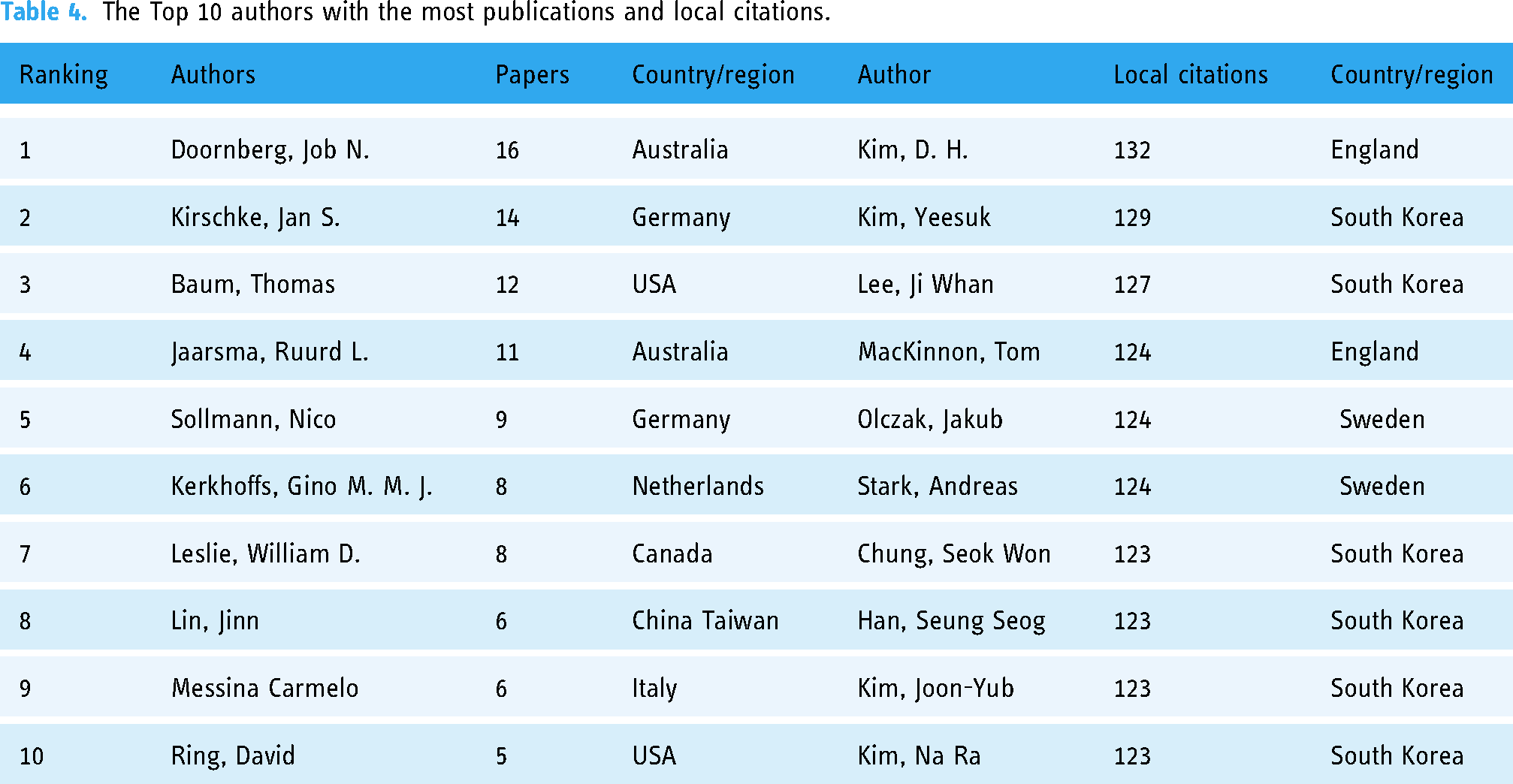
Among the 5555 authors, the most productive author was Doornberg JN, with 16 articles on AI and fractures, followed by Kirschke, JS (14) and Baum, Thomas (12). The most locally cited author was Kim DH (132), followed by Kim, Yeesuk (129) and Lee, JW (127) (Table 4). The author collaborations network is shown in Figure 4(A), with Doornberg JN as the most collaborative author. The network of authors’ co-citation relationships is shown in Figure 4(B). The yearly distribution of publications and citations of authors with the most publications in the field are shown in Figure 4(C).

The analysis of authors. (A) The coauthorship networks (a node represents an author, the links between nodes represent their collaboration relationships). (B) The cocitation network of authors (a node represents an author, the links between nodes represent their cocitation relationships). (C) The authors’ production over time that with the most publications. (The horizontal line represents the research time of the author, and the dot on the horizontal line is the time output of the year. The size of the dot is related to the number of publications, and the color is related to the number of citations).
The Top 10 authors with the most publications and local citations.
Core journals
Research in the field of AI in fractures was published in 415 journals, with Scientific Reports as the most published journal (25), followed by Diagnostics (16) and Osteoporosis International (14). Osteoporosis International had the highest number of citations (901), followed by Journal of Bone and Miner Research (721) and Radiology (629). The journals with the most publications or the most co-citations in the field are shown in Supplemental Table S1. The temporal pattern of publications in the top six journals is shown in Figure 5(A). The core journals in the field are shown in Figure 5(B) (gray area), with the horizontal coordinate being the journal name, and the vertical coordinate being the corresponding number of publications.
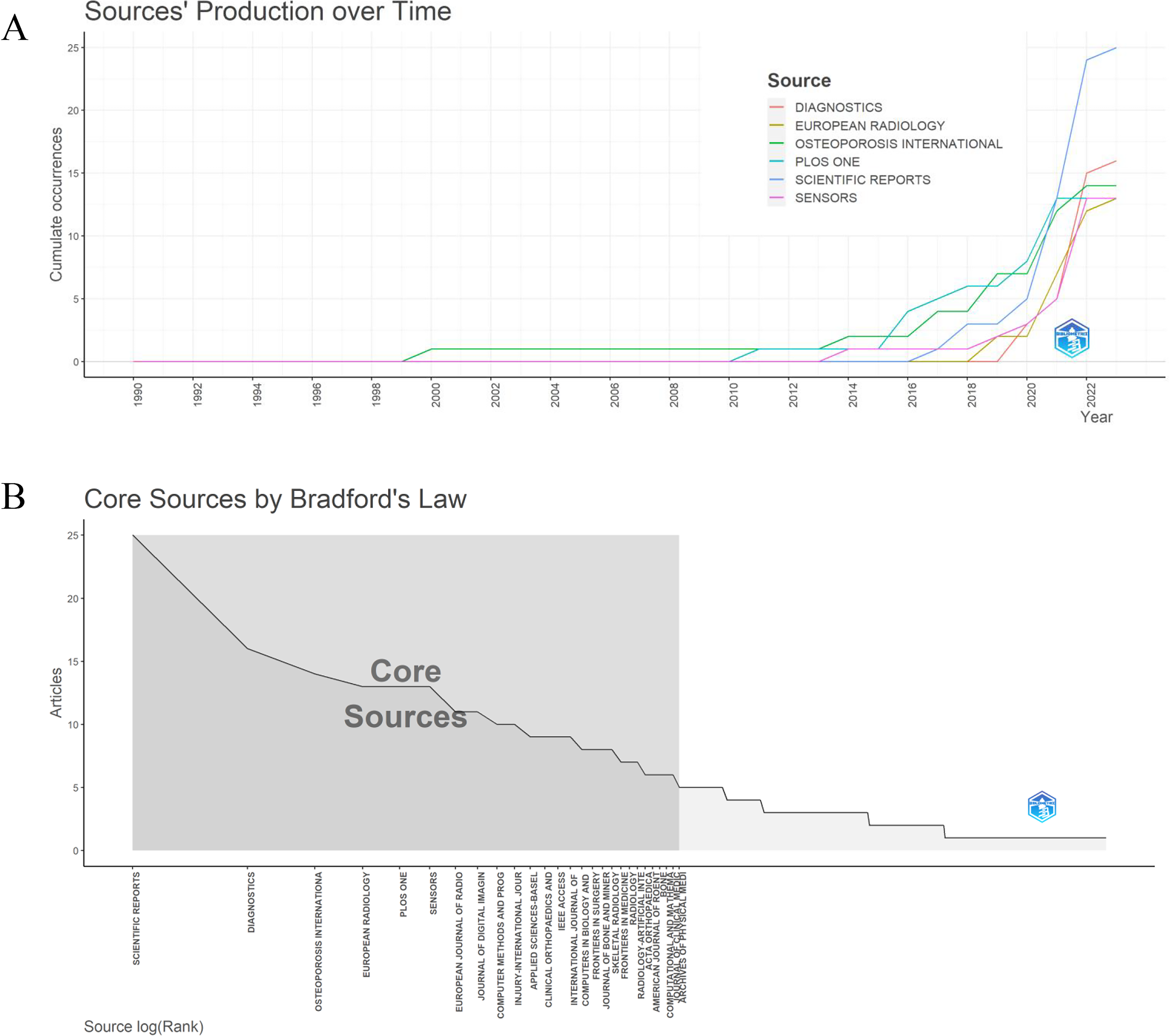
The analysis of journals. (A) The journals’ production over time that with the most publications (the vertical coordinate is the number of publications, the horizontal coordinate is the year, and the curves of different colors represent different journals). (B) The core journals based on Bradford's Law (the vertical coordinate is the number of publications, the horizontal coordinate is different journals, and the gray area is the core journals).
Reference analysis
The clustering information of the reference in the field is shown in Figure 6(A), with the keyword as the cluster caption. The main clusters were “osteoporosis,” “wrist,” “vertebra segmentation,” “prediction model,” “rib fracture,” and “musculoskeletal imaging.” A Q value of 0.8105 represents significant modularity, and a weighted mean silhouette value of 0.8666 represents the high credibility of the clustering result.
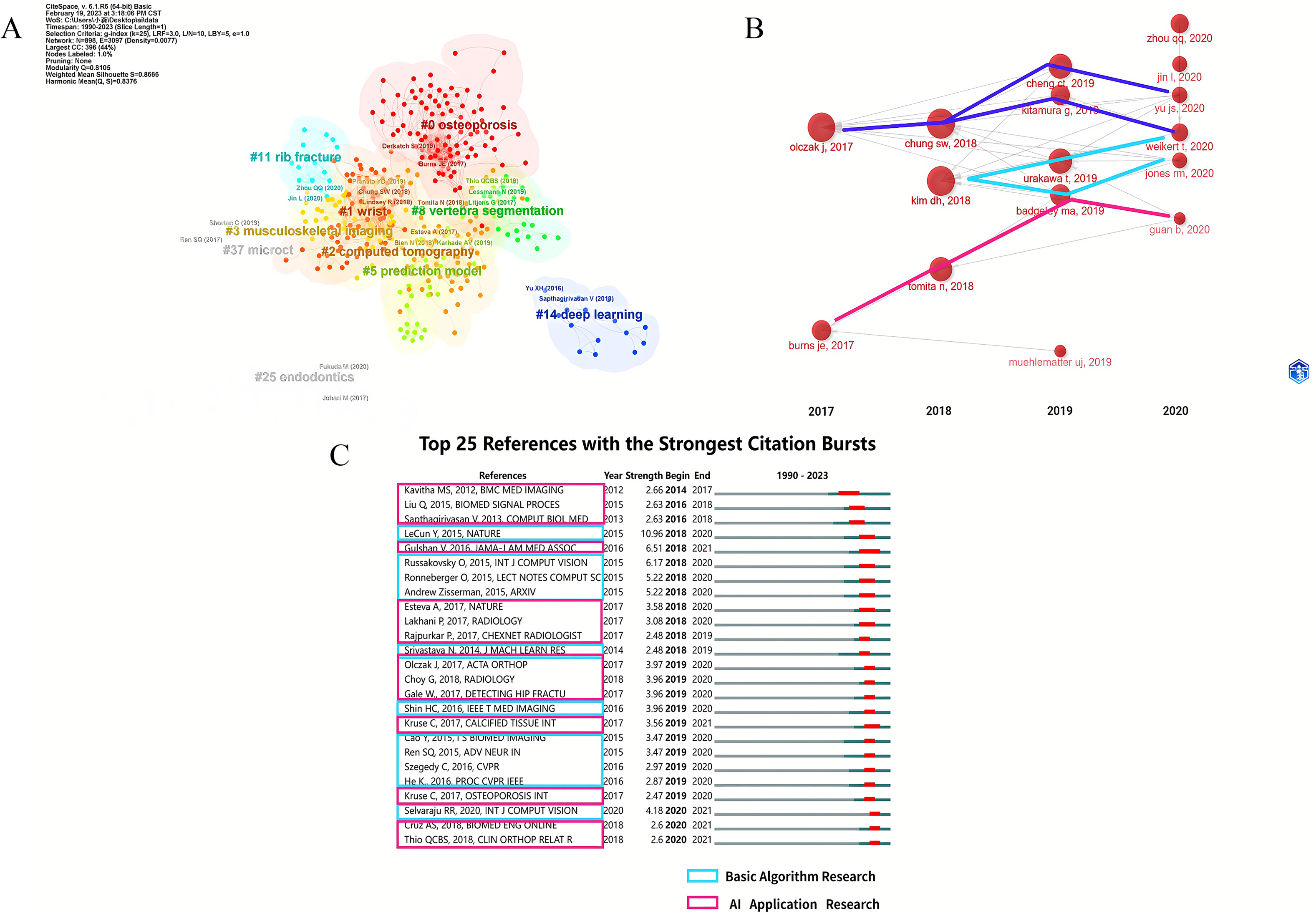
The analysis of reference. (A) The cluster of references in the field (each color region represents a cluster, and documents with similar research topics are grouped into a cluster). (B) The citation network of significant references (the lines between nodes indicate that there is a reference relationship, and the arrow points to the referenced document). (C) Top 25 references with the strongest citation bursts and their classifications (red bars indicate that the literature had a sudden increase in citations during that period).
The top 10 most cited articles are shown in Supplemental Table S2. Doi K's 2007 article in Computerized Medical Imaging and Graphics was the most cited article, which received 959 citations. Chung SW's 2018 article in Acta Orthopaedica was the most locally cited article, which received 97 citations (Supplemental Table S3). Meanwhile, the historical citation network of some important publications is shown in Figure 6(B).
The citation burst analysis shows the top 25 references with a sudden increase in citations, with red bars indicating that the literature had a sudden increase in citations during this period. These can be divided into two categories based on their research content: basic algorithm research (marked in blue) and AI application research (marked in pink) (Figure 6(C)), as shown in Supplemental Table S4.
Keyword analysis
The keywords with the highest frequency in the field were divided into three clusters (Figure 7(A)). The keywords represented in the red cluster were “deep learning,” “fracture,” “diagnosis,” and “classification.” The keywords represented in the blue cluster were “machine learning,” “bone mineral. density,” and “osteoporosis.” And keywords in the green cluster were “machine,” “learning.” The hierarchical clustering dendrogram is shown in Figure 7(B). The trend of topics is shown in Figure 7(C), wherein the beginning of the blue line indicates the first occurrence of the keyword, and the circle indicates the year in which the keyword appeared more frequently. The circle size was positively correlated with the number of occurrences. Keywords with the highest frequency were “classification,” “diagnosis,” and “risk.”
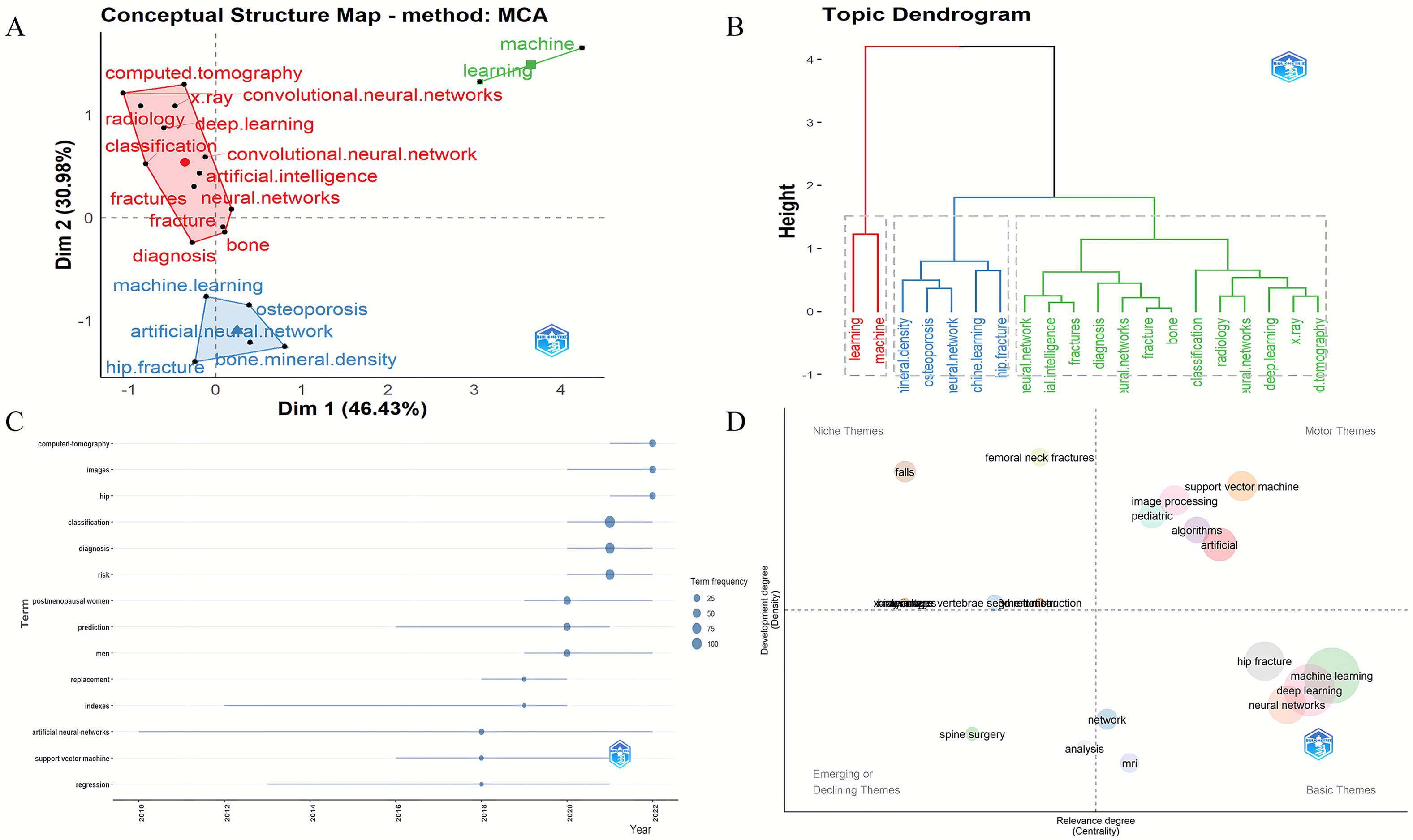
The analysis of keywords. (A) The conceptual structure map of keywords (keywords of the same color are divided into a cluster). (B) Dendrogram of the system cluster analysis of keywords (hierarchical relationship of keywords). (C) Trend topics of keywords (hierarchical relationship of keywords). (D) The strategic coordinate map of keywords (the keywords are divided into four quadrants, keywords in the first quadrant are core themes, those in the second quadrant are highly developed and isolated themes, the third quadrant are emerging or declining themes, and the fourth quadrant represents those basic and transversal themes).
In the keyword factorial analysis, representative keywords in the field were divided into four quadrants, as shown in Figure 7(D). The higher the density value, the more mature the research topic, and the greater the centripetal degree, the more the research topic is in the core position. The first quadrant was core themes, such as “algorithms,” “support vector machine,” and “image processing.” The second quadrant was highly developed and isolated themes, such as “falls.” The third quadrant was emerging or declining themes, such as “spine surgery.” The fourth quadrant was basic and transversal themes that are likely to be hot topics or future trends, such as “deep learning” and “natural networks.”
Based on the publication trends in the field, we set the time points as 2016, 2017, 2019, 2021, and 2023, an analysis of research themes evolution in the field was conducted (Figure 8(A)). The top 25 keywords with the strongest citation burst are shown in Figure 8(B), with red bars indicating the period of the citation burst. The keywords with the strongest citation burst recently are “vertebral fracture,” “object detection,” and “prevention.”

The analysis of research themes. (A) Evolution of research themes in the field from 1990 to 2023. (B) Top 25 keywords with the most citation bursts (the blue line is the time period when the keywords appear, red bars indicate the period of the citation burst).
Discussion
In this study, bibliometric analysis was used to systematically generalize AI and fracture-related research to provide researchers with key information in this field; the most productive countries; authors, institutions, and their collaborative networks; core journals in the field; and important research results, including analysis of research hotspots and future trends in the field. Compared to traditional literature reviews, our approach incorporates bibliometric analysis, allowing for a scientific examination of research within this field. By utilizing statistical analysis of literature, keywords, and their citation frequency, we are able to objectively identify research hotspots, trends, and pertinent scientific information.
Prior to 2017 the output in AI and fracture-related research was comparatively poor; however, after 2017, research rapidly increased, and this growth trend is expected to continue. The annual average citation curve (Figure 2(A)) showed that there was an output of highly cited papers from 2017 to 2019, and these papers were important in facilitating the growth of publications.
Furthermore, the findings of our study suggested that China had the most publications in this field, although the citations are relatively poor. The United States had the second most publications and most citations, and the average citations per article were superior. Chinese scholars’ research in this field is mainly focused on utilizing existing technologies to identify various types of fractures,16–18 rather than conducting groundbreaking research. However, it is worth noting that researchers in the United States have a multitude of high-quality review papers,19–21 and they have been the forefront of research in the of artificial intelligence in osteoporosis. 22 Additionally, the development of various fracture detection algorithms the United States has also been earlier compared to China. 23 These contribute to the higher number of citations that researchers in the United States received. In general, studies with the highest publications or citations were mostly those conducted in developed countries. The United States had a high degree of cooperation with many countries, especially with China. On the contrary, China had relatively few cooperation relationships with other countries. Hence, the future development of cross-border cooperation research is a significant direction. The Technical University of Munich was the most published institution. The University of California and Flinders University were the most collaborative institutions, where researchers can study or seek collaboration.
Combined with the literature citations burst analysis and keywords analyses, we summarized the following research hotspots.
Fracture diagnosis
In recent years, there has been a significant increase in the application of AI algorithms in fracture diagnosis. For instance, in 2006, Berry DB et al. developed a support vector machine-based algorithm, which demonstrated high-precision identification of X-ray wrist fractures, 24 A similar success was achieved by Satoshi et al. in the same year, who utilized AI to recognize vertebral compression fractures in lateral chest radiography, achieving an accuracy of over 90%. 25 Machine learning has also been employed to identify and classify hip fractures.26,27 Deep learning techniques have gained widespread popularity in fracture image processing. In 2018, Kim and MacKinnon tested the ability of CNNs to recognize wrist fractures, achieving an outstanding area under curve of 0.954, thereby demonstrating highly accurate fracture detection, 28 Fatih Mert et al. have also utilized deep learning to develop a wrist fracture detection system, achieving high recognition accuracy. 29 Concurrently, researchers have been continuously exploring the identification of various fracture types, including femoral neck fractures, calcaneal, 30 distal tibial fracture, shoulder fractures, 31 traumatic vertebral fractures, 32 and vertebral compression fracture.33,34 The demonstrated high-precision recognition capabilities of AI in fracture diagnosis can substantially assist physicians in identifying concealed fractures, enhance the work efficiency of radiologists, and facilitate timely diagnoses and treatments for fracture patients. However, it is important to note that the current performance of AI algorithms is limited to human judgment, as their training data is derived from human classification. Hence, doctors should exercise proper control over the results. 28
Osteoporosis diagnosis
AI has been widely applied in the field of osteoporosis diagnosis and fracture risk prediction. 35 For instance, researchers have used artificial neural networks to predict bone mineral density (BMD), 36 and machine learning to diagnose osteoporosis from micro-computed tomography images or oral X-rays.37–39 Machine learning has also been utilized to automatically identify root bone structure and distinguish osteoporosis patients from normal individuals. 40 Additionally, machine learning has been on tibial acoustic signals via electronic stethoscopes for diagnosing osteoporosis, 41 Deep learning has also been utilized to analyze photoacoustic signals and achieve accurate osteoporosis diagnosis with a prediction accuracy of over 96%. 42 The application of AI in early osteoporosis diagnosis has yielded satisfactory results and holds significant implications for the target population, as early intervention can help reduce the risk of fractures and other associated complications.
Risk factor prediction
The application of AI in predicting fracture risk, identifying risk factors, assessing osteoporosis risk, and predicting postoperative complications is a prominent area of research. Several studies have utilized machine learning techniques to achieve promising results in these areas. In 2012, Atkinson et al. employed machine learning algorithms to predict distal forearm fractures and vertebral fractures, yielding favorable outcomes. 43 Wo-Jan et al. utilized machine learning to predict the risk of hip fracture in individuals aged over 60. They identified low BMI, milk intake, and other factors as risk factors for fractures. 44 Tae et al. employed machine learning to identify the risk of osteoporosis in postmenopausal women, considering variables such as height, weight, and age. They achieved relatively accurate predictions for high-risk postmenopausal women. 45 Zhang et al. employed machine learning to predict one-year mortality after sternal fractures in elderly patients, identifying risk factors such as serum albumin and serum potassium. These predictions can provide valuable support for clinical decision-making. 46 The use of machine learning in predicting risk factors can offer clinicians clinical decision support and guidance for fracture prevention, osteoporosis management, and postfracture care. By leveraging AI, healthcare professionals can make informed decisions and optimize patient outcomes in these areas.
Literature, keyword citation burst analysis, keyword strategic coordinate charts, and topic evolution analysis can also be effectively utilized to determine the research trends in this field. Katharine EF et al. has demonstrated that machine learning can be effectively employed to evaluate the fall risk of the elderly. This breakthrough finding holds great potential in offering fall prevention measures and reducing fracture risks among high-risk groups. 47 Consequently, it has garnered significant attention in recent times. Moreover, the advancement of machine learning and deep learning algorithms, such as fracture recognition, risk prediction models, and osteoporosis recognition, has captivated researchers’ interest. These developments aim to enhance segmentation and prediction capabilities, thereby providing improved performance in this area.
Limitations
It is important to acknowledge that our study has certain limitations. For instance, we were unable to explore all potential application scenarios of AI in the field of fractures. We only reviewed English-language literature with publication type article in the WoSCC database, some studies not recorded in WoSCC were not included in the analysis, along with some video materials and books. Some literature published in the field during the submission period of this study have not been included in the analysis. However, given the time span of this study compared to the submission period, any resulting data errors have not impacted the research conclusions. Additionally, a lack of comprehensive studies and limited citations hindered our ability to provide detailed descriptions in certain AI roles. However, the impact of these factors will not affect the results of our analysis in this area.
Conclusion
Through bibliometric analysis and visualization, we provided an overview analysis of the field of AI applications in bone fractures. There were more than 60 countries participating in this field, and the relative researches had been growing rapidly in recent years. AI has demonstrated significant potential in improving fracture detection, prevention, and osteoporosis management. AI-powered tools have significantly advanced fracture detection capabilities, enabling clinicians to identify subtle fractures that may be missed by conventional methods. This enhanced accuracy and efficiency contribute to faster diagnoses and timely interventions. Smart wearable devices equipped with AI algorithms can effectively detect falls in elderly individuals, providing real-time alerts and potentially mitigating fracture risks. This proactive approach aims to reduce the incidence of fracture-related injuries. AI's ability to analyze large datasets allows for accurate identification and prediction of osteoporosis development. By identifying individuals at high risk, tailored interventions can be implemented to mitigate osteoporosis progression and minimize the risk of fracture. Through the analysis, we concluded the hot spots in this research field, including fracture diagnosis, osteoporosis diagnosis, and risk factor prediction. More attention would be paid to the application of AI in bone fractures in the future, and the future research trends are development of algorithms and fracture prevention.
Supplemental Material
sj-rar-1-dhj-10.1177_20552076241279238 - Supplemental material for Artificial intelligence applications in bone fractures: A bibliometric and science mapping analysis
Supplemental material, sj-rar-1-dhj-10.1177_20552076241279238 for Artificial intelligence applications in bone fractures: A bibliometric and science mapping analysis by Sen Zhong, Xiaobing Yin, Xiaolan Li, Chaobo Feng, Zhiqiang Gao, Xiang Liao, Sheng Yang and Shisheng He in DIGITAL HEALTH
Supplemental Material
sj-docx-2-dhj-10.1177_20552076241279238 - Supplemental material for Artificial intelligence applications in bone fractures: A bibliometric and science mapping analysis
Supplemental material, sj-docx-2-dhj-10.1177_20552076241279238 for Artificial intelligence applications in bone fractures: A bibliometric and science mapping analysis by Sen Zhong, Xiaobing Yin, Xiaolan Li, Chaobo Feng, Zhiqiang Gao, Xiang Liao, Sheng Yang and Shisheng He in DIGITAL HEALTH
Footnotes
Acknowledgments
We thank Bullet Edits Limited for the linguistic editing and proofreading of the manuscript.
Contributorship
Data curation: S.Z.; project administration: XL.L.; investigation: XL.L. and X.Y.; methodology: C.F. and S.Z.; software: S.Z.; visualization: Z.G. and S.Z.; writing—original draft: S.Z.; conceptualization: S.H., S.Y., and X.L.; supervision: S.H., S.Y. and X.L.; writing—reviewing and editing: X.Y. and S.Y.
Declaration of conflicting interests
The authors declared no potential conflicts of interest with respect to the research, authorship, and/or publication of this article.
Ethical approval
No patients were involved in this research, so the ethical approval is not required. The data sets analyzed during this study are available in the Web of Science core collections.
Funding
The authors disclosed receipt of the following financial support for the research, authorship, and/or publication of this article: This work was funded by the National Natural Science Foundation of China (Grant No. 82372442), the Science and Technology Commission of Shanghai Municipality (Grant No. 23015820300), Yunnan Academician Expert Workstation (Grant No. 202205AF150058), the National Key Research and Development Program of China (Grant No. 2022YFC3602203), and the Nanshan District Health Science and Technology Project (Grant No. NS2023002).
Guarantor
SH, SY, and XL.

Supplemental material
Supplemental material for this article is available online.
References
Supplementary Material
Please find the following supplemental material available below.
For Open Access articles published under a Creative Commons License, all supplemental material carries the same license as the article it is associated with.
For non-Open Access articles published, all supplemental material carries a non-exclusive license, and permission requests for re-use of supplemental material or any part of supplemental material shall be sent directly to the copyright owner as specified in the copyright notice associated with the article.
