



Abstract
Objective
Diabetes is a metabolic disorder that causes the risk of stroke, heart disease, kidney failure, and other long-term complications because diabetes generates excess sugar in the blood. Machine learning (ML) models can aid in diagnosing diabetes at the primary stage. So, we need an efficient ML model to diagnose diabetes accurately.
Methods
In this paper, an effective data preprocessing pipeline has been implemented to process the data and random oversampling to balance the data, handling the imbalance distributions of the observational data more sophisticatedly. We used four different diabetes datasets to conduct our experiments. Several ML algorithms were used to determine the best models to predict diabetes faultlessly.
Results
The performance analysis demonstrates that among all ML algorithms, random forest surpasses the current works with an accuracy rate of 86% and 98.48% for Dataset 1 and Dataset 2; extreme gradient boosting and decision tree surpass with an accuracy rate of 99.27% and 100% for Dataset 3 and Dataset 4, respectively. Our proposal can increase accuracy by 12.15% compared to the model without preprocessing.
Conclusions
This excellent research finding indicates that the proposed models might be employed to produce more accurate diabetes predictions to supplement current preventative interventions to reduce the incidence of diabetes and its associated costs.
Introduction
Diabetes mellitus (DM) is a chronic disorder that affects carbohydrate, protein, and fat metabolism, leading to abnormal blood glucose levels.
1
It is classified into two main types: type 1 and type 2 diabetes (T2D).
2
Type 1 diabetes typically occurs in children but can manifest in adults, particularly in their late 30s and early 40s. Patients with type 1 diabetes are usually not obese and often present with a life-threatening condition known as diabetic ketoacidosis.
3
The etiology of type 1 diabetes involves damage to pancreatic cells due to environmental or infectious agents, triggering an autoimmune response against
Health regulations emphasize regular screenings for individuals with diabetes risk factors, 9 highlighting the importance of timely identification and intervention. Preventive measures are crucial alongside diabetes care. 10 Early diagnosis and lifestyle modifications, such as healthy eating and exercise, can reduce the progression from impaired glucose tolerance to prediabetes. 11 Technology, particularly machine learning (ML), has gained popularity for early detection and prevention in healthcare.12–14 ML in diabetes management offers a promising avenue for predictive modeling. By analyzing vast datasets encompassing patient demographics, medical history, and lifestyle factors, ML algorithms can predict the likelihood of diabetes onset or progression with remarkable accuracy. These models not only assist in early detection but also empower healthcare providers to tailor personalized interventions, ultimately mitigating complications and improving patient outcomes.15,16
Several ML algorithms have been introduced for diabetes detection, offering benefits such as low computation costs, robustness, and high performance. 17 For instance, researchers have utilized classifiers such as Naive Bayes (NB), decision tree (DT), adaptive boosting (AdaBoost), and random forest (RF) for diabetes prediction, 18 while models such as generalized linear models with elastic net regularization (Glmnet), RF, extreme gradient boosting (XGBoost), and light gradient boosting (GB) machine have been explored for predicting type 2 diabetes. 19 According to recent projections, the prevalence of diabetes is expected to rise significantly, imposing a substantial burden on healthcare systems worldwide. 20 Early detection and effective management of diabetes are crucial for preventing complications and improving patient outcomes. ML algorithms have gained attention for their potential to enhance diabetes detection and prognosis by analyzing complex and non-linear medical data. 21 The following aims to provide a comprehensive overview of the ML approaches employed for diabetes detection and prognosis. By critically examining the existing research, we aim to identify the strengths and limitations of different techniques and highlight potential avenues for our proposal.
Ahmed et al. 22 developed an optimized ML-based classifier model for diagnosing diabetes using clinical data. Their approach included effective preprocessing techniques and achieved superior efficiency compared to existing methods, with an improvement in accuracy ranging from 2.71% to 13.13%. However, the generalizability of their model to different datasets and populations requires further investigation.
Hasan et al. 17 proposed a comprehensive architecture for diabetes prognosis, incorporating outlier exclusion, data normalization, and weighted ensembling of multiple ML models. Their suggested ensemble model achieved an area under curve (AUC) score of 95% on the Pima Indian dataset. However, the study’s limitation is that it focused only on the performance of a single dataset, limiting the assessment of generalizability.
Howlader et al. 23 applied ML strategies to identify T2D patients. They performed extensive feature selection and analysis using various classification algorithms, with the generalized boosted regression model achieving the best accuracy rate of 90.91%. However, the study’s scope was limited to the prediction of T2D and did not explore other types of diabetes or broader diabetes prognosis.
Deepajothi et al. 24 aimed to forecast diabetes in its initial phases by incorporating hereditary factors into a fuzzy classification model. Their suggested model achieved an accuracy rate of 83% for identifying T2D using the Pima Indian dataset. However, the study’s limitation is that it did not compare the performance of their models with other existing diabetes prognosis methods.
Rajagopal et al. 25 developed a modified combined approach of artificial neural networks with genetic algorithms for diabetes detection. Their model achieved an accuracy rate of 80% on the Pima Indian dataset. However, the study did not explore the performance of other ML algorithms’ performance or evaluate their approach’s generalizability on different datasets.
Nuankaew et al. 26 proposed a unique predicting approach called average weighted objective distance (AWOD) for diabetes forecasting. Their technique achieved an accuracy rate of 93.22% on the Pima Indian dataset and 98.95% on the Mendeley dataset. However, the study did not compare the performance of AWOD with other existing diabetes prediction methods.
Wei et al. 27 developed a methodology to estimate the usefulness of ambient chemical exposure in diagnosing DM. Their ML model utilizing the least absolute shrinkage and selection operator regression achieved an AUC of 80% for diabetes detection. However, the study’s limitation is that it focused only on the prediction of diabetes and did not consider other aspects such as prognosis or subtype classification.
Sivaranjani et al. 28 used support vector machine (SVM) and RF ML algorithms to predict the likelihood of developing diabetes-related disorders. The RF model achieved an accuracy of 83% after feature selection and principal component analysis dimensionality reduction. However, the study did not explore other classification algorithms’ performance or evaluate their approach’s generalizability on different datasets.
Ramesh et al. 29 introduced an end-to-end monitoring system for diabetes risk stratification and control. Their SVM model achieved an accuracy rate of 83.20% using the Pima Indian dataset. However, the study’s limitation is that it focused on risk stratification and did not extensively evaluate the performance of their model on other aspects such as diagnosis or prognosis.
Ravaut et al. 30 constructed an ML-based GBDT model for estimating adverse outcomes related to diabetes. Their model achieved an AUC statistic of 77.7% for predicting the three-year risk of developing diabetes complications. However, the study’s limitation is that it relied on organizational health data from a specific region, and the generalizability of their model to other populations requires further investigation.
Naz et al. 31 proposed a procedure for early diabetes estimation using various ML classifiers and the Pima dataset. Their deep learning (DL) approach achieved a success rate of 98.07% and retrieved viable properties. However, the study’s limitation is that it focused solely on DL-based methods and did not explore the performance of other ML algorithms.
Hassan et al. 32 provided a diabetes prognosis model based on ML algorithms, achieving accuracy rates of 94.5%, 96.5%, and 97.5% for logistic regression (LR), SVM, and RF, respectively. However, the study’s limitation is that it utilized a relatively small dataset of 250 variations, raising questions about the generalizability of its model to larger and more diverse datasets.
Gupta et al. 33 developed prognostic tools using DL and quantum ML (QML) approaches. Their DL classifier achieved an accuracy rate of 95%, while the QML classifier had 86% accuracy. However, the study’s limitation is that it focused on comparing DL and QML methods without considering other traditional ML algorithms.
Gupta et al. 34 introduced the application of Moth-Flame optimization (MFO), a metaheuristic algorithm, for classifying diabetes data. They incorporated MFO to update feedforward neural network weights and conducted performance evaluations on the Wisconsin Hospital dataset, along with a comparative analysis of contemporary literature.
Majhi et al. 35 investigated and compared multiple ML approaches for early diabetes risk assessment and medical diagnosis enhancement. Their study employed two real-world datasets: a diabetic clinical dataset (DCA) from Assam, India, and the publicly available PIMA Indian diabetic dataset. Various classifiers were utilized, with LR yielding the most promising results on PIMA, achieving an accuracy of 79.22%.
In contrast to these studies, our current work aims to address the limitations mentioned above. We propose an optimized data preprocessing pipeline, tackle imbalanced datasets, prevent overfitting using k-fold cross-validation, and conduct extensive experimental validation on diverse datasets.
It is undoubtedly challenging to predict diabetes in its early stages due to the complex interdependencies between numerous factors. Creating a medical prediction model that aids medical professionals in the prediction procedure is necessary. An accurate diabetes prognosis is crucial to prevent premature death. Therefore, achieving a greater accuracy rate with a lower error rate is required to forecast diabetes better. In this paper, we have adopted several ML algorithms to predict diabetes and identify the best one based on clinical data related to diabetes to address these issues. To improve accuracy and achieve higher performance, it is necessary to preprocess the raw data to match the criteria of different classifiers. An efficient data preprocessing pipeline is provided to the learning algorithms for predictive modeling. To assess our proposal, an extensive experimental analysis has been performed on four diabetes datasets, each with different attributes. Experimental results show that our proposal surpasses state-of-the-art research in predicting diabetes, with an average accuracy of 95.5%.
The paper makes the following contributions:
These contributions advance the field of diabetes research by providing an optimized preprocessing pipeline, addressing dataset imbalance, preventing overfitting, and demonstrating superior performance through extensive experimentation.
The hypothesis of this paper is described as follows:
Hypothesis
This study proposes an optimized data preprocessing pipeline and addresses the challenge of imbalanced datasets in the context of diabetes detection and prognosis. By implementing robust preprocessing techniques, including handling missing values, outliers, label encoding, and normalization, and employing random oversampling, we hypothesize that the dataset quality will be enhanced, leading to improved classifier performance. Furthermore, by employing k-fold cross-validation to prevent overfitting and conducting extensive experimental validation, we expect to demonstrate our approach’s superiority in accuracy, precision, recall, and F1-score compared to existing methods. These findings will validate the effectiveness of our proposed methodology for diabetes detection and prognosis, making a significant contribution to the field.
The remainder of this paper is structured as follows: The “Proposed Methodology” section outlines our proposed approach and the various machine learning algorithms employed for diabetes prediction. In the “Results” section, we present the experimental findings. The “Discussion” section provides a comparative analysis of our model against existing methods. Finally, the “Conclusion” section summarizes our findings and discusses potential future enhancements.
Proposed methodology
In this section, we have described our proposed methodology along with the different machine algorithms adopted in the system. Firstly, we explain the working principle of the proposal. Then, we briefly describe the ML models.
Figure 1 shows the basic workflow of the proposed approach. The proposal has five significant parts: data collection, data preprocessing, handling imbalanced class problems, splitting datasets using k-fold cross-validation and applying ML algorithms to train and test the models, and evaluating the performance.

The workflow diagram for diabetes prediction.
The steps performed in our study are as follows:
Data collection: We gathered the necessary data from publicly available sources. Data preprocessing: After data collection, we conducted data preprocessing to prepare the dataset for model training and evaluation. This includes cleaning the data, handling missing values, and performing outlier handling, label encoding, and data normalization. Handling imbalanced class problems: To address any class imbalance issues in the dataset, we employed techniques such as oversampling, undersampling, or synthetic data generation to balance the classes. This step aims to prevent biases in the model due to imbalanced data. Splitting datasets using k-fold cross-validation: We utilized k-fold cross-validation to split the dataset into training and testing folds. The preprocessing steps, including data balancing, were applied within each fold. This ensures that the data preprocessing steps are performed independently for each fold and prevents any information leakage between the training and testing sets. ML model building and evaluation: Within each fold, we built ML models using the training data and evaluated their performance on the corresponding testing data. This process was repeated for each fold, resulting in multiple model evaluations. Preventing data leakage: By performing data preprocessing separately for each fold, outside the cross-validation loop, information leakage from the test set to the training set is avoided. This ensures unbiased evaluation and a more accurate assessment of the model’s generalization capabilities. Realistic evaluation: Applying data preprocessing techniques outside the cross-validation loop mimics real-world scenarios where models encounter unseen, preprocessed data during deployment. This approach provides a realistic evaluation of the model’s effectiveness and its performance on truly unseen data. Efficiency: Placing data preprocessing outside the cross-validation loop improves computational efficiency. Preprocessing is performed once on the entire dataset before cross-validation, reducing redundant computations within each fold and speeding up the overall evaluation process.
By following this pipeline, we aimed to ensure a robust evaluation of our proposed method for diabetes prediction. In our proposed methodology shown in Figure 1, the “Data Preprocessing” box is placed outside the k-fold cross-validation loop in this proposal for the following reasons:
It is important to consider the specific requirements of the study and the nature of the preprocessing techniques used when deciding the placement of data preprocessing and cross-validation to ensure unbiased and reliable model evaluation.
Data collection
To ensure the robustness of our model, we gathered data from four distinct datasets, each containing different variables related to diabetes. These datasets were collected from various sources, including demographic data, diabetes statistics, and health characteristics obtained from individuals across different countries and healthcare institutions. The first dataset used in our study is the Pima Indian Diabetes dataset, 36 which is widely recognized as a valuable resource for evaluating ML algorithms in predicting diabetes within the general population. Dataset 2, 37 referred to as the Austin public health diabetes self-management education participant demographics 2015–2017, comprises demographic information collected from participants in the diabetes self-management education program conducted by Austin Public Health. For Dataset 3, 38 a survey was conducted to gather data from 950 records, including 19 attributes that have been identified as having a measurable influence on diabetes. Lastly, Dataset 4 39 was collected from the Iraqi society, as well as from the laboratory of Medical City Hospital and the Specialized Center for Endocrinology and Diabetes at Al-Kindy Teaching Hospital. By utilizing these diverse datasets, we aim to enhance the generalizability and applicability of our proposed model for diabetes prediction and prognosis.
Data analysis and data preprocessing
Data preprocessing is the process of preparing original data for ML. It is indeed the most important step in the process of developing an ML model. It is a necessary step for ML algorithms to improve the model’s accuracy and efficiency.
Data preprocessing covers data preparation, which includes data integration, cleansing, normalization, and transformation, as well as data reduction activities such as feature selection, instance selection, and discretization.
Algorithm 1 Handling outlier problem


Class balancing using oversampling
There is a class imbalance when observation in one class exceeds observation in other classes. This may cause poor performance as the ML algorithm may ignore the minority class. To deal with this problem, we apply the random oversampling method to balance the dataset. The benefit of oversampling is that no information from the original training set is lost because all members of the minority and majority classes are kept, and it also significantly increases the size of the training set.
ML algorithms
We have used seven different ML classifiers to train the model, including DT, NB, K-nearest neighbor (KNN), LR, extreme gradient boosting (XGBoost), and SVM, and predict diabetes. Depending on several performance metrics, the performance of each classifier has been analyzed. The following subsection will describe the ML algorithms used for the predictive model.
- DT is a supervised classifier commonly used for solving classification problems.
41
It effectively captures decision-making information from the dataset. Internal nodes represent features, and leaf nodes represent outcomes.
- RF is an ensemble classifier that trains multiple DTs.
42
The final classification is based on the majority vote of all trees. Increasing the number of trees generally improves performance.
- LR is a supervised classifier used for binary classification tasks based on event probabilities.
16
It assumes linear separability of data.
- KNN is a supervised learning method for classification.
43
It assigns the new case to the class nearest to it in the training dataset.
- GB predicts continuous or categorical target variables by iteratively improving models.
44
It corrects errors from previous models, enhancing overall performance.
- XGBoost is a gradient-boosted DT implementation known for its speed and efficiency.
42
- AdaBoost is an ensemble learning technique that improves the performance of ML algorithms, often using DTs with only one split.
45
- SVM efficiently separates datasets by finding optimal decision boundaries or hyperplanes in
K-fold cross-validation
Cross-validation is a resampling technique for evaluating ML models. It guarantees that every observation in the dataset can be selected in the training and test data. It is one of the best tactics if we have limited raw data. A badly chosen value for
Results
We have conducted our proposal using various preprocessing techniques as well as utilizing several ML algorithms to analyze and find the best model to use in the prediction of diabetes for clinical purposes. We have tested our proposal with four different datasets and each of them contains different types and numbers of attributes to prove that our preprocessing techniques are more efficient than the normal preprocessing process as well as other existing research works.
Experimental setup
All the experiments were conducted on a computer having an Intel Core i7 processor with a 4 GB graphics card, 16 GB RAM, and a 64-bit Windows operating system running at 1.80 GHz using the Python programming language. The dataset is shuffled and divided into 10 folds at random, with one fold used for the testing and the others used for training each ML model. Then, the resultant average value of any performance results has been taken to assess them.
Performance metrics
The prediction of any ML algorithm could have four distinct results depending on the confusion matrix as indicated in Table 1: true positive (TP), true negative (TN), false positive (FP), and false negative (FN).
Confusion matrix.
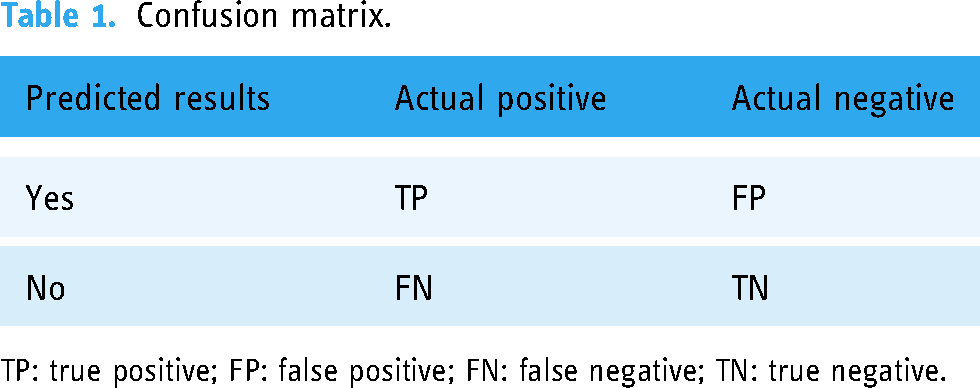
TP: true positive; FP: false positive; FN: false negative; TN: true negative.
Then, we consider the following metrics to analyze the proposal:
Accuracy measures the overall correctness of the model’s predictions. It is calculated as the ratio of the number of correct predictions (TPs and TNs) to the total number of predictions made (equation (3)). Precision quantifies the ability of the model to avoid FPs. It is calculated as the ratio of TPs to the sum of TPs and FPs (equation (4)). Recall measures the model’s ability to capture all positive instances. It is calculated as the ratio of TPs to the sum of TPs and FNs (equation (5)). The F1-score is the harmonic mean of precision and recall, providing a balance between the two metrics. It is calculated as twice the product of precision and recall divided by the sum of precision and recall (equation (6)). Mean absolute error (MAE) measures the average absolute difference between predicted values and actual values. It is calculated as the sum of absolute differences divided by the total number of instances (equation (7)). Mean-squared error (MSE) measures the average of the squares of the errors or deviations. It is calculated as the sum of squared differences divided by the total number of instances (equation (8)). Root MSE (RMSE) is the square root of the MSE and represents the average magnitude of the error. It provides a measure of how spread out the errors are (equation (9)). The area under receiver operative curve (AUROC) quantifies a binary classifier’s ability to distinguish between classes. It ranges from 0.5 to 1, where higher values signify better performance. In medical settings, AUROC assesses a test’s accuracy in identifying patients with a condition while minimizing misclassifications. It offers a concise measure of the model’s overall discriminative power, crucial for evaluating diagnostic tools in clinical practice.





Hyperparameters
Hyperparameter selection is an important aspect of ML model development, and we acknowledge that our previous submission lacked information on the hyperparameter optimization process. Here, we provided an overview of the hyperparameter values used for each ML model in Table 2.
Hyperparameter tuning values for ML models.

AdaBoost: adaptive boosting; ML: machine learning; XGBoost: extreme gradient boosting.
In the case of the DT and RF models, we used the default hyperparameter values as provided by the respective implementations. For LR, we set the maximum number of iterations (max_iter) to 1,200,000. For SVMs, we used a gamma value of “scale” and enabled probability estimation by setting the probability parameter to True. The KNNs model utilized a value of 10 for the number of neighbors (n_neighbors). For AdaBoost, we set the number of estimators (n_estimators) to 100. In the case of GB, we used 100 estimators, a learning rate of 1.0, and a maximum depth of 1. Lastly, the XGBoost model employed 100 estimators, a learning rate of 1.0, and a maximum depth of 30.
Results of Dataset 1
The Pima Indian Diabetes Dataset is one of the most useful datasets for testing ML algorithms for predicting diabetes in the general population.
36
This dataset was provided by the National Institute of Diabetes and Digestive and Kidney Diseases and is used to determine whether a patient has diabetes based on diagnostic measures such as pregnancy, glucose level, blood pressure, skin thickness, diabetes pedigree function, insulin, body mass index (BMI), and age. The attributes of the Pima Indian Diabetes Dataset are listed below:
Pregnancies: Number of occurrences of pregnancy Glucose: In a glucose tolerance measure, the plasma glucose concentration after 2 h Skin thickness: The thickness of the skin folds on the triceps (mm) Insulin: Serum insulin ( BMI: Body mass index Age: Age of the person in years Outcome: Class variable as a result (0 or 1)
The boxplot in Figure 2(a) shows that the dataset contains outliers, whereas Figure 2(b) shows clean data after applying the preprocessing algorithm. In the boxplot, different features have multiple outliers data which are indicated by multiple diamond signs beside each feature and after handling the outlier the boxplot looks like no diamond signs on each feature which proves no outlier existed.

Before and after outlier removal and oversampling results: (a) with outlier; (b) without outlier; (c) without oversampling; and (d) with oversampling.
Figure 2(d) depicts the balanced dataset distribution of the original imbalance dataset in Figure 2(c), where label 0 represents no diabetes and 1 represents diabetes. In the pie chart, we can see that it contains more portion of 1 than 0 and after random oversampling, we can see that we have the same portion of labels 0 and 1, ensuring data is balanced now.
Figure 3(a) and (b) presents the accuracy and MSE of our experiments for Dataset 1. The accuracy comparison before and after applying the proposal. The accuracy results of DT, RF, LR, SVM, KNN, AdaBoost, GB and XGBoost are 77.27%, 85.53%, 78.95%, 78.95%, 80.26%, 80.26%, 81.58%, and 83%, respectively. We found that, depending on the ML algorithms, accuracy performance increases from 4.95% to 12.15%. On the other hand, the MSE values of the algorithm reduced significantly, 5.27%, 12.15%, 5.95%, 4.95%, 8.26%, 6.23%, 8.85%, and 10.27% for DT, RF, LR, SVM, KNN, AdaBoost, GB, and XGBoost, respectively.

The performance results of Dataset 1: (a) accuracy and (b) mean-squared error (MSE).
Table 3 summarizes the other performance metrics. We found that the proposal can improve the precision values from 3.03% to 15.98% for any ML approach. An efficient data preprocessing and data balancing can improve the data quality; hence ML algorithms can accurately classify the test data. We found similar results for recall; the values increased from 0.41% to 11.94%. The F1-score also improved as expected, from 1.1% to 12.25%. On the other hand, the table also indicates that due to the high performance of the proposal, the values of MAE and RMSE are reduced significantly. It is observed that MAE values reduced from 4.95% for SVM to 12.15% for RF. Similarly, RMSE reduced greatly from 5.11% to 13.56%.
Performance result of Dataset 1 (Pima Indian dataset).

ML: machine learning; MAE: mean absolute error; RMSE: root mean-squared error; DT: decision tree; RF: random forest; LR: logistic regression; SVM: support vector machine; KNN: K-nearest neighbor; AdaBoost: adaptive boosting; GB: gradient boosting; XGBoost: extreme gradient boosting.
The extensive analysis of the experiments shows that RF outperforms others as it is an ensemble classifier that works by training a large number of DTs, leading to higher accuracy with good reliable predictions than other single algorithms. So, we consider this model as our proposed model.
Figure 4(a) depicts the confusion matrix and Figure 4(b) shows the receiver operative curve (ROC) curve for our proposed model. In the confusion matrix, the large number of TP and TN than FP and FN is a very crucial point to be a better prediction model for ML. In Figure 4(a), we can see that the TP and FN rates are high and FN and FP rates are very low which gives a better sign of diabetes prediction. The TP, TN, FP, and FN rates are 45%, 41%, 8%, and 6%, respectively. On the other hand, in the ROC, the value of AUC which is near 1 is the best model for ML. In Figure 4(b), we can see that the AUC value is 0.93 (93.07%), which means the positive and negative labels are mostly segregated, and the model is effective.
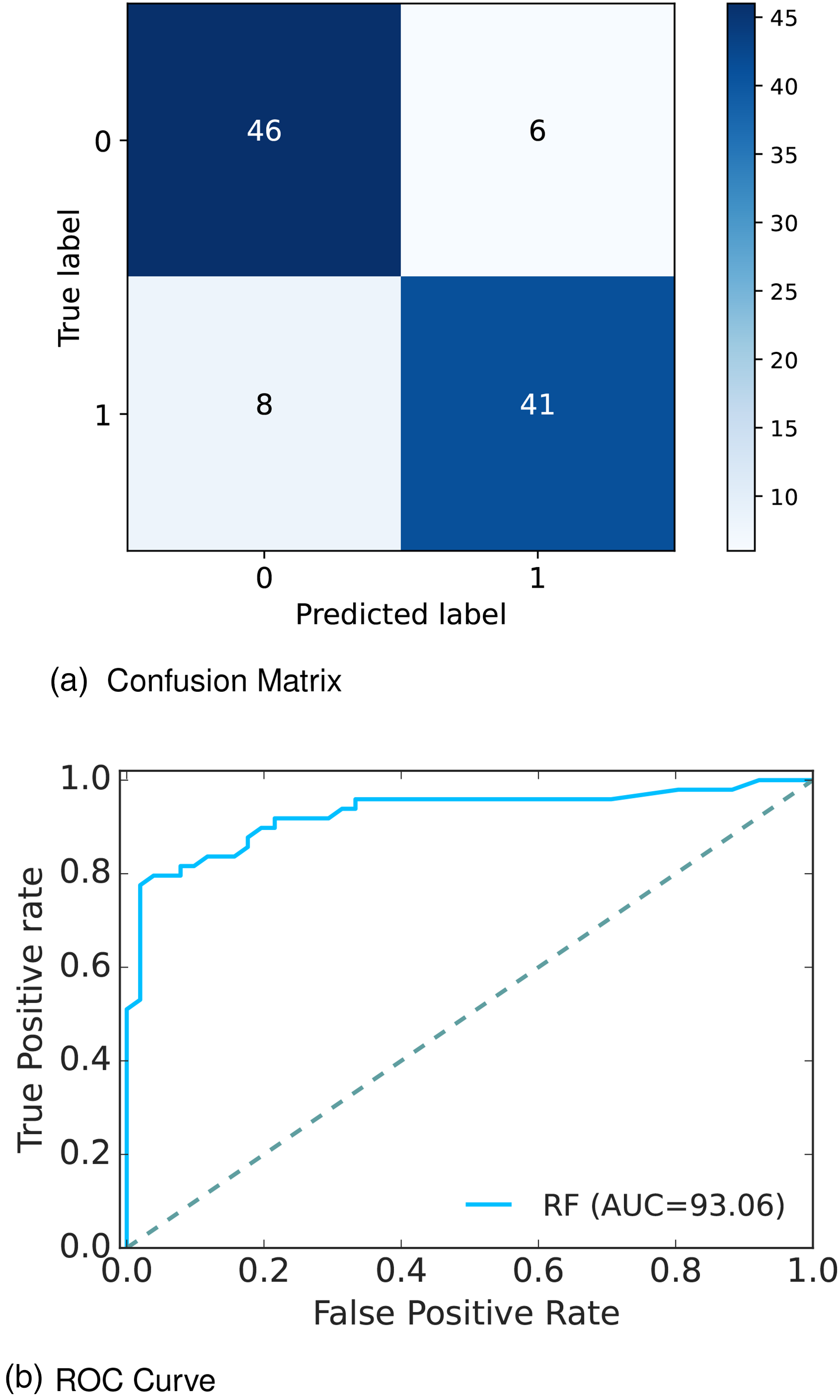
Confusion matrix and receiver operative curve (ROC) curve of Dataset 1: (a) confusion matrix and (b) ROC curve.
After analyzing multiple performance indicators, we can find that among all the ML algorithms RF outperforms others with an accuracy rate of 86%, 14% MSE rate, and 8% FP, as well as 6% FN rates.
Results of Dataset 2
Dataset 2 37 namely, Austin public health diabetes self-management education participant demographics 2015—2017, contains demographic information collected from Austin Public Health, Austin. Among the 1688 rows and 25 columns; various important attributes are considered for our experiment including diabetes status, health indicators, health behaviors including race/ethnicity diabetes status, heart disease, high blood pressure, tobacco use, previous diabetes education, diabetes knowledge, fruits and vegetable consumption, sugar-sweetened beverage consumption, and so on. The attributes of the Austin Public Health dataset are listed below:
Age: Age in year Gender: Gender of the patient Race/ethnicity: Race/ethnicity of participant Heart disease: Heart disease diagnosis (yes/no) High blood pressure: High blood pressure diagnosis (yes/no) Tobacco use: Tobacco user (yes/no) Previous diabetes education: Previous diabetes education reported by participant (yes/no) Diabetes knowledge: Self-reported knowledge of diabetes (poor/fair/good) Fruits and vegetable consumption: Fruits and/or vegetables eaten each week Sugar-sweetened beverage consumption: Sugar-sweetened beverages consumed each week Food measurement: Number of times food was measured each week Carbohydrate counting: Number of times carbohydrates were counted each week Exercise: Number of days participant exercised each week Diabetes status: Diabetes status (yes/no) of participant
The boxplot in Figure 5(a) shows that the dataset contains outliers, whereas Figure 5(b) shows clean data after applying the preprocessing algorithm. In the boxplot, different features have multiple outliers data which is indicated by multiple diamond signs beside each feature and after handling the outlier the boxplot looks like no diamond signs on each feature which proves no outlier existed.

Before and after outlier removal and oversampling results: (a) with outlier; (b) without outlier; (c) without oversampling; and (d) with oversampling.
Figure 5(d) depicts the balanced dataset distribution of the original imbalance dataset Figure 5(c), where the label “No diabetes” represents no diabetes and “Diabetes” represents diabetes. In the pie chart, we can see that it contains more portion of “No diabetes” than “Diabetes” and after random oversampling, we can see that we have an equal portion of the labels “No diabetes” and “Diabetes” which ensures data is balanced now.
Figure 6(a) and (b) presents the accuracy and MSE of our experiments for Dataset 2. The accuracy comparison before and after applying the proposal. The accuracy results of DT, RF, LR, SVM, KNN, AdaBoost, GB, and XGBoost are 95.45%, 98.48%, 83.33%, 93.94%, 87.88%, 96.97%, 93.94%, and 93.94%, respectively. We found that, depending on the ML algorithms, accuracy performance increases from 0% to 8.74%. On the other hand, the MSE values of the algorithm reduced significantly, 5.71%, 8.74%, 0%, 5.48%, 1.52%, 5.94%, 4.2%, and 1.63% for DT, RF, LR, SVM, KNN, AdaBoost, GB, and XGBoost, respectively.

The performance results of Dataset 2: (a) accuracy and (b) mean-squared error (MSE).
The other performance metrics are summarized in Table 4. We found that, for any ML approach, the proposal can improve the precision values from 0% to 14.41%. An efficient data preprocessing and data balancing can improve the data quality, hence ML algorithms can accurately classify the test data. We found similar results for recall, the values increase from 8.27% to 20.57%. The F1-score also improved as expected from 0.47% to 14.19%. On the other hand, the table also indicates that due to the high performance of the proposal, the values of MAE and RMSE are reduced significantly. It is observed that MAE values reduced by 8.74% for RF to 0% for LR. Similarly, RMSE reduced greatly from 19.72% to 0%.
Performance result of Dataset 2 (Austin dataset).
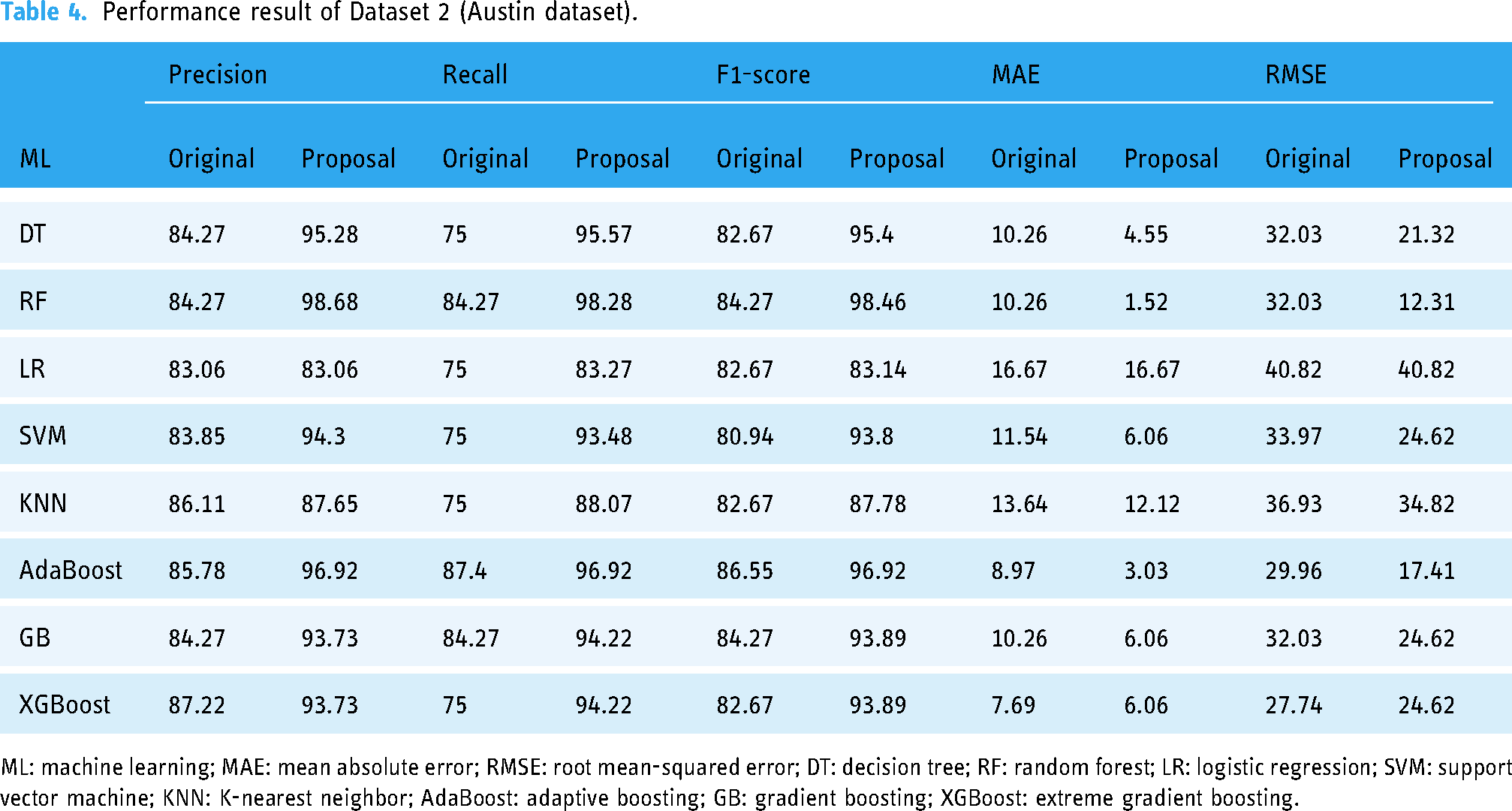
ML: machine learning; MAE: mean absolute error; RMSE: root mean-squared error; DT: decision tree; RF: random forest; LR: logistic regression; SVM: support vector machine; KNN: K-nearest neighbor; AdaBoost: adaptive boosting; GB: gradient boosting; XGBoost: extreme gradient boosting.
The extensive analysis of the experiments shows that RF outperforms others so we consider this model as our proposed model. Figure 7(a) depicts the confusion matrix and Figure 7(b) shows the ROC curve for our proposed model. In the confusion matrix, the large number of TP and TN than FP and FN is a very crucial point to be a better prediction model for ML. In Figure 7(a), we can see that the TP and FN ratess are high and FN and FP rates are very low, which gives a better sign of diabetes prediction. The TP, TN, FP and FN rates are 56.06%, 42.42%, 1.52%, and 0%, respectively. On the other hand, in the ROC curve, the value of AUC which is near 1 is the best model for ML. In Figure 7(b), we can see that the AUC value is 0.99 (99.35%) which means the positive and negative labels are mostly segregated, and the model is effective.

Confusion matrix and receiver operative curve (ROC) curve of Dataset 2: (a) confusion matrix and (b) ROC curve.
After analyzing multiple performance indicators, we can find that among all the ML algorithms RF outperforms others with an accuracy rate of 98.48%, 0% MSE rate, and 1.52% FP as well as 0% FN rates.
Results of Dataset 3
Diabetes 3 38 conducted a survey and collected a dataset containing 950 records and 19 attributes that have a measurable influence on diabetes such as family diabetes history, blood pressure, exercise, BMI, smoking level, alcohol consumption, sleeping hours, food habits, pregnancy, urination frequency, stress level, and so on. The attributes of the survey dataset are listed below:
Age: Age in year Gender: Gender of the participant Family_Diabetes: Family history with diabetes highBP: Diagnosed with high blood pressure PhysicallyActive: Walk/run/physically active BMI: Body mass index Smoking: Smoking Alcohol: Alcohol consumption Sleep: Hours of sleep SoundSleep: Hours of sound sleep RegularMedicine: Regular intake of medicine JunkFood: Junk food consumption Stress: Not at all, sometimes, often, always BPLevel: Blood pressure level Pregancies: Number of pregnancies Pdiabetes: Gestation diabetes UriationFreq: Frequency of urination Diabetic: Yes or no
We found a total of 48 missing values in the original dataset, including four missing values for BMI, 42 missing values for Pregnancies, one missing value for Pdiabetes, and one missing value for Diabetic.
The boxplot in Figure 8(a) shows that the dataset contains outliers, whereas Figure 8(b) shows clean data after applying the preprocessing algorithm. In the boxplot, different features have multiple outliers data which is indicated by multiple diamond signs beside each feature and after handling the outlier, the boxplot looks like no diamond signs on each feature, which proves no outlier existed.

Before and after outlier removal and oversampling results: (a) with outlier; (b) without outlier; (c) without oversampling; and (d) with oversampling.
Figure 8(d) depicts the balanced dataset distribution of the original imbalance dataset 8(c). where the label “No” represents no diabetes and “Yes” represents diabetes. In the pie chart, we can see that it contains more portion of “No” than “Yes,” and after random oversampling, we can see that we have an equal portion of the labels “No” and “Yes,” which ensures data is balanced now.
Figure 9(a) and (b) presents the accuracy and MSE of our experiments for Dataset 3. The accuracy comparison before and after applying the proposal. The accuracy results of DT, RF, LR, SVM, KNN, AdaBoost, GB, and XGBoost are 98.54%, 97.81%, 91.11%, 91.97%, 88.32%, 91.58%, 92.63%, and 99.27%, respectively. We found that, depending on the ML algorithms, accuracy performance increases from 2.25% to 10.75%. On the other hand, the MSE values of the algorithm reduced significantly, 2.98%, 2.25%, 8.63%, 10.75%, 7.66%, 3.26%, 4.31%, and 3.71% for DT, RF, LR, SVM, KNN, AdaBoost, GB, and XGBoost, respectively.

The performance results of Dataset 3: (a) accuracy and (b) mean-squared error (MSE).
The other performance metrics are summarized in Table 5. We found that, for any ML approach, the proposal can improve the precision values from 1.77% to 9.20%. An efficient data preprocessing and data balancing can improve the data quality, hence ML algorithms can accurately classify the test data. We found similar results for recall, the values increase from 2.06% to 25.34%. The F1-score also improved as expected from 1.99% to 22.74%. On the other hand, the table also indicates that due to the high performance of the proposal, the values of MAE and RMSE are reduced significantly. It is observed that MAE values reduced from 2.25% for RF to 10.75% for SVM. Similarly, RMSE reduced greatly from 5.15% to 15%.
Performance result of Dataset 3 (Tigga dataset).

ML: machine learning; MAE: mean absolute error; RMSE: root mean-squared error; DT: decision tree; RF: random forest; LR: logistic regression; SVM: support vector machine; KNN: K-nearest neighbor; AdaBoost: adaptive boosting; GB: gradient boosting; XGBoost: extreme gradient boosting.
The extensive analysis of the experiments shows that XGBoost outperforms others as it is a gradient-boosted DT solution that uses L1 and L2 regularization which leads to getting a better accuracy rate than others. So, we consider this model as our proposed model.
Figure 10(a) depicts the confusion matrix and Figure 10(b) shows the ROC curve for our proposed model. In the confusion matrix, the large number of TP and TN than FP and FN is a very crucial point to be a better prediction model for ML. In graph 10(a), we can see that the TP and FN rates are high and the FN and FP rates are very low, which gives a better sign of diabetes prediction. The TP, TN, FP, and FN rates are 49.64%, 44.53%, 3.65%, and 2.19%, respectively. On the other hand, in the ROC curve, the value of AUC which is near 1 is the best model for ML. In Figure 10(b), we can see that the AUC value is 0.99 (99.36%) which means the positive and negative labels are almost segregated, and the model is effective.

Confusion matrix and receiver operative curve (ROC) curve of Dataset 3: (a) confusion matrix and (b) ROC curve.
After analyzing multiple performance indicators, we can find that among all the ML algorithms XGBoost outperforms others with an accuracy rate of 99.27%, 0.73% MSE rate, and 3.65% FP as well as 2.19% FN rates.
Results of Dataset 4
Finally, the information was collected from Iraqi society, as well as the Medical City Hospital’s laboratory and Specializes Center for Endocrinology and Diabetes-Al-Kindy Teaching Hospital in Dataset 4. 39 The data consist of medical information as well as laboratory analysis including age, gender, creatinine ratio (Cr), BMI, urea, cholesterol, low-density lipoprotein (LDL), very low-density lipoprotein (VLDL), triglycerides (TG) and high-density lipoprotein (HDL) cholesterol, hemoglobin A1c (HBA1c), and so on. The attributes of the Iraqi Medical City dataset are listed below:
Age: Age of the patient Gender: Gender of the participant Sugar level blood: Sugar level of the patient Cr: Creatinine ratio BMI: Body mass index Urea: blood urea level Chol: Cholesterol TG: triglycerides level HDL: High-density lipoprotein cholesterol level LDL: Low-density lipoprotein level VLDL: very low-density lipoprotein level HBA1c: Average blood glucose (sugar)–hemoglobin A1C Class: Diabetic, non-diabetic, or pre-diabetic
The boxplot in Figure 11(a) shows that the dataset contains outliers, whereas Figure 11(b) shows clean data after applying the preprocessing algorithm. In the boxplot, different features have multiple outliers data, which is indicated by multiple diamond signs beside each feature and after handling the outlier the boxplot looks like no diamond signs on each feature which proves no outlier existed.

Before and after outlier removal and oversampling results: (a) with outlier; (b) without outlier; (c) without oversampling; and (d) with oversampling.
Figure 11(d) depicts the balanced dataset distribution of the original imbalance dataset in Figure 11(c). where the label “Y” represents diabetic, “N” represents non-diabetic and “P” represents pre-diabetic. In the pie chart, we can see that it contains more portion of “Y” than “P” and “N,” and after random oversampling, we can see that we have an equal portion of all the labels which ensures data is balanced now.
The research specifically aims to develop an ML model for classifying diabetes, focusing on the task of assigning diabetes labels (diabetes or no diabetes) using various diabetes datasets. While it may seem odd to include HbA1c as an input variable in this dataset (Dataset 4), we considered it relevant for our classification task. The inclusion of HbA1c as a feature helps the model learn patterns and relationships between other variables and the presence of diabetes. By including this feature, we aim to capture additional information that may contribute to the accurate classification of diabetes. We understand that the close-to-perfect performance of the model might raise suspicions. However, we assure you that our research was conducted rigorously, following standard practices and using appropriate evaluation metrics.
Figure 12(a) and (b) presents the accuracy and MSE of our experiments for Dataset 4. The accuracy comparison before and after applying the proposal. The accuracy results of DT, RF, LR, SVM, KNN, AdaBoost, GB, and XGBoost are 100%, 99.60%, 95.65%, 96.84%, 95.65%, 99.21%, 99.60%, and 99%, respectively. We found that, depending on the ML algorithms, accuracy performance increases from 0.19% to 9.84%. On the other hand, the MSE values of the algorithm reduced significantly, 2%, 1.6%, 11.09%, 21.84%, 18.28%, 3.71%, 7.6%, and 0.19% for DT, RF, LR, SVM, KNN, AdaBoost, GB, and XGBoost, respectively.

The performance results of Dataset 4: (a) accuracy and (b) mean-squared error (MSE).
The other performance metrics are summarized in Table 6. We found that, for any ML approach, the proposal can improve the precision values of 0.67% to 46.88%. An efficient data preprocessing and data balancing can improve the data quality, hence ML algorithms can accurately classify the test data. We found similar results for recall, the values increased from 0.83% to 47.59%. The F1-score also improved as expected from 0.42% to 46.52%. On the other hand, the table also indicates that due to the high performance of the proposal, the values of MAE and RMSE are reduced significantly. It is observed that MAE values reduced from 0.19% for XGBoost to 13.84% for SVM. Similarly, RMSE reduced greatly from 0.89% to 32.22%.
Performance result of Dataset 4 (Mendeley dataset).

ML: machine learning; MAE: mean absolute error; RMSE: root mean-squared error; DT: decision tree; RF: random forest; LR: logistic regression; SVM: support vector machine; KNN: K-nearest neighbor; AdaBoost: adaptive boosting; GB: gradient boosting; XGBoost: extreme gradient boosting.
The extensive analysis of the experiments shows that DT outperforms others since the ability to capture relevant decision-making information from the available dataset is the most important feature of the DT which leads to higher accuracy. So, we consider this model as our proposed model.
Figure 13(a) depicts the confusion matrix and Figure 13(b) shows the ROC curve for our proposed model. In the confusion matrix, the large number of TP and TN than FP and FN is a very crucial point to be a better prediction model for ML. In Figure 13(a), we can see that the TP and FN rates are high and FN and FP rates are very low which gives a better sign of diabetes prediction. The TP, TN, FP and FN rates are 35.97%, 64.03%, 0.0%, and 0.0%; 29.25%, 70.75%, 0.0%, and 0.0%; 34.78%, 65.22%, 0.0%, and 0.0% for N, Y, and P class, respectively. On the other hand, in the ROC, the value of AUC which is near 1 is the best model for ML. In the Figure 13(b), we can see that the AUC value is 1 (100%), which means the positive and negative labels are completely segregated, and the model is as effective as it can be.

Confusion matrix and ROC curve for RF of Dataset 4: (a) confusion matrix and (b) ROC curve. ROC: receiver operative curve; RF: random forest.
After analyzing multiple performance indicators, we can find that among all the ML algorithms DT outperforms others with an accuracy rate of 100%, 0% MSE rate, and 0% FP as well as FN rates.
Discussion
In this study, we conducted a comprehensive analysis of ML models for diabetes detection using four distinct datasets: Pima Indian, Austin Public, Tigga, and Mendeley. The performance metrics were evaluated to assess the effectiveness of the models in accurately identifying individuals at risk of diabetes as shown in Table 7.
Best performance analysis for each dataset.

ML: machine learning; MAE: mean absolute error; MSE: mean-squared error; RMSE: root MSE; RF: random forest; XGB: extreme gradient boosting; DT: decision tree.
On the Pima Indian dataset, the RF model achieved an accuracy of 85.53%. The precision and recall were 86.96% and 81.29%, respectively, resulting in an F1-score of 83.06%. The MAE and MSE were 14.47, and the RMSE was 38.04. For the Austin Public dataset, the RF model exhibited exceptional performance with an accuracy of 98.48%. The precision, recall, and F1-score values were 98.68%, 98.28%, and 98.46%, respectively. The model demonstrated low errors with an MAE of 1.52, MSE of 1.52, and RMSE of 12.31. The Tigga dataset showed outstanding results with the XGBoost model achieving an accuracy of 99.27%. The precision, recall, and F1-score values were 99.31%, 99.24%, and 99.27%, respectively. The model’s errors were minimal with an MAE of 0.73, MSE of 0.73, and RMSE of 8.54. Remarkably, the DT model achieved perfect performance on the Mendeley dataset, attaining an accuracy, precision, recall, and F1-score of 100%. Additionally, the model exhibited zero errors with an MAE, MSE, and RMSE of 0.
Interestingly, the DT model achieves perfect performance on the Mendeley dataset, with accuracy, precision, recall, and F1-score all reaching 100%. This remarkable result suggests that the features within the Mendeley dataset may be well-suited for DT-based classification, possibly due to the dataset’s inherent structure or the nature of the variables involved. It is worth noting that while the DT model demonstrates flawless performance on this particular dataset, its generalization to other datasets may vary, warranting further investigation into its robustness across different data domains. Moreover, the low error metrics (MAE, MSE, and RMSE) observed across all models and datasets indicate the models’ capability to make accurate predictions with minimal deviation from the actual values. These findings emphasize the reliability of ML algorithms in diabetes detection tasks and underscore their potential utility in clinical settings for early risk assessment and intervention.
Furthermore, the results of this study highlight the efficacy of ML models in diabetes detection across diverse datasets. While certain models excel in specific contexts, the overall performance underscores the promise of ML techniques in augmenting traditional diagnostic approaches and improving patient outcomes in diabetes management. Further research is warranted to explore the generalizability of these models across larger and more diverse populations, as well as their integration into clinical practice for personalized healthcare delivery.
The results indicate that the ML models can effectively detect diabetes. The RF model showed good performance on the Pima Indian dataset, while both the RF model on the Austin Public dataset and the XGBoost model on the Tigga dataset demonstrated excellent performance. The DT model exhibited perfect performance on the Mendeley dataset. These findings highlight the potential of ML in accurate diabetes detection, providing a valuable tool for early intervention and improved patient outcomes.
In our research, we included multiple datasets in our analysis to provide a comprehensive evaluation of the performance of ML models for diabetes detection. Each dataset represents a distinct population or data source, allowing us to assess the generalizability of the models across diverse scenarios. We evaluated the models on multiple datasets to gain insights into their strengths and limitations in different contexts. This approach helps experimenters understand the robustness of the models and identify potential challenges or biases that may arise when applying them to real-world scenarios. Additionally, it enables researchers to make informed decisions about which models are most suitable for specific datasets or patient populations. Regarding the conclusions, we acknowledge that the original discussion did not sufficiently elaborate on the insights gained from the extensive set of benchmarks. In light of the reviewer’s comment, we will revise the conclusion section to provide a more comprehensive analysis of the results and their implications. We will discuss the key findings from each dataset, highlight the factors that contributed to successful performance, and address the challenges and considerations experimenters should be aware of when deploying these models in practice. We will also emphasize any new information or novel observations that emerged from our study. Although some previous research has examined ML models for diabetes detection, our study contributes by analyzing a diverse range of datasets and comparing the performance of multiple models. This allows us to provide a more comprehensive understanding of the strengths and weaknesses of different algorithms and their applicability in various scenarios.
Furthermore, a comparison analysis is illustrated in Table 8 and in Figure 14, where we can see that our proposed approach outperforms others, which proves the better prediction models. In Dataset 1, RF outperforms other ML models with an accuracy rate of 86%. Similarly, for Dataset 2, Dataset 3, and Dataset 4, RF, XGBoost, and DT outperform other ML models with an accuracy rate of 98.48%, 99.27%, and 100%, respectively. The higher accuracy rate of diabetes predictions proves the robustness of our proposed model.
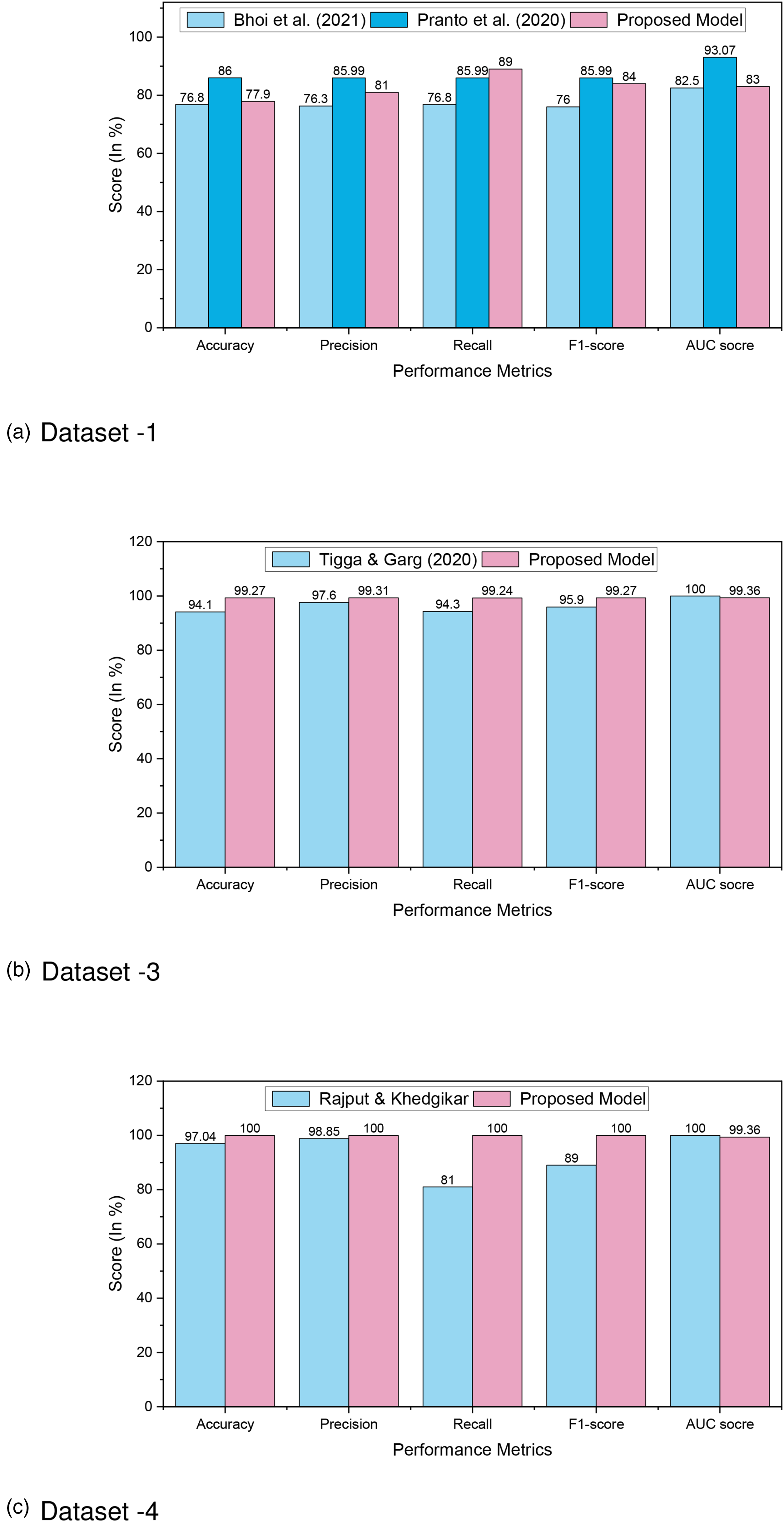
Comparison analysis of diabetes prediction for (a) Dataset 1; (b) Dataset 3; and (c) Dataset 4.
Comparison analysis of diabetes prediction for Dataset 1, Dataset 3, and Dataset 4.

ML: machine learning; AUC: area under curve; LR: logistic regression; XGBoost: extreme gradient boosting; NB: Naive Bayes; RF: random forest; AWOD: average weighted objective distance; SGB: stochastic gradient boosting; DT: decision tree.
The ML models RF, XGBoost, and DT exceed the performance indicators of other algorithms as well as research for Dataset 1, Dataset 2, Dataset 3, and Dataset 4. The proper efficient preprocessing upgrades the quality of data that helps to enhance the outcomes for various datasets. Yet, the RF, XGBoost, and DT algorithms had enhanced accuracy, and it is encouraged that they can be employed in the clinical categorization and prognosis of diabetes for greater performance.
Novelty and significance
This study acknowledges the well-established nature of optimizing preprocessing and oversampling techniques within the specific context of diabetes prediction using ML models. Our contribution lies in carefully implementing and evaluating these methods within the diabetes detection framework.
While our study introduces experimental evaluation techniques, we believe that the methodological and clinical insights gained from our rigorous analysis contribute to the field of diabetes prediction. By carefully implementing and evaluating oversampling techniques within the diabetes detection framework, we aim to provide practical guidance for researchers and practitioners working on similar problems.
The significance of this study lies in its contributions to the field of diabetes research and its potential impact on clinical practice.
Overall, this study holds significant implications for clinical practice, offering improved diagnostic accuracy, personalized management strategies, early intervention opportunities, and advancements in ML techniques. The findings have the potential to enhance diabetes care, contribute to preventive healthcare, and ultimately improve patient outcomes.
Conclusion
In this research, we have conducted a comprehensive study on diabetes detection using ML techniques, aiming to underscore both the scientific value added by our work and the applicability of our findings in clinical practice. Our contributions encompass the outcome of an optimized preprocessing pipeline, addressing dataset imbalance, preventing overfitting, and demonstrating superior performance through extensive experimentation. We have rigorously evaluated various ML models on four different datasets: Pima Indian, Austin Public, Tigga, and Mendeley. Our results showcase notable improvements in accuracy, precision, recall, and F1-score metrics compared to existing methods.
Specifically, the RF model achieved an accuracy of 85.53% on the Pima Indian dataset, with balanced precision and recall values. On the Austin Public dataset, the RF model excelled with an exceptional accuracy of 98.48%, along with high precision, recall, and F1-score values. The XGBoost model demonstrated outstanding performance on the Tigga dataset, achieving an accuracy of 99.27% with minimal errors in predictions. Notably, the DT model achieved perfect accuracy and precision on the Mendeley dataset, indicating flawless classification of diabetes instances. Our study reveals significant improvements over existing methods, with accuracy rates ranging from 86% to 100% across different datasets. Specifically, our suggested method outperforms previous works by 4.95% to 12.15% for Dataset 1, 0% to 8.74% for Dataset 2, 2.25% to 10.75% for Dataset 3, and 0.19% to 9.84% for Dataset 4.
However, it is essential to acknowledge the limitations of our study. Further investigation is needed to assess the generalizability of our approach to diverse datasets, feature selection, ensemble models and DL techniques. Additionally, the lack of interpretability in ML models poses a challenge in understanding the underlying factors driving predictions.
In conclusion, our study highlights the need for further research to address limitations and enhance the reliability and applicability of the proposed approach for diabetes detection using ML. Moving forward, potential avenues for future research include:
Feature selection: Exploring advanced feature selection techniques to improve the efficiency and accuracy of diabetes detection models. Ensemble models: Investigating the integration of ensemble learning techniques to combine multiple models for enhanced predictive performance. DL algorithms: Exploring the application of DL algorithms, such as convolutional neural networks and recurrent neural networks, to improve the prediction accuracy of diabetes detection models.
By pursuing these future directions, we aim to advance the field of diabetes detection using ML and contribute to improved healthcare outcomes.
Footnotes
Acknowledgement
The authors would like to extend their sincere appreciation to the Researchers Supporting Project Number (RSP2024R301), King Saud University, Riyadh, Saudi Arabia.
Availability of data and materials
The UCI ML Diabetes Dataset 1 is available on https://archive.ics.uci.edu/ml/datasets/diabetes; The Austin Public Health Diabetes Dataset 2 is available on https://data.austintexas.gov/Health-and-Community-Services/Austin-Public-Health-Diabetes-Self-Management-Educ/48iy-4sbg; The T2D Dataset 3 is available on https://www.kaggle.com/datasets/tigganeha4/diabetes-dataset-2019; The Mendeley Diabetes Dataset 4 is available on  .
.
Consent to participate
Not applicable.
Consent to Publish
Not applicable.
Contributorship
Md. Alamin Talukder contributed to Conceptualization, data curation, methodology, software, resource, visualization, formal analysis, and writing—original draft, review, and editing; Md. Manowarul Islam, Md Ashraf Uddin, Arnisha Akther, and Mohammad Ali Moni contributed to methodology, visualization, validation, investigation, and writing—review and editing; Majdi Khalid and Mohsin Kazi contributed to supervision, formal analysis, visualization, investigation, and writing–review and editing.
Declaration of conflicting interests
The authors declared no potential conflicts of interest with respect to the research, authorship, and/or publication of this article.
Ethics approval
Not applicable.
Funding
The authors received no financial support for the research, authorship and/or publication of this article.
Guarantor
Md. Alamin Talukder.