



Abstract
Introduction
The potential positive impact of computer game playing on cognitive function and its potential role in reducing the risk of Alzheimer's disease (AD) has been suggested. However, current observational studies have certain limitations. We utilized Mendelian randomization (MR) alongside extensive genome-wide association study (GWAS) data to examine the relationship between computer game playing, cognitive function, risk of AD, and levels of brain-derived neurotrophic factor (BDNF).
Methods
We collected datasets on computer game playing, cognition function, risk of AD, and BDNF level from the IEU Open GWAS project. Causal effects were assessed using various MR methods, including inverse variance weighted (IVW), weighted median, MR-Egger, simple mode, and weighted mode. To ensure the accuracy of the results, sensitivity analyses were conducted.
Results
Our analysis revealed a significant association between computer game playing and cognitive function (β = 0.801, 95% CI: 0.351, 1.328, P = 0.001). There was no statistically significant association between computer game playing and either BDNF level or risk of AD (β = −0.112, 95%CI: −1.315, 1.091, P = 0.855; OR = 1.000, 95% CI: 1.004, 0.997, P = 0.891, respectively). We further confirmed the reliability of our evidence through the MR-Egger intercept test, MR-PRESSO global test, Cochran's Q test, and funnel plots.
Conclusion
The results of our study indicate that engaging in computer game playing may confer a safeguarding influence on cognitive function. This underscores the potential advantages associated with computer gaming. Nevertheless, given the constraints inherent in our research, further investigation is warranted to substantiate our findings and delve into the underlying mechanisms.
Introduction
Dementia is found to be a leading cause of disability. 1 With the global aging population, the prevalence of dementia is expected to increase to 82 million by 2030.2,3 And in 2019, Medicare and Medicaid are estimated to spend $195 billion on Alzheimer's disease (AD), a form of dementia.2,3 Consequently, the World Health Organization (WHO) has prioritized the prevention of cognitive decline and dementia as a global mental health concern. Recently, computer games are gaining scientific interest as a cognitive training tool due to their playful nature. 4 Certain computer game training has been shown to yield positive effects on untrained tasks, commonly referred to as a transfer effect.
Computer games have been heavily promoted to consumers, specifically among older individuals to enhance their cognitive function. 5 As a result, geriatric clinicians and practitioners are frequently asked by older individuals whether they should engage in computerized games to prevent dementia. 6 However, the usage of computer games for the prevention and treatment of cognitive decline lacks robust scientific evidence currently, except for a general belief that specific computer games may have positive effects on cognition in certain individuals. 7
Cognitive impairment in AD is primarily a result of neurodegeneration, and neurotrophic factors such as brain-derived neurotrophic factor (BDNF) could potentially slow down this neurodegeneration. 8 BDNF has been extensively researched as a growth factor in mammalian brains. Its importance lies in its ability to assist in nerve growth and maturation during development, and in regulating synaptic transmission and plasticity in adulthood. 9 Previous studies have reported that BDNF levels in the brain, 10 blood, 11 and cerebrospinal fluid (CSF) 12 of AD patients decrease as the disease progresses. Furthermore, higher serum levels of BDNF have been associated with improved cognitive function in AD. 13 These findings suggest that BDNF could serve as a potential biomarker for AD diagnosis and therapy.
However, due to the potential risks associated with computer gaming, conducting controlled trials can be challenging or ethically problematic.14,15 To overcome the uncertainty surrounding the casual association between computer gaming and cognitive function, we employed Mendelian randomization (MR) analysis. MR uses genetic variants as instrumental variables (IVs) to mimic the random assignment of treatments in clinical trials, enabling the assessment of causal relationships between risk factors and disease outcomes. 16 In our study, we utilized data from large-scale genome-wide association studies (GWAS) to examine the causal effects of computer gaming on cognitive function, the risk of AD, and BDNF levels. Understanding the impact of computer gaming on cognitive health and the risk of dementia is crucial for informing public health strategies, providing recommendations, and promoting healthy gaming habits.
Methods
Study design
Conducted in adherence to the Strengthening the Reporting of Observational Studies in Epidemiology (STROBE) guidelines, this research was completed. (Supplementary information Table S1). 17 This study used de-identified publicly available data, so no ethical approval from an institutional review board was required. The study protocol was not preregistered. 18 In this study, we used a two-sample MR design to examine the causal effects of computer game playing on cognition function, risk of AD, and BDNF levels using GWAS summary statistics.
Data sources
The IEU Open GWAS project (https://www.ebi.ac.uk/gwas/, accessed on 8 August 2023) was utilized to obtain the GWAS summary-level data employed in this study. To avoid sample overlap across different studies and consortia, we retrieved the latest GWAS summary data of European ancestral individuals from different consortiums for exposure (computer game playing) and outcome phenotypes (cognition function, risk of AD, and BDNF level). The UK Biobank project, which involved the recruitment of around 500,000 volunteers in the United Kingdom, aimed to explore the roles of genetic predisposition and environmental exposure in various health outcomes. Summary statistics for genome-wide association studies (GWAS) related to playing computer games were acquired from a repository within the UK Biobank, which was made accessible by the MRC-IEU consortium. A total of 9,851,867 SNP were obtained, and the sample size was 462,433. The phenotype of interest was assessed by asking the question, “Do you play computer games?” Participants’ responses were then categorized as follows: 0 for Never/Rarely, 1 for Sometimes, and 2 for Often. The outcome phenotypes summary statistics were downloaded from the IEU open GWAS project: cognition function (GWAS ID:ieu-b-48380); AD (GWAS ID: ieu-b-5067) and BDNF levels(GWAS ID: prot-a-242). All GWAS were conducted in samples of European ancestry. The dataset IDs and other details are listed in Table 1.
Data sources.
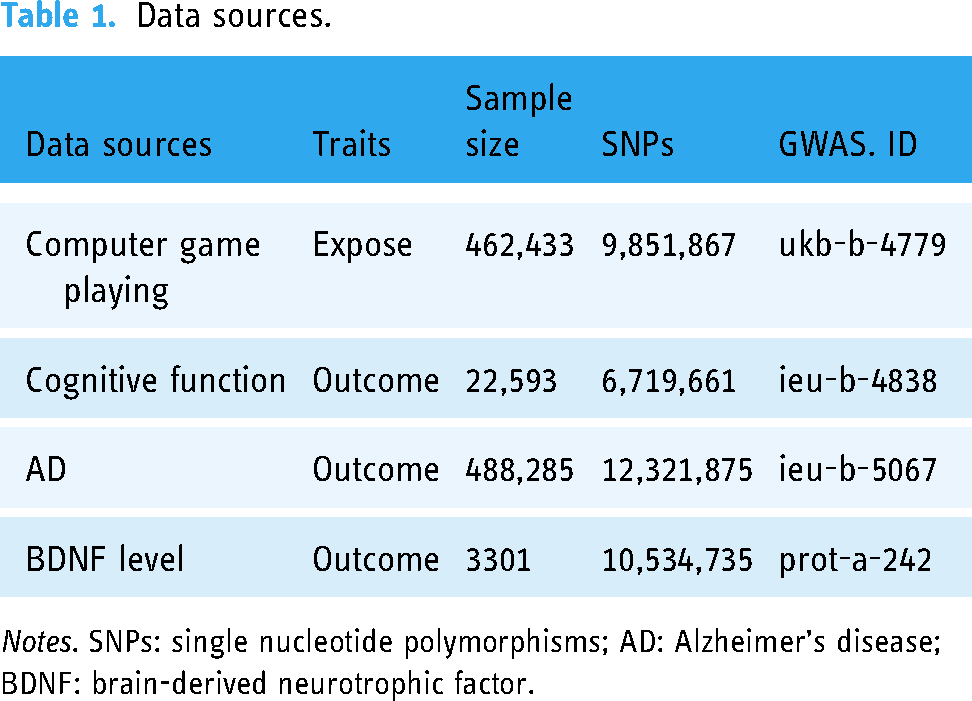
Notes. SNPs: single nucleotide polymorphisms; AD: Alzheimer’s disease; BDNF: brain-derived neurotrophic factor.
MR analysis
According to previous studies, we must first ensure that three assumptions are satisfied when conducting MR Analysis. First, predicting exposure of interest using genetic instruments (P < 5 × 10⁻⁸), second, ensuring independence of genetic instruments from potential confounders, three, genetic instruments influencing the outcome solely through risk factors. 19
To meet the first assumption, we established a typical genome-wide significance threshold (P < 5 × 10⁻⁸) in order to choose genetic instruments that were strongly associated with the exposure. 20 Additionally, all genetic variants initially identified underwent clumping using PLINK to ensure that our instruments were sourced from an independent set of variants. This was done to reduce potential biases caused by LD patterns and overlapping regions in the genetic data (with the settings: clump-r2 = 0.001 and clump-kb = 10,000 21 ). After this step, data harmonization was conducted to address any issues arising from ambiguous SNPs with inconsistent alleles and palindromic SNPs with ambiguous strands. Measures were taken to either correct or exclude these problematic variants to ensure the reliability of the genetic instruments used in the analysis. 22 In the next stage, the F-statistic for each instrument was computed using the formula F = beta2/SE2. 23 Specifically, instruments with an F-statistic of less than 10 were considered weak and thus were excluded from further analysis to avoid introducing bias and uncertainty into the results. 24 By applying these rigorous criteria and methods in selecting our genetic instruments and assessing their strength, we aimed to enhance the validity and robustness of our findings in the context of MR studies.
It should be noticed that the first assumption, the validation of the other two MR assumptions presents a significant challenge. 25 Therefore, several countermeasures were employed to address this problem. To mitigate reverse causality between exposure and outcome may introduce bias to the estimation, the Steiger filtering method was utilized to eliminate any SNP that was more predictive of the outcome than exposure.26,27 This method assesses the variance explained in both the exposure and outcome by the instrumenting SNPs, determining if the variance in the outcome is indeed less than that in the exposure. 27
Second, a significant concern with MR is the potential impact of horizontal pleiotropy, which can introduce bias by impacting confounding variables or directly influencing the outcome 28 (called correlated or uncorrelated pleiotropy, respectively 29 ). In order to address this issue, methods such as the MR-Egger intercept test and the MR Pleiotropy Residual Sum and Outlier test (MR-PRESSO) can be used to evaluate the presence of horizontal pleiotropy in MR studies. 30 These tests help researchers assess the validity of their findings and ensure that the results are not confounded by horizontal pleiotropy. By carefully considering and accounting for horizontal pleiotropy, researchers can enhance the robustness and reliability of their MR analyses.
Specifically, the MR-Egger intercept test is utilized for assessing directional horizontal pleiotropy. Independent of direct effect hypothesis, the intercept obtained from the MR-Egger analysis represents the typical horizontal pleiotropic impact of the genetic variant under investigation, and a non-significant intercept implies well-balanced pleiotropy. Conversely, the presence of directional horizontal pleiotropy or a violation of the InSIDE assumption (or both 31 ) could be indicated by a non-zero intercept.
On the other hand, The MR-PRESSO global test is used to assess horizontal pleiotropy among all IVs in a single MR test by comparing observed distances to the regression line with expected distances under the null hypothesis. 31 It is important to note that MR-PRESSO is based on the InSIDE assumption, which can be challenging to test. 31 To account for potential pleiotropic effects of genetic variants, five MR analytical methods were utilized in the evaluation of the causal effects of computer game playing on cognitive function, risk of AD, and BDNF levels. These methods include inverse variance weighted (IVW), weighted median, MR-Egger, simple mode, and weighted mode. Each of these methods provides a unique approach to estimating causal relationships in MR studies.
Standard IVW estimates were utilized for the primary analysis, combining each SNP's Wald ratio with the outcome to derive a pooled causal estimate. 32 To address overdispersion, this method was employed. Additionally, complementary MR analyses, including MR-Egger, simple mode, and weighted mode methods, were conducted alongside IVW due to their ability to generate more robust estimates in a wider array of scenarios. MR-Egger regression serves as a test for unbalanced pleiotropy and substantial heterogeneity, although a larger sample size is required for equivalent underexposure variation. 30 The weighted median method delivers consistent effect estimates when at least half of the weighted variance influenced by horizontal pleiotropy is accurate. 33 Furthermore, consistent with past research from our team and others, a stringent instrument P-value threshold was applied, with adjustments made if discrepant results emerged from various MR analyses. 34
Sensitivity analysis
Horizontal pleiotropy arises when genetic variants related to the investigated exposure impact outcomes through various pathways beyond the expected exposure effects. 35 Thus, we utilized Cochran's Q test, funnel plot, leave-one-out (LOO) method, and MR-Egger intercept examination to identify potential pleiotropy and verify result reliability. 36 In particular, heterogeneity was identified if the Cochran Q test’s P-value was below 0.05. 36 Additionally, we evaluated horizontal pleiotropy using the intercept value from the MR-Egger regression analysis. 37 To determine whether the causal estimate was driven by any single SNP, we performed LOO analysis, through which each exposure-associated SNP was discarded in turn to repeat the IVW analysis. 38
Statistical analysis
In order to address the issue of multiple testing in our primary analyses, we applied a corrected threshold for statistical significance using Bonferroni adjustment (0.050/3 outcomes = 0.016). 39 Our MR findings were reported as odds ratios (OR) and beta coefficients (β) along with 95% confidence intervals (CI), offering insights into the impact of computer gaming on cognitive function, BDNF levels, and AD risk per standard deviation (SD) increase. We considered a P-value below 0.016 as significant, while a P-value falling between 0.016 and 0.050 indicated a potential association. The statistical analyses were conducted using the TwoSampleMR package (version 0.4.25) within the R software (version 3.6.1).
Results
MR estimation
In the quality control process, no inadequate instruments were identified (all F-values of the independent variables exceeded 10). The primary summary of the MR estimates obtained from the IVW, weighted median, MR-Egger, basic method, and weighted method techniques is displayed in Figure 1 and Table 2. The IVW analysis indicated that computer game playing was significantly associated with cognitive function (β = 0.801, 95% CI: 0.351, 1.328; P = 0.001), similar to the results from the weighted median (β = 1.216, 95% CI: 0.602, 1.862; P = 0.000). The results from the other MR methods showed a consistent but non-significant direction (indicated by the slopes of the fitted lines in Figure 1). However, Our research did not find a significant link between playing video games and levels of (BDNF or the risk of developing AD (β = −0.112, 95%CI: −1.315, 1.091, P = 0.855; OR = 1.000, 95% CI: 1.004, 0.997, P = 0.891, respectively). This suggests that video game playing may not have a direct impact on these specific factors. It is important to note that other variables or factors may play a role in the relationship between video games and cognitive health.
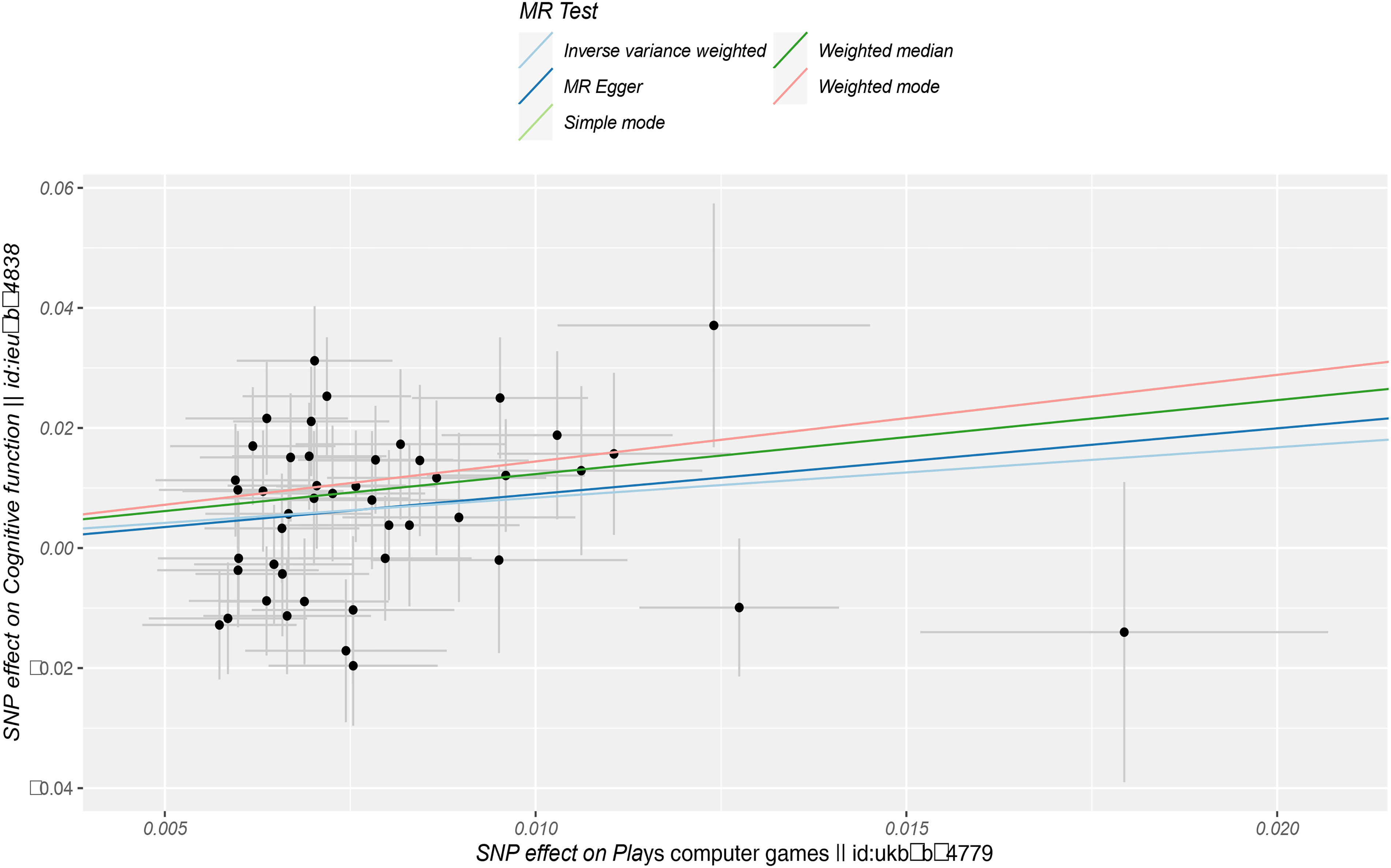
Scatter plots of associations between computer game playing and cognitive function.
Causal effects of computer game playing on cognition function, the risk of Alzheimer's disease, and BDNF.

Notes. IVW: inverse variance weighted; OR: odds ratios; β: beta coefficients; SE: standard error; AD: Alzheimer's disease; BDNF: brain-derived neurotrophic factor.
Heterogeneity and sensitivity analysis
To assess the robustness of the above results, a series of sensitivity analyses, including funnel plots, Cochran's Q test, MR-Egger intercept test, and MR-PRESSO global test, were conducted (Tables 3 and 4 and Supporting Information Figures S2–S4). The general symmetry in the funnel plots suggests a low risk of horizontal pleiotropy for the relevant results. The MR-PRESSO global test indicated significant horizontal pleiotropies concerning the risk of AD and BDNF (Table 2). However, the MR-Egger intercept test did not reveal any significant directional horizontal pleiotropy. Cochran's Q test revealed significant heterogeneity in cognitive function, which confirmed the pleiotropy problem suggested by MR-PRESSO. Nonetheless, the MR-Egger test indicated no evidence of directional pleiotropy; therefore, re-analysis was not performed. In contrast, no significant heterogeneity was found for the risk of AD or BDNF levels (Table 3). The MR-PRESSO distortion test showed no evidence of a difference in MR estimates before and after outlier removal, and the degrees of heterogeneity were attenuated after removing the outliers and SNPs with reverse causality, indicating the reliability of repeated IVW estimates. Meanwhile, the LOO plots show the robustness of the IVW estimates.
Pleiotropy diagnosis.

Notes. AD: Alzheimer's disease; BDNF: brain-derived neurotrophic factor.
The Cochran's Q test for assessing heterogeneity.

Notes. AD: Alzheimer's disease; BDNF: brain-derived neurotrophic factor; IVW: inverse variance weighted.
Discussion
This study set out to examine impact of computer game playing on cognitive function, risk of AD, and BDNF levels using the MR methods. The results showed that there is a causal link between playing computer games and improved cognitive function. However, the presence of heterogeneity highlighted by Cochran's Q test suggests that caution is needed when interpreting this association. Interestingly, no significant association was found between computer game playing and either BDNF levels or the risk of AD. Despite the potential heterogeneity issue, further analysis using MR-Egger intercept test, MR-PRESSO, Cochran's Q test, and funnel plots did not reveal any horizontal pleiotropy or heterogeneity, indicating the reliability of the causal effect found in this study.
Overall, our study indicates that engaging in computer game playing may actually have a positive impact on cognitive function. This conclusion is in line with some previous studies that have also suggested the potential benefits of playing video games. Several studies suggest that specific types of computer game playing may improve some cognitive and neural functions, especially in the cognitive decline population.40,41 For example, one study reported that prospective memory in a virtual week game dramatically improved following training relative to controls, suggesting that PM plasticity is preserved in older adults. 40 Computer games have been developed and designed for cognitive functions. However, our results highlight the wide range of prevention proposals. Commercial computer game playing appears to improve cognitive function, but the results suggest that it cannot be used to prevent the onset of AD. These findings point to the potential protective nature of computer game playing when it comes to cognitive function. Further research in this area could help to better understand the mechanisms behind these benefits and further validate the positive effects of playing video games on cognitive health.
The specific computer game genre was not identified in the original GWAS study, making it difficult to determine if it was a shooting game or a strategy game. However, it is suggested that the type of computer used may play a significant role in improving cognitive functions. This is because different computer games, with the exception of horror games, require varying levels of cognitive skills from players. For example, action video games have shown positive results for transfer effects in areas such as visual-spatial ability.42,43 However, some researchers have different views that video games show difficulties in eliciting transfer effects, even exhibiting weak to no correlation between video game experience and cognitive function.44,45 The results of our study agree with Dobrowolski's view that 46 the treatment of video games as a “black box” that enhances cognition should be reconsidered; instead, they should be examined in terms of the requisite skills for success within the game and their correlation with specific cognitive functions.
However, the efficacy of commercial games as a preventive intervention for AD should be approached with caution, given the insufficiency of current evidence supporting their effectiveness in this preventive capacity. This is indirectly supported by the lack of a significant association between computer game playing and BDNF in the current analysis. One study reported that in patients with chronic schizophrenia, serum BDNF levels were significantly higher in the experimental group following six weeks of video game intervention. 47 However, little is known about whether computer game playing can upregulate BDNF, and future work needs to investigate the mechanism of this regulation.
This study benefits from the use of MR, which helps to address the issue of confounding in observational studies. This approach allows for a more reliable assessment of the relationship between exposure and outcome, even when confounders are not measured. By utilizing this method, our study adds to the existing body of evidence supporting previous observational findings. Additionally, the use of distinct samples in our research helps to prevent bias that may arise from overlap in study populations. This ensures that our results are more robust and accurate, providing a clearer understanding of the relationship being studied.
However, some limitations were present in this research. Initially, only datasets from individuals with European ancestry were utilized, leading to potential challenges in generalizing the results to diverse ethnicities. Additionally, while the primary estimator appeared to be reliable, concerns regarding horizontal pleiotropy in the connection between computer gaming and cognitive function emerged, highlighting the need for further investigations using alternative datasets or innovative statistical approaches. Furthermore, due to data restrictions, the focus was solely on computer gaming, neglecting other electronic gaming platforms such as PlayStation and smartphones, each with distinctive features and utilization scenarios. Additionally, the specific genres of computer games, such as real-time strategy and action games, could not be differentiated. Moreover, the study's scope was limited to providing initial indications of the link between computer gaming and cognition without exploring potential variations in cognitive function based on gender and age, which could potentially influence the outcomes. As a result, future studies are encouraged to explore genetic markers associated with gaming habits.
Conclusion
This study investigated the relationship between computer game playing and cognitive function, the risk of AD, and BDNF levels. Utilizing the GWAS database and MR method, the findings suggest that regular computer gameplay may enhance cognitive function. This highlights the potential benefits of digital games and provides valuable information for developing public mental health promotion strategies based on digital technology. However, due to limitations in study design and data availability, the underlying mechanisms could not be fully elucidated, warranting further investigation in future research.
Supplemental Material
sj-docx-1-dhj-10.1177_20552076241256519 - Supplemental material for Exploring the impact of computer game playing on cognitive function, Alzheimer's disease risk, and brain-derived neurotrophic factor levels: Basic evidence from Mendelian randomization
Supplemental material, sj-docx-1-dhj-10.1177_20552076241256519 for Exploring the impact of computer game playing on cognitive function, Alzheimer's disease risk, and brain-derived neurotrophic factor levels: Basic evidence from Mendelian randomization by Jinlong Wu, Zhenwei Mao, Zhanbing Ren, Wanli Zang, Haodong Tian, Li Huang, Haowei Liu, Feiyang Liu and Li Peng in DIGITAL HEALTH
Footnotes
Availability of data and materials
All data mentioned in the manuscript are available in the website provided in the article.
Contributorship
JW conceptualized the study. JW and ZM collated, charted, and analyzed all data. JW was responsible for the writing of the manuscript, with review from ZR, WZ, HT, LH, HL, FL, and LP. All reviewing authors provided feedback on all sections of the review, including the abstract, background, methodology, results, and discussion. All feedback from all reviewers was incorporated.
Declaration of conflicting interests
The authors declared no potential conflicts of interest with respect to the research, authorship, and/or publication of this article.
Ethics approval and consent to participate
The dataset mentioned above were all publicly available. The corresponding inform consents from participants were received in the original research. Thus, no ethics was required for our study.
Funding
The authors received no financial support for the research, authorship, and/or publication of this article
Guarantor
LP is the guarantor who has taken full responsibility for this article, including the accuracy and appropriateness of the reference list.

Supplemental material
Supplemental material for this article is available online.
References
Supplementary Material
Please find the following supplemental material available below.
For Open Access articles published under a Creative Commons License, all supplemental material carries the same license as the article it is associated with.
For non-Open Access articles published, all supplemental material carries a non-exclusive license, and permission requests for re-use of supplemental material or any part of supplemental material shall be sent directly to the copyright owner as specified in the copyright notice associated with the article.
