




Abstract
Introduction
Clinical studies indicated that computer games improve various aspects of physical function in different patients. However, research on the prevention of neuropsychiatric disorders through computer games is still insufficient. We utilized Mendelian randomization (MR) to assess whether there are the causal associations between playing computer games and schizophrenia (SCZ), bipolar disorder (BP), depression, panic disorder (PD), and Alzheimer's disease (AD).
Methods
We utilized summary statistics from genome-wide association studies of computer game playing and neuropsychiatric disorders. Inverse variance weighted (IVW) method was used as the primary analysis approach to perform bidirectional two-sample MR analysis on the data. Cochran Q test, MR-Egger intercept analysis, and leave-one-out method were used to perform sensitivity analysis to assess the reliability of the analysis results.
Results
Findings revealed that computer gaming significantly lowers the risk of SCZ (IVW: odds ratio [OR] = 0.066, 95% confidence interval [CI]: 0.013–0.327, p = 8.885 × 10⁻⁴) and BP (IVW: OR = 0.213, 95% CI: 0.053–0.850, p = 0.029), with individuals having these conditions tending to reduce their computer gaming activities. Similarly, computer gaming was found to decrease the risk of depression (IVW: OR = 0.565, 95% CI: 0.323–0.989, p = 0.046), PD (IVW: OR = 0.234, 95% CI: 0.078–0.700, p = 0.009) and AD (IVW: OR = 0.323, 95% CI: 0.132–0.786, p = 0.013).
Conclusion
Our study emphasizes the potential of computer games in the prevention of various neuropsychiatric disorders, providing new perspectives and references for the prevention of neuropsychiatric disorders.
Keywords
Introduction
In the past few decades, neuropsychiatric disorders such as depression, schizophrenia (SCZ), and bipolar disorder (BP) have become a global health concern, causing various adverse effects on patients. 1 These diseases not only affect the quality of life of patients, but also bring a heavy economic burden to families and society. Therefore, finding effective preventive and therapeutic methods is an important topic in current medical research. In recent years, computer games have been used in many clinical applications, helping and improving the physical function of different patients in many ways. Video games can enhance one's cognitive function,2,3 and different types of video games are associated with different aspects of cognitive function. 3 Computer games are likewise beneficial for visuospatial function in older adults. 4 Previous studies have found that video games are associated with structural changes in brain regions and can be used to supplement clinical treatment as an intervention for patients with reduced volume in brain regions such as the hippocampus and prefrontal cortex.3,5,6 Game training can be used to reduce risk factors for many neuropsychiatric disorders such as post-traumatic stress disorder, SCZ, and neurodegenerative diseases. 5 Computer games can serve as a complementary therapy for patients with SCZ, potentially reducing cognitive deficits and enhancing social functioning, as well as improving activities of daily living and quality of life.7,8 A study suggested that playing brain games could delay the onset of dementia and slow cognitive decline in individuals with Alzheimer's disease (AD). Additionally, engaging in mental activity during gaming may lower the risk of developing AD. 9 Researchers found that exergames have a positive effect on alleviating depressive symptoms through a meta-analysis of nine previous studies. 10
There has been a systematic review suggesting that online games can reduce stress, anxiety, depression, and loneliness in populations such as adolescents during the home confinement period of the COVID-19 pandemic. 11 An influential view is to see SCZ as an extreme case of a range of psychotic symptoms. 12 Symptoms related to SCZ usually appear in late adolescence or early adulthood. 13 According to the World Mental Health Report released by the World Health Organization (WHO) in 2022, nearly one billion people worldwide suffer from mental illness, with one in eight people may suffer from a mental or psychological illness. BP is a chronic, relapsing mental illness that affects roughly 2% of American adults. 14 Such patients may also paradoxically be affected by depressive symptoms during periods of high mood. 15 Since the COVID-19 pandemic in 2020, there has also been an upward trend in the prevalence and disease burden of depression globally. 16 It is estimated that more than 300 million people worldwide suffer from depression. 17 Panic disorder (PD) is a major manifestation of anxiety disorders. The lifetime prevalence of PD reported in the United States is 5%. 18 Patients with PD may experience suicidal ideation and make suicide attempts. 19 AD is often characterized by short-term memory and cognitive decline, as well as personality changes. 20 The literature predicts that by 2050, 139 million people worldwide will have dementia, 21 leading to an increase in the number of individuals developing AD. In view of the above, clinical treatment alone is not sufficient for neuropsychiatric disorders, so effective prevention methods need to be explored to reduce the number of patients.
Previous studies in the field of computer games have primarily focused on clinical treatment, utilizing traditional observational or experimental research methods. These studies have mainly concentrated on the clinical treatment and functional improvement of games for various patient populations. However, there is a lack of research from the perspective of using games for the prevention of neuropsychiatric disorders.
In this study, we extracted single nucleotide polymorphisms (SNPs) from the summary statistics of genome-wide association studies (GWAS), applying Mendelian randomization (MR) as the analysis approach. This approach allowed us to investigate the potential bidirectional causality between computer game playing and neuropsychiatric disorders, while minimizing the impact of confounding factors and reverse causality often seen in traditional research methods. By doing so, we were able to uncover a more definitive causal relationship between exposure to computer games and the development of neuropsychiatric disorders. This study aims to shed light on the effects of computer games on neuropsychiatric disorders and the positive aspects of gaming.
Methods
Study design
In this study, we applied the two-sample MR design (Figure 1). We used summary statistics from publicly available GWAS combined with two-sample MR analysis methods to assess bidirectional causality between computer game playing and neuropsychiatric disorders. First, GWAS summary statistics related to playing computer games, SCZ, BP, depression, PD, and AD were obtained, and the p-value threshold was set to 5 × 10⁻⁸, and SNPs that did not meet the requirements were eliminated. Second, qualified SNPs were processed synergistically so that SNP alleles referring to exposure and outcome were in the same orientation, i.e. the effect loci were aligned, while SNPs that could not be oriented were excluded. Immediately thereafter, two-sample MR analysis was performed on the data to assess whether there was a causal relationship between computer game playing and several neuropsychiatric disorders. Finally, the SNPs used in the analysis were tested for heterogeneity and pleiotropy to ensure that the findings were robust and reliable.

Study overview. (A) We assessed the bidirectional association between playing computer games and several neuropsychiatric disorders by MR analysis. (B) Three main assumptions of MR analysis. (C) Overview of the study design. Notes. MR: Mendelian randomization; SNP: single nucleotide polymorphism; GWAS: genome-wide association studies; LD: linkage disequilibrium; PGC: Psychiatric Genomics Consortium.
Data sources
The data used in this study to analyze the association between playing computer games and a variety of neuropsychiatric disorders were derived from large-scale GWAS summary statistics. These data are used to identify associations between specific genomic regions and specific traits or disorders by analyzing large amounts of genomic data for genetic variants associated with specific phenotypes. To avoid the problem of sample overlap, we chose GWAS data with exposure and outcomes from different studies and consortiums. The data related to playing computer games come from the summary statistics of UK Biobank (UKB). A total of 360,817 research subjects were included, and the number of SNPs was 13,187,546. The summary statistics of SCZ are derived from the GWAS data of the Psychiatric Genomics Consortium (PGC). The included sample size is 127,906 cases, including 52,017 cases and 75,889 controls. 22 Data related to BP comes from the analysis data of PGC, with a total of 413,466 research subjects were included, including 41,917 cases and 371,549 controls. 23 Data related to depression, PD, and AD were obtained from FinnGen. The sample size for data related to depression included a total of 494,164 cases, including 59,333 cases and 434,831 controls, with a SNP count of 20,112,636. Data related to PD included a total of 451,325 study subjects, including 6,911 cases and 444,414 controls, with a SNP count of 20,112,148. Data related to AD included a sample size of 500,348 subjects, including 13,964 cases and 486,384 controls, with a SNP count of 20,112,714. These data were based primarily on European populations. The data used in this study are publicly available and no additional ethical review was required. Information on the GWAS summary statistics for the datasets is shown in Table 1.
Datasets information.
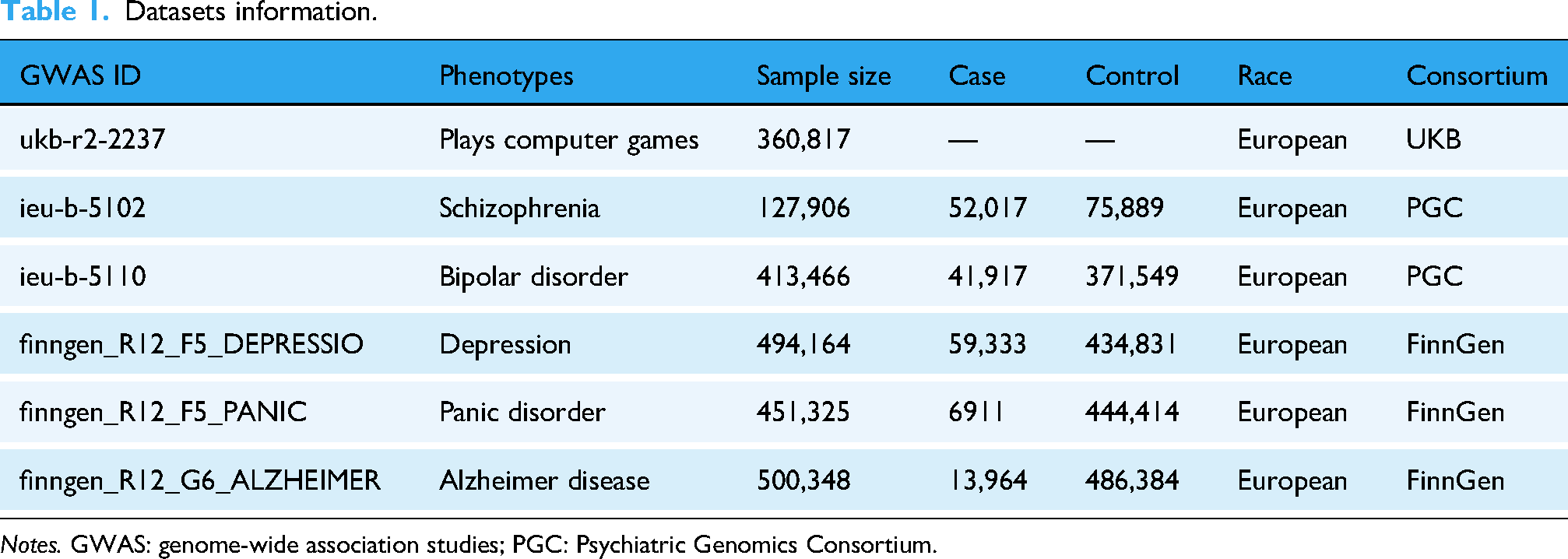
Notes. GWAS: genome-wide association studies; PGC: Psychiatric Genomics Consortium.
Selection of genetic instruments
In this study, two-sample MR analysis was used to assess the causality between computer game playing and several neuropsychiatric disorders, and the SNPs selected needed to satisfy the three main assumptions of MR, namely that SNPs are strongly associated with exposure factors (association assumption), SNPs can only be associated with study outcomes through exposure factors in the study (exclusivity assumption), and SNPs are not associated with other confounders that may have an effect on the results of the analysis (independence assumption). 24 In the study, we screened SNPs through a series of steps. To begin with, to avoid potential bias from weak IVs on the analysis results, the p-value threshold was set to 5 × 10⁻⁸, the genetic distance was set to 10,000 Kb, and the linkage disequilibrium (LD)r2 was set to 0.001, ensuring that the pairwise (LD)r2 is less than 0.001 within 10,000 kb, to obtain IVs with higher independence and free from interference by confounding factors. Besides, to ensure the statistical strength of the SNPs, the F-statistic of each SNP was calculated, and SNPs with an F-value<10 were considered weak IVs and were processed for exclusion. 25 Finally, the compliant SNPs were synergistically processed so that the SNP alleles referring to exposure and outcome were in the same direction, SNPs that could not determine the direction were excluded, and the SNP data were merged for subsequent MR analysis.
Statistical analysis
We used a bidirectional two-sample MR analysis approach to explore the causal association between computer game playing and several neuropsychiatric disorders, with inverse variance weighted (IVW) as the assessment analysis method. Related studies have concluded that under certain conditions, the IVW method is more robust than the conclusions drawn by other methods. 26 IVW is a preferred MR analysis method for effective assessment of causality when the SNPs selected for the study are valid for all genetic variants by sensitivity analysis. 27 It has also been argued that IVW is the most effective MR analysis method with the greatest statistical validity. 28 In order to assess the robustness of the results of the MR analyses and to identify factors that may affect the results, we also conducted a sensitivity analysis of the study. Sensitivity analyses were conducted through heterogeneity tests and pleiotropy tests. In MR analysis, the Cochran Q test is a heterogeneity test that is used to test whether the causal effect estimates of different IVs are similar and to assess the extent of this heterogeneity. 29 The pleiotropy in SNPs is detected by the MR-Egger intercept analysis, if the IVs do not show pleiotropy, it means that the IVs only affect the outcome through the exposure effect. In this case, there is no need to re-select the IVs, indicating that the MR analysis results are reliable and robust. Additionally, the leave-one-out method was used to assess the influence of each IV on the overall results. By excluding each IV one by one and recalculating the causal effect estimates for the remaining IVs, we can determine if any individual IV significantly impacts the stability of the results in MR analysis. Power estimation was also performed in the study. The statistical power in MR analyses is governed by three principal parameters: the allele frequency of examined genetic variants, the effect size of these variants on target exposures, and the participant cohort size.30,31
Results
Instrumental variables selection
Through a series of steps of screening and selection, 20 SNPs were retained in the group used to assess the causal association between computer game playing and SCZ, and 146 SNPs were retained in the opposite direction. The group used to assess the causal association of playing computer games with BP ended up incorporating 19 eligible SNPs, with 44 SNPs retained in the opposite direction. To investigate the relationship between playing computer games and depression, 21 SNPs were utilized as instrumental variables, additionally, 32 SNPs were considered in the opposite direction. Similarly, the investigation into the connection between computer game playing and PD involved 21 SNPs for further analysis, with no eligible SNPs found in the opposite direction. 21 SNPs were used to assess the causal association between playing computer games and AD, with an additional 21 SNPs in the opposite direction. The process of directional synergistic processing of SNP alleles resulted in the elimination of several palindromic structure SNPs with moderate allele frequencies, as indicated in Table 2.
Palindromic structure SNPs.
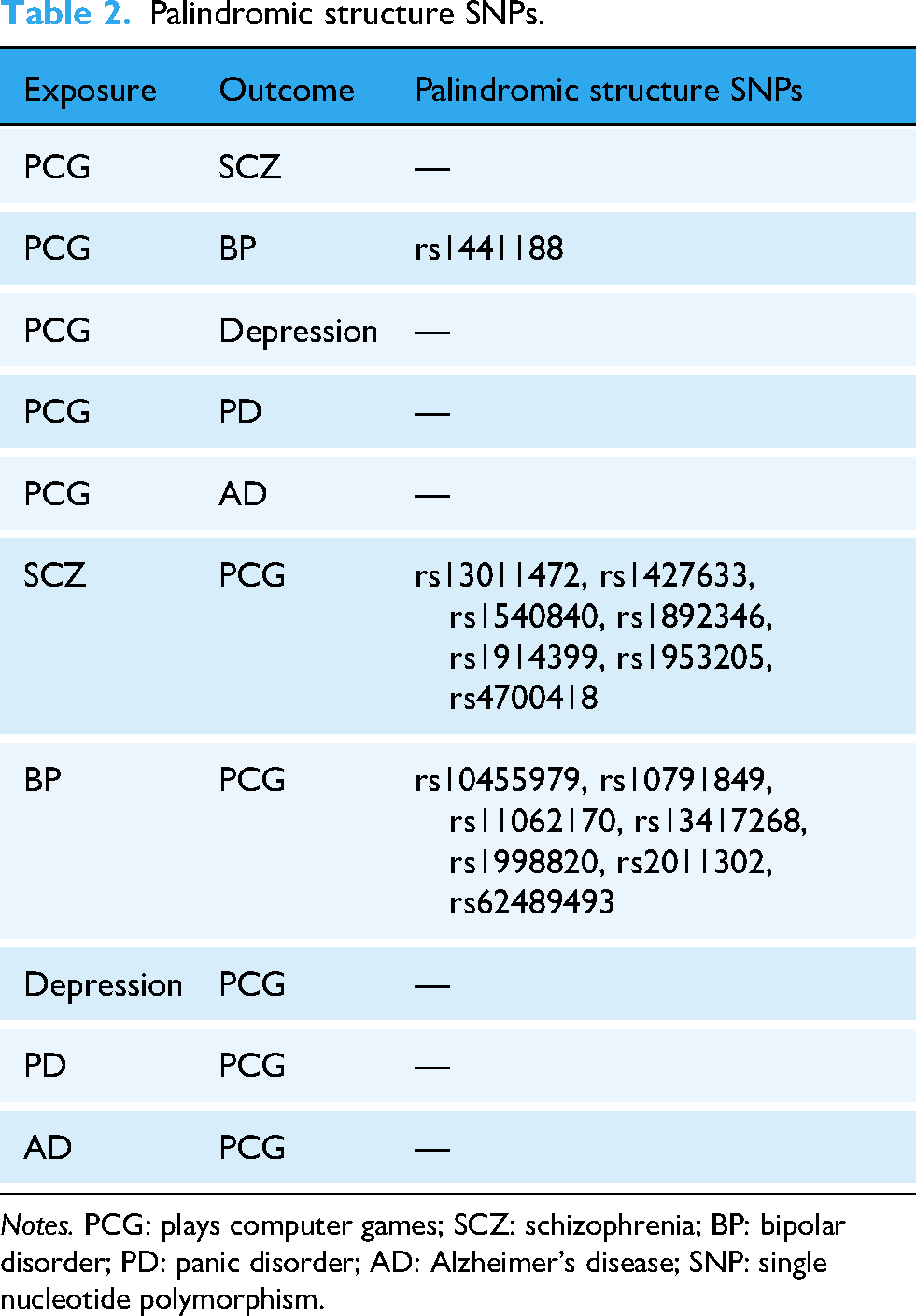
Notes. PCG: plays computer games; SCZ: schizophrenia; BP: bipolar disorder; PD: panic disorder; AD: Alzheimer's disease; SNP: single nucleotide polymorphism.
Bidirectional MR analyses of computer game playing and schizophrenia
For the data on playing computer games and SCZ, the results of the IVW method showed that the behavior of playing computer games significantly reduces the risk of developing SCZ (IVW: odds ratio [OR] = 0.066, 95% confidence interval [CI]: 0.013–0.327, p = 8.885 × 10⁻⁴). In an analysis in the opposite direction, the results indicated that having SCZ reduced the act of playing computer games (IVW: OR = 0.985, 95% CI: 0.979–0.990, p = 4.381 × 10⁻⁸). Weighted median method also provides evidence for a correlation between the above two. We adopted forest plot to showcase the analyzed results and detailed data of MR (Figure 2). The visualization of the results was also done through scatter plots (Figure 3).

Forest plot of the causality between computer game playing on schizophrenia, bipolar disorder, depression, panic disorder, and Alzheimer's disease. Notes. SNP: single nucleotide polymorphism; OR: odds ratio; CI: confidence interval.

Scatter plots of the causality between computer game playing on schizophrenia, bipolar disorder, depression, panic disorder, and Alzheimer's disease. (A) MR estimates for plays computer games on schizophrenia. (B) MR estimates for plays computer games on bipolar disorder. (C) MR estimates for plays computer games on depression. (D) MR estimates for plays computer games on panic disorder. (E) MR estimates for plays computer games on Alzheimer disease. Notes. MR: Mendelian randomization.
Bidirectional MR analyses of computer game playing and bipolar disorder
MR analysis of data on playing computer games and BP showed that the behavior of playing computer games reduced the risk of developing BP to a large extent (IVW: OR = 0.213, 95% CI: 0.053–0.850, p = 0.029). In an analysis in the opposite direction, having BP also reduced the behavior of playing computer games (IVW: OR = 0.989, 95% CI: 0.979–0.999, p = 0.040). Weighted median method also provides evidence for this association. We adopted forest plot to showcase the analyzed results and detailed data of MR (Figure 2). The visualization of the results was also done through scatter plots (Figure 3).
Bidirectional MR analyses of computer game playing and depression
Correlation analysis of data on playing computer games and depression. The results of our analyses show that playing computer games reduces the risk of depression (IVW: OR = 0.565, 95% CI: 0.323–0.989, p = 0.046), whereas in analyses in the opposite direction, there was no causal effect of depression on playing computer games. We adopted forest plot to showcase the analyzed results and detailed data of MR (Figure 2). The visualization of the results was also done through scatter plots (Figure 3).
Bidirectional MR analyses of computer game playing and panic disorder
MR analysis of SNPs for playing computer games and PD showed that the behavior of playing computer games reduced the risk of developing PD to a great extent (IVW: OR = 0.234, 95% CI: 0.078–0.700, p = 0.009). In the opposite direction, the analysis was not done because no eligible SNPs were present. We adopted forest plot to showcase the analyzed results and detailed data of MR (Figure 2). The visualization of the results was also done through scatter plots (Figure 3).
Bidirectional MR analyses of computer game playing and Alzheimer disease
MR analyses of the IVs of playing computer games and AD showed that the behavior of playing computer games reduces the risk of developing AD to a large extent (IVW: OR = 0.323, 95% CI: 0.132–0.786, p = 0.013). Weighted median method is also consistent with IVW. In an analysis in the opposite direction, we found no causal effect of having AD on the behavior of playing computer games. We adopted forest plot to showcase the analyzed results and detailed data of MR (Figure 2). The visualization of the results was also done through scatter plots (Figure 3).
Sensitivity analysis and power calculation
The results of the Cochran Q test showed heterogeneity in the analyses of playing computer games with SCZ, BP, and depression, while there was no heterogeneity in the analyses of playing computer games with PD and AD (Supplementary Figure 1). However, the results of the MR-Egger intercept analysis showed that there was no pleiotropy in all five groups and that the IVs do not bias the causality estimates of the MR analysis method. 32 Therefore, the MR analyses we performed were not affected by factors other than exposure factors, and the results of the analyses were stable and reliable. The results of the analysis of MR-Egger intercept are shown in Table 3. Immediately after that, we applied the leave-one-out method to assess the effect of each SNP on the total causal effect and visualize the pleiotropy (Supplementary Figure 2), and the results of the analysis showed that the SNPs would not have an effect on the overall analysis results, so the IVs used in the study would not interfere with the overall analysis results. The estimations of statistical power are shown in Supplementary Table 1.
MR-Egger intercept analysis.

Notes. PCG: plays computer games. MR: Mendelian randomization; SCZ: schizophrenia; BP: bipolar disorder; PD; panic disorder, AD: Alzheimer's disease.
Discussion
This study used large-scale GWAS summary statistics related to computer game playing, SCZ, BP, depression, PD, and AD. By employing multiple stringent criteria to select SNPs, it ensured that all SNPs used in the analysis met the study's requirements. IVW was used as an analytical method to perform the bidirectional two-sample MR analysis of the data to assess the causal association between playing computer games and neuropsychiatric disorders. The results of IVW showed bidirectional causal associations of computer game playing for SCZ and BP, and unidirectional causal associations of computer game playing for depression, PD, and AD. The MR analysis results have been validated through sensitivity testing methods, including MR-Egger intercept analysis and the leave-one-out approach. These tests confirm that the instrumental variables chosen for the study do not introduce bias into the estimation of causal relationships. As a result, the obtained results are deemed robust and reliable.
The most recent randomized controlled trial study indicates that following gaming training, individuals with SCZ demonstrated a notable enhancement in their ability to focus attention on threatening scenarios. 33 Additionally, video games have been shown to contribute to the improvement of cognitive function.33,34 Furthermore, online games have the potential to decrease psychological distress in individuals with SCZ and alleviate the impact of external stressors on their mental well-being. 35 Active video gaming intervention significantly improves overall neurocognitive functioning in people with SCZ, specifically increasing information processing speed, sustained attention, working memory, and visual learning. 36 Epidemiological survey has shown that mental disorders characterized by comorbidities of anxiety, such as SCZ, BP, and PD, generally adopt outpatient management model, and there are insufficient attention and attention at the clinical level, which may cause huge healthcare costs and heavy disease burden. 37 Healthcare workers can use computer games as an intervention medium to enhance treatment adherence in psychiatric patients through customized digital therapy programs, assist with stress management strategies, and provide systematic social skills training modules to promote functional recovery. 38 Action-based games significantly increased gray matter volume in the right parietal cortex, which is closely associated with visuospatial processing and allocation of attentional resources, and strategy-based games had a specific enhancement effect on the strength of functional connectivity in the dorsolateral prefrontal cortex. 39 This neural remodeling may form a potential protective mechanism against cognitive decline in neuropsychiatric disorders by optimizing working memory capacity and cognitive flexibility. Neuroimaging studies further revealed that computer gaming behavior interacts deeply with the brain reward system, and the functional connectivity strength of the dopaminergic circuits in the ventral striatum-prefrontal cortex involved in its neural mechanisms is significantly enhanced. Game-related cues specifically activate memory encoding nodes in the limbic system, including structural plasticity remodeling in the hippocampus, optimization of situational memory extraction efficiency in the parahippocampal gyrus, and reinforcement of emotionally potent encoding in the amygdala, leading to induced neuroadaptive alterations and enhanced cognitive functions. 40 In summary, computer gaming behaviors have an impact on a variety of brain functions that may influence behavioral changes and cognitive performance by inducing neuroplasticity changes in specific brain regions, ultimately moderating the risk of neuropsychiatric disorders.
Elevated perceived stress may have an impact on the development of potential mental disorders such as Internet gaming disorder. 41 Impaired emotion regulation and neurotransmitter abnormalities prevalent in patients with psychiatric disorders such as SCZ and BP may theoretically create a high-risk environment for triggering Internet gaming disorder through a pathway that enhances the sensitivity of the stress perception system. In the current study, however, the frequency of gaming behaviors was decreased in patients with psychiatric disorders, a phenomenon that may stem from the bidirectional regulatory effects of the body's neurobiological protective mechanisms. When chronic stress triggered by psychopathological states reaches a critical threshold, the prefrontal-limbic system reduces the expectation of reward from gaming behaviors by downregulating striatal dopamine D2 receptor expression. 42 Whole-cortex intracortical myelin was associated with verbal memory function in BP, and the entire cortical network was associated with verbal memory function, with particularly strong effects in the left dorsolateral prefrontal cortex. 43 Patients with BP have impaired verbal memory functioning, which may cause patients to experience a linear decrease in computer games and thus play games relatively less frequently. In addition, the study mentions that auditory cortical plasticity-driven training of the brain may improve cognitive functioning in SCZ. 44 The auditory cortex of the brain is somewhat affected in SCZ, which may cause patients to have a much higher rate of auditory sound localization error and not receive positive feedback in games, which in turn leads to a reduction in computer game playing behavior. Meanwhile, epigenetic modification of glucocorticoid receptors in the hippocampus may diminish stress-driven gaming craving in patients, and overactivation of the amygdala may lead to the generalization of negative emotions, a pathological defense mechanism that may reduce the frequency of gaming exposure in patients. 45
Systematic review has presented evidence that video games can effectively alleviate the clinical symptoms of depression by synthesizing and analyzing previous studies. 46 Additionally, meta-analysis has indicated that virtual reality exercise games may have a potentially positive impact on an older population with depressive mood. 47 In our study, we conducted an in-depth analysis to find a causal association between playing computer games and depression. Playing computer games may be used in the future not only to alleviate depressive symptoms in clinical treatment, but also to prevent depression. It has been suggested that the effect estimates were considered significant only when PIVW <0.05, and both MR Egger and Weighted median method have consistent β directions. 48 MR analyses of depression outcome in this study showed that the robustness of the core results was confirmed by systematic sensitivity analyses, despite the fact that the MR Egger method presented effect estimates in the opposite direction of the IVW method. The MR-Egger intercept analysis did not detect statistical evidence of the presence of pleiotropy, and leave-one-out method also indicated that causal associations were not overly influenced by individual SNPs. It is worth noting that the IVW method showed statistically significant associations with the exclusion of multivalence interference, whereas the non-significance of the MR Egger estimates may stem from the loss of statistical efficacy that accompanies its correction for multivalence bias. Taken together, this convergent evidence of multi-methodological validation, combined with a rigorous multi-effectiveness analysis, collectively supports the reliability of causal inference in the IVW framework. In order to obtain more reliable conclusions, future studies need to be further analyzed and experimentally validated to refine the explanation of the relevant biological mechanisms and to apply them in clinical practice.
In the field of research on AD and other neurodegenerative disorders, serious games are being used to assess and improve various patient functions and cognitive abilities. These games also offer innovative solutions for patient treatment, cognitive stimulation, and rehabilitation. 49 It has been suggested in a current study that computer gaming can improve cognitive function and prevent dementia. 50 A recent MR study found that playing computer games may have a protective effect on cognitive function. However, the study concluded that there is no direct causal link between playing computer games and the development of AD. 51 We note that the AD data used in this study originated in 2022, whereas we applied the most recent R12 version of the GWAS summary statistics released by FinnGen in 2024 in our study, which may be one of the factors contributing to the discrepancy in the study results. In addition, issues such as sample overlap between exposures and outcomes may also lead to differences in results. As more GWAS studies continue to emerge, new genetic variants will be found to be associated with specific diseases or traits. The use of these updated data can provide more precise information about genetic variants, which in turn can enhance the accuracy and reliability of MR analysis results.
This study has several strengths in terms of data selection, research design and analysis. Primarily, this study used large-scale GWAS summary statistics, which are derived from multiple independent large-scale cohort studies and cover a wide range of genetic variation information associated with multiple traits and diseases. With this data, we are able to analyze the associations between behaviors and diseases in genetics more comprehensively and delve deeply into potential causal relationships. Furthermore, the exposure and outcome data selected for this study were derived from GWAS summary statistics from various studies and consortiums, which effectively avoiding bias that may be caused by overlapping samples. In this study, MR was used to analyze the causal relationship between computer game playing and neuropsychiatric disorders in third place. Genetic variation was employed to explore the causal effects of IV on outcomes through exposure factors. The advantage of this approach is that alleles are randomly assigned during gamete formation, effectively avoiding the possible influence of confounding factors and reverse causal associations on the findings. This results in a more robust and reliable causal relationship. In addition, the summary data used by the institute is based on populations of European descent, which reduces the potential impact of ethnic and racial differences on the analysis results. Finally, through sensitivity analyses, we tested for the absence of pleiotropy in the IVs used for the analyses, ensuring that the results were statistically robust.
There are limitations to this study. Initially, the genetic data used were mainly from European populations. While racial differences are unlikely to bias the results, it is uncertain if the findings can be applied to other ethnic groups worldwide. Additionally, the GWAS summary data used in the study did not provide detailed information on specific individuals, which means that many of the associations identified in the GWAS analyses may be difficult to directly interpret as biological mechanisms or apply in clinical practice. Therefore, future studies need to conduct more in-depth analyses and experimental validation to refine these findings. Moreover, action-based games have been shown to enhance the brain's control of attention and improve response inhibition by enhancing prefrontal-striatal circuit function. 52 Exergame enhances verbal memory and aerobic endurance, and improves lower limb strength and balance. 53 In our study, limited by the available GWAS summary statistics, it was not possible to conduct an in-depth analysis from the perspective of the differential effects of different types of computer games, such as action, strategy, and role-playing games, on neuropsychiatric disorders. The current results should be viewed as preliminary evidence of a holistic association, providing new perspectives on the prevention of neuropsychiatric disorders, rather than a causal inference between specific game genres and neuropsychiatric disorders. Moving forward, it is important to investigate the connection between various types of computer games and neuropsychiatric disorders more thoroughly. Additionally, the research findings should be utilized in various ways to improve disease prevention and clinical practice.
Conclusion
This finding indicates the causal associations between playing computer games and five neuropsychiatric disorders, namely SCZ, BP, depression, PD, and AD, providing new perspectives and references for the prevention of neuropsychiatric disorders.
Supplemental Material
sj-jpg-1-dhj-10.1177_20552076251339263 - Supplemental material for Assessment of causality between computer game playing and neuropsychiatric disorders: A bidirectional Mendelian randomization study
Supplemental material, sj-jpg-1-dhj-10.1177_20552076251339263 for Assessment of causality between computer game playing and neuropsychiatric disorders: A bidirectional Mendelian randomization study by Kangming Huo, Yinping Liu and Zhongwen Zhang in DIGITAL HEALTH
Supplemental Material
sj-jpg-2-dhj-10.1177_20552076251339263 - Supplemental material for Assessment of causality between computer game playing and neuropsychiatric disorders: A bidirectional Mendelian randomization study
Supplemental material, sj-jpg-2-dhj-10.1177_20552076251339263 for Assessment of causality between computer game playing and neuropsychiatric disorders: A bidirectional Mendelian randomization study by Kangming Huo, Yinping Liu and Zhongwen Zhang in DIGITAL HEALTH
Supplemental Material
sj-docx-3-dhj-10.1177_20552076251339263 - Supplemental material for Assessment of causality between computer game playing and neuropsychiatric disorders: A bidirectional Mendelian randomization study
Supplemental material, sj-docx-3-dhj-10.1177_20552076251339263 for Assessment of causality between computer game playing and neuropsychiatric disorders: A bidirectional Mendelian randomization study by Kangming Huo, Yinping Liu and Zhongwen Zhang in DIGITAL HEALTH
Footnotes
Acknowledgements
Thanks to all the participants in our study. We appreciate all the researchers who shared these data.

Ethical considerations
Each of the GWAS utilized in this study received ethical approval from their respective institutional review boards. Therefore, no additional ethical approval was required.
Author contributions
KH identified the research topic and conducted the research design, contributed to data analysis and interpretation, as well as drafted the manuscript. YL was responsible for data visualization. ZZ serves as the guarantor of this work, he had full access to all data in the study and takes responsibility for the integrity of the data as well as the accuracy of the data analysis. All authors participated in the revisions and approved the final version of the manuscript.
Funding
The authors disclosed receipt of the following financial support for the research, authorship, and/or publication of this article: This study was funded by the Young Backbone Teacher Training Program Project of Binzhou Medical University, the Key Project of Applied Research Topics in Statistical Science of Shandong Province (No: 2023TJZD005), and the National Natural Science Foundation of China (No: 82473732).
Declaration of conflicting interests
The authors declared no potential conflicts of interest with respect to the research, authorship, and/or publication of this article.
Data availability statement
All GWAS summary statistics covered in this study are publicly available for download by eligible researchers.
Guarantor
ZZ is the guarantor who has taken full responsibility for this article, including the accuracy and appropriateness of the reference list.
Supplemental material
Supplemental material for this article is available online.
References
Supplementary Material
Please find the following supplemental material available below.
For Open Access articles published under a Creative Commons License, all supplemental material carries the same license as the article it is associated with.
For non-Open Access articles published, all supplemental material carries a non-exclusive license, and permission requests for re-use of supplemental material or any part of supplemental material shall be sent directly to the copyright owner as specified in the copyright notice associated with the article.


