



Abstract
Objective
Immunocompromised individuals, particularly HIV patients, worldwide are at risk from cryptococcal infection. There are a number of videos of cryptococcal infection and more and more individuals may search these videos, but the quality of videos on YouTube is unclear. This study set out to assess the content and quality of YouTube videos regarding cryptococcal infection.
Methods
The keywords “Cryptococcus,” “Cryptococcosis” and “Cryptococcal infection” were searched on YouTube. The videos were evaluated and graded by two impartial raters. A 14-point content score was used to categorize videos as bad, good or exceptional. The reliability and quality were evaluated utilizing the DISCERN instrument and a 5-point global quality score. Videos were then divided into groups based on uploading sources and content types.
Results
A total of 46 videos were located, and the ratings provided by the two raters were identical. Our scoring algorithm determined that 54.3% (n = 25), 32.6% (n = 15) and 13.0% (n = 6) of the videos were poor, decent and exceptional, respectively. Regarding quality, no difference was identified between the various video categories. The global quality scale, number of views, days posted, content score and DISCERN showed a significant positive relationship.
Conclusions
Professional individuals or healthcare organizations should be encouraged to submit high-quality videos for the expanding internet population, as only a small proportion of available videos had exceptional quality.
Introduction
Cryptococcal infection is primarily caused by opportunistic invasive attacks from Cryptococcus neoformans or Cryptococcus gattii. The clinical manifestations of cryptococcal infection are diverse, with a focus on pneumonia or meningitis. Cryptococcal meningitis, in particular, is a severe condition, with a mortality rate ranging from 41% to 61%. Most patients with cryptococcal meningitis have compromised immune systems, with HIV infection being a major risk factor. Other contributing factors include iatrogenic immunosuppression, autoimmune diseases and decompensated cirrhosis.1,2 Cryptococcal infection poses a persistent threat to public health due to its substantial global burden and mortality rates.3,4 However, novel screening and preemptive treatment strategies hold the potential to alter this scenario significantly. Learning about cryptococcal infections-associated in formation including introduction, epidemiology, risk factor, symptoms, the susceptible person, treatment and prevention can help patient to prevent death by cryptococcal infection better. These detailed informations will give patient a better understanding of the risks and the actual impact of cryptococcal infection.
In recent years, the development of mobile internet technology has provided a new avenue for the dissemination and exchange of health information. Approximately 80% of the population engages in searching for health-related information on the Internet. 5 YouTube, the most widely used video-sharing website in the world, has over 1.9 billion monthly visitors and established itself as a free resource for a variety of information. 6 An increasing number of health-related short videos have been uploaded on YouTube, but the video quality of different health-related information on YouTube varies greatly. The information quality of these videos varied depending on the sources. 7 While there are several benefits in obtaining health knowledge through social media platforms, videos can be uploaded by anyone for free, resulting in varying and uneven video quality. 8 Low-quality videos, outdated or containing wrong information, can mislead the public potentially affecting public uptake of health and disease management. 9 Therefore, there is a need for a continuous critical assessment of the quality of YouTube health-related videos.
To the best of our knowledge, no prior study has assessed the quality of YouTube videos regarding cryptococcal infection. Therefore, the purpose of this study was to determine whether YouTube serves as a good source for individuals to gain knowledge pertaining to cryptococcal infection by assessing the content and quality of videos regarding this infection on YouTube.
Methods
Search strategy
On 30 May 2023, YouTube's (www.YouTube.comdefault) “relevance” search settings were used to systematically search for videos about cryptococcal infection using the keywords “Cryptococcus,” “Cryptococcosis” and “Cryptococcal infection.” Users are unlikely to exceed the first five pages of search results; hence, the first 100 videos (20 videos/page, first 5 pages) of each search result were screened. 10 Each video was added to the YouTube library of this study for further review and sharing with other researchers. All adverts in the search results or those in the video's introduction or midway were skipped over. Each video was assessed by a separate researcher in accordance with the inclusion or exclusion criteria. Since the study involved viewing freely available online videos, ethical committee approval was not necessary.
Criteria for inclusion and exclusion
The videos were eligible for inclusion if they were (a) in English and (b) linked to cryptococcal infection in content. The videos were excluded if they were: (a) pointless videos, (b) ads, (c) not in English, (d) duplicate videos or (e) lacked sound.
Video categories and characteristics
Using the Google Chrome plugin “vidIQ Vision for YouTube,” specific details about the videos were extracted. Title, length of video, number of views, number of comments, number of likes, number of dislikes and date of upload were among the obtained information.
Videos were divided into the following categories based on the style displayed in each video: (a) educational video, (b) news story, (c) personal account and (d) interview. Videos were additionally divided into five groups based on the uploaded sources: (a) news organizations, (b) professional associations, (c) individuals, (d) professionals and (e) websites devoted to health.
Furthermore, the likability (defined as likes divided by posted days), viewing rate (defined as views divided by posted days), percentage positivity (defined as the number of likes divided by the total number of likes and dislikes of that video) and viewer interactions (defined as the number of likes minus the number of dislikes divided by the total number of views of that video) were calculated.
Scoring system
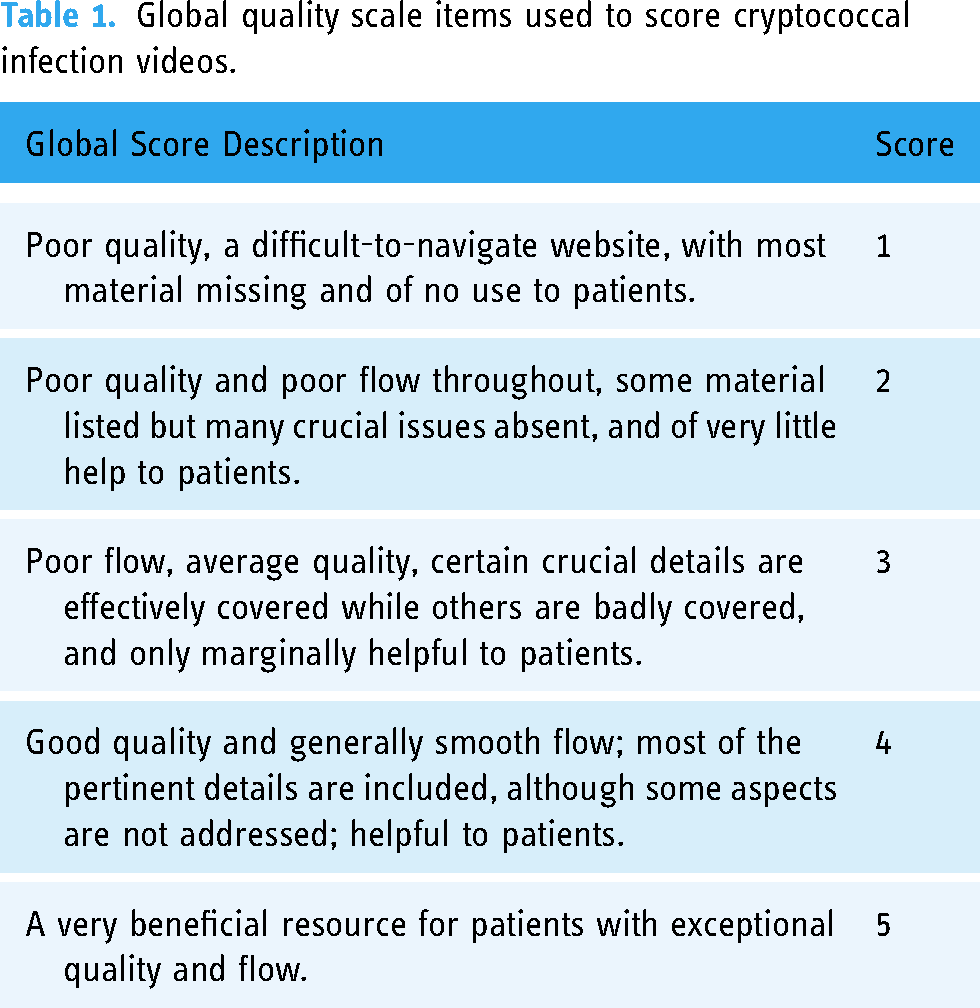
Each video's quality was evaluated using the global quality scale (GQS), which is a five-point Likert scale (Table 1). 11 Seven sections of the videos—epidemiology, diagnosis, susceptible population, risk factors, clinical signs, therapy and prevention of cryptococcal meningitis—were evaluated. The video received zero points (not mentioned), one point (briefly introduced) and two points (introduced in depth) in accordance with the details of each item. 12 The total score was out of 14, with 0–4 points denoting videos with poor content, 5–10 points denoting good material and 11–14 points denoting great content. The trustworthiness of YouTube videos was evaluated using the DISCERN instrument, as shown in Table 2. 13 Each of the five questions on this five-point scale was either answered “yes” or “no.” For a total of five points, each “yes” was worth one point.
Global quality scale items used to score cryptococcal infection videos.
Assessing cryptococcal infection videos’ information reliability.
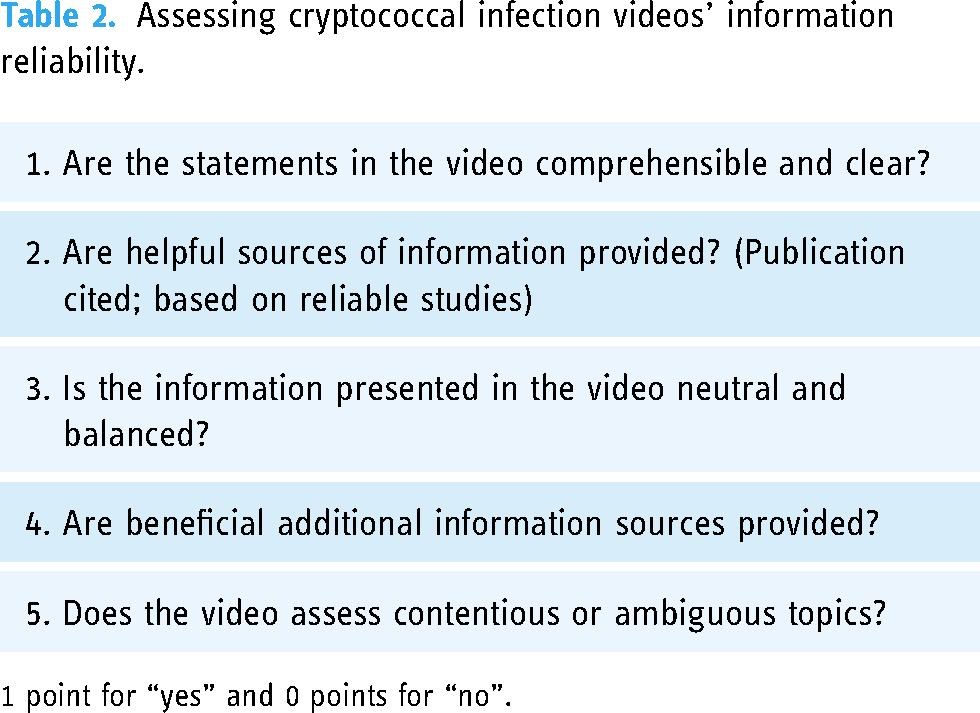
1 point for “yes” and 0 points for “no”.
Two independent researchers (Dongli Lu and Jianping Xia) evaluated the videos for eligibility before rating them using the updated YouTube library. All viewers were blinded to each other’s result. Disagreements (differ by three or more points) between viewers regarding the content scores or GQS scores were resolved by an arbitrator (Kun Chen) who gave the final scores. In addition to the scores given by the arbitrator, the scores given by the two viewers were averaged for the final results and statistical analysis.
Dongli Lu and Jianping Xia are anti-infective clinical pharmacists with an interest in cryptococcal infection. Kun Chen is a respiratory clinician with rich experience in the clinical diagnosis and treatment of microbial infections. They were trained before assessing the quality of videos and did not discuss any detail during the assessment process.
Statistical analysis
SPSS 26.0 statistical software (Armonk, NY: IBM Corp.) was used for the statistical analysis. Calculating Cohen's kappa coefficient (κ) for the raters’ scores allowed us to determine how well they agreed upon the ratings. Additionally, the degree of agreement between the two raters was evaluated using the interclass correlation coefficient (ICC). The data's normality was examined using the Kolmogorov–Smirnov test. The Kruskal–Wallis (two-tailed) test was used to compare the data. The potential relationships between the GQS, content and DISCERN scores were examined using Pearson correlation coefficients. Statistical significance was defined as a two-tailed p-value of 0.05.
Results
The first five pages (100 videos) of each search result were reviewed using the keywords “Cryptococcus,” “Cryptococcosis” and “Cryptococcal illness.” A total of 46 videos were included for evaluation in this study after the inclusion and exclusion criteria were applied. Figure 1 depicts the flow diagram of the video selection process. The videos ranged in length from 0.75 to 59.6 min, with 10.4 min being the average length. The videos lasted 478.8 min in total. Between 7 and 12,873 total video views were recorded. Videos were uploaded from 16 May 2007 to 18 May 2023. Of the 46 videos assessed, 54.3% (n = 25) were deemed to have poor content, 32.6% (n = 15) had decent material and 13.0% (n = 6) had great content. The ratings provided by the two raters were identical. The ICC was 0.950, and Cohen's kappa coefficient (κ) was 0.615.

Details of videos included in the study.
The length between the exceptional-, good- and poor-content groups was significantly different, as indicated in Table 3 (p = 0.028); however, there were no other significant characteristic differences. Most films covered the clinical signs and epidemiology of cryptococcal infection; however, only the best ones touched on the danger signs and ways to avoid it. The quality of the video content did not significantly differ across the various categories of video source or style.
Comparison of the characteristics between videos with poor, good and exceptional content.
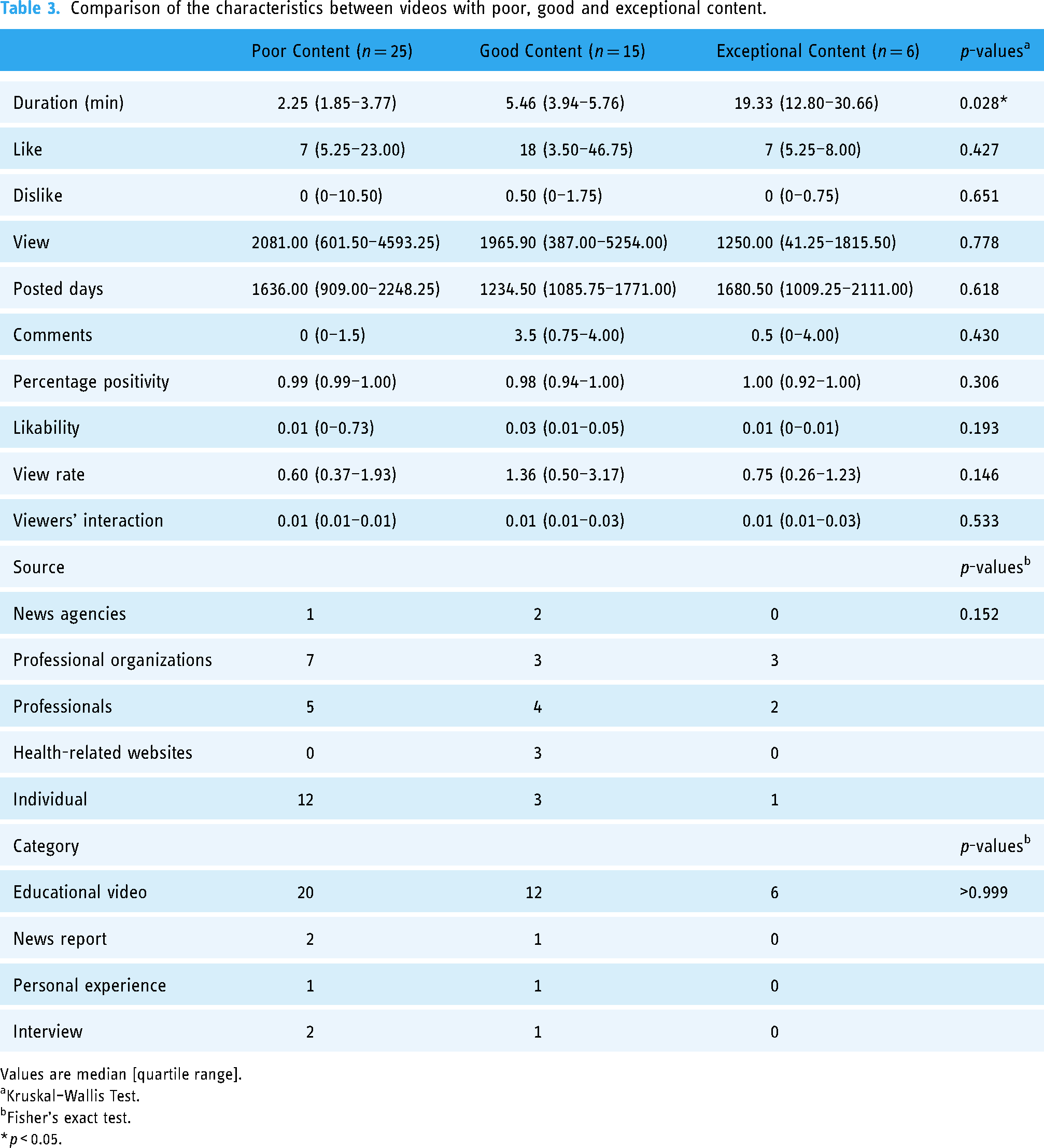
Values are median [quartile range].
Kruskal–Wallis Test.
Fisher's exact test.
*p < 0.05.
As shown in Table 4, “Educational video” (n = 35, 76.1%) received the most submissions, followed by “News report” (n = 5, 10.8%), “Personal experience” (n = 5, 10.8%) and “Interview” (n = 1, 2.2%). There were no statistically significant differences in duration, likes, dislikes, posted days, comments, % positivity, likability, views, view rate and viewer interaction among various video categories when the characteristics were compared by category.
Comparison of characteristics of videos according to category (median [quartile range]).

Values are median [quartile range].
Kruskal–Wallis Test.
*p < 0.05.
As shown in Table 5, the association between GQS and the number of views (r = 0.301, p < 0.05), posted days (r = 0.469, p < 0.01), content score (r = 0.927, p < 0.01) and DISCERN (r = 0.495, p < 0.05) was significant and positive. In this study, it was discovered that the content score had a significant positive relationship with both posted days and DISCERN (r = 0.404, p < 0.01). Additionally, DISCERN and posted days showed a strong positive relationship (r = 0.419, p < 0.01).
Correlations between quantitative variables and scores.

GQS: global quality scale.
*p < 0.05; **p < 0.01.
Discussion
To the best of our knowledge, this is the first investigation on the information found in YouTube videos regarding cryptococcal infection. The study's findings showed that most of the assessed videos lacked relevant information and were of poor quality. Most notably, this study found that less than half of the videos listed risk factors or strategies for preventing cryptococcal meningitis, such as early detection of cryptococcal antigenemia in HIV-infected patients and preventive fluconazole therapy in the absence of cryptococcal meningitis. Risk factors included cell-mediated immune deficiency, underlying lymphoid hematological malignancies and prolonged steroid therapy. 14 These details are quite valuable as references for fragile patients. Many previous studies have found that the quality of health-related videos on YouTube is generally high, providing viewers with valuable information. This has positioned YouTube as the reliable resources of information on various health topics, such as Candida auris infection, 12 obstructive sleep apnea 15 and surgical preparation. 16 However, the content of videos related to Cryptococcal infection is not up to par, making YouTube not the best source for information on Cryptococcal infection.
The findings showed that the videos with exceptional content had the longest video duration among the three groups (p < 0.05). This might be due to videos with outstanding content typically having longer discussions or more content overall. However, no significant differences in other video characteristics were identified between the poor-, good- and exceptional-content videos, suggesting that viewers may find it challenging to choose high-quality videos based on characteristic data provided on YouTube. This finding corresponded with the results of the earlier study. 17 This study discovered that videos with outstanding content had the longest durations but the fewest views. Several earlier studies discovered that viewers lacked the patience to view a video for longer than 10 min.18,19
Therefore, deciding on the right length of videos could be crucial for distributing health information on YouTube. Additionally, this study's findings indicated that educational video views were often low. The viewers of educational videos could find them to be dull since they are overly formal. According to a recent study, “entertainment” videos were more popular than other styles of videos, 20 which suggests that employing understandable language in educational videos may draw viewers’ attention. Additionally, no discernible disparities in the video content's quality were discovered across the various categories of video source or style. According to this finding, consumers find it challenging to select high-quality videos from a variety of sources or video styles.
This study identified a strong positive link between GQS and the number of views, the number of days that content was posted, the content score and DISCERN. Similar to this study's findings, Ayhan Askin's YouTube analysis of transcranial magnetic stimulation found a favorable connection between GQS and content. 21 The high quantity of useful elements and information flow in videos may raise the quality and content scores, which explains the association between the GQS and content score. In his YouTube evaluations of orthodontic clear aligners, Gokay Ustdal also noted a favorable link between GQS and DISCERN. 22 This might be because patients found more value in videos with credible sources and fair information.
Our study has several limitations. First, it is a cross-sectional study, and the results are limited by the search time and method; the analyzed outcomes only represent the quality of video information during the search period. Second, with numerous video platforms available, our data only originates from one, and future research could assess video quality across different social platforms. Third, in this study, only English-language videos were analyzed, and languages prevalent in regions with a high incidence of Cryptococcal infection, such as Chinese, were not included. We recommend further research to encompass videos in other languages.
Conclusions
In conclusion, YouTube has a lot of information available on cryptococcal infection, making it a potential resource for internet users. Given that more than half of the films were of low quality, it is proposed that thorough and dependable videos on cryptococcal infection should be made available online in the future to satisfy the growing demand of internet users. Therefore, it is important to encourage medical experts to post more exceptional YouTube videos.
Footnotes
Acknowledgments
None.
Contributorship
Conception and design by HQ. Administrative support by ZJ and ZF. Provision of study materials or patients by KL. Collection and assembly of data by DL and KC. Data analysis and interpretation by JX and ZW. Manuscript writing by all authors. All authors read and approved the final manuscript.
Declaration of conflicting interests
The authors declared no potential conflicts of interest with respect to the research, authorship, and/or publication of this article.
Ethical approval
The study was designed as a cross-sectional study. Since the study did not include any human participants or animals and the videos were available to everyone, ethics committee approval was not required.
Funding
The authors disclosed receipt of the following financial support for the research, authorship, and/or publication of this article: HQ is supported by the Joint Funds for the Innovation of Science and Technology, Fujian Province (Grant No. 2019Y9051) and Guiding Project of Science and Technology, Fujian Province (Grant No. 2021Y0019). The funder had no role in the design of the study or collection, analysis and interpretation of data or in writing the manuscript.
Guarantor
HQ.
Informed consent
No patient is necessary as the research does not involve human subjects.
