



Abstract
Background
Cervical cancer remains a serious global threat to women's health, with rising incidence and younger demographic impact, challenging reproductive health. Short-video platforms have become key public sources for health information due to digital health communication advances, yet the scientific accuracy and reliability of their cervical cancer content are widely questioned. A systematic evaluation of its quality and dissemination patterns is lacking.
Objective
This cross-sectional study assessed cervical cancer-related videos on YouTube, TikTok, and Bilibili, examining content breadth, information quality, and dissemination impact.
Methods
Videos were systematically retrieved in July 2025 using “cervical cancer” keywords across the three platforms. After applying inclusion/exclusion criteria, 201 videos were analyzed. Quality, reliability, and educational value were evaluated using the Global Quality Score (GQS), modified DISCERN, Patient Education Materials Assessment Tool (PEMAT—assessing understandability and actionability), and Journal of the American Medical Association (JAMA) benchmark criteria. Platform differences were compared using the Kruskal–Wallis H test (significance p < 0.05).
Results
Platform differences emerged: YouTube videos demonstrated the highest quality (GQS mean 3.47 ± 1.06 vs. Bilibili 2.85 ± 0.89, TikTok 3.09 ± 0.75; p = 0.001) and significantly higher PEMAT understandability (76.94 ± 10.43 vs. TikTok 70.14 ± 11.07; p < 0.001). TikTok had the strongest dissemination power. Content coverage was inadequate: only 50.2% mentioned screening, 33.3% covered human papillomavirus vaccination, and a mere 8.0% recommended male vaccination. Creator expertise significantly influenced outcomes: Professionals (doctors/researchers) had higher JAMA authority scores and PEMAT actionability. Patient-created videos generated the highest interaction but scored lowest on quality metrics.
Conclusion
Cervical cancer information quality on short-video platforms is uneven. YouTube offers the highest overall quality, while TikTok achieves the widest reach but lacks content depth. Critical prevention information (e.g. male vaccination) has low coverage. Professional creators provide more reliable content but have limited reach. Platforms should enhance promotion of authoritative content and implement quality review mechanisms.
Keywords
Introduction
Among malignant tumors affecting women worldwide, cervical cancer ranks fourth in incidence, 1 with its disease burden particularly severe in developing countries. According to the latest report from the World Health Organization, there were 604,000 newly diagnosed cervical cancer cases globally in 2022, resulting in 342,000 deaths; notably, China accounted for 18.2% of the global new cases. 2 Data from the National Cancer Center indicate that the age-standardized incidence rate of cervical cancer in China has been steadily rising, with approximately 151,000 new cases annually and a mortality rate of 8.1 per 100,000 population. 3 Of particular concern is the marked increase in cervical cancer incidence among women under the age of 35 worldwide in recent years, 4 a trend closely associated with persistent infection by high-risk human papillomavirus (HPV). Among the numerous high-risk HPV genotypes, types 16 and 18 stand out for their global prevalence and high oncogenic potential, being responsible for approximately 70% of cervical cancer cases caused by persistent infection with these two strains. 5
Cervical cancer is one of the few malignancies where effective preventive measures can significantly reduce the risk of onset. The cornerstone of primary prevention is the HPV vaccination, which effectively prevents infections with high-risk HPV types. 6 The efficacy of the nine-valent HPV vaccine is particularly remarkable: studies have shown that vaccination reduces the risk of high-grade cervical precancerous lesions by 88%. 7 Secondary prevention relies on standardized screening, with a combination of cytology (TCT) and HPV DNA testing effectively reducing the risk of invasive cancer. 8 Increasing cervical cancer screening coverage can significantly lower its mortality rate. 9 However, research indicates that by 2023–2024, the coverage rate for at least one cervical cancer screening among adult women in China is still insufficient, standing at only 36.8%. 10
Short-video platforms like TikTok, Bilibili, and YouTube have become important channels for public health information dissemination due to their powerful health communication capabilities. Studies have shown that users generally rate YouTube's content quality positively, which could significantly impact their health outcomes. 11 These platforms enhance the accessibility and audience engagement of health information through visual content and narrative expressions (such as sharing patient experiences). However, the fragmented nature of content delivery often leads to insufficient depth, and algorithm-driven recommendation systems may amplify misleading information. 12 Analysis indicates that the spread of false information is significantly correlated with the increase of negative content about the cervical cancer vaccine on social media: in countries with moderate levels of exposure, the proportion of such posts observed a 15-percentage-point increase. 13
There is an urgent need for a systematic evaluation of content across multiple short-video platforms. Existing studies mainly focus on domestic platforms (such as TikTok or Kuaishou) and are limited to basic content analysis, 14 with a lack of cross-platform quality comparisons and clinical usability evaluations, both domestically and internationally.
This study conducts a cross-sectional analysis of cervical cancer-related short videos across Bilibili, TikTok, and YouTube. Through content feature analysis, quality rating, and dissemination effectiveness assessment, it aims to reveal both the strengths and weaknesses of current health information. The findings are intended to identify strengths and weaknesses in current health communication practices, thereby providing evidence-based strategies for optimizing public education on cervical cancer prevention.
Methods and materials
Data collection
This cross-sectional study was conducted in July 2025. Using the Chinese keyword “宫颈癌” (“cervical cancer”), searches were performed separately on Bilibili, TikTok, and YouTube, retrieving the top 100 ranked relevant videos from each platform. To minimize the potential bias introduced by personalized recommendation algorithms, we employed a multi-account strategy. Three newly registered accounts were used for each platform, with search histories cleared before each search. No interactions (e.g. liking, commenting, sharing) were performed during the search and data collection process to ensure the results reflected the default, non-personalized ranking as much as possible. This approach aimed to capture a more representative sample of videos that a new user without established preferences would encounter.Videos were screened and excluded based on pre-defined criteria, including: duplicate content; videos with no audio or severely impaired sound quality; advertisements or content unrelated to cervical cancer; self-promotional content by physicians; and student lecture recordings. After screening, a total of 201 eligible videos were included in the final analysis—67 from Bilibili, 64 from TikTok, and 70 from YouTube.
To ensure accuracy and quality in the evaluation, two independent gynecologists reviewed and scored all included videos. Prior to formal assessment, a pilot review of 20 videos was conducted to calibrate the understanding and application of the evaluation tools (Global Quality Score (GQS), modified DISCERN instrument (mDISCERN), Patient Education Materials Assessment Tool (PEMAT), Journal of the American Medical Association (JAMA)). Any discrepancies in scoring during the pilot phase were discussed until a consensus was reached. During the formal evaluation, if a scoring discrepancy for any video exceeded a pre-defined threshold (e.g. a difference of ≥2 points on a 5-point scale), a third senior gynecologist was consulted for adjudication. The team categorized the video uploaders into professionals and non-professionals. Professionals included gynecologists, traditional Chinese medicine (TCM) practitioners, and other specialists such as oncologists and surgeons. Non-professionals primarily consisted of patients and science communicators. The detailed process for video data collection is illustrated in Figure 1. The information gathered covered multiple dimensions, including the source platform, uploader name and verification status, video duration, number of likes, comments, and favorites, thematic coverage, and video quality. For standardized management, all collected data were organized and stored in a structured format within an Excel spreadsheet. Video engagement metrics, including the number of Likes, Comments, Collections (or Saves), and Shares, were recorded directly from the platform interface at the time of data collection. It is crucial to note that these metrics represent the existing engagement data publicly available on the videos. The research team did not perform any of these actions (liking, commenting, etc.) as part of the study. These metrics were used as objective indicators of user interaction with the content.

Cervical cancer short-video collection strategy.
Evaluation methods
To enhance the accuracy of assessing the quality and reliability of cervical cancer-related videos, this study employed four evaluation frameworks: the GQS, the mDISCERN, the PEMAT, and the JAMA benchmark criteria. These tools were used to evaluate the videos’ overall quality, credibility, and educational value. GQS is primarily used to assess the overall quality, credibility, and practical utility of health information. It uses a 5-point scale and is designed to quickly filter high-quality health information.15–17 mDISCERN, 5-point instrument specifically evaluating the reliability and evidence-based nature of health information, focusing on the quality of references and evidence supporting the content. 18 PEMAT is specifically designed to systematically assess the understandability and actionability of patient education materials, with scores ranging from 0 to 100%. 19 To assess the quality and reliability of cervical cancer videos, the JAMA benchmark standards were further applied. These standards cover four core dimensions: author qualifications, source attribution, content timeliness, and disclosure of conflicts of interest.20–22 These tools complement each other: GQS and mDISCERN offer global quality impressions, PEMAT focuses on patient comprehension, and JAMA assesses foundational credibility standards.
Content analysis categories
The content of the included videos was analyzed based on pre-defined categories to assess the breadth of information coverage. The analysis framework encompassed three primary domains: disease introduction, prevention, and prognostic notes. Specifically, within the disease introduction domain, videos were evaluated for covering basic pathological knowledge, including etiology (explanation of causes, specifically persistent HPV infection), symptoms (description of signs such as abnormal bleeding or pelvic pain), general treatment approaches (remedy), and specific mention of chemoradiotherapy. The prevention domain assessed the coverage of key preventive measures, including cervical cancer screening (mention of methods like Pap smear/TCT or HPV DNA test and their importance), HPV vaccination (discussion of its purpose, target population, and effectiveness), and vaccination for men (explicit recommendation or discussion for males). The prognostic notes domain focused on post-diagnosis or post-treatment management information, such as suggestions for boosting immunity, encouragement of maintaining a positive attitude, and recommendations on lifestyle modifications (e.g. diet, exercise, smoking cessation). A video was marked affirmatively for a category if it contained any relevant mention of the topic, regardless of the depth or accuracy at this stage; accuracy and quality were separately assessed using the quality assessment tools (GQS, mDISCERN, etc.).
Statistical analysis
The Shapiro–Wilk test was used to assess the normality of the extracted video variables. Data following a normal distribution were presented as mean ± standard deviation, whereas non-normally distributed data were reported as the median and interquartile range (IQR). The choice of statistical test for group comparisons depended on the number of groups: the Mann–Whitney U test was applied for comparisons between two independent groups, while the Kruskal–Wallis H test was used for comparisons involving three or more groups. Spearman's rank correlation coefficient (ρ) was calculated to explore the associations between basic video metrics (including number of likes, favorites, shares, comments, and video duration) and quality/reliability scores. The strength of correlation was classified as follows: |ρ| < 0.2 (negligible), 0.2 ≤ |ρ| < 0.4 (weak), 0.4 ≤ |ρ| < 0.6 (moderate), 0.6 ≤ |ρ| < 0.8 (strong), and |ρ| ≥ 0.8 (very strong). A two-sided p-value < 0.05 was considered statistically significant. All data processing and analyses were performed using R software (version 4.4.0). Inter-rater reliability was evaluated using Cohen's kappa (κ) coefficient. In this study, the κ value exceeded 0.80, indicating an excellent level of agreement between raters. 23
Results
Video characteristics
Based on the inclusion and exclusion criteria, a total of 201 videos were included in the study, with 67 videos from Bilibili, 64 from TikTok, and 70 from YouTube, as shown in Figure 1. A cross-sectional study of the cervical cancer short videos across the three platforms revealed significant differences in platform characteristics, creator identity, and core content, as summarized in Table 1.
Comparison of content features across different short-video platforms.

GQS: Global Quality Score; mDISCERN: modified DISCERN; PEMAT: Patient Education Materials Assessment Tool; HPV: human papillomavirus; JAMA; Journal of the American Medical Association; SD: standard deviation.
At the platform level, TikTok videos had the shortest duration (median: 79 s), primarily consisting of fragmented content. TikTok also exhibited a remarkable level of audience interaction, with the highest median likes (2155.5, IQR: 534.25, 7373.00), comments (median: 569, IQR: 94.75, 1962.75), saves (median: 449.5, IQR: 118.25, 1132.25), and shares (median: 842.5, IQR: 98.25, 2733.00), but had the lowest understandability score on PEMAT-U (median: 70.14, IQR: 64.00, 77.25). YouTube had the highest quality, with the best GQS (median: 3.47, IQR: [data missing]). Bilibili videos had moderate reliability (mean mDISCERN: 2.91), but the lowest user engagement.
Table 2 further analyzed the creators. Professional creators, especially gynecologists, ensured information transparency and focused more on clinical treatment content, but their videos had limited reach. Videos created by patient uploaders, which resonated emotionally with viewers, received the highest likes, and performed exceptionally well in terms of engagement. Table 3 also revealed that videos created by non-professionals had stronger dissemination power and relatively higher levels of interaction.
Characteristics of video uploaders(creators).

Global Quality Score; mDISCERN: modified DISCERN; PEMAT: Patient Education Materials Assessment Tool; JAMA: Journal of the American Medical Association; SD; standard deviation; TCM: traditional Chinese medicine.
A comparison of content quality between professional and non-professional uploaders.

GQS: Global Quality Score; mDISCERN: modified DISCERN; PEMAT: Patient Education Materials Assessment Tool; JAMA: Journal of the American Medical Association; SD: standard deviation.
Uploader characteristics
As shown in Figure 2(a), gynecologists represent the largest group of video creators, comprising 35.82%, while TCM practitioners account for less than 5% across all platforms. The stacked bar chart in Figure 2(b) reveals differences in platform composition, with Bilibili having the highest proportion of gynecologists (57.8%), TikTok showing a notable proportion of patient uploaders (38.8%), and YouTube having 32.9% science communicators. Figure 2(c) shows that professionals account for 62.69% of the total uploads, while non-professionals make up 37.31%. Figure 2(d), showing platform distribution, indicates that professionals are the primary providers of health content, with TikTok having a notably high percentage of professional uploaders (73.4%).
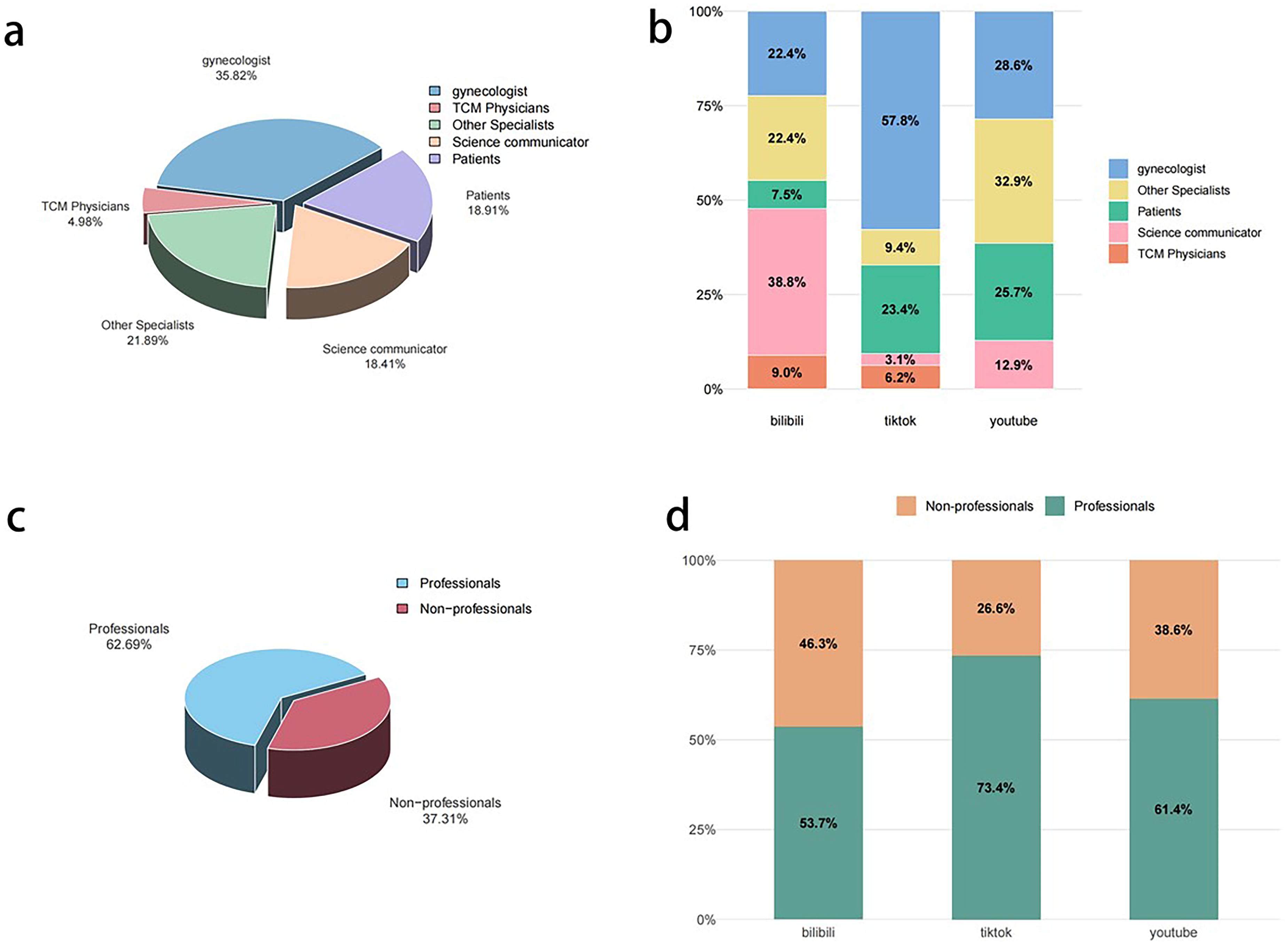
Distribution of video uploaders across short-video platforms. (a) Overall distribution of video uploaders by category. (b) Distribution of video uploaders across short-video platforms. (c) Overall distribution of professional vs. non-professional uploaders. (d) Distribution of professional vs. non-professional uploaders on different platforms.
Video content
As shown in Table 1 and Figure 3, key preventive information in the videos was severely lacking. HPV vaccination was mentioned in only 33.3% of videos, male responsibility education appeared in just 8.0%, and prognostic management (lifestyle guidance: 3.5%; psychological support: 10.4%) was widely neglected. Additionally, there was an imbalance in coverage across platforms. Bilibili featured more content on vaccine promotion (46.3% of the platform's videos), but neglected the importance of cervical cancer screening. TikTok had 57.1% of videos focusing on psychological support, but very few mentioned the vaccine, with only one video addressing it. YouTube, however, featured 46 videos emphasizing the importance of cervical cancer screening and 19 videos covering HPV vaccination. Fewer than 10% of the videos comprehensively covered the entire “prevention-screening-treatment” process, and none provided an in-depth analysis of treatment side effects, which could lead to public misconceptions.

Quality assessment of video content across different short-video platforms. (a) Content analysis. (b) Disease prevention. (c) Prognostic recommendations.
Video quality
As shown in Table 1, the median GQS score on TikTok was 3.00, with a mean of 3.09 ± 0.75; for YouTube, the median was also 3.00, with a mean of 3.47 ± 1.06; and for Bilibili, the median was again 3.00, with a mean of 2.85 ± 0.89. Regarding mDISCERN scores, TikTok had a median of 3.00 and a mean of 2.86 ± 0.53; YouTube had a median of 3.00 and a mean of 2.84 ± 0.63; and Bilibili had a median of 3.00 and a mean of 2.91 ± 0.81. As illustrated in Figure 4(a), (c), and (e), statistically significant differences were observed among TikTok, Bilibili, and YouTube in GQS, PEMAT-U, and JAMA scores, suggesting that YouTube videos generally exhibited higher quality and credibility, though they performed less well in terms of actionability. In contrast, no significant differences were found among platforms for mDISCERN and PEMAT-A scores (Figure 4(d)). The distribution characteristics of each scoring metric and the inter-platform differences are visualized in detail in Figure 5.

Comparison of quality and reliability scores across different short-video platforms. (a) GQS score. (b) mDISCERN score. (c) PEMAT-U. (d) PEMAT-A. (e) JAMA. GQS: Global Quality Score; mDISCERN: modified DISCERN; PEMAT: Patient Education Materials Assessment Tool; JAMA: Journal of the American Medical Association.

Distribution of quality and reliability scores for different types of video uploaders. (a) GQS score. (b) mDISCERN score. (c) PEMAT-U. (d) PEMAT-A. (e) JAMA. GQS: Global Quality Score; mDISCERN: modified DISCERN; PEMAT: Patient Education Materials Assessment Tool; JAMA: Journal of the American Medical Association.
Comparison of video quality and reliability by uploader type
When comparing video quality and reliability across different uploader types, significant differences were found in the mDISCERN, PEMAT, and JAMA scores, with videos uploaded by patients scoring lower in quality than those uploaded by experts and science communicators. Notably, the GQS scores did not show significant differences, but gynecologists had noticeably higher GQS median scores compared to other uploaders. When uploaders were further categorized as professional or non-professional, videos uploaded by professionals exhibited significantly higher mDISCERN scores compared to non-professional uploaders. Although there were some differences in GQS scores between professional and non-professional uploaders, these differences did not reach statistical significance. In the JAMA scoring system, TikTok performed relatively well in the author qualifications dimension, with 73.4% of video uploaders being professionals, followed by YouTube (61.4%) and Bilibili (53.7%). Furthermore, Bilibili had the lowest information transparency (average JAMA score: 1.46). Among professional categories, professionals significantly outperformed gynecologists in the JAMA average score (2.07), with TCM practitioners and other specialists scoring 1.70 and 1.86, respectively, which was notably higher than the scores for science communicators and patients.
Correlation analysis
Spearman correlation analysis, as shown in Figure 6, clearly reveals significant positive correlations between video interaction metrics. For instance, likes and favorites (r = 0.93), likes and comments (r = 0.88), likes and shares (r = 0.85), favorites and comments (r = 0.81), and comments and shares (r = 0.78) all exhibit similar trends. However, user interaction behaviors appear to be generally disconnected from multidimensional information quality scores (GQS, mDISCERN, JAMA, PEMAT, etc.), with some even showing weak negative correlations.

Correlation analysis between baseline video information and quality scores.
Discussion
Our cross-sectional analysis of cervical cancer videos across Bilibili, TikTok, and YouTube revealed significant platform-specific differences in content quality and user engagement. These findings provide critical insights for developing more effective health communication strategies.
This cross-sectional study reveals significant disparities in the quality and dissemination of cervical cancer-related information across three major short-video platforms. While YouTube leads in content quality and reliability, TikTok dominates in user engagement but lags in informational depth—a finding consistent with prior studies on health communication in short-video ecosystems.24–27 The inverse relationship between engagement metrics and quality scores underscores a critical challenge: algorithmic prioritization of high-interaction content may inadvertently promote superficial or emotionally charged narratives at the expense of scientific rigor.28,29
Although TikTok excels in engagement, its content understandability (PEMAT-A) has a median score of only 67, and the disclosure of author information (JAMA-Authorship) is 0.73 ± 0.45 (higher than Bilibili's 0.46), yet still far lower than that of professional creators (0.93). Overall, professionals (gynecologists, other specialists) have significantly higher JAMA-authorship disclosure rates (0.93 ± 0.26) compared to non-professionals (0.09 ± 0.29) (p < 0.001), and also score higher on mDISCERN (2.90 ± 0.62 vs. 2.83 ± 0.74). There is a clear positive correlation between JAMA scores and user engagement. Previous studies have shown that higher JAMA transparency scores (especially author disclosure) significantly enhance user deep engagement behaviors (such as saving and commenting),20,22,30,31 as it builds trust in medical authority, promoting retention and dissemination of health information. 32 However, videos by non-professional creators (such as patients and science communicators) tend to spark more engagement (median likes: 426 vs. 350.5 for professionals), suggesting that emotional resonance or storytelling methods offer greater dissemination advantages. Emotional resonance evokes deep feelings in the audience (such as joy, sadness, empathy, anger), stimulating intrinsic motivation, encouraging them to spontaneously pay attention, remember, and share. In the era of information overload, content that triggers emotions or tells a good story is more likely to break through the noise, spark discussions, establish connections, and ultimately achieve broader, more lasting dissemination effects.21,28,33
Structural bias in health information and recommendations
The structural bias observed in content coverage—specifically the neglect of prevention (e.g. male HPV vaccination, mentioned in only 8.0% of videos) and prognostic management—reflects a broader misalignment with public health priorities. This bias is exacerbated by platform-specific dynamics; for instance, TikTok's focus on emotional storytelling likely explains its minimal coverage of vaccination (4.0%) compared to Bilibili (15.4%) and YouTube (13.9%).34–36 Such omissions perpetuate misconceptions, such as the perception of cervical cancer as solely a women's issue, hindering progress toward herd immunity.37,38 Therefore, future cervical cancer awareness efforts should shift from a “women's protection” focus to “partner health,” creating joint vaccination-themed short videos to dismantle gender biases.
Prognostic health management oversight
Correlation analysis shows that post-treatment health management is severely neglected, with lifestyle adjustments and other management topics making up only 3.5%, and mainly concentrated on YouTube (6 videos). Most videos only cover the treatment phase (e.g. 23.4% mention chemotherapy and radiotherapy), with little guidance on recovery (e.g. boosting immunity, psychological adjustments). Studies indicate that cancer patients’ survival willingness is significantly influenced by their psychological state: negative attitudes weaken the will to survive, while positive attitudes can effectively strengthen survival determination. This finding strongly suggests that, alongside managing physical symptoms, providing psychological support and meaning-focused guidance is crucial to helping patients develop a positive mindset and improve their quality of life.39–41 Non-professional creators (such as patients) should ideally share recovery experiences, but their videos barely address prognostic management, instead focusing on fear-based narratives about the disease, potentially exacerbating public negative perceptions of cancer. Therefore, it is essential to optimize recovery story repositories, inviting cervical cancer survivors to focus on lifestyle adjustments (such as diet and exercise), and also foster collaboration between non-professionals and professionals. After patients share their experiences, doctors’ accounts could add explanations to form a closed-loop of content.
Limitations
This study has several limitations. First, the time frame is limited to data collected in July 2025, which does not account for the dynamic impact of algorithmic iterations on content recommendations. Additionally, the evaluation tools used focus on modern medical standards and do not incorporate perspectives from TCM, which may lead to an underestimation of traditional medical content. There is also a potential risk of subjective bias, as video quality assessments rely on manual annotations, which could introduce evaluator bias. Furthermore, user feedback is absent, and the study does not collect data on audience questions or misunderstandings, making it difficult to assess the actual dissemination effect of the information. Finally, the representativeness of both platforms and users is limited, as platforms such as Xiaohongshu and WeChat Video Channels were not included, and the role of health literacy in content understanding was not considered. Future research should expand the sample size, incorporate AI analysis tools, and integrate cross-platform user behavior data.
Conclusion
Short-video platforms, with their large user base, vivid content formats, and rapid dissemination speed, have become an indispensable channel for the dissemination and popularization of cervical cancer health knowledge. However, the quality of content on these platforms varies significantly. While content uploaded by medical professionals tends to be more scientific and reliable, its audience reach is relatively limited, failing to meet the needs of the broader public. It is noteworthy that user engagement behaviors (such as likes, comments, and shares) do not show a significant positive correlation with the quality of the information itself, which may result in high-quality content being overlooked. To leverage this powerful communication tool more effectively, it is crucial for short-video platforms to collaborate deeply and regularly with medical professionals, especially gynecologists, oncologists, and public health experts. Such collaborations can harness the platforms’ technical outreach capabilities and the professionals’ expertise, leading to the creation of high-quality health education content that significantly improves public awareness of cervical cancer and risk management. Additionally, this study suggests that relevant authorities and organizations, when utilizing short-video platforms for health communication, should focus on improving content quality, correcting dissemination biases, expanding the reach of professional voices, and exploring more effective interaction and communication mechanisms to maximize the platforms’ potential in enhancing public health.
Footnotes
Acknowledgements
The authors gratefully acknowledge the video uploaders for their valuable contributions to public health discourse.
The authors affirm that no artificial intelligence tools were utilized in the conception, drafting, or finalization of this manuscript.

Ethical approval
As this study analyzed publicly accessible data, approval from an ethics review board was not required.
Author contributions
YL designed the study. YL and RW performed data collection and analysis. YL drafted the initial manuscript. YL and FR independently conducted video content evaluations, while YL and RW jointly completed video quality scoring. YL and LYZ critically reviewed, revised, and approved the submitted manuscript. All authors contributed to manuscript refinement and endorsed the final version for publication.
Funding
The authors received no financial support for the research, authorship, and/or publication of this article.
Declaration of conflicting interests
The authors declared no potential conflicts of interest with respect to the research, authorship, and/or publication of this article.
Data availability
Data can be obtained from the corresponding author.