




Abstract
Objective
This study aimed to examine the effects of semi-immersive virtual reality (VR)-based exercise on the quality of life of older adults.
Methods
It used a randomized controlled trial design. Older adults (mean age: 72.16 ± 4.9 years) were randomly assigned to experimental (n = 48) and control (n = 50) groups. The experimental group engaged in semi-immersive VR exercise for 75–90 min, twice a week, for 12 weeks and partook in no other intervention between the end of the exercise intervention and follow-up. Control group members did not participate in any similar program during the intervention or follow-up periods. Both groups completed three assessments: at baseline (pre-test), post-intervention (post-test), and 3 months later (follow-up). Quality of life was assessed using the World Health Organization Quality of Life Instrument-Older Adults Module.
Results
Generalized estimating equation analyses indicated that the experimental group exhibited significant post-intervention improvements in quality of life in terms of sensory ability, autonomy, social participation/isolation, death and dying domain, and overall quality of life scores. However, none of these significant effects were maintained 3 months after exercise intervention cessation.
Conclusions
Semi-immersive VR exercise may be a feasible strategy toward enhancing the quality of life of older adults. However, the participants’ quality of life was not maintained upon exercise cessation, indicating that older adults need to be encouraged to exercise regularly to maintain a good quality of life. VR may need to be combined with other modes of intervention in the future to facilitate long-term quality-of-life improvement in older adults.
Introduction and background
Longer life expectancies and declining birth rates have resulted in a change in the world's demographics. 1 This increase in life expectancy does not necessarily entail an improved quality of life. 2 WHO defines quality of life as an individual's perception of their position in life in the context of the culture and value systems in which they live and in relation to their goals, expectations, standards, and concerns. 3 Active aging is defined as “the process of optimizing opportunities for health, participation, and security in order to enhance quality of life as people age”. 4
Aging is a complex process that entails physical, psychological, and social changes. 5 It is accompanied by a decrease in body muscle mass, which may be associated with a decline in physical function, resulting in a deterioration of one's quality of life.2,6 Multiple studies have demonstrated that regular or sustained participation in physical activity can improve the mental and spiritual health and quality of life of older adults.7–9 Furthermore, traditional exercise interventions, such as multimodal exercise, step aerobics, and strength training,10–12 have a positive impact on the quality of life of older adults. Therefore, engaging in multimodal physical activity can have positive benefits for the mental health of older adults.
Evidence from a systematic review and meta-analysis of randomized controlled trials suggests that exercise programs using telephone networks and mobile applications are effective in improving people's knee pain and quality of life. 13 Emerging technologies, such as internet-based physical activity programs 14 and games, 15 have been used to improve the quality of life of older adults. Recent studies have revealed that virtual reality (VR) exercise interventions have a facilitating effect on the mental health of older people. Short-term VR exercise and leisure-oriented immersive VR have both been shown to improve self-perceived health 16 and increase one's quality of life.16–18 Moreover, they can also alleviate pain, 19 anxiety and depression. 20 Despite the beneficial effects reported by certain studies, the applicability of their findings is limited by the recruitment of participants with suboptimal health, 18 single-sex cohorts, 16 small sample sizes18,19 (e.g., total n = 12 or 16), and/or short-term interventions16–19 (e.g., 5–8 weeks). Therefore, we engaged in efforts to increasingly publicize our study in the community so that older people could understand the mental health benefits of participating in VR exercise, and this increased their interest in participating in our study. One objective of our study was to help promote the relationship between older adults’ participation in new fitness technologies and improved mental health.
Previous studies have demonstrated that an immersive VR-based exercise system is a potentially effective, safe, and acceptable approach toward supporting poststroke motor rehabilitation. 21 Furthermore, a systematic review and meta-analysis of randomized controlled trials confirmed the effectiveness of VR-supported exercise therapy for the rehabilitation of patients with suboptimal health. 22 Additionally, a study with both practicality and acceptability in Taiwan revealed that older adults have positive perceptions towards accepting and using VR to support active aging. 23 Existing evidence supports the feasibility and health-promoting effects of VR application.
Furthermore, participation in multimodal exercise is an important strategy for maintaining mental health in older adults.24,25 A 24-month intervention with a 2-year follow-up showed that multi-component exercise improved the physical and psychological dimensions of quality of life in older adults with diabetes. 26 Similarly, a 12-week multimodal exercise intervention was found to be effective in improving quality of life in older adults with balance disorders. 27 Moreover, at the 24-week follow-up evaluation of the foregoing study, the improved quality of life was maintained. However, the aforementioned studies focused on patients with suboptimal health.
Longitudinal research evidence suggests that the mental health of older people may deteriorate progressively with age. 2 Even healthy older adults may still require mental health support. A prospective research suggests anxious healthy older adults revealed specific decrease in episodic memory over a 3-year interval. 28 Interventions to improve health outcomes through VR have demonstrated the potential for community-dwelling older adults. 29 However, the effects of VR exercise on the quality of life of healthy older adults and whether any benefits are retained after intervention cessation remain unclear.
Objectives of the current study
To address the foregoing research gaps, the main objectives of this study were to: (1) evaluate the effects of a 12-week VR exercise intervention on the quality of life of older adults and (2) monitor the changes in the participants’ quality of life 3 months after discontinuing the VR exercise program. The purpose of the follow-up assessment in this study was to detect and elucidate any changes in the health status of healthy older adults after the exercise intervention.
Methods
Participants
This study employed a randomized controlled trial design (Clinicaltrials.gov; NCT05565963) with single-blinding (outcome assessors). Participants were recruited from the Daan District of Taipei City, Taiwan, and nearby communities. For the power analysis, G*Power software (version 3.1.9.7) was used. We estimated the number of participants using repeated measures of F tests. For an estimated moderate effect size, the approximate sample size required was 43 for each group when the alpha level and power were set at 0.05 and 0.80, respectively. To account for possible patient dropouts, the total number of participants was increased by 15%. Eligible participants were recruited based on the following criteria: (1) age ≥ 65 years, (2) ability to perform daily activities of living, (3) no past or current history of medical conditions mentioned in the Physical Activity Readiness Questionnaire (PAR-Q), and (4) are interested in VR exercise, being able to accept exercise in darker environments.
Ethics statement
Ethical approval for this study was provided by the Institutional Review Board of the National Taiwan Normal University (202008 HM007), and all participants understood the intent of the study and signed informed consent forms.
Recruitment and baseline procedure
This study followed the Consolidated Standards of Reporting Trials Guidelines. The assistant released a recruitment message inviting eligible older adults who met the inclusion criteria to participate in this study. Three participants were excluded in the first stage. An assistant who did not otherwise participate in the study used random number selections from https://www.randomizer.org/ to randomly divide the participants into two groups: experimental (n = 52) and control (n = 53). Moreover, the assistant subsequently notified all participants of their assignment by phone and email. A flowchart outlining the participant enrollment process and assessments is provided in Figure 1.

A flow diagram of the study.
Semi-immersive VR exercise intervention
The exercise intervention took place in one of the sports rooms in the university gymnasium. This study used Uniigym (Interactive Somatosensory Fitness Corporation, Taipei, Taiwan) (https://www.uniigym.com/) as the exercise intervention tool for this study. Three large projectors (Panasonic PT-VMZ60 T Laser Business Projector; New Taipei City, Taiwan) were used to project videos onto the wall in a wrap-around state. The aim was to create a semi-immersive VR exercise environment. 30 During the intervention, the experimental group performed VR exercise by following the instructions of an on-screen virtual coach, hopefully enjoying the visual immersion during the process (Figure 2). The entire experimental group worked out together. A nurse was present to ensure their safety while exercising.
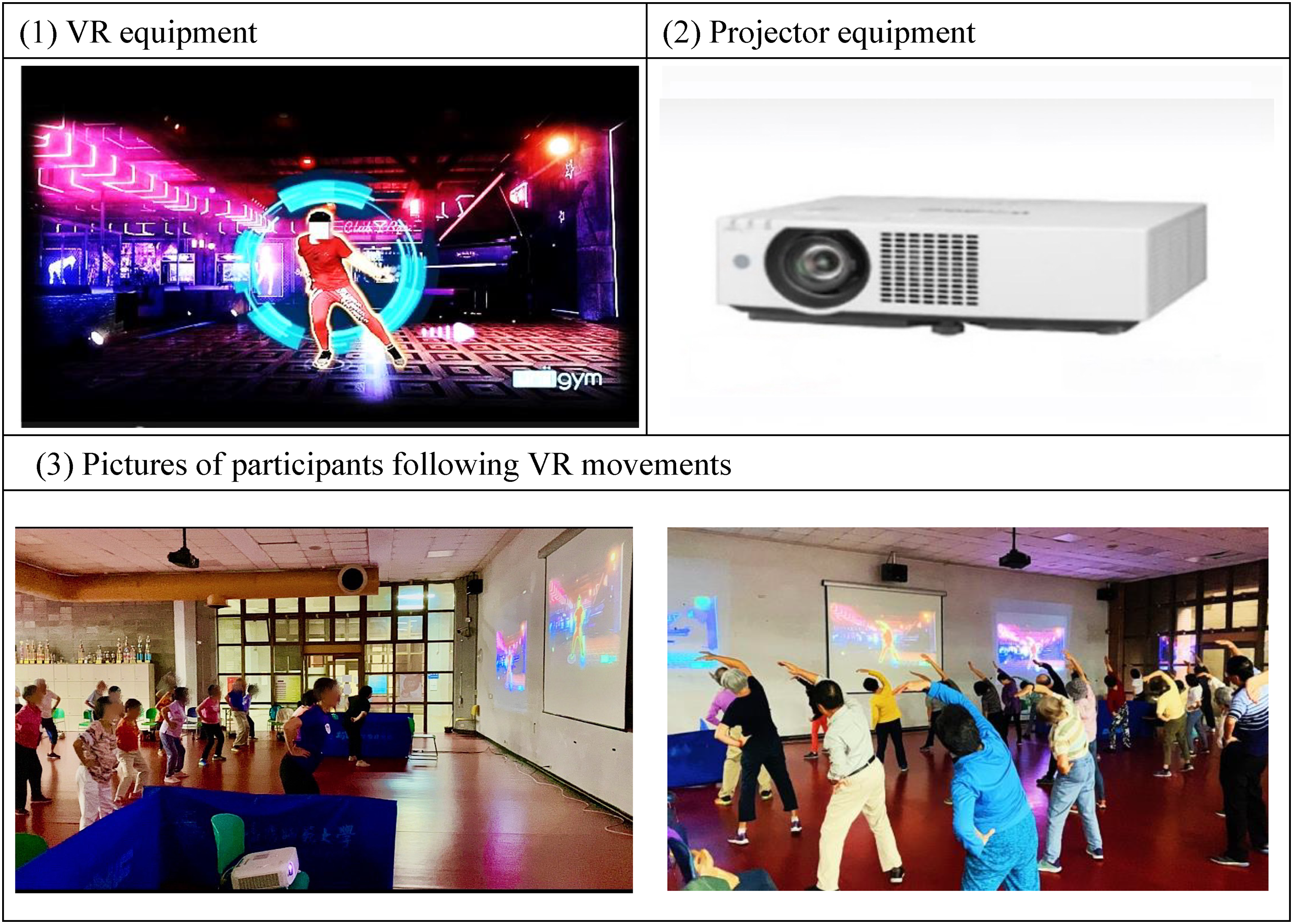
Virtual reality exercise.
Exercise intensity was determined according to the American College of Sports Medicine (ACSM) 31 and the Physical Activity Guidelines for Americans. 32 Exercise type, intensity, and difficulty level were determined and evaluated by the researchers before the intervention to ensure their suitability for older adults.33,34
The components of the VR exercise program included flexibility training (e.g., Tai Chi, basic flexibility exercises, and yoga) that focused on stretching, breathing, and upper- and lower-limb extension exercises, among others. These served as warm-up and cool-down routines to enable the joints and muscles to have sufficient mobility. Balancing exercises using chairs or balls (e.g., standing on one leg and semi-squatting positions, with breathing for body stabilization) were also included. Each video lasted approximately 15–20 min. Another component was basic muscle strength and fitness to strengthen the upper and lower body (e.g., biceps, triceps, back, thighs, and calves) along with cardiorespiratory fitness, comprising aerobic dance and boxing (i.e., frequent changes in hand and foot movements) at various paces and in different coordination modes based on the style of the video. Each video lasted approximately 55–60 min. A total of 12 consecutive weeks of exercise sessions (75–90 min per session, twice a week) were performed by the experimental group. The VR exercises commenced at beginner level and were subsequently upgraded to the intermediate level; moreover, they were administered by the research assistant based on participant status and ability.
To consider the impact of the exercise intervention on each participant's quality of life, the experimental group's attendance rate had to be > 80%. Only then could the results be used in the analysis. The experimental group partook in no other interventions between the end of the exercise intervention and the follow-up assessment. Control group members did not participate in any similar program during the intervention or follow-up periods.
Questionnaires
The World Health Organization Quality of Life Instrument-Older Adults Module (WHOQOL-OLD) was used to measure the quality of life of older adults. This questionnaire comprises 24 items divided into six domains, with each domain possessing four items. 35 These domains include sensory abilities; autonomy; response to past, present, and future activities; social participation/isolation; response to death and dying; and response to intimacy. Responses were rated on a 1–5-point Likert scale for each item (1 [not at all] to 5 [extremely]). Each dimension's score was obtained by totaling item scores, and the scores of the six dimensions were subsequently summed to obtain the total score. A higher total score indicates a better quality of life.
In this study, we used the Taiwanese version of the WHOQOL-OLD, with internal consistency coefficients (Cronbach's α) of 0.71–0.86 and inter-item correlation coefficients of r = 0.62–0.88. 36 The Taiwanese version of the WHOQOL-OLD possesses the best psychometric properties and appears to be the most suitable for older Taiwanese adults. All participants were asked to evaluate their quality of life at pre-test, post-test, and 3 month's follow-up.
Baseline assessment
Demographic characteristics: age, sex, employment status, educational attainment, living status, marital status, smoking status, drinking status, body mass index (BMI), 37 and physical activity were used for classification. The participants’ usual physical activity was assessed using the Taiwanese version of the International Physical Activity Questionnaire-long version, as it provides favorable stability and retest reliability (Spearman's ρ = 0.78). 38 Participants were asked to recall their leisure time physical activity for the preceding week, taking note of the date and time.
Data analysis
The two-tailed chi-square and independent t tests were used to compare baseline characteristics (age, sex, employment status, educational attainment, living status, marital status, smoking status, drinking status, BMI, and physical activity) between the experimental and control groups. Hotelling's T 2 test was conducted to verify whether the outcome measures at baseline were normally distributed. A generalized estimating equation was then used to investigate the effects of time, group, and their interactions on the outcome variables, thus elucidating change patterns over time at both individual and group levels. We used it to compare changes over time in quality of life between the two groups at pre-test, post-test, and 3 month's follow-up. Statistical analyses were conducted using SPSS (version 22.0; IBM, Inc., Armonk., NY, USA), with an alpha level of significance set at p < .05.
Results
Participant characteristics
The initial sample comprised 108 healthy older adults. The first phase excluded three participants because they were (1) aged < 65 years (n = 1) or (2) unfit to participate in the study as revealed by the PAR-Q (n = 2). During the second phase, a total of seven participants were excluded from this study because of injury or personal reasons (experimental group, n = 1; control group, n = 3) or incomplete attendance (missed ≥ 20% of the exercise program; experimental group, n = 3), leaving a total of 98 participants (experimental group, n = 48; control group, n = 50). Table 1 exhibits the participants’ characteristics. The participant's mean age was 72.16 ± 4.9 years. No statistically significant differences were noted between groups in terms of age, sex, employment status, smoking status, drinking status, or BMI. Moreover, no differences in total time spent on leisure-time physical activities or in the types of vigorous, moderate, or leisure-time physical activities were observed. However, significant differences were exclusively noted between the experimental and control groups in terms of educational attainment (p = .004), living status (p = .002), and marital status (p = .030). Owing to the significant differences in educational attainment, living status, and marital status, these confounding variables were controlled for in the generalized estimating equation analysis.
Basic characteristics of participants.

Notes. Number of participants (percentage); BMI, body mass index: <18.5–24 kg/m2: underweight and normal weight, ≥ 24 kg/m2: overweight and obese. aAnalyzed using the chi-square test; banalyzed using the independent t-test. * p < .05.
Effects of semi-immersive VR exercise intervention and retention on quality of life
Generalized estimating equation analysis results indicate that the experimental group experienced significant improvements from pre-test to post-test compared with the control group in terms of sensory abilities, autonomy, social participation/isolation, response to death and dying, and overall quality of life. A significant group × time interaction was noted for the five outcome measures. Group × time 2 for the experimental group displayed significantly greater improvements in sensory abilities (β = 3.30, p < .001), autonomy (β = 1.48, p = .003), social participation/isolation (β = 0.95, p = .002), response to death and dying (β = 1.35, p = .002), and overall quality of life (β = 8.10, p < .001). However, participants’ responses to past, present and future activities (β = 0.52, p = .107) and intimacy (β = 0.50, p = .135) exhibited no significant improvements between the pre- and post-test results.
According to the generalized estimating equation analysis results, the experimental group did not demonstrate any similar significant effects from pre-test to 3 month's follow-up compared with the control group. No significant group × time interaction was observed for any of the outcome measures. Group × time 3 for the experimental group revealed no significant differences in sensory abilities (β = 0.00, p = 998); autonomy (β = 0.42, p = .431); response to past, present, and future activities (β = 0.20, p = .653); social participation/isolation (β = 0.00, p = .990); response to death and dying (β = 0.10, p = .899); response to intimacy (β = –0.12, p = .810); or overall quality of life (β = 0.62, p = .735).
These results indicate that semi-immersive VR exercise can improve one's quality of life. However, this improvement tends not to be maintained once the exercise is discontinued. The analysis results are shown in Table 2, while changes in quality-of-life domains over time for both the experimental and control groups are displayed in Figure 3.

Comparison of changes in quality-of-life dimensions between the experimental and control groups at three time points for (1) sensory abilities; (2) autonomy; (3) past, present, and future activities; (4) social participation/isolation; (5) death and dying; (6) intimacy; and (7) overall quality of life. T1: pre-test; T2: post-test; T3: 3-month follow-up.
Improvements in quality of life.
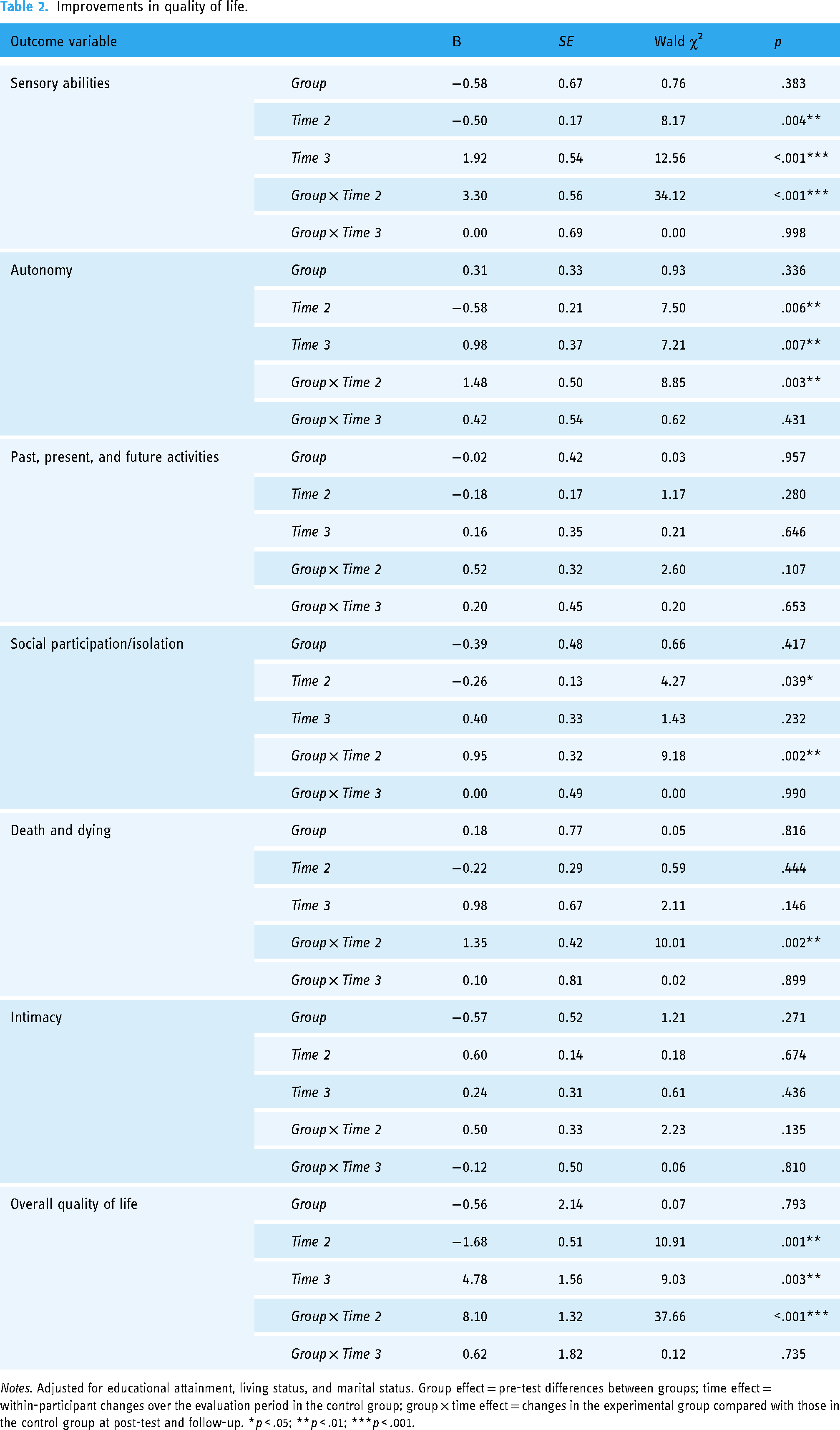
Notes. Adjusted for educational attainment, living status, and marital status. Group effect = pre-test differences between groups; time effect = within-participant changes over the evaluation period in the control group; group × time effect = changes in the experimental group compared with those in the control group at post-test and follow-up. *p < .05; **p < .01; ***p < .001.
Discussion
This study entailed a 12-week semi-immersive VR multimodal exercise intervention. Moreover, it extended the follow-up period to 3 months post-intervention to track changes in the quality of life of older adults. This study generally had a greater number of participants and longer intervention duration than previous studies. In addition, none of the previous VR exercise intervention studies conducted a post-intervention follow-up assessment. Notwithstanding, we found that positive outcomes were not maintained during the post-intervention follow-up period, which is important for designing long-term programs that use technology-based exercise strategies to enhance the quality of life of older adults.
First, the current study's results prove that semi-immersive VR exercises can significantly improve the quality of life of older adults in terms of sensory abilities, autonomy, social participation/isolation, response to death and dying, and overall quality of life. These findings are consistent with those of previous studies. A previous study found VR exercise to result in considerable improvements in the self-perceived health of older women (e.g., vitality and emotional well-being) after undergoing three sessions a week for 8 weeks. 16 Another study, which employed 15-min VR exercise sessions twice a week for 6 weeks, also revealed improved scores in certain aspects of quality of life (e.g., pain and anxiety/depression). 17 Furthermore, its findings corroborate those of other studies on the effectiveness of traditional exercise on the self-perceived quality of life of older adults, such as those by Haraldstad et al., 10 who noted improvements in quality of life after 12 weeks of strength training, and Dunsky et al., 11 who found step aerobics and balance training to enhance quality of life. The results of our intervention suggest that using semi-immersive VR exercise to enhance the self-perceived quality of life of older adults in the community is a promising approach. Furthermore, the enhancement of social cohesion among older adults in urban areas contributes to improving their quality of life. 39 Therefore, using VR exercise to further enhance their cohesion is considered to be one of the reason for their success.
This study's results demonstrate that quality of life decreased once the exercise program was discontinued, as revealed by the 3-month follow-up assessment. Therefore, positive outcomes were not retained post-intervention. This result somewhat contradicts that of previous studies, such as that by Gouveia, Gouveia, 27 which utilized ProBalance 3D Training and found that older adults with balance impairment who attended sessions for 12 weeks exhibited satisfactory quality of life 12 weeks after exercise cessation. A study by Rosenberg, Depp 40 investigated the effects of playing Nintendo's Wii for 35 min three times a week for 12 weeks (with a follow-up at 20–24 weeks) on the quality of life of older people with depression. The improvement in depression was maintained at follow-up. However, another study yielded contrasting results. It investigated the effects of 3 weeks of conventional rehabilitation combined with VR exercise training on the quality of life of older patients with stroke, followed by a 3-month detraining period. 41 At the 3-month follow-up assessment after treatment completion, the effect of the combined intervention was attenuated, especially in the dimensions of pain, anxiety, and depression.
The ACSM recommends that older people engage in regular daily exercise to enhance their mental health. 42 Moreover, longitudinal studies, as well as a cross-sectional study, revealed that to mitigate the decline in health-related quality of life during aging, older people need to engage in various physical activities, particularly multimodal exercise, to maintain their quality of life.2,43 Thus, technology-based sports can be integrated into regular exercise routines to help maintain mental health.
However, our results revealed no significant positive effect on the participants’ response to past, present, and future activities or their response to intimacy. The current intervention was dominated by exercises based on VR. The experimental group exercised together; however, no interaction occurred during the exercise. Thus, more static-type interventions, such as those that improve emotions and intimacy and explore deep, inner feelings, may be required to enhance mental health in older adults. A 9-week intervention study combining three-dimensional (3D) VR and hands-on horticultural therapy was found to have beneficial effects on the physical and mental health of older adults. 44 Moreover, after a 9-week combined 3D VR and hands-on aromatherapy program, improvements in well-being, perceived stress, meditation experience, and life satisfaction performance were observed in older adults. 45 Furthermore, positive thinking (i.e., meditation) can help reverse the negative thoughts and behaviors of older adults, thus achieving an enhanced quality of life.46,47
A close relationship exists between technology and the availability, acceptance, and usability of exercise. For example, age, perceived usefulness, attitude, and self-effects have been found to play significant roles in the acceptance of immersive VR games as upper-limb exercises. 48 A study of the perceptions regarding machine learning-based lower-limb exercise training in older adults with knee pain revealed that they were satisfied with the system's ease of use. 49 In a survey on Qigong Training app use for feedback and learning outcomes, participants indicated that the apps were pleasant to use and useful for learning. 50 Although we conducted an intervention study, we did not assess the participants’ feelings toward the intervention. Evaluating usability and acceptability can provide insight into how older adults feel and how well they participate. For market developers, apps can be customized to optimize user experience. This may increase the willingness of older adults’ willingness to continue engaging technology for fitness in the future.
Limitations
Notably, this study's participants were healthy older adults who were capable of independent living. Therefore, the positive results obtained after the short-term exercise intervention in this study cannot be generalized to populations with suboptimal health. In addition, this study entailed a VR semi-immersive exercise intervention. Therefore, determining whether combining VR with real exercise interventions will have superior long-term effects on quality of life was unclear. A study on 3D VR and hands-on horticultural therapy revealed physical and mental benefits in older adults, and these effects persisted for up to 2 months. 44 Therefore, future studies could try to combine virtual and real interventions to improve the long-term effectiveness of an intervention program.
Conclusion
This study proves that semi-immersive VR exercise can improve the quality of life of older adults in terms of sensory abilities, autonomy, social participation/isolation, death and dying, and overall quality of life. However, this improvement in quality of life is not maintained after discontinuation of the exercise program. This study also reveals the importance of regular exercise in maintaining quality of life in older adults. Technology-based fitness could be used as an innovative strategy for older adults to maintain their physical and mental health. Future studies are recommended to determine whether combined virtual and real interventions have a greater impact than either of the individual interventions alone. This will serve as a reference for the promotion of sports technology in enhancing the quality of life of older adults.
Footnotes
Acknowledgments
I would like to thank all the participants for their time and dedication.
Contributorship
L-T WANG conceptualized the study, recruited the participants, analyzed the data, and wrote the manuscript.
Declaration of conflicting interests
The author declared no potential conflicts of interest with respect to the research, authorship, and/or publication of this article.
Funding
The author received no financial support for the research, authorship, and/or publication of this article.
