



Abstract
Background
China is experiencing a rapid increase in its aging population, leading to the emergence of significant challenges to improve the quality of life (QoL) of older adults. The study aims to explore the potential benefits of using mobile health technology in improving the QoL for older Chinese adults.
Method
This study utilized a subsample of adults aged 60 and above from a cross-sectional, population-based national survey conducted among Chinese adults (N = 852). A moderated mediation analysis was conducted to investigate the impact of mHealth use on older Chinese adults’ QoL, focusing on the mediating roles of eHealth literacy and patient activation and the moderating effect of motivation for health promotion and prevention.
Result
The results indicate that mHealth use directly enhances the QoL of older Chinese adults (β = .061, p < .001), and this effect is mediated by eHealth literacy and patient activation (β = .057, Boots 95% CI [.044, .072]). Furthermore, motivation for health promotion and prevention moderates the relationship between eHealth literacy and patient activation (β = .133, p < .001).
Conclusion
These results demonstrate the positive impact of mHealth use on the QoL of older Chinese adults and reveal the underlying mechanisms involving mental and physical factors. These findings underscore the significance of increased attention to promoting mHealth use among older Chinese adults and provide a new way to enhance eHealth literacy and patient activation by encouraging the adoption of mHealth products.
Keywords
Introduction
Since 2000, China has entered an aging society, with the proportion of older adults expected to reach 14% by 2025.1,2 This demographic shift poses significant challenges. Older adults often face physical health issues, chronic diseases, and disabilities, 3 which necessitate long-term care services. These health issues restrict the independence and daily functioning of older adults and significantly impact their overall satisfaction and happiness, diminishing their subjective quality of life (QoL). 4 QoL refers to an individual's overall well-being, integrating objective descriptors and subjective evaluations across physical, psychological, social, and other domains.5–7 According to recent studies, QoL among older Chinese adults is notably low, with health status being one of the main influencing factors. 8 Therefore, these findings underscore the urgency of developing effective interventions to improve QoL for this population.
The widespread adoption of information and communication technologies (ICTs) has significantly transformed the way how older adults can manage their health.9,10 Mobile health (mHealth), as a specific application of ICTs, 11 has attracted increasing research attention due to its ability to improve health outcomes.12–14 For example, existing studies examine the impact of mHealth use on QoL among patients with cancer,15,16 chronic diseases, 17 or diabetes. 18 In the context of older adults, mHealth technologies have been shown to improve QoL, 19 particularly among those with cognitive impairments.20,21 A systematic review of mHealth technology in improving healthy behaviors among older adults 22 revealed that mHealth technology can encourage physical activities,23,24 enhance sleeping quality, 25 and improve mental health, 26 all of which are key factors contributing to a higher QoL. 6
However, a review of the existing literature on the effects of mHealth use on QoL reveals two significant gaps. First, existing studies need more theoretical exploration to strengthen the argument for the beneficial impact of mHealth on QoL among older adults. Although some qualitative studies have attempted to explore how mHealth use can improve QoL, 21 there is a scarcity of quantitative research aimed at uncovering the underlying mechanisms of this relationship. Secondly, research focusing on the relationship between mHealth use and QOL in the older Chinese adult population is exceedingly rare. As China rapidly transitions into an aging society, the adoption of smartphones and mHealth devices among older adults has increased substantially in recent years. 27 Therefore, research in this area is necessary given the growing prevalence of mHealth use among this demographic.
To advance research in this domain, the present study introduces cognitive factors such as eHealth literacy, patient activation, and health-related personality tendencies into the analysis. By employing a moderated mediation model, this study aims to elucidate the mechanisms through which mHealth use enhances the QoL of older Chinese adults.
Mediation roles of eHealth literacy and patient activation among associations between mHealth use and QoL
The World Health Organization 28 defines “mHealth” as the use of mobile devices, like mobile phones, patient monitoring devices, and personal digital assistants for health management and intervention. It is evident that the majority of research on the impact of mHealth use primarily focuses on two key aspects: mHealth interventions (like mobile-based patient-provider communication) and the use of mHealth for sports and fitness activity tracking.23,29,30
As a subset of health literacy, 31 eHealth literacy focuses explicitly on individuals’ skills and knowledge in utilizing technology-based health tools to access health information and make informed decisions. 32 A systematic review of eHealth literacy among older Chinese adults found that their eHealth literacy is generally low, highlighting a clear need for improvement. 33 Results show that an individual's demographic, health conditions, internet use frequency, belief in online health resources, and being taught to use the internet for health information are crucial factors for enhancing eHealth literacy among older adults.34,35
As a way to acquire health information, mHealth use has also been proven to benefit users’ health literacy and knowledge. 36 Primarily, the convenience of mHealth devices provides individuals with opportunities to access and engage with various health-related resources, leading to the gradual enhancement of eHealth information literacy. 37 Additionally, mobile-based patient-provider communication allows patients to acquire scientific knowledge and increase their health literacy. 38 Finally, the personalized feedback and monitoring mechanisms offered by mHealth interventions further contribute to the development of eHealth literacy by promoting self-awareness and active participation in health management.39,40 While those advantages of mHealth use have been linked to enhanced eHealth literacy, few studies have focused directly on whether mHealth use can improve eHealth literacy. 36 A more critical research gap is the lack of studies examining this relationship among older adults in China. Previous research on enhancing eHealth literacy in older Chinese adults has predominantly focused on demographic factors,33,41 leaving the potential impact of emerging mHealth technologies underexplored. This study seeks to fill this gap by offering a new perspective on how the adoption of mHealth technologies can contribute to improving eHealth literacy among older adults in China.
Higher levels of eHealth literacy have been consistently linked to greater health knowledge and more proactive involvement in health management. This enhanced literacy, in turn, bolsters individuals’ decision-making capabilities, patient activation, and self-management skills. 42 A cross-sectional study conducted in Singapore found a significant association between “understanding health information” and “finding good health information” with patient activation among adults with chronic diseases. 43 A systematic review 44 of 24 publications focusing on older adults found that eHealth literacy showed inconsistent associations with health-related QoL. At the same time, it had stronger ties with health cognition, like health acknowledgment and decision-making. This result suggests that other factors may significantly impact the relationship between eHealth literacy and QoL among older Chinese adults.
The concept of patient activation is crucial in understanding the impact of eHealth literacy on health outcomes. Patient activation refers to an individual's knowledge, skills, and confidence to manage their health and participate actively in their care.45,46 Studies have shown that higher levels of patient activation are associated with improved health outcomes, including better adherence to treatment plans, reduced hospitalizations, and lower healthcare costs. 47
Patients’ competencies for self-management have also been proven to be associated with better health outcomes (e.g. QoL).48–50 Additionally, patient activation assessment helps acknowledge the level of self-care and potential adherence to health behaviors, which consistently positively impacts physical and mental health, thereby contributing to overall QoL. 51
The moderating role of health motivation
Individual personality tendencies have been proven to influence health outcomes,52,53 like optimism associated with better health, 54 trait levels of conscientiousness and neuroticism predicted self-reported blood pressure, 55 and self-motivation has been found to impact individuals’ decisions to adhere to or abandon health behaviors.56,57 To examine the influence of individual personality tendencies on health outcomes, Snell Jr., Johnson, Lloyd, and Hoover 58 proposed the concept of health orientation, which refers to an individual's overall disposition, attitudes, and beliefs related to their health and well-being. This concept encompasses various dimensions, but our study specifically focuses on health motivation, which encompasses motivation to avoid unhealthiness and motivation for healthiness.
Previous studies have demonstrated that motivation to maintain health is a potential moderator influencing health behavior changes.59–62 Specifically, Chrysochou and Grunert 63 analyzed how health motivation moderates the evaluation of products in response to health-related advertisements. Additionally, health motivation also acts as a moderator in the relationship between health knowledge and health behaviors. 64 Among the aging population, health motivation has also been proven to positively impact health behaviors and outcomes, such as increased attendance in health promotion programs 65 and enhanced perceptions of health and well-being among older men. 66
Drawing from previous studies, we propose a moderated mediation model to investigate the relationship between mHealth use and QoL among older Chinese adults, considering the influence of eHealth literacy, patient activation, and health motivation. The following hypotheses guide our investigation and help us formulate the conceptual model presented in Figure 1: mHealth use is positively associated with QoL among older Chinese adults. Among older Chinese adults, mHealth use is positively associated with their eHealth literacy. Among older Chinese adults, eHealth literacy can positively impact patient activation. eHealth literacy and patient activation sequentially mediate the relationship between mHealth use and QoL among older Chinese adults. Among older Chinese adults, motivation for promotion and prevention can positively moderate the relationship between eHealth literacy and patient activation.

Conceptual model.
Methods
Data
Research ethics approval for this study was obtained from the Institutional Review Board of the University of Macau, with application reference number SSHRE23-APP013-FSS. The study was based on an anonymous national survey conducted in collaboration with Kantar (an international market research company) between January and September 2023. This cross-sectional survey employed a random sampling method, drawing participants from all 31 provinces (or equivalent regions) in mainland China, achieving a response rate of 15% and resulting in the participation of 4979 adults. Before the survey, each participant was provided with a participant information sheet that explained the purpose of the study, the voluntary nature of participation, and the confidentiality of their responses. A written informed consent was obtained from all participants before their involvement in the study.
Subsample processing
For this study, we applied two inclusion criteria to refine the sample for analysis. First, we included only individuals aged 60 and above, focusing on older adults. Second, to specifically examine older adults with recent medical experiences, we excluded participants who reported “0 times” in response to a question about the frequency of medical care in the past year. After applying these criteria, 852 respondents were included in the final analysis.
Variables and measurement
The dependent variable, QoL, was assessed using a well-established and validated scale frequently used in prior research to measure QoL across various populations, including older adults.7,67–69 This composite variable consisted of ten items from four subscales, covering aspects such as sleep quality, physical activity, entertainment satisfaction, and psychological well-being. Each item was rated on a five-point scale from 1 (“not at all”) to 5 (“extremely”), and the scores were averaged to form a composite score (M = 3.92, SD = .54). The scale demonstrated strong reliability in our study, with Cronbach's α = .84, indicating a high level of internal consistency.
The independent variable mHealth use was the sum of four items operationalized through a four-item scale, capturing participants’ utilization of mobile devices and wearables for mHealth interventions and health activities tracking. Participants were asked whether they employed their phones or pads to track the progress of health programs, make decisions about treatment or address health problems, and engage in health consultations with doctors. Additionally, participants were queried about their use of other wearables, such as armbands, glucose meters, and sphygmomanometers, for health tracking purposes. Each item was answered with a binary response, coded as 1 for “Yes” and 0 for “No”. We combined all the items to form a composite score, where a higher score indicates a greater diversity in the use of mHealth applications (M = 3.32, SD = .88).
The first mediator variable, eHealth literacy, was assessed using the widely recognized and validated eHealth Literacy Scale (eHEALS), which has been reliably employed across diverse populations and languages in previous studies.70–73 This classic measure evaluates participants’ confidence and skills in using information technology effectively for health purposes. The scale consists of eight questions, with responses collected on a five-point scale, ranging from 1 (“strongly disagree”) to 5 (“strongly agree”). Consistent with past research, which demonstrated high reliability and validity across different samples, the scale in this study also showed strong internal consistency, with a composite score of (M = 3.93, SD = .59) and a Cronbach's α = .86.
The second mediator variable, patient activation, was a compound variable extracted from the 22-item patient activation measure scale. It was initially developed by Hibbard, Stockard, Mahoney, and Tusler 45 to conceptualize and measure patient activation. This scale has become one of the most extensively used tools for evaluating patient activation, with its reliability and validity consistently confirmed across various studies and populations.47,74 Participants were prompted with the question, “Based on previous medical experience, how often do you have the following thoughts?” Thirteen items focused on individuals’ sense of responsibility for their health, confidence in health management, understanding of medical information, and proactive engagement with healthcare professionals. Statements included taking responsibility for personal health, confidence in preventing or addressing health issues, understanding prescription effects, and expressing concerns to healthcare providers. Responses were collected on a five-point scale (1 = “never” to 5 = “always”). All items were averaged to form a composite score (M = 3.75, SD = .55). The internal consistency of the scale in this study was strong, with Cronbach's α = .88, aligning with prior research validating the scale's reliability.
The moderator variable, motivation for health promotion and prevention, was measured using five items from the subscale of the health orientation scale (HOS).75,76 Participants were asked to rate their agreement with statements such as “I will do something to keep healthy”, “I try to avoid engaging in behaviors that undermine my physical health”, and “Staying healthy is very important to me” on a 5-point Likert scale, ranging from 1 (“strongly disagree”) to 5 (“strongly agree”), averaged to form a composite score (M = 4.02, SD = .57, Cronbach's α = .77).
Control variables were respondents’ socio-demographic characteristics: age, gender (1 = “female” and 0 = “male”), education (1 = “primary school or below” to 6 = “Bachelor's degree or above”), annual household income (1 = “RMB30,000 to RMB50,000” to 5 = “RMB1000,000 or above”), and marital status (0 = “other” and 1 = “married”).
Analytical methods
Data analysis was conducted using SPSS.26. First, descriptive analyses were performed to summarize the characteristics of the key variables. Second, a Pearson correlation test was conducted to examine the relationships among focal variables. Third, we employed SPSS macro PROCESS model 6 to identify the cross-sectional serial mediating effects of eHealth literacy and patient activation in the association between mHealth use and QoL. The SPSS PROCESS macro is an add-on tool developed by Andrew Hayes for SPSS that facilitates advanced statistical analyses, such as mediation and moderation. 77 Specifically, Model 6 within this macro is designed to examine serial mediation, where multiple mediators operate sequentially. Furthermore, PROCESS model 91 was utilized to assess the interaction effects of motivation for health promotion and prevention on the relationship between eHealth literacy and patient activation of the mediation model.
Results
Descriptive analysis of demographics
The descriptive statistics are presented in Table 1. The study sample, with a mean age of nearly 64 years, included 396 individuals (46.5%) who identified as female. Regarding education levels, the majority of participants had completed high school (30.8%), followed by those with a bachelor's degree or above (29.8%) and college education (24.5%). In terms of marital status, a substantial proportion of the sample reported being married or living with a romantic partner (95%). The annual household income distribution revealed that a significant portion of participants (45.3%) reported income concentrations around ¥150,000 to ¥500,000.
Descriptive statistics of variables (n = 852).

SD: standard deviation; M: mean.
Correlation analysis of research variables
As shown in Table 2, the Pearson correlation findings revealed a significant correlation among the research variables. mHealth use, eHealth literacy, patient activation, and motivation for health promotion and prevention show a positive correlation with the QOL (ranging from r = .345 to r = .753, p < .001). Education (r = .218, p < .001), annual household income (r = .182, p < .001), and gender (r = −.130, p < .001) have a significant correlation with QoL.
Zero-order Pearson correlations (n = 852).

*p < .05; **p < .01.
Direct association analysis of QoL
H1 predicted a positive direct association between mHealth use and QoL among older Chinese adults. As presented in Table 3 and Figure 2, the direct association (β = .061, p < .001) is statistically positive. Therefore, H1 is supported.
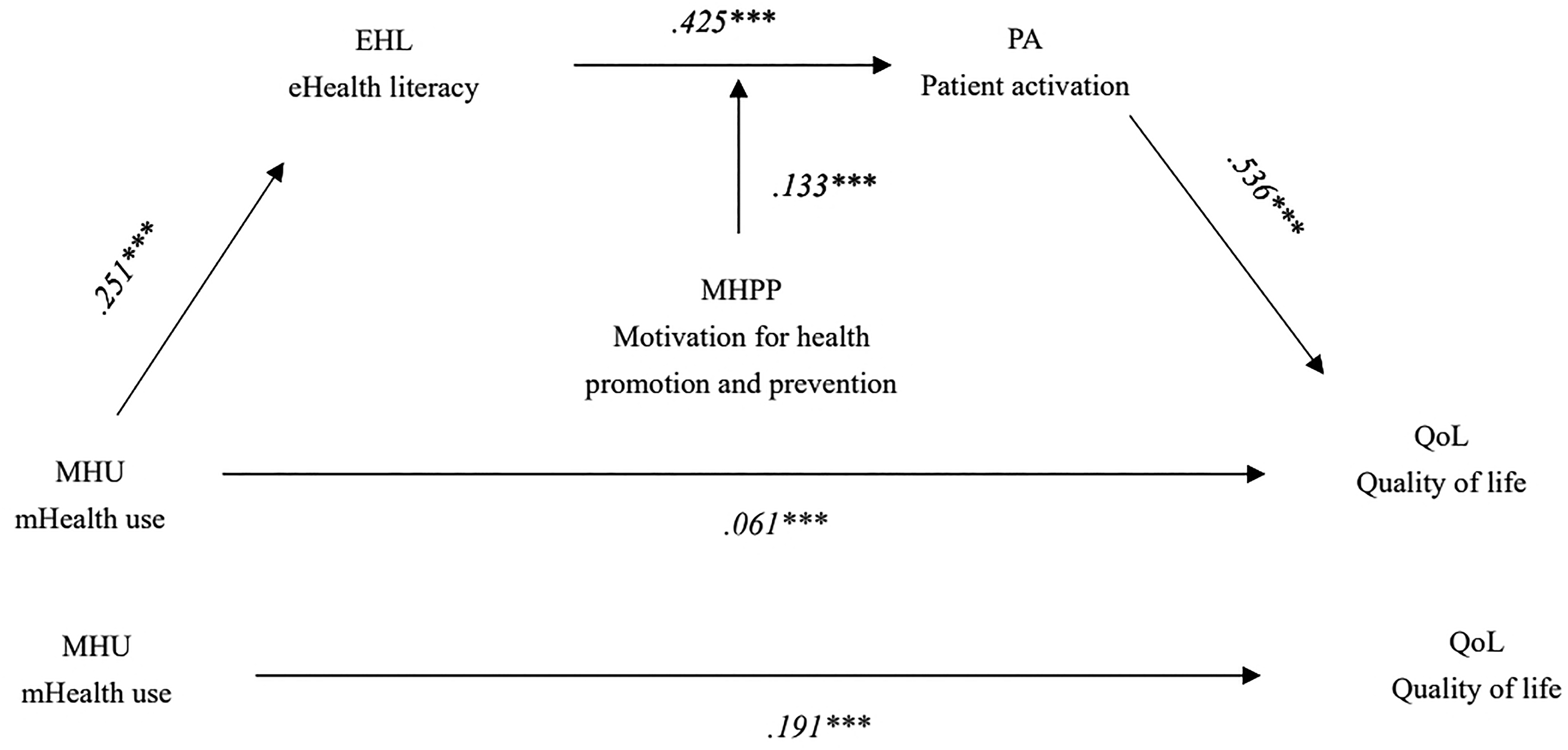
Effect of MHU on QoL mediated by EHL and PA, moderated by MHPP.
Mediation analysis (N = 852).

Note. Standardized betas are shown in each cell; Boot: bootstrap; N: number of observations; SE: standard error; LLCl: lower limit confidence interval; ULCl: upper limit confidence interval.
* p < .05; ** p < .01; *** p < .001.
Mediation analysis of eHealth literacy and patient activation
The results showed a statistically significant positive serial mediation effect (β = .057, bootstrap 95% CI ranges [.044, .072]). Specifically, the use of mHealth was positively associated with eHealth literacy (β = .251, p < .001). This eHealth literacy increase was linked to greater patient activation (β = .425, p < .001). Finally, higher levels of patient activation led to an improvement in QoL (β = .536, p < .001). Therefore, hypotheses H2, H3, and H4 were all supported.
Moderation analysis of motivation for health promotion and prevention
Table 4 and Figure 3 show that motivation for health promotion and prevention positively moderated the association between eHealth literacy and patient activation among older Chinese adults (b = .133, p < .001). Specifically, this moderation effect was stronger at higher levels of motivation. Additionally, the index of moderated mediation is also statistically significant (Index = .0179, bootstrap 95% CI [.008, .028]), supporting H5. This means that the higher the motivation for health promotion and prevention, the more positive relationship between eHealth literacy and patient activation becomes more pronounced. Conversely, at lower levels of motivation, this relationship is weaker.

Moderation effect of motivation for health promotion and prevention on the relationship between eHealth literacy and patient activation (l path).
Conditional and indirect effect of eHealth literacy on patient activation at values of motivation for health promotion and prevention as moderator (N = 852).

Note. Low means 1 SD below the mean: high means 1 SD above the mean: N: number of observations; SE: standard error; Boot: bootstrap; LLCl: lower limit confidence interval; ULCI: upper limit confidence interval; QoL: Quality of life.
* p < .05; ** p < .01; *** p < .001.
Discussion
The goal of this current study was to clarify the impacts of mHealth use on older Chinese adults’ QoL through direct and indirect pathways, with implications for health policy and clinical practice in aging societies. Firstly, the results indicate that a greater diversity of mHealth use is associated with higher QoL among older adults. Secondly, a serial mediation effect of eHealth literacy and patient activation on the relationship between mHealth use and QoL was revealed. Finally, the study verified the positive moderating role of motivation for health prevention and promotion on the path from eHealth literacy and patient activation. The following paragraph will discuss these findings in detail.
The mediating roles of eHealth literacy and patient activation
This research confirms that using new health technology, mHealth, can assist older adults in improving their QoL, which is consistent with prior research.15,17,20 To reveal the hidden factors behind this association, our study found a psychological mechanism whereby mHealth use enhances the QoL among older Chinese adults, operating within a moderated mediation model. Specifically, mHealth use facilitates the improvement of eHealth literacy. Individuals with greater eHealth literacy are more likely to prioritize their well-being and have more excellent health maintenance knowledge.41,78 Consequently, when these older adults encounter health issues, they are more inclined to actively engage in treatment, adopt healthier lifestyles, and ultimately enhance their health status and QoL. 79 The sequential mediation model revealed in this study has scholarship and practical implications regarding older adults’ mHealth use.
Previous studies have proved that mHealth intervention can help patients enhance their self-management and activation levels,80,81 and this study further stepped into this relationship. We confirm that mHealth use can impact and improve patient activation levels. This influence occurs through a psychological factor, eHealth literacy, which addresses the literature gap and has implications for the public.
First, this study offers a new perspective on enhancing eHealth literacy among older Chinese adults. Previous research indicates that this demographic has low eHealth literacy, 33 highlighting the urgent need for improvement. Simultaneously, the model in our study provides a new approach to enhancing their eHealth literacy by assisting them in utilizing new health technologies, such as mHealth. In the Chinese context, mHealth experienced significant development, 82 but older adults always face more challenges and barriers to adopting mHealth. 83 Health policy for the aging population should prioritize the development and promotion of mHealth interventions and health-tracking technologies that are specifically designed to meet the needs of older adults. In practical terms, hospitals and health departments should integrate mHealth interventions into patient-provider communication and regularly conduct education on adopting mHealth technology within community settings. By promoting mHealth use, these initiatives can encourage healthier behaviors, improve health outcomes, and elevate the overall eHealth literacy level among older Chinese adults.
Second, eHealth literacy significantly impacts patient activation among older Chinese adults, providing valuable insights for mHealth technology development. Individuals who are well-informed about their health conditions and can access helpful health information online are more likely to engage actively in healthcare decision-making, self-management, and taking responsibility for their health.42,43 This finding suggests that mHealth products should prioritize delivering accessible and relevant health information to empower older adults in their health management. Public health initiatives could focus on integrating eHealth literacy enhancement into mHealth strategies to boost patient activation levels, especially among older adults.
Last but not least, the sequential mediation effect in our study also clarified that patient activation could improve users’ QoL, which aligns with the previous survey.79,84,85 This improvement may be influenced by two key factors: first, the use of mHealth increases eHealth literacy, which in turn enhances individuals’ health awareness and proactive health management. Second, mHealth usage gives users the confidence to take charge of their health, further boosting their patient activation.86,87 Therefore, when promoting mHealth technologies among older adults, it is crucial to tailor product features to their specific needs. These features should include easy-to-use health and activity monitoring tools, faster and more direct communication with healthcare providers, and personalized health advice and action plans. By addressing these needs, mHealth technologies can effectively support patient activation and, ultimately, enhance health-related QoL in older adults.
While our study demonstrates that mHealth use can significantly improve the QoL among older adults, it is important to acknowledge that the mediators we identified—eHealth literacy and patient activation—may represent only a subset of the potential factors influencing QoL. Previous literature has highlighted various other contributors to QoL,88,89 such as social support, physical health status, mental well-being, and environmental factors. Our focus on eHealth literacy and patient activation offers valuable insights, but future research should explore additional mediators, such as social engagement, cognitive functioning, and healthcare accessibility, to fully understand the complex mechanisms through which mHealth impacts the QoL of older adults. Expanding the scope of mediators will offer a more comprehensive understanding of how mHealth interventions can holistically enhance people's well-being.
The moderating role of motivation for health prevention and promotion
On the path from eHealth literacy to patient activation, this study revealed a moderating role of motivation for health prevention and promotion. Motivation exerts a positive effect, indicating that the greater the motivation for health prevention and promotion, the more positive the effect of eHealth literacy on enhancing patient activation. This finding aligned with the COM-B theory model, 90 widely applied in behavior change studies, has demonstrated effectiveness in public health areas such as smoking cessation and weight loss.91–93 This theoretical model identifies three critical factors for behavior change: capability, opportunity, and motivation. 94 In this study, mHealth provides older adults more opportunities to encounter health information and enhance their capability (eHealth literacy) in managing health. Consequently, with the promoting effect of motivation for health prevention and promotion, they exhibit greater patient activation. This finding clarified the essential role of motivation for health prevention and promotion of taking and keeping healthy behavior, 75 which needs further research to find out factors to improve health orientation.
For health policy and clinical practice, it is urgent to enhance older Chinese adults’ health motivation to maximize the health outcomes derived from mHealth use and its impact on QoL. Policymakers and healthcare providers should implement strategies that enhance access to mHealth technologies and actively foster and maintain health motivation among older adults. First, promote mHealth awareness campaigns to educate older adults about the benefits and practical uses of these technologies. Second, develop and encourage the use of age-friendly mHealth tools and applications. For example, apps should feature simplified interfaces, larger fonts, and voice-guided navigation to accommodate the needs of older users. Third, mHealth tools should be integrated into regular care routines. Healthcare providers should ensure that older adults become familiar with these technologies during clinical visits. Organizing training sessions for both healthcare staff and patients will facilitate this integration and enhance the effective use of mHealth tools.
Limitations and future research
Several limitations warrant attention and further investigation. First, due to the cross-sectional design of this study, causal relationships between variables cannot be definitively established. Thus, longitudinal or experimental designs are needed to verify the hypothesized relationships and long-term impactation. Second, as this study relied on a large-scale survey, some questionnaire items may require more meticulous measurement to ensure accuracy. For instance, this survey only focuses on using mHealth to track health-related activities and interventions. Future studies should further differentiate and explore the different dimensions of mHealth use. This may include investigating other aspects such as mHealth interventions for specific health conditions, medication adherence, remote monitoring, and health education. Future research should also prioritize the development of more precise measurements of eHealth literacy and targeted interventions to enhance it among older adults. This could involve creating educational modules that teach older adults how to navigate mHealth apps, interpret digital health information, and effectively use these tools for health management. Lastly, the overall response rate for the initial survey was relatively low (15%) due to its online format, potentially leading to a bias with more activated older adults being more inclined to participate. Future research should explore strategies to boost response rates among a broader range of older adults to enhance the generalizability of the findings.
Conclusion
Through the exploration conducted in this study, we have identified the underlying mechanism of association between mHealth use and QoL among older Chinese adults. Our findings demonstrate that using mHealth can assist older adults in improving their eHealth literacy, thereby elevating their level of patient activation and ultimately enhancing overall QoL. Moreover, we have also revealed the moderating effect of health motivation besides uncovering the mediating role of eHealth literacy and patient activation. This underscores the importance of promoting mHealth technology among older adults and ensuring the age-appropriateness of mHealth applications to enhance the health status of this demographic. Furthermore, our study sheds light on the complex underlying factors, providing valuable insights for future interventions promoting healthy behaviors among older adults. Developers of mHealth solutions and policymakers must recognize that providing valuable health information and tracking functionalities within mHealth platforms can enhance the eHealth literacy of older adults. Stimulated by high health motivation, this can raise patient activation, thus improving health outcomes and leading to cost-effective enhancements in the healthcare system for aging societies.
Footnotes
Acknowledgments
Not applicable.
Author contributions
The author's contributions to this manuscript are as follows. Sha Sarah Qiu conceptualized the study and wrote the original draft of the manuscript. Jizhou Francis YE contributed to reviewing and revising the manuscript. Fei You contributed to data analysis and assisted in replicating results. Muhan Liu also contributed to writing the original draft. Xinshu Zhao served as the guarantor for the research.
Consent statement
This study used data from a China national survey which launched by research group of Xinshu Zhao and haven’t been made public.
Declaration of conflicting interests
The authors declared no potential conflicts of interest with respect to the research, authorship, and/or publication of this article.
Ethical approval
Research ethics approval for this study was obtained from the institutional review board of the corresponding author's institution.
Funding
This research was supported in part by grants from the University of Macau, including CRG2021-00002-ICI, ICI-RTO-0010-2021, CPG2021-00028-FSS, and SRG2018-00143-FSS, Xinshu Zhao PI; Macau Higher Education Fund, HSS-UMAC-2020-02, Xinshu Zhao PI.
